



Abstract
Purpose
The purpose of this study is to explore the uncharted territory of disciplinary actions taken against educators for their misconducts. The study examines demographics of the educators who have committed various types of offenses to find out whether results are different than the findings in the criminal justice literature.
Methods
The data used in this study include all 582 educators who were disciplined for misconduct in the 2012–2013 school year in Texas. Various descriptive and significance tests were used to answer the hypotheses of this study.
Results
Some of the findings correspond with the findings of the criminal justice literature while others do not. Young, male, and black educators are more likely to offend. Contrary to the literature on “student discipline” and “criminal justice,” minority educators are not treated more harshly when they are disciplined. There are some offenses committed more often by younger, male, and those educators who have held their credentials for a shorter amount of time.
Conclusion
The results have raised many questions similar to the ones studied in the field of criminal justice. A new body of research needs to address questions such as discrimination and the constitutional rights of the accused and the victims.
There are more than 50 scholarly journals dedicated to the publication of studies related to the field of education. Various aspects of the field such as finance, pedagogy, performance, race, etc. have been subjects of intense investigation. Surprisingly, with the exception of sex offenses, the literature has been silent about offenses committed by public school educators. How prevalent are the various offenses committed by educators? What are the demographics of offending educators? Are minority and male educators more frequently and severely punished than others, as the literature on student discipline in public schools suggests (Tajalli and Garba, 2014)? Do younger educators engage in offensive behaviors more frequently than older educators?
While most educators do not find themselves subject to discipline, there is a small percentage of educators who commit offenses and face sanctions. Research on discipline in education has primarily focused on how teachers and administrators discipline students. Similar studies about teachers disciplined for misbehaviors, on the other hand, are nearly impossible to find. In fact, when referring to “good” and “bad” teachers, studies are typically referring to teaching performance and effectiveness rather than the teachers’ personal behavior. While all states in the United States have instituted administrative procedures for disciplining educators’ misconduct, there is a paucity of scholarly research on this area.
The purpose of this study is to tap into this uncharted territory and pave the way for future investigators. This study examines different types of offenses committed by educators in order to examine how these different offenses are punished and whether there are demographic differences among the offending educators. The study will also look at the relationships between the demographics of the offenders and the types of offenses committed and sanctions levied. Texas has the second largest public school system after California. This study uses the entire population of Texas public school educators for the 2012–2013 academic year to answer the questions of this study.
Literature review
Of the limited research on educator misconduct that exists, most focuses on sexual abuse: its prevalence and students’ vulnerability (Fromuth et al., 2010; Shakeshaft, 2004; Simpson, 2010), descriptions of sexual abusers (Ratliff and Watson, 2014), perceptions of teacher–student sexual relationships (Fromuth et al., 2010; Bryant, 1993), and strategies to protect children from predators (Knoll, 2010; Ratliff and Watson, 2014; Shakeshaft, 2004). This is understandable, as sexual deviance is the biggest concern of parents and administrators. Objectionable behaviors committed by educators are not limited to sexual offenses, however. Physical and emotional abuse, changing grades, drug use, and numerous other illegal behaviors can be just as objectionable and alarming. The literature that does address broader forms of educator misconduct focuses on the effect of misbehavior on educators’ employment (Hooker, 1994; Trebilcock, 2000) and the role of leaders to mitigate the impact on their organizations (Page, 2014). Studies that do address other misconduct and state sanctioning of teaching certificates are dated and too simplistic (Di Nello and Hawkins, 1970) or are still primarily about sexual misconduct (Simpson, 2010). Page’s study (2013) comes closest to delving into different forms of misconduct, the differences between male and female offense rates, and even differences in discipline based on the grade level of the certificate held by the educator. However, even Page’s primary focus was on organizational misconduct and the factors that influence educator misbehavior. He did not assess differences in race/ethnicity, nor how the regulating agency addressed the misconduct. Clearly, educator misconduct and the discipline process are largely unexplored, and they deserve attention.
There is some indication that sexual misconduct, while making up the largest single percentage, does not represent the majority of total offenses (Page, 2013; Simpson, 2010). Instead, the majority are a litany of other offenses that are addressed with an equal assortment of disciplinary actions. Revocation is the most severe punishment and is reserved for the most egregious conduct (Umpstead et al., 2013). Since not all behaviors warrant such severity, regulating agencies can choose instead to enforce other restrictions on a license (Umpstead et al., 2013). What may be considered “minor” misconduct (compared to sexual offenses) is quietly punished by state licensing agencies, with the public often ignorant of educators’ misconduct and the disciplinary action the offender has received. Educators themselves typically only become familiar with the process when they are accused of some misdeed. Just as studies have attempted to understand how individuals are punished in other legal and administrative settings, it is important to gain insight into the disciplinary process of educators.
To address educator misconduct, some states have discipline units, others rely on professional organizations, and some simply rely on the courts. Some states have established standard codes of ethics in order to clarify what constitutes unacceptable behaviors, while others have not (Umpstead et al., 2013). While some offenses, such as sexual abuse, have some uniformity in punishment—revocation—many other offenses do not. Similar to criminal prosecution, various factors like age, seriousness of the offense, and the possibility of recidivism can determine an educator’s punishment (Trebilcock, 2000). An added problem is that often there is a misalignment between what regulatory agencies consider an offense and what educators believe to be inappropriate (Barrett et al., 2012, 2006). For example, two studies show that educators considered behaving unethically outside of work not to be a violation of teacher ethics (Barrett et al., 2012, 2006). In reality, outside behavior can significantly impact an educator’s credential (Eckes, 2013; Hooker, 1994; Trebilcock, 2000). In a 1969 landmark case, Morrison v. Board of Education, the Supreme Court of California established the idea that there exists a “nexus” between the behaviors of educators and their ability to teach (Hooker, 1994; Trebilcock, 2000). When behavior meets that nexus, even if outside of school hours, regulating agencies can justify sanctioning an educator’s credentials (Hooker, 1994). Therefore, educators must be able to distinguish the types of behaviors that could lead to punishment, regardless of their own opinions, as they are the ones that stand to lose their teaching credentials.
The reason for holding educators responsible for their off-campus behavior is rooted in the idea that teachers as role models have a moral and ethical influence on their students (Colnerud, 2006; Texas Administrative Code, chapter 249.5). In fact, from the time the teaching profession was first regulated in the U.S., teachers’ ethical behavior has been the concern of hiring institutions (Hooker, 1994). Such concern can be seen throughout the evolution of educator certification requirements. Throughout the nation, the high moral character of teaching applicants has always been a prerequisite for receiving teaching certification (Hooker, 1994; Trebilcock, 2000).
Given the scant research on educator misconduct, researchers focusing on this subject can draw some inspirations from the field of criminal justice. The field is well developed with an extensive literature on every possible aspect of law, courts, incarceration, equity, nature and causes of crime, demographics of the offenders, etc. The rich literature in this field can help us to develop hypotheses in other areas of social science. We acknowledge that the two populations of educators and the general public are different on many respects, such as the level of education, income disparity, employment, and other demographics. Nevertheless, one may speculate whether some demographics of the misconducting educators parallel that of the offenders in the general public. Studies on the effect of gender on crime and punishment (Doerner and Demuth, 2014; Steffensmeier and Allan, 1996; Steffensmeier and Demuth, 2006), race disparities in sentencing (Crutchfield et al., 2010; Everett and Wojtkiewicz, 2002), and the decline of criminal activity in adulthood (Hirschi and Gottfredson, 1983), all bring into mind the possibility of similar relationships among misconducting educators.
The field of criminal justice suggests that men are more likely than women to commit crimes, be prosecuted and therefore, be incarcerated (Doerner and Demuth, 2010). Men are also more likely to receive more severe punishments (Steffensmeier and Demuth, 2006), but this is in part explained by their tendency to commit more serious offenses than women (Doerner and Demuth, 2014; Steffensmeier and Allan, 1996). Still, females generally receive more lenient punishments (Doerner and Demuth, 2014; Everett and Wojtkiewicz, 2002; Steffensmeier et al., 1998b), are less likely to be incarcerated, and they are convicted for shorter sentences (Doerner and Demuth, 2010).
Given that female teachers make up about 76% of all teachers in the nation (National Center for Education Statistics), an analysis of educators that offend could shed light on whether male and female educators follow similar offense rates and penalty disparities as that of the general public. In one study of teachers in the UK, Page (2013) found that male educators were overrepresented in the number of disciplinary orders, at all grade levels. A study by Ratliff and Watson (2014) found that educators disciplined for sexual misconduct tend to be male; this coincides with sexual offense characteristics among the general population. In recent years the percent of female perpetrators of sexual offenses has grown (Freeman and Sandler, 2008), not necessarily due to an increase in actual offenders, but rather due to an increase in prosecution (Reid, 2012). Similarly, the number of female teachers accused of sexual abuse of students has come under greater scrutiny (Knoll, 2010). Since most of the literature on educators’ misconduct focuses on sexual offenses, it is difficult to use a different example. However, we can think of it as a springboard to begin thinking about and formulating questions about how men and women offend and are punished differently for other forms of educator misconduct.
Another issue that has not been addressed by researchers is how disciplinary actions may be affected by the educator’s race or ethnicity. Teachers tend to be overwhelmingly white, but some states have a significant number of teachers that are racial minorities (Boser, 2011; US Department of Education, 2012). In the 2011–2012 school year, African-Americans made up 25% of Mississippi teachers, 20% of Louisiana teachers, and almost 19% of Alabama teachers (6.8% was the national average) (US Department of Education, 2012). That same year, Hispanics made up 36% of teachers in New Mexico, 23% in Texas, and 17% in California (7.8% was the national average) (US Department of Education, 2012). These percentages are not insignificant, and with calls to further diversify the teaching workforce (Boser, 2011), their numbers may continue to grow. There is a wealth of literature about student discipline, which indicates that black students are disproportionately punished, and more harshly (Blake et al., 2011; Porowski et al., 2014; Tajalli and Garba, 2014). The criminal justice system shows similar racial disparities in punishment (Crutchfield et al., 2010; Everett and Wojtkiewicz, 2002; Steffensmeier and Demuth, 2006; Steffensmeier et al., 1998b). Racial disparities found in students’ discipline and criminal offenders are valuable findings that suggest inequitable treatment—one that has not been tested in the punishment of educators.
Studies on crime have shown that age plays a role in the propensity to commit crimes (Hirschi and Gottfredson, 1983). A study on adult onset of crime (Sohoni et al., 2014) indicated that criminal activities not only decrease with age, but adult offenders typically begin their criminal activity during adolescence and rarely initiate it after the age of 20.Similarly, Steffensmeier et al. (1998a) found that the likelihood of imprisonment and longer sentences are highest for offenders aged 21–25, followed by those aged 26–29. Their study also indicated that after the age of 30, offenders were less likely to be incarcerated, and if they are incarcerated they are sentenced for shorter periods of time.
The relationship between age and crime is noteworthy since educators are well into adulthood when they begin their careers in the education field, with the possible exception of teacher aides. Some teachers are new graduates and in their early 20s, while others follow alternative routes to certification, making them part of an older cohort of new teachers. The average age of all teachers, nationwide, is 42 (Goldring et al., 2013), well beyond the presumed stage of initial onset of criminal activity. Given the range of ages, even for new teachers, it would be interesting to determine if newer, younger teachers follow similar patterns of offending as that of the general population.
There have been some assertions that the type of certificate an individual holds may have a relationship to the propensity to offend. Shakeshaft (2004), for example, indicated that music teachers and coaches were more likely to commit sexual offenses, due to the increased one-on-one time these educators have with students. At least one study specific to music teachers tested this claim, but failed to confirm it (Simpson, 2010). In his study of British schools, Page (2013) noted that teachers that held secondary grade certificates were disciplined at a higher rate than other certified teachers. The disparity was more pronounced for sexual offenses, where men significantly outpaced women. However, examining a sample of sexual offenders in five southeastern states in the U.S., Ratliff and Watson (2014) found no significant gender difference among the grade levels taught by the offenders.
Research questions
The paucity of literature about educator misconduct leaves open numerous possibilities for research. This study is an attempt to answer some of the basic questions of this largely understudied area. The following hypotheses will be tested that pertain to the deficiencies discussed in this article. They are: H1: Male educators are more likely to commit offenses. H2: Male educators commit different types of offenses than women. H3: Male educators are more severely disciplined than female educators. H4: Younger educators are more likely to commit offenses than older educators. H5: Younger educators commit different types of offenses than older teachers. H6: Educators who have held their certificate for a shorter amount of time commit more offenses than educators who have held certificates longer. H7: Secondary teachers commit more offenses than primary teachers. H8: Ethnic minority educators are more likely to commit an offense. H9: Ethnic minority educators are more severely disciplined than white educators.
Method
Data for this study consist of the entire Texas population of educators as well as all 582 educators who were disciplined for an offense during the period of 1 July 2012 and 30 June 2013. The selected time period coincides with the contractual year for educators and the availability of data, such as the total number of all Texas educators and their demographic makeup. Data for sanctioned educators include the offense category, sanction (punishment); date of sanction; as well as individuals’ date of birth, ethnicity/race, and gender. The Texas Education Agency (TEA(a)) has divided educator offenses into 14 categories. For the purpose of this study, we collapsed these offenses into six broader categories, combining some that were similar (e.g. theft and burglary) and several that made up a very small percentage of discipline cases. The categories of offenses used in this analysis are sex-related misconduct (sexual assault, sexual abuse, sexual harassment); inappropriate relationship with a student or minor (IRWSM) (texting, sexual intercourse with a student old enough to give consent); violence (child abuse, physical assault); drugs (possession, DWI, furnishing alcohol to a minor); theft/burglary/fraud (larceny, property theft, burglary, falsifying records, forgery); and miscellaneous (includes arson, trespassing, resisting arrest, official misconduct, hazing, contract and testing violations, as well as other code of ethics violations).
Sanctions levied against offenders by the TEA also consisted of numerous categories that were collapsed into three broader categories. The first category used in this analysis is “reprimanded.” This category includes inscribed and noninscribed reprimands, as well as probated suspensions. These forms of discipline were combined due to their similarity as the weakest forms of punishment, since educators are allowed to continue teaching. The second category of discipline is “suspended.” This sanction keeps the disciplined educator from the classroom for a set period of time, but the educator is ultimately eligible for reinstatement to the classroom. The third category is “barred from teaching” and is the most severe sanction. This category includes individuals whose certification was denied, revoked, or surrendered voluntarily “in lieu of disciplinary proceedings, and renders that certificate permanently invalid” (TEA, 2017c).
Certification information for the 582 disciplined educators was acquired from the TEA’s public certificate database to provide details about each of their certificates. This included the subject and grade level of all credentials held by each educator, as well as the date when they first established any educator credential. An educator credential includes Educational Aide certificates, Emergency permits, One-Year Certificates, Probationary certificates, Temporary certificates, Provisional (Lifetime) certificates, Professional certificates, and Standard certificates. When educator certificate data found on the public site did not appear to match educator discipline information provided by the TEA(b), additional clarification was requested and received from the agency.
Texas teaching credentials have changed over the years so they do not easily split into elementary, middle, and high school categories. To create some uniformity, we created four different categories of certificates that were held by the disciplined educators: Elementary-Middle, Middle-High, All-Levels, and Aide. Elementary-Middle certificates were elementary through the middle school grades (e.g. Elementary 1–8). Middle-High was used for individuals that held credentials from middle through high school grade levels (e.g. Science 6–12). All-Levels was used for educators that held credentials that comprised all grades (e.g. Music PK–12). Often educators hold numerous certificates that cumulatively cover them for various, if not all, levels (e.g. Elementary 1–6 and Math 6–12). Aide was used for Educational Aides (teaching assistants).
Certification data of all Texas educators that taught during the 2012–2013 school year include race/ethnicity, gender, age, and grade level taught. A cursory look at teachers’ certification process in the U.S., particularly in Texas, can shed light on the subject matter at hand.
Historically states and local communities have been in charge of licensing of public school educators in the United States. From 1800 to around 1880, locally elected boards or superintendents issued local teaching licenses. From 1880 to WW II, states began establishing some minimum standards for licensing teachers. By the end of this period, 40 states required at least a high school diploma, 34 states required at least some additional professional preparation beyond high school, and five states required four years of college for obtaining a teacher’s license. In the early years of the 1950s, public education in the nation suffered from racial segregation and poor quality. Half of the nation’s teachers did not have a college degree and states did not require state-wide testing for granting licenses. The impetus to reform the educational system of the country was the launching of Sputnik by the Soviet Union. Among the many educational reforms that ensued the Sputnik’s wake-up call was the emphasis on teachers’ qualifications. By the end of the 20th century, teachers’ preparation programs and exit testing for licensures had become the norm among all 50 states.
Constitutionally, education is among the many functions of states but the federal government has been able to use its power of the purse to influence the states’ conduct of their educational system. The most recent federal intervention effort that has impacted educator preparation programs was President George W. Bush’s passage of the “No Child Left Behind” Act of 2001 (NCLB). The NCLB mandates became prerequisite for receiving federal financial support. These mandates required that all classrooms have “highly qualified” teachers and that all beginning teachers be fully licensed by 2006. Additionally, the mandates set high standards for states’ licensing requirements.
Every state in the country requires school teachers to be licensed or certified. However, states vary on the licensing procedures, standards, requirements, and disciplinary actions. The task of establishing these various provisions is usually delegated to either the education department of the state or most frequently to a professional board that is composed of school teachers, school administrators, university faculty, politically appointed officials, and community members.
In 1928, the state of Texas created the State Board of Education (SBOE) for the purpose of performing all legal duties concerning public education and the preparation of educators. In 1949, the Texas Legislature created the TEA (b) as the administrative arm of the SBOE. The 74th Texas Legislature passed Senate Bill 1 in 1995 creating the State Board for Educator Certification (SBEC) as the state governing body of teacher preparation. The bill granted SBEC the authority to rule on all issues affecting educator preparation programs and sanctioning educators’ misconduct. Traditionally in Texas, university-based programs were the only routes to teacher preparation and certification. Currently, there are four routes to educator certification:
University-Initial Certification: a program usually delivered as part of a baccalaureate program. University Post-Baccalaureate: a program that may be offered to an individual who already holds at least a bachelor’s degree and is seeking certification. University Alternative Certification program: an Alternative Certification Program offered by a university. Non-University-Based Alternative Certification: a nontraditional Educator Preparation Program for individuals who hold bachelor’s degrees or higher.
Institutions charged with providing teachers education in Texas range from universities, community colleges, for-profit companies, and nonprofit agencies. These Educator Preparation Programs are charged to train the prospective teachers with essential skills and knowledge specified by the SBEC. They are also charged with the responsibility of screening out unsuitable candidates before they reach the classrooms. The Texas Education Code requires the licensing agencies to obtain the fingerprint and national criminal history of the applicants for screening. They are authorized to disqualify a candidate from receiving a license or taking a licensing examination if the applicant’s records show that he/she is “unworthy to instruct.”
The SBEC regulates and oversees all aspects of the certification and standards of conduct of public school educators. The Texas Education Code has also authorized the board to adopt rules that provide for disciplinary proceedings for certificate holders. The causes of discipline are not limited to the criminal conduct of the educator but also to the “moral fitness” of the person. Chapter 249.5 of the Texas Administrative Code clearly specifies that the moral fitness of a person to instruct the youth of this state must be determined from an examination of all relevant conduct, is not limited to conduct that occurs while performing the duties of a professional educator, and is not limited to conduct that constitutes a criminal violation or results in a criminal conviction.
The disciplinary codes clearly specify that all morally objectionable “personal, academic and occupational behavior,” both in professional as well as personal life, can be a cause of dismissal or other types of discipline (TEA, SBOC, TAC 19, Chapter 249). Staff of Texas Education Agency, in behalf of the SBEC, will perform the investigation of complaints based on the severity and immediacy of the allegations and the likelihood of harm posed by the subject of the investigation. Some of the misconducts specified by the SBEC to be subject to discipline are being “unworthy to instruct or supervise the youth of the state,” violations of code of ethics, behaviors involving “moral turpitude,” “failure to report or hindering the reporting of child abuse or the known criminal history of an educator as required by law and Board rules,” and “Crimes involving sexual or physical abuse of a minor or student or other illegal conduct with a minor or student” (TEA: Educator Discipline).
Results
Teacher, educational aides, and professional staff by gender.

Significant at α < .01.
Odds of men.
Offenses by gender.

IRWSM: inappropriate relationship with a student or minor.
Significant at α < .01.
Odds of men.
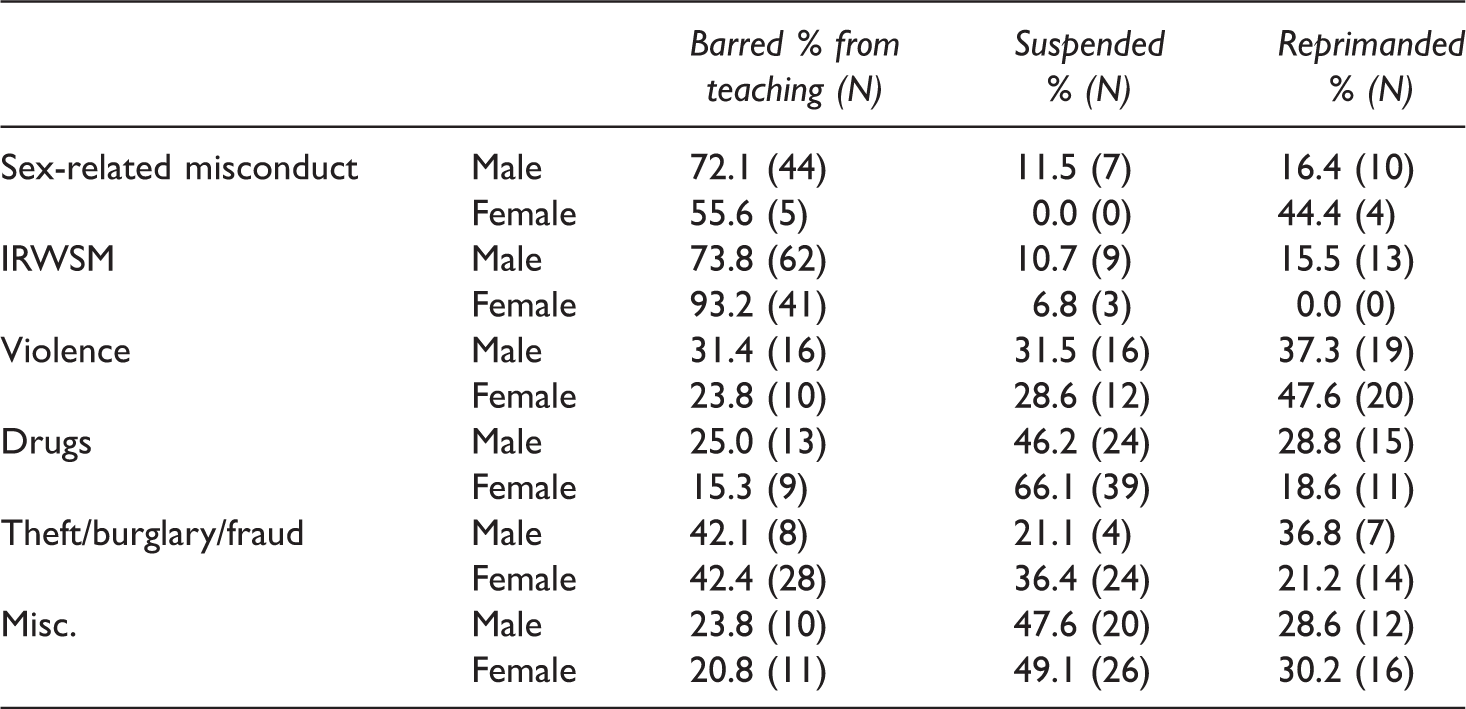
Discipline by offense and gender.
IRWSM: inappropriate relationship with a student or minor.
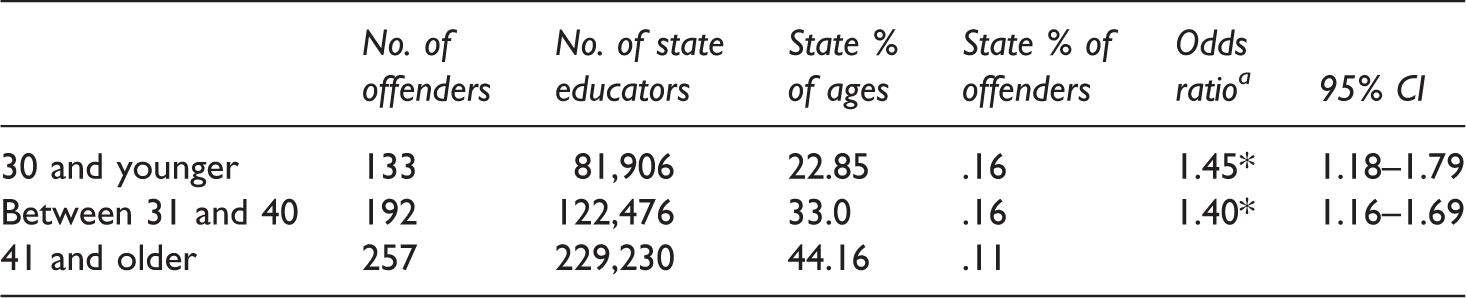
Teacher, educational aides, and professional staff by age.
Significant at α < .05.
Older than 41 is the reference group.
Comparison of states’ averages with that of offenders’ average age and the number of credentials held.

IRWSM: inappropriate relationship with a student or minor.
Significant at α < .05.
Significant at α < .01.
The sixth hypothesis puts into question whether educators who have held credentials for less time are more likely to commit an offense than educators who have held certificates for longer. The data revealed that 70.5% of the offenses took place within the first 11 years a credential is held. For the 2012–2013 school year, the average years of experience for teachers was 11.5 years. It is important to mention that the years a credential is held is not the same as total years of classroom experience. However, classroom experience is closely related to how long a credential is held and was used as a proxy for the state mean. Table 5 shows that for the offense of IRWSM, offenders on average held their credentials for about 3.5 fewer years than the state average of 11.5 years. For “miscellaneous” offenses, offenders held their credentials for about two fewer years than the state mean. Similar to our position on the fifth hypothesis, we partially support the supposition of the sixth hypothesis.
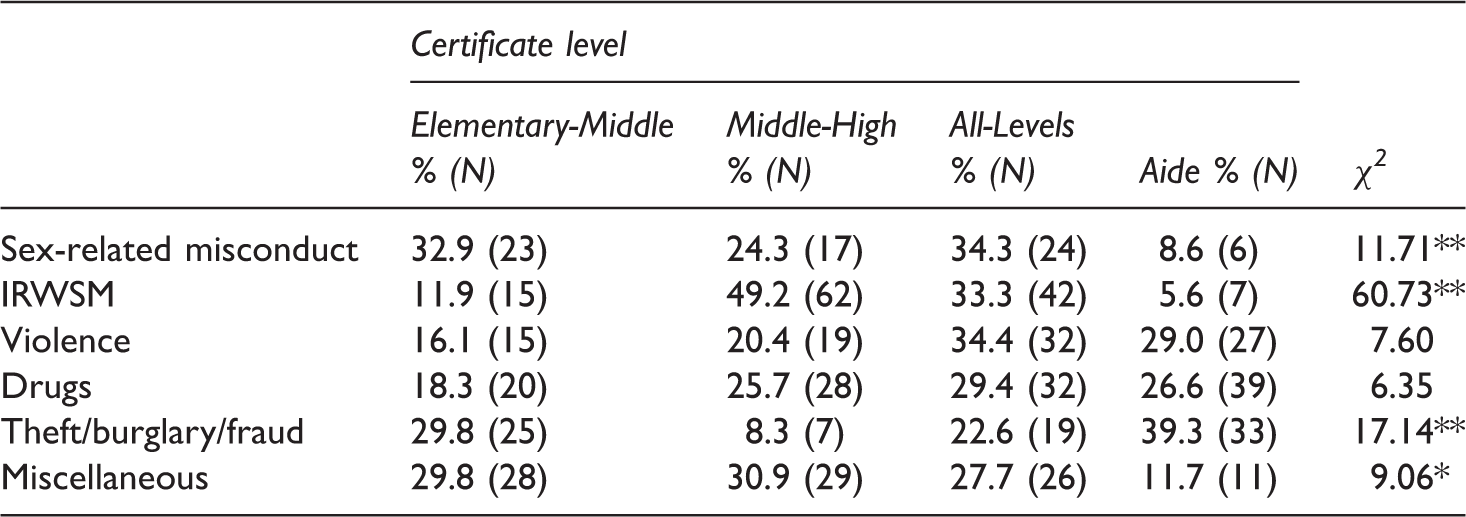
Offenses by certificate level.
IRWSM: inappropriate relationship with a student or minor.
Significant at α < .05.
Significant at α < .01.
Distribution of offenses by ethnicity/race.

Significant at α < .01.
White as the reference group.
Distribution of discipline by offense and race.

n.s.: Not Significant.
Discussion
Our results, to a large extent, parallel findings on the general population. Male educators commit offenses significantly at a higher rate than female educators; younger educators at a higher rate than the older ones, and black educators at a higher rate than their white counterparts. Similarly, men are more severely punished than women in most categories of the offenses committed by educators. Two reassuring findings are compliments to the teaching profession. Fortunately, these positive findings are not in line with the crime statistics of the general public. Happily, only a very minute portion of educators (about .1%) engage in offensive actions that demand discipline. Our second encouraging finding also runs counter to the literature on race and crime. Data from the second largest school system in the U.S. and the largest school system in a region of the country that historically has not been known for its impartiality toward minorities do not indicate that minority educators are more harshly punished than their white counterparts.
This study has tapped into an uncharted territory of offenses committed by educators. By examining these offenses, we have described the state of teachers’ discipline in one of the largest school system in the U.S. As is the nature of science, our findings have produced many other unanswered questions regarding the offenses, offenders, processes and procedures, and the environments that encourage (or discourage) educators to commit offenses. Further studies in this area can greatly enhance our understanding of the various aspects of the issue and hence lead us to better protect our children, and the men and women of the profession. Hence, we offer several broad research suggestions for future investigators. Answers to every one of these questions can have policy implications.
Our research focused on internal punishment of offending educators. It will be very informative to investigate the cases of offending educators that were adjudicated by the courts. Many questions that are pertinent to the field of criminal justice can be asked of crimes committed by educators. Questions such as Are younger, male and minority educators disproportionately represented in these cases? Are minority educators more harshly punished by our judicial system? What type of cases is referred to the courts and are minorities overrepresented in such cases? It will be very revealing to examine cases that were investigated by administrative agencies and those cases that were then referred for discipline. This could shed light on disproportionalities found in this study. For example, are there gender or racial disproportionalities in reported cases as compared to disciplined cases? Are disciplinary referrals from the school investigative units discriminatory toward a certain gender or race? What percentage of referrals are investigated, and what percentage of those investigated cases are actually sanctioned? Do administrative units follow the policy of quietism in order not to tarnish their image? Are the constitutional rights of the accused protected by the relevant administrative units? How are the rights of students (such as privacy) protected? Investigators can research the relationship between educators’ offenses and the demographics or wealth of school campuses or districts. For example, what type of school districts/campuses is prone to have more offenses? Are white school districts/campuses prejudicial in reporting or punishing minority educators? Do wealthier school districts/campuses experience fewer offenses by their teaching staff? The present study does not claim its findings to be generalizable to other states. As we have noted, states vary in their treatment of offending educators and their administrative procedures. A wealth of information can be obtained by examining the entire administrative process and procedures pertaining to the cases of educators’ offenses. Comparison of the Bible belt states with their own unique moral, cultural, and educational flavor, with those of the liberal Northeastern states can be informative. Comparison of the two largest school systems in the nation, California and Texas, as well as a national study can also shed light on the educators’ misconduct in the U.S.
Footnotes
Declaration of conflicting interests
The author(s) declared no potential conflicts of interest with respect to the research, authorship, and/or publication of this article.
Funding
The author(s) received no financial support for the research, authorship, and/or publication of this article.