




Abstract
In the spirit of reformulating notions of critique, this response builds on the creative research experimentation that the authors enacted to consider air differently. The authors continue to be lured by generosity, curiosity, surprise, and wonder and suggest two feminist responses that relate to and generate knowledge in alternative ways. Two experimentations (collective experimental story writing and erasure poetry) are offered to readers with the aim of activating new thinkings, doings, and relations with air.
In a clarion call for “the resurgence of original speculative metaphysics,” the Series Editors of New Metaphysics, Graham Harman and Bruno Latour (quoted in Dolphijn and van der Tuin, 2012) invoke the spirit of “the intellectual gambler.” Intellectual risk takers are not new in academia. For instance, Thomas Kuhn, Michel Foucault, and Judith Butler’s ideas about “truth” and knowledge were considered revolutionary at the time and our own scholarship has benefited from the gambles they took. The field of new materialism is a new metaphysics populated by such gamblers who have, since the late 1990s, been attempting to dismantle canonical and canonized notions of materialisms. Scholars like Rosi Braidotti and Karen Barad have attempted to chart the cartography of new materialisms through a posthuman, post-anthropocentric and post-secular lens. In 2013, a special issue of Cultural Studies
 Critical Methodologies, guest edited by Mirka Koro-Ljungberg and Maggie Maclure, attempts to question the postpositivist, empirical grand narratives of data. In responding to their invitation for “provocative contributions,” we took a gamble by enacting posthuman and performative research practices to consider air differently. Overall, it was a creative experimentation that required a relinquishing of control and a different kind of attentiveness to and with “data.” Karen Barad (2012a: 207) describes practitioners of feminist science studies as “being responsible and responsive to the world’s patternings and murmurings”. She continues, “Doing theory requires being open to the world’s aliveness, allowing oneself to be lured by curiosity, surprise and wonder” (207). This is part of a larger project to rethink human/man centered inquiries and we were driven by these impulses in rethinking air as data.
Along with the turn to new materialisms and alternative approaches to studying them, there has also been a call to reformulate notions of critique, to move away from models of debunking based on hierarchical binaries and judgment, towards critiques that are “productive, collaborative and careful” (Latour, 2004; Maclure 2015). Carefulness implies taking notice, reading widely, and studying. Critics like Karen Barad (2012b), Brian Massumi (2010), and Bruno Latour (2004) have been particularly instrumental in positing critiques that are affirmative and eventful.
As feminist scholars, we are interested in paying attention to the affirmative, visionary, and transversal approaches that feminists such as Donna Haraway (1988, 2008), Karen Barad (2012a), Iris van der Tuin (2015), and others take up in their scholarship and are inspired by the ways in which they engage with theory, conduct research, and provoke us to do more. We pay careful attention to how they work with embodied knowledges, simultaneously prioritize the discursive and the material, advance “encounters” or “events” rather than trying to “pin down” facts, and how they are open to and with the world. We also notice their citational practices, not just who they reference, but how they generously make explicit that knowledge production is done with a whole host of others. Relationality, connectivity, partiality, and response-ability are concepts they are putting to work.
By paying careful attention to these scholarly acts, we realize that a feminist response is one that prioritizes “difference, entanglement and undecidability” (Maclure, 2015: 95), is generative, and may well be imperfect. Rather than engaging with oppositional arguments, our feminist response relates and refers to knowledge differently. It wonders what might become possible if we make room for air to entangle readers in different and unknowable ways. How might we activate new human–air relations? To generate such relations demands experimentation. Sometimes it is necessary to do things that might not immediately (or ever) make sense or seem relevant.
In the spirit of activating new thinkings, doings, and connections with air, we offer two experimentations. Experimentation 1 is in the form of a Mad Libs® story, There’s Something in the Air. Mad Libs® was invented by American writers Leonard Stern and Roger Price in 1958. They are short stories that have key words missing and replaced with blanks. Beneath each blank is a lexical or other category, such as “noun,” “adjective,” or “a type of tool.” One player asks another player to contribute a word for each blank. Although this might be reminiscent of completing reading comprehension tests in grade school, which are anything but “open,” this is not the point. Instead, when the story is read out loud, it is usually comical, absurd, and eventful. Our aim with this collective experimental story writing and telling is to give up control about air. In doing so, we hope these newfangled stories about air might activate different kinds of relations with air.
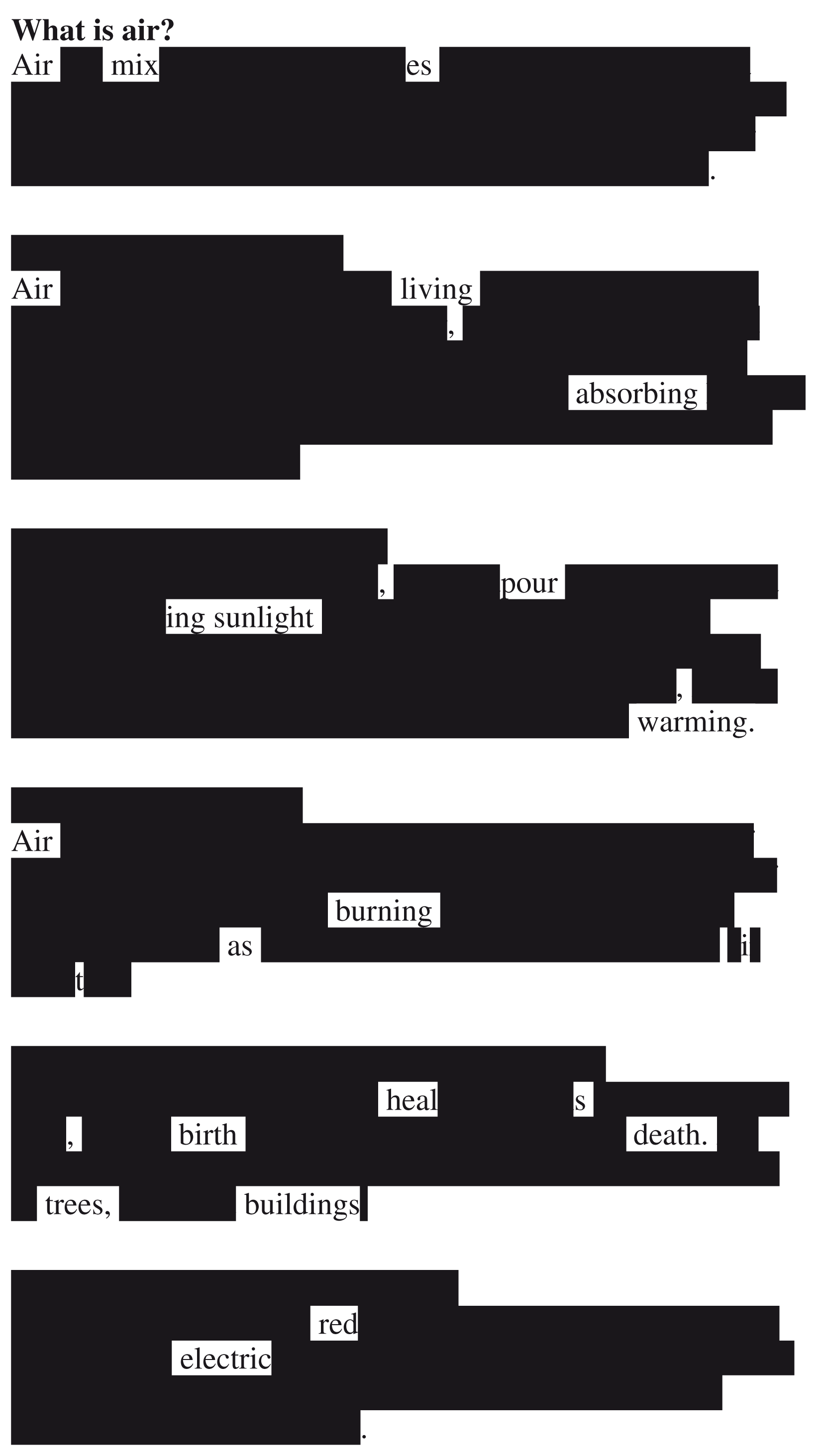
Experimentation 2 is a piece of erasure poetry. Erasure poetry is a form of found poetry also called blackout or redaction poetry. It is created from an existing text by obscuring many of the words or parts of words, in order to reveal a new arrangement of words which creates a very different kind of meaning. To craft our erasure poem, we began with a textbook-like excerpt entitled “Air” listing some “fun facts” about air (Kidsbuilder.com, 2007; see Appendix 1). The chosen excerpt is a perfect example of the positivist, empiricist approach to matter that conceptualizes it as “known, familiar and inert” (Koro-Ljundberg and Maclure, 2013). In reworking this piece of writing and creating erasure poetry out of it, we have attempted to rethink air as something more complex and creative, even agentic. We hope the poem rising out of the ashes of representing air as static and passive enables us and readers to encounter air very differently.
Our responses are a gamble. There is a chance they will not be useful. But there is also a possibility they will make room for something more to emerge; comingling, entangling, and becoming-with relations with air. Regardless what happens, these responses are non-innocent, partial, serious, playful, imperfect, and unapologetically feminist. 1
Experimentation 1
It was a hot, ______________ afternoon when Bidisha and Mindy decided to set
(name of season)
out on the crowded ___________of Hong Kong to do what all girls like to do …
(plural noun)
___________!
(gerund)
Stepping out of her ______, Mindy immediately felt as though she would _____.
(noun) (verb)
Within seconds, sweat was ________ dripping down her _________________
(adverb) (name of body part)
causing her blouse to stick to her _________________. While keeping count of the
(name of a body part)
________ concrete steps she had to walk down, she caught a glimpse of herself in
(number)
the reflection on the store _____. Her hair was ________, reminding her how much
(noun) (adjective)
she ________________ the humidity in the summer air which played havoc with her
(verb, ending with s)
hair. The air was _________, forcing her to slow down, while trying not to _____ into
(adjective) (verb)
the people on the crowded __________. It was a Sunday and the open spaces were
(plural noun)
already being occupied by foreign domestic workers _______ their day off. They
(gerund)
often huddled in _________ areas with the hope of a slight breeze. Mindy marveled
(adjective)
at the transformation of the _________ downtown district on Sundays into a quasi
(adjective)
domestic space for foreign bodies. The air that transported _______ attired men and
(adverb)
women into the comfort of their airconditioned offices during the weekdays, now
chose to ____ still and heavy on the tired bodies of these women emerging from the
(verb)
homes they helped keep _________ all week.
(adjective)
Bidisha and Mindy met at the ferry terminal, where they stepped onto the historical
Star Ferry,
which _______________ them across Victoria Harbour. Standing on the upper deck,
(verb, past tense)
the wind blew their _______ and brushed across their bodies. With a _________ look,
(noun) (adjective)
Bidisha ______________ her nose, before ________her hand over her mouth and
(verb, past tense) (gerund)
nose, while screaming, “Eewwwwh, what is that smell? Something _____.” Filling her
(verb)
lungs with air, she cautiously took a __________ , __________ breath in. The air smelled
(adjective) (adjective)
of a mixture of rotten ________, _____________ and __________________. She could
(noun), (type of spice) (chemical compound).
taste the air on her ______________. At the same time, her eyes felt scratchy, and
(muscular organ)
they started watering. She couldn’t stop blinking and it was hard to keep from
_______ her eyes. The taste of the ___________ air, made her feel sick. Was she going (gerund) (adjective)
to vomit? Quickly, she grabbed Mindy’s __________________, headed into the
(name of a body part)
airconditioned cabin and immediately felt relief from the hot, polluted, and humid
Hong Kong _____. Had Hong Kong air always been this ________? What about the
(noun) (adjective)
early days of the Star Ferry when the ride was much longer and land reclamation
hadn’t swallowed large swathes of the ______? Founded by an Indian merchant in
(noun)
1888, it was the only means of crossing the _____for many years. The breathtaking
(noun)
view of the Hong Kong ______, which still gave Bidisha a ______in her throat, and
(noun) (noun)
the gentle morning ____________, were always mentioned as the highlights of a
(plural noun)
ferry trip across the harbor. “The best way to get your night breeze” screams
aTripadvisor review. But on days like this, Bidisha really wondered if this was
the best place to
______ a breeze. “It literally took my breath away” she thought as she finally _____.
(verb) (verb)
Experimentation 2
Footnotes
Declaration of conflicting interests
The author(s) declared no potential conflicts of interest with respect to the research, authorship, and/or publication of this article.
Funding
The author(s) received no financial support for the research, authorship, and/or publication of this article.
Note
References
 Critical Methodologies