



Abstract
The challenge set before Black economists in 1967 by Harold Cruse in his seminal work The Crisis of the Negro Intellectual: A Historical Analysis of the Failure of Black Leadership, to create new economic theories, methodologies, and institutional forms, from a Black community point of view, is still with us, and growing more urgent by the day.
Mainstream economics has failed to shine much light on fundamental problems of inequality, poverty, and financial and productive stability, particularly as these problems intersect with racial disparity.
After 100 years of African American economists, perhaps it is time to strike out on our own behalf and search for the solutions to our community's problems by creating and employing our own lamps.
Introduction
In 2005, I had the privilege of participating in a Union of Radical Political Economy (URPE)-sponsored symposium, for a special issue of the Journal of Black Studies. The theme for the symposium was Black Political Economy in the 21st Century: Exploring the Interface of Economics and Black Studies (Z0). The special issue was coedited by Jessica Gordon Nembhard and Mat Forstater. Also contributing were James Stewart, Julianne Malveaux, Patrick Mason, and Mwangi Wa Githingi. James Stewart and Julianne Malveaux were discussants. Sandy Darity was the chair. Imagine that, a URPE-sponsored event for the Journal of Black Studies, featuring National Economic Association (NEA) members!
I was, as they say, in “high cotton”—a doctoral candidate on a panel with heavyweights. It was my first time presenting at the Allied Social Science Association (ASSA) annual meeting. It helped that the meeting was in Philadelphia and my niece was in attendance.
Sandy and I differed in our thinking about grand theory versus middle-range theory. I took the position then that the focus should be on middle-range theory, which would lead to direct application in practice. Sandy took the other position.
I was then very focused on what I would have called practical matters. My understanding of grand theory was influenced by C. Wright Mills, who coined the phrase in his critique of the structural-functionalist grand theory of Talcott Parsons (1960).
Mills’ attack on grand theory was directed to his claim that it was so generalized (sic) as to be useless as it disengaged theoreticians from observation. It turned sociology into a syntactical exercise and was blind to semantics. Grand theory excluded many structural features fundamental to the understanding of human society from its realm of abstract concepts. These monolithic concepts are irrelevant to understanding historical realities (https://qualityresearchinternational.com/socialresearch/grandtheory.htm).
My thinking has evolved, and I have come to believe they (Mills, Parsons, and Darity) are all correct! Grand theory, or metatheory, is needed to organize concepts, but there is no one way to do it (I, like many others, reject Parsons’ structural functionalism). The organizing of concepts, in metatheory, necessarily precedes what sociologist Archer (1995) calls “practical social theory.”
What I did not know at the time was the interesting fact that both C. Wright Mills and Talcott Parsons were students of the leader of the Texas School of Institutional Economics, Clarence Ayres. Parsons was at Amherst College and Mills at the University of Texas at Austin. The story is that Ayres and Parsons had significant disagreements. In contrast, Mills and Ayres got along well and Mills acknowledges that his power elite theory owes much to Ayres’ ideas.
My focus on practical matters had much to do with why I became an economist. My occupation before returning to school to study economics was in computer science for 20 years, the last 10 years being with my own software development and systems’ integration company.
Being in business I became involved with the Black Chamber of Commerce of Greater Kansas City, chaired its business and economic development committee, became president, and decided that economic development was where it was at. I understood that even though I was doing well personally, my community was not, and I wanted to study ways to transfer my success to it.
I was fortunate in attending my (2nd) hometown university, in that when I returned to school at the University of Missouri Kansas City (UMKC) in 1996, institutional economics had had a 50-year history there. The distinctive Kansas City school of institutional economics, distinguishing it from its Texas, Oklahoma, and Denver roots was in its infancy, which offered an opportunity for me to make my contribution. But I knew nothing about institutional economics and had no idea of what I needed to know in order to gain insight into economic development in the Black community. I only knew what I wanted to accomplish.
The first courses I took as “prereqs” to getting into the graduate program were intermediate courses in micro and macro. Both courses at that time at UMKC were taught by mainstream economists. I had no particular disagreement with the macro, but then I had no particular knowledge of macro things.
However, in the micro course, when the professor began to teach the “theory of the firm,” it became obvious to me that there was something very wrong. The way price setting was theorized was not something that I had ever done in business. The theory did not correspond with my reality. What I did not know at the time was that the method that I had used in business to set my prices was what institutionalists 1 called “administered prices” and what post Keynesians called “markup pricing,” 2 which provide a more empirically based/realistic alternative theory of pricing than marginal cost pricing.
Even though I was disappointed, I persisted, taking an economic development course at UMKC that summer from a Nigerian economist who had just graduated from the University of Oklahoma, which was the locus of the Oklahoma School of Institutional Economics. Although I did not get much institutional economics in that course, I was introduced to the ideas of Gunnar Myrdal.
That fall I took my first institutional theory course from another Oklahoma economist, who was to become my mentor, dissertation advisor, colleague, and friend. I remember saying to myself consciously, “this is what I need to know.” What caught my attention were three ideas: (a) the institutionalist conception of culture, (b) the importance of culture in human development, and (c) how cultural development proceeded evolutionarily. My understanding of what was meant by institutions in institutional economics was still conventional, still akin to organization.
Having studied biological evolution, I was aware of controversies in the area of human evolution and race, but being a natural science and math nerd from forever, and coming from computer science, I was unlearned on the controversies surrounding the concept of culture and the social science use of the concept of evolution. For me, there could be no serious debate on whether Black community development was anything but human community development. That debate is serious for some and all encompassing; not for me. And the way “original” institutionalism conceptualized culture made the debate superfluous, if not logically absurd.
In June of 2005, I attended a birthday celebration in Oakland, CA, for the African-centered psychologist Wade Nobles, one of the founders of the Association of Black Psychologists. It was also a conference in observance of the 25th anniversary of the founding of the “Institute for the Advanced Study of Black Family, Life and Culture, Inc.” Attending that celebration/conference was the psychologist Cheryl Grills. I had not been aware of Dr. Grill’s work, but in her presentation, she said something that has influenced my way of thinking ever since.
She had become involved in economic development projects in Philly, which she had come to believe were a necessary adjunct to the counseling that she did with Black men. She realized that counseling Black men through their depression over not being able to support their families and other injustices of being a Black man was not enough. After their counseling they still were out of work. So, she started a construction company and employed them in their communities rehabbing housing.
She noted that African-centered scholars had spent 25 years or more figuring out the nature of what we were against, it was now time to figure out what we were for.
It was an insight that resonated with my Black Political Economy paper presented earlier in the symposium. I defended my dissertation 2 months later. Much of what follows draws on that paper and the papers of the other symposium contributors.
Difficulties
Critiques of Black Economists
Harold Cruse’s Critique
The title of my symposium paper, following the theme, was “Black Political Economy in the 21st Century: Exploring the Interface of Economics and Black Studies—Addressing the Challenge of Harold Cruse.”
In his seminal 1967 work The Crisis of the Negro Intellectual: A Historical Analysis of the Failure of Black Leadership historian and social critic Harold Cruse, (1967/1984) issues a challenge to Black Intellectuals in general, and Black Economists in particular, for the “studied creation” of new economic institutional forms, not limited by the economic ideologies of Capitalism or Marxism.
Cruse uses the term “new institutionalism,” which does not refer to the new institutionalism of North et al. (see the Appendix) to define his project for the development of economic theory aimed at creating a viable Black economy via “a new and dynamic synthesis” of “politics, economics, and culture” (Cruse, 1984, p. 343). He argued that:
the initial ideas on the nature, content and forms of these new institutions must emanate from the minds of an advanced type of Negro intelligentsia, or they will not emerge (Cruse, 1984, p. 336).
I believe that Cruse’s broad, but insightful critique from 1967 is still essentially valid today. Moreover, I contend that if the challenge is to be met it requires the development of a Black Political Economy more robust than the current choices between the political liberalism or “noneconomic liberalism” (Cruse’s term) promoted by early Du Bois or the economic conservatism or Black Capitalism promoted by Washington, both of which are pro-Capitalist/pro-neoliberal, or Black anti-Capitalism, that is, Black Marxism.
Cruse was opposed to an uncritical reliance on both Marxist and mainstream theorizing and is calling for what I call an “irenic” blend of theory and practice, one allowing a deliberative community empowering process of community/institutional analysis, followed in practice by a synthesis, a “studied creation,” of new economic institutional forms—a Praxis.
Critique by Black Social and Behavioral Scientists
Cruse’s was not the first assessment by an eminent Black scholar of the deficiencies of Black Intellectuals in economic matters, or the last. Prominent prior analyses to the same effect were made prior by Woodson (1933), Du Bois (1986), and Frazier (1962), and had been made since by Frazier (1973), Walters (1973), and West (1993–1994). Nor has it been the only call for the development of “new institutional forms” by Black scholars desiring change in the Black economic situation. The later Du Bois (1986, p. 707; post Great Depression) saw a need for “institutional development” and “new economic institutions”. Concordant with Cruse, in sociologist and psychologist Nathan Hare’s chapter in Joyce Ladner’s revolutionary volume The Death of White Sociology: The Challenge of the Black Scholar, he writes,
The black scholar must develop new and appropriate
In addition to “new institutional structures,” Hare is arguing for the deliberate development and employment by the Black scholar of explicit norms and values, axiology to avoid the hidden ideologies of western social science, a point I will discuss later.
Political scientist Ron Walters writes in his chapter in Ladner’s volume, of
“the tragic mistake” being made by “most of the relatively few black economists” [still relatively few] is “embracing unequivocally the principles and practices of American Capitalism; the same system that White people manipulate and scheme to deny Black people significant participation” (Walters, 1973, p. 197).
Walters goes on to argue that Black economic development fails because it builds on “the concepts of White social science [which] assumes the ideology of the capitalist system” (Walters, 1973, p. 197). Fully addressing the question of why the development of Black Political Economy as an aspect of Black Studies has not kept pace with the development of other Black Studies disciplines requires a historical analysis beyond the scope of this paper. However, Ijere (1972) asked a similar question in 1972, contemporaneous with Walters, thus providing evidence of a parallel concern among Black economists for “the bewildering paucity of Black Economists” in Black Studies programs (Ijere, 1972, p. 161).
Who is Empowered (and Disempowered) by a Theory?
I want to segue for a moment from the challenge of Cruse and others to the issue of power, in fact to a definition of Political Economy itself. From the perspective of institutionalist political economy (for me that phrase is redundant)—institutions matter. Surprise! However, as opposed to institutions in “new institutionalism,” original institutionalism theorizes institutions as both enabling and constraining outcomes, not just constraining them. In fact, constraints on some are enablements of others, and vice versa, an idea that new institutionalists should have retained from John Commons 3 when they borrowed his concept of transactions. Institutions do so because they structure the distribution of power, and through power “who gets what, when, and how,” a definition of politics from political scientist Lasswell (1936).
Why is it important to have validly constructed definitions? I will give three examples.
Again, back to North, he writes that “[i]nstitutions are the rules of the game of a society or more formally are the
Social institutions are often the enabling structures allowing those already advantaged to grow more advantaged, at the expense of those who grow relatively less advantaged. Things do not just work themselves out to a stable equilibrium between the powerful and the powerless.
In the following concept map 4 (Figure 1), I conceptualize institutional political economy, as a metatheory of the relationship between politics and economics. Social Institutions are what connect economics (on the left), with politics (on the right).
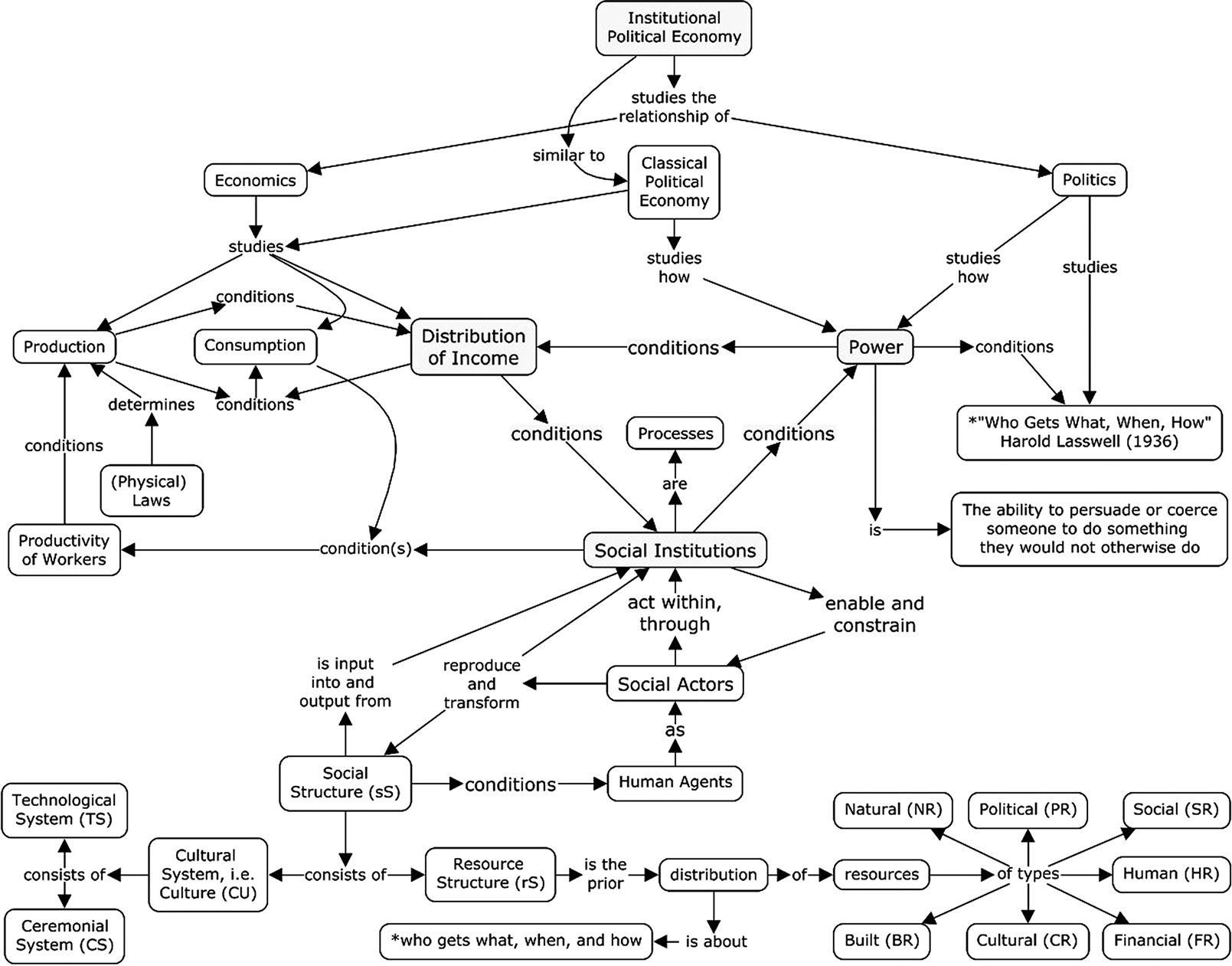
The power triangle.
In what I call the “Power Triangle” (center, shaded) social Institutions condition (but do not “determine”) power (defined as the ability to persuade or coerce someone to do something they would not ordinarily do). Power conditions distribution—and for economic purposes the distribution of income. The distribution of income conditions 5 social institutions, a component of which is the distribution of wealth (financial resources [lower right corner of the diagram] as a component of the prior distribution of resources). This is a recursive causal cycle, vicious for some, virtuous for others; or to paraphrase Rodney (1972), development and underdevelopment are two sides of the same coin.
Because there is power conditioning in the distribution of income, there is no “theory of marginal productivity” applicable here, and no need for one, to explain the distribution of income. Even the mainstream agrees that if there is power affecting the distribution of income (as opposed to free markets), the standard theory does not apply. Mainstream theory hypothesizes what “would” occur if power did not interfere with distributional processes. However, even if there has ever been a case of free markets, it is a theory of, to echo Polanyi (1944), “a stark utopia.” Power is involved in the creation and protection of markets, and the creation and protection of property rights; there is therefore no possibility of a free market without these political institutions.
For institutionalist political economy and I suspect that for most of us the marginal productivity doctrine—that people are paid what they are worth (and even worth what they are paid)—is a nonstarter. We know all too well that people are paid what they can get, what they can persuade or coerce someone to pay them.
I suggest that we get rid of the marginal productivity doctrine and formally replace it with something that accords with our and everyone else’s experience. There is no need to deny what our experiences, individually and as a community, tell us. We can come up with a better set of propositions, and there are many testable hypotheses that can be generated and tested from the metamodel shown in Figure 1, and, by the way, propositions in line with what Adam Smith and other classical political economists postulated—that wealth is power.
From the perspective of my own critical institutionalist political economy, which draws on the philosophy of science insights from the Critical Realism of Bhaskar (1975) and the Pragmatism of Dewey (1981), the question of who and what is conceptualized as “real” by a theorist is fundamental to the evaluation of a theory’s theorized enablements and constraints. Ontology is important! What people believe is “real” sets the components of metatheory, and from those components are constructed the causal relationships of theory. In fact, ontology, metatheory, and theory are all constructions and parts of institutional structure! They are “settled habits of thought common to the generality of men” by which “men order their lives” (Veblen, 1909, p. 626).
An evaluation of a theory’s theorized enablements and constraints need not be profound! For example, in theories that use GDP as a concept—say, neo-classical growth theory—ignoring the value of household work sets the framework for the devaluation of the work traditionally done by women and does so as an absurdity. One might argue that household work should no longer be considered women’s work, but that is not the absurdity. Consider this: let us say we have two parents P1 and P2, who take care of their own children C1 and C2. Since these are not market transactions, they are invisible to GDP calculations. As far as neo-classical growth theory is concerned self-child care has no value. But, change the situation where P1 takes care of C2, and P2 takes care of C1, and have them exchange $100 per week with each other, and GDP increases by $200 per week. Value is suddenly discovered, because it is market value! How can this be anything but absurd?
Feminism as a broad project spans the social, behavioral, and even the natural sciences. It seems to me that Feminist Political Economy has made great strides in developing along the lines that Cruse advised for Black Political Economy, as a blending of politics, economics, and culture. Differential power between men and women is central to the project. Feminist institutional economist Ann Mari May writes:
Feminist economics is explicitly political. Feminist theorizing requires that I ask the sometimes troublesome questions about the effects of disparate power relations in the identification and generation of knowledge claims and ultimately that I ask the question “who is empowered by the theory?” (Ann Mari May, 2002)
Perhaps Feminist Political Economy’s interaction with the concept of culture has been less inhibited than Black Political Economy’s development with the same because no one seriously makes an argument that the culture of women, particularly the culture of White women, should be questioned. It would be ridiculous for opponents to argue that the culture of (White) women is pathological relative to the culture of (White) men. Instead, Feminist Political Economy does not back away from the challenge and puts the problem squarely on the cultural hegemony of men.
However, Feminist Political Economy still has internal ontological, metatheoretical, and theoretical work to do. Nina Banks informs us that “[t]he community is an important site where
Understanding women’s work experiences requires a
Banks offers a new metatheoretical framework; “Firm, Household, and Community as Sites of Production”; to organize that theorizing.
A methodological reconceptualization can bring the previously invisible into view. It can also clear away unnecessary obstacles in the way of the view ahead. Black economists, in general, find themselves defending against charges of the pathology of Black culture. I believe we would benefit from a reconceptualization of the concept of culture, and that would allow us to stop spending much precious time responding to badly intended idiocy and direct our limited resources to other things. To be provocative, (and perhaps ironic), I want to quote Thomas Sowell from the Fairmont Papers: Black Alternatives Conference held at the Fairmont Hotel in San Francisco in 1980.
The moral regeneration of White people might be an interesting project, but I am not sure we have quite that much time to spare.
(As Bernard Anderson was in attendance at that meeting, he may have something to add. 6 )
What Is It Good For?
he who neglects what is done for what ought to be done sooner effects his ruined than his preservation (Nicolo Machiavelli, The Prince, Chapter XV)
The above quote may seem to be making the point made by mainstream economists, that in order for economics to be a science it must deal in positive facts rather than normative values, and in so doing making the point that values and valuation are to be avoided. In fact, it does the opposite, because the mainstream argues that what ought to be done ought to be done regardless of the facts, or would be done if the facts did not exist. It has moved so far from the facts that all that is left are values.
Do not take my word for it, take the words of luminaries in the field: four winners of the Bank of Sweden Prize in Economic Science.
… economics has become increasingly an arcane branch of mathematics rather than dealing with real economic problems (Friedman, 1999, p. 137).
That such models [rational expectations, efficient markets] prevailed, especially in America’s graduate schools, despite evidence to the contrary, bears testimony to a triumph of ideology over science. Unfortunately, students of these graduate programmes now act as policymakers in many countries, and are trying to implement programmes based on the ideas that have come to be called market fundamentalism (Joseph, 2002).
Existing economics is a theoretical system which floats in the air and which bears little relation to what happens in the real world (Coase, 1999, p. 2).
Page after page of professional economic journals are filled with mathematical formulas. Year after year economic theorists continue to produce scores of mathematical models and to explore in great detail their formal properties; and the
You could infer from the above-quoted statements that I, like some of my institutionalist colleagues, believe that math is the problem, or even deductive reasoning itself. This is certainly not the position of those quoted, and it is not my position! Heck, Milton Friedman was a student of the institutionalist Wesley Mitchell and referred to him as his “great teacher” in his Nobel lecture. Abram Harris was a colleague of Friedman and both were fellow students of Mitchell at Columbia.
Math is just a tool, a means to an end, and we need more tools, not fewer. But when it becomes the end in itself it can become like a snake eating its own tail—math as a means to math as an end. What good is it? becomes a real question and not just a way to dismiss.
The points that I ask you to take from the above is that—mainstream economics does not “[deal] with real economic problems,” “bears little relation to what happens in the real world,” is full of (unstated and unacknowledged) “ideology,” its “standard theories are of little help,” and “is sick.”
The problems of the Black community are real, even existential! We cannot wait for the mainstream to “heal” itself, while the Black community suffers. We need to move on!
Prospects
Now that I have argued, perhaps too long, for what we should be against, let me, for a moment, argue for the important work ahead—what we should be for. So, back to Cruse.
Cruse’s Critique of Black Economists in Six Points
Cruse's critique in Crisis is most forcefully contained within two short chapters—“Black Economy—Self-Made Myth,” and “Capitalism Revisited.” I summarize his argument in six points (for a fuller discussion see Tauheed, 2008).
That the orientation of Black leadership and Black economic theorists towards racial integration, and their fear of being labeled nationalist or separatist, limits their ability to lead the Black community in the development of a Black Economy (Cruse, 1984, p. 309, 333). That the proper historical basis for the development of economic models for a Black economy must start with an updating of the economic programs of Washington and [the later] Du Bois (314). That the development of a viable Black economy requires the theorization and creation of new economic institutional forms, a “new institutionalism” (314), resulting in “a new and dynamic synthesis” of “politics, economics, and culture” (343), not bound by the limited theoretical choices of the standard (Capitalist or Marxist) models. Such economic forms would be from a “certain community point of view” and would “intelligently blend privately owned, collectively owned, cooperatively owned, as well as state-sponsored economic organizations” (Cruse, 1984, p. 314). That the ability of the Black economy to exert political, economic, and cultural power on the White economy requires the “certain community point of view” to “condition the climate for effective action” (Cruse, 1984, p. 314). That the Black community must be mobilized by education and persuasion toward group rather than individualistic solutions to the problems of economic development (Cruse, 1984, p. 314). That a necessary condition for a Black economy is that “the bulk of profits accrued from commercial enterprises in the Black community, be poured back into the community for further economic development” (Cruse, 1984, p. 315).
I will not have time to discuss all of these or any of these in any detail, but all of the above calls forth an intention to build a Black economy. Point #1, about the fear of the labels of nationalism or separatism, must be weighed against the urgency of the problems to be addressed. Cruse called the need for even a great scholar such as Du Bois to maintain a distance from the charge of being a nationalist or separatist “the only real flaw in the man’s intellectual equipment” (Cruse, 1984, p. 309). Cruse sees “American Negro history [as] basically a history of the conflict between integrationist and nationalist forces in politics, economics, and culture” where “[t]he pendulum swings back and forth between these two extremes” (Stewart, 1984, p. 564). In Cruse’s opinion, Du Bois recognized the futility of this conflict and attempted to deal with it theoretically, starting in the 1940s, but too late in his life (Du Bois was in his seventies) to make much progress. Cruse argues (point #2) that freeing ourselves from this polarization and pursuing the theoretical unification of Du Bois’ and Washington’s positions is an essential work to be done before we can move forward into new theoretical territory (point #3).
Black economists, I would argue, have not taken up the challenge. And I believe this is in part a result of strictures placed on their research agendas by the tenure processes of the economics departments where they teach and research, the need to “make a living” in hostile environments, and in part a result of their academic training. I want to propose a change in the intent and content of that training, as a way to guide coming Black economists beyond past limitations, towards innovative praxis. Because the content is dependent on what we are trying to accomplish I will discuss intent first, and then content.
Intent: What are we Trying to Accomplish?
I am not arguing that the Black economy project calls for the establishment of a completely “separate” Black economy. It can (and I believe should) mean more of what Du Bois (1986, p. 712) meant when he advocated for the establishment of a “cooperative commonwealth” of producer and consumer cooperatives in the Black community that included cooperative efforts in education through school and church (point #5), and economic cooperation in the arts, health care, trade unionism, banking, law, and insurance among other aspects of economic and social life. Du Bois did not see his program as able to create an isolated Black economy capable of supplying all of the needs of the Black community; instead, he envisaged interaction between the Black and White economies. Still, he considered that the developed part of the Black economy
could be so important and wield so much power that its influence upon the total economy of Negroes and the total industrial organization of the United States could be decisive for the great ends towards which the Negro moves (Du Bois, 1986, p. 699; Cruse’s point #4).
It seems to me that the reparations work of Darity and Mullen (2020), Hamilton (2020), and others, and the prep work connected to it, what Sandy calls by the euphonious phrase, “pre-reparations preparations” is such a project. Should a reparations program become policy, and the estimated roughly $11 trillion in payments be made over a course of years (Darity and Mullen, 2020), “pre-reparations preparations” requires that wealth from those payments remain within the Black community, else the gap will reappear. For me this is exactly the purpose of a “cooperative commonwealth.”
The work of Gordon Nembhard (2008), and others, in cooperative economics is also such a project. With the Black community as the owners, via producer cooperatives, of the production entities from which they (and others) purchase their goods and services, consumption, which would otherwise leak out of the community, is reinjected back into the Black community (Cruse’s point #6).
Those projects, and others like them, require the intent to create an economic base for the Black community that is as independent of the larger economy as possible, but interdependent, not just dependent. I believe that Lloyd Hogan’s (1984) conceptualization of internal and external labor provides a way of properly thinking about the work to be done.
The design of such economic forms is to be theorized with the intention of retaining wealth and growing that wealth at least at the rate of the external economy, else the wealth gap reappears and widens. The alternative, I believe, is for the economy of the Black community to ebb and flow unsustainably as the greater economy ebbs and flows, but with the historical greater magnitude in the ebbing and less recovery in the flow, such as in the “last hired/first-fired effect.”
Content—New Methodological, Technical, and Social Skills
A Two-way Street Between Black Political Economy and Black Studies
The other articles in the symposium special issue were
Gordon Nembhard (2008). “Alternative Economics—A Missing Component in the African American Studies Curriculum: Teaching Public Policy and Democratic Community Economics to Black Undergraduate Students.” Malveaux (2008). “Why Is Economic Content Missing from African American Studies?” Mason and Githingi (2008). “Excavating for Economics in Africana Studies.” Nembhard and Forstater (2008). “Introduction: Incorporating Black Political Economy into Black Studies.” Stewart (2008). “Africana Studies and Economics In Search of a New Progressive Partnership.”
These articles were intended to attempt not only to bring Cruse’s challenge to the light of day to economists, but also to alert Black Studies scholars that there was a group of Black economists who are aware both of the opportunity to reestablish the connections from the 1960s and 1970s, of Black economics to Black Studies, and of the expected continuing rejection by Black Studies scholars of the work of Black economists if Black economists insisted on theorizing from a mainstream perspective.
The founding of the Caucus of Black Economists in 1969 was such a connection, but, in a real sense the connections made in the 1960s and 1970s, when Black economists as Black Political Economists were very active in the Black Studies movement and liberation movements around the world, has not been maintained. And, there still does not appear to have been much, if any, direct response among Black economists, as a whole, to Cruse’s critique. 7
There has been much vitally necessary work to expose the injustices and inequities within the Capitalist system: discrimination, poverty, unequal distribution of income and occupation and so on, and to expose the resulting differential distribution in wealth, education, political power, health outcomes, etc. This work is of immense importance in providing knowledge about the structure and functioning of the current state of the system.
There have also been many Black economists working in the wilderness, as Black Political economists, who receive many accolades and recognition, and calls for help, from noneconomists, who recognize the value of their work in its interdisciplinarity, even as economists, in general, devalue it.
Black Political Economy and the Need for Interdisciplinarity
Black Studies is inherently interdisciplinary, exploring the interrelationship between the factors influencing Black History, Black Religion, Black Sociology, Black Politics, Black Economics, Black Creative Production, and Black Psychology (Karenga, 1982). However, standard economics is described as a methodologically “separate” science. Economic philosopher and ethicist Daniel Hausman has articulated a powerful critique of standard economics on this point arguing that standard economics sees itself as
a domain in which a small number of causal factors predominate. This vision of economics as a separate science, although not often expressed in this terminology, remains … central to contemporary microeconomics [i.e., welfare economics]. The whole project of microeconomics and general equilibrium theory presupposes that a single set of causal factors underlies economic phenomena and determines their broad features. Other relevant causal factors are regarded as disturbing causes.
To surrender the vision of economics as a separate science would be to part with the grand vision that a single theory could provide one with a basic grasp of the subject matter (Hausman, 1992, p. 225, emphasis added).
Thus, Black Political Economy is methodologically at odds with standard economic theory, of the capitalist or Marxist varieties; theories that rely predominately on a single predominant causal factor, self-interested maximization or class struggle, respectively. Although Marxist economics is more integrative of political and sociological knowledge and insight than capitalist economics, Black Political Economy calls for a Methodology able to integrate knowledge and insight from the other Black Studies disciplines (History, Religion, the Arts, and Psychology) as well, and to do so from the unique standpoint of Black cultural life. Doing so requires interrelated coursework in these disciplines so that Black political economists are at least able to converse with researchers in the other disciplines, as well as benefit from their published research. Perhaps it also starts with an appreciation for those other disciplines which are viewed as not as rigorous as economics and doubly viewed as such because the work is done by Black scholars.
Again, Black Studies is inherently interdisciplinary and Black Political Economy, if it is not to remain hobbled by the “separateness” of standard economics, must be an interdisciplinary science. As previously noted by Hare (1973, p. 76), this requires a methodology able to “subsume and overlap existing norms of scholarly endeavor.”
In addition to a sound foundation in economic and political-economic theory—orthodox and heterodox—we must add instruction in economic history with a centering in Black economic history and history of economic thought—orthodox and heterodox.
Praxis and the “Community Economist” Workplan
What should be the role of Black Political Economy and Black political economists in helping to organize, mobilize, and educate the Black community towards “group rather than individualistic solutions” and the “certain community point of view” that Cruse sees as needed to “condition the climate” for Black economic development? My answer to that question grows out of how I see the nature of the problem facing Black economic development. Although much of this calls for further explanation, something I cannot do here, listed they are:
The “problem” is systemic and complex; it has no single source of production or reproduction. All social macroinstitutions (i.e., Family, Economy, Polity, Education, and Religion) are interinvolved. Cruse’s “certain community point of view” prescribes systemic analysis. Community structure may be analyzed by investigating the interactions between the social institutions from the context of the distributional Structure of Resources, the Cultural System, and Human Agency. Current community functioning may be analyzed by investigating the capabilities and liabilities of community structure leading to the current production/reproduction of outcomes. The structure of new institutional forms must promote expressed community interests, and confront the problems generated by the structure of the current system. The plan for new institutional forms must recognize that there will always be those working against community interests. Therefore, “solutions” require constant adjustment. Social action yields unintended consequences; there are no perfect plans. Therefore, “solutions” must be routinely evaluated for convergence with goals and adjusted accordingly. Goals may also need adjustment.
I see the role of the Black political economist in the community against these challenges as one of “helper” rather than “leader,” and define this role as that of “Community Economist” (Tauheed, 2008).
8
The Community Economist Workplan structures this role to support grass roots, bottom-up development.
The term “Community Economic Development” has come to mean the development of a neighborhood by outside real estate and business “developers.” Community Economic Development as outlined by the Community Economist Workplan is a very different paradigm, one which supports the community’s efforts to plan and control its own development process, in response to its own perceived and stated needs.
Technical Skills
The set of technical skills proposed in the Workplan is the easiest to discuss. These skills are to include all ranges of quantitative and qualitative research methods (data gathering, processing, and analysis). No tools are to be out of bounds, but are to be used as appropriate to the problematic situation to be analyzed—we need more tools, not fewer. This includes various types of structural and functional analysis, and Systems Thinking. And nonlinear dynamic modeling techniques like System Dynamics and Agent-based Modeling, so that models can handle complexity and feedback.
Social Skills
The Workplan requires, in addition to the above technical skills, the social skills necessary to help facilitate, in conjunction with community members, the processes of developing a community vision, with deliberation over policy alternatives and selection, and advocacy for desired “institutional adjustments” and policy changes. The development of such social skills is not typically a part of an economist’s academic training, but is essential in carrying out the Workplan.
To be clear, I am not arguing that every Community Economist needs to be expertly trained in all of the above technical and social skills; a division of labor is appropriate and probably more efficient. However, some background in the “toolkit” of skills helps when deciding what skills are appropriate in what situations. Knowing this they should, to paraphrase Dr. John Hendrik Clarke, “do their best work.” 9
Back to the Future (a Sankofa Moment)
In many ways, the community point of view called for by Cruse and others brings us “back to the future,” back to the founders of the NEA who were very much a part of the confluence of Black scholars in the struggle to redefine their disciplines.
Recently, Darrick Hamilton in his 2017 NEA Presidential Address issued what I interpret as a call for a revitalization of Black Political Economy consistent with this writing. Hamilton (2020), referencing his 2017 NEA Presidential Address, reiterates his “Economic Bill of Rights” that operationalizes a moral imperative, and underlabors for the “intent” of a Black Political Economy. An explicitly moral imperative rejects the ideology of a value-free economics (think Hare’s previously referenced call for “new norms and values,” and a “new ideology”), replacing the current mainstream economics’ implicit neoliberal ideology. Hamilton argues that:
Economists should do a better job of understanding political economy, including power and initial endowments [the prior distribution of resources]…Without such analysis, our profession is more than complicit in the continued trajectory toward stratification both within and across nation-states (Hamilton, 2020, p. 333).
There is an internal Black economy awaiting its development and growth. I suggest that we not wait for the economics profession at large to heal itself from its sickness. I, for one, am not convinced that it can. I also believe we do not have time to waste?
Cruse has offered a challenge…how will Black Political Economy respond in the 21st Century?
Footnotes
Appendix
Declaration of Conflicting Interests
The author declared no potential conflicts of interest with respect to the research, authorship, and/or publication of this article.
Funding
The author received no financial support for the research, authorship and/or publication of this article.
