



Abstract
Addressing the problems of low footage and premature failure of existing PDC bits in high-temperature geothermal wells, this study investigates the limestone fragmentation characteristics of PDC cutters under high-temperature conditions. Adopting a combined approach of experimental testing, numerical simulation, and full-scale drilling verification, the effects of key parameters—temperature, rake angle, and cutting depth—on rock-breaking characteristics. The findings reveal that: (1)The mechanical parameters of limestone, such as compressive strength and shear strength, first increase and then decrease with rising temperature, reaching a peak at 250°C, where rock-breaking difficulty is the highest; (2)Single-cutter cutting tests indicate that 350°C is the optimal rock-breaking temperature, and the specific energy of fragmentation is the lowest with the highest rock-breaking efficiency when the rake angle is 15° and the cutting depth is 2mm; (3) Simulations demonstrated that both the temperature and contact stress on the cutter face increase with penetration depth but decrease with rake angle; (4)A new Φ118mm drill bit is designed based on the research. Experimental results show that the bit operates well in high-temperature environments, with a torque increase of 5.8% and a rate of penetration improvement of 31.9% compared to conventional PDC bits. This study clarifies the optimal rock-breaking parameter combination of PDC cutters under high-temperature conditions, providing key technical support for the cutter profile optimization, structural design, and drilling parameter regulation of PDC bits for high-temperature geothermal wells.
Keywords
Introduction
Geothermal energy, as a renewable and clean energy source, is gaining increasing global attention as non-renewable resources like petroleum and coal become increasingly scarce.1,2 Geothermal energy, as a renewable resource, has emerged as an effective alternative to non-renewable resources. The utilization efficiency of geothermal resources is projected to reach 30%-80% of global medium-to-high-temperature energy, with increasingly widespread applications.3–6 While drilling challenges are relatively minor in low-to-medium temperature formations, drill bit performance significantly degrades in high-temperature environments due to altered bottomhole conditions. High-temperature formations typically range from 150-650°C and consist of highly abrasive, hard metamorphic or igneous rocks (e.g., granite, gneiss). PDC bits exhibit markedly reduced performance in high-temperature geothermal drilling.7,8 Extensive research on high-temperature geothermal drilling has been conducted globally. Regarding high-temperature-resistant drill bits, Smith’s Kadera series roller cone bits achieve enhanced high-temperature performance through synergistic optimization of sealing materials and lubrication systems. Abandoning traditional sealants, they employ fiber-reinforced fluorocarbon compounds as core components for roller cone seals, substantially improving the seal structure’s resistance to high temperatures and wear. Simultaneously, specialized synthetic lubricants and functional additives are injected into the seal chamber, forming an efficient lubrication protection system that reduces high-temperature friction losses in bearings. Field data indicates this series achieves approximately 33% higher average penetration rates than conventional products. Upon well exit, bearings and sealing components remain intact and fully functional, 9 substantially reducing operational costs and downtime risks in high-temperature formations. Baker Hughes focused on enhancing bearing system high-temperature adaptability, launching the Vanguard™ series geothermal-specific drill bits. These drill bits replace traditional elastic seals with metal sealing structures, leveraging the high-temperature stability of metal materials to prevent seal failure. Combined with high-viscosity specialized grease, they maintain stable form and lubrication performance within high-temperature ranges, providing continuous bearing protection, 10 enabling stable operation under extreme high-temperature geothermal drilling conditions and providing reliable equipment support for geothermal development. Yang Yingxin’s team at Southwest Petroleum University addressed severe tooth loss and breakage in roller cone bits during high-temperature geothermal drilling by researching tooth setting strength under elevated temperatures. 11 By analyzing the impact of high temperatures on the bonding strength between teeth and the roller body, they optimized the setting structure and process parameters, developing two improved roller bit types: “8½″HF637HDY” and “8½″HF637Y”. In geothermal drilling technology, Li Guangqiao et al. developed a novel flat rubber seal ring for high-temperature roller bit 12 features adjustable contact area, delivering extended service life under high-temperature, high-speed conditions with no severe field damage, offering new insights for high-temperature seal design. The HT-1 high-temperature protective agent developed by CNPC Great Wall Drilling’s Drilling Engineering Technology Research Institute enhances the activity of foam fluids in high-temperature drilling. 13 Additionally, Jianghan Drill Bits extensively deployed its “HJT Series” tricone bits in Kenyan geothermal wells. This series incorporates sliding bearing structures with metal seals, paired with specialized diameter-maintaining features and reinforced palm-back structures, tailored to meet local geothermal drilling requirements. PDC bits have achieved over 92% of total drilling footage in oil and gas operations. However, existing geothermal PDC bits perform poorly under high-temperature conditions, exhibiting low penetration rates and rapid failure.14,15 Consequently, research on rock fragmentation characteristics in high-temperature environments is urgently needed to provide foundational data for developing PDC bits suited for such conditions.
Experimental study on single-tooth fracturing of limestone in high-temperature environments
Testing of rock mechanical properties under high-temperature conditions
Rock mechanical properties significantly influence the rock-cutting performance of PDC bits during actual operations. In geothermal wells, rocks undergo substantial mechanical property changes due to high temperatures compared to ambient conditions. To provide effective mechanical data support for setting rock parameters in subsequent numerical simulations, rock samples were heated to specified temperatures and then subjected to uniaxial confining pressure tests to determine relevant mechanical properties. For convenience in mechanical testing machines, typical test specimens are cylindrical cores with a diameter of approximately 50mm and a height-to-diameter ratio of about 2. The tests employ a high-temperature, high-pressure triaxial rock mechanical testing machine capable of reaching temperatures up to 400°C. To ensure the accuracy of rock mechanical parameters throughout the testing process, each core undergoes three identical test sets under identical conditions. The axial loading rate of the rock mechanics testing machine is controlled between 0.5 and 90MPa/s, with displacement controlled at 0.1mm/min (Figure 1). Determination of rock mechanical properties. (a) High-temperature, high-pressure rock mechanics testing machine, (b)limestone sample, (c) failure morphology.
Rock mechanical properties.

The mechanical relationship between limestone compressive strength and shear strength with temperature variation is shown in Figure 2. The figure indicates that both compressive strength and shear strength of limestone exhibit a trend of initially increasing and then decreasing with rising temperature. Maximum values occur at 250°C, while minimum values are observed at 350°C. Curves showing the relationship between mechanical properties of limestone at different temperatures. (a) Compressive strength variation graph, (b)shear strength variation graph.
PDC cutter rock cutting experiment under high-temperature conditions
Experimental details.

The single-tooth rock-breaking test was conducted on a modified bullhead planer used as a single-tooth cutting rock-breaking tester. This tester offers advantages such as adjustable cutting speed, low impact force, smooth cutting motion, and constant cutting force. Its experimental principle and equipment are illustrated in Figure 3. The equipment used includes the single-tooth cutting rock-breaking tester, data acquisition system, triaxial force sensor, and cutting tooth. Schematic diagram of single-tooth cutting test.
Prior to testing, rocks undergo a preheating process to reach a preset temperature. Each temperature condition requires at least 4 hours of heating to ensure uniform internal and external temperatures. After the heating period, rocks are removed and wrapped in insulating material to maintain temperature. The heated rocks are placed on the testing machine. Before cutting, the rock temperature was reconfirmed using a thermometer to reconfirm it, followed by the cutting test. Simultaneously, a thermal imaging system monitors temperature rise during the experiment (Figure 4). Rock heating schematic.
Before the single-tooth cutting test, place the rock sample in the rock clamping tool and secure it so that the scraped upper surface of the sample is parallel to the workbench surface. Adjust the cutter holder to set the cutting depth to the required level. Place the insulated rock sample on the testing machine, measure the temperature with a high-temperature gun, and then perform the cutting, as shown in Figure 5. After cutting, collect the broken rock chips and record the cutting process with high-speed photography. Figure 5(b) shows rock scratches under different temperature conditions. The figure indicates that at temperatures not exceeding 200°C, the degree of brittle fracture in the cut groove is essentially consistent. As temperature increases, rock strength decreases and brittleness increases, leading to a pronounced brittle fracture phenomenon in the cut groove. This enhances rock breaking efficiency. Figure 5 displays thermal imaging monitoring during cutting of rock at ambient temperature and at 250°C, respectively. Temperature measurement during rock cutting process with pdc cutters. (a) Cutting process graph, (b) scratch trace graph, (c) thermal imaging of room-temperature graph, (d) thermal imaging of high-temperature graph.
During single-tooth cutting at a fixed depth, rock fragmentation primarily relies on tangential force. The magnitude of the tangential force reflects the difficulty of rock cutting: the smaller the tangential force, the easier the rock breaks and the lower the cutting power consumption. Therefore, the ratio of work done by tangential force to the volume of fragmented rock sample serves as an efficiency metric for rock fragmentation at different temperatures.16,17 The specific work required for rock fragmentation during single-tooth cutting is:
Analysis of single-tooth cutting test results
Figure 6(a) shows the force characteristics of PDC circular cutters after cutting limestone. It can be observed that as temperature increases, the tangential force of PDC teeth first rises and then decreases, reaching a peak around 250°C. After approximately 300°C, the tangential force remains relatively stable. Compared to cutting at ambient temperature, the tangential force decreases by approximately 38.5%–39.6% between 250°C and 350°C.When cutting limestone, once the temperature exceeds 250°C, thermal stress arises due to the rock’s inherent heterogeneity. The rock contains various particulate materials with differing coefficients of thermal expansion. Under varying heating temperatures, these internal materials expand, causing mismatched thermal deformation among the rock particles and leading to thermal cracking. When temperature reaches a certain threshold, internal expansion stabilizes. As temperature continues to rise, sample expansion plateaus, resulting in minimal fluctuations in cutting load. Thus, the optimal fracturing temperature for limestone is 350°C.Figure 6(b) illustrates the relationship between temperature and rock-breaking specific energy during limestone cutting operations. The graph shows that rock-breaking specific energy first increases then decreases with rising temperature, peaking around 150°C. At 350°C, rock-breaking specific energy is lowest, indicating maximum crushing efficiency. Variation of tangential force and rock-breaking specific energy during limestone cutting with temperature. (a) Tangential force variation graph, (b) variation of rock-breaking specific energy.
Figure 7 shows the rock cuttings after cutting under high-temperature conditions. It can be observed that higher temperatures result in more scraped rock particles with larger cutting sizes, indicating that increased temperature facilitates limestone crushing. Rock cuttings at different temperatures. (a)25°C, (b)200°C, (c)350°C.
Figure 8 shows the tangential force and rock-breaking specific energy when a single-tooth scraper with different rake angles cuts limestone at a depth of 2mm. Observing vertically, as the temperature rises from ambient to 350°C, both tangential force and rock-breaking specific energy first increase then decrease. They peak at 250°C, where rock-breaking efficiency is lowest. Beyond 250°C, both values drop sharply, reaching their lowest at 350°C, where rock-breaking efficiency is highest. Horizontally, as the rake angle increases, both the tangential force and rock-breaking specific energy first increase and then decrease. The tangential force and rock-breaking specific energy are highest at a rake angle of 30°,lowest at 15°. Tangential force and specific energy during limestone cutting at different rake angles. (a) Tangential force variation graph, (b) variation of specific energy.
Figure 9 shows the tangential force and rock-breaking specific energy of PDC cutting teeth during limestone cutting at different temperatures and penetration depths. Longitudinally, as temperature increases from ambient to 250°C, both tangential force and rock-breaking specific energy rise, peaking at 250°C where rock-breaking efficiency is lowest. Beyond 250°C, both values drop sharply, reaching their lowest at 350°C. Horizontally, increasing penetration depth enhances efficiency by increasing tangential force and decreasing rock-breaking specific energy. Efficiency is lowest at 0.5 mm penetration and highest at 3 mm penetration. Tangential force and rock-breaking specific energy for limestone cutting at different penetration depths. (a) Tangential force variation diagram, (b) variation of specific crushing power.
Numerical simulation of single-tooth crushing of limestone under high-temperature environment
Model establishment
Numerical simulation of single-tooth cutting was conducted using the finite element deletion method. The rock strength criterion is crucial for numerical simulation, as it reflects the rock failure mechanism. To accurately characterize the rock failure mechanism, the plastic behavior of rock was modeled using the Drucker-Prager criterion, with shear damage adopted as the damage initiation criterion for rock failure. The evolution process of the damage stage was described by equivalent plastic displacement (

When the equivalent plastic displacement ( Stress-strain curve of the rock constitutive model.
Cutting model. (a) Model boundary conditions, (b) model mesh generation.
Analysis of simulation results
Figure 12 shows the temperature contour maps of PDC cutters during limestone cutting at different temperatures. The figure indicates that the maximum tooth surface temperature increases significantly with rising ambient temperature: At room temperature, the temperature rise is small, originating solely from frictional heat generation. In high-temperature environments, the superimposed effect of rock heat transfer causes a more pronounced temperature increase. The figure shows multi-colored temperature bands radiating outward from the cutting edge, with temperatures increasing closer to the edge. This occurs because during cutting, temperatures continuously accumulate on the tooth surface, while the rock generates heat under compression and transfers it to the tooth surface through contact. Therefore, under high-temperature conditions, higher ambient temperatures facilitate greater heat accumulation at the cutting edge, accelerating tooth wear. Temperature contour maps of cutter surfaces at different temperatures.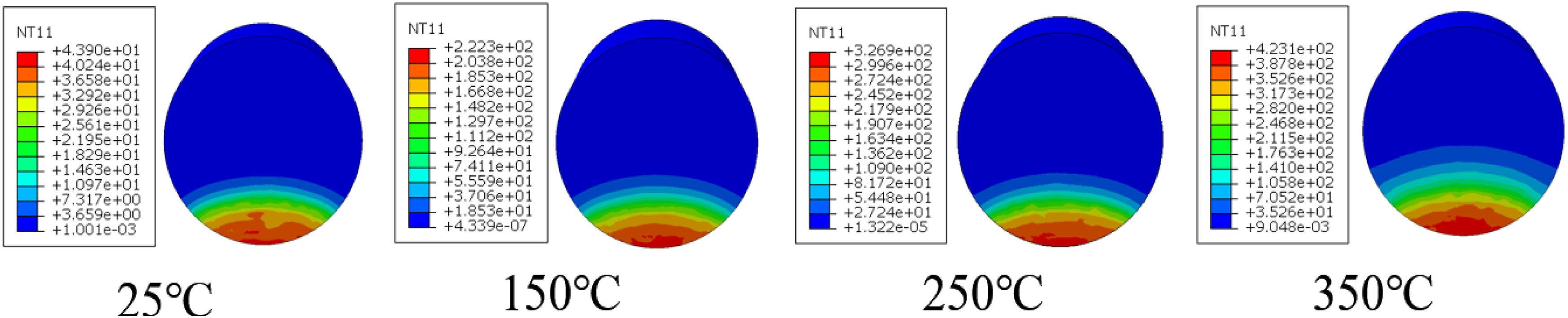
To effectively analyze cutting edge stresses during tooth-rock contact, the Cpress stress values at element nodes within the -90° to 90° range of the cutting edge were extracted. The lowest point corresponds to an azimuth angle of 0°, as shown in Figure 13. The figure reveals the contact stress distribution zone on the PDC cutting tooth surface—the area where cutting contact occurs with the rock. As ambient temperature increases, this contact stress zone gradually expands, and the stress distribution becomes more uniform. Stress contour maps of cutter surfaces at different temperatures.
Figure 14 shows the variation curve of contact stress on the tooth surface during PDC tooth cutting of rock at different ambient temperatures. The figure reveals a clear upward trend in contact stress from room temperature to 250°C. Beyond 250°C, contact stress decreases significantly, with the largest fluctuation amplitude occurring at 250°C.This pattern directly correlates with the temperature-dependent mechanical properties of rock: when rock temperature reaches 250°C, its compressive strength and other mechanical properties peak, causing synchronous increases in contact stress on the cutting teeth. At this point, the drill bit experiences more uneven loading, increased drilling resistance, and significantly heightened risk of cutting tooth wear. However, when temperatures exceed 250°C, the mechanical properties of the rock, such as compressive strength, gradually decrease with rising temperature. The rock becomes more brittle and easier to cut, leading to a continuous decrease in the contact stress on the cutting tooth surfaces. Variation of tooth surface contact stress at different temperatures.
Figure 15 shows the tooth surface temperature variation during rock cutting at different rake angles for limestone at 250°C.The data indicates that the maximum tooth surface temperatures at rake angles of 5°, 10°, 15°, 20°, 25°, and 30° are 323.2°C, 331.9°C, 341.9°C, 353.9°C, 378.2°C, and 385.4°C respectively. While the rake angle has a relatively minor effect on the maximum temperature, the temperature gradient range decreases as the rake angle increases. This occurs because as the rake approaches 0°, the tooth surface becomes more parallel to the rock, resulting in a larger area for heat transfer between the tooth and the rock. Temperature field on the tooth surface at different rake angles.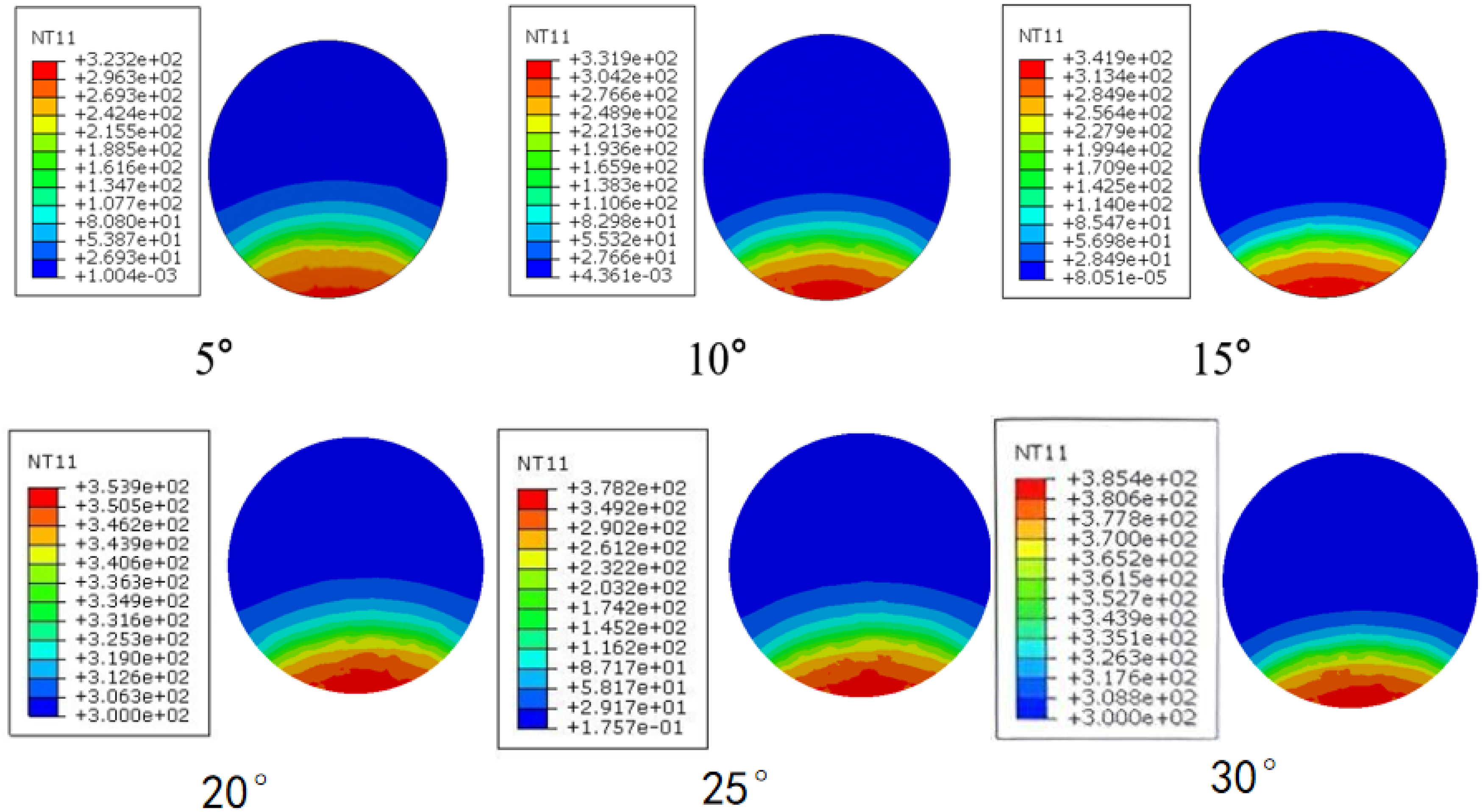
Figure 16 shows the variation in tooth surface contact stress when cutting teeth scrape rock in 250°C limestone under different forward rake angles. As the forward rake angle increases, both the cutting edge stress and stress fluctuations of PDC teeth rise. This is because a larger rake angle expands the contact area in the tooth edge’s extreme angle region, intensifying stress fluctuations and tooth-rock squeezing effects. This can lead to non-uniform wear of the cutting teeth, adversely affecting their service life. Variation of tooth surface contact stress at different rake angles.
Figure 17 shows the temperature variation on the cutting edge surface when cutting rock at different penetration depths in 250°C limestone. The figure shows that at 250°C, the maximum tooth surface temperatures for penetration depths of 0.5mm, 1mm, 1.5mm, 2mm, 2.5mm, and 3mm are 276°C, 282°C, 329°C, 345°C, 362.3°C, and 385.4°C respectively. Both the temperature and the temperature gradient range near the tooth edge increase with cutting depth. This occurs because greater cutting depth expands the contact area between the tooth and rock, intensifying friction-induced heat generation and thermal conduction. Ultimately, deeper penetration depths make cutting teeth more susceptible to thermal wear failure. Temperature distribution on the tooth surface at different penetration depths.
Figure 18 shows the variation in tooth surface contact stress during rock cutting by cutting teeth at different penetration depths in 250°C limestone. The figure indicates that increased penetration depth elevates PDC tooth contact stress and intensifies stress curve fluctuations. The enlarged contact area increases friction and cutting forces, leading to more uneven loading on the cutting teeth. Therefore, greater penetration depth results in more fluctuating stress curves and increased susceptibility to tooth wear. Variation of tooth surface contact stress at different penetration depths.
Full-drilling test under high-temperature conditions
Unlike single-tooth cutting, actual drilling involves a composite process of cutting -extrusion-shearing-fracturing rather than pure cutting. To comprehensively study PDC bit performance in fracturing limestone, full-drilling tests were conducted.
Test principle
A newly designed Φ118mm drill bit was used for the full-drilling test. The experiment was conducted on the “YD100” drilling simulator at Southwest Petroleum University, with the principle illustrated in Figure 19. The parameters of the new drill bit and the conventional drill bit are compared in Table 3. Principle of full-drilling test. Parameter comparison of two drill bits.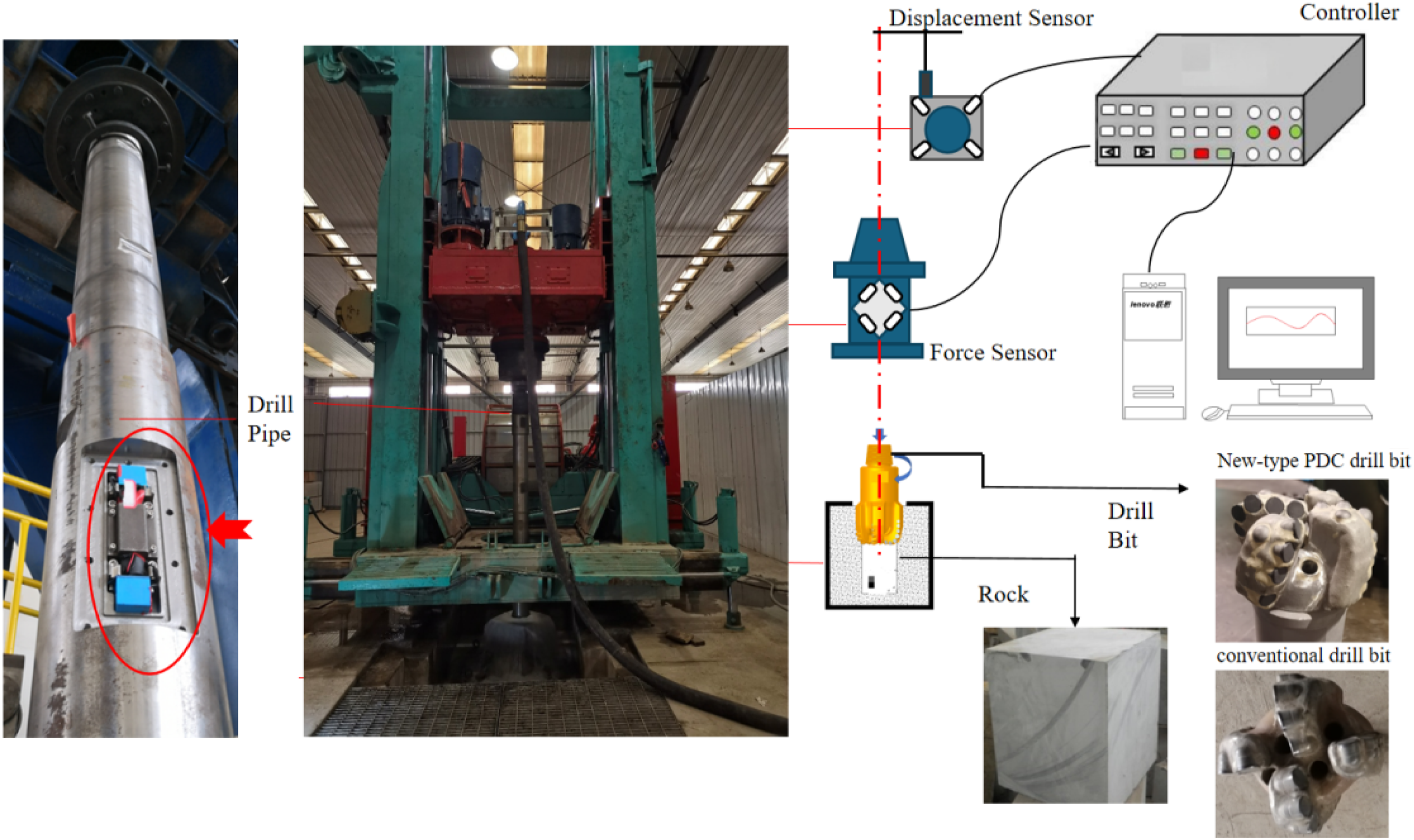

The experimental rock sample consisted of limestone, measuring 350mm in length and width, and 200mm in height. The drill bit was heated prior to drilling (Figure 20). Heating process of PDC drill bit.
Test results
Laboratory testing yielded the results shown in Figure 21. Observation of Figure 21(b) reveals no significant wear on the drill bit after completing the drilling. From Figure 21(c) and (d), it is found that the bottom-hole morphology formed by the new-type drill bit is favorable, and its contour is clearer than that formed by the conventional drill bit. This indicates that the cutting effect of the new drill bit on the rock remains basically stable during each rotation cycle, and the cutting trajectory presents regular repetition. This characteristic enables the drill bit to bear relatively uniform loads during the drilling process, so its stability is better than that of the conventional drill bit. Experimental results diagram. (a) Bit pullout temperature plot, (b) bit after pullout, (c)bottom hole with new-type drill bit, (d)bottom hole with conventional drill bit.
Comparing the drill bit with a conventional drill bit, the results are shown in Figure 22. Under identical conditions of 400°C and 15kN drilling pressure during the experiment, the torque and mechanical drilling speed of both drill bits were compared. Observations revealed that the torque of the conventional drill bit was 998.83 N·m, while the torque of the new PDC drill bit reached 1062.58N·m, 5.8% higher than the conventional drill bit. The increased torque indicates that the new PDC drill bit exerts greater cutting force on rock during drilling, resulting in superior rock-cutting capability. Furthermore, the ample torque effectively suppresses load fluctuations during drilling, helping maintain stable drilling conditions. Experimental data also indicates that the mechanical drilling rate of the conventional bit is 5.11m/h, while the new PDC bit achieves 6.74m/h—a 31.9% improvement over the conventional bit. This result fully demonstrates that the new PDC bit possesses higher rock-cutting efficiency and better adapts to the complex working environment of geothermal wells. Therefore, for the design of high-temperature geothermal drill bits, the optimal cutting angle of the cutters is 15°, the cutting depth should not be excessively large, with 2 mm being optimal, and the adoption of spiral blades is more appropriate. Experimental results diagram. (a) Torque comparison chart, (b) mechanical drilling rate comparison chart.
Conclusions
This study investigates the limestone rock-cutting characteristics of PDC cutters in high-temperature environments through experiments and simulations. Single- -tooth cutting tests were conducted to record the mechanical relationship during limestone cutting with individual PDC cutters. Additionally, digital simulations of single-tooth cutting were performed to analyze the variation patterns of cutting tooth stress fields and temperature fields under different parameter conditions. Subsequently, full-drilling experiments were conducted using the designed PDC bit and compared with conventional bits. The aim is to provide a theoretical basis for geothermal well bit design. 1. Research on rock mechanical properties under high temperatures was conducted. Results indicate that under elevated temperatures, the compressive strength, shear strength, and internal friction angle of limestone first increase and then decrease, with maximum values occurring around 250°C. 2. Single-tooth cutting rock-breaking experiments were conducted under varying temperature conditions. Results indicate that elevated temperatures alter limestone’s internal structure, enhancing fracturability. Compared to ambient conditions, tangential force decreases by approximately 38.5%-39.6% at 250°C-350°C. At 350°C, limestone cutting efficiency peaks with maximum tooth penetration capability. Simultaneously, high-speed cameras and thermal imaging instruments were employed to observe cuttings generation and temperature variations. 3. Single-tooth rock-cutting experiments were conducted under varying parameters. Results indicated that a 15° rake angle produced the lowest tangential force, the lowest specific rock-cutting power, and the highest rock-cutting efficiency. Conversely, increasing cutting depth led to higher tangential forces, lower specific rock-cutting power, greater rock chip generation, and larger cutting sizes. 4. Digital simulations of single-tooth cutting rock breaking under varying parameters were conducted. Results indicated that as the cutting tooth’s ambient temperature increased, the contact stress zone gradually expanded and stress distribution became more uniform. Both the cutting tooth surface temperature and contact stress increased with penetration depth but decreased with increasing rake angle. 5. A new Φ118mm drill bit was designed and subjected to full-drilling rock-breaking tests. Both the drill bit and rock were heated during testing. Results showed no significant wear on the drill bit after completion, with excellent wellbore bottom morphology. Compared to conventional PDC drill bits, torque was increased by 5.8% and mechanical drilling speed increased by 31.9%.
Footnotes

Ethical considerations
This article does not contain any studies with human participants performed by any of the authors.
Author contributions
TL was involved funding acquisition, experimental data collection, original draft preparation, and writing review & editing. XR was involved simulation data collection. SR was involveddata curation and original draft preparation. CZ and HRwas involved writing review & editing, validation, data curation, and supervision.
Funding
The authors disclosed receipt of the following financial support for the research, authorship, and/or publication of this article: This work was supported by the National Science and Technology Major Project of the Ministry of Science and Technology of China[2025ZD1406805], Key Technologies for Efficient Construction of New Underground Gas Storage Facilities, and China National Petroleum Corporation Research Project[2023DJ8308],Research on Wellbore Treatment and Rapid Construction Methods for Oil/Gas Reservoirs and Thin Salt Layer Storage Caverns.
Declaration of conflicting interests
The authors declared no potential conflicts of interest with respect to the research, authorship, and/or publication of this article.