



Abstract
Introduction
Rectal prolapse is the complete protrusion of the rectum through the anal canal, incarceration rarely complicates rectal prolapse. Even more rarely, it becomes strangulated and gangrenous, necessitating emergency surgery.
Case presentation
We present the first reported case of strangulated acute rectal prolapse as the first manifestation of rectal prolapse. The patient was a 26-year-old man who presented with a 20×6 cm semi-spherical mass extra-anally. Rectosigmoidectomy with sacral rectopexy was performed, resecting 20 cm of the incarcerated rectum and sigmoid colon. The postoperative course was uneventful with a good final result after colostomy closure and continuity restoration.
Conclusion
The successful treatment of this patient illustrates the value of surgery in this difficult and unusual case scenario of rectal incarceration.
Introduction
Rectal prolapse is the complete protrusion of the rectum through the anal canal. 1 It is most common in elderly people, but can rarely affect individuals at any age. It was described in the Ebers Papyrus as early as 1500 BC. 2 There are many contributing factors including constipation, pregnancies, diastasis of the levators, redundant sigmoid colon, deep cul-de-sac, abnormal rectal angle and lack of retroperitonealisation of the rectum. 3
Incarceration rarely complicates rectal prolapse. Even more rarely, it becomes strangulated and gangrenous, requiring emergency surgery.
To the best of our knowledge, our case is the first to describe a strangulated acute rectal prolapse as the first manifestations of this pathology in a patient without previous history or symptoms of rectal prolapse.
Case report
A 26-year-old man was admitted to the emergency department with a painful extra-anally protruding mass evolving for 24 h. He reported a sudden protrusion of a mass from the anus during defaecation, accompanied by significant anal pain. The patient had no medical history, in particular no previous history or symptoms of rectal prolapse or constipation.
Physical examination showed abdominal distention, with no signs of peritonitis. At the anus, there was a prolapse – strangulated, oedematous, dark red – measuring 20 cm long by 6 cm wide (Figure 1).
Rectal prolapse strangled at the admission to the emergency department.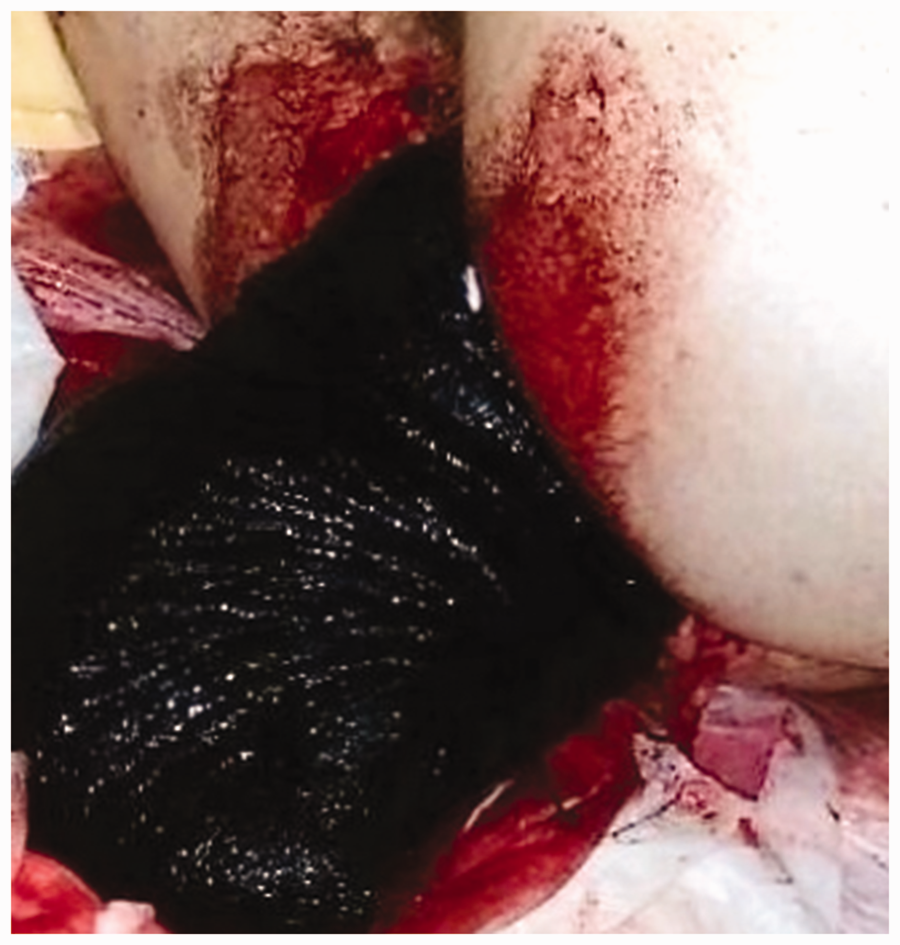
The laboratory data only showed a slightly elevated white blood cell count (11,800/μl) and C-reactive protein level (2.4 mg/dl).
Following the failure of external manual reduction and the appearance of established necrosis, we decided to perform an emergency laparotomy. The incarcerated sigmoid and rectal wall was reduced back into the normal position by both transanal and intra-abdominal manoeuvring. Since the anterior wall of the sigmoid, upper and mid-rectum was necrotic (Figure 2), rectosigmoidectomy was done by resecting 20 cm of the necrotic rectosigmoid colon with a sacral rectopexy.
Intraoperative picture showing a necrotic area of the sigmoid colon.
The postoperative recovery was uneventful with bowel function recovery on the second day postoperatively and the patient’s returning home on the sixth day. Histopathological examination revealed transmural necrosis in resected sigmoid and rectum.
Six months later, the patient was readmitted for colostomy closure. Anal manometry, colonoscopy and barium enema were normal. The colostomy was closed without any complications. Two years later, the patient remains well.
Discussion
Incarceration rarely complicates rectal prolapse. Even more rarely, it becomes strangulated and gangrenous. 4 This rare complication usually occurs in patients with recurrent prolapse. 5
To our knowledge, this is the first case of incarcerated acute rectal prolapse without a relevant previous history or predisposing pathology.
Important signs of strangulation include irreducibility, pain, oedema, swollen mucosa and purplish red appearance. When this initial stage passes, the mucosa becomes cyanotic. 5
The exact mechanism of incarceration of this first episode of rectal prolapse is unclear. No neoplastic mass could be identified as precipitating cause. In patients with chronic prolapse, the anal sphincter and pararectal tissues become lax. It is thought that the lack of such pelvic floor failure contributed to the strangulation in this case.
There is still no clear consensus on which technique to use in the management of strangulated rectal prolapse. 6
Several external manoeuvres have been described to attempt reduction of a strangled prolapse: ordinary table sugar for its drying effect on tissue oedema, 7 the injection of hyaluronidase, 8 wet bathing and elastic compression wrap. 9 Unfortunately, these actions are effective only if they are used early before significant swelling and oedema are established. These external manoeuvres must be done with delicacy, under general anaesthesia, to avoid rupture of the prolapse. 9 Where prolapse is irreducible and accompanied by ischaemic signs, surgical treatment is required. In this case, the technique of choice remains the rectosigmoidectomy with rectopexy which has successful results. 10
Several other surgical techniques have been reported for the purpose of repairing the anatomical anomaly, restoring good function and normal anorectal physiology. The surgical techniques used are resection, fixation techniques or a combination of both. The approach can be transabdominal – either open or laparoscopic – or transanal.11,12 Abdominal rectopexy techniques such as those of Ripstein (anterior rectal sling), Wells (posterior rectal) or Loygue Orr (latero-rectal) are frequently performed. Randriamananjara and Rabarioelina call first for a colostomy to allow resorption of oedema, before proceeding to a rectopexy. 6 By perineal approach, the interventions of Delorme (mucosectomy and rectal muscle plication) and that of Altemeier (rectosigmoidectomy with or without colostomy) are most frequent.
The transabdominal and transperianal surgeries both result in the resolution of symptoms and an improvement of quality of life for most patients. 13 Rectopexy with or without resection confers balances a low risk of recurrence with a similar complication rate to transperineal surgery. 14
Conclusion
To our knowledge, this is the first reported case of incarcerated acute rectal prolapse, without a previous history or symptoms of predisposing pathology. The exact mechanism of incarceration was unclear; however, surgical management with resection and rectopexy techniques still seemed the most appropriate.
Footnotes
Authors’ contributions
All authors contributed to all sections. All authors revised the article critically for intellectual content and approved the manuscript for publication.
Declaration of Conflicting Interests
The author(s) declared no potential conflicts of interest with respect to the research, authorship, and/or publication of this article.
Funding
The author(s) received no financial support for the research, authorship, and/or publication of this article.