



Abstract
Objective
To provide synthesized evidence on the association between sarcopenia and risk of mortality, recurrence and postoperative complications in patients with bladder cancer and undergoing radical cystectomy (RC).
Methods
Only studies with observational design that investigated the association between sarcopenia and outcomes of interest among patients with bladder cancer undergoing RC were included. The outcomes of interest were mortality, recurrence, and postoperative complications. The systematic search was conducted using three large databases, that is, PubMed, EMBASE, and Scopus. A random effects model was used for the analysis and pooled effect sizes were reported as odds ratio (OR) or hazards ratio (HR) along with 95% confidence intervals (CIs).
Results
A total of 21 studies with 4997 patients were included. Compared to non-sarcopenic subjects, those with sarcopenia had increased risk of all-cause mortality (HR 1.45, 95% CI: 1.32, 1.61), cancer-specific mortality (HR 1.74, 95% CI: 1.49, 2.03) and a lower recurrence free survival (HR 1.84, 95% CI: 1.30, 2.62). Patients with sarcopenia also had higher risk of developing complications within 90 days postoperatively (OR 1.77, 95% CI: 1.23, 2.55).
Conclusion
Sarcopenia among patients with bladder cancer and managed using RC is associated with adverse survival outcomes and an increased risk of postoperative complications.
Keywords
Introduction
Urinary bladder cancer lists among the top 10 most common cancers in the world. 1 Globally, it contributes to around 3% of all new cancers being diagnosed and as per the contemporary data from GLOBOCAN, nearly 500,000 individuals were diagnosed with bladder cancer in the year 2018.1,2 Worldwide, the incidence is higher in males (9.6 per 100,000), compared to females (2.4 per 100,000). 1 Surgery remains the mainstay of treatment and in cases of localized disease, radical cystectomy (RC) along with pelvic lymphadenectomy and urinary diversion is the preferred approach. 3 A number of factors have been shown to affect the prognosis such as the histological type (squamous cell carcinoma have poorer prognosis compared to urothelial cell carcinoma), stage (higher stages with poor prognosis), age of diagnosis (poor prognosis with increasing age), ethnicity, and lymphovascular invasion.4–6.
An important factor that has been shown to influence prognosis in other types of cancers is the presence of sarcopenia. A systematic review by Philip et al. 7 included 100 studies that documented the association of sarcopenia with “any” cancer. Their pooled analysis showed that sarcopenia was associated with nearly two times increased risk (hazards ratio (HR) 1.69) of mortality related to cancer. 7 The cancers studied were mostly gastrointestinal, followed by liver and intrahepatic bile duct, urinary tract, pancreatic, and ovarian/endometrium. One of the most dynamic and highly plastic components of human body is the skeletal muscle that constitutes nearly 40% of the body weight. 8 Further, by virtue of being an enormous reservoir of protein, it contributes to around 50%–60% of the overall human bodily protein content. 8 Conditions that tend to negatively impact muscle homeostasis may result in muscle wasting and deterioration in functional capacity, culminating in cancer cachexia. 9 Sarcopenia is defined as a progressive and generalized loss of skeletal muscle mass, muscle strength, and overall physical performance. 10 It is mostly measured at the level of psoas muscles in the lumbar region and forms a part of the diagnostic criteria to identify and define cancer cachexia. 11 It has shown to be associated with poor tolerance to surgical intervention, chemotherapeutic drugs, increased risk of postoperative complications, and a reduced survival in cancers.12–15
We conducted this meta-analysis to provide evidence on the association of sarcopenia, among patients with bladder cancer undergoing radical cystectomy, with the risk of mortality and complications. Our study aims to build upon the previous meta-analysis on this issue by Ibilibor et al., 16 with the intent to update the existing evidence for informing clinical practice.
Methods
Search strategy and use of databases
To ensure transparency and rigor in the review process, the study protocol was registered with PROSPERO (registration number CRD42023414875) and the PRISMA guidelines were followed. 17 The search strategy involved using three commonly used databases, namely PubMed, EMBASE, and Scopus, to identify relevant studies for inclusion in the review. The search strategy included the following terms: (sarcopenia OR psoas muscle area OR psoas muscle loss OR lean psoas muscle OR psoas muscle attenuation) AND (bladder cancer OR urinary bladder carcinoma OR urothelial cancer OR bladder carcinoma) AND (survival OR mortality OR complications OR clinical outcome OR prognosis OR recurrence free survival OR cancer specific survival). We preferred to include studies published in English language. All studies published until 31 March 2023 were eligible for consideration.
Inclusion and exclusion criteria
Studies documenting the association of sarcopenia with risk of mortality or complications in patients with bladder cancer undergoing radical cystectomy were eligible to be included. Included studies should have had computed tomography (CT)-based assessment of sarcopenia. Further, CT images utilized in the study should have been taken pre-operatively within 90 days of surgery. The mortality- and recurrence-related outcomes reported in the eligible study should have been assessed after a minimum of 12 months of follow up, except for postoperative complications where the reporting should have been within 90 days postsurgery. We intentionally adopted this criterion as we were interested in long-term survival and recurrence outcomes. We preferred to include studies with an observational design such as cohort (prospective and retrospective), case-control or cross-sectional. There were no planned exclusions based on the criteria for reporting sarcopenia. We excluded studies in which the management of bladder cancer was done without radical cystectomy, for example, studies with only radiotherapy or chemotherapy, those with tri- or tetra-modal therapy or those that used immune checkpoint inhibitors. Also, studies were excluded in which, upon assessment by the study authors, it was found that the sarcopenia was a result of the cancer management process (e.g. due to neoadjuvant chemotherapy).
Selection of eligible studies
The search strategy was executed in the three databases and the total number of studies was identified. This was followed by removing the duplicates and screening the title and abstract of the remaining unique studies. After exclusions were made on screening of the title and abstract, the full text of the remaining studies was retrieved and reviewed independently. The title and abstract screening as well as the review of the full texts was done by two authors independently. Studies were excluded upon review of full text and finally, the included studies were read again to extract relevant data for analysis. All disagreements were resolved through mutual discussions between two authors.
Data extraction and statistical analysis
Data extraction was done using a pretested sheet. All analysis was conducted using STATA 16 software (TX, USA). The pooled effect sizes were reported either as odds ratio (OR) or HR along with 95% confidence intervals (CIs). We planned to use random effects model for the analysis. This was because the authors noted that the included studies differed in their characteristics such as the mean age of the subjects, distribution of male and female subjects, sample size, study setting, and assessment method for sarcopenia. These differences could potentially contribute to substantial heterogeneity in the reported findings. We used Egger's test as well as visually inspected for funnel plot symmetry in order to report on publication bias. 18 The Newcastle-Ottawa Scale was used for assessment of the risk of bias. 19 A p-value of <0.05 was used to denote statistical significance.
Results
Using the search strategy, we initially retrieved 465 studies, of which 119 duplicates were removed, leaving 346 unique studies. Based on title and abstract screening, we excluded 311 more studies. Subsequently, we performed a full-text review of the remaining 35 studies, resulting in the exclusion of 14 more studies. Ultimately, our meta-analysis comprised 21 studies, as depicted in Figure 1.20–40 Specific details of the included studies are presented in Table 1. The majority of studies (n = 19) had a retrospective design, while two studies had a prospective design. Five studies each were conducted in Japan and the USA, respectively, four studies in China, and two studies in Germany. One study each was conducted in Sweden, France, Republic of Korea, and Egypt. Additionally, one study was multicentric and conducted across various health centers in Europe. The mean age range of the participants in the included studies ranged from 60 to 75 years. In all the studies, more than 70% of the participants were males. The median period of follow up in the studies ranges from around 14 to 76 months. A total of 14 studies had majority (>70%) of the participants with local tumor stage (T2–T4). In four studies, a higher proportion of participants had stage T0 to T ≤ 2. Majority of the studies (n = 16) had participants (>70%) with N0 nodal status. The studies included in this review contributed to a total of 4997 participants. There were four studies that did not provide group specific sample sizes, that is, participants in sarcopenia and non-sarcopenia group. In the remaining studies, there were a total of 1653 participants with sarcopenia and 2381 participants without sarcopenia. The studies used different cut-offs for defining sarcopenia, which is detailed in Table 1. The quality assessment of the included studies is presented in Table 1. Some studies did not report on certain important aspects, in accordance with the Newcastle-Ottawa Scale, such as control for baseline differences in the study groups (n = 4), documentation of other treatment modalities (n = 4), presenting sufficient details regarding follow-up time (n = 3), and explanation for loss-to-follow up (n = 6).The scores assigned to studies were between 6 and 9 (of the maximum attainable score of 9). The mean score was 7.7 suggesting that, overall, the included studies were of good quality.

Selection process of studies included in the review.
Characteristics of the studies included in the meta-analysis.

AI: artificial intelligence; BMI: body mass index; CT: computed tomography; PMA: psoas muscle area; PMHU: psoas muscle Hounsfield units; PMI: psoas muscle index; SMI: skeletal muscle index; TPA: total psoas index; TPI: total psoas index.
Association of sarcopenia with mortality
Individuals with sarcopenia were at a higher risk of all-cause mortality in long-term follow up (HR 1.45, 95% CI: 1.32, 1.61, N = 16, I2 = 0.0%) compared to non-sarcopenic subjects (Figure 2). Analysis further indicates that individuals with sarcopenia had a higher risk of cancer-specific mortality (HR 1.74, 95% CI: 1.49, 2.03, N = 7, I2 = 0.0%), and a lower recurrence-free survival (HR 1.84, 95% CI: 1.30, 2.62, N = 3, I2 = 0.0%) compared to those without sarcopenia (Figures 3 and 4). There was no indication of publication bias in the analysis of all-cause mortality (Supplemental Figure 1). However, for cancer-specific mortality, evidence of publication bias was observed on Egger's test (p < 0.05) and funnel plot (Supplemental Figure 2). The p-value (>0.05) suggests no publication bias for recurrence-free survival, but Supplemental Figure 3 indicates possible bias due to one small study underestimating the effect size.

Association of sarcopenia with all-cause mortality in subjects with urinary bladder cancer undergoing radical cystectomy.
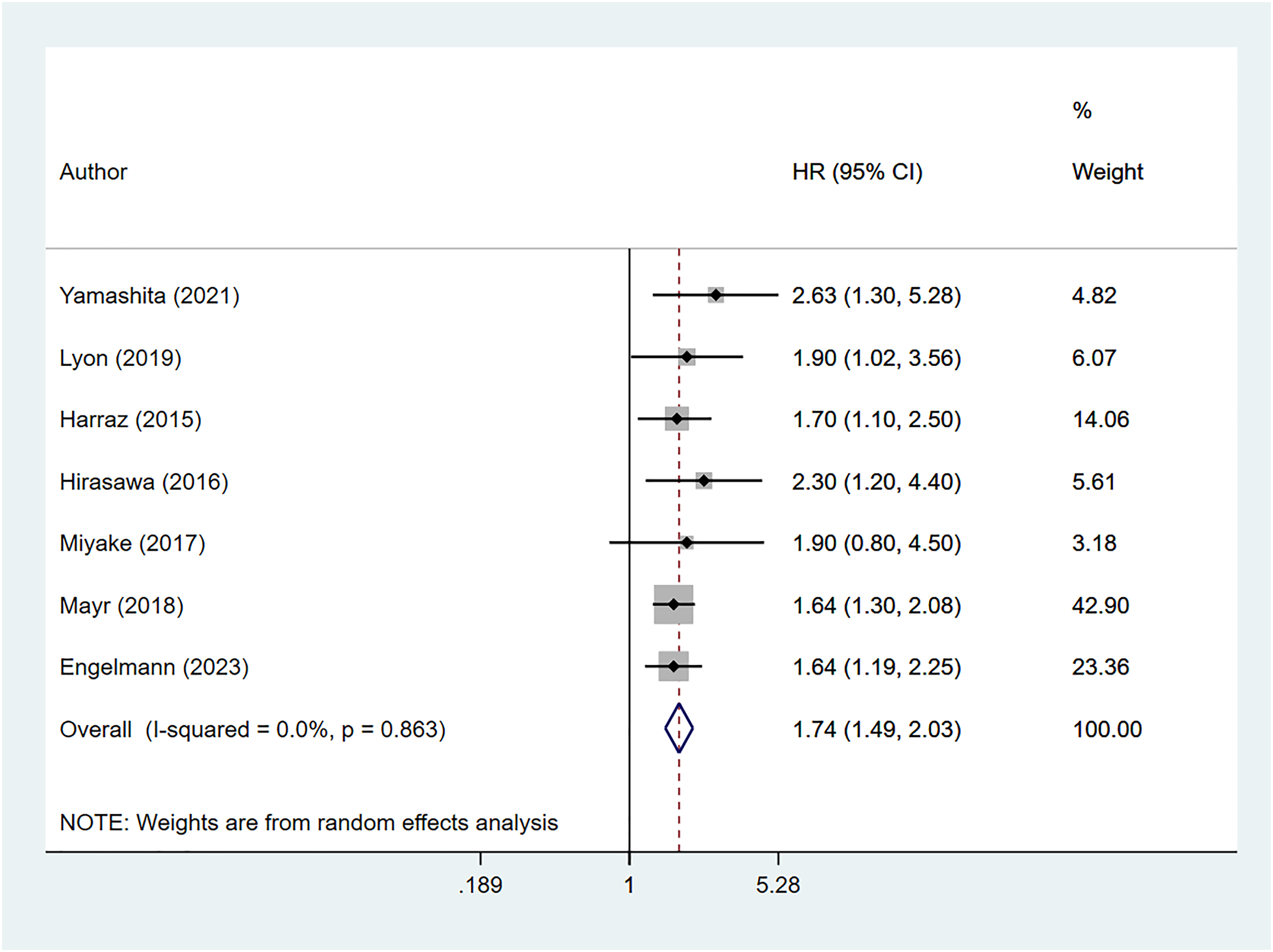
Association of sarcopenia with cancer-specific mortality in subjects with urinary bladder cancer undergoing radical cystectomy.

Association of sarcopenia with recurrence free survival in subjects with urinary bladder cancer undergoing radical cystectomy.
Association of sarcopenia with risk of postoperatively complications
Individuals with sarcopenia who underwent radical cystectomy had a significantly higher risk of experiencing complications within 90 days postoperatively compared to those without sarcopenia (OR 1.77, 95% CI: 1.23, 2.55, N = 9, I2 = 62.7%; Figure 5). There was no evidence of publication bias (Supplemental Figure 4). The most commonly reported complications in the included studies were wound dehiscence, sepsis, venous and pulmonary thromboembolism, lymphocele, urinary leak, arrhythmia, and gastrointestinal bleed.

Association of sarcopenia with risk of complications following radical cystectomy.
Discussion
This meta-analysis found that presence of sarcopenia increased the risk of all-cause mortality, cancer-specific mortality, and postoperative complications. Further, those with sarcopenia had a lower recurrence free survival. The findings are similar to previous meta-analysis and systematic reviews that attempted to understand the association of sarcopenia, in subjects with bladder cancer undergoing RC, with clinical and prognostic outcomes. For instance, the review by Ibilibor et al. 16 included 5 studies with around 1400 subjects and found that cancer-specific (HR 1.64) as well as all-cause mortality (HR 1.41) increased in those with sarcopenia, compared to non-sarcopenic individuals. Another narrative review by Ahmadi et al. 41 included five studies and reported that psoas muscle mass has been shown by studies to predict adverse outcomes following RC, including complication rate and mortality. Similar findings were reported by the narrative review by Bellos et al. 42 Hu et al. 43 conducted a meta-analysis to understand the prognostic value of sarcopenia in surgically treated patients with urothelial cancers. Five out of the total of 12 included studies had patients with upper tract urothelial carcinoma. The remaining seven studies had patients with urothelial bladder cancer. The analysis suggested that sarcopenia is associated with reduced overall survival and cancer-specific survival. 43
It is useful to understand that frailty and sarcopenia are related conditions, with sarcopenia contributing to physical frailty in many cases. However, frailty is a broader concept encompassing various physical and functional deficits beyond just muscle loss. While our study primarily focuses on sarcopenia, it also advocates for the incorporation of frailty assessments in individuals undergoing significant urological surgical procedures. A recent study by Kostakopoulos et al. 44 underscores the significance of frailty as a critical patient characteristic impacting the surgical outcomes of urologic oncology operations. The authors proposed that assessing frailty can serve as a valuable tool for guiding treating surgeons in modifying and enhancing specific factors contributing to patients’ frailty. This, in turn, can enable these patients to safely undergo invasive treatments with curative intent. Additionally, another study conducted by Suskind et al., 45 utilizing data from the American College of Surgeons National Surgical Quality Improvement Program (ACS-NSQIP), establishes a strong correlation between frailty and the risk of postoperative complications in individuals undergoing urologic surgery. Importantly, this association was found to hold true across all age groups and the majority of urologic procedures.
It is important to consider that the observed findings should not be considered causal. Majority of the studies included had high grade tumor and in moderately advanced stage. This largely implies that many of the subjects included in these studies would have been or in the process of being cachexic. This would have reflected as sarcopenia. So, while we observed an association between sarcopenia and poor survival outcomes, the increased risk of mortality would most likely be due to advanced tumor grade and/or stage. Prior efforts have been made to evaluate alternative nutritional indices as potential predictors of prognostic outcomes in urological cancers.46–49 Among these indices is the Controlling Nutritional Status (CONUT) score. 50 A systematic review and meta-analysis of 13 studies found that a higher CONUT score was linked to worse overall, cancer-specific, and recurrence-free survival in urothelial cancers and renal cell carcinoma. 51 The prognostic nutritional index (PNI) is another commonly used index. 52 A recent meta-analysis of 12 studies showed that lower PNI levels were associated with reduced overall survival, as well as cancer-specific and recurrence-free survival in patients with bladder cancer and renal cell cancer. 47 Despite the convincing evidence supporting the use of these nutritional indices for predicting outcomes in urological cancers, there is a significant limitation to their use. Unlike skeletal mass and quality (represented by sarcopenia), these indices are not as stable and can be influenced by non-nutritional factors such as the presence of an inflammatory state and body fluid volume.53,54
Based on the findings of this review, it appears that additional studies are needed to assess the potential advantages of nutritional interventions on survival and other essential clinical outcomes in patients with bladder cancer. Nonetheless, it is important to acknowledge the limitations of this review. The majority of the studies included had a retrospective design, which increases the likelihood that some significant confounding variables were not sufficiently controlled for in the analysis. Secondly, through our analysis, we could not comment on the causality, that is, we cannot ascertain whether sarcopenia leads to poor survival or that sarcopenia could be due to advanced tumor induced cachexia caused by advanced tumor stage which may have led to increased risk of mortality. Thirdly, there were methodological differences among the studies. The included studies used different cut-offs for defining sarcopenia and the duration of follow up was also variable among the studies. It is important to comprehend the findings of the meta-analysis with these differences in consideration. Most studies were done in the United States, Japan, and China and therefore, the findings of our analysis may not be applicable to a large geographic setting, including low to low-middle-income settings. We have reported the risk of overall complications with sarcopenia. However, the association with specific complications could not be done due to the absence of data pertaining to specific complications in the included studies. We acknowledge that this may be an important limitation of our study.
Conclusion
The findings suggest that presence of sarcopenia in patients undergoing RC for bladder cancer is associated with poor outcomes pertaining to survival and risk of complications. However, the findings have limited generalizability to low-middle-income settings and lack of harmonized cut-offs for labeling sarcopenia lower the validity of the findings. Nonetheless, improvement in the nutritional status and rehabilitative care of such patients should be prioritized as part of the cancer management plan.
Supplemental Material
sj-tif-1-scm-10.1177_00369330241234690 - Supplemental material for Impact of sarcopenia on outcomes of bladder cancer undergoing radical cystectomy: A systematic review and meta-analysis
Supplemental material, sj-tif-1-scm-10.1177_00369330241234690 for Impact of sarcopenia on outcomes of bladder cancer undergoing radical cystectomy: A systematic review and meta-analysis by Fanyi Qin and Jiacheng Wu in Scottish Medical Journal
Supplemental Material
sj-tif-2-scm-10.1177_00369330241234690 - Supplemental material for Impact of sarcopenia on outcomes of bladder cancer undergoing radical cystectomy: A systematic review and meta-analysis
Supplemental material, sj-tif-2-scm-10.1177_00369330241234690 for Impact of sarcopenia on outcomes of bladder cancer undergoing radical cystectomy: A systematic review and meta-analysis by Fanyi Qin and Jiacheng Wu in Scottish Medical Journal
Supplemental Material
sj-tif-3-scm-10.1177_00369330241234690 - Supplemental material for Impact of sarcopenia on outcomes of bladder cancer undergoing radical cystectomy: A systematic review and meta-analysis
Supplemental material, sj-tif-3-scm-10.1177_00369330241234690 for Impact of sarcopenia on outcomes of bladder cancer undergoing radical cystectomy: A systematic review and meta-analysis by Fanyi Qin and Jiacheng Wu in Scottish Medical Journal
Supplemental Material
sj-tif-4-scm-10.1177_00369330241234690 - Supplemental material for Impact of sarcopenia on outcomes of bladder cancer undergoing radical cystectomy: A systematic review and meta-analysis
Supplemental material, sj-tif-4-scm-10.1177_00369330241234690 for Impact of sarcopenia on outcomes of bladder cancer undergoing radical cystectomy: A systematic review and meta-analysis by Fanyi Qin and Jiacheng Wu in Scottish Medical Journal
Footnotes
Declaration of conflicting interests
The authors declared no potential conflicts of interest with respect to the research, authorship, and/or publication of this article.
Funding
The authors disclosed receipt of the following financial support for the research, authorship, and/or publication of this article: Nantong Science and Technology Bureau (JCZ2022076).

Supplemental material
Supplemental material for this article is available online.
References
Supplementary Material
Please find the following supplemental material available below.
For Open Access articles published under a Creative Commons License, all supplemental material carries the same license as the article it is associated with.
For non-Open Access articles published, all supplemental material carries a non-exclusive license, and permission requests for re-use of supplemental material or any part of supplemental material shall be sent directly to the copyright owner as specified in the copyright notice associated with the article.
