




Abstract
WitchTok describes a subsection of the social media platform TikTok dedicated to users and content related to Witchcraft. Though a range of topics and discourses circulate within WitchTok, this article focuses on a particular phenomenon: posts related to hexes and curses. Through critical thematic analysis of videos, captions, and comments, this article explores the content of spells, their intended purposes, and other ideas regarding magic which circulate. I argue that WitchTok reveals the ethics of magic which users collaboratively construct. The presence and promotion of hexes among modern Pagans and other magical practitioners provides a deeper understanding into the ways in which magic is understood, as well as the instances when harming others (or defending oneself) is considered acceptable. More broadly, discourses around hexes on WitchTok offer a case study to understand how religious and ethical norms are constructed on digital platforms.
WitchTok describes a sub-culture within the social media platform TikTok that is populated by Pagans, Witches, and other magical practitioners. This space is doubly shaped, by the larger Witchcraft community (which possesses unique beliefs and practices) as well as the social trends and algorithmic forces that make up TikTok. As such, WitchTok affords insights into both the beliefs and rituals of a religious community, and also media’s impact on the transmission of content and information. Focusing on a particular form of practice within Witchcraft – hexes – this article seeks to explore how magic is understood and how this knowledge circulates online. Across videos, users establish the properties of ingredients and how spells can help fulfil various purposes. This online discourse reveals outlooks on how magic operates. Further, observing the ends to which hexes are directed offers insights into when harming others is considered acceptable or justified. Finally, this study reflects on how religious ideas circulate on social media.
Background
What is TikTok?
Created in 2016 and now boasting over 1.5 billion users (Statista, 2024), TikTok is a video-based social media platform. 1 One way that TikTok differs from other video-based platforms like YouTube are its built-in editing features, including filters, music, greenscreen backgrounds, and captions. TikTok’s most unique feature is perhaps the For You Page (FYP), which one sees immediately upon opening the app. 2
The algorithmic logics of social media powerfully shape user experience (Domingos, 2015; Ugoretz, 2024). Unlike traditional social media, which are still largely tied to a person’s social network, algorithmic platforms like TikTok rely on digital patterns to shape how users engage with content (Metzler and Garcia, 2024: 742). Though the precise functions of TikTok’s algorithm remain a ‘black box’, suggested content generally reflects past viewing patterns. Data including what videos one watched, liked, commented on, skipped immediately, or watched repeatedly influences what content one subsequently sees. Due to these algorithmic forces, TikTok is particularly effective at fostering sub-cultures. FitTok, CottageCore, and BookTok are examples of digital clusters that emerge around certain topics. Rather than spaces one consciously joins, simply watching a video can subsequently bring related content into one’s feed.
Romele notes that while digital platforms are becoming more personalized to reflect what users what to see, algorithms are also controlled by companies who have a vested interested in ‘reducing the social actors to mere agglomerations or clusters of preferences, tendencies, and expected behaviours with respect to specific objects, products, or situations’ (2024: 121). In other words, individual preferences are curtailed by algorithms that are interested in aggregating people and ideas which they deem similar. Digital habitus, which Gambetti defines as ‘a set of learned preferences, dispositions and behavioural schemes whereby individuals craft their selves using information and communications tools and devices within an elaborate technologically mediated social space’ (2021: 295), reinforces that individuals eventually adapt to and emulate the norms reflected in the content that they are delivered.
Focusing on one particular niche on TikTok, this article explores the effects of algorithmic sorting on religion. While WitchTok in a broad sense is populated by Witches, Pagans, and other magical practitioners, 3 this article examines a sub-niche of users who specifically discuss harmful magic. In addition to highlighting the ideas and practices around magic that circulate, this article examines how media logics can influence the way that religious practitioners engage with content.
Defining Witches and Witchcraft
It is difficult to pin down precisely who is a Witch, and exactly what practices they perform, as definitions transform widely across time and cultures (Hutton, 2017). For the purposes of this article, a definition of modern Paganism offers a useful guide to understand who or what is a Witch. 4 Pagan is an umbrella term which unites a ‘diverse and decentralized movement’ (Adler, 1979: 3). Groups within this family include Wicca, Druidry, Heathenry, and reconstructed Greek, Egyptian, or Eastern European traditions (Davy, 2007: 5). Although some practitioners follow specific traditions, many Pagans draw eclectically on various sources – including ancient mythology and early modern folklore – to construct their beliefs and practices (Hutton, 1999). Cowan and Bromley outline three beliefs that broadly unite Pagans, including the sacredness of nature, immanent divinity, and ‘a Pagan’s ability to interact with the subtle processes and energies by which the universe is established and maintained’ (2015: 162). This last belief is central to the Pagan belief that one can perform magic, or bring about change in conformity with one’s will (Crowley, 1976: xii).
Emerging in the late twentieth century, Paganism has also often been defined by a feminist ethos (Berger and Ezzy, 2007; Klassen, 2008; Zwissler, 2018). This partly reflects that the majority of practitioners are women (Berger, 2019: 21; Berger et al., 2003: 27). A feminist ethos also shapes religious practice, through the elevation of female goddesses, the central role of women in many rituals, and women holding leadership positions as leaders within communities. Finally, many practitioners self-identify as feminists, and are committed to feminist issues through political activism and community organization (Berger, 2019: 136). In these ways, Paganism and Witchcraft is often seen as a resistance against patriarchal structures and a form of women’s empowerment.
WitchTok and the underlying Pagan worldview also reflect broader themes of spirituality in the twenty-first century. Despite declining affiliation in traditional religions, people continue to explore spiritual ideas and practices (Heelas and Woodhead, 2005). With spiritual ideas saturating popular culture and social media, individuals selectively combine inspiration from various sources (Partridge, 2005). These include practices associated with traditional religion(s). such as yoga, as well as things less rooted in religion such as healing crystals. Social media – and TikTok in particular – represent one place where spiritual seekers encounter and ‘try on’ beliefs, identities, and ideas (Reinis, 2025). Pagan beliefs and practices are often intertwined with the larger packages of ideas that circulate online. From people who feel a spiritual connection to nature to those who use tarot readings for guidance, the overlap between Pagan practices and the broader spiritual milieu are often blurry, and this is especially the case in online spaces.
Harmful magic
Although Paganism privileges individual authority, there are some outlooks which tend to permeate across practitioners. One such principle, which has achieved a quasi-orthodoxy among Pagans, is the Wiccan rede (Doyle White, 2015). Sources offer varying permutations, but most boil down to the statement: ‘an it harm none, do what thou will’ (Doyle White, 2015: 142). This statement frames a broad understanding that while practitioners are free to perform magic in any way (and to any purpose) that they wish, harming others is not acceptable. Many practitioners (and some scholars), nevertheless, cite the Wiccan rede as evidence that Wiccans and other Pagans would never cause harm (Harrow, 1996: 21; Smith-Stoner and Young, 2007: 281–282; Stewart, 2011: 140). Of course, given Paganism’s libertarian disposition, not all practitioners follow the rede.
Perhaps reflecting a desire to not stigmatize an already marginalized community, there is little research which analyses how Pagans engage with baneful magic. Some notable exceptions include Oake’s (2019) survey that identified an array of outlooks on harmful magic, and Magliocco’s (2020) analysis of a mass hex against the US President. Aside from these examples, this form of magic is largely under-explored. Rather than ignore or dismiss the Pagans who use harmful magic, this article approaches TikTok as a lens into how ideas and norms surrounding appropriate magical conduct are collaboratively constructed.
To better understand how harm is understood among Pagans, this article explores online discourse around hexes. Employing a broad definition, I classify a hex as any spell intended to negatively affect another person. As Beaman (2008: 12) argues in Defining Harm, this is a fluid concept and a contested category. Acknowledging the stickiness of this category, I approach harm as actions from one party which hurt another party or infringe on their autonomy. Beaman argues that perceptions of harm build on an imagined body and mind which is ‘autonomous, freely choosing’ (2008: 142). Quoting Margrit Shildrick, Beaman adds that this follows ‘a liberal humanist conception of the moral and social order “in which gender-neutral, individual and autonomous actors conduct their own lives and enter into contractual relations with other individuals on the basis of free will and relationality”’ (2008: 142). When it comes to magic, the harm people enact varies greatly in degree. Negative effects can include inflicting pain, causing bad luck, or even compelling someone to fall in love. In all cases, the target’s free will and consent are violated, and they are coerced towards an outcome dictated by the performer.
In her survey, Oake (2019: 33) finds that the Pagan community is split on using harmful magic. More specifically, Oake identifies a spectrum along which Pagans approach hexes. At each pole are those who perform hexes freely and those who oppose them entirely. In the middle are those who believe that there are times when hexing or causing harm is justified. Some argue that punitive actions are just retribution against the party who caused initial harm (Oake, 2019). Alternatively, hexes can be construed as contributing to a ‘greater good’ (Magliocco, 2020). Harming one person can reduce or eliminate suffering for a larger population. Reflecting Paganism’s long-standing overlap with the feminist movement, Oake (2019: 29) suggests there is particular support for harmful magic directed towards political and feminist issues.
Acknowledging that the broader Pagan community maintains diverse outlooks on harm, this article focuses on one segment of an online sub-culture that deems hexes appropriate. This article is ultimately not concerned with arbitrating the ethics of which actions are justifiable. Instead, within a digital habitus specifically oriented around harm, I focus on how hexes are performed, how people believe they work, and what sort of justifications are given.
Digital religion
The ‘media turn’ in the study of religion (Engelke, 2010) has led to scholars recognizing the interconnection between religion and technology. The concept of mediatization suggests that religion (among other institutions) is increasingly shaped by media logics (Hjarvard, 2011, 2013). Technology facilitates people’s engagement with religion in manifold ways. The Internet can function as a repository of information about religion (Anderson, 2020; Cheshire, 2019; Evolvi, 2018; Mann, 2020), a means of social connection to co-religionists (Abu-Gweder, 2024; Illman and Sjö, 2015; McClure, 2017; Pennington, 2018), or a platform to actually perform rituals (Cowan, 2014; Helland, 2013; Hogan, 2023; Scheifinger, 2013). Despite critiques of mediatization, due to its over reliance on institutions and flattening the agency of religious actors (Lövheim, 2011), the theory generally captures that media shapes the ways in which people understand and engage with religion.
Pagans have long been early adopters of technology (Berger et al., 2003: 32; Cowan, 2005), using social media in all of the above ways. Past research has traced how Pagans engage with various platforms including YouTube, Twitter, Facebook, and Instagram (Downing, 2019; Miller, 2022b; Renser and Tiidenberg, 2020; Warren, 2020). While each platform brings unique functionalities, this work broadly demonstrates how technology both connects communities and enables practitioners to establish norms. With regards to TikTok specifically, scholars have studied a range of dynamics, including the role of gender (Jabłońska, 2024) and consumerism (Miller, 2022a), or how traditional forms of magical practice are translated into this digital space (Houlbrook and Phillips, 2023). This article hopes to build on these studies by tracing how a particular form of magic (hexing) is discussed and understood. In addition, recognizing how the digital environment itself shapes the transmission of information, this study of TikTok attends to the algorithmic flows of digital religion.
Though digital religion represents a third space for many traditions (Echchaibi and Hoover, 2023), this function is especially important for a Pagan community made up primarily of solitary practitioners (Berger, 2019). Social media offers a valuable sense of community and outlet for communication (Lövheim and Linderman, 2005: 135; Renser and Tiidenberg, 2020: 7). While scholars often describe Paganism as a ‘well read’ community (Aitamurto and Simpson, 2016: 487), recent work suggests that Pagans may be shifting towards largely gathering information from other sources, including the Internet (Fitzpatrick, 2021: 216). Further, since few people are raised as Pagan (Kermani, 2013), encountering the religion through technology plays a crucial role in socializing newcomers (Barnette, 2022). As a platform that skews towards a young user base, TikTok is a key site to understand what information about Witchcraft novice practitioners encounter. Overall, technology plays a major role in how practitioners construct knowledge about Paganism. Focusing on conversations around how, when, and why to perform spells, this study highlights what sort of information about magic users encounter.
Building on theories of mediatization, scholars have highlighted the critical role of consumption in shaping transformations of religion and media. Jansson (2002: 6), for instance, suggests that consuming goods and media texts have largely become the same thing. Morgan likewise notes that media ‘seem to carry an implicit sacredness, a potency that operates independent of explicit or institutional religion’ (2011: 150). TikTok, through its infrastructure and media logics, represents a pinnacle of media consumption. Users consume content in an addictive process of scrolling, where the viewer’s attention is fully exploited and monetized by recommending a seemingly endless stream of content that reflects past consumption patterns. Despite the very human forces at work behind TikTok’s algorithm, it has even acquired a semi-sacred status for some. Spiritual practitioners in particular often hint that supernatural forces may be at work, delivering them a video that they were meant to see (St. Lawrence, 2024). In addition to discourses around harmful magic, this article attends to how TikTok’s media logics shape the information that users share and receive, and how users produce and consume knowledge about how magic and rituals ought to work.
Methodology
This study applies a multi-stage, multi-method analysis to explore how harmful magic is practised and understood. Combining qualitative and quantitative approaches help to uncover both the practical elements of how to perform magic (and to what ends it is directed), as well as a more fluid and nuanced understanding of the digital sub-culture in which this form of magic is embraced and discussed. Scholars have previously used offline ethnographic methods including interviews and focus groups to understand how people engage with religion through social media (Campbell, 2005; Han, 2022). 5 However, in order to more deeply understand how the digital environment acts on users (Tsuria et al., 2017: 75), this study adopts a virtual ethnographic approach largely driven by the researcher’s own use, observation, and analysis of the platform.
Netnography describes the application of ethnographic methods to digital worlds (Kozinets, 2020). Digital platforms like TikTok represent a digital habitus (Gambetti, 2021), as do specialized sub-groups within these spaces. Users adopt specific language and reference in-group trends and events. Researchers must understand this local context in order to appreciate community interaction. My first stage of analysis therefore involved what Hall (1975: 15) terms a ‘long preliminary soak’ in the data. Since 2021, using a dedicated account, I regularly viewed content on WitchTok. This netnographic ‘preliminary soak’ first provides a sense of popular topics, styles, and users within the sub-culture. A second, more practical function concerns algorithmic patterns. The ongoing routine of watching videos related to Witchcraft creates a curated feed deeply steeped in this sub-culture. As I narrowed my focus to studying hexes, my FYP responded in kind, delivering content tailored to this theme. 6
After identifying and becoming familiar with this ‘hashtag-associated affinity space’ (Gee, 2005, 2017; Greenhalgh and Chapman, 2023: 2), the next step was to assemble a sample of posts related to harmful magic for closer analysis. 7 Collecting this sample involved two processes, carried out simultaneously from October-November 2024. The first sampling strategy used TikTok’s search function to find videos containing two hashtags: #WitchTok and #Hex. I included videos in the order that they appeared in search results. 8 The second sampling strategy used TikTok’s FYP. Over several weeks, I viewed videos on my FYP, and added to the sample any videos related to the topic of hexes. This dual sampling strategy was intended to capture both the content that users might discover through actively searching or through more passively scrolling. A sample size of 100 videos – derived evenly from the two sampling methods – was determined sufficient to offer theoretical saturation.
Reflecting this study’s mixed-methods approach, videos in the sample were analysed both qualitatively and quantitatively. Videos were coded independently by the author according to a range of variables. These included determining a spell’s ingredients and purpose. This data reveals the practical nature of how harmful magic is performed and what practitioners seek to accomplish through spells. Additional data for quantitative analysis included sorting videos into distinct categories and noting any captions and hashtags used by the creator. Quantitative text analysis of this material highlights broad patterns in terms of how Witches share content on TikTok, and more specifically, how ethics around harm are framed.
After coding each video in the sample, qualitative analysis was applied to the visual content of videos, the narrations and other audio effects creators use, and user comments. 9 Visual/audio analysis attended to the aesthetics of materials and sounds across videos. Comments were analysed to determine whether users supported, opposed, or critiqued the creator (and their spell) and the ways in which users framed outlooks. This mixed-methods approach hopes to capture both the specifics of how harmful magic is performed and the broader ways through which Witches interact online.
Findings
Types of videos
Most of the videos in this sample are either demonstrations on how to execute a particular spell (n = 40), or more general lessons on conducting magic (n = 23). Most demonstrations follow a standard formula, adding ingredients to a jar or bowl, accompanied by captions or a voiceover. 10 Some videos are short (roughly 20 seconds), rapidly listing the materials and steps required. Other videos give explanations behind each step, highlighting, for instance, the substitutions one could use for a given ingredient. Rather than demonstrate a single spell, many videos offer more general lessons on Witchcraft. Common topics include how to tell if you yourself have been hexed, how to defend yourself against hexes, or the qualities associated with different herbs and crystals. These videos – or the comments, where users raise questions – establish the fundamental mechanics of how magic works.
The remaining videos reflect what one might what call general dialogue among Witches. In some of these, creators share their opinion on topics, such as what they believe are the appropriate grounds for hexing someone. Reflecting the broader media landscape of TikTok, other videos are ‘skits’, or short, humorous re-enactments of scenarios that viewers will find relatable. Finally, a small number of videos capture snapshots of daily life, from creating an altar to preparing a package for shipment. 11
Hex purposes
To understand why people perform hexes, demonstration videos were coded according to their intended purpose (see Table 1). 12 Revenge was the most common purpose. Concerning reasons why one might seek retribution, most creators broadly reference being ‘wronged’ or ‘harmed’. Rather than needing specific and explicit justifications behind hexes, Paganism’s individualist ethos of personal authority generally prevails. Creators and commenters are rarely questioned on if their revenge is necessary or warranted, and instead it is presumed that they must have a good reason for revenge, if they are seeking/using such a spell.
Categories of hex videos on WitchTok.
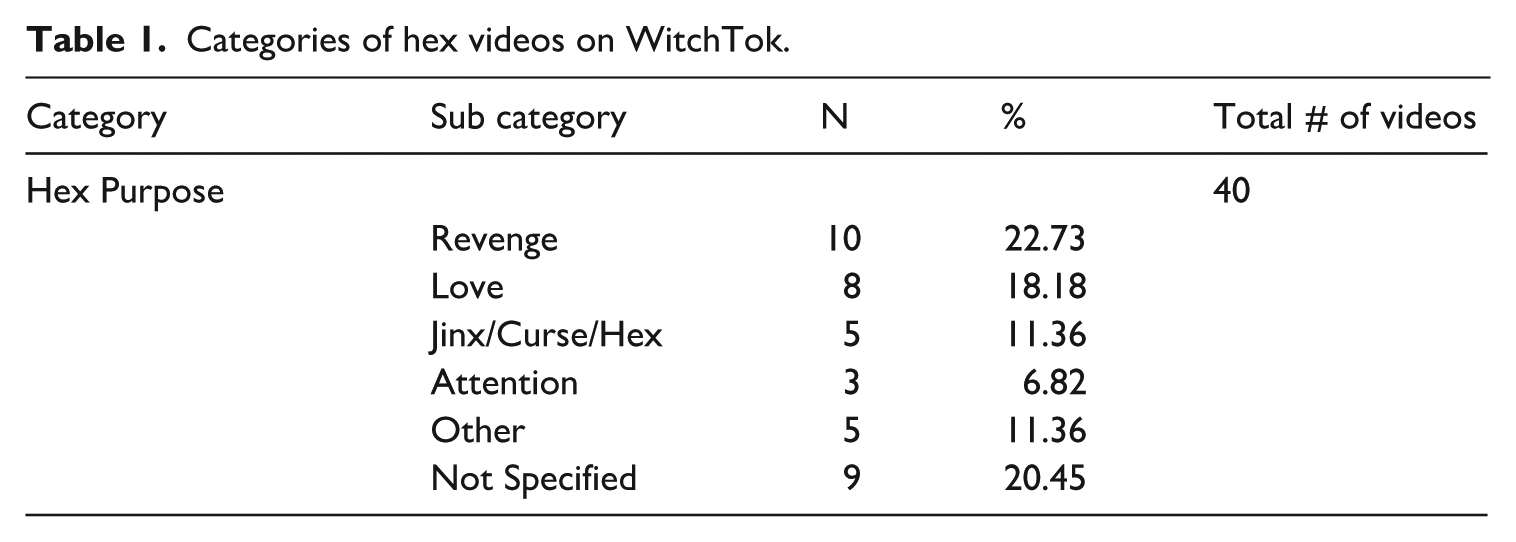
In the instances when users do offer justification, many captions or comments reference sexual or gender-based violence. One commenter succinctly outlines the ethics of when it is appropriate to hex: ‘u should only b hexing or cursing some1 that truly deserves it. Like if they’re a r@pist, p3do, abus!ve, stalkers or trying 2/has harmed u or ur family in some way, etc’. 13 Stemming from these reasons, ex-partners are also common targets of hexes. One commenter asks: ‘can u do this to my ex’? Another commenter offers a desperate plea: ‘I’ve been stalked for over a decade by my ex. I want him to leave me alone!’ Believing they have found the right spell, one user writes: ‘My GRAPIST is gonna be fked. Thanks’. Hashtags related to abuse also occasionally appear on revenge videos, including #Abuser, #NarcissisticAbuseRecovery, #HexYourEx, and #SASurvivor. Again, though justifications behind hexes are not always given, recourse against physical, sexual, and emotional abuse are the most common.
Love – another common purpose – comprises spells aiming to attract a new partner, compel an existing partner to stay, or get an ex-partner to return. One might wonder why spells for love or attention are considered harmful. If the object is getting someone to notice you, then what is the difference between casting a spell and doing things like wearing perfume or playful flirting? I classify such spells as harmful to acknowledge the magical worldview they reflect. In descriptions, captions, and comments, practitioners suggest that these spells actively compel (as opposed to merely influence) certain actions. By coercing someone into attraction, hexes violate that person’s free will. Again however, such actions are generally seen as acceptable among users, and a legitimate means to attract a partner.
As Table 1 indicates, many demonstrations defy categorization, as creators do not really clarify a spell’s purpose or intent. One video shows the steps to make a ‘curse jar’ with the caption: ‘im in control now’. This hex clearly offers power and agency, but any other details are unclear. In many cases, Witches operate on the belief that one does not need to justify their actions or decisions to others. Especially in demonstration videos, these offer a set of ritual tools, without deeper engagement with when they might be used. This generally reflects Paganism’s individualist ethos.
Ingredients
The ingredients used in hexes reveals the material elements through which magic is understood to work (see Figure 1). Certain fundamental ingredients – paper, candles, and some sort of container – can be understood as the ‘building blocks’ Witchcraft, while other elements are included as the spell (or personal preference) dictates.

Top 20 most common ingredients used in hexes on WitchTok.
Cayenne or chilli peppers, vinegar, and soil are common in spells aimed at revenge, as are sharp objects including screws, nails, pins, and needles. By contrast, hexes that aim to attract love or attention more frequently include perfume, roses, cinnamon, and honey. 14 Finally, spells geared towards protection often include what might be called ‘neutral’ ingredients, such as salt, black pepper, incense, and egg shells.
Despite a small number of specialized ingredients that would only be available from occult stores, most spells only use items which would be found in any kitchen. In addition, though some videos explain the precise meaning behind ingredients, most rely on an intuitive, sensory understanding: spicy, sour, sharp, or bitter materials will cause pain, while sweet, fragrant ingredients compel attraction.
In addition to vague guidance around ingredients and their properties, several creators post videos and state they did not list all of the ingredients used. Instead, they encourage others to customize their spells as they see fit. Rather than establishing rigid guidelines for how a spell works or what ingredients are necessary, videos merely offer rough parameters. This approach to magic reflects the importance of individualization among Witches.
Used in over half of all hex demonstrations, article highlights the practitioner’s role in performing magic. Unlike most items which are simply added to a jar, Witches must act upon paper in some way. This usually involves writing down the intended target’s name, then folding the paper in a specific manner. 15 Folding the paper towards you, for instance, is meant to attract something, and is therefore useful in love spells. By contrast, folding away from you helps to repel something, and functions to send negative energy at a target.
Overall, how ingredients are used reveals the underlying magical worldview among Witches. Videos reinforce that mundane materials can be transformed towards magical purposes through individual intervention. Witches both internally possess magical power, but can also harness immanent (latent in the natural world) and transcendent (deities they invoke) forces. Through this process, Witches can direct energy to achieve their desired ends.
Hashtags
Operating as the focus of data collection, #WitchTok was obviously the most popular hashtag in this sample, with #Hex also being quite common (see Figure 2). Alternatives, including #Witchcraft, #WitchesOfTikTok, and #Witchy were also common. Variations on spirituality (e.g. #SpiritualTikTok) appear occasionally. Somewhat less common, and barely visible in Figure 2, are terms such as Pagan and Wicca. This reinforces that Witch is the dominant term and identity around which this digital sub-culture is constructed.
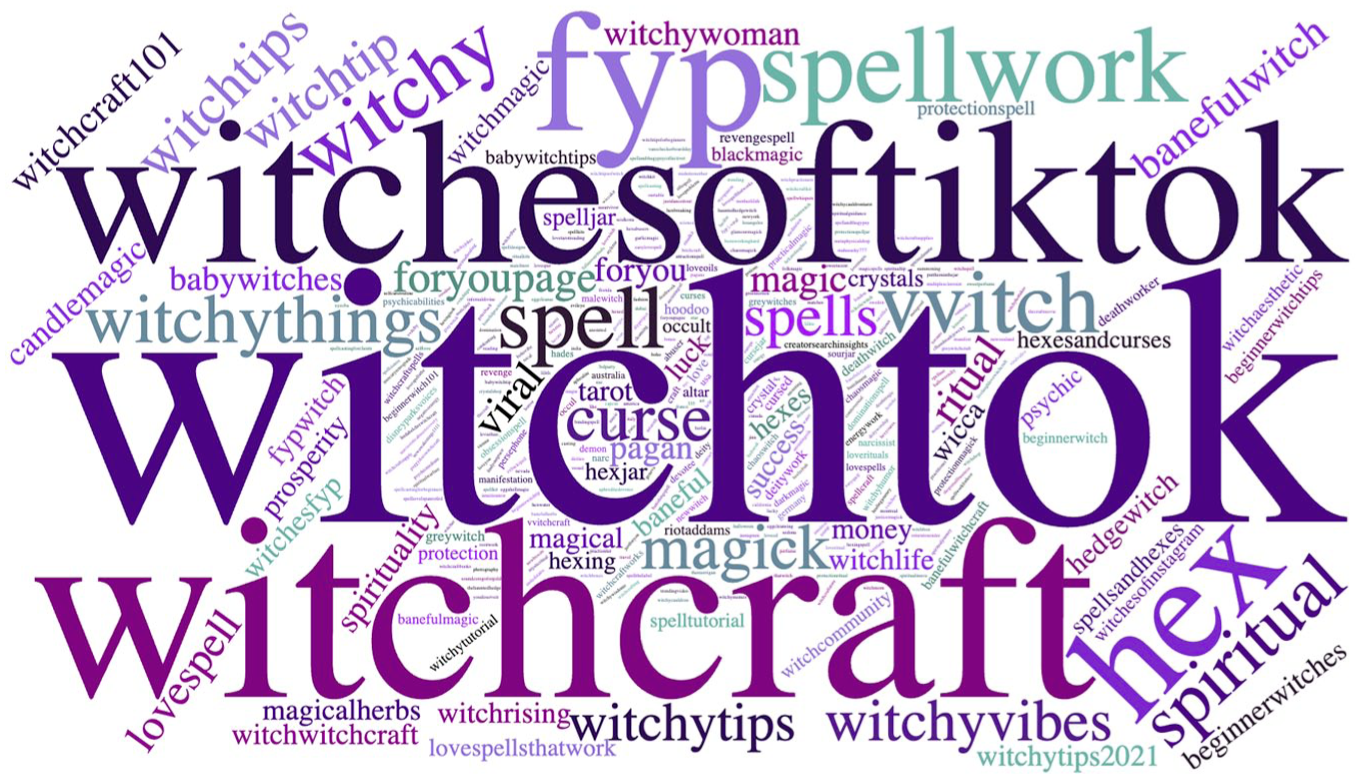
Word cloud displaying all hashtags used in posts on WitchTok.
As the visible presence of social media algorithms, hashtags also reveal how broader networks overlap in online spaces. Hashtags including #Tarot, #Crystals, and #Psychic reveal WitchTok’s crossover with the broader spiritual milieu (Woodhead, 2024). Though scholars do not always place these themes from the New Age movement alongside Paganism (Harrington, 2007: 441; York, 2019: 26), the lines between Witchcraft, Paganism, and other traditions dissolve in digital spaces as users draw simultaneously on a range of spiritual technologies.
Finally, hashtags reveal how digital infrastructure shapes the flow of information. Across TikTok, many creators use generic hashtags (e.g. #FYP, #ForYouPage, #Viral) in an effort to reach wide audiences. Using a large number of hashtags in one’s post also represents an attempt to attract more viewers. Videos in this sample included around 12 hashtags per post. Demonstration videos included (on average) more hashtags than videos where creators simply express their outlook on a topic. This indicates a slight division between creators who are seemingly content speaking to their more niche community of existing followers (who only use a few hashtags) versus those seeking to reach a wide audience (who use many). Likewise, from the average user’s perspective, since they contain more hashtags (and attract more digital traffic), one is more likely to encounter videos that demonstrate how to perform a spell, rather than ones discussing a recent event in the Pagan community. In this way, WitchTok broadly reflects larger social media trends. Brief, direct content is prioritized over longer, more nuanced discourse.
Discussion
The mediatization of religion suggests that religious beliefs, practices, and community transform as a result of media becoming more deeply integrated into society. This article explores how one religious community engages with a particular social media platform to discuss a specific form of magic. One key finding is the way that digital technology constructs spaces that contain unique sub-cultures. These forces are especially powerful on TikTok, which uses algorithms to deliver users content specific to their perceived desires.
If algorithms function as a Bourdieusian ‘structuring force’ which shape the digital habitus (Ugoretz, 2024: 301), then hashtags are the visible component of this force. The hashtag #WitchTok is the most obvious and central signpost around which this online community has formed. A closer examination however reveals the existence of an array of overlapping spaces and sub-cultures. Some of the hashtags that frequently appear on posts in this sample (#Witch, #Wicca, #Magick) are directly related to Paganism. Others, meanwhile, reflect adjacent sub-cultures (#Crystals, #Tarot, #Goth, #Love, #Art). This suggests that in addition to Pagans and Witches, WitchTok is also populated by (or intersects with) people interested in broader spiritual trends. Finally, content (and hashtags) related to hexes, harm, and baneful magic highlight that WitchTok contains many niche spaces catering to interest in specific forms of practice. The average user typically moves fluidly across multiple spaces, both within and beyond WitchTok. Some however, are clearly more interested in this theme, and their personal algorithm will reflect this deeper, more exclusive consumption.
The lens of mediatization also highlights how social media influences the construction of knowledge around beliefs and practices. WitchTok, like Paganism itself, tends to lack central authorities that dictate orthodoxy. Instead, knowledge is seemingly legitimated by consensus, and this study reveals the consolidation of ideas about how magic works. The basic format of spells – add ingredients to a container, seal the container, then place it under a bed, in a freezer, or underground – reflects this consolidation. As these steps are repeated across videos, belief in this process and its overall efficacy is reinforced. How various ingredients align with specific purposes also reveals this consolidation process. As noted, some creators offer detailed explanations of the magical properties certain materials possess. However, that many videos can simply list ingredients and have the spell’s purpose taken for granted highlights that repeated claims can reinforce their legitimacy. In addition to videos that explicitly offer ritual instructions, skits provide ongoing reinforcement that magic is real. Granted, the spells that Witches share through TikTok undoubtedly predate social media, and can also be found in books or oral traditions. However, given the climbing rate of media use across all generations, repetition on social media plays a major role in knowledge transmission, ritual standardization, and worldview reinforcement.
In addition to the broader ways in which religious discourse circulates on social media, this article was also concerned with discovering the uses and justifications of harmful magic. While scholars and practitioners often suggest that Pagans do not use magic to cause harm, the data from this study reveals a different reality. Indeed, a surprising initial finding was that performing hexes was generally a non-controversial practice. Rather than chastise creators for transgressing Pagan ethics, typical comments state that they found a spell successful, or asking the creator what alternative ingredients they could substitute. 16 In this way, much like the demonstration or lesson categories of videos, these comments are largely aimed at helping people to perform magic more effectively. Magliocco (2020: 54–55) similarly found that much of the online discourse around the ‘bind Trump’ spell concerned the importance of protection or how to re-tool the spell to make it more effective. In other words, complete dissent against hexes is rare. Discussion mostly focuses on how to improve one’s practice.
The relative absence of users challenging the use of harmful magic reveals two important themes. The first is the strength of digital silos. As noted above, WitchTok intersects with some communities and interests that extend beyond Paganism. At the level of identity, users therefore seemingly include Witches, Pagans, and others who fit in the broader spiritual milieu. At the level of outlook however, in this specific corner of WitchTok, users seem wholly in agreement with the permissibility of using magic to cause harm. Similar to the echo chambers that form online around political ideology (Li et al., 2025), even religious communities active online may be divided and sorted according to differing beliefs.
The second theme this consensus around harm reveals is Paganism’s individualist ethos. Though hardly a universal tenet among Pagans, the Wiccan rede famously dictates: ‘an it harm none, do what thou will’. The content analysed in this study reveals that users exclusively ascribe to the latter half of this principle. Witches in this space accept and promote the idea that magic offers recourse to achieve one’s desires, and there are no restrictions on its use.
If harmful magic is acceptable, then an important question is to what ends is it used? Past studies have suggested that feminist and political issues are a primary motivation for using harmful magic (Magliocco, 2020; Oake, 2019). These partly surfaced in this sample, such as a 4-minute video of a creator discussing the political state of the world in 2024, and encouraging viewers to channel their energy into magical workings. Spells geared towards revenge – overwhelmingly the most common type of hex – also often have important connections to feminism. Instructional guides on how to ‘hex your ex’ or representations of male genitalia as the central focus of spells show that past partners are a frequent focus. Though lower in frequency, hashtags such as #Abuse, #Abuser, and #SASurvivor (short for sexual assault survivor) also appeared.
As one might expect, social media is becoming a popular space for survivors of abuse to share their stories (Bogen et al., 2019; Mendes et al., 2019). Sharing experiences not only gives survivors a voice (Alaggia and Wang, 2020) but also supports prevention and recovery for audiences of these messages (Schwab-Reese et al., 2024). The reason why some survivors eschew official channels in favour of social media is often due to unsupportive or insufficient responses from institutions (Carretta et al., 2015; Moors and Webber, 2012). Turning to magic as a response against sexual violence may also stem from disappointment in public institutions. Following Brock Turner’s 6-month sentence for committing sexual assault, Witches organized a mass spell, offering allies who felt ‘outraged and helpless’ a sense of agency (Oake, 2019: 27). For survivors and allies, WitchTok serves two important purposes. The discourse around hexes can first be viewed as an outlet for sharing narratives of abuse. Talking with other users offers both validation and support. WitchTok also serves the purpose of providing a tangible means of response for survivors. Particularly for those disillusioned by traditional institutions, magic becomes a way to reclaim power and rebalance justice.
Since WitchTok is a diverse space, there are certainly many other aims to which hexes are directed. Less lofty goals such as love and money are also the focus of many practitioners. In addition to many demonstration videos being geared towards love and attention, hashtags including #LoveSpell, #LoveSpellsThatWork, and #LoveMagic also appeared semi-frequently. A commenter on one love spell video asks: ‘Can I just write MONEY on the paper & it have the same affect?’ This question was met favourably, with such responses as ‘I say go for it… improvise!’ and ‘no there’s a variety of other money spells, try a money bow’. Offering encouragement or suggesting alternative spells to try, these comments show that users are generally receptive to directing magic towards personal and material enrichment. This reinforces the overall Pagan outlook of individual authority, as practitioners are free to use magic to pursue any goals they see fit.
Though some seek revenge against physical or emotional abuse, others who seek revenge may be responding to fairly minor transgressions. It therefore makes sense to understand WitchTok in the same manner as any community: a diverse array of people with a range of ideas, beliefs, and practices. This diversity likewise shapes how hexes are understood and justified. Reflecting Paganism’s emphasis on individual authority (Harvey, 2016: 351), the underlying sentiment across WitchTok seemingly dictates that the only justification needed to perform hexes is completely left to the practitioner.
Scholas occasionally describe Paganism as a response to disenchantment (Magliocco, 2004: 120–121; Puckett, 2009: 129). Through a focus on hexes, this study highlights both the possibilities and pitfalls of living in an enchanted world. On the one hand, Pagans believe that they possess the ability to influence matter, energy, and other people in accordance with their will. This power offers incredible agency and control to bring about positive changes for oneself or to mete out retribution to deserving parties. On the other hand, Pagans are subject to living in a world where others possess this same power. Videos reinforce the importance of protecting oneself pre-emptively and regularly checking to see if one has been cursed. Belief in an enchanted world means it is enchanted for everyone. For those who regularly engage in harmful magic, this study reveals a preoccupation with constant vigilance, to avoid falling prey to harmful energy sent out by others.
In addition to refining the contours of how magic works, videos importantly contribute to Witches establishing identity and belonging. Most obviously, content all revolves around the belief that magic is real, and can help people achieve their desires. In a broader sense, videos also contribute to a sense of what it means to be a Witch, and a ‘baneful Witch’ in particular. Stylistic sensibilities are reinforced through one’s magical items, outfits (when the creator is visible), home décor, or the background music selected. Users generally reflect a gothic aesthetic dominated by colours like black, purple, red, and gold and motifs including skulls, birds, and symbols from the ancient world. Beyond visual aesthetics, users also often approach magic with a dark and edgy humour. Users often celebrate when a spell is perceived to be successful, relishing in the schadenfreude of an enemy. The stylistic sensibilities across users therefore reinforce not only how Witches should look, but also legitimize an outlook that causing harm can be justified and even celebrated.
The findings of this study reflect a particular sub-culture that exists relative to two separate, broader spheres. Users on WitchTok are part of the larger Pagan community, but their engagement with social media sets them apart from practitioners who primarily use other platforms, or who are less invested in technology altogether. Further, while WitchTok exists on a platform alongside hundreds of millions of other users, the content that circulates among Witches will look entirely different from that of other sub-cultures. This position relative to other social media users and other Pagans is important for contextualizing the discourses of harmful magic on TikTok.
Adopting a netnographic approach and immersing myself in this digital space, my own unique experience on TikTok reveals how algorithmic forces shape content consumption. As my own feed indicates, even brief engagement with a particular topic facilitates deeper immersion into a particular sub-culture. Rather than suggest that merely viewing a video will drag unsuspecting users down a rabbit hole, I will note that my chosen research method involved actively liking videos, viewing certain videos multiple times, reading through comments, viewing user profiles, and searching for specific content. My own research process offers an example of how novice practitioners might encounter a given sub-culture or community. Starting from genuine interest in a topic, and through sustained interaction, algorithmic forces function to slowly enmesh users in a digital habitus. As the default mode of viewing content on TikTok, the For You Page stands out as an algorithmic mechanism that clusters users together and shapes how digital habitus like WitchTok can emerge.
To make sense of how this digital technology shapes engagement with religion, I propose the dual metaphor of silos and cyclones. Though scholars have long recognized the way in which social life is segmented into silos or echo chambers online, this study reveals just how small or segmented silos can be. If WitchTok is a silo within TikTok, and Witches who hex is a silo within WitchTok, one can only imagine the further divisions that exist between individual social media feeds, separated by such factors as affiliation, location, gender, sexuality, occupation, and interests. The analogy of cyclones helps to capture the atmospheric forces that act upon users in social media. Though people have some agency to decide which topics or ‘silos’ they explore, algorithms function to pull people deeper inside various niches. Though most people hover around the edges of various sub-cultures, it is important to note the (largely unseen) forces that can pull people in different directions based on their activity and proclivities.
Conclusion
To better understand how Pagans engage with magic, this article explored a subsection of TikTok in which users discuss harmful spells or hexes. Performing hexes is ultimately not functionally different from most other forms of magic within Paganism, including those types which Pagans discuss online. Rather, it is the practitioner’s intentions which make certain spells into hexes.
While harmful magic is a somewhat contentious issue across Pagan communities, this study found little evidence of debate over the appropriateness of hexing. I argue that this is a function of the infrastructure of social media. Hashtags and unseen algorithms function as a structuring force which create a digital habitus geared towards this specific interest. This digital sub-culture begins from the basic assumption that performing hexes can be justified, and it is ultimately up to the individual to decide what counts as appropriate. Accepting the justification of individual authority, discourse largely concerns how to successfully perform this type of magic.
Though Pagans more broadly draw on texts, oral traditions, and other sources, WitchTok represents an extension of how knowledge is established and transmitted. Given the media saturation of modern society, TikTok and other social media are sources whose role will likely grow in the coming years. While this study demonstrates how knowledge circulates among Pagans, similar processes likely apply to other religious communities and non-religious sub-cultures. Most notably, through videos that replicate similar practices, ideas, and claims, norms about how the world functions are solidified.
Footnotes
Acknowledgements
The author wishes to thank members of the Circle of Fellows at the Jackman Humanities Institute during the 2024–2025 academic year, whose thoughtful reflections and conversations supported the development of this article.
Funding
The author received no financial support for the research, authorship, and/or publication of this article.

Notes
Author biography
Address: University of Toronto, 170 St. George St., Toronto, ON, Canada.
Email: