




Abstract
This article relies on a historical sociology approach to trace the shifting trajectory of community formation and the forging of boundaries through three discrete though corresponding imaginaries—panth (community), qaum (nation) and punjabiyat (regional identity)—in the Sikh political narrative. The emergence of each of these grand ideas of Sikh solidity has a history putatively inter-laced with the social make up and political economy of its time. The central object of enquiry for this article is the Shrimoni Akali Dal (SAD) and the attempt is to examine the shifting terrain of its religio-political goals and objectives. Since its inception in 1920, the SAD as a political organisation and Shrimoni Gurudwara Prabandhak Committee as the chief ecclesiastical authority, have been the principle bearers of the Sikh religio-political consciousness. The three constitutive imageries of community formation that SAD in particular and Sikh politics in general has fostered, do not betray a linear trajectory. Instead, there is a discernible simultaneity where each of these ideas co-exist, but subject to contextual operationalisation.
By most accounts, the 2014 general election was a watershed moment in India’s electoral history. It emphatically announced the triumph of a resurgent Hindutva or Hindu nationalism, a drift in Indian polity that was further re-inforced in 2019 with a resounding victory of the Bhartiya Janata Party (BJP) and its allies, and concomitantly a near decimation of the principle opposition, the Congress. In almost all the states of northern and western India, the BJP registered its proximate total hegemony which was repeated in many of the state elections too. Punjab, however, chose to sing a different tune, in 2014 as much as in 2019. If 2014 was also an expression of exasperation with the 10-year old United Progressive Alliance-led central government, this did not end up in shoring up all out support for the BJP or its ally, the Shrimoni Akali Dal (SAD). A good section of the Punjabi electorate opted for Aam Aadmi Party in 2014, and returned to the Congress in 2019. The Assembly elections in 2017, contested in the backdrop of high tide of Hindutva across the country, resulted in almost total rejection of both the BJP and its ally, the SAD. In stark contrast to its sterling victories in the neighbouring states such as Haryana (2014) and Himachal Pradesh (2017), the BJP in Punjab could barely manage to win three seats, while its major partner, the SAD returned with merely fifteen assembly seats (ECI, 2017).
Not only did Punjab decisively vote against the BJP and its coalition but its rebuttal of Hindu nationalist politics is also visible in various popular mobilisations against the BJP-led central government. The farmers’ agitation against the three farm laws promulgated in September 2020 witnessed massive participation of the Punjab peasantry. They filled the rank and file while simultaneously providing leadership to the entire movement. Thirty two of thirty five farm leaders who represented the farmers’ case during negotiations with the central government belonged to Punjab, and mostly Sikhs. Sikh religious slogans like ‘Vaheguru ji ka Khalsa, Vahiguru ji ki Fateh’ and ‘Jo bole so nihal, Sat Sri Akal’ became the rallying cry and reverberated in all protests and assemblies of the farmers (Kaur & Singh, 2021). Earlier, when the protests against the implementation of new citizenship laws and the impending National Register of Citizens broke out, Sikh civil society organisations lent their support, and some of them actively participated in the nationwide agitation.
Almost 58% of the population in Punjab is Sikh, and concentrated predominantly in rural areas, while the Hindus, nearly 38% of the population, largely reside in the towns and cities (Census of India, 2011a). The BJP has its support drawn from the Hindus, particularly the upper castes. Traditionally, the SAD in Punjab has claimed to represent the religio-political interest of the Sikhs, and has found its social base among the numerically dominant Jat Sikhs (Judge, 2012, pp. 17–20). In terms of simple arithmetic, the SAD–BJP alliance seems to be a formidable one. The repeated rejection of Hindutva politics in Punjab is therefore all the more difficult to comprehend. The persistent rebuttal of the Punjab electorate of its ideological and political project is a puzzle that finds little explanation within the Hindu nationalist worldview. Hindutva theorists have repeatedly argued that the Sikhs are the militant arm of the Hindu nation. In this worldview, Sikhism is declared as part of the all-encompassing Hindu dharma. A distinction is drawn between dharma and panth (community) wherein Sikhism along with Buddhism and Jainism were panths of the Hindu Dharma leading to the ‘same entity or God Almighty’ (Sudarshan, 1987, p. 12). 1 Article 25 of the Indian Constitution that guarantees freedom of religion and conscience too lends credence to the Hindutva discourse as it construes ‘persons professing the Sikh, Jaina or Buddhist religion’ amongst Hindus (GOI, 2015, p. 13). Though the Sikh versus Hindu debate has a long and tortuous history dating back to the period of the rise of the Singh Sabha Movement and spread of the Arya Samaj in Punjab in the late 19th century, a section of the Sikhs termed as Sanatani Sikhs as against the Khalsa Sikhs, continue to hold that Sikhism is only an extension of Hinduism. Besides, social science scholarship on history of Sikhism and Sikh–Hindu relations is eloquent on fuzziness of boundaries and hybridity between the two identities in terms of shared ritual practices and spiritual philosophy (Mahmood, 1989; Oberoi, 1994).
How do we then explain the evident uneasiness in the relationship between Hindutva and Punjab, specifically Sikh public consciousness? Why does it continue to stand as an outlier despite being integral to the Hindu nationalist imagination of Indian nationhood? As a methodological point, what analytical lens and conceptual tools do we employ to arrive at a convincing comprehension of the problem at hand? This article relies on a historical sociology approach to trace the shifting trajectory of community formation and the forging of boundaries through three discrete though corresponding imaginaries—panth, qaum (nation) and punjabiyat (regional identity)—in the Sikh political narrative. 2 The emergence of each of these grand ideas of Sikh solidity has a history putatively inter-laced with the social make up and political economy of its time.
For Cohen, community is symbolically constructed. The meaning of the symbol varies with ‘members’ unique orientations’ towards it. Since the meanings are variable, the ‘consciousness of community’ has to be kept alive through constant ‘manipulation of symbols’ to the extent that the reality of community boundaries and community itself depends upon them (Cohen, 2001, p. 15). Shifting boundaries and malleable meanings impact the Akali enterprise at boundary demarcation and community formation. Thus, ‘sikhi’—the Sikh religious weltanschauung immanent in the verses and actions of the Gurus, memories of valour and martyrdom and collectively preserved history of Khalsa raj—is invariably and often selectively invoked to infuse power and authority into these ideas of community formation.
A linear explanation centred on the essence of religion, or formation of competing Sikh and Hindu identities, leaves us with unanswered questions. For history is replete with instances of coalescence as well as contention. This extends from the field of social and cultural practices, where the adherents of the two religions have found several common grounds, to the domain of politics where again instances of coalition are numerous. From time to time, the deployment of the ideas of panth, qaum and later Punjabiyat, also in a way corresponds to this complex social make up of Punjab. Panth, qaum and Punjabiyat are formulations representing the shifting dynamics of this relationship. On account of their fluid meanings and connotations, one needs to be cautious in arraying them as empirically compartmentalised categories. Both panth and qaum are at times used interchangeably in the Sikh theo-politics to pronounce the sovereignty of the Sikh faith. In the Hindutva discourse, as mentioned above, panth is a constituent of all-encompassing Hindu dharma, not a sovereign faith community. Punjabiyat too has several readings—cultural, territorial as well as trans-territorial. 3 Heuristically, the effort in this article is to comprehend the overlaps as well as deep political meanings and outcomes that each of these analytically separable imaginations of community formation convey.
The central object of enquiry for this article is the SAD and the attempt is to examine the shifting terrain of its religio-political goals and objectives. Since its inception in 1920, the SAD as a political organisation and Shrimoni Gurudwara Prabandhak Committee (SGPC) as the chief ecclesiastical authority, have been the principle bearers of the Sikh religio-political consciousness. Both the SGPC and the SAD emerged in the backdrop of a powerful movement for the liberation of the Sikh shrines, the Gurudwaras, from the control of the Udasi Mahants. The resultant Gurudwara Reforms Act (1925) not only restored the Gurudwaras to the Khalsa Sikhs but also concurrently came to authoritatively define who is a Sikh—a question specifically pertinent given the transient nature of Sikh–Hindu distinctions. Though during its foundation, the SAD was purported to be the coordinating agency to raise and train volunteers for action under the SGPC, the Akali volunteers frequently overstepped the limits fixed by the latter. In effect, the SAD grew independent of SGPC control though the goal broadly remained the same (Narang, 1983, p. 2; Singh, 1997b, p. 92). At the time of its foundation, the bulk of the Akali jathas under SAD comprised Sikh peasantry. In particular, the Jat Sikhs, dominant in rural Punjab made up nearly 66% of the Akali volunteers while the leadership came to be provided by the urban middle class Sikh professionals (ibid., pp. 97–98).
Since the 1960s, the Jat Sikhs have displaced the non-Jat urban middle class from leadership positions. It follows that along with questions of Sikh religiosity and identity, the agrarian interest of the landed elite came to be reflected in the policies and programmes of the party. By presenting itself as a panthic party, the SAD not only has been able to enlist the support of both rural and urban Sikhs but also maintains near complete hold over the SGPC. Factionalism based on rural–urban divide or extreme and moderate expressions of Sikh interest has gripped the Akali Dal from time to time; nevertheless, the political line centred around panthic and agrarian interest is largely adhered to by all factions and splinter groups. Of late, the SAD (Badal) has emerged as the principle political formation in comparison to all other factions such as SAD (Amritsar), SAD (Mann) or SAD (Democratic).
Panth Versus Qaum
Guru Gobind Singh, the final personal Guru of Sikhism, founded the Khalsa in 1699 apparently to mark the Sikhs as discrete from other religious groups. The identity centred around the five kakkes—kes (uncut hair), kangha (a comb), kara (a steel bangle), kirpan (a sword or knife) and kachcha (special breeches or undergarments)—according to Uberoi were chosen by the Guru in opposition to certain rites of renunciation or samyasa then prevalent in Hinduism (Uberoi, 1999, pp. 132–133). 4 However, it was not before the late 19th and early 20th century that the Khalsa established itself as the core identity among the adherents of the Sikh faith. The clams of competing sects such as the Nanakpanthis, the Udasis, the Sahajdharis, the Nirankaris or the Namdharis were thus set aside. The period saw the rise of the Singh Sabha Movement (founded 1873), initially in response to the proselytisation activities of the Christian missionaries (Oberoi, 1994, pp. 218–222). Besides, the movement was also a reaction of the orthodoxy against the perceived decline in the founding principles of Khalsa faith. Accordingly, it reaffirmed the idea of the brotherhood in panth. However, what constituted the most representative Sikh identity was a contested question within the Sabha. The Amritsar Sabha left the membership open to all Sikhs, including the non-baptised ones (Singh, 1997a, p. 46). Thus, both Sahajdhari and the Khalsa were put at equal plane and the use of derogatory references like mona Sikhs for the former was barred. However, the low-caste Mazhabi and Chamar Sikhs were not accorded the same status as that of a high caste. In contrast the Lahore Sabha, whose views prevailed eventually took the line of the orthodoxy—the tat(true) khalsa view. Membership was restricted to only Khalsa Sikhs wearing the five Ks as markers of external identity. Caste practices were despised and the membership was largely drawn from amongst middle and lower sections of Sikh society. Strict instructions were given to all the constituent members and bodies to observe the democratic traditions of the Khalsa in letter and spirit (ibid., p. 49). The Amritsar Singh Sabha, in contrast, came to be associated with Sanatan Sikhism that saw Sikhism as only a branch of Hinduism. The Khalsa, in this view, was merely a voluntary society within the Sikh panth formed to combat Mughal oppression.
The forging of the religious boundaries around tat khalsa ideology was also prompted by the growth of the Arya Samaj in Punjab at the turn of 20th century. The Khalsa ‘self’ developed in direct opposition to the attempts of the Arya Samaj activists to appropriate Sikhism within the reformed Hindu fold. In the initial years, young Sikh youths were drawn towards the Samaj that presented its cause as identical to that of the preaching of the Gurus. Sooner than later, as the Arya Samaj stretched its wings further, the lines of separation were strictly drawn. Through speeches, pamphlets and competing polemical writings the Arya Samaj and the Khalsa Sikhs were at loggerheads. For the Samaj, Sikhism was founded on Vedic principles by Guru Nanak, and therefore, at most was a reform movement within Hinduism. Similarly, the divinity accorded to the Granth sahib by the Sikhs was refuted by the Samaj leaders and activists. The Singh Sabha activists, on the contrary, aggressively defended the sovereignty and distinctiveness of their faith. Bhai Kahn Singh Nabha, for instance, published Nabha (1899) which ran into several editions. Nabha relied on the Khalsa pool of symbolisms to delineate a distinct trajectory for Sikhs. Thus, among many other evidences produced, the set of injunctions during the amrit-taking ceremony is stressed. Sporting of five Ks is invoked as an essential condition apart from the advisories against practicing caste segregation, worshipping any other deity or prophet other than the Akalpurakh, having faith in any other religious text except of Guru Granth Sahib, considering anything else apart from Gurudwaras as places of worship or having food offered to any deity and so on (Nabha, 2006, pp. 33–35). The individuality of the Khalsa Sikhs having been conclusively established, Nabha appealed to the Nanakpanthis to realise their true faith and join the Khalsa panth. He reminded them of the atrocities of the Hindus—forcible proselytisation, installing of Hindu deities in Gurudwaras and usurping of Sikh properties. Hum Hindu Nahin did not articulate any idea of Sikh nationality. Sikhs were a distinct panth, and along with other communities were, integral to the nation (ibid., pp. 127–128).
The Singh Sabha reformers attempted to kill two birds with one stone. The new panthic identity insisted on separateness of Sikhs from Hinduism. The Sikhs therefore were a vakhri qaum (meant a separate religious community here), not simply a panth in the Hindu dharma. Intrinsic to this construction of exclusivity was the pre-eminence of the Khalsa over other divergent versions of the faith. The Singh Sabha campaign and the Akali movement inspired by the Sabha activists produced two legislations of far-reaching importance in this regard. The Government of India (1909) gave legal validation to the Khalsa marriage rituals for the Sikhs as against the Sanatan Sikhs. It further fortified the boundary between Hindus and Sikhs as it sanctioned marital ties only between confirmed Sikhs. The Sikh Gurudwara Reform Act (1925), a culmination of the Akali movement to expel the Udasi mahants from the management of the Gurudwaras, further established the individuality of the Sikh as against the syncretic sects such as the Udasis, Nanakpanthis and Sahajdharis. It also debarred the Patit (apostate) Sikhs from membership of individual committees and the central board.
The Act of 1925 paved the way for the institution of Shiromani Gurudwara Prabhandhak Committee (SGPC). By virtue of being the custodian of Akal Takht, the SGPC frequently issues hukamnamas (edicts) that are considered to be binding on all believers of the faith. It is argued that in the SGPC, the Sikhs found a symbol of their ‘corporate existence’ and a ‘substitute for their theo-political personality’ that was lost after the end of the Sikh empire in 1849. In doing so, however, the Sikh ‘Church’ draws its legitimacy from the orthodoxy as well as from the modern state. Kushwant Singh equated the SGPC with the ‘parliament of the Sikhs’. Its decisions carried the weight of edicts or gurmata while the Akali Dal was no less than its army. The control over resources, gurudwaras, educational institutions and seminaries—all made the SGPC a ‘government within the government’ (Singh, 1966, p. 215).
The Politicisation of Panthic Identity: Sikhs as a Minority
With the introduction of the representative form of governance in British India, communities were fearing for being overawed by the majority clamoured for safeguards. The Sikh panthic identity hitherto engrossed in the construction of a distinct spiritual sphere, transformed into that of a political minority. The second Government of India Act (1919) extended the provision of separate electorates and safeguards to the Sikhs in Punjab who, according to the framers of the Act, despite being ‘distinct’, ‘important’ and ‘gallant’ people, were a ‘minority’ and ‘under-represented’ (Montagu & Chelmsford, 1918, p. 150). The 1919 Act failed to satiate the Sikh political aspirations. Though the Sikh population in united Punjab stood at 13%, the claim made by their representative organisation was for a 30% share in provincial legislature. This was justified by the Chief Khalsa Diwan (predecessor to Shrimonai Akali Dal) on the grounds that they were located fundamentally in Punjab and contributed to nearly 40% of the canal and land revenues of the province (Rekhi, 1999, p. 111).
The Sikhs, at this point of time, saw themselves as a community marked by its own distinctiveness, a panth, and on that account, a minority. The idea of being a nation with territorial aspirations was yet to strike them. This position was maintained in almost all of their public pronouncements and representations made to the colonial government. In a memorandum submitted to the Simon Commission, several prominent Sikhs under the aegis of Chief Khalsa Diwan reaffirmed their commitment to the ‘development of a united nation’ while being ‘anxious to maintain their individuality as a separate community’. The demand for a 30% share in the legislature was forcefully re-iterated (Singh, 1980, p. 69). The Motilal Nehru Committee of the Congress (1928) and the Round Table Conferences (1930, 1931 and 1932) were other occasions when the Sikhs, now led by the Akali Dal, sought concessions as a minority at par with other minority groups.
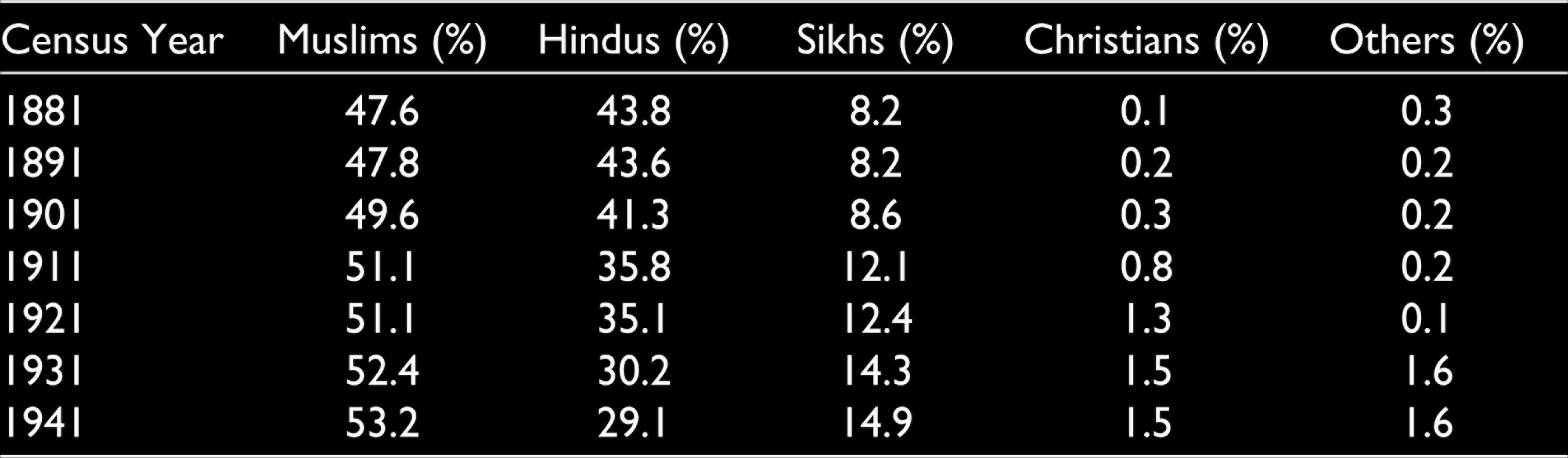
The distinctiveness of panthic identity stood in opposition to the Hindu or Arya Samaj attempts at co-option. In contrast, while claiming minority status and safeguards, the Sikh political interest stood contrary to that of the Muslims who constituted a majority in colonial Punjab. On this ground, the Akali representatives vociferously opposed reservation for the Muslims in the provincial legislature. It was argued that fixed quota for Muslims corresponding to their share in the population of the province, would turn them into a permanent constitutional majority and the Sikhs as a powerless minority. Despite a very vociferous campaign led by the Akali Dal, the Fazal (2015, p. 116) soured the Akali expectations. As against the Akali stress on 5% representation in the Federal Assembly, the Act could grant only 6 seats in a House of 250 representatives In the Council of States, a similar story was repeated as Sikhs could secure only 4 seats out of 150 However, it was the impending scenario in the Provincial Legislative Assemblies that raised the Sikh anxieties the most. In a House of 175, Muslims, whose population proportion in Punjab stood at 52.4% (1931 Census in Table 1), had been able to block 84 seats under the separate electorate system even as Sikhs were left with only 31 seats (Fazal, 2015, p. 116).
From Panth to Qaum
The preliminary reference to Sikhs being a nation-in-themselves is found in the early colonial accounts penned by company officials, administrators and army commanders. Joseph Davy Cunningham, political officer in the company army during the first Anglo-Sikh war portrayed the Sikhs as a nation, a people of history tied to a definite territory—‘from Delhi to Peshawar, and from the plains of Sindh to the Karakoram mountains. The fulcrum of this nation was the war like Singhs of the tenth king (Guru Gobind Singh) (Cunningham, 1853, p. 1). They, in his view, were ‘filled with a lofty although fitful longing for social freedom and national ascendancy’ (ibid., p. 82). An almost identical view was held by British orientalist H. H Wilson. In a paper published in the Journal of Royal Asiatic Society, as early as early as in 1848, he saw the Khalsa as incorporating ‘the notion of a unity of interests, or national identity among the Sikhs’. It articulated the desire of the Sikhs to be under ‘one spiritual guidance in temporal as well as spiritual affairs—a sort of abstract theocracy’. Such a unity, according to Wilson, was best maintained during the reign of Ranjit Singh (Wilson, 1848).
The national consciousness struck the Sikh psyche much later. It was the Lahore session of the Muslim League (1940) and its adoption of the Pakistan resolution that prompted the Akali Dal and the SGPC to fashion themselves as a nation in search of sovereignty. Sikh nationhood centred around territorial autonomy expressed itself through several formulations, namely Azad Punjab, Sikhistan or Khalistan. As per the 1941 Census, Sikhs constituted close to 15% of Punjab, far smaller than the Muslims (53%) and Hindus (29%) (see Table 1). It required some amount of ingeniousness to transform Punjab into an exclusive homeland of the Sikhs. The SAD explained the Azad Punjab scheme as a re-adjustment of the territorial boundaries of Punjab by the transfer of pre-dominantly Muslim districts to NWFP. The rest of the province could be salvaged as the homeland of the Sikhs. The Azad Punjab scheme failed to impress the Hindus of Punjab who saw in it a ploy to dismember Akhand Hindustan. The Akali Dal disparaged the Hindus and the Arya Samaj for their opposition to the scheme (SAD, 1943, p. 525–526).
Religious Composition of the Population of Punjab, 1881–1941
In their declaration that the Sikhs-qua-Sikhs were a nation with their homeland in Punjab, the SAD and other Sikh nationalists expressed their disillusionment with the identity of a minority and the politics of protectionism. In contrast, the idea of being a ‘nation’ was laden with power, for it alone could secure an autonomous state for Sikhs and Sikhism to survive and flourish. A resolution adopted in Lahore in 1946 on behalf of the entire panth argued that both, the idea of Akhand Hindustan as well as Pakistan, were deeply majoritarian and detrimental to the interest of the Sikhs. Thus, no safeguards or constitutional protection was adequate to let the Sikhs as a nationality flourish with distinct religious, ideological, cultural and political character (SAD, 1946, app. 1–3). The second rationalisation was the antiquity of Sikh nation with its distinct foundational myths of the origin of the Khalsa, heritage of martyrdom and memories of Khalsa Raj on account of which the Sikhs refused to ‘accept for the Khalsa the status of being a mere community’ (ibid., pp. 32–33).
The reconfiguration of Sikh political identity, from panth to qaum, from minority to sovereign nationhood did not go uncontested. The Baba Kharak Singh led Central Akali Dal, organised Akhand Hindustan Conference in which the Azad Punjab scheme was declared identical to the Muslim nationalism of the Muslim League. The conference appealed to the nationalist Sikhs and Hindus to unite against plans to establish ‘Muslim communal raj’ in Punjab (Singh, 1943a, pp. 223–227). The nationalist Sikhs organised Hindu–Sikh Milap Conference in which the two communities were called upon to become allies in ‘politics of self-preservation’. Notably, while the Sikh leaders in the conference stressed on fortifying strategic ties between the two communities so as to withstand the perceived Muslim onslaught, the Hindu leadership revived the old theories about Sikhs being protectors of Hindus and by the extension of the entire nation (Singh, 1943b, p. 240).
A ‘Proto-Nation’
Partition severely truncated British Punjab with nearly 66% of its land area awarded to Pakistan. Approximately, 3.6 million Hindus and Sikhs crossed over to Indian Punjab replacing the Muslim population of these areas. A few years later, the princely states (grouped together as PEPSU—Patiala and East Punjab States Union) were merged with Punjab. The Sikh population climbed to 33% in the 1961 Census from a 15% share in pre-partition Punjab (Table 1). Numerically, they were still a minority compared to 63% Hindus enumerated in 1961 Census. In the new situation, the idea of the Sikh sovereignty—Sikhistan, Azad Punjab or Khalistan—stimulated by the SAD in pre-partition Punjab was instantly put to rest. The desire to have a homeland reminiscent of the Khalsa raj, though within Indian territories, continued to thrive. The Akali Dal refashioned its quest for a Sikh homeland into a demand for Punjabi Suba, in tune with the linguistic re-organisation of the state. A Sikh majority state was sought to be achieved on the basis of redrawing the map of Punjab. Thus, the incongruence between Sikh nation and its territorial abode could be annulled.
It demanded the inclusion of all areas of Sikh concentration for the realisation of a ‘Sikh homeland within the Union of India’. During the course of the movement for Punjabi suba, the ‘self’ versus the ‘other’ dynamics in Punjab politics saw a re-orientation. Punjabi Hindus replaced the Muslims as the ‘communal majority’ in the Sikh identity discourse. In opposition to the Sikh demand for Punjabi suba, the Arya Samaj, the Hindu Mahasabha and Jan Sangh began a campaign for maha Punjab that would include Hindi-speaking areas of Himachal Pradesh, Haryana, Delhi and parts of Uttar Pradesh. It succeeded in impressing upon the first States Re-organisation Commission 1955 which favoured the maha Punjab scheme over the Punjabi suba demand of the Sikhs (Narang, 1983, p. 125). Language and religion, though conceptually exclusive, were conflated by both the camps. In the 1961 Census, the Jan Sangh asked the Punjabi Hindus to return to Hindi as their mother arguing that Punjabi was only a dialect of Hindi. Hindi nationalism for them was akin to Indian nationalism (Rai, 1986, pp. 288–289). The Akalis, on the other, considered Punjabi in Gurmukhi script as the fulcrum of Sikh nationality. In 1966, the Punjabi suba was achieved after a prolonged agitation. The majority of the districts had Sikh concentration. The Sikh share in the newly created Punjab jumped to almost 60% in 1971 Census. Yet it did not satiate the Akali demands. The SAD manifesto saw in it a ploy to ‘relegate and contain Sikhs in a narrow, war-torn, undeveloped and suppressed reserved area’ (SAD, 1967, pp. 39–40).
To the question as to how would this fledgling Sikh nationalism relate to the idea of Indian nationhood, one has to rely on a contextual analysis. From minority to nation, panth to qaum, there is a processual journey. The idea of a sovereign Sikh nation—Sikhistan or Azad Punjab—emerged in the context of Partition when the Muslim League claimed distinct nationhood. However, it was a short-lived one. The idea of the Sikh qaum or nation in the years after Independence, was in a complex relationship with Indian nationhood. It contested the idea of homogenous Indian nationhood by averring to Sikh nationhood, yet it was at peace with Indian integrity. A ‘constitutionally recognized homeland, within… an integrated Indian nation’, to ‘preserve the Sikh way of life’ was what the SAD aimed at (Singh, 1969). Patriotism was frequently flaunted by citing Sikh contribution to the freedom movement as well as their participation in the Indian army. Yet the Akali intellectuals, such as Sardar Kapur Singh, indicted the Indian state of being enveloped by the majoritarian psyche that was intolerant towards non-Hindu way of life (ibid.).
Theoretically, assertions of nationhood based on a separate Gurmukhi script, sacred territory and historical memory is an unsettled one. Bombwall refuted it citing multiple cleavages within the Sikh society. A year later, he was to revise it (1986, p. 888). Paul Brass on the other found the Sikhs ‘closest to satisfying the definition of nationality or nation’ (Brass, 1974, p. 277). However, the Akali formulation of nationhood-sans-sovereignty makes the subject more intricate. For Anderson, nations dream to be free and the ‘gage and emblem of this freedom is the sovereign state’ (1991, p. 7). In this sense, the Akali imagination of Sikh nationality could be termed as a ‘proto-nation’ or a ‘quasi nation’, a nation without aspirations of self-determination.
1984 and the Reconstitution of the Sikh Self
From the late 1970s, the Sikh political consciousness embodied in the SAD went through yet another modification. The rise of Khalistan separatism amongst a section of the Sikhs, prompted the SAD to clarify its earlier theorisation of Sikhs being a qaum or a nation. Maximalist and minimalist positions were adopted by rival factions of the SAD. The Anandpur Sahib Resolution (1973), for all intents and purposes, a forgotten document became the centre of storm. In the course of heated exchanges, multiple versions of the Resolution, each vouching for its authenticity, came to the fore. In these different readings of the text, the vacillation between minority versus nation, panth versus qaum imaginaries, was discernible. For the more belligerent Talwandi faction, the historic Sikh nation had been subjugated by a ‘brute majority’, which was set to erase its political and cultural identity, since 1950, the year the Constitution was promulgated (Singh, 1994, p. 95). The official SAD led by Longowal passingly referred to Sikhs as a nation while absorbing itself into the spiritual concerns of the community such as management of Gurudwaras, propagation of faith, amrit prachar (baptism of the Sikhs), free translation of gurbanis. Though the attainment of the Khalsa was declared as the ultimate goal, but this was to be realised by restoring the Punjabi-speaking areas to Punjab. It relied on the principle of true federalism so as to strengthen national integration and safeguard the country from ‘centrifugal tendencies’. India, in these theorisations, was a multi-national society while the polity, on the contrary, had centralising tendencies (Fazal, p. 135). At the same time, the SAD, unlike the Khalistan militants, steered clear of claiming political sovereignty for the Sikh nation. The declaration of Dharam Yudha Morcha (holy war) by Sant Longowal in 1981 to achieve the goals set by Anandpur Sahib Resolution concentrated on minority safeguards and protections. It demanded protections for Sikh religion, concessions for the Punjab peasantry and representation of Sikhs in public offices and armed forces. It resisted all accusations of secessionism and emphatically declared that Khalistan was never the Akali objective (Longowal, 1981, p. 3).
The 1984 military action in the Golden Temple and the massacre of Sikhs following the assassination of Prime Minister Indira Gandhi marked a brief departure in the Sikh identity discourse. The Akali ambivalence between minority and nation was christened as a compromising one by the Khalistan enthusiasts. Consequently, a gurmata passed in a sarbat khalsa samagam declared the Akal Takht as the supreme, and formed a five member panthic committee to guide the panth. 5 Thus, the authority of the SGPC and the Akali Dal in religio-political matters of the Sikh was undermined. The relation between Sikh qaum and Indian nationhood, theorised as non-conflictual in the Akali discourse, went through a re-orientation in the Khalistani narrative. It proclaimed territorial sovereignty for the ‘subjugated’ Sikh nation. At the same time, India was termed as an abode of Hindu nation, which in its brahminical form was hostile to the autonomy of Sikh faith (Panthic Committee, 1986, p. 7).
‘Raj Karega Khalsa’ (The Khalsa shall reign) was the cherished dream of the militant nationalists. It was held that the Khalsa panth will have its own home, that is, Punjab. In this formulation, religion and politics were not two different spheres of activity, but inseparable. Guru Hargobind Singh, the founder of the Akal Takht, was seen as an inspiration in this regard. The Guru is considered to be the architect of the principle of miri and piri—one symbolising religious authority while the other political power (Singh, pp. 191–192). Among Sikhs, the militant discourse tried to settle the identity debate by upholding the observances of amritdhari Sikhs as the purest form of Sikhism. The Constitution of the proposed Sikh state pre-conditioned the adorning of amrtidhari identity for holding political offices.
Turn Towards Punjabiyat
The SAD as the custodian of the religio-political identity among the Sikhs has vacillated between community versus nation, panth versus qaum identity-constructs. Having briefly flirted with the idea of Sikhs being nation, the SAD in recent years has reverted back to the minority framework. In 1986, the central government accorded the Sikhs the status of a minority which led to further complications in the state of Punjab where Sikhs are a numerical majority. A little later, the Akali Dal government in the state followed suit. To prove that the Sikhs were rather a minority in the state, the state government relied on Tat Khalsa identity kit. This excluded the various contending sects of Sikhism such as the Kukas, Udasis, Nirankaris and Radhasoamis.
The idea of Sikhs being a qaum or a nation in themselves, sans dreams of statehood, still survives in intellectual quarters and occasional utterances of Sikhs. SAD through its resolutions intermittently reaffirms the distinctiveness of Sikh nation. However, this idea of nationhood is a hollowed-out version which serves to position the Sikhs at distance from Hindu nationalist tendencies of assimilation. Rajinder Kaur, the then president of Istri Akali Dal, spelt out the intent:
In order to preserve the socio-religious and political entity of the Sikh Panth, Shiromani Akali Dal has reaffirmed that Sikhs are a nation but India is their country. Nothing secessionist is involved in it…Those who want to reabsorb the ‘Sikh Panth’ into the fold of Hindu society are perturbed over this declaration otherwise there is nothing to feel alarmed about it. (Kaur, 1994, pp. 263–264)
The 1994 Amritsar Declaration facilitated by the Akal Takht brought different radical factions of the Akali Dal together. Though largely perceived as a separatist document, the Declaration fashioned India as a ‘sub-continent’ of diverse nations and cultures and visualised a ‘confederal constitution’. It committed itself to the creation of a ‘separate region for the Sikhs’. At the same time, the idea of Punjabiyat too made an appearance:
In this territory, religious, economic, political and social institutions based on the Sikh way of life will uphold moral awareness, and also provide the Sikh people a place in history, hitherto unavailable. With this achievement, the Sikhs and Panjabiyat will be able to make a laudable contribution to enrich world culture. (SAD, 1994)
Despite its aggressive postures, Akali Dal (Amritsar), barring its initial success in the 1989 elections, failed to cut ice with the Sikh electorate. It was the more moderate SAD (Badal) that grew into prominence and secured electoral success. According to several commentators, the success of the latter alludes to the yearning for peace and inter-community tranquillity in post-militancy Punjab. Alert to the shifting concerns in Sikh political consciousness, the SAD (Badal) has suitably amended the trajectory of political discourse from a pre-occupation with Panthic (religious) questions to those more aligned with agrarian and regional issues. Electoral demography too could be a compelling reason for the Akali shift in stance. With nearly 38% Hindu population, a Sikh-centric political programme could fetch only limited dividends. Thus, the SAD (Badal)’s manifesto for 1992 Assembly elections emphasised on Hindu–Sikh unity, stressed on ‘true federalism’ as claimed in Anandpur Sahib Resolution (1973) and a string of promises to the peasantry ranging from free power, free canal water and higher procurement prices. The manifesto reiterated the ‘need to maintain peace in Punjab at all costs’ (Singh, 2000, p. 186). Instead of religion, the region came to be foregrounded by the Akalis. The Moga Declaration 1995 underlined the Dal’s resolve to uphold the spirit of Punjabiyat so that matters ‘get projected as common problems of the entire Punjabis rather than a section thereof’ (Kumar, 2017, p. 49). Foregrounding of Punjabiyat helped the Akalis to appeal to the lower castes among Hindus, Sikhs and Christians through social welfare schemes. Organisationally, it became far more inclusive with greater representation of different sections of the state’s population (Singh, 2014, pp. 65–66).
The Akali appeal to regional consciousness has an intriguing history. In the 1960s, the agitation for a separate Punjabi Suba relied on linguistic distinctiveness and regional identity. The reference to region and grievances alluding to perceived ill-treatment of the Punjab peasantry, inadequate share in river water and canal irrigation, transfer of Chandigarh and the merger of the left-out Punjabi-speaking areas with Punjab were central to the Ananpur Sahib Resolution (1973) of the Akalis. The Punjabi Hindus, dreading the loss of their numerical edge in erstwhile Punjab, returned themselves as Hindi speakers in the Census enumeration conducted during the Punjabi Suba movement. 6 This exacerbated inter-community antagonism (Jodhka, 2005). Region dispelled the idea of the ‘nation-state’. Envisaging themselves as owners and possessors of a monochromatic idea of Indian nationhood, the Punjabi Hindus (primarily the upper castes), led by the Punjab Arya Samaj stood in opposition to the Akali stimulation of regional sentiments.
Pointedly, in its earlier imagery, the region for the Akalis was laced with religion—as a holy land of the Gurus and a homeland of the Sikhs. Underlying the Punjabi Suba movement for instance was the camouflaged Akali desire to accomplish a Sikh majority state. On the other, post-militancy Akali turn towards regional identity was palpably different. It marked the increasing secularisation of Sikh politics, a shift from symbolic to temporal politics. Punjabiyat, in Akali constructions then came to signify the plural cultural ethos of Punjab. In this sense, it was both a cultural and a territorial idea. The 2017 manifesto of the SAD (Badal) furthered this shift in Akali politics. In an effort to distance itself from Sikh exclusive politics, the manifesto emphasised on Punjabi culture, history and identity. The Punjabi share in the freedom struggle was recounted; their contribution was estimated to be more than 80% as compared to the rest of the country while their count amongst martyrs projected at 95%. The manifesto complained that despite the unparalleled sacrifices of its residents, Punjab continued to be discriminated against:
With a role as astounding as this, it was expected that powers that be after the freedom of the country would acknowledge and value the role played by Punjabis and would accord them a place of high honour in the country. But right from the start, Punjabis were subjected to discrimination and injustice on almost every front…Punjabis (had) to undertake a long and painful struggle to secure a Punjabi suba…they were subjected to injustice and discrimination on territorial and river water issues. Vast Punjabi speaking areas were kept out of the state, and the state was denied even its capital Chandigarh. (SAD, 2017, p. 10)
Conclusion
It is argued that the Akali politics broadly adheres to three distinct axes— community, class/caste and region (Jodhka, 2001, pp. 97–98). Religion is at the core as SAD, since its inception is ceased with questions of Sikh religiosity and identity. It fashioned itself as a panthic party that zealously guarded both the spiritual pursuit as much as material interests of Sikhs exclusively. Internally however, the exclusivist tendency is constrained by Jat Sikh dominance which obliges the SAD to endorse agrarian interests primarily of the rich and the middle peasantry. Beyond this rather narrow social base, region, the third axis of Akali politics, allows it to tactically explore plausible social and political coalitions. At times, an overlap between religion and region, community and territory produced ideas of Sikh nationhood. Punjab, thus was the holy land of the Sikhs in the sacred geography sketched by the Khalistan nationalists. Punjabiyat instead signifies a rupture between territory and religious essentialism. Alternatively, it revels in the eclecticism intrinsic to Punjabi society and culture. 7
Does the turn towards Punjabiyat imply the demise of panthic politics of the Akali Dal? In other words, does it lead to secularisation of Sikh identity politics? While it is always difficult to predict the course of politics contingent as it is to the broader dynamics of power and its contestants, history holds out some clues. Panth, qaum and Punjabiyat, the three constitutive imageries of community formation that SAD in particular and Sikh politics in general has fostered, do not betray a linear trajectory. Wedded to the Tat Khalsa identity kit, the SAD and its predecessors worked at producing Sikhs as a discrete community through the Singh Sabha and Gurudwara reform movement. It thus pledged counter to the assimilationist programmes led by the Hindu revivalist organisation such as the Arya Samaj. The founding of the community or panth was followed with SAD entering into minority politics and its recognition as such by the Montagu–Chelmsford Reforms (1919). The metamorphosis into a qaum or a nation took place a few decades later, specifically at the time of the partition of Punjab when a section of the SAD resolved to achieve Sikhistan, Khalistan or Azad Punjab. But the term qaum or nation has had several connotations, not in all sense was it deployed to claim separate statehood except for the period during the days of militancy in Punjab. That apart, the sentiment of qaum is an expression of religious and cultural autonomy against Hindutva assimilation. Alternatively, it also signifies the desire for a truly federal polity as against ideas of a monochromatic nation-state. In the post-militancy phase, Akalis have also toyed with the idea of a minority and raised demand for safeguards (Jodhka, 2005, pp. 1498–1499). The turn towards more inclusive idea of Punjabiyat though recent, has roots in notions of regional exclusivism that shored up in the past. History of Panth, qaum and Punjabiyat, the three imaginations of community formation around which the symbolic politics of the Akalis is built, is a vacillating one. Rather than linearity, there is a simultaneity where each of these ideas co-exist, but subject to contextual application.
The construction of the ‘other’, it is argued, is critical to any formation of the ‘self’. However, quite distinct from the binary of ‘self’ and the ‘other’, this article emphatically argues for a triadic framework that accords centrality to the idea of the ‘nation-state’ in the formation of politically charged solidities and identities. Cautioning against post-modernist reduction to ‘self-versus-other’ in the study of ascriptive identities, Dipankar Gupta makes a strong plea for the adoption of a triadic framework for the sake of analytical depth (1997, pp. 189–191). In the organisation of modern politics, the state and state power remain most critical. Identity groups clamour for state power as much as the mechanisms of the modern state construct, fortify, aggregate and disaggregate identities. Symbolically, when the ‘nation-state’ is owned and possessed by certain social groups, others, usually the minorities, tend to get excluded. This relationship of the majority and the minority with the ‘nation-state’ is not fixed in perpetuity but goes through several mutations in history. The Sikh vacillation between being a minority/community and being a nation is contingent upon how the ‘nation-state’ styles itself, as accommodative or hegemonic. The evident uneasiness of Sikh political consciousness with that of Hindutva too is a pointer towards aggressive nationalism and centralisation that the latter is given to pursue.
Footnotes
Declaration of Conflicting Interests
The author declared no potential conflicts of interest with respect to the research, authorship and/or publication of this article.
Funding
The author received no financial support for the research, authorship and/or publication of this article.