




Abstract
This article offers a preliminary analysis of the New Education Policy document 2020 (NEP 2020) that was released by the government after considerable delay. Since 2016, the government has been trying to bring out a policy document on education, and NEP 2020 is at the end of several attempts that fell by the wayside. The context for the present discussion is that of the unprecedented expansion in higher education among students in recent decades. Within the emergence of a heterogeneous student body, the presence of women students—which has even reached parity in mainstream disciplines at the undergraduate and postgraduate levels—has somehow escaped public attention. The NEP document, especially the section concerning higher education, has to be read with care in order to go beyond its welcome aspects, such as those of multi-disciplinarity and holism. What is disturbing is evidence of a tiered differential structure that is likely to have negative effects on the kind of access that women have achieved. The hard question before us is whether the unprecedented entry of women across social groups that recent decades have witnessed, however poorly recognised or understood, will see a reversal in the wake of the lack of interest in questions of equity that the NEP vision document demonstrates. With the important exception of issues of sexual harassment on campuses, the overall neglect of the meanings and purpose of women’s increased claims on higher education bodes ill for the future.
Introduction
When the New Educational Policy vision document 2020 (NEP, 2020) was finally released in July 2020 it was much awaited. It was only the third national policy to have been created since Indian independence—the first was in 1968 (under Indira Gandhi, when education was a state subject) and the second in 1986 (under Rajiv Gandhi, by which time it had moved to the concurrent list), with its Plan of Action in 1992. Each of these had its share of pressures, of Prime Ministerial fiat, but each one was nonetheless subjected to extensive and visible consultative processes at the state and central levels where strong differences were aired.
NEP 2020 therefore arrived after a gap of well over three decades, at a moment in India’s development when education has witnessed extraordinary expansion and several transformations, and when there is palpable sense of crisis. Commentaries and essays are bearing witness to the experience of being under siege, and universities are being described as ‘broken’ (Apoorvanand, 2018, p. 2). At a time of rather belated, if nonetheless welcome reflection on the state of higher education in India today, occasioned in large part by protests and attacks of a kind not witnessed before, I would like to situate these very preliminary reflections on the section of the NEP vision document that deals with higher education with the assistance of numbers. How aware are we of the profound changes, beginning with access to an elite good like higher education that recent years have witnessed? We are more used to accounts of fundamental failure when it comes to our educational system, given how unequal and hierarchical Indian schooling has become, and how long it took to make education a fundamental right at the elementary level. It is harder to grasp the sheer expansion in higher education that has been taking place, when this has happened alongside processes of privatisation and commercialisation.
Drawing on annual statistics provided by all higher educational institutions (HEIs) in the country, the 2019–2020 All India Survey of Higher Education (AISHE) reports 1,043 universities, 42,343 colleges and 11,779 stand-alone institutions (Department of Education, 2020)—by far the largest such institutional structure in the world. Out of these almost 400 universities are privately run, as are 78.6% of India’s colleges. In terms of students (totalling 37.4 million enrolled), there has been a doubling in enrolment over the last 20 years (now at 27.1% of the 18–23 year age group). Among the most important, if little discussed, aspects of higher education today are the transformation in the composition of the student body.
To put this in perspective, in 1950 the entire student body was in the region of 1 lakh—composed almost entirely of urban middle class upper caste male students—of which a bare 10% were women. Today, thanks to the staggered implementation of reservations [first for scheduled castes (SC) and scheduled tribes (ST) and more recently for the other backwards classes (OBC)] as well as an expansion in terms of entry from rural areas, there has been a steady increase in the diversity of students, including first generation learners. According to AISHE data for the year 2019–2020, SC students constitute 14.7% and ST students 5.6% of the total enrolment. Approximately 37% students belong to OBC, and again these have been slowly increasing. The one group that is seriously under represented are Muslims at just 5.5%, and 2.3% are from other minorities. Of course, there are others for whom figures are hard to come by—people with disabilities for instance (who are just entering the quota system in public universities) and those who identify as non-normative or queer (though transgender persons are beginning to get counted).
Gender is the most surprising and remarkable of all, where a ‘silent revolution’ has been unfolding, though unacknowledged in public discourse. In this discussion I am using gender in its basic binary form, that is those who identify as women and men. If 10% of the student body in 1950 was female, this shot up to 40% in 2000 and has been steadily increasing ever since: For the year 2019–2020 women compose 49% of the student body overall, which in fact translates into a situation where women have crossed parity, given the skewed sex ratio! And this situation cuts across all the social groups under discussion and is by no means confined to better off urban or upper-caste populations. I am further tempted to say that this kind of gender and caste heterogeneity in public institutions is unique in contemporary India. Higher education has become a remarkably diverse space and is closer to mirroring the composition of the nation than any other public institution in the country today. In relation to gender, certainly no other public spaces, whether of employment or politics (with the exception of local self-government) has anything remotely like this by way of the presence of women.
However, having said this, it is vitally necessary to provide a somewhat more disaggregated picture. The majority of all students in higher education in India are in mainstream undergraduate programmes (out of 295 lakh students 32.5% are enrolled in BA, 15.9% in BSc and 14.2% in BCom). Professional undergraduate courses are dominated by engineering and technology degrees at 12.5%, followed by BEd at 5.4%, medical sciences (including nursing) at 4.6% and law at 1.5%.
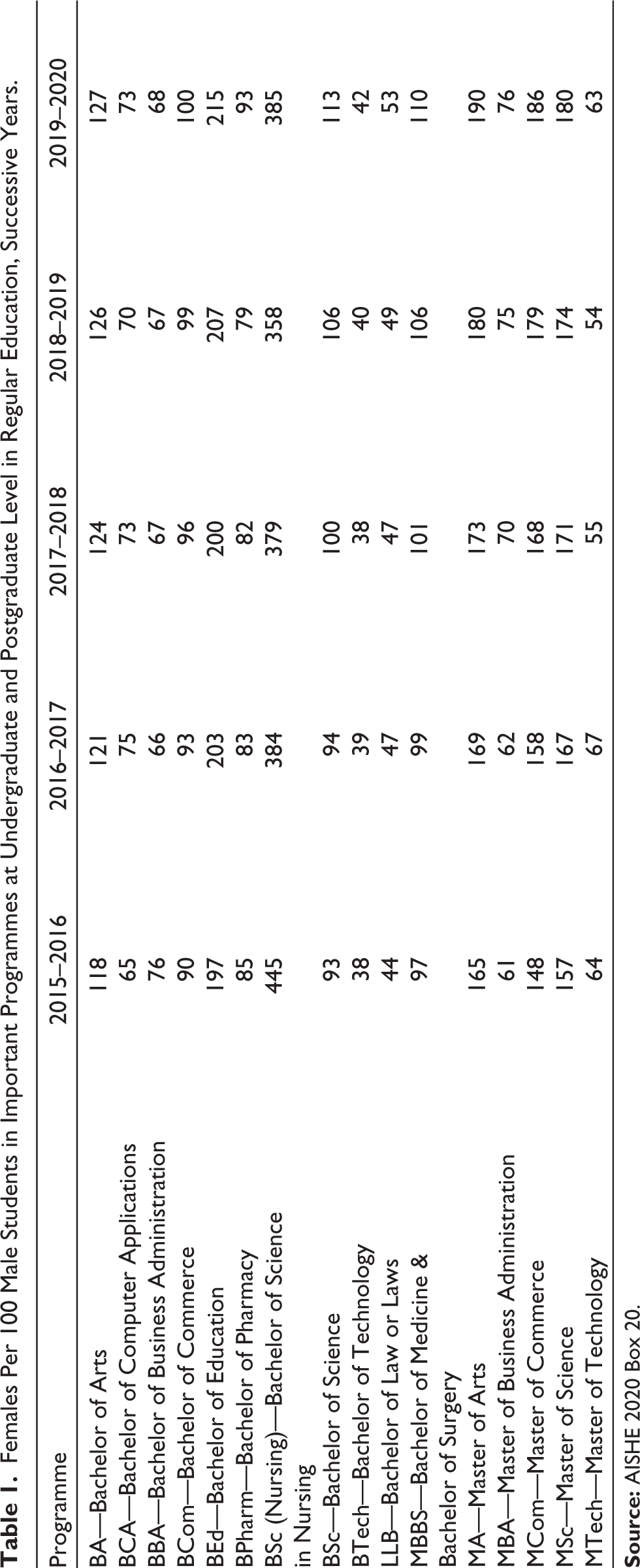
Table 1 has been taken from the AISHE Report of 2019–2020 and provides a picture of the last 5 years across different undergraduate and postgraduate programmes by the ratio of the number of women students per 100 men. In a situation where the adverse sex ratio already tilts against women, the figures below are all the more remarkable. Notice first of all that, barring a very few programmes such as BBA and nursing, women students have been gaining over the years. Nursing is a very interesting exception given its feminised status, where male nurses are just beginning to make inroads. Furthermore, there are more women than men students in several courses—BA, BEd, and especially in several Master level degrees. Interestingly, women are catching up or overtaking men students in degrees such as BCom, BSc and even MBBS. It is only in fields such as technology and the law where women remain about half that of men—though this is a major advance from the past.
Females Per 100 Male Students in Important Programmes at Undergraduate and Postgraduate Level in Regular Education, Successive Years.
While in terms of numbers, male students exceed female students at the undergraduate level for the country as a whole, there are, according to the same report, more women than men in several states—Assam, Chhattisgarh, Haryana, Himachal Pradesh, Karnataka, Kerala, Punjab, Tamil Nadu, Telangana, Uttar Pradesh and West Bengal.
Even more remarkable, to the extent that disaggregated data are available for SC, ST and OBC, the gender-wise break up across different courses does not diverge much from that of the general category. There are more SC, ST and OBC women in BA degrees than their male counterparts, and in the case of law the skew is worse in the general category.
Therefore, even allowing for variations across disciplines and states, there is no gainsaying the fact that higher education is witnessing an aspirational transformation that has hardly gained the attention that it so rightly deserves. Obviously, these figures are but an entry point, and urgently need to be fleshed out with much more information. We may wonder, for instance, about completion and drop-out rates. Note, however, that the high presence of women is even more pronounced at the level of master’s degrees, and has been rising over the years. But before discussing this further, let me turn to the NEP.
Prior Policy Initiatives
How should such developments and their potential be situated in terms of the state’s perspectives on higher education in recent years? When we locate the NEP in relation to prior efforts in the world of policy, only certain priorities appear to have been in focus. Previous governments since the beginning of the twenty-first century were already extremely active on the subject of education and higher education in particular. Few would remember that the National Democratic Alliance (NDA) government (1999–2004) appointed Kumar Mangalam Birla and Mukesh Ambani as part of a special group to guide the financing of education, health and rural development. Their Policy Framework for higher education, as one might have expected, expressed full faith in a future made up of privately run universities, with deep market driven perspectives and rather short sighted views about the very purpose of education. Under the subsequent United Progressive Alliance (UPA) government, two noteworthy reports were to emerge under their respective Commissions or Committees—the report of the National Knowledge Commission (NKCR, 2009) and the Report of the ‘Committee to Advise on Renovation and Rejuvenation in Higher Education’, better known by the name of its Chairperson, the late Yash Pal (YPCR, 2010). It is not possible to go into any detail about these reports. What should be mentioned, however, is that these reports bore definite signs of the new winds that were blowing in contrast to an earlier policy environment, where universities were predominantly funded by the state, but where the growing phenomenon of private and commercial higher education was not being acknowledged (with the South Indian states of Kerala, Karnataka, Tamil Nadu and Andhra leading the way from the 1970s). Both of these reports wished to see an end to the system of affiliated colleges, and announced a slew of recommendations for disbanding the University Grants Commission (UGC) in favour of new kinds of regulatory bodies. The UPA government in its Eleventh Five Year Plan (2007–2012) made the unexpected move of turning around prior years of declining state investment in education, and especially in higher education. This Plan came to be colloquially known as the ‘Education Plan’, and amongst its special features was an almost nine fold increase in expenditure outlays for higher education. The final years of the UPA-led government also saw several hurriedly formulated new Bills being brought before Parliament, when Kapil Sibal was the Education Minister, in an explicitly announced attempt to make India a global player in the universe of ‘world class universities’.
All this is being mentioned in the present context to indicate what sorts of trends have been underway in the policy world of education and higher education in the last couple of decades, however confusing and contradictory. Already in those years, experts in the field of educational policy complained about the ‘absence of a policy perspective in higher education’ (Tilak, 2004). Others were openly looking to a vastly changed role of the state when it came to higher education (e.g., Kapur and Mehta, 2007; Kumar, 2011). Even so, or perhaps for precisely this reason, the new government has been running into clear difficulties in its efforts to produce a policy of its own to bolster its agendas. As Niraja Gopal Jayal has pointed out, two versions of NEP 2020 were released (without explanation) and they are not identical (Jayal, 2020; see also John & Nair, 2011). I have chosen to focus here on the one that appears to be the latest and has the most finished look (with a tri-colour cover design) which is 66 pages long (a summary perhaps of a longer version that has not been made public).
The current government has in fact been repeatedly attempting to bring out an education policy document. Five versions have circulated in some form or other since 2016, ranging from 43 to 484 pages. They have been produced by government appointed committees but without any public process of consultation. Under the chairpersonship of T. S. R. Subrahmanian the first version of a report was leaked to the press in 2016 but was then disavowed by the government. The next version ‘Some Inputs towards a New Education Policy’—all of 43 pages long—made an appearance, and turned out to have been culled from a longer document purporting to be the proceedings of a Conference. But this too fell by the wayside, and in 2019 a new Committee under K. Kasturirangan produced longer and shorter versions of a draft NEP 2019. Finally, there are the twin versions of 2020—and these versions do not have any names by way of authors or committee members. This adds to our difficulties as scholars and concerned intellectuals in figuring out the policy environment for grasping the significance of the NEP.
The NEP Report
A casual reader—unconversant with all that has been happening in the field of education by way of discussion and debate, and without a sense of the crisis that has been besetting higher education—may well be content with the feel good ethos of the report. It is suffused by a positive language, such as the idea of ‘knowledge clusters’ in place of regular schools or colleges. India is to become a ‘happy nation’ composed of ‘integrated HEIs’ teeming with healthy innovating students, under the leadership of meritorious teachers, where ancient cultural values go hand in hand with a modern scientific temper, governed by a multi-tiered system of regulation and accreditation, that is frivolously described as ‘light but tight’ but is nothing of the sort.
The main point I wish to make is about the report’s double structure. The report provides clearly articulated views on what ails education today and therefore what the solution is. So, ‘fragmentation’ heads the list of what is wrong with India’s HEIs, which will be solved by ‘integration’ into ‘holistic’ and ‘multidisciplinary’ institutions. The term ‘multidisciplinary’ appears as much as 70 times in the report, while ‘holistic’ appears 41 times.
Consider a paragraph such as the following that comes right at the beginning of the second part of the report dealing with higher education:
Given the 21st century requirements, quality higher education must aim to develop good, thoughtful, well-rounded, and creative individuals. It must enable an individual to study one or more specialised areas of interest at a deep level, and also develop character, ethical and Constitutional values, intellectual curiosity, scientific temper, creativity, spirit of service, and 21st century capabilities across a range of disciplines including sciences, social sciences, arts, humanities, languages, as well as professional, technical, and vocational subjects. A quality higher education must enable personal accomplishment and enlightenment, constructive public engagement, and productive contribution to the society. It must prepare students for more meaningful and satisfying lives and work roles and enable economic independence. (NEP, 2020, p. 33)
What more perfect vision could be imagined? This is an extraordinary statement and offers much hope. But note the very next paragraph:
For the purpose of developing holistic individuals, it is essential that an identified set of skills and values will be incorporated at each stage of learning, from pre-school to higher education. (ibid.)
Beginning with schooling, the report evinces a very strong focus on the notion of ‘stages’. So, for instance, between pre-school and class 5, children would receive foundational knowledges of literacy and numeracy, and these would be publicly assessed. At class 5 vocational education would be introduced, and, where appropriate, other ‘local’ subjects. All this can sound very innocuous or even encouraging. But there is all the difference in the world between a genuinely inclusive curriculum and one that effectively introduces different streams at various stages. Who is going to opt for vocational studies from class six? Urban middle class boys?
In the case of higher education this ‘stage’ wise thinking has been taken to extraordinary levels. Firstly, the entire system is to be revamped in a crude imitation of the US structure of higher education. In fact, the term ‘liberal arts’ education is used a number of times to describe this new trend, while decrying the current tendency in India to specialise already at the undergraduate level. Higher education is to be transformed into a 4-year undergraduate degree programme, followed by a 1-year masters and then doctoral research. In several universities such as Delhi University this transformation has already been initiated in the 2022–2023 academic year, in spite of the problems created by 2 years of pandemic induced closures and online learning. The existing affiliating university system is to be scrapped altogether and, in its place, a three tiered structure composed of autonomous colleges, teaching-centric universities and research-centric universities is to be set up (with suitable flexibility between these). But hear this: There are to be exit (and entry) points at all stages—after the first year of a UG course one could leave with a ‘certificate’, after 2 years with a ‘diploma’, after 3 years with a basic ‘degree’ and after four with a chance to move on to post-graduation.
Hopefully the problem being identified is clearer by now: On the one hand, there are repeated excellent claims about integration, giving one a picture of inclusivity, and, on the contrary, equally frequent and much more specific aims that speak of difference. These are not just benign differences but ones that will have deeply unequal consequences. Unless vocationalisation and open learning are so integrated as to be genuinely advantageous to elite students, what NEP 2020 appears to be rolling out is a multi-pronged hierarchical structure—whether this be through differences in type of institution, in subjects and streams, or even in the number of years of education.
The subject of inclusion comes close to the end and is quite briefly addressed. There are references to socio-economically disadvantaged groups and regions (SEDGs) but it is never spelt out as to what the criteria here are. Though there are a few explicit mentions of SC, ST and OBCs (with only one mention of minority communities) and—as we saw in the earlier quotation—the Constitution is alluded to, there is never any mention of reservations. Indeed, when it comes to faculty there is only talk of merit. Even more worrisome is that a tenure system is to be introduced—that is, faculty will be on probation for a certain period of time and will only be made permanent based on certain criteria, which include such undefinables as leadership qualities and loyalty. This is a major step backwards compared to the draft NEP 2019, one of whose most welcome aspects was to say categorically that all vacant positions must be filled and that the system of appointing ad hoc and temporary teachers be summarily ended. Women find practically no mention anywhere.
What about the financing of education? Once again double speak is in evidence—the proportion of GDP to be spent on education is to be raised from 4% to 6%. But on closer inspection, the heads under which state financial support is to be provided begins with early childhood education (ECCE) and nutrition programmes, apart from a few Model institutions and some fellowships. Since many years the pre-school system in operation has been the anganwadi programme under the ICDS, along with a nutritional programme through mid-day meals. But this comes under the Ministry of Women and Child Development (MWCD)—in fact it constitutes more than 90% of the MWCD’s budget. What this could well mean is that in actual fact there may be a huge reduction in funding to education, if all the budgeted amount under the MWCD is now shifted sideways to the new Ministry of Education. This means that the role of the state under the NEP is mostly going to be one of regulation. Little is even said to distinguish private philanthropy from commercial pathways, except to encourage the former and curb the excesses of the latter. The trend towards privatisation is not new—in earlier reports under the UPA, there was much talk of increasing the role of private funding in higher education. But at least strong distinctions were drawn between philanthropic versions and outright commercialisation, with recommendations that commercialisation had to stop.
One of the most genuinely challenging questions facing education in India has been its language policy. It has to be acknowledged that India has reneged on this matter and that educationists themselves have not been able to implement any of their principles and theories. In the name of a three language formula, what exists today is basically poor quality government schooling where state languages are the medium of instruction, coupled with a spectrum of schools where teaching is in English. At the level of higher education there is the unsatisfactory juxtaposition of state languages and English in state institutions, and in Central universities English is the main language, while some accommodation is allowed for Hindi. The previous draft NEP 2019 had come out with a three language formula that included Hindi, which immediately invited strong negative reactions from Tamil Nadu. Hindi is mentioned only once in the current report with no mention of its compulsory nature. Instead, however, Sanskrit is discussed at considerable length, this language being mentioned 23 times. It is more than likely to figure in any future three language design. But it remains interesting that state languages have been given some acknowledgement and a recent news announcement reported that some technical institutions were preparing to start teaching in their respective state languages. This could be one of the aspects of the NEP 2020 that call for much more engagement, given the enormous challenges involved and the failures of the past.
The Gender Question in the NEP
I have provided a very brief sketch of the main dimensions of the NEP document pertaining to higher education that required some foregrounding in order to pose the question of gender, which is not a theme one can find in the document at all. Women’s empowerment is a commonplace in most policy documents in the field of education—the 1992 Plan of Action for example is often remembered for explicitly bringing it into focus, and even pointing to the role that the fledgling field of women’s studies could be playing in furthering agendas of equality. But in this document, for all its references to multi-disciplinarity and holism, and to a liberal arts curriculum, women’s or gender studies is conspicuous by its absence.
Therefore, one has to embark on a more speculative enterprise. What might be the consequences of the world view of the NEP and its main characteristics and dangers as these have been outlined in the previous sections? If women have been making giant strides across social groups as recent entrants into higher education what might the new NEP inspired structures hold in store? The best reading of the new 4-year undergraduate programme with its multiple entry and exit options is that it has been taken from certain western contexts where relatively high levels of employment have been a pattern across groups and across genders. In such a world, men and women from different social locations may well see some purpose in juggling jobs of varying duration with further credentialing in the hope of improving their prospects. This kind of system is debatable in the west itself with its lack of stability. However, in a job starved market in India—where in particular women’s employment levels have been low and even declining in recent decades—what would this tiered system achieve? Is it actually going to be one of expanded options or just a gilding of the lily of dropout rates?
When it comes to women, it is quite noticeable that with such low rates of viable job opportunities it is not employment but marriage that is the most definitive horizon in terms of their futures. The Indian marriage market is amongst the most complex and hierarchised—by wealth, by caste and community, and continues to be dominated by the families who do the ‘arranging’ for the couple in question. So it might well be argued that a college system with multiple options of entry and exit could better accommodate such a marriage market, and provide chances of re-entry, for instance, some years after marriage. This is however highly speculative—there are more examples of women leaving education and even leaving jobs to cope with marriage and family pressures. While natal families are undoubtedly willing to invest as never before in their daughter’s education for the sake of ‘settling’ them in a socially and economically secure marriage (often accompanied by a hefty dowry), there is much less evidence of in-laws giving their newly acquired daughters-in-law options of re-entry in say higher degrees. Moreover, in a context where the cost of education is clearly going to be born increasingly by families—with educational loans expanding correspondingly—one has to wonder—will daughters continue to be seen as equally worth such investments compared to sons? Who is going to bear the burden in the repayment of a girl’s educational loan?
It is obvious that we are not well placed in thinking about the possible impact of the NEP that is already being implemented across several universities and colleges. When it comes to gender, my worry is that we have not given the extraordinary presence of women in HEIs sufficient attention in the first place. For reasons that I do not understand, their very presence has not been taking seriously enough.
The statistical evidence of women’s growing presence in HEIs that I alluded to earlier on is but the tip of the ice-berg. There is so much more that needs to be explored and better understood about the experiences of higher education for different women. Beyond questions of access, what meanings can be attached to the hopes that women have placed on gaining entry, to the kinds of courses they choose and the obstacles they encounter? There is one issue that has gained public attention, especially in recent years, in the context of women’s presence in spaces such as colleges and universities. Sexual harassment on campuses has gained some space and voice when it comes to acknowledging problems that women students might well experience.
Since the 1970s, sexual harassment in public spaces has been on the agenda of the women’s movement. In the 1990s the first efforts were made to set up mechanisms for dealing with sexual harassment in a few universities. Yet further attention came in the wake of the Delhi gang rape of 2012—called the Nirbhaya case by the media. Much has been written about the extraordinary protests that erupted across cities in the aftermath of the case. As I have discussed elsewhere (John, 2020), new movements among young people and especially among students made waves and were by no means confined to the city of Delhi. Perhaps because the victim was a student, the institutional responses to the incident also included a sense of accountability on the part of the UGC. A Task Force was set up to look into questions of safety and freedom and the result was a report Saksham (UGC, 2013). Gender sensitisation on Indian campuses turned out to be one of the least addressed of issues, and the subject of considerable confusion and denial among administrators. When they were able to share their views in open forums, the vulnerability of students to sexual harassment was undeniable, compounded by axes of disability, sexuality, class, caste and minority status. Students placed considerable hope on what a different campus culture could achieve. The Saksham Report attempted to capture the views of students who strongly and repeatedly articulated that a university ‘should help women transition from the protected atmosphere of the home into a real life situation where she had to be independent’ (ibid., p. 37).
A decade has elapsed since the fatal gang rape of 2012 and the kinds of interventions that followed—such as the Prevention of Sexual Harassment at the Workplace Act (2013) and the UGC’s Saksham report. Some years later the UGC brought out the revised regulations for Internal Complaints Committees (ICCs). Harassment and sexual violence have continued to occupy public attention, both in universities and in workplaces. India witnessed its own #MeToo moments in 2017 and 2018 (John, 2020). The point I am making here is that there is something about sexual violence that provides both a language of protest and one of redressal and accountability from institutional locations, including from bodies such as the UGC. I am not arguing that the situation is therefore a satisfactory one. Far too few universities to this very day have redressal systems in place or engage in gender sensitisation activities on their campuses. The sheer expansion in the presence of women students is no guarantee of their greater freedom and safety or that institutions will respond to their demands.
I have briefly taken up the question of sexual harassment here because it occupies such a recognisable space in women’s lives. The question before us is, what might be the consequences of the implementation of the NEP when gender per se does not seem to be on its horizon of concern in the first place? One wishes that the implementation of the NEP will be examined and held to account in much the way that harassment has been in the recent past.
To be quite clear, it is the larger policy ethos that has been evolving in the last few decades—one that has largely bypassed thinking about women’s futures—that should also be held responsible for the fact that the NEP could be so cavalier in its treatment of questions of equity more generally and gender more specifically. In a world where gender inequalities have otherwise been so rife, higher education has been a unique space of access, in spite of all its limitations and problems. I have suggested, however speculatively, that a closer look at the NEP policy document with its differential structures of entry and exit, its nod towards commercialisation and so on, does not bode well for women students among others. By acts of commission and omission—that is, by its overall neglect of questions of gender and its vague treatment of SEDGs, with none of the reservations architecture being given its due—the NEP may have to take it share of responsibility that the unexpected growth in the presence of women in higher education is going to witness a retreat in the coming years.
Footnotes
Declaration of Conflicting Interests
The author declared no potential conflicts of interest with respect to the research, authorship and/or publication of this article.
Funding
The author received no financial support for the research, authorship and/or publication of this article.