




Abstract
This article explores the Hawthorne studies, an industrial research programme conducted at Western Electric Company from 1924 to 1933. The analysis focuses on the longest-running experiment, in which female workers in their twenties operated a relay assembly in a room specially designed for the experiment and were monitored by a group of engineers and industrial researchers. Based on the authoritarian setting, this research situates the experiment in the wider history of making workers through complex systems of value attributions, such as classifications and technologies of characterisation. However, examination of previous research and accounts of the Hawthorne studies suggests that the relay assembly test was also an ambivalent research setting characterised by negotiations and strategies which converged into the dynamics of knowing and being known. This article thus offers a new critical perspective on the experiment by regarding the operators as active players in an industrial labour process game rather than cooperative, adaptive laboratory subjects.
Introduction
The Hawthorne studies, an industrial research programme conducted at the Hawthorne Works of Western Electric in Cicero, Illinois, from 1924 to 1933, is among the most discussed experimental studies in management history. On the one hand, it has been argued that this experiment, interpreted by Australian-born psychologist Elton Mayo (1880–1949) in cooperation with colleagues at Harvard Business School, built the scientific foundation of personnel management and the Human Relations School. On the other hand, however, critics have raised serious questions about the experiment’s authoritarian nature and Mayo’s role in it. Did the experiment achieve a breakthrough in industrial management, or did Mayo merely manipulate workers’ minds to fit capitalism? Was Mayo a legitimate psychologist, industrial researcher and organisational theorist, or a seductive consultant who sold managerial and political elites attractive stories about teamwork and adaptation? These questions have been debated in management theory since the 1950s, but nevertheless, a consensus holds that the scientific setting of the experiment speaks directly to the core of executive concerns, particularly those related to unionised labour and problems of adaptation to mass production (Burawoy, 1979; Frenkel & Shenhav, 2006; Gillespie, 1991; Hanlon, 2016; Hassard, 2012; Illouz, 2008; Mannevuo, 2015; O’Connor, 1999; Rose, M. 1978; Rose, N. 1999; Stearns, 1994; Whyte, 1956/2002).
This article draws on and extends earlier critical works with a nuanced reading that is more reparative than paranoid (Sedgwick, 2003). The aim of this research is not to expose and track the obvious, violent exploitation of factory workers in the early twentieth century; indeed, one need not be delusional to find clear evidence of oppression in these settings. Instead, the aim is to develop a new critical perspective on the Hawthorne experiment from an ‘alternative historiography’ based on the premise that ‘any knowledge tends to grow in chaotic, unorganized and often hybrid manner’ (Shenhav, 2005, p. 185). This approach connects previous critical studies to wider debates about the classed and gendered conditions of possibilities shaped by the classifications, characterisations and technologies of value attributions (Skeggs, 2010). I am especially interested in how character types were attributed to workers during the Hawthorne studies and how these character types were used as ‘systems for creating distinctions’ (Ahmed, 2011, p. 232) between workers and their actions. However, although my reading focuses on the ambivalences of knowledge production, it does not deny the harsh reality factor workers experienced in the early twentieth century.
This reading situates the Hawthorne experiment within the cultural framework of the nationalistic fantasies of the 1920s, 1930s and 1940s, particularly those of making respectable factory workers adapted to industrial mass production. Drawing on Lauren Berlant’s (2008) theories on the unfinished business of sentimentality in American culture, I suggest that the Hawthorne studies, with their focus on adaptation and personal equilibrium, are part of the affective culture of capitalism that flourishes in proximity to the political, although it is not always defined as political. As explained, this culture operates through classed, gendered and racialised welfare programmes and experiments ‘managed by elites who are interested in reproducing the conditions of their objective superiority’ (Berlant, 2008, pp. 2–3). Nevertheless, as I argue, despite the obvious violence and authoritarianism, these settings always have fractures that might open up possibilities for reparative readings of the process of making workers and thus revise overly deterministic theories of oppression and vulnerability.
The case examined in this article is the relay assembly test, the longest-running experiment in the Hawthorne studies. From 1927 to 1931, the experiment took place in a specially designed room where five relay assemblers, young women in their twenties, sat alongside each other on a bench, and a sixth worker, the layout operator, prepared trays of relay parts for the operators to assemble. The experiment’s aim was to investigate the effects of illumination, humidity and temperature on the operators’ individual production and attitudes towards assembly work. This article focuses on details recorded in the massive, final report on the experiment, Management and the Worker: An Account of a Research Program Conducted by the Western Electric Company, Hawthorne Works, Chicago (1939/1961), written by Fritz Jules Roethlisberger, a student of Mayo, and William J. Dickson, the chief of the Hawthorne Works employee-relations research department. The account is supplemented by Mayo’s well-known work The Social Problems of an Industrial Civilization (1949/2000), as well as his biography by Richard C. S. Trahair (1984/2009). The 600-plus page account of the experiment mentions Mayo only three times: in the acknowledgements and two notes explaining that the researchers used his therapeutic methods to interview workers and listen to their complaints (Roethlisberger & Dickson, 1961, p. 272 n. 1, p. 325, n. 1). Nevertheless, Mayo is often regarded as a key actor in the experiment who developed a management theory with a therapeutic twist for industrial and political elites.
As Richard Gillespie (1991) points out in a detailed archival analysis, Manufacturing Knowledge: A History of the Hawthorne Experiments, the relay assembly test was a highly ambivalent experience for the workers. On one hand, it gave them a special position with benefits, such as tea and snacks, whereas, on the other hand, they also had to accept constant monitoring, observation and medical tests. In addition, gossip about the experiments circulated in the regular departments, and after hearing that tea was served in the test room, other assemblers started to call it the ‘T room’ (Gillespie, 1991, p. 59). In my reading, I do not speculate about how the operators truly felt about the experiment, but inspired by Foucault’s (1966/1994) archaeology of the sciences, I investigate how the scientific methods of characterisation were used to classify and subordinate various character types to one another. How did the method of characterisation link character types to functions and organise them according to the industrial architecture? How did this experimental method flourish in proximity to the nationalistic fantasies of an adaptive society, and how did it serve as a technology of value attribution?
This article is structured in four parts addressing these questions. In the next section, I outline the case of the relay assembly room test and analyse an incident in which two operators were replaced due to uncooperative behaviour and adaptation problems. I then turn to the two main points of this article. First, I analyse the process of characterising workers in the T room as a technology of attribution when workers become problems, creating the need to question their character. Second, I ponder how this technology of value attribution was used to create distinctions between character types to develop a powerful narrative about teamwork and wholehearted cooperation with management. Next, I show how Mayo used the methods of characterisation to explain the transformation of an established social order into an adaptive social order. Finally, I conclude by situating this experimental method in the broader affective history of the rationalisation of labour, which I argue cannot be separated from the complex systems of value attributions and the constant struggles within these compromised conditions of possibilities.
Workers in the relay assembly test
The Hawthorne experiments were planned by a team of industrial engineers led by George Pennock, the superintendent of the Technical Branch at the Hawthorne Works, who also belonged to the general directive board of the Committee on Industrial Lighting. After the experiments began in 1924, the relay assembly test room, also led by Pennock, was established in 1927. The initial aim of the experiment was more technical than therapeutic: to determine the most appropriate technical and social arrangements for the production process, as indicated in Gillespie’s (1991) archival findings. In retrospect, however, one can argue that the test room setting offered a great opportunity for industrial psychologists to monitor the psychophysiological effects of tedious, monotonous assembly work requiring calm nerves and concentration.
The women selected for the relay assembly test room were roughly representative of the unskilled relay assemblers at the Hawthorne Works. Gillespie (1991, p. 55) gives the workers’ names, ages, ethnicities and identification numbers:
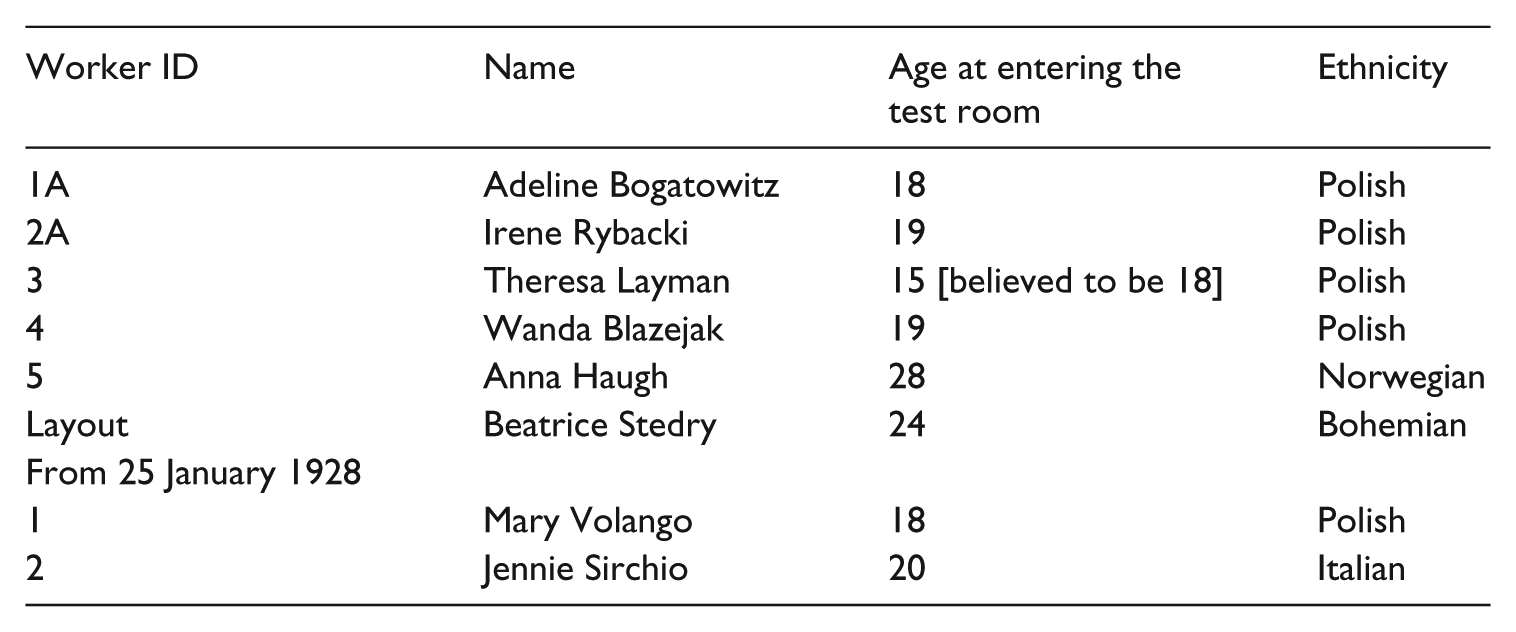
As this list shows, the operators were young women in or near their twenties. Operator 3, Theresa Layman, was believed to be 18 years old but had lied about her age to obtain a job at the Hawthorne Works. This, along with other details of the women’s social backgrounds from Chicago’s ethnic working-class communities, indicates that the operators had to work at the factory to earn additional income for their childhood families (Gillespie, 1991, pp. 53–54). As well, while working at the factory, they participated in an ‘Americanisation program’ (Meyer, 1980, p. 75) aimed at ‘teaching’ immigrants the American way of life through adaptation to the system of mass production. Consequently, the social relations of the test room were extremely hierarchical and set; the researchers, for instance, referred to the operators as ‘girls’ – ‘a practice still adopted by many recent commentators’ (Gillespie, 1991, p. 55). Nevertheless, as the experiment continued, the ‘girls’ became eager to articulate their own interpretations of their work and how it should be organised. This active role pushed the experiment in a different direction than expected.
The research setting of the relay assembly test room is one of the peculiarities in the Hawthorne studies. The setting was highly gendered, hierarchical and authoritarian, but the girls were also invited to take an active role. For instance, they were given unusual directions for assembling work that they should not ‘hurry’ or ‘drive’ and should ‘work at a natural pace’ (Roethlisberger & Dickson, 1961, p. 32) and the work environment was ‘friendlier’ than in the regular department with hundreds of relay assemblers. The women nevertheless also had different obligations than the workers in the regular department. They had to undergo monthly medical examinations and share intimate personal details, such as the timing of their menstrual periods. From the start, the women, especially Adelene Bogatowitz, held ‘somewhat antagonistic’ (Gillespie, 1991, p. 59) attitudes towards the examinations and the doctors’ and nurses’ personal questions. The research team attempted to diminish the formality of the medical experiments by transforming them into a ‘party’ with a cake (Roethlisberger & Dickson, 1961, p. 34). Despite, or perhaps partly because of, these ‘friendly’ gestures, confrontations started to occur in the relay assembly test room.
The problems first emerged when Operator 2A (Rybacki) started to ‘abuse’ the test room privileges (Roethlisberger & Dickson, 1961, p. 50). For example, she refused the cake offered at the medial tests and made sarcastic, cheeky comments, such as ‘Do you see any holes in my head?’ and ‘I’m going “nuts” on this job. … If I get any more repairs, I’m going on strike’ (Roethlisberger & Dickson, 1961, p. 50). Gillespie (1991, p. 61) writes that Rybacki also had a favourite chant (‘We do what we want, we work how we feel, and we say what we know’), which her close friend Bogatowitz also adopted. Surprisingly, the researchers somewhat tolerated Rybacki’s cheekiness and chants. What they saw as a problem was her disruptive talking, which affected not only her personal productivity but also the productivity of the whole team.
Indeed, Rybacki was a young woman in her teens, so her babbling, laughing and eagerness to talk about movies, clothes and boyfriends while working can be seen as normal and harmless. In the factory setting in the 1920s, however, such behaviour was strictly forbidden, including at Hawthorne Works, although the factory was well known for its ‘welfare capitalism’ and ‘taking care’ of its employees to discourage the rise of organised labour (Hassard, 2012, p. 1438). In many ways then, Rybacki crossed the lines of the rules of behaviour more frequently than workers were allowed to. Confrontations arose, especially when she was late by three minutes a couple times. At this point, the researchers became concerned that Rybacki and Bogatowitz, the leaders in the movement of excessive talking (Roethlisberger & Dickson, 1961, p. 53), could jeopardise the experiment. The researchers then held a serious conversation with operators 1A and 2A: The first step was to call Operator 2A into a conference with the test room authorities. She was told of her offences, of being moody, inattentive and not co-operative. In this conference she was apologetic and promised to improve. But upon going back to the test room her old attitude returned immediately. She was later interviewed by the superintendent, with no better results. Her output continued downward, and her attitude became more hostile than ever. Operator 1A was clearly her ally, and her output was likewise affected, although both girls improved slightly during the last two weeks of the period. It was finally agreed, however, that for the best interests of the test these two girls should be returned to the department and replaced by two new girls. (Roethlisberger & Dickson, 1961, p. 55)
The description of this incident makes visible the hierarchical nature of the experiment setting. Here, the T room operators’ special position encountered the harsh reality of industrial management and the Americanisation programme, where immigrant workers gained value solely through hard work, obedience and self-discipline. Rybacki and Bogatowitz’s replacement with two new girls makes this dominance even clearer.
Soon after the replacement of these two operators, the production rate of the test room increased. Pennock, the primary investigator in the experiment, proposed some explanations for this improvement, but the change in outputs nevertheless puzzled him. Clarence Stoll, vice president of the Hawthorne Works, encouraged him to seek consultation through his networks at the Western Electric Company’s New York headquarters. Soon, Pennock told the ‘T room girls’, ‘We’re going to have a man come out from one of the colleges and see what he can tell us about what we’ve found out’ (Gillespie, 1991, p. 68). This man was Elton Mayo, who had been appointed professor of industrial research at the Harvard Business School in 1926. Mayo entered the experiment in 1928, which gave him the momentum to continue his research programmes on psychopathologies and industrial fatigue. He immediately found his favourite case during his first visit to the Hawthorne Works: Irene Rybacki, whom he characterised as a troubled, anaemic Bolshevist.
The riddle of an anaemic Bolshie
When Mayo joined the Hawthorne experiment, he had a reputation for connecting his clinical career treating soldiers suffering from shell-shock with the psychopathologies of industrial settings (Trahair, 2009, p. 171). Predictably then, he was interested in the operators’ medical records and, during his first visit, found that Rybacki’s records indicated anaemia. This finding encouraged him to speculate that there might be a connection between Rybacki’s organic imbalance and her ‘pessimistic or paranoid preoccupations, fatigue and organic disability’, which eventually made her to ‘turn Bolshie’ (Gillespie, 1991, p. 73). Indeed, Rybacki provided an unexpected opportunity for Mayo, who was fascinated by her. He appears to have seen in her case the possibility to combine two questions that had puzzled him throughout his intellectual career: working-class antagonism and women’s neurasthenia and irrational fears. The former gained his attention after his encounters with the irreconcilable extreme left in Australia during the 1910s, and he encountered the latter in his clinical work and his personal life. As his biography reveals, Mayo was eager to treat his three sisters-in-law, Katherine, Ursula and Barbara, whom he believed all suffered from different types of neurasthenia (Trahair, 2009, pp. 110–123). As a case, Rybacki connected all these puzzles: neurasthenia, Bolshevism, imbalanced organic equilibrium and the relations among politics, psychoneurosis and the seamy side of industrial progress.
In the article ‘The mind of the agitator’ (1922), Mayo relies heavily on the assumptions of Freudian psychopathologies to explain social ills. He asserts, for instance, that ‘the agitator is usually a genuine neurotic’ who is ‘quite definitely disoriented to his world: he cannot see society as a group collaboration’ (Mayo, 1922, as cited in O’Connor, 1999, p. 126). It is no wonder then that Mayo considered Rybacki, with her chants and uncooperative behaviour, to be a classic case of a troubled woman whose suffering from anaemia and industrial fatigue turned her into a Bolshie. Bolshevism then was a symptom, which an experienced psychologist could cure with proper treatment. Mayo even had a recovering-from-Bolshevism mantra: ‘as soon as one decides to act instead of pitying oneself, life improves, and work becomes productive’ (Trahair, 2009, p. 234). To prove his theory, Mayo told the story of a Bolshevist, whom he describes as one of the most difficult communists he met at union meetings in Australia. The man was extremely hostile and unable to form normal human relationships. Eventually, after some incidents, he ‘drifted into the hands of a medical colleague with whom I was accustomed to work on problems of adaptation’ (Mayo, 2000, p. 24). After his colleague established a clinical relation with the Bolshevist, he made a good recovery: He [‘Socialist, I.W.W., Bolshevist, Communist’— ‘whatever the change of name or doctrine’ (Mayo, 2000, p. 23)] discovered that his medical adviser was not at all interested in his political theories but was very much interested in the intimate details of his personal history. He made a good recovery and discovered, to his astonishment, that his former political views had vanished. He had been a mechanic, unable to keep his job although a good workman. After recovery he took a clerical job and held it; his attitude was no longer revolutionary. (Mayo, 2000, p. 24)
Drawing on his experiences with the extreme left and the clinical methods he had developed with his sisters-in-law, Mayo recommended that Rybacki should be put on a special diet and have a two-week vacation. After this treatment, her blood count improved, and she ‘began to take positive interest in life at home’ (Trahair, 2009, p. 230). This story claims that Rybacki was ‘cured’, and although she left the study, she continued to work as relay assembler until 1930.
Although Rybacki was only one of the thousands of female workers at Hawthorne, Management and the Worker focuses almost obsessively on her character: an anaemic, nervous, irritable and dominating personality able to manipulate operator 1A (Bogatowitz), who, in contrast, was quiet, shy and influenced by others’ opinions (Roethlisberger & Dickson, 1961, pp. 167–169). Rybacki then ‘turned Bolshie’ (Trahair, 2009, p. 230) not only as she was anaemic and started to believe her colleagues from the regular departments who said that the test room study was a management scheme to maximise profits. She also turned Bolshie as she was a wilful, moody, talkative, ill-tempered woman. This type of characterisation is, as Ahmed (2011, pp. 232–233) notes, a technology of attribution that can be used to question a person’s character and to create distinctions between character types and arrange them to solve conflicts between individual and general will. Rybacki’s chants were seen as an example of the conflict between individual will (‘working how I feel’) and general will (improving productivity), so her wilfulness was compared to that of more adaptive, productive operators, particularly her replacement, Jennie Sirchio. The next section focuses on the process of the characterisation of the highly productive Sirchio. Following this, the analysis turns to how the researchers used the technology of value attribution to draw conclusions about the larger society based on differences between the assemblers.
Making a dream team
As established, the Hawthorne studies research team, including Mayo and his colleagues, characterised Rybacki as a moody, ill-tempered woman who posed problems for the experiment and the T room team. Her replacement, Sirchio, was explicitly characterised as the opposite. In accounts of the experiment, Sirchio even emerges as an informal leader who took responsibility for encouraging the group to cooperate wholeheartedly and spontaneously (Mayo, 2000, pp. 62–64; Roethlisberger & Dickson, 1961, p. 167). But did the process of making a dream team go as smoothly as described? Did Sirchio work wholeheartedly and spontaneously?
When supervisors recommended the 20-year-old Sirchio for the experiment, she was going through an extremely stressful period of life after the death of her sister. Her supervisors thought that the change would do her good, but unfortunately, soon after she joined the experiment, she suffered a new shock as her mother died unexpectedly. Moreover, after these tragedies, her father and brothers were laid off from work, making Sirchio the breadwinner, housekeeper and financial manager in the family (Gillespie, 1991, p. 64; Roethlisberger & Dickson, 1961, p. 171). Needless to say, this moment in her life was stressful, both emotionally and financially. No wonder then that Sirchio is often described as a worker highly motivated to achieve high output, especially when the assemblers could earn bonuses (e.g. Rose, 1978, p. 120). Indeed, the researchers repeatedly highlight that Sirchio adamantly evaluated opportunities to improve working conditions at the test room solely in terms of wages. For instance, when the researchers asked about the girls’ thoughts about the possibility of shorter working days, Sirchio answered, ‘As long as we can make as much money, it is fine’ (Roethlisberger & Dickson, 1961, p. 62).
Mayo, however, did not pay any attention to these details. Instead, he characterised Sirchio as an ambitious worker who had an outstanding ability to adapt and cooperate. Thus, for Mayo, the change from moody operator 2A to ambitious operator 2 meant that the whole group began participating in the experiment without any reservations or coercion from above or limitations from below (Mayo, 2000, p. 72). Setting all the records in speed tests and various dexterity and intelligence tests, Sirchio changed not only the productivity of the test room but also the technologies of attribution. Whereas Rybacki was characterised as a blabbering Bolshie, Sirchio was permitted to be talkative and to suggest changes in the test room – even to criticise company policies, have ‘occasional critical outbursts’ and give ‘caustic’ comments to the other girls (Roethlisberger & Dickson, 1961, p. 167). Apparently, Sirchio had a habit of chastising other workers (‘Come on, you. Do some work and shut up’), which occasionally led them to snap at her (‘Oh, shut up, ambitious’) (Gillespie, 1991, p. 64). Nevertheless, the accounts and archives tell that the girls became good friends and achieved both individual and collective records.
Management and the Worker obviously records the narrative of outstanding cooperation from the researchers’ point of view. Interestingly, it implies that the researchers had an emotional, sympathetic identification with the girls: ‘they never treated them as nonhuman laboratory specimens’, although they wanted them ‘to be good human laboratory subjects (i.e. co-operative)’ (Roethlisberger & Dickson, 1961, p. 183). From the observer’s perspective, the women indeed had a special position at the factory with occasional privileges, such as tea, snacks and rest breaks. Is it possible then that the researchers expected them to be grateful? This could partly explain the tense dynamics in the test room. Even after the replacement of operator 2A (Rybacki) by operator 2 (Sirchio), the girls kept challenging the supervisors by organising the test room to serve their benefit and by talking silently and secretly (Gillespie, 1991, p. 80). However, Mayo, as well as the other researchers, remained obsessed with their fantastical ideals and claimed that the researchers’ interest in the girls gave them a sense of importance which changed their mental attitude from reluctance and suspicion to cooperation.
The research team, however, raised some conflicting views. For instance, Imogen Rousseau, hired to interview the girls in 1931, stressed to Mayo that she was unsure whether there had been any changes in their attitudes and that she found the interview process uncomfortable. During the interviews, the girls were impertinent, suspicious and wilful; they kept track of time and avoided personal subjects by asking how their answers would affect their wages (Gillespie, 1991, pp. 85–87). Unlike what the theories of wholehearted cooperation suggest, the test room seems to have been more like a labour process game with a set of limited choices and strategies that affected the outcomes, sometimes in unintended ways (Burawoy, 1979, pp. 92–93). To elaborate, I propose that the T room was not solely an effective, manipulative, managerial scheme but also ‘a cultural machine’ (Thompson, 1996, p. 23), where the zones of finances and affect intertwined and worked in tandem with capitalist production. Whereas the research team regarded the participants as foolish, young girls for whom work was more about friendship and feelings than money or wages, the women quite cleverly used their position to their benefit, as Rousseau’s views on the experiment imply.
The narrative of the experiment could have been different if the women had been treated as political, not vulnerable, subjects. However, the researchers, particularly Mayo, desired to perceive the experiment as a unanimous effort to make a dream team that worked wholeheartedly with the management. Moreover, the researchers were eager to interpret the experiment as a cure for industrial fatigue and antagonism using suitable but vague psychological concepts, such as adaptiveness and equilibrium. This methodology turned the antagonistic factory worker (a person with a status in a hierarchy) into a subject of feeling (Berlant, 2008, p. 145), a figure in a story of non-anxious social membership. Mayo later used this sentimental framework to establish a powerful argument against economists’ theories of industrial research positing that there is a logical inference between a complaint and its origin. By contending that ‘diagnosis, rather than argument’ should be ‘the proper method of procedure’, Mayo (2000, p. 73) offered a theory for the industrial and political elites to save society from antagonism and class politics. To support his argument, he used characterisation as a technology of attribution and claimed that Sirchio, despite her troubled financial and emotional situation and occasional critical outbursts, was productive as she was able to sustain her equilibrium with self-discipline and proper guidance. This assumption, as analysed more closely in the following sections, formed the basis of Mayo’s theory of an adaptive society.
A movement towards an adaptive society
In The Social Problems of an Industrial Civilization, Mayo (2000, pp. 66–67) writes that while analysing the Hawthorne experiment in the 1930s, he did not yet understand how many problems the ‘radical change from an established to an adaptive social order’ would cause in relations between management and individual workers. Starting from this premise, Mayo developed a new diagnostic, emotion-focused managerial theory to govern and educate workers during the 1940s (Rose, 1999, p. 72). However, his theory was not aimed solely at curing individual workers but also at civilising all of society which, in his theory, could suffer a nervous breakdown caused by irrational ‘night-minded’ savages (Frenkel & Shenhav, 2006, pp. 864–865). In Mayo’s vision, all kinds of hatred and bitterness, including those that led to the world wars, could have been avoided if humanity developed its social skills to the same extent as its technical skills. This civilising mission is also visible in the technologies of attribution and differentiation between Sirchio, the productive team leader, and 15-year-old Theresa Layman, operator 3, whom the researchers believed to be 18 years old.
Layman was as critical of the T room experiment as Rybacki, but she was not accused of turning Bolshie. In one instance, Layman even told to the observer to ‘shut up’, which made Sirchio to laugh and state: ‘Look at that. Look at the way she tells her boss to shut up’ (Roethlisberger & Dickson, 1961, p. 71). Why then did the observers keep Layman in the T room? First, she possibly was considered to be a foolish young girl, not a problem character like Rybacki, with her Bolshevist chants and ill temper. Second, Roethlisberger and Dickson (1961) repeatedly stated that operator 3 (Layman) had a problematic, dysfunctional family and that her mother was a dominating, controlling personality who kept using Layman’s salary. The researchers characterised Layman as a ‘frivolous’ character whose mother caused her ‘hypochondriacal complaints’ and childish need for men (Roethlisberger & Dickson, 1961, p. 172), and unlike Rybacki, she was viewed as a chameleon who gave the impression of being light-hearted, although she was very sensitive and oppressed. Small wonder then why Layman wondered out loud what dress she should wear to an interview with Rousseau: ‘I guess I have to wear my coat down there. My dress is too short. That shows depression’ (Gillespie, 1991, p. 86). Indeed, Layman knew that she, along with her family, was an object of knowledge. Interestingly, this awareness gave her some, albeit minor, possibilities to take an active role in the experiment.
Although Layman received some tolerance from the researchers, they also considered her to be a problem for the experiment and the team. The account of the experiment states, for instance, that her moods influenced her output, leading to continual disputes with Sirchio (Roethlisberger & Dickson, 1961, pp. 168–169). These conflicts and Layman’s ‘antagonism’, however, gradually ‘diminished’ when ‘Operator 3 became the butt of considerable joking from the whole group, which she took good-humoredly’ (Roethlisberger & Dickson, 1961, p. 74). These moments indicate that Sirchio was allowed to admonish other workers without being defined as a dominating personality. Whereas Layman, seen as sensitive, was permitted to display a somewhat antagonistic attitude, Sirchio had relative freedom to be talkative and bossy.
The most obvious explanation for this hierarchical characterisation was Sirchio’s productivity. However, the technology of attribution was used to evaluate not only individual workers but also their families and their adaptation to the American way of life. Unlike Layman’s ‘dysfunctional’ family, Sirchio’s Italian family was described as highly respectable, ‘well-integrated members’ of American society for whom a ‘close relationship to a foreign culture had been a stabilising force … although this ordering had involved … certain conflicts with surrounding American culture’ (Roethlisberger & Dickson, 1961, p. 173). Thus, in the researchers’ view, not only Sirchio but also her whole family were adaptive. This respectable social membership was projected onto Sirchio: Operator 2 lived with her father and three brothers in the Italian quarter of Chicago. … She was devoted to her family and valiantly strove to keep the home as her mother had kept it. But this dutiful acceptance of her family responsibilities, imposed by her Italian tradition, also involved some personal frustrations. In order to take care of the family, she had to give up an Italian boy with whom she had been keeping company for many years. … Although she had wanted more education, she had to leave school at 14 years of age to support her family. The idea of working at the factory had always been distasteful for her, but the difficulty of obtaining office work and the smaller remuneration which such a change would have entailed had forced her to stay in the factory. There is no question that these frustrations of her personal ambitions had helped to develop her restless nature [emphasis added]. (Roethlisberger & Dickson, 1961, pp. 171–172)
Considering that Sirchio’s family experienced major setbacks and tragedies before and during the Hawthorne experiment, it can be argued based on this account that these sufferings contributed to the perception of Sirchio and her family as respectable, hard-working citizens. When Sirchio demonstrated the ability to achieve self-mastery by overcoming psychological obstacles through hard work, she was transformed into a subject of feeling, a more respectable version of herself (cf. Berlant, 2008, p. 145). The account highlights this perception with speculations that Sirchio could have chosen otherwise but decided to stay at the factory to support her family – and to work hard even though factory work was ‘distasteful’ to her – which nurtured her restless nature. Unsurprisingly then, Sirchio became the example of adaptation in the experiment in contrast to wilful Rybacki and frivolous Layman.
The Hawthorne studies, their psychological framework and their technologies of attribution provided a wealth of information for industrial psychology. In the 1920s and 1930s, psychologists struggled to establish their profession and enter the market of industrial rationalisation with a humanist lexicon (Illouz, 2008; Stearns, 1994). The industrial and political elites embraced this seemingly high moral calling, seeing the possibility to adapt workers to capitalist production with civilising ‘scientific’ management (Hanlon, 2016, pp. 165–166). Although Mayo was a minor actor in this larger context, the political and industrial elites saw promise in his theories of adaptation when they needed strategies to encourage teamwork, especially during the 1930s’ Great Depression and the Second World War. Indeed, amid uncertainty, it is convenient for the elites to establish a rationalisation process based on instrumental rationality and to consider labour unrest as a psychological and technical, not political, issue (Shenhav, 2005).
However, did Sirchio work with management as wholeheartedly as the story implies? Gillespie’s (1991) archival findings indicate that she was not as easily governable and dutiful as often assumed. Instead, she played with the cards on her table and made her choices from a limited set of cards – or, at least, this is what the researcher’s final encounter with Sirchio indicates. The encounter occurred in 1932, after the T room experiment was halted by the Great Depression, and the relay assemblers were laid off. Soon after, Mayo’s assistant tried to contact the operators but could track down only Sirchio, who agreed to contact others, who remained her friends. She nevertheless maintained ‘the distance between the relay assemblers and the researchers’ by closing her letter with the signature ‘Your Blood Pressure Subject’ (Gillespie, 1991, p. 89). This closure, although a minor detail, confirms, along with the other evidence presented, that the T room represented not a crucial moment in an emerging, new managerial paradigm but a scene in the history of the rationalisation of labour, in which the making of workers was situated in a complex system of value attributions.
The making of adaptive workers
Soon after joining the Hawthorne experiment and examining Rybacki’s medical records, Mayo observed an urgent need to develop a therapeutic management model to govern industrial behaviour. In short, his model centred on an interview programme allowing for ‘emotional release’ as workers talked through their complaints and grievances to their supervisors. Whilst designing the programme, Mayo drew methods from Swiss clinical psychologist Jean Piaget’s theories on interviewing children. Supervisors were trained to avoid an argumentative style or interruptions or saying anything that might end free expression (Mayo, 2000, p. 65; Roethlisberger and Dickson, 1961, pp. 297–298). Indeed, as Eva Illouz (2008, p. 71) notes, the programme had ‘all the characteristics of a therapeutic interview except the name’. Roethlisberger and Dickson (1961) describe Mayo’s method as an ‘improved technique’ (p. 54) to control irrational workers by talking with them before any problems occurred. From a critical perspective, Mayo developed a curriculum to train managers and executives to control and manipulate workers’ (agitation-prone) minds (Hanlon, 2016, pp. 173–177; O’Connor, 1999, pp. 124–126; Trahair, 2009, p. 135; Whyte, 2002, p. 37). Nevertheless, the account frames this technique as a democratic process to heal industrial fatigue (Roethlisberger & Dickson, 1961, pp. 292–293).
Due to its therapeutic twist, Mayo’s management curriculum is often described as a reaction against the hardness of Fordist and Taylorist (scientific) rationalisation. Mayo’s civilising mission and his obsession with attributing moral values to industrial workers, however, was not that far from Henry Ford’s lexicon. Mayo, for instance, considered liberal democracy to be a socialistic theory and therefore declared that power should never be placed ‘in the hands of the least skilled workers’ as ‘where there is no understanding there can be no real control’ (Mayo, 1919, cited in O’Connor, 1999, p. 126). Similarly, Ford (1922/2016) described industrial management as a form of art in which the artists, namely, managers, mould ‘the political, social, industrial, and moral mass into a sound and shapely whole’ (p. 111). Indeed, Mayo and Ford located industrial workers in a similar symbolic system of value attribution. Mayo, however, considered his therapeutic civilising mission to be conducted via management, whereas Ford selectively chose his workers. In an autobiography, Ford (2016) deeply despises hiring petty personalities who must always have an atmosphere of good feelings around them to work; ‘it is as if their bones never attained a sufficient degree of hardness to enable them to stand on their own feet’ (p. 276).
Contrary to common assumptions, Frederick W. Taylor and Mayo complemented each other and shared a focus on shaping individual workers and populations through exploiting knowledge (Hanlon, 2016). While Mayo found his ideal worker among the young, female, immigrant assemblers at the Hawthorne Works, Taylor (1911/2014) discovered his ‘high-priced man’ among immigrant workers piling pig iron in an abandoned stock made valuable by the Spanish-American-Cuban-Philippines War. This shows, as Elizabeth Esch and David Roediger (2009) describe, the foundation of the premises of scientific rationalisation in racial knowledge. For instance, Taylor named the worker ‘Schmidt’ he viewed as ideal to ‘emphasize that the workers’ agreement to submit to the new system, and his ability to produce, flowed in part from his membership of the German “race” ’ (Esch & Roediger, 2009, p. 22). Although Taylor’s experimental setting was different than the Hawthorne settings, the method of making workers was still based on characterisation as a technology of value attribution.
To elaborate, I briefly describe Taylor’s method. First, he carefully monitored the workers and, second, selected four based on their character, habits and ambitions. Third, he chose one worker who was tough, hardworking and, due to his financial conditions, sensitive to money: ‘a penny looks about the size of a cart-wheel to him’ (Taylor, 2014, p. 20). At this point, Taylor used the technology of value attribution to highlight Schmidt’s respectability and his eagerness to work and save as he was ‘engaged in putting up the walls of a little house for himself’ (p. 19). After this cruel selection process, Taylor recorded ‘Schmidt’s’ every move, transforming him ‘from working subject to worked object’ (Salzinger, 2003, p. 17). During the experiment, Taylor confronted the ‘mentally sluggish’ Schmidt with ‘rough talk’, forcing him to say that he wanted to be ‘a high-priced man’ as opposed to the ‘cheap fellows’, unmotivated workers accustomed to talking back and ‘soldiering’ (Taylor, 2014, pp. 20–25). Indeed, Taylor and Mayo both used technologies of value attribution to create distinctions between character types and arrange them to resolve conflicts between individual will and managerial will.
What remains unresolved in this authoritarian, oppressive setting is the question of cooperativeness and adaptiveness. Were Sirchio and Schmidt as adaptive and governable as management theories imply? Following Sedgwick (2003), the theoretical framework for addressing this question has often been derived from overly deterministic but popular theories tracing and revealing systemic oppression. Indeed, paranoid readings are the dominant theory used to approach management theories designed by elites to accomplish a civilising mission and increase capitalist production. However, oppressive situations also contain elements of refusal – even small ones – amid the ‘constant struggle to continually deflect the negative connotations’ (Skeggs, 2010, p. 348). This process, as Skeggs (2010) and Andrew Sayer (2005) note, cannot be divorced from attributions of worth and personal value as it entails more than being governed: ‘it is ontology, the conditions for the possibilities for living’ (Skeggs, 2010, p. 349). What I suggest here is that reparative readings can help analyse all the nuances, details and ambivalences in the affective rationalisation of labour. Otherwise, especially in cases related to the gendered and racialised working class, workers might be too easily perceived only as vulnerable objects of manipulation, which may lead to rearticulating theories about the seamy side of industrial progress which renders workers powerless as work detaches them from self-love.
Conclusion
Since the 1950s, the Hawthorne studies and Mayo’s contributions have remained widely researched and discussed, especially in the fields of management theory and organisational sociology. These experiments, with their details and peculiarities, were sites and scenes where the realm of economic action and industrial progress intertwined with psychology, paternalism and anti-unionism. However, the Hawthorne studies were also a moment when the affective culture of capitalism intertwined with a civilising mission and methods of value attributions in an industrial experimental setting that flourished in proximity to the political and industrial elites. In this setting, aided by Mayo’s seductive rhetoric and overly simplistic characterisations of the workers, the research transformed from a technical experiment into a powerful, astonishing narrative about cooperation, teamwork and the smooth transition from an established society to an adaptive society free of hatred and bitterness.
Drawing together the threads of these arguments, I highlight some points concerning the relay assembly test room experiment that I consider to be integral to rethinking the complex processes of making workers then and now. First, characterisation can be used as a technology of attribution to create and establish relations and distinctions in a complex structure. Second, the attribution of values and profiles to individual workers can support drawing conclusions about workers in general. These overly simplistic conclusions can, in turn, be applied to analyse all of society and characterise difficulties adapting as psychophysiological conditions from which one can recover with proper guidance. Third, the riddles of workers’ psyches can be used to save the political from politics by transforming workers from subjects of politics to subjects of feeling in a sentimental framework (Berlant, 2008, p. 145). This process is highly ambivalent as it often operates through ‘welfare’ programmes and experiments.
The Hawthorne studies are only one of many experiments throughout industrial history, but little did the young women participating know that numerous engineers, doctors and researchers would monitor and evaluate them and that many scholars would write about them over the years. Moreover, the women did not know that they would be identified either as problematic characters who defined the challenges to adaptation or as adaptive team players who exemplified wholehearted cooperation in the human resources curriculum. Neither could the women have known that enormous amounts of ink would be split discussing their vulnerability and oppression in the experimental setting. All this ink split motivated me to approach the T room experiment from a new theoretical perspective focused not only on the research team and Mayo but also on the girls and their signatures in this experiment, an important event in the human relations curriculum. The experiment was certainly far from democratic, and the participants were forced to negotiate conflicting conditions of possibilities. Nevertheless, these young women should be seen as clever actors in a labour process game that produced knowledge rather than as assistants, research objects or vulnerable laboratory subjects easily manipulated.
Footnotes
Funding
This research received no specific grant from any funding agency in the public, commercial, or not-for-profit sectors.