




Abstract
This essay discusses peer-to-peer social dynamics and the relevant technological infrastructures that enable new modes of production. Commons-based peer production is presented as an alternative to the profit-driven peer-to-peer production models of the digital economy. The latter models utilize the peer-to-peer dynamics to harness social creativity, collaboration and information sharing. The created value is then captured and valorized towards profit maximization. This essay argues that there are possibilities for moving away from such extractive models to more generative ones. Commons-based peer production seems to encapsulate both social and environmental sustainability, and thus has the potential to influence such a transition. As commons-based peer production cannot yet reproduce itself outside of a mutual dependence on capitalism, it risks being subordinated. To counter this, a commons-oriented solid and protective ecosystem is needed to fully unleash the creative capabilities of commons-based peer production.
Introduction
Within the context of today’s information-based digital economy, peer-to-peer (P2P) is related to an emerging set of dynamics that influences production and exchange. This essay attributes a series of qualities/properties to P2P: it is realized as a type of social relations in human networks, described as an array of technological infrastructures, and promoted as a new mode of production.
According to this approach, P2P, first as a relational dynamic of human interaction, seems to invoke ideally a model in which humans act or have the potential to act as equals. In practice, this means that they may organize themselves in decentralized and non-hierarchical networks, with the aim of communicating, collaborating, creating and exchanging value. Such interactional potential pertaining to P2P is evolving as information and communication technologies are becoming accessible on a universal basis. In a P2P network, peers are interconnected nodes holding interchangeable roles, either that of the file server or that of the client, both of which can share resources via the Internet without the use of a centralized administrative system. In recognition of its significant position within the technological spectrum, P2P has been used more widely as an umbrella term to describe everything from YouTube, a fully commercial and closed platform, to open networks using the BitTorrent protocol (Lund & Venäläinen, 2016).
Despite the absence of a centralized administrative system, P2P does not always imply a decentralized structure, fairness, or any kind of common property among participants. As any type of new technology, P2P technologies cannot be seen as something good, bad, or neutral. Following Feenberg (2012), technology is a terrain of struggle, in which different interests and values strive for supremacy. Facebook, Bitcoin, Airbnb, Wikipedia and GNU/Linux are some well-known examples that use P2P socio-technological infrastructures, but in such a different manner: in the digital economy there exist P2P models of production that operate in an extractive way as well as P2P models that have more generative orientations. Within a semantic comparison between these two polar extremes, extractive as a notion refers to any activity that depletes a source with no provision for replenishment, whereas generative implies propagation, reproduction and enrichment of a source. The extractive models utilize the P2P dynamics to harness social creativity, collaboration and information sharing towards profit maximization, thus carrying out a form of surplus value extraction. The aforementioned can be illustrated by the case of Facebook. As with most social media, Facebook is offered as a free online service, where information exchange among its users creates value that is valorized to such an extent that it becomes a commodity with a market price. ‘Facebook is not actually selling what we produce on social media, which is about sharing “use value” with our peers, but what they are selling is derived from our sharing, i.e. data about our likes and interests’ (Bauwens & Niaros, 2017, p. 10). According to Arvidsson et al. (2016), the ‘rent’ that Facebook can extract per user is about US$2 a year.
This essay argues that there are possibilities for moving from such extractive models to more generative ones using P2P socio-technological dynamics. In that direction, we here focus on those more generative and non-proprietary P2P projects and networks, where shared resources are produced. Those projects exemplify what Benkler and Nissenbaum (2006) have called ‘commons-based peer production’ (CBPP), some notable examples of which are Wikipedia, GNU/Linux and WordPress. As opposed to the extractive P2P models like Uber and Airbnb, CBPP does not view peers merely as individual nodes able to directly communicate with each other and create contracts, but as collective ones able to shape a community that produces, consumes and manages a common property as well. This common property pertains to information such as knowledge, code and design. Benkler (2014) referred to those common entities as the ‘new commons’.
In essence, the aim of this essay is to provide a bird’s-eye view of the ecosystem of CBPP, that is, based on those ‘new commons’, and outline its transformative, yet tentative dynamics. The concept is introduced in the next section, then, in the third section, the ecosystem of CBPP is presented through four short case studies. Based on the analysis of the CBPP ecosystem, the fourth section addresses how small group dynamics could now be applied and be advocated at the global level, and lastly, the fifth section summarizes the themes of this essay while concluding with suggestions for future research and action.
The ecosystem of commons-based peer production
This essay discusses the evolution of a CBPP ecosystem as generally consisting of three institutions: the productive community; the commons-oriented entrepreneurial coalition(s); and the for-benefit association. Each one has a different composition and facilitates different stages of CBPP, yet together, those three institutions are interconnected towards achieving the integrity of a CBPP project.
Our description of the CBPP ecosystem cannot be all-inclusive, for each ecosystem is unique, nor do we want to claim that there is a deterministic evolution of all CBPP projects that in maturity reaches the trinity of institutions. It cannot be definitive either, since we are dealing with a rapidly evolving mode of production (Bauwens, Kostakis, & Pazaitis, in press). For example, there are CBPP projects in which an institution like the for-benefit association does not exist, or in which only the productive community can be identified. In short, the aim of this essay is to offer an overview of the expanding universe of CBPP. Table 1 outlines the existence of the three aforementioned types of institutions, as found in five of the older and most well-known CBPP ecosystems. Each of these institutions contributes differently to the internal function of the particular ecosystem as well as the latter’s external affairs with the market and the state.
The three institutions of five CBPP ecosystems.
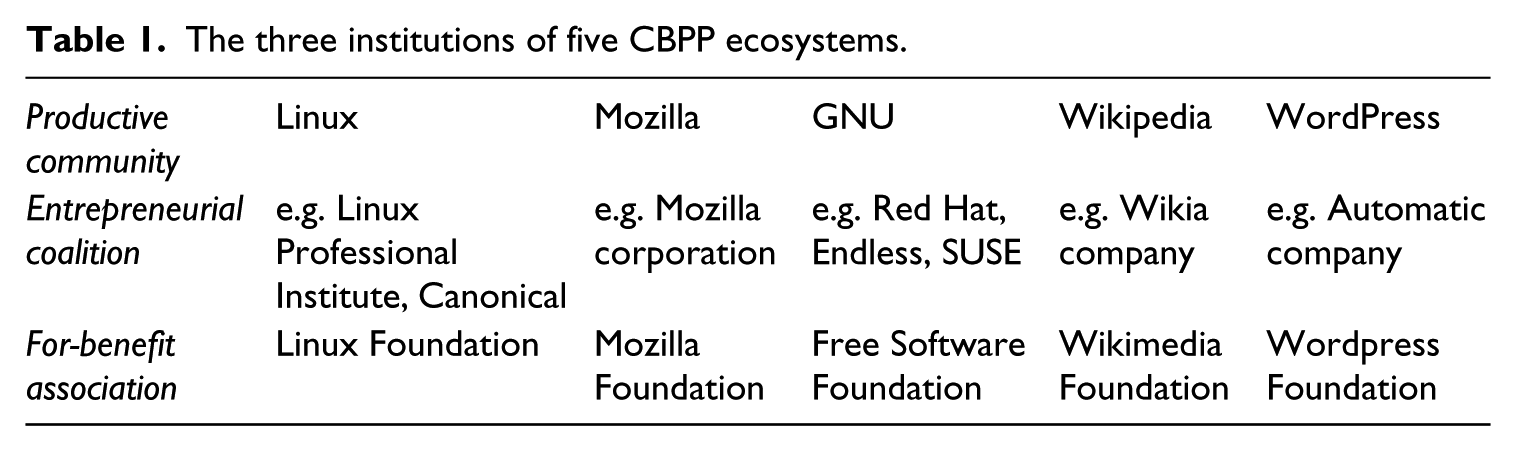
A striking feature of the first institution-component of CBPP, the productive community, is that it comprises all the contributors to a project, not the ‘direct’ contributors alone. This means the end users of CBPP products can also be part of this community; this ‘indirect’ contribution pertains to the detection of bugs, the suggestion of modifications and the request of new functionalities, for example, thus forming a feedback loop that leads to the improvement of the CBPP products. As an additional aspect of this indirect contribution, emerges the participation of end users in forums, forming to a certain extent the way that the initiative is developed. Under those circumstances, the product can thus be constantly upgraded. Bauwens (2005) and Benkler (2006) clearly acknowledge that synergetic cooperation among participants (direct contributors) and users (indirect contributors) is an immanent characteristic of CBPP. Analysing in depth the CBPP concept with a special focus on the productive community, it becomes evident that participation needs no permission, as the threshold of the involvement is as low as possible.
Moving on to CBPP practices, we can identify the use of P2P platforms facilitating synchronous and asynchronous collaboration (De Filippi, 2015), in which everyone can see the manifestations of the work of others, and can therefore adapt to the needs of the system as a whole. The key motivating factor for contributing to a CBPP project is not monetary compensation, but in most cases, the motivation is the creation of something mutually beneficial (Benkler, 2006, 2011). Other motivations may be the need to learn, belong and communicate; a form of social value – emotional value – that is mostly generated outside the market economy and cannot therefore be assessed through conventional market mechanisms (De Filippi, 2015). Concerning the need to belong and communicate, Arvidsson et al. (2016), in their three-year ethnographic research on CBPP communities, claim that CBPP digital communities and similarly most physically rooted communities are characterized by a low density of interaction and socialization and that, apart from the constituent ones, most other members participate only sporadically. As a last note, Arvidsson et al. (2016) observe that the participants in a CBPP project may gain reputation (a sort of ‘proto-currency’) that in the CBPP context can be thought of as a kind of social capital and a valid non-shared asset, that gives some members authority and access to scarce goods within communities or grants them decision making on behalf of those communities.
The second discernible institution is the commons-oriented entrepreneurial coalition, which attempts to produce either profits or livelihoods by creating added value for the market, based on the common resources (Bauwens et al., in press). With this in mind, a substantial number of people who contribute to CBPP projects want to be able to make a living out of their CBPP activities (Arvidsson et al., 2016). In the best of cases, the community of entrepreneurs coincides with the productive community. Provided that something like this happens, the contributors may through their activities make a livelihood, while producing the commons, and reinvest surplus in their own well-being and the overall commons system they co-produce (Bauwens et al., in press).
The third institution is the for-benefit association. The for-benefit association can be seen as the governance institution of a CBPP project, which supports the infrastructure of cooperation. Despite for-benefit associations often taking the form of non-profits, they do not command and direct the CBPP process itself. Conversely, for-benefit associations operate from a point of view of abundance. They recognize problems and issues, but believe that there are enough contributors that desire to assist in solving these issues. Hence, they maintain an infrastructure of cooperation, that allows contributive communities and entrepreneurial coalitions to engage in CBPP processes vital for solving those issues. Not only do they actively protect these commons through licences, but may also help manage conflicts between participants and stakeholders, fundraise, and assist in the general capacity building necessary for the commons in particular fields of activity (for example, through education or certification) (Bauwens et al., in press).
Given the above, a CBPP ecosystem can be visualized as a plant, as illustrated in Figure 1. The flowers and the stems of the plant can be thought of as the digital commons representing non-rival resources, whereas the soil in which the plant is rooted as the productive communities. These enrich the soil with nutrients through their contributions, thus nourishing the flowers and the stems: the digital commons. The flower pot that contains the soil and protects the plant ecosystem can be thought of as the for-benefit associations. Lastly, the bees that pollinate the plant, the digital commons, resemble the commons-oriented entrepreneurial coalitions. Those bees create added market value around the common resources to secure livelihoods for the commons-producing communities, thus enriching the soil through generative practices.

The new ecosystem of value creation.
In the remainder of this essay, we will briefly present four case studies that depict four emerging ecosystems of CBPP, observed via the scenario of the trinity of institutions that fortifies them.
Short case studies of four emerging ecosystems
In addition to the well-documented ecosystems of free and open-source software projects (see Benkler, 2006; Dafermos, 2012; Harhoff & Lakhani, 2016; Mateos-Garcia & Steinmueller, 2008; Von Hippel, 2016) and a three-year ethnographic study on CBPP communities (Arvidsson et al., 2016), the cases of Enspiral, Sensorica, Farm Hack and the P2P Foundation offer a broader perspective on the rich tapestry of CBPP ecosystems. Apart from observing the existence of the three institutions in each of those cases, which strengthens our argument, they have been chosen because they depict an ‘ecosystem of ecosystems’, that is to say, a bigger picture of the CBPP universe. Here inspiration is a keyword – a concept that functions to prompt these three institutions to imitate one another, share value beliefs and interact for the promotion and augmentation of CBPP initiatives. Looking back, we can see 1 how, for instance, Loomio, a member of Enspiral, in the beginning consulted the P2P Foundation on issues of organization and the structure of CBPP initiatives and, quite possibly, was consequently inspired. The P2P Foundation, in turn, as a network monitoring and promoting actions geared towards a transition to a commons-based society, was inspired by Loomio, Enspiral and other initiatives, which in fact fuel its research field and help it continue its research and advocacy, as is the case with the present study. So, the P2P Foundation through its institutions, produces commons, which are used by other initiatives and vice versa. The authors, as core members of the P2P Foundation, present a view that comes from the inside through participatory case study, acknowledging the possibility for biased interpretation of the results. On the other hand, as insiders, we had the chance to experience the complex interconnections between the institutions and different initiatives.
The above cases, although younger than those presented in Table 1, exhibit characteristics of developing – to a certain extent – the three types of institutions described as well.
Enspiral 2
In order to be able to elaborate our argument regarding CBPP ecosystems, a description, first, of the case of Enspiral is in order. Within an array of meanings, first and foremost Enspiral is a network of professionals and companies that are ‘working on stuff that matters’, i.e. socially oriented projects (Enspiral, 2017a). Enspiral corresponds to a multi-faceted network of members – either companies or individuals – who, amid a diversity of skills, foci and working methods, manage to retain an operative equilibrium under a set of shared values and a passion for positive social impact. The notion of social impact is reflected in what Vanclay (2003) refers to as a change-facilitator: changes that refer to one or more of the following: (1) people’s way of life including work and interaction; (2) culture, like people’s beliefs and values; (3) community, its cohesion and stability; (4) political systems and people’s participation in their democratization; (5) environment; (6) people’s health and well-being; (7) people’s personal and property rights; (8) their fears and aspirations. Enspiral is a broad community of diverse professionals (productive community), including developers, legal and financial experts, and these members pool their skills and creative energy to produce a commons of knowledge and software, while collaborating online, through digital tools, and offline, in a shared co-working space (Enspiral, 2015). A web of business ventures called the Enspiral Ventures, operating around thοse commons, offer open-source tools and services, that enable creative communities to address certain challenges related to democratic governance and the digital age. Realizing ventures as entrepreneurial coalitions, it comes as no surprise that members of the community are free to choose when to join or leave and how to contribute to the network.
The picture is completed with the Enspiral Foundation (for-benefit association), a cooperatively governed non-profit, that facilitates collaboration and supports, as custodian, the network as a whole. All assets held by the Enspiral Foundation are managed collectively by its members. The Foundation, as the ‘root node’ of the network (Vial, 2012), is the entity with which all professionals and companies have a formal relationship. It maintains the network’s infrastructure, holds the collective property and guarantees its culture and mission. Finally, its legal form is a limited liability company (Ltd) with a charitable constitution, though not officially registered as a charity.
At the time of writing, there are about 300 people contributing to one or several of the 15 business ventures that are linked to the Enspiral Foundation (Enspiral, 2017b; NZ Ministry of Business, Innovation and Employment, 2016). These include Scoop, Loomio and Rabid. To begin with, Scoop is a participatory model for news publishing, New Zealand’s largest independent news source and, specifically on the Internet, a place for publishing ‘what was really said’ (Enspiral, 2017b). Continuing with Loomio, the grounds for its establishment as an open-source platform for participatory decision making were initially laid by a team of activists from the local Occupy movement in Wellington, New Zealand, who cooperated with Enspiral to create a tool to help self-organized communities make decisions without centralized coordination (Schneider, 2016). The last one, Rabid, is a company offering expert services on web development, which supports the open-source community.
The non-profit nature of the aforementioned Ventures (Scoop, Loomio and Rabid) is further revealed by their generation and distribution of revenue: starting by offering their software solutions and services to clients, they eventually distribute this revenue back to the contributors, yet a part of it (usually 20%) is fed into the Foundation in the form of voluntary financial contributions. Each Venture defines how to contribute to the network, financially and otherwise; this free rein does not put up barriers to collective activities within the Foundation – quite the opposite: Ventures are invited from the Foundation to participate in the collaborative funding process and decide how the discretionary portion of their contribution will be allocated. The remaining collective funds can be requested as needed for a project, by any member. A digital application, Cobudget, developed as an Enspiral solution, is used in this collaborative funding process by Enspiral itself, but also by various groups, institutions and ventures. This exemplifies the development of new tools in practice, that promote and unleash more democratic ways of money flows and project support. Such tools enhance the ‘pollination’ of the commons community, reinvesting in a horizontal way value that can be used by the commons-based productive community. Moreover, Loomio offers its software solutions for free to commons-based initiatives (while not doing the same for market-based initiatives), exemplifying in the best possible way how an initiative, supported by its for-benefit association, can support itself and other forms belonging to its ecosystem.
The Enspiral culture is dedicated to the creation of value for the society, rather than for shareholders. To put it another way, it is oriented towards the common good and is proactively creating the conditions to serve this purpose. This approach on value is more clearly illustrated by one of Enspiral key principles, the so-called ‘capped returns’. The general idea is to introduce an upper limit (a ‘cap’) on the total returns which investors may receive on the equity of a business. For this, the shares issued by a company are coupled by a matching call option, which would require the repurchase of the shares by the shareholders at an agreed price ceiling. Once all shares have been cashed by the company, it is then free to reinvest all future profits into its social mission. Through this mechanism, external and potentially extractive capital is disciplined to become ‘cooperative capital’.
Sensorica
The case of Sensorica also illustrates the CBPP ecosystem trinity. Sensorica is an open-source hardware business which, on an operational level, is regarded and run as a collaborative network, devoted to the design and deployment of fibre optic-based sensors and sense-making systems (Sensorica, 2017a). Of its many services, the most prominent of all is an open digital platform where individuals of any type of skill or expertise (e.g. engineers, researchers, developers or lawyers) can interact, as well as organizations from the business and public sector, and civil society. Transparency is a key characteristic of Sensorica’s culture: everyone can observe the designs/documentation of each of Sensorica’s products, regardless of the stage of construction. In this way, through what is characterized as a ‘capturing mechanism’ (Sensorica, 2017a), members are able, on the one hand, to provide work and resources, whenever and wherever needed, and on the other, take the lead at any stage of the value chain – from product development to distribution. However, the fruition of all products is not definitive; the construction process of those products that do not sustain the interest of members, and thus are not perceived as valuable by others, will end naturally (Turgeon, Thai, & Epuran, 2014).
At this point, special mention should be made of the productive community, which lies at the heart of Sensorica’s network. The productive community is identified with the creation of projects in the form of open ventures. The way these open ventures acquire the needed resources is through processes like crowdsourcing (time-based contributions) and crowdfunding (financial and material contributions). The commons co-created by the productive community can be commercialized, but they always remain legally secured under Creative Commons Licences (Sensorica, 2017a). The members of the productive community, however, are not allowed to complete transactions with the market. For this reason, they have to pass through Sensorica’s designated ‘exchange firm’. This exchange firm can be thought of as Sensorica’s Foundation, an association responsible for: (1) certifying Sensorica genuine products by stamping every product with Sensorica’s logo; (2) preventing concentration of power within the network; (3) ensuring that those products and services meet the required quality and ethical standards; and (4) nurturing the Sensorica brand (Turgeon et al., 2014). This exchange firm stands between the market and the productive community, as it executes transactions and redistributes the revenue to the contributors. On the other side, all the agents participating in the network are affiliated with this for-benefit association, which, inter alia, is responsible for the management of the common infrastructure and resources, and has custody of the assets, and of the network. This set-up is based on a ‘non-dominium’ agreement. By definition, ‘non-dominium’ refers to the prohibition of one or more agents having any form of control over the shared resources. Such a regime exemplifies the principal characteristics of Sensorica: its structure its dynamic and highly adaptable and it strives to combine open, large-scale collaboration with fair distribution of the co-created value. Therefore, we can see that Sensorica not only supports the infrastructure of cooperation, but moreover, experiments in new ways that will help the community accomplish its mission and realize its values.
All revenue following the commercialization of the community’s products is fed back into the network, and, in particular, to the people that have been involved. For this, Sensorica has developed a system that facilitates value accounting and resource management in the network (Sensorica, 2017b). This system records and determines every member’s input in each project, and redistributes revenue in proportion to each contribution, but also detects and returns revenue to possible contributors from other projects (e.g. pieces of code used from other open-source projects), by using the so-called Network Resource Planning – Value Accounting System (NRP-VAS) (Sensorica, 2017b). Reflecting Zimmermann’s criticism (2015), this value accounting system, a ‘surveillance machine’, which measures and counts all sorts of contributions people make to a project, may undermine the intrinsic motivation which appears as a driver in the whole open-source world. The second attribute of this system, that of resource manager, refers to the tracking of all activities in the network in terms of the relevant resources which are either used or generated by a project – given that one project’s output can be another project’s input – which is done via the so-called Open Value Network (OVN) (Sensorica, 2017b). This refined system of attribution of values confirms Arvidsson et al.’s (2016) findings, according to which, the majority of the CBPP initiatives that were studied in their research expressed a wish and a need for more structured methods in assessing participation and work offered in the community, in order to have a better way of allocating reputation.
One of the most successful Sensorica projects is Mosquito, which is a force/displacement sensor device with numerous applications in biotechnology, which has been commercialized by a sensor company for scientific, educational, industrial and medical applications.
To summarize, Sensorica is part commons-based community and part entrepreneurial entity. On the one hand, individuals and organizations (productive community) pool resources and organize themselves around projects that produce open-source hardware technological solutions. On the other hand, a group of independent business entities (entrepreneurial coalitions), often launched by the community, introduces the innovative solutions to the market, through Sensorica’s exchange firm (for-benefit association) (Bauwens et al., in press). Sensorica’s case does not appear to have a separate entity with the role of for-benefit association, thus we can consider Sensorica itself as such. What is evident, and is best depicted in Sensorica’s business model (Figure 2), is the productive community and the entrepreneurial coalition, which form Sensorica’s commons-based ecosystem.
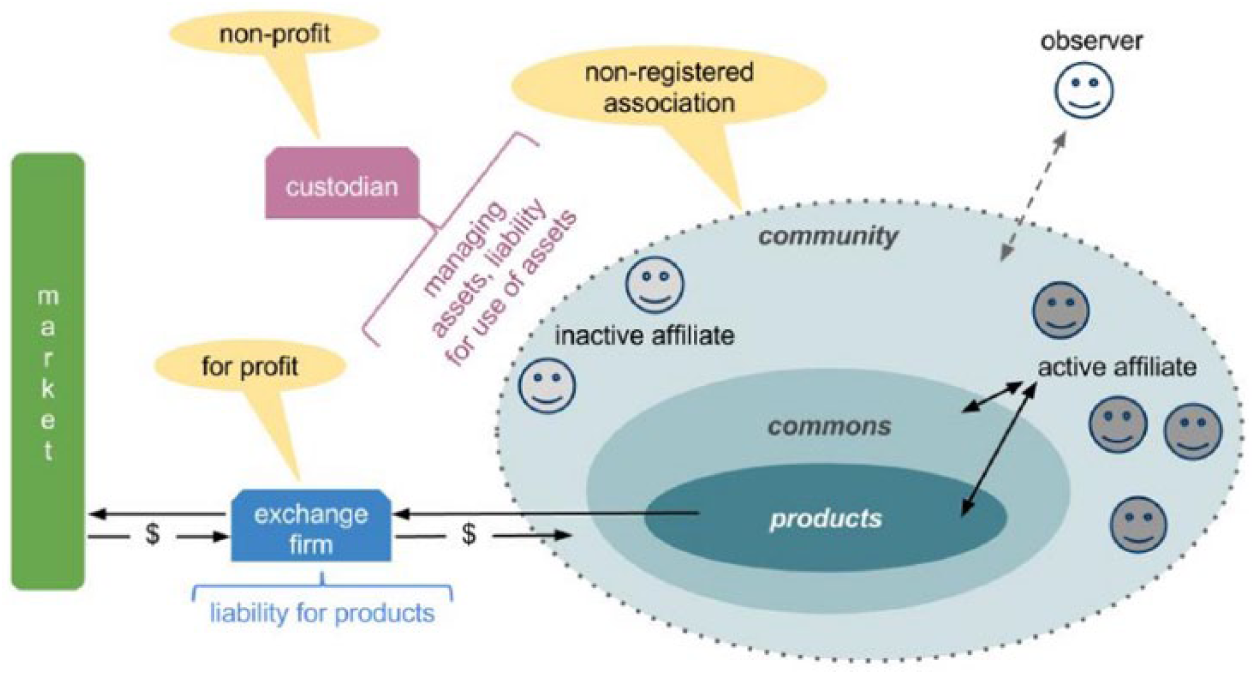
Transactions between Sensorica, active affiliates and inactive affiliates in the Sensorica business model.
Farm Hack
On our route to comprehending the concept of CBPP ecosystems, we now deal with a case study that focuses on the primary sector, that of Farm Hack. First we should focus on its internal structure, starting with its established network of agents. Farm Hack is an open-source community which functions as a ‘glue’, bringing together farmers, engineers, roboticists, designers, architects, fabricators, tinkerers, programmers, hackers, in order to build and modify tools and machinery with the aim of moving towards sustainable farming through global design and local manufacturing (Farm Hack, 2016). The hub of Farm Hack is framed by important nodes. First there is its digital platform, a platform for community-based sharing and collaborative research, through which the productive community shares designs, know-how and ideas. For example, through its website, Farm Hack provides an extensive guide on how to organize and run events, and offers communication support, as long as activities are in line with the community’s basic principles (Giotitsas & Ramos, 2017). Therefore, Farm Hack performs as a for-benefit association supporting individuals or groups that coexist under the same denominator, namely their shared passion regarding open-source technologies and agrarian machinery. Other than that, Farm Hack also organizes events for the development of tools; these events can be open or more focused, targeted at disseminating technical knowledge or at specific problem solving, respectively (Giotitsas & Ramos, 2017).
Farm Hack’s dynamic trajectory can be portrayed by what its online tool platform features, as well as the size of its community: the platform offers more than 500 tools and pieces of machinery, while the community is followed by around 6000 members from all over the world. Tools include both open-source software and hardware. Among these is FarmOS, an open-source web-based application for farm management, planning and record keeping (FarmOS, 2017). Another example featured on the platform, among the agricultural hardware, is the Cover Crop Roller. This tool is designed for such purposes as the increase of organic matter in soil, the retention of moisture and the reduction of herbicide use. All tools and designs produced by the Farm Hack community are made available under Creative Commons Licences, and may be accessed by everyone (Farm Hack, 2016).
A non-profit (for-benefit) association monitors, maintains and improves the platform according to the ethos and desires of the community. At the same time, some of the most active inventors/farmers contributing to the platform invest a considerable amount of time and resources to developing prototype tools. The community enables them to engage in entrepreneurial activity (entrepreneurial coalitions) in order to continue enriching the community commons and support themselves in the process (Bauwens et al., in press). These inventors/farmers are able to decide upon the business model they will adopt, as long as the basic principle of openness is maintained. These inventors/farmers may manufacture and sell the tools or components. They may also sell partially assembled kits, or simply conduct workshops to teach other farmers how to build their own tools. This ongoing process is not without its detractors, a major point of discussion as well, within the community (Giotitsas & Ramos, 2017). Yet, the creation of sustainable commercial activity benefiting from, and at the same time empowering the community is clearly desired. Therefore, the Farm Hack community empowers people and groups to share and develop knowledge, and to elaborate ways to create added value for the market, enhancing and supporting a diverse creative community (Bauwens et al., in press).
P2P Foundation 3
The last of our four case studies of CBPP ecosystems is the P2P Foundation. The P2P Foundation (P2PF) and its research branch, P2P Lab, is a global network that consists of researchers and activists monitoring and promoting activity geared towards a transition to a commons-based society. Its ultimate aim is the construction of a knowledge commons ecosystem for the growing P2P/commons movement (P2P Foundation, 2017a). At the time of writing, the P2PF’s dynamic ecosystem consists of a global core team and few regional nodes. Around them, operate the affiliates and the supporters that together complete the network. Their coordinated and joint action constitutes a productive community that documents, researches and promotes P2P alternatives and the commons, while its internal structure resembles the characteristics of our trinity of institutions.
The core team consists of people who work for the P2PF. Focusing on the microcosm of the P2PF, its concept and direction serve to safeguard the overall vision, and is mainly focused on the advocacy of the commons and the peer production through policy proposals. Within its policy framework, certain activities are manifest: P2PF supports two blogs and several wikis, releases reports and organizes and participates in activities, so that people can communicate ideas or discuss topics of common interest (P2P Foundation, 2017b).
The P2P Lab is a media lab dedicated to interdisciplinary research on free and open-source technologies and P2P practices (P2P Lab, 2017) that nurture the Foundation’s vision. The P2P Lab develops its structure and way of working according to the characteristics of the fields it studies, as it considers itself part of them. Therefore, peer-to-peer practices are common between its members, like sharing workload, money, infrastructure and time, and implementing do-ocracy and meritocracy in the decision-making processes. Moreover, the P2P Lab participates as a member or consultant in various initiatives related to the commons, with the aim of being a living cell in the commons-based ecosystem, supporting initiatives, helping knowledge transfer and communicating research outcomes.
These two entities can be perceived, respectively, as the for-benefit association (P2PF) and the entrepreneurial coalition (P2P Lab) of the ecosystem. The P2PF is a non-for profit organization that gets both structural and project-based funding. The P2P Lab has research projects funded through various sources, including the European Union, university and institutional funds. People that work in these two organizations create livelihoods through those funds, in order to research and strengthen the CBPP ecosystem. Around the P2PF exist several regional nodes, like the P2PF France and the P2PF Korea, which support the advocacy of the commons, while also supported by the P2PF in their projects. These regional nodes can be thought of as the local for-benefit associations (even though at an early stage, at present, and therefore open to future modification), which try to support CBPP ecosystems in different areas. The P2PF, the P2P Lab and the regional nodes constitute the ‘active members’ of the network.
Around the circumference of the core teams and its regional nodes are found the affiliates: individuals, teams or organizations that are free to self-organize their time and work, and have a high level of engagement with the P2PF, P2P Lab or the regional nodes. Such an engagement can take various forms, like contributing to the P2PF blog, taking part in reports and sustaining the P2PF’s digital infrastructures. A point worth mentioning is that the affiliates can be supported by the P2PF, but do not receive funds through it. On the periphery we can identify the supporters of the network: nodes that may be thought of as all those individuals, teams or organizations that informally engage in social media, and/or support and promote the work or events of the P2PF and P2P Lab.
Finally, a P2PF Stakeholder Advisory Board that consists, mainly, of academics and researchers of the commons was recently created. This board has the role of advisor and of conflict resolution, and therefore can be seen as a for-benefit association.
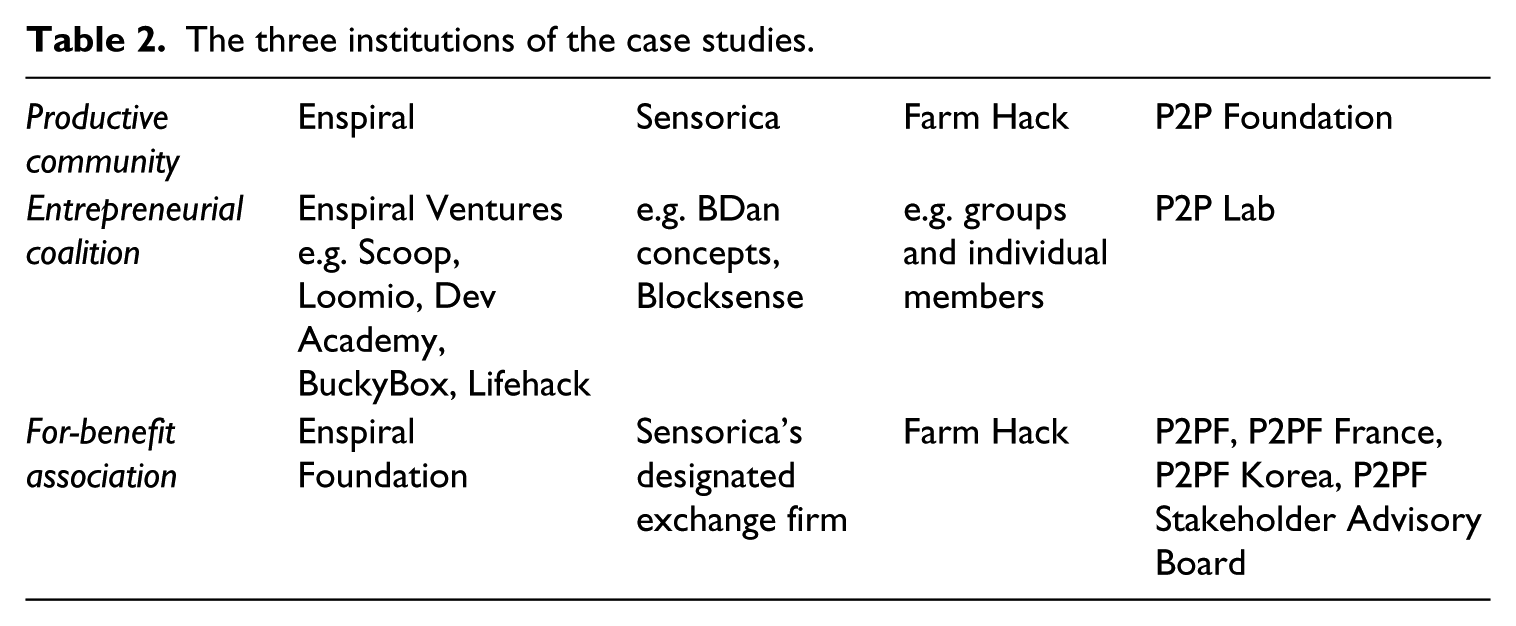
To close the discussion, it is important to mention that Enspiral, Sensorica, Farm Hack and the P2PF fit within the parameters of our description of the ecosystem of commons-based peer production, like many free and open-source software projects, and an increasing number of open design projects, that build new post-capitalist ecosystems of value creation. These ecosystems of various CBPP projects are interrelated through their digital commons (the output of one project can be the input of another) and, thus, CBPP can be seen as a grand ecosystem consisting of diverse smaller, but not subsidiary, ecosystems and their institutions. Table 2 depicts the existence of the three types of institutions, as found in the four case studies investigated.
The three institutions of the case studies.
Moving from micro- to macro-level: The commons trinity
As Bauwens et al. (in press) note, if we look at the micro-level, CBPP participants struggle to make a direct livelihood for themselves by contributing to the pool of digital commons. In most cases, they turn either to the state (payment by the state, for example via public universities and publicly-funded science, or subsidies for culture and non-profits), or the capitalist market. So, the CBPP model should be seen as a prototype (proto-mode), since it cannot yet fully reproduce itself outside of the limits imposed by its interdependence with capitalism. In order for the CBPP model to move from a prototype into a full mode of production, some crucial steps should be realized.
CBPP’s innovative activities take place within a context of capitalist competition, and because capitalist firms, which can access and utilize the knowledge commons, possess a competitive advantage over firms that do not and use proprietary knowledge relying only on their own research (Benkler, 2006; Tapscott & Williams, 2005), P2P and the commons are at times exploited by the extractive capitalistic models. According to Bauwens et al. (in press), the cooptation of P2P and the commons by capitalism is not a negative thing in itself, but rather a condition that increases the societal investment in a P2P-based transition. This cooptation means that capital flows towards P2P projects, and even though this distorts P2P, prolonging the dominance of the old economic models, it simultaneously creates new ways of thinking towards a more commons-centric society. This multidimensional interrelation between capitalism and the commons makes us seriously contemplate ways for the CBPP model to reach a commons-centric production mode, where citizens participate in the collaborative creation of value through commons. This would be a situation in which the commons capture capital and make it work for their own development. This type of reverse cooptation has been called ‘transvestment’ by Dmytri Kleiner and Baruch Gottlieb (Gottlieb, & Kleiner, 2016; Kleiner, 2016). Transvestment describes the transfer of value from one modality to another (in our case this would be from capitalism to the commons), and it seems that the trichotomous system that we have analysed here would help to achieve this, unlike the case where initiatives were disconnected from each other and from the broader ecosystem of the commons. Transvestment strategies aim to help commoners become financially viable and independent by ‘taming’ capital. The financial sustainability of CBPP projects is of crucial significance for its disengagement from capitalist extractivism.
Having already had an idea of what the cosmos of the CBPP ecosystem would look like, if it were not to be bound to a prototype mode alone, it is now time to reflect on ways to move from theory to practice. Using the CBPP ecosystem, presented in the second section as the blueprint of the micro-level, we hereby endeavour to portray a shift to the macro-level. So, looking at the macro-level, the three aforementioned institutions could be said to correspond to the three great spheres of social life. The overall rationale is that the productive community corresponds to the civil society with its citizen-contributors; the entrepreneurial coalitions to the economic society of market entities; and the for-benefit association to the political society of the state (Bauwens et al., in press). The for-benefit associations of the CBPP ecosystems are, at the micro-level, a snapshot of ‘the state of CBPP’, meaning that they serve the ‘common good’ of the entire system. When seen at the macro-level, this allows us to look at the evolution of the state, in a commons-centric society, from a ‘market state’ to a ‘partner state’ (Bauwens et al., in press; Kostakis, 2011). Moving to a ‘partner state’ scenario, what we can anticipate is that, in such a state, the public authorities would empower and enable the direct creation of value by civil society, on a territorial scale, by creating and sustaining infrastructures for commons-based contributory systems (Bauwens et al., in press). Indeed, a partner state approach is already seen in some urban practices, such as the Bologna Regulation for the Care and Regeneration of the Urban Commons or the Barcelona En Comú (BeC) citizen platform.
The Bologna Regulation is based on an amendment in the Italian constitution which allows engaged citizens to claim urban resources as commons, and to declare an interest in their care and management. After an evaluation procedure, an ‘accord’ is signed with the city, specifying how the city will support the initiative with an appropriate mix of resources, and specifying a joint ‘public–commons’ management. In Bologna itself, dozens of projects have been carried out, and more than 140 other Italian cities have followed suit (Bauwens et al., in press). This innovation is radical in providing citizens with direct power to put forth policy proposals and transform the city and its infrastructure, and to function as an enabler in this. The key here is the reversal of logic: the citizenry initiates and proposes, the city enables and supports.
Moving about 1000 km from Bologna to the west, Barcelona has become a reference point for CBPP. This geographical shift indicates a shift as well in the focal point of our discussion. Barcelona is home to a great diversity of grassroots initiatives, from the commons-oriented crowdfunding platform of Goteo to the Cooperativa Integral Catalana to Guifi.net, a free/open telecommunications community network. Nonetheless, it is essential to keep in mind that Barcelona is not a city in reform from the top down; it is a city in transformation from the bottom up. This is how the BeC citizen platform emerged, took power, and currently governs as a minority in the City of Barcelona. The activist-level praxis matured into a political force, attempting to share its hard-won knowledge and experience internationally (Bauwens et al., in press).
In mid-March 2016, Barcelona hosted the Commons Collaborative Economies event (or ‘Procomuns’), centred on producing public policy proposals for the commons economy. The event, which drew a huge, diverse audience from 30 countries, produced a joint statement and a series of policy recommendations targeted towards the Barcelona City Council, the European Commission and other local governments.
Within the small interstice (BeC holds 11 seats out of 41) between simple legislation and doing nothing at all, attempts are being made by BeC to embrace cooperatives and citizen activism, despite the numerous limits and problems at the government level. A novel, hybrid participatory process combining in-person and digital input has been developed for city residents to collaborate in municipal debate and decision making (called ‘decidem.barcelona’). This hybrid process is also being used in other cities in Spain, and is being promoted to cities internationally. The BeC platform has been built step by step, acknowledging every little victory that adds up to something that previously seemed inconceivable. Appreciation of the small steps is part of the change.
Without overlooking the aforementioned synergies with the state, a commons transition asks for allies further afield. Those are to be found among the forces representing the other modes of production and allocation. This implies uniting the forces which support the commons, support generative and ethical markets and support the development of an enabling and empowering state. Moving from micro- to macro-level requires commoners as the agents of change; and to have commoners, the sphere of the commons must expand.
Conclusions
The participatory capacities of the Internet gave rise to online P2P networking, which successively gave birth to new models of production, both digital and physical. The capitalist models, using the capacities of users’ communication and exchange, as a bait to fish for profit maximization, struggle for the control of proprietary P2P networking platforms (Bauwens et al., in press). On the other hand, the commons-based mode of production is continuously advancing, now expanding beyond the digital sphere into primary, material production. In order for the transfer of value from capitalism to the commons (transvestment) to be effective, higher level forms of organizations need to evolve, like those described in the current analysis. The trinity of CBPP institutions – corresponding to the civil society, the market entities and the state – simulates the natural environment in the ecosystem of the commons, and thus its vigour too. In contrast to the familiar comparison of societies with machines, CBPP and its generative practices can be better thought of as a natural living ecosystem.
Furthermore, there is an important desire within the world of CBPP to create an institutional framework that enables the products and efforts of CBPP to be exchanged and valorized without the need to form markets, or interact with states or capital (Arvidsson et al., 2016, p. 55). Different from both bureaucratic state power and the commodity logic of the market, the commons build on a definition of value that respects and reflects the irreducible diversity of particular local contexts and communities (Arvidsson et al., 2016, p. 55), and therefore, they develop their own institutions.
The aim of this essay has been to demonstrate CBPP as a generative P2P model of production and understand its transformative, yet tentative dynamics. We firmly believe that, for the further evolution of CBPP, a deeper understanding of its characteristics is required. Therefore, the emerging pattern of the trinity of institutions described here is useful, we believe. However, from our discussion so far it has become clear that, at the present time, CBPP is largely unable to reproduce itself outside capitalism. The economic sustainability of CBPP should be seen as a prerequisite of its future and its underlying transforming dynamics. But towards this important course, social and environmental sustainability that are promoted through CBPP should not be forgotten. As the notion of P2P spreads, so too should its capabilities be disseminated and advocated on a global level. Any change in the production mode will only occur if a problem is first identified. In line with this, the fact that the users’ ‘peer identity’ creates a value that is subsequently captured and valorized by capitalistic online businesses should at first be unveiled. Thus, the generative P2P alternatives, and their potential outcomes should be advocated globally. At this point, and if a transition from extractivism to generativism is any time close, CBPP and the commons dynamics may be unleashed.
Footnotes
Acknowledgements
We thank Alex Pazaitis for his help with the case studies on Enspiral and Sensorica and Chris Giotitsas for his help with the case study on Farm Hack. Moreover, we are grateful to Ann Marie Utratel and Stacco Troncoso who shared their insights about Barcelona En Comú and Kostandina Tziouma for the language editing.
Funding
We would like to thank La Fondation Charles Léopold Mayer (FPH) for its continued support of the P2P Foundation. Alekos Pantazis acknowledges financial support from IUT (19-13) and B52 grants of the Estonian Ministry of Education and Research.