



Abstract
The sharing economy is fertile sociological ground for studying important themes like labor, exchange, consumption, and inequality, as well as larger political-economic trends that are reflective of this post-recession era. The multifaceted research agenda of the sharing economy can provide lessons around many themes relevant to sociologists, but what does the sharing economy teach to those who participate in it? What is learned from the sharing economy and how do participants learn it? In this article, the author explores the pedagogic elements of one case study within the sharing economy: open learning. Drawing from 51 interviews with 34 participants and roughly 300 hours of participant observation, the study uses Bernstein’s theory of pedagogic discourse to ask how open learners learn to share. The author argues that an ethos of communalism and cooperativism dominated moral discourse for learners and regulated social order. Entrepreneurialism was learned through a flexible sociality, where participants contributed to each other’s learning as a means of validating and legitimizing that learning. The need to contribute or give back was taken for granted by participants, who felt compelled to give their own expertise or labor to the commons after taking something from it. This study depicts a tension between a neoliberal entrepreneurial frame and a communalist, cooperativist frame that is also present within the larger sharing economy. The author suggests that a similar pedagogic approach that asks how participants learn to share could be developed in the larger sharing economy in order to better understand learning and economic relations as two sides of the same coin in contemporary capitalism.
Introduction
In its early formulations, proponents of the sharing economy praised its ability to create a culture of shared access and use rather than private ownership (Botsman & Rogers, 2010). As academic research on the topic evolved, researchers began theorizing the often paradoxical aims and outcomes of the sharing economy, citing tensions between themes like openness and distinction (Schor, Fitzmaurice, Carfagna, Attwood-Charles, & Poteat, 2016); neoliberal commodification and morally attuned domestic production (Fitzmaurice, Ladegaard, Attwood-Charles, Carfagna, & Schor, 2018); and trust and discrimination (Edelman, Luca, & Svirsky, 2016). With so many diverse sites and practices that have, at one time or another, been loosely bound to the label of the sharing economy, scholars have also been critical of whether or not ‘sharing’ is even an appropriate term to describe the types of exchange present on several platforms (Ravenelle, 2017). While the sociological research agenda of the sharing economy has been mostly critical, these studies have taught us that the sharing economy is fertile sociological ground for studying important themes like labor, exchange, consumption, and inequality, 1 as well as larger political-economic trends that are reflective of this post-recession era.
This multifaceted research agenda has much pedagogic potential for students of sociology, but what about those who participate in the sharing economy? What is learned from the sharing economy and how is it learned? In this article, I ask how participants in one ethnographic case study within the sharing economy learn to share. The aim is to develop a theoretical and empirical basis for understanding how learning to share happens elsewhere in the sharing economy. The case study this article focuses on is open learning, 2 which is understood for this project as a practice that utilizes free or low cost resources for learning that entail some combination of open-access, peer-driven, shareable, and digitally mediated. Utilizing Bernstein’s (1996) theory of pedagogic discourse in the spirit of public pedagogy research that studies sites outside formal education (Sandlin, O’Malley, & Burdick, 2011; Sandlin, Schultz, & Burdick, 2010), I show how participants learn to share in open learning contexts. Drawing from 51 interviews with 34 participants and roughly 300 hours of participant observation, I find that the majority of participants learn an instructional discourse of entrepreneurialism, in the wake of the precarity following the financial crisis of 2008 and its subsequent recession. Out of the 34 respondents, 26 had experienced some form of precariousness after the crisis and recession and they had lost faith in the formal structures of schooling to prepare them for a struggling labor market. In response, these young people built expertise through open learning and narrated a sense of responsibility for their future.
This sense of responsibility signals a risk shift (Hacker, 2006) from institutions to individuals. Precarious open learners in this study mitigated that risk shift by connecting to others in order to legitimate and validate their learning. The additional eight participants who did not experience precariousness as a result of the crisis and recession viewed open learning as a way to create alternative futures. These alternative futures could be achieved through connection rather than relying on dominant institutions and social norms. I show that non-precarious participants, whom I call ideological challengers, share a set of social values with open source software development communities and the New Communalists of the late 1960s (Turner, 2006). Open source software developers value a flexible sociality without strong commitments to others, but do so with an ideological commitment to maintaining the commons (Benkler, 2004). The New Communalists valued technology, social connection, and the transformation of consciousness as sources of social change rather than direct political action (Turner, 2006). As a result, an ethos of communalism and cooperativism was also present together with entrepreneurialism in open learning. Using Bernstein’s (1996) theory of pedagogic discourse, I argue that the ethos of communalism and cooperativism was dominant in terms of creating a moral regulative discourse and social order. Entrepreneurialism was learned through a flexible sociality, whereby participants contributed to each other’s learning as a means of validating and legitimizing that learning. The need to contribute or give back was taken for granted by participants, who felt compelled to give their own expertise or labor to the commons after taking something from it.
This study depicts a tension between a neoliberal entrepreneurial frame and a communalist, cooperativist frame that is also present within the larger sharing economy. I show that the embedding of an instructional discourse of entrepreneurialism in a regulative discourse of communalism and cooperativism explains how sociality came to be revalued (Tonkinwise, 2011), or how open learners learned to share. In the larger sharing economy, I suggest that a similar pedagogic approach that asks how participants learn to share could be developed. I argue that learning and economic relations are two sides of the same coin in contemporary capitalism, and that in order to better understand the potential of economic systems that dematerialize, create access, and have a ‘social thickness’, we must also use a robust theory of pedagogy to understand how those systems are learned. In the following pages, I first theorize this connection between learning and economic relations and then give a brief sociotechnical history of open learning. Then, I explain Bernstein’s theory of pedagogy and show how I theorize learning to share. Next, I detail my methodology and describe my data before depicting an analysis of my findings of learning entrepreneurialism and learning communalism and cooperativism. Finally, I discuss how participants learn to share in open learning and explore how this approach could be utilized to understanding learning in other sites within the sharing economy.
Background: Open learning and the sharing economy
When Botsman and Rogers first wrote about the sharing economy, then called ‘collaborative consumption’, they included sites like Skillshare as part of their universe of sharing (Botsman & Rogers, 2010). Skillshare is an online platform that allows individuals to learn skills from peers for free or low cost in both online and offline settings. Documenting a cultural shift away from ownership to one of shared access and use, Botsman and Rogers (2010) detailed cases and sites like Skillshare that many now would recognize as part of the open learning landscape and might not consider as part of the sharing economy. Whether one considers open learning to be part of the sharing economy or not, learning to share is an integral part of each. In asking how open learners learn to share in this article, I begin to develop a theoretical and empirical basis for understanding how learning to share happens in the sharing economy. In order to do so, the link between economic relations and learning needs to be better established.
Tonkinwise (2011) argues that the sharing economy reverses Polanyian theory, in that it resocializes ‘everyday economies’ by restoring ‘sociality to goods distribution’ (p. 2). Social experiences or ‘sociality’, as Tonkinwise (2011) projects, is revalued in the sharing economy, such that sociality may either be the good that is being sought out or is a newly tolerated transaction cost of exchange. As more venture capital backed sharing economy sites entered the space, the promises of dematerialization and social connections, once the hallmark of the sharing economy, fell prey to what Tonkinwise calls a ‘precariat-creating way of monetizing social interactions’ (Tonkinwise, 2014, p. 1). Critiques of the sharing economy as a field that promotes sociality abound (Ravenelle, 2017; Tonkinwise, 2014), with terms like ‘sharewashing’ (Troncoso, 2014) being coined to describe the exploitation of sociality by capital. The sharing economy now hosts a tension between a neoliberal frame, where sharing economy providers are seen as micro-entrepreneurs that take on risk in order to create capital for the financial class, and a communal or cooperative frame, where sharing economy participants distribute risk and capital for collective gain (Scholz, 2014). Neither of these frames may be correct in all cases, but they demand that the sociality be revisited and clarified.
Tonkinwise suggests the term sharing be reserved for ‘economic relations that have a social thickness to them’ (2014, p. 10). In this study of open learning, I found learning that could be described as having a ‘social thickness’. Rather than suggest that open learning is an analog of the sharing economy or arguing whether or not it is part of the sharing economy, I contend that in this current economic era economic relations and learning are two sides of the same coin. Contemporary capitalism relies upon knowledge labor that ‘produces and distributes information, communication, social relationships, affects, and information and communication technologies’ (Fuchs, 2011, p. 98). Fuchs (2011) includes education and social relationships as indirect knowledge labor in his definition. Cote and Pybus argue that immaterial labor (Hardt & Negri, 2004), of which knowledge labor is part, has great pedagogic value because studying what we learn gives insight on how we ‘extend, amend, and reproduce social relations in networked form that are also capital relations’ (2011, p. 177). In other words, ‘capital relations are always social relations’ (Cote & Pybus, 2011, p. 177) and social relations are always learned. Further, from a Bourdieusian perspective, learning and social relations are forms of capital (Bourdieu, 1986). In the case of learning to share, that capital takes the form of human, social, and cultural capital – all of which can be converted into economic capital (Bourdieu, 1986). Thus, in the sharing economy and open learning, learning to share is at once about economic relations and learning. In the next section, I show how sociality has been a longstanding narrative in the history of connected computing, the sociotechnical precursor to open learning, and briefly detail this history. I also show how the same tensions currently present in the sharing economy, between neoliberal and communal/cooperative frames, have been part of this sociotechnical history.
From connected computing to open learning
To understand open learning, one must first understand how it evolved from Open Educational Resources (OER), which are rooted historically in the connected computing counterculture of the late 1960s. During a time of political and cultural unrest in the United States, a group of counter-culturalists emerged and moved away from protest and public demonstration against the state, at the same time without accepting the rigid social norms, bureaucratization, and militarization brought on by the Cold War era. Dubbed ‘the New Communalists’, these people ‘turned away from political action and toward technology, social connection, and the transformation of consciousness as the primary sources of social change’ (Turner, 2006, p. 4). Streeter narrates a similar history of connected computing and shows how the Internet as we understand it today has long been attached to romanticized tropes (Streeter, 2011). Some of those tropes, he argues, are paradoxical. For example, the Internet has been understood at different times in history as the following: a tool for democratic dialogue; a community builder; a venue for capitalism; and a prime example of free market politics (Streeter, 2011). Technology, Streeter argues, is not so much a manifestation of what is possible or should be possible, but rather a deeply cultural force of ‘human passions made articulate’ (Streeter, 2011, p. 2).
The sociotechnical history of the Internet is ripe with tensions between neoliberalism and a communal/cooperative frame. By the late 1990s, connected computing had evolved from the digital utopia of the communalist counterculture to the ‘transcendence of markets in an anarchist open source utopia’ (Streeter, 2011, p. 2). Having represented the frontiers of free markets in the 1980s to then ‘boom and bust’ with dot.com companies in the early 1990s, connected computing was once again tenuously bridging the self-interested actor and the domain of solving collective social problems in the late 1990s. That tension was later played out over copyright laws when Richard Stallman set off on a moral project that became the GNU public license and Free Software Foundation (Williams, 2002).
Stallman’s licenses allowed free access and sharing to software users, but his emphasis on ‘free’ as a moral project dismayed others who were intrigued by the market possibilities of his innovation (Wiley & Gurrell, 2009). Those advocates instead coined the term ‘open source software’, which offered a pragmatic resolution to the tension between free and proprietary software. Open source developers were aligned with the goals of creating a culture of collaboration and transparency, but their goals were also rooted in a desire to foster accountability in development while encouraging entrepreneurial innovation from others who could then benefit from better products with limited investment (Wiley & Gurrell, 2009). From here, the open source software movement was bridged to the realm of education in 1998 with the creation of the Open Content License. This license was inspired by the same call to collaboration and accountability, but could be used for anything from educational software to scholarly research. From Open Content Licenses came the Open Publication Licenses of 1999 and then finally in 2002 Larry Lessig founded the Creative Commons License, which significantly expanded the scale and scope of OER (Wiley & Gurrell, 2009).
From OER multiple projects were born, like Open Courseware at MIT and Carnegie Mellon University. At these schools, faculty members would put courses and content online for the larger public to access their teaching. These projects would then become the Web 2.0 version we see now, the Massive Open Online Course (MOOC), visible from companies like Coursera and EdX. Designed to open premier college courses to the larger public at a massive scale, these courses feature pre-recorded videos, uploaded readings, and evaluation opportunities often graded by peers or artificial intelligence. At first completely free, MOOCs have started to include low cost options to credential learners through some universities and businesses. Despite their focus on free or low cost access and openness, MOOCS have been hotly criticized as a ‘Neoliberal Assault on America’, to quote the title of one article (Barkawi, 2013). Hall (2013) described MOOCs as: … a global pedagogic project aimed at subsuming the whole of social life under the treadmill logic of capitalism. It is a project that seeks to deny sociability and to enforce individuated entrepreneurial activity. (Hall, 2013)
3
The denial of sociability or sociality in open learning is a tenuous claim, especially if one considers the sociotechnical history detailed in this section that shows a recurring theme of collaboration, communalism, or cooperativism. The entrepreneurial activity of open source software is far from individuated and is embedded within sociality (Benkler, 2004). Open licenses allowed others to work on pieces of projects in order to improve them or bridge them for other uses. In addition, while Hall (2015) focuses on the political economy of MOOCS in order to make his claims about a pedagogic project of neoliberalism, I show in the next section how a focus on what is being learned and how it is being learned allows for a more complete evaluation of what is being valued in pedagogic projects. In order to understand what is being learned and how, learning must be evaluated from the vantage point of the learner.
MOOCs have dominated conversations on open education (Meisenhelder, 2013), but other organizational forms began to emerge following the 2008 financial crisis, which deviated from the college classroom analog model. Sites like General Assembly and Skillshare, catering mainly to entrepreneurs and DIYers, boasted free and low cost pay models for one-off to several week courses. Peer to Peer University (P2PU), a more intentionally democratic and egalitarian version of open education, also shared considerable attention in the open education world and received funding from notable foundations like Hewlett and the MacArthur Foundation. The preponderance and diversity of sites and models in open education suggested to key innovators and advocates in the space that a different name might be necessary to capture the milieu effectively: open learning. While open education emphasizes the product or resource itself, open learning highlights the practice and begins to eliminate questions of what counts as open learning or not. Fierce advocates of openness might bemoan this flexibility, but if one is to approach the study of learning through the vantage point of the learner and not the rigid structure of the resource, then the shift is necessary. Open learners do not neatly fit their learning into questions of whether something matches the definition of open or not. They move seamlessly from resource to resource and in that movement they borrow a bit from each, regardless of the licensing of those sites. Therefore, an intentionally loose definition of open learning was used in this study in order to understand learning from the vantage point of the learner rather than that of key innovators in the space. Open learning, for this project, is understood as a practice that utilizes free or low cost resources for learning that are some combination of open-access, peer-driven, shareable, and digitally mediated. In the next section, I discuss why and how I study the pedagogy of open learning, and in this case the specific question of how open learners learn to share.
Why pedagogy? Learning as a process of revaluation
Since the mid-1990s, a subgenre of education research and cultural studies has used the term public pedagogy to analyze educative processes and sites beyond formal schooling (Sandlin et al., 2010, 2011). Public pedagogy research has theorized teaching and learning in diverse sites such as informal institutions and public spaces as well as popular culture and social movement activism. While public pedagogy has been novel in its theorizing, it has lacked sufficient empirical studies from the vantage point of the learner and at times offers little explanation of how learning happens, beyond articulating an intended learning agenda of a dominant site or discourse (Sandlin et al., 2011; Savage, 2010). In this study, I combine Bernstein’s theory of pedagogic discourse with the spirit of public pedagogy in order to better describe how learning happens beyond formal schooling. Specifically, I ask how open learners learn to share in sites that do not belong to the field of formal education.
In Tonkinwise’s (2011) description of the sharing economy, sociality is revalued and sharing is the result of that revaluation. Therefore when asking how one learns to share, I am asking a question about how sociality came to be revalued. Bernstein’s (1996) theory of pedagogic discourse displays how learning is constantly a process of revaluation and it shows how specialized pedagogic subjects are created through ‘contexts and contents’ (p. 31). Pedagogic discourse embeds two discourses: an instructional discourse that relates to skills and their relationship to each other and a regulative discourse that relates to social order or values (Bernstein, 1996). In both open learning and the sharing economy, the competing contextual frames of neoliberal and communal/cooperative necessitate an analysis of sharing in changing contexts. Bernstein’s theory is useful in this study because it gives a schema for understanding the how and what of learning; it also theorizes how changing contexts can change what is learned, even if the contents stay the same. The regulative discourse, which relates to contexts, is dominant and creates the social order and dominant values for the instructive discourse, which relates to contents. How one learns depends upon the dominant values of the context; what one learns is then ordered by those values.
Ultimately, the how and what of learning create pedagogic subjects. Pedagogy, for Bernstein, is a model of symbolic control that ‘attempts to shape and distribute forms of consciousness, identity, and desire’ (1996, p. 201). For example, imagine a fictitious scenario where high school students are learning about compound interest as a mathematical skill. A teacher may instruct students to research different careers, their salaries, and how much they would have to contribute to private investments in order to save for retirement. The teacher also imparts on the student an element of morality while they do the exercise: she highlights the importance of making good career choices and possessing financial literacy, so that students do not become burdens of the state. Here, she imparts the regulative discourse, a set of values that contains within it a social order from some field of production that has been recontextualized as part of the theory of instruction, or the how of the learning. In this case, the regulative discourse is one of personal responsibility in a neoliberal political economy: personal investment rather than a welfare state cares for aging members of society. As pedagogic subjects, students are learning how to become members of society that provide for themselves as much as they are learning a mathematical skill. The teacher could have taught compound interest in other ways, perhaps through an exercise where students are given a fictitious universal basic income from the state and are then instructed to compare investment strategies in co-op markets versus personal financial accounts. The what of learning stays the same (compound interest) and the how or theory of instruction changes slightly (commons vs. personal responsibility). However, in this latter example, the values imparted are quite different: students are instead given an opportunity to understand different types of financing and provision, presumably from a society that values this kind of diversity. As pedagogic subjects in this new context, they might make decisions for themselves then about what kind of members of society they want to be when they grow up.
By asking how open learners learn to share, I am asking how sociality came to be part of the regulative discourse of open learning and how the regulative discourse recontextualized what open learners were learning. I find an instructive discourse of entrepreneurialism that has been recontextualized with a regulative discourse of communalism and cooperativism. The discourse of communalism and cooperativism is rooted in a myth of open source developer culture, where participants can remain autonomous but are socially organized to contribute and share to produce something. The entrepreneurialism participants are learning through alternative practices requires feedback mechanisms to be legitimated and validated, which encourages learners to seek out others to verify and validate their learning. Thus, participants’ learning requires that they value sociality. In the next section, I discuss the data and how this study was designed to capture open learning from the vantage point of the learner. Without this vantage point, and without a robust theory of pedagogy, it would be too easy take a totalizing view of open learning as neoliberal and miss the inherent sociality among participants.
Methodology and data description
This study of open learning is one of nine cases in a larger team research project lead by Juliet Schor at Boston College on the sharing economy. The open learning case data analyzed in this article are from phase one of a two-phase ethnography I conducted between mid-2011 and 2015. In phase one of the research, I interviewed 34 open learners in the United States, gathered demographic data on these participants through an online survey, and also conducted roughly 300 hours of participant observation online and offline at open learning sites. Phase one started in mid-2011 and ended in early 2014. During phase one, participants using open learning sites in the age range of 18–34 were recruited because they represent a generation most affected by the 2008 financial crisis. Participants in this age range are also most likely to be early adopters of new technology in the sharing economy, which was of interest to the larger research team (Rossa, 2015). This article focuses on phase one of the research, where sharing was first being learned by participants as a novel practice and where the effects of the crisis and recession were more salient in the minds of participants than in phase two.
Interviews participants were recruited from participant observation, recommendations from other interview participants, and the occasional recommendation from open learning platform employees. Interviews lasted between 45 and 90 minutes and were conducted primarily in person or on video chat, with only two taking place by phone. All interviews were transcribed and coded using Dedoose and field notes were also coded. Coding followed both an inductive and deductive approach. Since this study was part of a larger research project, a set of codes were used that were relevant to the team project. In the inductive coding approach, codes were generated from several group readings of the transcripts with three undergraduate research assistants trained in open coding. Tables 1 and 2 break down the demographic data from the study.
Participant education levels.
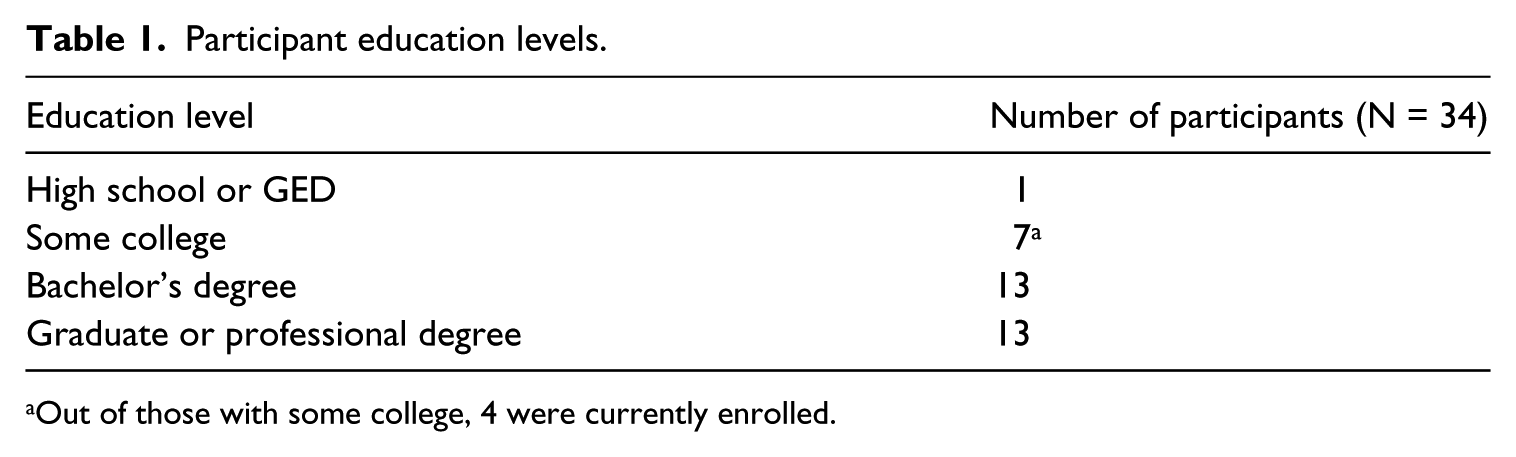
Out of those with some college, 4 were currently enrolled.
Number of participants in income, debt, and asset ranges.
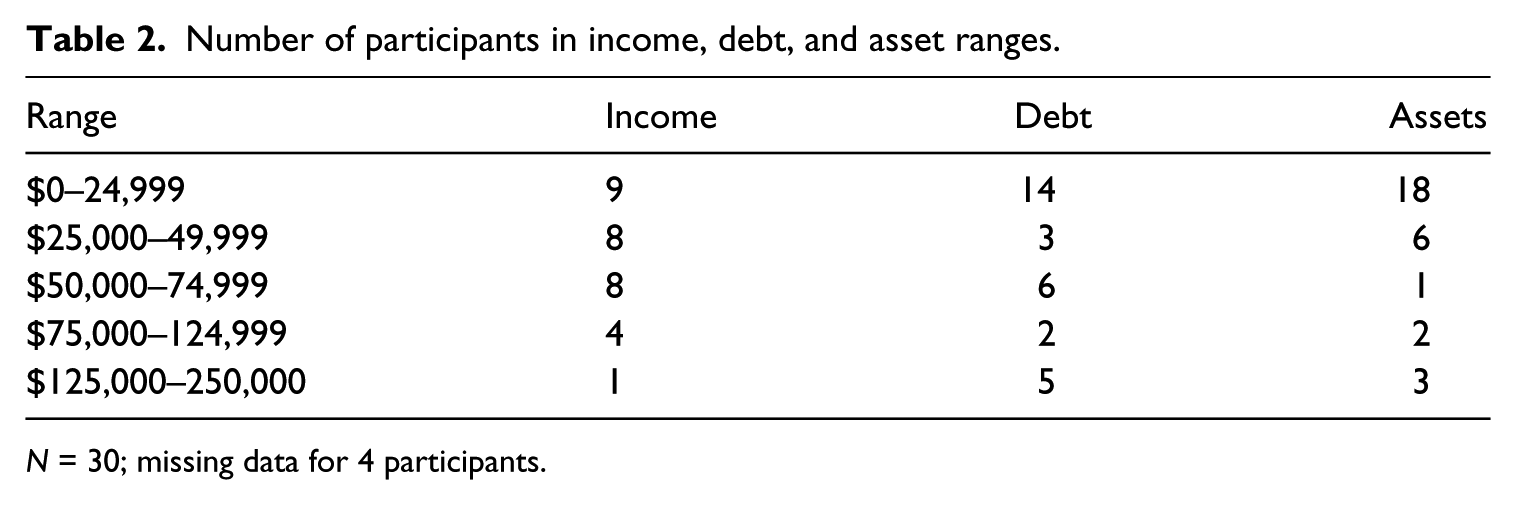
N = 30; missing data for 4 participants.
In phase one, participants named more than 50 sites and resources as part of their open learning ecology. As reported in the background section, I used an intentionally loose definition of open learning in this study in order to best capture open learning from the vantage point of learners. By focusing less on what counts as open and more on what and how participants were learning, I was able to see how they navigated resources beyond the ways that they were designed or intended. For example, few people who used MOOCs in my study finished the MOOCs. To simply classify them as dropouts, as many did when evaluating the effectiveness of MOOCs (Rivard, 2013), would overlook why people in my study did not complete MOOCs. In a traditional classroom setting, one must complete all curricular objectives in order to receive a grade and, later, a credential. In my study, participants used MOOCs to sample course content and move on to other learning opportunities when the content was no longer relevant or outside the abilities of learners. For example, Jess, a white woman in her late twenties, enrolled in a class on website user analytics only to discover a few classes in that she needed a stronger base in statistics. At no penalty, she left the course to pursue resources that could teach her statistics so she could rejoin the class later. By studying open learning from the vantage point of the learner, I was able to identify practices and values present in participants’ open learning. Through interviews, I asked participants to describe their learning and noted what values they attached to that learning. Through participant observation, I was able to validate the presence of their described practices and join in the culture of open learning.
Analysis
Learning entrepreneurialism: ‘Be[ing] able to figure anything out’
Participants were learning entrepreneurialism through their open learning, meaning that they were learning flexible, modular skills that could be picked up quickly and applied to other contexts easily. They contrasted this entrepreneurial learning with traditional education, where learning focused on mastery in order to receive a credential. For example, Brian, a Latino man in his late twenties, discussed entrepreneurialism as the skill of being able to ‘figure anything out’: I think if you’re going to be an entrepreneur – and I’m intro-learning here – but, like, you have to be able to figure anything out, like, anything possible that comes up.
Brian worked at a large corporate home improvement store to make ends meet before going back to school for a graduate degree. He hated his minimum wage job, but having graduated during the recession, the home improvement store was the only place hiring. While in his graduate program, he was encouraged by faculty to take advantage of other learning opportunities available outside the university through open learning. In addition to his graduate coursework, Brian regularly enrolled in MOOCs and participated in several other open learning practices to supplement his education. He had the general sense about him that education was not enough in a bad labor market and that only through some form of entrepreneurialism could a person guarantee a future. While Brian was committed to his traditional schoolwork, he saw it as secondary to the kind of entrepreneurial learning he was doing on his own.
McMillan Cottom (2017) discusses the entrepreneurial worker as one who is always looking for the next opportunity through networking and continuing education that allows the person to acquire newer, market-relevant skills. The entrepreneurial worker, she argues, is a product of expanded labor market precarity (Standing, 2011), declining job tenure for younger workers (Hipple & Sok, 2013), and a risk shift from institutions to individuals (Hacker, 2006). The entrepreneurial worker also assumes that even if they have a job, it might not exist in the future and one way to exit that kind of uncertainty is to strive to become an entrepreneur, or be your own boss (McMillan Cottom, 2017). Brian was an entrepreneurial learner: a student who was already enrolled in a traditional program, but who also did not trust that his program would lead him to a job. Thus, Brian was learning entrepreneurialism and had the aim of one day owning his own business.
While not all entrepreneurial workers and learners intend to become entrepreneurs, they learn and behave in similar ways. In this study, some participants had started or desired to start their own company, like Brian. Others, like Erin, a white woman in her mid-twenties, were learning skills like web development in order to better market herself as a social media guru in her future career as a nurse practitioner. In my sample, participants were learning technical skills in areas like computer programming, marketing, and business development, as well as lifestyle skills in areas like attention and executive functioning, self-development, and self-promotion. Some were also learning traditional liberal arts or professional school complements and substitutes through open learning, like Jimmy, a 19-year-old Asian man, who dropped out of college freshman year to learn exclusively through open learning while working on his startup. Jimmy was taking a few liberal arts MOOCs to effectively round out his education, since he recognized that his tech heavy DIY curriculum did not give him opportunities to learn things like history and literature. However, open learning that focused on the traditional liberal arts or professional school complements were not common in my sample.
The majority of participants in this study had internalized the great risk shift described by Hacker (2006) and later contextualized in the field of education by McMillan Cottom (2017). In other words, participants in my sample viewed learning marketable skills as their own responsibility, and had lost faith in traditional forms of education to lead them to stable employment. For 26 out of the 34 respondents, open learning was linked with some form of material or proximal precariousness related to the 2008 financial crisis and subsequent recession. Fourteen of those 26 participants experienced material precariousness, which I define as having lost a job, struggled to find a job, or having been underemployed as a result of the crisis and recession. The additional 12 out of those 26 participants experienced proximal precariousness, meaning that someone close to them, like a family member or close friend, had experienced material precariousness as a result of the crisis and recession. For these individuals, the crisis and recession had a myth-like quality and they tried to stay ahead of its consequences through open learning.
Elaine, a white woman in her early twenties, did not experience material precariousness herself, but she watched several of her friends graduate college and struggle to find jobs. If they were lucky, they were like Brian, underemployed but still employed. She talked about how the education system was failing because her friends that were successful were the ones that learned something on their own outside of school. Elaine heeded this proximal example and taught herself to use Google Analytics while still in school: Yeah, but I felt like I needed to have the supplementary, tangible skills, that I could say, ‘Hey this is a tool that I know how to use.’ With statistics, I can do these things, or I can write. And I feel like, originally, my education gave me none of that.
Elaine was like many others who felt it was their responsibility to learn on their own. The ‘supplementary, tangible skills’ she was learning were modular, meaning that they could be applied to any context, presumably for profit.
Despite the entrepreneurial self-focus of open learning and narrative of responsibility present for my sample participants, entrepreneurialism was not the dominant value. Learning entrepreneurialism meant learning a set of flexible, modular skills; it was a tool, a way of getting things done. Learning entrepreneurialism for my participants was a shared experience. The additional eight participants in my study who did not report experiencing precariousness as a result of the crisis and recession were creating this shared experience. These eight participants saw their open learning as an ideological challenge to traditional education and traditional norms of work, and as such, I refer to them as ideological challengers. Ideological challengers were open learning as a way to hack institutional life and social norms that they viewed as inaccessible, dull, irrelevant, and socially unjust. Ideological challengers echoed values similar to the New Communalists studied by Turner (2006): they envisioned a more connected, communal, cooperative society that could provide for itself through the aid of technology. They also demonstrated similar entrepreneurial tendencies to precarious open learners, but did so with a grand strategy of connection and alternative institution building in mind. Their ideological challenge resonated with precarious open learners, who were willing to try alternative practices like open learning and had hopes of an alternative future of work.
In order for that alternative future to be possible, someone or something had to be validating the open learning of participants. Flexible, modular learning required feedback and that feedback came in several forms, most of them social. On MOOCs, participants interacted with artificial intelligence that graded quizzes and papers, but also with other participants. Peer grading was a common strategy on MOOC platforms. In the more entrepreneurial spaces, like Skillshare and General Assembly, feedback came from humans. A participant might work in groups during an in-person workshop or might go to a hackathon and work on one part of a learning challenge with a group of other people. If something was not right, feedback would be given, and the person would be given the chance to learn from their mistakes and iterate their work. Finally, in non-profit spaces, like Peer 2 Peer University (P2PU), participants could not earn badges without evaluating other participants’ work first. The community decided whose work was valid or not and it was common to see participants suggesting that another learner revisit their work and try again. Without these shared experiences, learning could not be validated and more importantly, legitimated alternative futures could not be built. The shared experiences encouraged precarious learners to buy into the communal and cooperative values. In the next section I show how the communal and cooperative values of the ideological challengers were embedded in learning entrepreneurialism, such that participants learned to revalue sociality and learned to share.
Learning communalism and cooperativism: ‘Know[ing] people who know things’
Participants in my sample had a sense that they could take what they needed from open learning, but also had to give something back in the process. In other words, open learning was dominated by a regulative discourse of communalism and cooperativism that valued sociality and sharing. Through participant observation, I experienced this sociality in the ever-present feeling of welcome when entering a new context and heard about it from participants who reported feeling the same sense of welcome. Once welcomed into a space or on a site, participants reported feeling like they needed to give something back to it. Alexandra, a white woman in her mid-twenties, felt this in her first experience with open learning. She was enrolled in a prestigious graduate program in education when she first started open learning. An ideological challenger, Alexandra had not experienced precarity as a result of the recession and could be described as someone who had alternative values. As a queer woman, she rejected the idea that she should be on a dominant, culturally sanctioned path of home buying, marriage, and childrearing. Open learning to Alexandra was a way to create alternative communities and institutions, where connected individuals provide for themselves and create their own norms rather than rely on institutional frameworks and norms. Her first experience with open learning encouraged this view: Everybody had like really like an edgy sensibility about education. Like they were doing cutting edge research … everybody just seemed really to be doing very very interesting innovative things on [open learning site] and so I’d be able to sort of take from it … but then as I began to take from it, I wanted to give something back to it.
Alexandra felt prompted by the open learning environment to contribute something of her own once learning something from someone else. She started teaching creative writing on the platform and boasted that she still keeps in touch with several of the people from her online class. The participants in her class were still helping each other find publishing opportunities, many years later.
Contributing to open learning environments did not exclusively mean being able to teach something, which might require some level of comfort or expertise with content. Precarious open learners like Annie, a white woman in her early twenties, found that the barriers to entry in open learning were low. Not only were classes free or low cost, participants could give what they had in order to contribute to their learning environments, even if they had not developed expertise yet. Before she started developing expertise, Annie created a breakfast club for startup founders and employees who were leading and teaching in the open learning spaces where she was learning: It’s only recently that I have begun to feel advanced in – expert like – in some areas. So before I didn’t want to, you know, risk looking like a fool in front of thirty people and not knowing what I was talking about. But I do want to teach a class. It’s a great way of learning … What I have done to give back to the community – because I think that is extremely important when you are trying to do all this – is that I run a breakfast for start-up founders and members … We get together once a month, and do breakfast for an hour or two, and chat. And that way I’ve met a lot of great people and people have met each other. And at the beginning people introduce themselves, and they have to say one thing that they need help with. It basically like, you know – it’s everything from being a developer to needing money to, ‘I just had a baby, what do I do?’
Annie had a habit of connecting with peer instructors offline for coffee and connection, using those experiences to build her personal learning network (Kamenetz, 2010) and also better understand content she was learning in their classes.
The sense of communalism and cooperativism was salient to Nicolas, a white man in his mid-twenties, who would describe sociality and sharing as inherent to his learning: I think what I’m looking for more than anything else is I can’t say that I’m, you know, how do you do X, Y, or Z, whatever, or marketing, or writing. It’s, you know, I just want to know people who know things. So more often than not I’m looking for people. What can I contribute to them and what do I have to learn from them?
Nicolas’s statement very aptly captures the tension ever present in open learning spaces. On one hand, there was an instrumental, entrepreneurial side to ‘know[ing] people who know things’. On the other hand, however, there was a communal and cooperative ethos to his statement about contributing to and learning from people. Instrumentally, expanded networks meant expanded social capital and often times those connections opened up access to experiences that could expand cultural capital, which could be translated into economic capital (Bourdieu, 1986). Through participant observation with Nicolas, I came to know him as something other than a cold and calculative rational actor. His latter statement, about contributing to others and learning from them, was genuine, and I watched it in practice through several hours of participant observation. A formal middle school teacher then gym owner, Nicolas was constantly meeting with people to help them expand their interests or enterprises. He spent several hours a day online or in person, connecting over social media or in coffee shops, getting to know peers who were passionate about their work or what they were learning. Everywhere Nicolas went, he was offering himself, his skills, his networks, even at his favorite pizza stop, where he demanded that I stop with him while telling me the story of the owner’s family business. ‘Know[ing] people who know things’ was as much entrepreneurial as it was communal and cooperative. In the next section, I discuss what this means in terms of learning to share and suggest future research on pedagogy in the sharing economy.
Discussion
Learning to share: Pedagogy and the sharing economy
In this article, I ask how open learners learn to share in order to develop a theoretical and empirical basis for understanding how learning to share happens in the sharing economy. In my sample of open learners, the labor market precarity participants experienced as a result of the financial crisis of 2008 and subsequent recession encouraged the majority of them to learn entrepreneurialism in order to ‘be able to figure anything out’. The ability to figure anything out meant learning flexible, modular skills that could be applied to most contexts. This instructive discourse of entrepreneurialism signifies a risk shift from institutions to individuals and precarious open learners internalized learning entrepreneurialism as their responsibility in order to combat labor market precarity.
While the focus on learning entrepreneurialism reads as evidence of a neoliberal frame, I argue that a regulative discourse of communalism and cooperativism recontextualized entrepreneurialism into a flexible sociality committed to the commons. Those in my sample who had not experienced precariousness as a result of the crisis and recession lead an ideological challenge against traditional education through their open learning. These ideological challengers imagined an alternative future where connected communities aided by technology could provide for themselves in the absence of dominant institutions and institutional norms. Ideological challengers brought with them an ethos of communalism and cooperativism, which precarious learners learned as a result of needing their open learning legitimated and validated.
The tension between rational, instrumental entrepreneurialism on the one hand and communalism and cooperativism on the other is reminiscent of a call made by Yochai Benkler in the closing remarks of the 2016 OuiShare Fest (Benkler, 2016). In his remarks, Benkler called participants to accept tensions as creative, rather than simply silencing, ignoring, or tabling them for later discussion. Benkler’s work on peer production acknowledges competing sensibilities in the social relations of sharing, and even noted that a true ‘communalist’ might struggle with peer production whereas a liberal, libertarian, or post-modernist might not (Benkler, 2002, 2004). Locating its roots within the open software community, Benkler argued that peer production allowed for flexible social relations rather than strong commitments, and in doing so allowed for the kind of autonomy that developers preferred in their work (Benkler, 2002, 2004). However, flexibility and autonomy in social relations did not mean that these communities lacked ideological commitments. Their commitment to the commons was their ‘north star’, a metaphor he used in the OuiShare closing remarks to remind participants of the necessary ‘intellectual framework’ that would embed social relations into production (Benkler, 2016).
Similarly, a paper by the larger research team that I am part of argued that sharing economy participants had in common an ideological commitment to creating a ‘moral market’ through their sharing economy practices (Fitzmaurice et al., 2018). That is, despite critical reviews of the sharing economy as a profound example of neoliberalism, participants instead were deeply critical of neoliberal markets and saw their own activity as an attempt to bring a sense of moral order back into markets by returning to the connected, autonomous, and creative elements of domestic production. Benkler’s historical example of open source software communities fits the definition of a moral market because they value flexibility, autonomy, and connection as part of peer production. Further, his call for an intellectual framework of sharing that embeds production into social relations can be likened to Bernstein’s pedagogic discourse (1996), especially as he calls for the commons to be ‘learn[ed] at the practical habits of mind level’ (Benkler, 2016).
In my study, participants created a flexible sociality without strong commitments, like Benkler (2002, 2004) found in open source software developer communities. As I showed in the background section, open learning shares a historical lineage with open source software development back to the sociotechnical history of connected computing. Furthermore, Turner’s New Communalists preferred social connection and autonomy from the state, and sought innovative ways to live and provide for each other through technology. Similarly, the ideological challengers in my study preferred sociality to their learning and wanted autonomy from dominant institutions, and were seeking innovative ways to learn and work with the help of technology. They also kept the commons as their ‘north star’, heeding Benkler’s vision for the sharing economy and peer production (Benkler, 2016). This ‘north star’ guided precarious learners who were learning the skills of entrepreneurialism in the midst of a precarious labor market, but were doing so in communal and cooperative ways in order to legitimate and validate their learning in the absence of formal credentialing institutions.
Bernstein (1996) states that a pedagogic discourse cannot be defined by either its regulative or instructive voice and argues that too many scholars of education try to focus on either transmission of skills or the transmission of values. For Bernstein, skills and values are part of one pedagogic voice, and it is within this voice that dominant values become disguised through instruction. Therefore, it would be incorrect to classify learning to share as a process of either learning entrepreneurialism or learning communalism and cooperativism. The two speak together, in what I describe in other work as the ‘pedagogy of precarity’ (Carfagna, 2017). Thus, learning to share, the process by which sociality becomes revalued, is dependent on both the ideological intentions of economically stable actors and the precarious immaterial labor of economically unstable actors. Pedagogically, this means that a regulative discourse of communalism and cooperativism recontextualizes an instructive discourse of entrepreneurialism.
In the future, it is unclear if the same need for legitimacy and validation will encourage a sociality to open learning. As platforms and practices become mainstream and traditional higher education institutionalizes open learning under the guise of 21st-century skills, the need for connection may lessen. The peer-to-peer practices of open learning may no longer dominate the space, and the ‘social thickness’ of open learning may be gone (Tonkinwise, 2011). According to Tonkinwise (2011), there is no sharing without that ‘social thickness’. Learning to share, then, may only be dependent upon the precarity of learners – in which case it is questionable if sharing was ever a durable strategy or if it is nothing more than a buffer for hard economic times. While I was able to show how this sociality came to be valued, its ideological component was also based on a lineage of techno-class actors who dismissed organizing against injustices of the state and embraced communalism as a strategy for self-provision. Ideological challengers had a similar disposition when it came to the state and powerful corporate actors. For them, organizing was not the answer and they instead intended to create shared learning experiences and alternative futures.
In the larger sharing economy, this pedagogic approach could be developed to better understand what work participants do, how they learned to do that work, what contexts that work is done within or what contexts are battling for ideological control. The platform Fiverr, for example, embraces entrepreneurialism as part of both the instructive and regulative discourses. Entrepreneurs sign up to provide services to other entrepreneurs in exchange for revenue. The platform explicitly advertises that their site is for ‘doers’, people who get things done at all costs. An empirical study of Fiverr may uncover some other instructive and regulative discourses than the ones voiced by the platform’s advertising, but without such data and a robust theory of pedagogy it is hard to know what participants are learning. In contrast, another team study of time banking showed how sharing services in exchange for time credit in a high status community had the unintended effects of some higher status participants reproducing market logics rather than a communal project. In that study, it is possible that a regulative discourse of status enhancing was recontextualizing an implicitly egalitarian and communal instructive project (Dubois, Schor, & Carfagna, 2014). Learning to share for time bankers, perhaps, was no different than learning distinction, which is hardly a strategy for connection.
Conclusion
Learning to share is not an automatic process and is not guaranteed by perfect user interface design or ideological mission statements. Without a robust theory of pedagogy and empirical evidence to back up that theory, studies of learning are limited to studies of either skills or values rather than how skills and values create one pedagogic voice. In addition, open learning, much like the larger sharing economy, has been critiqued as inherently neoliberal and has been mischaracterized as denying sociability (Barkawi, 2013; Hall, 2013). These claims are tenuously made and lack the empiricism emphasized in this article. In the absence of a theory of pedagogy and empirical study, it would be too easy to take a totalizing view of open learning in this case and miss an opportunity to describe how a practice within the sharing economy actually does teach sharing, despite its potential limits for the future. This article offers an analysis of what is learned and how it is learned in an ethnographic study of open learning. A better understanding of the sharing economy’s diverse sites, practices, aims, and outcomes, I argue, can be accomplished through the lens of pedagogy. While many sharing economy sites have vague ideological commitments to valorized aims like sharing or egalitarianism, ideology is not enough to necessitate social action. A theory of pedagogy applied to the sharing economy provides an analytical frame through which we can analyze learning and economic relations as two sides of the same coin in contemporary capitalism.
Footnotes
Funding
This research was conducted with funding from the MacArthur Foundation as part of the Connected Learning Research Network.