




Abstract
This article focuses on the representation of qualitative sociological research to academic and non-academic audiences. It argues that a broader, ethically informed consideration of the communication of findings is required, rather than the current, audit-shaped approach, to do justice to complex (affective) data and to research participants. An important catalyst for this article is the concern that the current predominance of peer-reviewed articles may contribute, however unintentionally, to the maintenance of stigmatizing social imaginaries of groups including marginalized young people. This article draws on interdisciplinary sources to extend Avery Gordon’s work on haunting to the representation of research. It contends that research ‘outputs’ can ‘haunt’, or stay with and produce empathy in their audience, by communicating the ‘seething absences’ that trace the everyday effects of power affectively and by highlighting the ‘complex personhood’ of those affected. The possibilities of such an approach are illustrated through consideration of textual and visual representations of findings from a project that explored understandings of ‘belonging’ among young people in state care, and particularly a short film, co-produced with, and featuring, a participant. While ‘representation’ is employed here primarily in an everyday sense, this article discusses ‘non’ or ‘more than’ representational approaches, while advocating a strategic negotiation with representation in relation to social justice.
Keywords
This article focuses on the representation of qualitative sociological research to both academic and non-academic audiences. I argue that a broader, ethically informed consideration of the communication of research findings is required instead of the current, audit-shaped approach. In the UK, government measurement of research activity in the social sciences focuses largely on the production of peer-reviewed articles for academic journals. However, the conventional norms of academic writing for peer review, often including rigid word counts and the automatic ‘anonymization’ of participants, may not do justice either to complex (affective) data or to participants themselves. Worse, the predominance of peer-reviewed articles may contribute, however unintentionally, to the maintenance of stigmatizing and misleading social imaginaries of certain groups, including the disadvantaged young people on whose lives my research has focused. Such young people are often imagined in the media and political rhetoric as ‘undisciplined’ and ‘dependent’, and their behaviour understood in terms of irresponsible choices or indifference rather than structural disadvantage. The concern animating this article is that the overall representation of research projects should take such considerations into account, and I argue that the work of Avery Gordon can be extended to the representation of research to consider these matters further.
In her book Ghostly Matters: Haunting and the Sociological Imagination (2008), Gordon argues that an overwhelming sociological focus on the concrete and tangible may obscure the many ‘seething’ and intangible absences associated with living in difficult circumstances. As such, the ‘complex personhood’ of those whose lives are discussed may remain unrecognized, and many research outputs may present them, unintentionally, as inadequate, passive and unable to speak for themselves. In contrast, Gordon argues that research should ‘haunt’ (2008) by exploring social circumstances in an affective way that produces a sense in the audience that something needs to change as a result. This article draws on her work to explore how different representations of research can highlight difficult experiences in ‘haunting’ ways that do not reinforce reductive stereotypes and may even challenge stigmatizing ‘social imaginaries’ of marginalized groups. It argues that sociologists can learn from ethnography, cultural geography, photographic theory and from artists in thinking about how their work might do so. The first section therefore considers sociological, photographic theory, anthropological and other work relevant to this aim. This section is followed by a consideration of how longer, text-based publications, but more specifically small-scale visual representations of research, can ‘haunt’, in part by communicating absence and highlighting complex personhood. A final section discusses related ethical issues and, specifically, whether automatic ‘anonymity’ may prevent ‘haunting’. I argue that the notion of ‘harm’ should be reconsidered in the light of broader ethical values including participant autonomy, especially in relation to co-produced research. Furthermore, an ‘ethics of recognition’ rather than concealment may help to reflect data in ways that highlight difficult circumstances while also recognizing the intelligence and imagination of those living them.
Haunting and the representation of research
This article is prompted by reflections on my research with marginalized young people. Such groups are often stigmatized through imaginaries of dilapidated neighbourhoods (Byrne, Elliott, & Williams, 2016; Taylor, 2012) and ‘troubled’ family lives (Shildrick, Macdonald, & Furling, 2016). Tyler argues that such imaginaries focus on ‘voluntarily adopted lifestyles’ (2013, p. 186) while diverting political attention from social structures. By doing so, they support a ‘form of governance legitimizing the reproduction and entrenchment of inequalities and injustices’ (2013, p. 8). In this article, I focus on one of my previous studies, ‘the Sights and Sounds’ project, which explored understandings of ‘belonging’ among young people in state care, through participatory visual, audial and arts-based methods, including photo elicitation, sound recording and drawing. The article considers different representations subsequently made of these findings in ‘outputs’ including more conventional peer-reviewed articles and book chapters (Wilson, 2015, 2016; Wilson and Milne, 2016) but focuses on a short, very simple film, produced somewhat serendipitously at the end of the project (with the support of social workers) 1 as part of two days of activities at a charity creative media centre. The film is available at https://www.youtube.com/watch?v=Pf6NgvvucvU&feature=youtu.be. Six self-selected project participants chose from activities including drawing, film-making and song-writing to translate key project findings with the help of media workers. Three participants chose to collaborate on a film on leaving care. The article focuses on an excerpt from this film in which an identified, adult project participant (David) and I discuss the comic strip format drawings he made to illustrate his (traumatic) move from a residential unit that he loved into his own, hated flat. He deploys his artistic skills and knowledge of film imagery to evoke his anger at this abrupt move and arrival at a tiny, empty, silent bedsit, in which he could not sleep after the friendly bustle of a residential home. The very positive and engaged reactions provoked by this film in both academic and non-academic contexts made me feel increasingly uneasy about institutional pressures to privilege the production of peer-reviewed articles rather than considering broader concerns around the representation of data and their potential connections with stigmatizing social imaginaries.
In recent years, there has been increasing criticism of the predominance of peer-reviewed articles in representing research (Pandian & McLean, 2017; Smart, 2010; Smart, Hockey, & James, 2014), which in the UK relates to the way that universities are audited by government through the Research Excellence Framework (REF). 2 In part, this critique relates to the flourishing of artistic, performative and sensory methods (also see Mason, 2011; Mason & Davies, 2010; Pink, 2009; Rose, 2007), much of which developed in the wake of feminist, queer and indigenous scholarship (Edwards & Brannelly, 2017), and which may not be best reflected in conventional, text-focused academic articles. Smart urges sociologists to think of themselves as ‘storytellers as well as sociologists’ (2010, p. 5). She emphasizes that ‘qualitative, empirical research deserves to be written in a way that captures the imagination of, and engages, the reader’ (Smart et al., 2014, p. 14) and that ‘layers of voices’ can provide moments of ‘transformative recognition’ (Smart, 2014, pp. 132, 146) and of openness to different understandings of social life. Similarly, Abbott (2007) calls for a non-narrative, ‘momentary’ and ‘lyrical’ genre within sociological writing. Such approaches have been more common in representing ethnographic work as exemplified by Stewart’s (2007) experimental assemblage of disparate scenes to convey ‘the texture of knowing’ and to ‘slow the jump’ to representational thinking. Pandian and McLean suggest that ethnographic writing should be an affective ‘mode of displacement’ rather than ‘a detached reflection upon the world’ (2017, pp. 1, 3). Such considerations have also led many researchers to include non-textual representations of research findings (Coleman, 2016; Roberts, 2008). For Pink ‘[p]hotographs have the capacity to bring textures, surfaces and the sensory experiences they evoke right up close to the reader’ (2009, p. 136), and she cites MacDougall’s suggestion that scholars should value ‘the visual, auditory and textual modes of expression found in film’ (MacDougall, 2005, p. 60).
Several writers contend that such concerns suggest overlaps between social science writing and fiction. For Pandian and McLean, while there are important distinctions between freely invented literature and ethnography, there are also similarities relevant to the representation of research: ‘[a]n ethnography carries beings of one world into another one. This is a promise that our writing shares with fiction, poetry, cinema, and most other expressive arts’ (2017, p. 1). Consequently, they argue that ‘[t]he question of writing’s fidelity to the real cannot be adjudicated on the basis of conventional distinctions between “documentary” and “fictional” registers’ (Paper Boat Collective, 2017, p. 20). Such an approach again has a longer history in anthropology. Abbott (2007) refers to Malinowski’s monographs as ‘lyrical’; Behar (1997) uses the essay form to argue passionately for an anthropology that ‘breaks the heart’; and Ghodsee (2016) advises how to transform ethnographic notes into readable narrative. Similarly, in visual terms, the ‘ethno-fiction’ of Rouch and Marshall combined elements of documentary and fiction and blurred the lines between them to better reflect the emplaced thoughts and feelings of research subjects (MacDougall, 2009, p. 58; see also Paravel & Castaing-Taylor and their immersive film Leviathan 3 ). This article will focus on a short film excerpt but does not argue that haunting effects can only be achieved through the visual.
Examples of film-making that in some ways blurs the lines between documentary and fiction to haunting effect include the work of Pennell. In The Host 4 (2016; Korossi, 2017) she uses her own family’s and British Petroleum archive photographs to challenge deterministic, neocolonial corporate narratives of Iranian history (particularly of the 1953 US/UK backed coup to overturn Mossadeq’s plans for oil nationalization), and to recognize affectively the lives of ordinary Iranians who wished and campaigned otherwise. Similarly, Jablónski uses photographs from a Nazi administrator’s archive of the Jewish ghetto of Lódz in the film Fotoamator (‘Photographer’ 5 ). Baer argues that these stills provide a ‘deictic’ and fragmentary way of looking that can challenge the photographer’s narrative and any subsequent sense of historical inexorability. In his view, the power of photography is ‘to capture [such] experiences without integrating them into a mitigating context’ (Baer, 2005, p. 6). Both films linger on stills of faces, some of which return the photographer’s gaze. In Jablónski’s case these include those of a barber and of children queuing for soup. In Pennell’s film the camera hovers over a photograph of the variously angry and scared faces of diversely dressed, striking oil workers. It is a group photograph, but the time devoted to this still allows emotions and differences between group members to emerge. In Baer’s analysis, such faces again challenge monolithic views of historical fate as ‘inevitable’ or anonymous, forcing the viewer ‘to assume a responsibility with regard to the image’ (2005, p. 182) across time. Both further emphasize the importance of sound to film in its evocation of a world and time beyond the edges of the frame, leaving a space for other subjectivities than those reflected in the logic of the archive itself. Pennell (2016) uses popular music to create an Iranian counter-subjectivity to BP’s narrative, and to point to the filmmaker’s presence, thereby again contesting any sense of detachment from the present. As Baer puts it, quoting Semprun, (some) films can ‘tear reality out of the numbing factuality of straightforward realism’ (2005, p. 172, emphasis added) and stay with us, haunting the viewer. Similarly, Abbott (2007, p. 86) argues that a ‘lyrical’ genre of sociological writing can challenge the inexorability of long narratives, highlighting the ‘indeterminate character of historical passage moment to moment’.
Both Smart and Pennell acknowledge Gordon’s work in considering how academics might learn from fiction and film-making respectively to ‘haunt’ their audiences. In addressing issues of representing research findings, and more particularly the lives of research participants, this article extends Gordon’s concerns for a more embodied and sensory knowledge of the traces of power and injustice, to its communication. In Gordon’s view, sociology limits its potential to respond to what she considers to be a neoliberal ‘attachment to epistemologies of blindness’ through its commitment ‘to an empiricist epistemology and its supporting ontology of the visible and the concrete’ (2008, p. xix, emphasis added). In response, she argues that sociologists should aim to produce research that does not focus explanation on individual anguish only, but that has the power to ‘haunt’ through providing ‘moment[s] of affective recognition’ (2008, p. 132). For Gordon, Williams’s notion of the ‘structure of feeling’ (1977, p. 129), or the ‘sensuous knowledge, of … the tangle of the subjective and the objective … the personal and the social’ is a crucial element of how sociological enquiry might prompt such haunting ‘moments’ (Gordon, 2008, p. 200). Her work therefore focuses on making absences – the non-visible, the non-concrete – or intangible visible. Notably, she aims to highlight the ‘traces of power’s presence’ not only in the form of blatant human rights abuses or physical violence but also in the less visible, everyday violence and ‘seething absences’ of living in a place containing only ‘furniture without memories’ (Gordon, 2008, pp. 200, 3). This is a notion of visuality that combines Rose’s (2014) notions of the visible and visual. To bring such haunting absences into view, Gordon argues that the ‘particular density, delicacy, and propulsive force of the imagination’ or the ‘fictive’ (2008, p. viii) must be incorporated into sociological analysis.
An integral element of Gordon’s argument is that to haunt, sociological research must ‘see the things and the people who are primarily unseen and banished to the periphery of our social graciousness’ (2008, p. 196). Furthermore, when making these things and people visible, it is critical for sociologists to be attentive to their ‘complex personhood’. Her notion of ‘complex personhood’ shares elements of Honneth’s concern for the ‘intersubjective recognition of … identity’ (1992/2005, p. 5). Importantly, Gordon demands that, as part of this process of recognition, researchers reflect that while people may ‘get stuck in the symptoms of their troubles, [they may] also transform themselves’ (2008, p. 4). In this way, she avoids the damage-focused, and ultimately static and reductive perspective that characterizes many research representations of marginalized groups.
Drawing on Gordon’s idea that haunting should reinforce concerns for social justice, the aim here is not only to communicate the sensory and intangible, as is the focus of much ‘non-representational’ work (Lyon, 2016). Instead, and like Doucet (2018), the idea is also to challenge stigmatizing, and ultimately false, social imaginaries of social groups through a strategic negotiation with representation. For Levitas, social imaginaries, including their ‘images of potential futures’, are always part of the ways in which ordinary people in particular places ‘imagine the societies they inhabit and sustain’ (2013, p. 219). As Alexander puts it the imagination is institutionalized and therefore ‘intrinsic to the very process of representation’ (2012, p. 14). I suggest that to do so, it is necessary to provide more complex ‘counter-representations’ (Byrne et al., 2016), ‘counter-visuality’ (Depeli, 2016) or ‘counter-narratives’ (Denzin, 2003) in ways that stay with the audience, provoking empathy and potentially action. However, I also argue that the possibility of doing so is reduced by the prevalent ethical stricture, often reinforced by journals, that research participants should not be identified. While the concern to ‘do no harm’ remains crucial, anonymization can feel like a form of ‘erasure’ of personhood, one that ‘creates distance that separates participants from researchers and the audiences for whom they write’ (Smart et al., 2014, p. 11). Similarly, Sinha and Back (2014) argue that ‘automatic anonymity’ silences and confines subjects of research while making more ‘sociable’ and dialogical research methods difficult. These authors all highlight therefore the ethical ambiguity of automatic anonymity in a context in which the co-production of data, and the idea that ‘the outcomes of research should impact on other people’s lives’ (Smart et al., 2014, p. 15), are encouraged. Ginsburg’s (2014) work further suggests the difficulty of countering predominant social and political relations if certain situations are not made visible. The next sections will draw on Gordon’s notion of ‘haunting’ to discuss the difference in affect produced by textual and visual outputs other than peer-reviewed articles. They will focus in particular on the importance of highlighting ‘seething absences’ and the complex personhood of research participants, as well as on ethical dilemmas raised, before returning to a broader discussion of academic outputs in a concluding section.
Making the violence of seething absences visible
The ‘Sights and Sounds’ researchers attempted to reflect the violence of the ‘seething absences’ associated with several participants’ disorienting experiences of leaving care, both in peer-reviewed articles and in the film mentioned above. It is argued in this and the following sections that while the former presented certain advantages, it is the film that ‘haunts’ the viewer more effectively.
Most care-leavers interviewed were extremely unhappy in their post-care accommodation, experiencing an absence of care and belonging there. The peer-reviewed articles subsequently produced tried to reflect these findings through their inclusion of several relevant quotations from participants who had, notably, thrown furniture out of the window in frustration, or experienced episodes of mental ill-health. When relating such highly sensitive circumstances, it should be noted that anonymization is not problematic and permits the inclusion of particularly sensitive data.
At the same time, such relatively thin representations of data may not stay with their audience. I argue that the conventions often associated with peer-reviewed articles, which remain the primary means of disseminating findings under audit culture, can detract from the likelihood of communicating such absences in a haunting way. Smart laments how when writing peer-reviewed articles, in contrast to monographs that allow for extensive, rich descriptions, ‘one spends so much time on the formalities (the research question, the methodology, citing other studies etc) that there is little room for working more creatively with data-based conceptualisations’ (2010, p. 9). Furthermore, peer reviewers often criticize draft articles that include multiple quotations, especially if those quotations are from a single or small number of respondents, and did so in relation to the texts mentioned above. There are good intellectual reasons for such critiques, including the concern to show the trustworthiness of analysis across a relevant sample. However, as Pahl observed, when writing up the longitudinal Sheppey ‘Divisions of Labour’ study, and justifying his decision to devote part of his dissemination activities to detailed case studies such as that of ‘Linda’ and ‘Jim’:
If I had [used] single quotations from the many different … households that were studied, it would have done violence to the complexity that the interviews revealed. There would, I felt, have been a danger that such quotations would have both simplified and insulted the humanity that the figures, on inspection, soon reveal (Pahl, 2017, p. 179, emphasis added).
Such long-term case studies, extended to heart-breaking effect in Elliott and Lawrence’s (2017) reconsideration of ‘Linda’ and ‘Jim’s’ story in the light of later unpublished interviews, can be very affective. The presentation of such in-depth backstories is often impossible, however, due to the word count constraints associated with peer-reviewed articles and research reports.
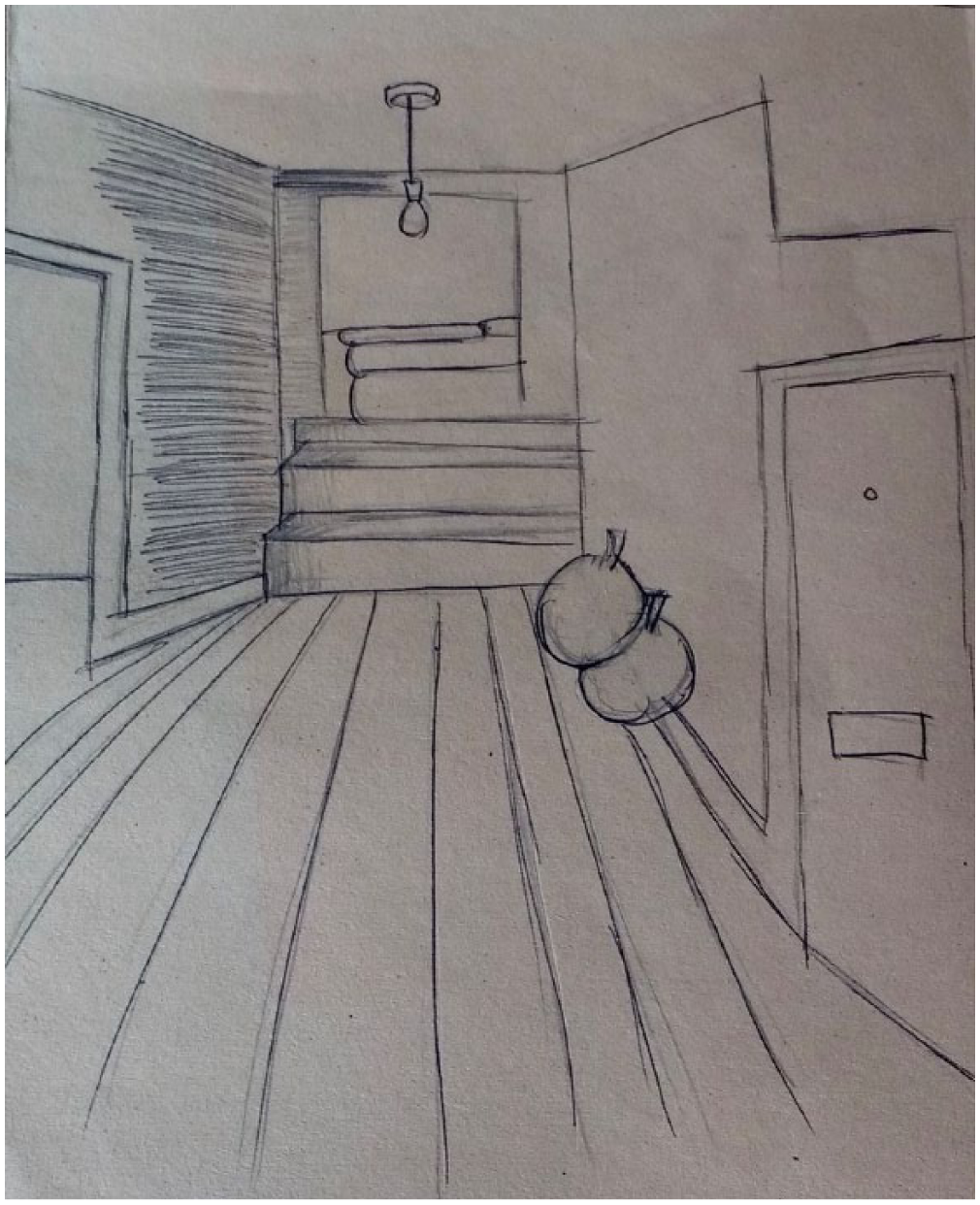
Similarly, in relation to my own research, I argue that even the brief passage of film analysed here can communicate something more ‘haunting’ of the absences in David’s life than such articles. Through David’s drawings, the film shows, rather than states, the emptiness of the flat as he arrived with his belongings in bin-bags. The main impression created by his drawings is one of physical and emotional desolation (Figure 1). Through his drawing and discussion of the naked light bulb that greeted him, he highlights ‘the difference a lampshade can make’ and transforms this absence into a visual symbol of the lack of care or ‘recognition’ (May, 2013, drawing on Honneth) shown to him [see 02 min 13 sec].
David’s drawing of the empty flat.
David’s own appreciation of the potential for visual imagery to communicate his predicament is further evidenced in the film by his spoken explanation of the influence on his own drawings of a film he had seen, in which the camera follows a character down an interminable, empty corridor, an image antithetical to homeliness. Alexander might analyse such drawings in terms of ‘well-trodden narrative formulas and visual clichés’ (2012, p. 209). In contrast, in an analysis of his own notebook drawings, Taussig (2011, p. 13) argues that their evocative potential, and that of ‘still life’ drawing in general lies in the fact that they ‘come across as fragments that are suggestive of a world beyond’. Such analysis comes close to Pennell and Baer’s consideration of the ‘haunting’ nature of photographic stills. 6 Similarly, for Bachelard (1958/1994) such fragmentary visual or textual imagery of ‘hostile space’ reflects something more profound, beyond metaphor or narrative formula. In his poetry-inspired phenomenology of the imagination of home, Bachelard asserts that home should be ‘our corner of the world’ (1958/1994, p. 4), a place of warmth and protection. Indeed, he specifically mentions lampshades as a positive image of solitude (1958/1994, p. 36). Similarly, caskets, cupboards and other enclosed spaces are for him all aspects of the (ideal) home that affords the retention of memories, and construction of an optimistic sense of self into adulthood. In stark contrast, David’s flat did not feel like his ‘corner of the world’. Explaining the prominence accorded to the naked light bulb in his drawings, he recounts that on his arrival, ‘[i]t hit me like a ton of bricks … That was me…trapped.’
David could not imagine his flat as an intimate, protective ‘corner’ therefore, and through his drawings and our discussion, the film expresses rich and intangible aspects of private experience or absences that are difficult to communicate so concisely or directly in peer-reviewed articles. By communicating this ‘structure of feeling’, the film also suggests the potential effects of these domestic circumstances on his sense of self and agency and imagination of the future. It evokes a seething absence of a sense of future; the flat, and its sparse ‘furniture without memories’ could not provide him with any sense of ‘integration’ (Bachelard) or ‘orientation’ (Ahmed, 2006). Similarly to the arts-based methods used by Carabelli and Lyon (2016) with contemporary Sheppey youth, his drawings and their discussion in the film trace his sense of a fragile trajectory. Furthermore, the film achieves this in a way that emphasizes David’s ‘complex personhood’, as explored in the next section.
Representing complex personhood
This article also argues that such uses of film can present advantages in terms of recognizing participants’ complex personhood. In emphasizing the ‘complex personhood’ of research participants as people with emotions who can change over time, Gordon’s concern is to avoid the flattening effects of sociological categorization that can seem to rule out a different, more positive, future. Several writers have pointed to the difficulty of communicating the ‘social vitality’ (Back, 2014, p. 67) of respondents’ lives in peer-reviewed articles. Notably, Back argues for extended, written sociological accounts that provide ‘an unfolding portrait of a [whole] life’ (2014, pp. 68–69), employing ‘crafted repetition’ alongside ‘vivid description’ to return the reader to important themes. 7
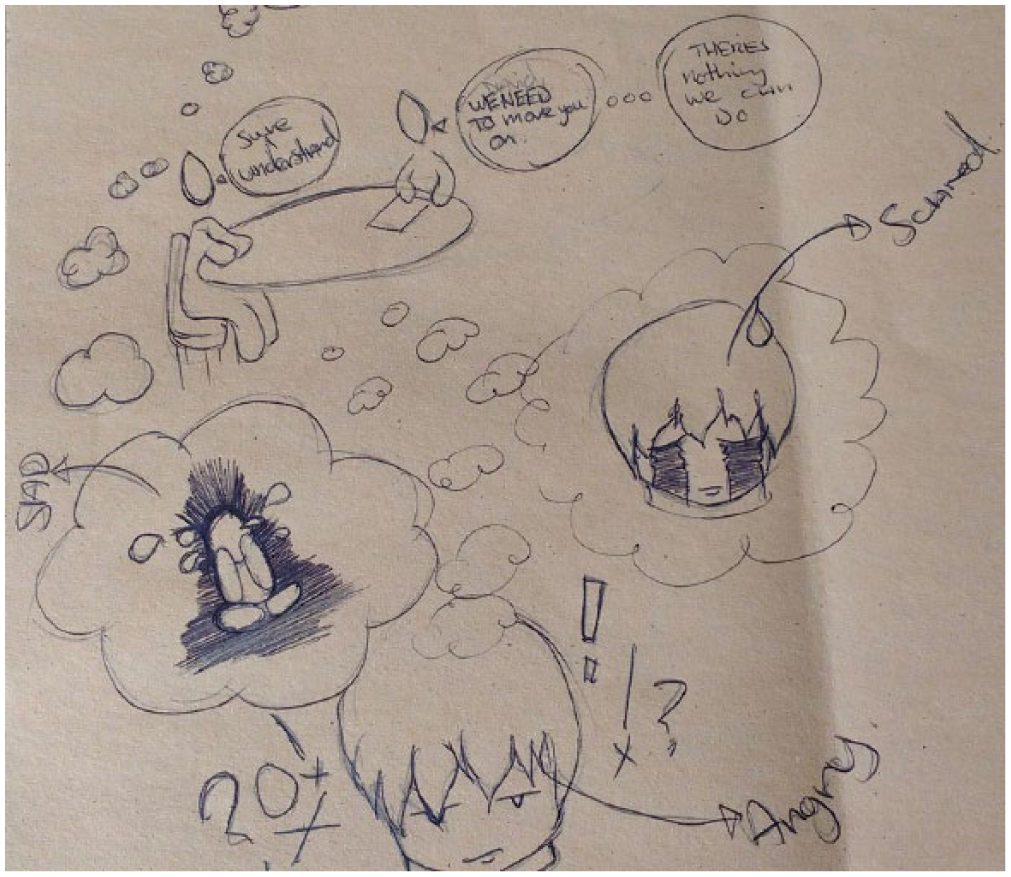
The film does so more concisely. It highlights David’s strong emotions on arrival at his flat. His comic strip drawings and their discussion reveal his understandable, but in the moment unexpressed, anger at being forced to leave the (residential) home he loved. As David himself identifies, at the time he was restricted by a script of what Harvey would call neoliberal adulthood in which expressions of anger or unfairness are considered ‘inappropriate’. In the film, David points to this pressure to remain polite and to conceal anger. He draws himself saying ‘Sure I understand’ in response to the social worker who told him he had to leave (Figure 2), commenting ‘[y]ou’ve got to be civil’. When describing coping with minimal support after the move, he acknowledges ‘they are busy people. I understood that.’ However, he uses the comic strip convention of thought bubbles in his drawings to communicate his simultaneous anger and fear in an aesthetically accepted way (see 47 seconds onwards). As such, the invisible (and inaudible) violence of such expectations of civility in a context in which a young person is being removed from the home that they loved is highlighted. David’s sense of abandonment is underlined by the audible emotion in our voices 8 as we discuss this event.
David’s graphic expression of his feelings on being told he has to move.
As such, the film’s visual and audial elements communicate layered emotions of circumstances in a more nuanced and immediate way than possible through the ‘numbing factuality’ and tone of much academic writing, including peer-reviewed articles and the very short briefings expected by policymakers. Furthermore, the film represents emotion in ways that do not either diminish David or flatten his justified anger. This might have been the case had his anger been reported in a research paper either as an observation of body language (whereas in the film he is calm), or perhaps as a transcription of an expletive-laden conversation (although David does not habitually swear). Instead of perhaps drawing on prevalent negative imaginaries of young people to fill in the gaps, the viewer is confronted by a recognizably rational and responsible adult placed in very difficult circumstances. The video shows him to be the intelligent person that he is. He is not a passive or simple object of social structural disadvantage, frozen either textually or visually in his circumstances, and discussed in his absence. He speaks for himself, and, as Arendt (1958/2103) might put it, engages in the public sphere. He is present, and his drawings suggest talent, possibility and future (or the injustice of his feeling that he might not have a future).
It is argued therefore that the film not only presents a haunting account of the injustices and absences associated with David’s move to his flat, but does so in a way that highlights his ‘complex personhood’. According to prevalent interpretations of ethical codes however, this film should not have been made as David’s contribution is not ‘anonymized’. The complex ethical dilemmas raised by the film are addressed in the next section, which also raises the possibility that conventional ethical strictures may present a barrier to haunting and to the representation of complex personhood.
The difficulty of reflecting complex personhood under current academic regimes
Great care is always required to ensure, as far as possible, that representations of research in any form do not contribute to the further stigmatization of the person or social group discussed. There are risks attached to exposing participants’ private lives and always ‘the possibility that what has been revealed to us will escape from our control’ (Hockey, 2014, p. 99). Furthermore, it is not argued that anonymity should be waived in all visual or other outputs, or that identifying respondents is the only way of attempting to communicate complex personhood or to ‘haunt’. Anonymized photographs or displays of personal objects (Cole, 2015) may be highly effective in telling a story. In the ‘Sights and Sounds’ project, photographs taken of treasured objects, and the often poignant associated stories, have been included in peer-reviewed articles. However, it is argued that a blanket emphasis on anonymity can have important downsides in terms of respecting participants’ autonomy, motivations for taking part and in reflecting their ‘complex personhood’. It is suggested therefore that a broader approach to such issues should be adopted.
As mentioned, interviews sometimes provide rare occasions for memorialization. Many participants in Hockey’s work on bereavement, for example, did not want to be anonymized as the interview process had given them an unusual opportunity to leave ‘traces of times, places and people no longer present’ (2014, p. 105). Similarly, Elliott and Lawrence report that Pahl felt: ‘guilty that the professional ethics which led him to use pseudonyms … had denied “Linda” the recognition she craved for her story’ (2017, p. 203). She had wanted to be able to show her friends that she was in a book, and perhaps thereby to (re)gain some of the respect and recognition denied to her by bruising encounters with state authorities on no longer being able to work. Bates (2013) has also pointed to the way that anonymization may reinforce the stigma associated with illness.
As Hockey emphasizes, anonymization is ‘[clearly] about boundary maintenance’ (2014, p. 99) at a time when the boundaries between researcher and researched are becoming more blurred. Participants often want to maintain their identities in representations of research which they have co-produced rather than being denied the opportunity to participate in the ‘circulation of imagination’ created by the resulting research outputs (Sinha & Back, 2014). David was aware that his appearance in the film was not risk-free. However, he wanted to take part to ‘speak’ to professionals, if he could do so on his terms. He was intimately involved in discussions relating to how he should be represented in the film. Notably, except for in one shot [see 02 min 45 sec], he rejected suggestions that he should consistently appear as a relatively small figure placed ‘inside’ large mock-ups of his drawings to reinforce his difficult circumstances. Equally significantly, the film was not made in the flat he loathed. As such, David’s main concerns related not to his appearance but to the potential for both more creative and more realist representations to freeze perceptions of him inside his limited present, denying him, in representational terms, the possibility of a more open-ended future.
Attending to presence, absence and their possible interpretations in planning representations of research should therefore be of equal ethical significance as to whether participants are identified. Many ‘Sights and Sounds’ project participants took photographs that might have reinforced negative stereotypes of young people and their activities, especially if presented without further explanation, or as Baer and Pennell’s work shows, without audial or other aesthetic means of subverting archivists’ or viewers’ stereotyped narratives. Similar points have been made in relation to documentary photography that constructs ‘less developed’ regions of the world as inhabited by passive and helpless peoples (Ginsburg, 2014, p. 55). However, it is argued that where stigmatized groups are concerned, it is more difficult to challenge stereotyped public imaginations or to reduce distance from those treated as ‘generalised others’ (Kohn, 2016), without contrary detailed and sometimes visual and potentially identifying evidence. Considering automatic anonymity in such a light suggests that, in some circumstances, it might be seen as unethical, and as supporting, however unintentionally, a neoliberal governmentality (Tyler, 2013) invested in ‘epistemologies of blindness’. In contrast, as Ginsburg contends in relation to human rights abuses, ‘[e]xposure makes it impossible for us to shelter in our lack of knowledge, implying that the act of exposure also exposes [the viewer]’ (2014, p. 52), including other academics, and may help to create new understandings. In relation to David, it is argued that automatic anonymity might be seen as contributing to the general invisibility of the complexity of disadvantaged young people’s circumstances, thus leaving the overwhelmingly negative imaginations of ‘undisciplined’ lives that demonize them unchallenged. In Gordon’s terms, automatic anonymity might be seen as impeding the haunting that might challenge these imaginations. These arguments suggest that there is a need to consider ethical principles to ‘do no harm’ in more nuanced terms and to place a more balanced emphasis on participants’ autonomy and on representing the complex personhood of certain groups. As such, an ‘ethics of recognition’, rather than one of concealment, may be more appropriate. Such an approach is contained in the Statement of Ethics of the Association of American Geographers, according to which ‘[i]nformants should be asked whether they prefer anonymity or recognition, and the project should be implemented and its results should be presented in keeping with these individuals’ preference’ (Bates, 2013).
Discussion
This article does not argue for an end to peer-reviewed articles as an important means of situating studies in relation to theoretical conversations. However, it criticizes the ‘uniformity imposed by contemporary managerialism’ (Smart, 2014, p. 147), and the resulting predominance of peer-reviewed articles in representing findings in a time-constrained academic context driven by university managers’ concern to excel in audit exercises such as the REF. It also implicitly challenges the current division of academic representation into outputs for academic and non-academic (‘impact’) ‘beneficiaries’. In an open access world, it can no longer be assumed that non-academics, including journalists, will not have access to academic journals and the protection of participants supplying sensitive data therein will become even more critical. Equally, it should be recognized that concealment may not only protect individual participants but reinforce collective prejudice against them. As such, the potential broader and combined effects (or lack of them) of the outputs produced for a project need to be considered ‘in the round’. Such reflections suggest the importance of greater time and space in which to engage in experimentation around the textual and visual re-presentation of findings in ways discussed with participants. As Jackson argues, there is a need to consider ‘new techniques for integrating the arts of showing with the sciences of knowing’ (2017, p. 48). Such developments may include longer monographs that place methodological and theoretical discussion into appendices, end chapters or footnotes 9 (Desmond, 2016; Lareau, 2011), writing that incorporates literature, poetry and references to music (Mason, 2018) or that is composed of assemblages of scenes (Stewart, 2007), or larger-scale collaborations with artists and filmmakers. This article focuses on a much smaller-scale and concise approach that does not require access to great technical knowhow or a large budget to buy in such expertise.
Drawing on Gordon’s notion of ‘haunting’, this article, perhaps ironically a peer-reviewed article itself, reflects on my awkward realization that the film better conveyed both David’s ‘complex personhood’ and a ‘structure of feeling’ of his sense of abandonment and lack of future, to both academic and non-academic audiences, than the peer-reviewed articles also produced. In particular, David is not reduced to an inanimate object of academic analysis, but speaks directly to these audiences. In addition, while not the main focus of this article, it is important to note that he loved the process of making the film, its reception at the research launch and the knowledge that it is now used in social worker and teacher education, while I also learnt from the more self-risking process of putting myself on screen. Such observations point to the further need to consider participants’ motivations for contributing to a project, and to whom and how they might wish to be represented or to represent themselves through it.
The film’s use of David’s drawings and their incorporation of elements from broader visual culture raises further points. As Back points out, it is not the raw data of transcription, of film or of photographs that convey the ‘social vitality’ (2014, p. 67) of the lives studied. Careful documentary analysis/editing of recorded action and interviews is one approach to achieving this and potential haunting 10 (though one determined by the editor and not necessarily by the participants). Alexander (2012) and others focus on the importance of constructing a ‘narrative’ in whatever form. A further approach, depending on context and purpose, is that of Baer (2005) and Pennell (2016) who, like Abbott (2007), eschew a straightforward narrative approach, preferring to focus on fragments or moments supplied by photographic stills in film, supported or undercut by sound, to puncture the deterministic grip of ‘history’ or challenge stereotyping narratives that deny future. The film draws on both approaches. Such techniques bring sociological practice closer to the fictive (Puwar and Sharma, 2012), and make some uneasy. 11 Overall, however, this work suggests the importance of developing discussions around the ‘common byways’ (Michael, 2012, cited in Coleman, 2016, p. 7; Galman, 2009) between sociology and art/fiction and of diverse ways of showing the ‘fidelity’ of research outputs to the data produced. Such discussions may also help to further translate the promise of qualitative research and its concern with people and their complex everyday realities rather than numbers.
David’s appearance in the film, in stark contrast to the conventional academic practice of ‘automatic anonymity’, raises significant ethical considerations however. ‘Exposing’ someone like David to a critical gaze is not risk-free and it is not suggested that participants should always be expected to speak for themselves in the way he did, or without careful joint consideration. Recording David’s hands, drawings and voice rather than exposing his face might have proved equally affecting and less easily identifying. The article also raises the less explored ethical issues associated with the non-visibility of the complex personhood of groups made ‘abject’ through stigmatizing discourses (Tyler, 2013). At the very least, the experience of the film suggests that there is a need to subject institutional ethical processes to broader, but also contextualized, reflection on research relationships (see also Tilley, 2017) and on the potential effects of such processes on the representation of data, including in public debate. In some contexts, it may be that a relatively ‘mute’ presentation of objects or of victims, as in some of the photographs of injured Palestinians discussed by Ginsburg, fulfils the purpose of supplying visibility or human rights ‘witnessing’ where recognition of that oppression may be denied. In others, like those of David, a non-speaking presentation may not suffice to counter discourses that relate assumed passivity to a deserved fate.
It is argued then that the simple film discussed succeeds in providing a small measure of ‘counter-representation’ but in an affecting way. There is of course no guarantee of a ready audience, academic or otherwise for it. As Alexander warns, the production of accepted narratives of social suffering requires ‘intense, cultural and political work’ (2012, pp. 2–4). Gordon herself does not explore how the sociological research she advocates, or the figure of the ‘ghost’, will be received in a particular society, including by academics. However, this article constitutes an invitation to consider more holistically, and to experiment with, the possibilities of different representations, or in Pollock’s terms ‘representational systems’ (1988/2003, p. 20), of hard-produced research data.
Footnotes
Acknowledgements
I am very grateful to: David; E-J Milne; SWAMP Creative Media (Scotland); the three generous anonymous peer reviewers; Ruthie Ginsburg, Kinneret Lahad, Vanessa May, Regev Nathansohn and Yvette Taylor who really helped me to clarify this article; and Anna Schober-de Graaf who commented on an early version presented to the RG57 Visual Studies Group at the International Sociological Association World Congress held in Vienna in 2016.
Funding
The project was funded by the ESRC: ESRC First Grant (2011–2013) ‘Young People Creating Belonging: Spaces, Sounds and Sights’ (RES-061-25-0501) (Archived ReShare record 852654).