




Abstract
The air is, in many urban contexts, polluted. Governments and institutions monitor particles and gas concentrations to better understand how they perform in the light of air quality guidance and legislation, and to make predictions in terms of future environmental health targets. The visibility of these data is considered crucial for citizens to manage their own health, and a proliferation of new informational forms and apps have been created to achieve this. And yet, beyond everyday decisions (when to use a mask or when to do sports outdoors), it is not clear whether current methods of engaging citizens produce behavioural change or stronger citizen engagement with air pollution. Drawing on the design, construction and ethnography of an urban infrastructure to measure, make visible and remediate particulate matter (PM2.5) through a water vapour cloud that we installed at the Seoul Biennale of Architecture and Urbanism 2017, we examined the effects and affects of producing a public space that allows for physical interaction with data. In Yellow Dust, data from PM2.5 were translated into mist, the density of which was responsive to the number of particles suspended in the air. Data were made sense/ible by the changing conditions of the air surrounding the infrastructure, which can be experienced in embodied, collective and relational ways: what we call ‘molecular intimacies’. By reflecting on how the infrastructure facilitated new modes of sensing data, we consider how ‘data intimacies’ can re-specify action by producing different forms of engagement with air pollution.
Introduction
On a cold spring morning, Nerea Calvillo (NC) received an invitation to produce an installation on the topic of air in a communal space at the first Seoul Biennale of Architecture and Urbanism (2017). Yellow Dust DIY Sensing Infrastructure (YD) was proposed: an infrastructure to measure, make visible and partially remediate particulate matter through a cloud of water vapour. 1 A few months later, NC received an email from one of the curators, arguing that YD was not relevant to Seoul because it already has many ‘good quality’ monitoring stations in place, and that to make reference to Hwangsa, the storm of particulate matter that invades South Korea each spring, was not taking seriously the severity of the event. Basically, if the installation could not produce ‘good data’ (scientific and accurate?) or ‘clean’ air pollution, it was not needed.
This anecdote points to disagreement about the use and meaning of data, and shows how a techno-scientific approach is often believed to be the only path to addressing air pollution. It also demonstrates the rather extended assumption that ‘good data’ are the environmental knowledge that will lead to immediate social, environmental and political change. This has led to national networks of monitoring stations worldwide. Yet knowledge of air pollution derived from data does not always result in improved air quality. In this article, the relationship between data–knowledge–action will be explored through the analysis of YD. Employing design and ethnographic methods, we focused on the experience of, and engagement with, the infrastructure by members of the public visiting the Biennale, and its potential application by end-users, such as the metropolitan government in Seoul, activists, cultural practitioners, architects, urban designers/planners and publics. The ethnography was conducted by Emma Garnett (EG).
YD, which despite the curator’s comments was finally commissioned, was a temporary urban infrastructure to measure, make visible and partially remediate air pollution at specific times and places. It measured fine particulate matter (PM2.5) 2 because this is the highest and most controversial pollutant in Seoul, due to Hwangsa (Yellow Dust in Korean 3 ), the fine soil clouds that originate in the Gobi Desert and northern parts of China and cover Seoul in an unbreathable yellow cloud during spring. To make it visible, YD produced a coloured water vapour mist, the intensity of which varied in real time relative to the concentrations of PM2.5 in the air. The more particles, the denser the mist (for a more detailed description of the design see Calvillo, 2018a).
The questions that drove the project were as follows: as numerical data only make sense for certain cultural practices (scientists, for instance), what if, instead of seeing the data produced by the sensors, we feel them? Would this change the ways in which we know and relate to air pollution, and open up new practices? Through intensities of water vapour, YD prioritised embodied experience and the sensing of pollution over seeing and interpreting numerical readings instantaneously. YD made sense of the data and made data sensible; understanding and getting a feeling for intensities required time to get to know air pollution by attuning to the mist. By inviting people to feel the mist with their bodies, the infrastructure encouraged a form of collective sensing. It was an exercise in translation too, performing the data of air pollution in ways that made it penetrable through our skin, as a sort of intimate encounter with the data. And yet, data were still needed, because even if not numerically quantifiable, the mist made the pollution of the space in which it was located visible and functional as a tool for environmental justice.
Therefore, in this article, we ask: How can an intimate encounter with air pollution data through different senses and in a public space produce other forms of engagement? How can data intimacies be designed or facilitated as forms of data sensing? In what ways do these effects and affects challenge and re-specify action?
Data intimacies, molecular intimacies
Metrics and data are part of our everyday lives. We use them to describe, govern, understand and judge. Data surround us, and they are not only informational forms but assemblages of material things, people and other non-human beings and processes. Beer (2016) has shown that the political effects of data result from what they make visible and therefore possible. Instead of simply focusing on the accuracy of measurements, exploring the social implications of metrics involves tracing the relations of circulation that make and mobilise measurements as powerful and socially meaningful forms. Part of this circulation, Beer (2016) and other scholars suggest (Arvidsson, 2011; Baym, 2013), is the relationship between measurements and the affective implications of measurement systems. Although in a rather different context from the data that forms the empirical analysis of these studies, the YD infrastructure was similarly interested in understanding the way in which measurements can incite responses other than knowledge and action. YD explicitly experimented with the capacities of data because the air pollution data were translated into mist rather than numbers. Mobilising a sensory apparatus for knowing air pollution through the inclusion of different ‘categories’ of knowledge, such as touch and feeling, created an opportunity to consider data in ways beyond enumeration, and to test the effect of this shift.
One of the ways in which data and action are often problematised is through the uncertain relationship between personal or ‘local’ data and collective action or shared responsibility. Bickerstaff and Walker (2003) have shown that situated interactions between society, environment and technology mean that how people know air pollution and what it means is different in different spaces and times. In recent years, there have been attempts to communicate the issue of air pollution differently to various publics. Speaking about Particle Falls, an art installation that measures and displays concentrations of particulate matter (also PM2.5) on a large projection in a public square, Olga Kuchinskaya (2017) has argued that environmental visualisations can aid interpretation of a complex issue like air pollution. In Particle Falls, the more particles were detected in the air, the more coloured dots were displayed. This provides a tangible framework for engaging with data, potentially over a period of time. However, Kuchinskaya also recognises the difficulty of interpreting what the visualisation produces and indeed how to recognise ‘community involvement’. Part of the ‘action’ was anticipated as the result of ‘being there’ with the visualisation, which, by providing an understandable framework, supports ‘fast interpretation’ of data describing air pollution. However, YD moves away from visibility and focuses on other forms of sensing, in order to explore different outputs for ‘fast interpretation’.
The assumed scalar relationship between data–knowledge–action, and the personal and the collective can be complicated and refigured through the material and affective concept of intimacy as a tool to specify engagements with data. YD materialised data in ways that could help specify engagements with air pollution by aligning it with affective and embodied experiences. Broadly, the concept of data intimacy has been used to describe data on personal lives, data that are not sharable and which belong to the private realm (Hong, 2016). But our take is different. What we will discuss are forms of encountering (environmental) data that go beyond – or that don’t focus on – visibility, and which examine intimate and embodied encounters with it. This intimacy, again, does not refer to a presupposed ‘self’ that enters into contact with data, but to what Mel Chen has termed ‘molecular intimacies’ (2012, p. 208): the transfer of matter that takes place through bodies. If, in her example, molecular intimacy takes place through the lead transferred from mother to child in breast milk, here it is about air particles transferred to our bodies through water vapour. Understanding that intimacies are always mediated, by language, affect and technologies (Atwood, Hakim, & Winch, 2017), data, transformed into water particles, access our skin, hair, noses, lips, and through the air get inside our bodies, distributing the vapour’s content between different organs. These exchanges may also perform a queer intimacy, following Chen (2012, p. 206), which refers to the way intimacies can be both good and detrimental at the same time. Although its effects are usually beneficial, because water vapour touches bodies and enters into them, it includes, despite being diluted, metals, carbon and other types of toxic particles. And yet when these particles get lodged in bodies they are taken out of atmospheric circulation, so others cannot inhale them and become exposed. Such an exchange puts bodies at risk, both now and in the future (see Jablonka, 2013).
Although all molecular intimacies are situated, one of the main conditions of the molecular intimacy in our case study is that it takes place in public space. As well as showing the issue (the polluted air), through the mist, YD puts people in the stuff and inside the problem of air pollution. Being inside the problem means being in touch with the material and affective relations of data, pollution and bodies. YD holds different forms and processes together in one space in order to foster new modes of caring and relating (Puig de la Bellacasa, 2011, 2017). In doing so, the relations become concerned with how to breathe and move with the particles, instead of measuring and thereby detaching oneself from them. By staying with the trouble (Haraway, 2016) of particles, molecular intimacy is shared between bodies, things and the climate: humans, benches, insects, particles, gases, bricks, wind, machines. This means that other concerns and more-than-human relations are brought to account, beyond those involved in generating accurate measurements and interpreting them with authority in relation to human health. Constructing the problem collectively means the solution (action) can also be different (Stengers, 2000, p. 59).
In YD, the provocation that we can construct the problem differently in ways that open up other potential ways of responding was materialised, in part, through a specific form of molecular intimacy: the touch of mist on the skin and the ingestion of air through breathing. Bodies become active, responsive and part of the sensing infrastructure, as an affective relation between self and world, self and other and between-us (Paterson, 2004; cf. Irigaray, 1996). Recognising the forms of sociality that embodied processes comprise, from touch to breath to ingestion, also encourages different ways of relating to air pollution. In ‘molecular intimacies’ we consider the embodiment of data as mist as a more-than-human assemblage that includes skin, gesture, matter and affect. Touch and other forms of relational embodiment like breath highlight the materiality and corporality of being in the mist. By thinking about touch as intra-action (Barad’s [2007] concept for understanding bodies as constituted by the interactions between them), pollution can be considered in terms of its unfolding relations with bodies, for there is no distinction between who or what is doing the touching and who or what is being touched (Puig de la Bellacasa, 2009; cf. Barad, 2007). Like the queer intimacy that Chen recalls, the materiality and corporality of air pollution is not something that can be achieved at a distance, but which emerges in direct material engagement with the world (air’s materiality) (Barad, 2007, p. 49). Further, engaging with material and embodied experiences and processes can acquire political significance through the crafting of forms of action with everyday practices (Puig de la Bellacasa, 2009).
Haptics in research can be put to work in ways that increase a sense of our entanglement with multiple materialities. Myers (2008) has shown this through her studies of sensing in scientific research, and in particular the ways in which protein crystallographers move their bodies to explore phenomena. Garnett’s (2016) research has shown how, when producing data, scientists develop a feeling for what constitutes good data. Scientists’ fostering of relations with data produces material responses, such as the writing of papers or the sharing of data with those outside of the disciplinary field. However, developing a feeling for data takes years of study and disciplinary expertise. YD was an opportunity to develop, or design, other relations with data that may be instantaneous or develop over time: data were figured in mist and action grounded through skin and touch. These situated encounters were anticipated as moments where a sense of data might emerge that could mobilise data as both meaningful and actionable. Perhaps through the mist our bodies could potentially open up to new ways of making sense of these data on particles in the air, such as in public spaces or collectively. However, as in the previous examples, this may take time, which is why YD was designed to be in a public space for a longer period than the Biennale.
Attending to corporeal processes of ‘practising air’ (Hauge, 2013) and mundane and specific encounters with touch (Puig de la Bellacasa, 2017, p. 115) challenges the hierarchical structure of knowledge that makes numerical data more authoritative than embodied knowledge. Scientists’ bodily intuition or their sensory knowledge of air, developed through everyday performance, are often ‘devalued categories’ in formal knowledge structures like those of science and policy, and activism too. In terms of environmental justice, measuring and sensing practices are often designed to change human behaviour. However, as detailed in the hypotheses, YD was built on the premise that in generic and unmediated contexts like a public space in a crowded city, a causal relation between knowledge and action, in the shape of behavioural change, cannot be presumed. Sensing air pollution through the density of mist foregrounds the density of water vapour and the feeling of it on the skin over that of the accuracy of numerical outputs. The embodiment of data as mist was an invitation for people to participate in the issue of air pollution on their own terms: the mist, similar to the description of skin by Castaneda (2001), was an encounter with touch for learning, interaction and possibility.
The question we ask, then, is: do these molecular intimacies produce entanglements that enhance other forms of engagement with air pollution? Can ‘action’ be challenged from these experiments?
Data ethnography
To account for what took place under the infrastructure once the exhibition opened, the ethnography examined the ways in which people actively engaged with and interpreted YD. Research involved participant observation of the YD site for 10 days and the administration of short questionnaires for people to record their experience, interpretation and response to YD. These were printed in English and Korean (N = 73 were completed in total). Seven interviews (N = 11 participants) were conducted with anticipated end-users of the installation, including municipal government (environmental policy makers), urban planners, activists, cultural practitioners and architects based in Seoul and internationally. Interviews were conducted in English, with a Korean translator when required. Recruiting visitors to the Biennale for in-depth interviews was not considered feasible due to the public setting of YD and language barriers. Further, as a sensory infrastructure it was not only cognitive understanding, which can usually be more easily articulated verbally, that needed to be recorded. Through observations, as well as the questionnaires and informal conversations with visitors, emergent forms of shared engagement, interactions and the embodied responses of the public could be studied (at times with the help of Biennale guides who spoke both Korean and English). Observations broadly focused on: how visitors engaged with the infrastructure; people’s different responses to the environmental conditions produced by YD; and how visitors interacted with one another in these. These observations were also supported by the questionnaire, which generated further discussion with visitors.
Rather than studying the intimacy of ethnographic relations between humans (Fraser & Puwar, 2008), the ethnography was attentive to the ways in which ‘molecular intimacy’ emerged and took shape in particular circumstances. In contrast to other ethnographic studies of environmental pollution that have focused on the social and public health effects of air pollution (Fukuda, 2017); information and measurement practices (Garnett, 2016); pollution’s cultural meanings (Liboiron, 2016); or by tracing the material and toxicological valences of different late-industrial landscapes (Fortun, 2011; Shapiro & Kirksey, 2017), the YD ethnography attempted to articulate sensory and embodied responses to the mist as a starting point for developing ways of thinking about and conceptualising interventions and actions in these conditions. Pollutants, toxicants and their chemical materialities have led to new methodological developments in the social sciences. Chemo-ethnography (Shapiro & Kirksey, 2017), for instance, is a methodology that involves tracing what a chemical does to bodies and socio-material relations. Such an approach to chemicals involves caring for their socialities and building methodologies for further exploring these. Our form of ‘chemo-ethnography’ traces the data of the chemical (pollutant), what these data produce, and ways of conditioning and exploring these effects and affects rather than attending to the materiality of the chemical itself.
Chemo-ethnography is a reminder that there are other social and material practices and processes of pollution that need to be taken into account if we are to create the conditions for environmental justice. Ethnographic research was developed here to examine the ways in which design might foster new and different relations with environmental data that change the conditions of environmental justice, specifically in terms of how the continuum of data, knowledge and action is typically established. In this article, intimate entanglements are actions that happened because of molecular intimacies, and through our methods we detail the ways in which the linearity of the flow of data–knowledge–action was disrupted and challenged. In the sections that follow we introduce some of the molecular intimacies that took place through YD. We then explore three different intimate entanglements that emerged as a consequence, and how these challenged and re-specified what data, knowledge and action can do.
YD molecular intimacies in Seoul
Some people instantly reach their arms into the air when they approach YD to touch the mist, others are scrunching their faces in anticipation of the mist. Closing their eyes, what must be felt first is the mist on the body rather than vision of the mist outside the body. People are opening their mouths, as if drawing in the mist into their body. Maybe breathing in and breathing out are being reversed here. A young boy, around 5–7 years old, is blowing out at the mist. Instead of breathing in he is breathing out, or at least becoming aware of how he breathes. (Fieldnotes, 3 September 2017)
From the moment the infrastructure started functioning, molecular intimacies took place: particles transformed into energy pulses through the sensors, which blended into water that blew through the air, touching people’s skin. This was not a passive interaction. ‘Being in the mist’ often encouraged movement, either by lifting arms, projecting the face into the mist, or running through and following the movement of mist in space and time. Children, especially, sang and ran around in circles, laughing; it was a very lively site where people reacted to others, chasing one another and responding with their bodies to the mist and light and cool atmosphere (Figures 1 and 2).
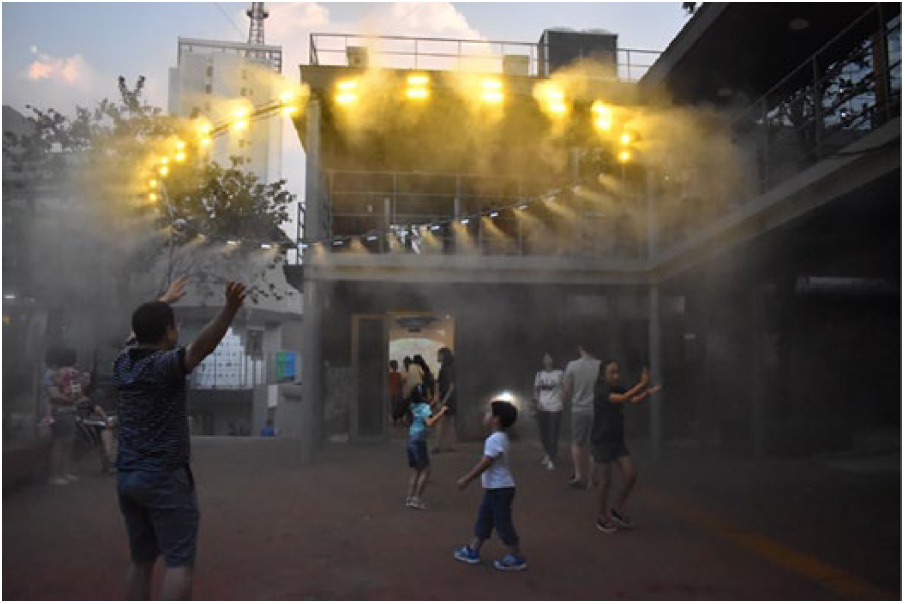
‘Being alongside the mist’ (author’s photo).
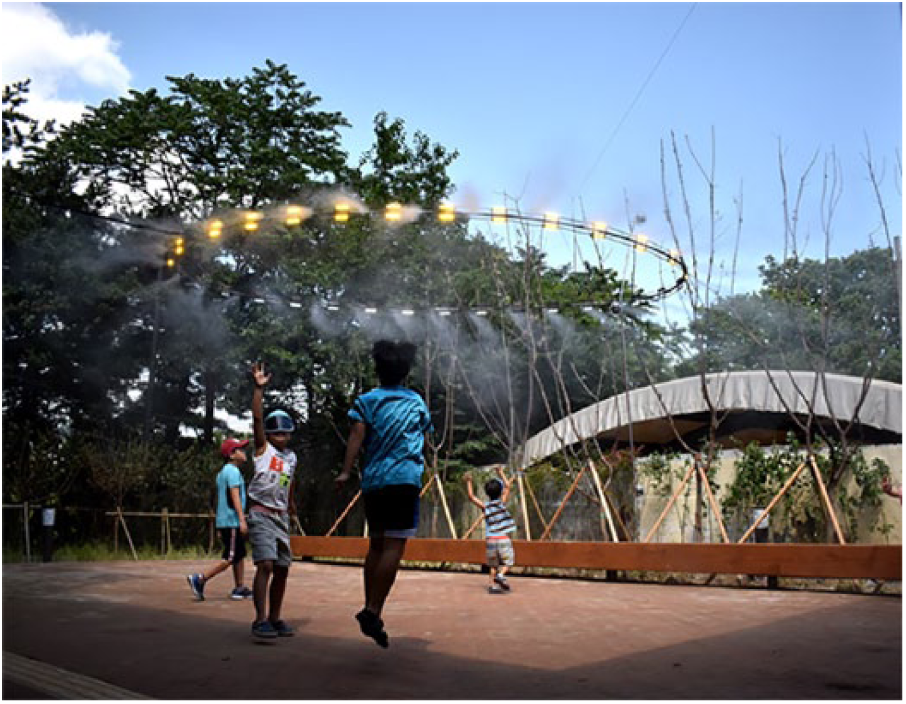
‘Chasing the mist’ (author’s photo).
While some people moved their bodies with the mist (Figures 1 and 2), others sat on the perimeters of the YD looking in (Figure 1), mesmerised by the mist or captured by people’s movements within it. Becoming immersed in the mist was not an active search for molecular engagement, however, because the water molecules also sought out the visitors. Even breathing practices seemed to be affected when entering the mist, momentarily displacing the idea of breathing as an individual act. Here, the mediation of affect (Raffles, 2002) was different to that of visualisation, which is generally about presentation and reception rather than immersion and reaction.
The project’s contention was that people would gain an understanding of the intensity of air pollution through embodied encounters. Early on we realised that this only happened when people knew that the water represented particles. Despite this, the causality was not that linear, and the effects not so predictable. In fact, ambivalence was the most frequent response. How to make sense of and interact with the mist generated a feeling of uncertainty, inciting a dialogue of curiosity with others, the pulling of confused looks and shared glances, as well as moving towards the mist with trepidation. Individuals often described their initial response as one of enjoying the feeling of coolness on the skin at the same time as querying whether the air around YD was bad or good. Several visitors asked NC and EG whether the mist was unhealthy; was it dangerous? (Fieldnotes, 1–10 September 2017). This shared ambivalence also generated a space for interaction, however, where people talked to one another to discuss what it meant and in order to try and work out ways to interact with it. How YD made people feel emerged in multiple and often conflicting ways (e.g. coolness is refreshing but the mist might be unhealthy). It was through the intimacies produced by the body–mist entanglements that YD became a performative space where engagements with the sensible data unfolded in indeterminate ways. We argue that this state of ambivalence produced queer intimacies that simultaneously made perceptible the situations in which people could breathe better or worse. Thus, the intimacies produced by YD were not necessarily positive and the mist, although offering coolness in humid Seoul, was also always an embodied encounter with pollution.
Did the perception of data (or a presence that substituted it) produce knowledge about air pollution and then induce change, as the data–knowledge–action chain presumes? As Kuchinskaya (2017) suggests, tracing this chain empirically is very difficult. We attempted to trace this through observations that could help us understand what ‘change’ might look like (e.g. is noticing breath a change?), but also through the questionnaire that visitors were invited to complete in the exhibition space. Some people wrote down, or commented to the ethnographer, that they would change their everyday practices by using public transport or having fewer BBQs, for example. Others commented that YD was capable of producing awareness and collective change, proposing its installation next to busy roads or in public spaces in Seoul and other polluted cities. Indeed, these are all good but predictable outputs, and similar to other air pollution visualisations in public spaces. However, were there any unexpected affects and effects as a result of the molecular intimacies that took place? What kinds of entanglements did these molecular encounters produce? What kinds of engagement with pollution did they specify and how? What forms of action did they evince/elicit?
Intimate entanglement 1: Challenging data, sensing collectivity
The molecular intimacy between data and bodies through water vapour created visual effects: the mist blurred, at intervals, the background of the Biennale. By reducing vision, visitors’ attention was focused not on trying to decipher quantities of data. Closer objects, like the sensors, came to the foreground, entangling particles, sensors, humans, design, pedagogy, the square, water vapour, plexi semi-spheres, energy, etc. This first entanglement considers what happens if making accurate data is not the main aim or final end-point.
The sensors and data explain this is ‘our data’. [It] does the purpose and […] engages with the audience in effective and affective ways. So, [it is] extremely pedagogical, talks all the time, what it is doing [for example, the] sensors have balls around them, of plastic, so everyone sees they are the centre. (Interview 2, Architect 1, 3 September 2017)
One of the expected effects was the collectivities that emerged through the data; ‘Our data’, as Architect 1 mentioned. Data and not just air were described as personal: ‘the data infrastructure makes air pollution intimate, something that is felt and surrounds the body’ (Interview 2, Architect 2, 3 September 2017), whilst at the same time relating to an undefined collective: ‘[YD] is as much of a collective thing. When they feel it altogether’ (Interview 4, Cultural critic, 8 September 2017). For the same respondent, touching and sensing data were recognised as articulating the issue in a different register and one that clearly related to action: ‘it is no longer something you worry alone but you feel it, you touch it and smell it as a society together, and by doing so democratically we can apply pressure on the authorities’ (Interview 4, Cultural critic, 8 September 2017, our emphasis).
Technologies can engage publics in ways that do not just invite visitors but also produce agnostic encounters (Marres, 2011). Making the hardware of the infrastructure visible revealed the role of design in making the sensors ‘talk’. The pump, arduinos, 4 controllers, and so forth, are usually black boxed, but in YD comprised part of the sensory experience of data. So instead of discussing the legitimacy of the data, which is fundamental when working with specific communities (Wylie, Shapiro, & Liboiron, 2017) and something one architect we interviewed who had experience in citizen science did raise (Interview 2, Architect 1, 3 September 2017), visitors generally engaged with the pedagogical capacities of the infrastructure, therefore highlighting how sensing and data are entwined.
By paying attention to the ways in which people interacted in the square we observed how the infrastructure re-specified engagement with environmental data. Generating fresh air was achieved because ‘everyone is sitting round [the installation]’ (Interview 1, Urban planner, 2 September 2017). Although this might not appear to be action, the same respondent goes on to argue that, because YD makes visible ‘the mechanics of the environment […] we can [begin to] modify it’ (Interview 1, Urban planner, 2 September 2017). Instead of understanding and practising collective action as a deliberative process about what to do with the data or as a discussion around who is included in the collective, what emerged were different partial relations (Strathern, 1991). People were under and around the mist, sharing the space and the intimacy it produced. The sense of collective data, driven by the presence of the sensors in the public space, and the shared atmospheric mist, constituted the ‘altogether’ mentioned by the cultural critic quoted above. A distributed recognition of air pollution emerged while people shared the space with strangers, which opened up and made more open-ended the question of how data could be used to evoke future change.
Intimate entanglement 2: Challenging knowledge, sensing the issue
[Hwangsa] it is an industrial thing and everyone knows it but they keep blaming China. (Fieldnotes, 6 September 2017).
The media often portray Hwangsa – the yellow dust storms coming from China and Mongolia that colonise Seoul in the spring – as a foreign invasion. One of the objectives of YD was to make visible the city’s own production of particulate matter, and challenge the political use of Hwangsa. Even though we expected to spark conversations about the politics of data through the colour of the mist – yellow, in reference to the colour of Hwangsa – these kinds of encounters emerged as a result of the information on the exhibition panels, too. The exhibition panels connected the data measured by the sensors with people’s bodies and with emission sources in the city, including unexpected emitters such as BBQ restaurants and saunas, both of which are very popular spaces for socialisation in South Korea. The intimate entanglements that emerged, then, connected the Gobi Desert, BBQs, saunas, water vapour, breath, particles, with people living in Seoul.
When asked the question ‘can you describe your initial response to the YD infrastructure?’, one individual explained that what they felt was valuable about the YD infrastructure was its inclusion of social and cultural factors relating to air pollution and its articulation of what is unique about Seoul’s air. Indeed, this respondent pushed touch beyond skin intimacy: ‘The BBQ touches them. Koreans have them every Friday night, so including this as a source is significant’ (Interview 5, Cultural and artistic curator, 8 September 2017). Visitors often laughed and pointed at the reference to BBQs and saunas. This could be interpreted as the information being surprising, unexpected or resonating with people. The questionnaire responses further corroborated this observation in frequent references to BBQs and food and leisure patterns in respondents’ reflections on how they would change their everyday practices. Through the BBQ’s ‘touch’, people sensed local pollution emitters in a symbolic way and in relation to everyday practices like eating together on Fridays and chatting in saunas. The molecular intimacies between air pollution and bodies were expanded here too, to food ingestion and sweat, connecting intakes and excretions to environmental issues.
In addition to provoking visceral responses, such as when people touched the mist, chased the mist, tried to catch the mist (Figure 3), scrunched up their faces towards it and opened their mouths to ingest the water droplets, the mist also heightened awareness of the surrounding environment and connected air pollution to other local issues. One member of the public, standing outside the mist looking in, talked about the irony of the location of the Biennale next to a building site that was generating a lot of dust (Interview 8, Environmental activist, 11 September 2017). The same respondent went on to discuss the eviction of people living in Seoul as a result of rapid construction. Here, ‘being alongside’ the collective also entangled the contingencies of experience with wider questions of urban space and power. Molecular intimacy, then, challenged the idea that air pollution data produce knowledge of air pollution because the entanglement mobilised by this individual connected the causes of dust in the air to community displacement (something that data did not measure). The political and structural relations of pollution made prescient here suggest that molecularity not only concerns the materialities of air, but also how that materiality is suspended into affective intensities of race, geography and capital (Chen, 2012), or, in the case of YD the intimate entanglements of nation-state, cultural practices and growth in capital.
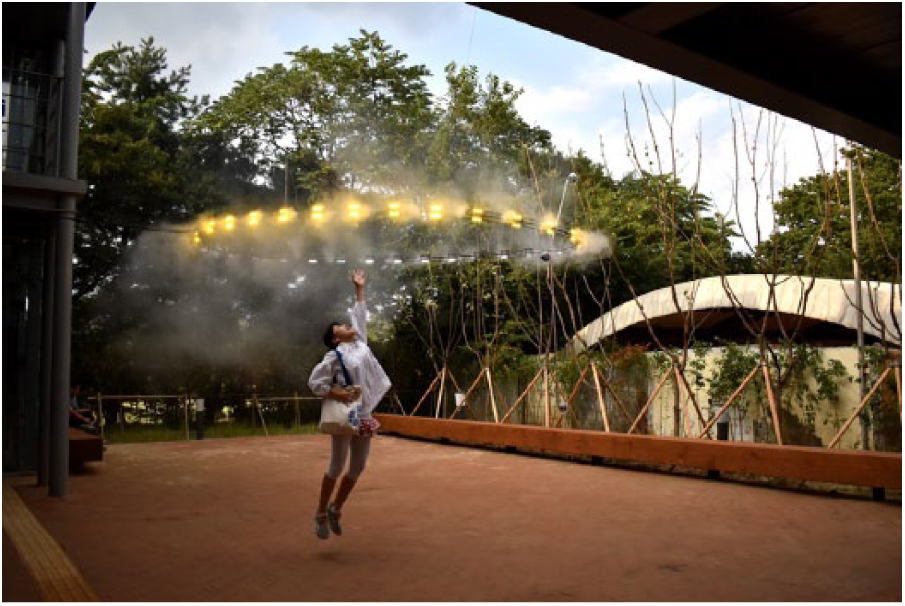
‘Catching the mist’ (author’s photo).
This second intimate entanglement re-specified the problem of air pollution in ways we suggest influenced what counts as valuable forms of action and response. Instead of scientific and technical knowledge, YD suspended bodies and particles to produce ‘intimate knowledge’ (Raffles, 2002) that was specific to place and generalisable in the form of numerical data. Intimate knowledge, however, was not about particle concentrations but about cultural and social aspects of air pollution. In the questionnaires people stated that they would change their habits. Acknowledging the contribution of individual practices to emissions transformed existing social biases about the origins and ‘otherness’ of pollution (for instance, that it comes from China). This change in cultural framing has legal implications. In many countries, transboundary pollution is discounted from the daily and annual averages for which countries are made accountable by national and international bodies. Challenging this politically could enhance international collaboration on air pollution.
Intimate entanglement 3: Challenging action, sensing affect
Molecular intimacies produced by the sensing infrastructure transformed the environment of the square. The mist, for instance, reduced the surrounding temperature. As one respondent explained, the infrastructure ‘shifts’ the environment in ways that make you aware of it rather than experiencing it as passive (Interview 9, Architect 4, 14 November 2017). In transforming the environment ‘the rhythms and sensations not disclosed to daily life are experienced at an intimate level’ (Kanyeredezi, Brown, McGrath, Reavey, & Tucker, this issue). Action in relation to environmental data is usually thought to involve ‘doing things’ that can be measured. Yet this results in the environment itself being framed as fairly passive. The same goes for the ‘objects’ of measurement practices. Yet, as Beer (2016) argues, the act of making visible through measuring and classifying also produces emotions and affects. Even if visitors to YD often mentioned that they would ‘do things’, like change their behaviour, we were keen to explore whether the affects that emerged contributed to change by any other means?
We found that very few people explicitly acknowledged the remediation capacities of YD (the mist sediments particles), despite anticipating this would be the main feature of the project because it directly connects with prevailing techno-scientific responses to air pollution: to clean it. Nevertheless, YD sought to alter the conditions of the environment surrounding the infrastructure. In this third intimate entanglement, we show how making sensible data created different environmental conditions and new attachments to atmospheres (Choy, 2012). Stengers (2000) writes that different entanglements emerge by including things, feelings, processes presumed to be ‘outside’ of science (and, perhaps, the making of ‘good data’). Without knowing the level of consciousness of their actions we observed, people did feel the effects of the mist, spending time under it and commenting on the cool and fresh feeling of it, and perhaps even breathing easily. It is through bringing into perception the specificity of these attachments, and thereby encounters with air pollution, that affectivities can have multiplying effects, ‘extending the range of experiences rather than extending one mode of experience’ (Puig de la Bellacasa, 2017, p. 113).
As imagined in the design of YD, the translation of one molecule (PM) to another (vapour) transfers affects to a new realm, to the space that the YD infrastructure occupied. Because of this translation the environment of the infrastructure was transformed and the climate made softer. This was an atmospheric shift that people noticed and enjoyed. In the questionnaire, several respondents described the space as a happy space, others as a space to chat and hang out in (Figure 4). YD also created an atmosphere for both pausing and interacting. In the time spent by the ethnographer on site, the manual workers supporting the Biennale frequented the infrastructure space when they took their breaks each morning and afternoon (Fieldnotes, 1–10 September 2017). The mist made connections that expanded the publics to whom YD was initially addressed, becoming a meaningful space for new ‘visitors’.
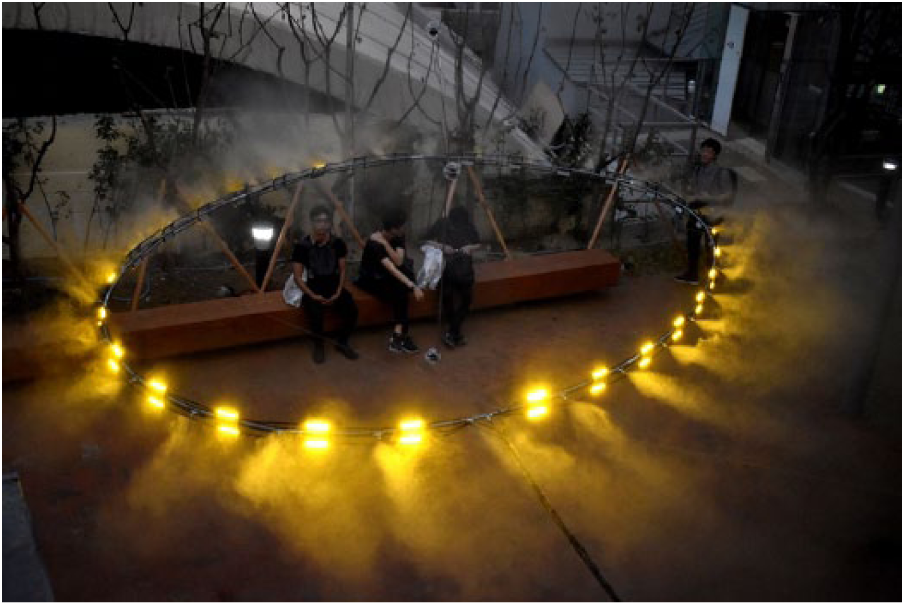
‘Sitting outside the mist’ (author’s photo).
Another unanticipated effect of the installation, but which points to its multiplying effects and affects, was the way visitors took photos. Often people arrived, took photos, selfies and group selfies, and left. In an early conversation with EG, NC was concerned that people were not engaging with the infrastructure: ‘people take a photo and leave and see it as an object’ (Fieldnotes, 3 September 2010). Yet, through the ethnography we began to see these practices as a way of making connections with air pollution, connections that are not mediated by expertise but by proximity. Proximal relations enable a broader kind of relational engagement with air pollution (Puig de la Bellacasa, this issue) from the distant relations often encouraged in the generation of numerical data. As we have already described, people were often cautious about moving inside the circular space of the mist. Consciously avoiding the mist was an avoidance of the molecular intimacy it produced, and therefore also one of its effects. Instead, taking photos performed new attachments, such as feedback loops between the visual and sensory, which generated further intimacy. For instance, sharing photos on social media is an interactive medium for being with others, recording that moment and recreating it. The collective capacity to respond that YD enabled was valued by environmental policy makers, and the individuals EG spoke to proposed it as a way of encouraging wider public participation in practices that reduce pollution, like Seoul’s no-driving campaign (Interview 6, Municipal government, 7 September 2017). Although this example is somewhat instrumental, the sensuous sensibilities and material entanglements mobilised by molecular intimacies show that paying attention to ways of being with air pollution can also help us scrutinise and reimagine environmental care and management (Callén Moreu and López Gómez, this issue).
The photos and their mobilisation conditioned the public use of the space of YD through the fostering of curiosity, anticipation, friendship, memory and shared experience. The interviews highlighted the strong role of public space in Seoul. Describing a day-time camping excursion to a big national park just outside Seoul, an expat living in the city recalled her surprise when she realised the excursion was about ‘being in public space’. Such occasions involve families, the young and old gathering together; they are ‘instagrammable spots’ and ‘about being in and being seen in public space altogether’ (Interview 5, Cultural and artistic curator, 8 September 2017). So, acting in the square as if it was a public space was an achievement. Taking photos outside the mist does not necessarily indicate detachment because it was also a performance of being in public. Being in the data (as mist) produced a molecular intimacy with it, whilst also mobilising opportunities to conjoin different spaces, people and atmospheres in situated ways. This intimacy involved sharing air and experiencing its proximity, which led to actions that created new practices and supported the continuation of existing ones. These unfolding relations and practices did not encourage changes centred on the self – like ‘I will walk more’ – but were instead collective responses that had different aims and effects, from sharing a space and talking to each other about air pollution, to considering the data themselves as a common good, or circulating and recirculating images of air pollution visualisations. Even when trying to avoid the mist, individuals were also still entangled with its social and cultural resonances. As Callén Moreu and López Gómez (this issue) suggest, by thinking from matter, through different forms of contact with air pollution, in our case rather than about matter (e.g. knowing air pollution from measurement data), we can better attend to their openings and closures, limitations and opportunities. YD re-specified a becoming that entangled differently with air pollution, in which the main focus was not to clean the air but to think and feel ways of being with it.
Conclusions
This article has explored what intimate encounters with data through our bodies and in spaces might produce in terms of personal and collective forms of engagement with air pollution. Our focus has been not on the production of knowledge or public understanding of air pollution science but on exploring ways of representing air pollution data that might offer different forms of environmental and political action from those proposed in prevailing environmental health narratives (e.g. cleaning the air or changing behaviour). Drawing on the design of, and ethnographic research on, YD, we examined three different intimate entanglements produced through molecular intimacies. Molecular intimacies are forms of engagement with air pollution that make sense/ible expected and unexpected effects and affects. We argue that the production of molecular intimacies with data changes the conditions through which environmental justice can be achieved. Exploring these situated relational encounters meant that we could specify what was and could be achieved by materialising data as water vapour, and thereby re-specify the continuum of data, knowledge and action.
The first entanglement produced by the visual effects of the molecular intimacies challenged the role of data in a public space. Surprisingly, no one asked ‘how much is the air polluted?’ Instead people sensed the hardware of the infrastructure, engaging with epistemic questions about air pollution. We suggest this built an ephemeral form of collectivity that re-specified environmental action through experiencing data spatially and in a situated way, which set the groundwork for future action through pedagogy. This was a re-specification of action in relation to data because, as we stated at the start of the article, the focus in science and policy is often on the quality of the data and the invocation of an individualised response.
The second entanglement re-specified public knowledge about the environment through an ‘intimate knowledge’ that was global and personal at the same time. This intimate knowledge cared for the cultural and social aspects of air pollution by shifting focus away from deciding who to blame and drawing attention to the social and political arrangements needed to respond to air pollution. Differences in exposure and harm that result from actions in urban space were raised by those interviewed living and working in Seoul, demonstrating a disruption of the idea of otherness that is so dominant in contemporary narratives about air pollution. Getting to know the presence of particles in the air through the mist was done in embodied ways and by generating a sense of proximity with the issue. For instance, BBQs and leisure patterns in the exhibition became entangled and re-situated by visitors in ways that produced new connections, such as between the government’s rapid construction in Seoul and the health burden of pollution on vulnerable populations.
The third entanglement challenged assumptions about how to act. The chemical effects of the molecular intimacies, as well as creating corporeal experiences of air quality, also concerned the composition of the environment surrounding the infrastructure. Rather than detachment, watching the mist from afar or taking photos on the periphery were continuations of the intimacy that YD made possible. These responses demonstrate engagement with air pollution in a different register. The affects made sensible by the mist led people to occupy and re-claim space in ways that involved being with others, both human and non-human. Attuning to the mist was also a way of avoiding the molecular intimacy produced by YD. YD invited visitors to claim commonness and connection whilst heightening awareness of the spaces they inhabited, redirecting action away from cleaning the air to feeling and being in the mist.
We propose that these three intimate entanglements produced, even if temporary and ephemeral (in part due to the short duration of the Biennale, in part due to its location within a Biennale and not in a public space), forms of engagement that translate into different kinds of environmental action. The intimacies produced through the data as mist grounded bodies in time and space and generated experiences to talk about with others. This intensified human and more-than-human relations with data built situated narratives about air pollution and subsequently generated alternative possibilities for engaging with it. What these emergent responses show is that intimate entanglements occupy and co-produce multiple spaces and temporalities, which suggests that intimacy does not relate to action in the same way or at the same speed as visualised or numerical data. It is slower, more distributed, difficult to grasp. Data intimacies, we propose, may be a form of environmental activism because they re-specify and expand existing forms of knowing and engaging with air pollution, and enhance collective (more or less articulated) responses (Calvillo, 2018b). For these responses to translate into more established forms of political action, time and stronger forms of organisation would be needed. And yet, unsettling techno-scientific approaches is a fundamental step to achieving it. By carefully designing the material conditions for generating (sensible) air pollution data (through research, ethnography and design), we show that it is also possible to foster the un-designed in terms of how to respond and act, that is, to not simply reproduce existing ways of framing and enacting air pollution but instead support situations through which other things can happen.
Footnotes
Acknowledgements
We would like to thank the academic faculty at the Centre for Interdisciplinary Methodologies for their useful feedback to an early draft of this paper, as well as all the collaborators and participants of YD and the ethnography for making it possible.
Funding
The ethnography and part of the production of Yellow Dust were conducted with the support of a University of Warwick and ESRC IAA grant (reference ES/M500434/1).