




Abstract
The article analyses two contrasting photographs that powerfully shaped Danish debates about the refugee crisis in September 2015. In the first, a civilian man is seen spitting at a group of refugees from a highway bridge. In the other, a police officer sits on the highway as he plays with a young refugee girl. Politicized photographs such as these offer unique and rarely utilized sociological prisms to probe the narratives and binary codes that define national value complexes and categories of ‘inside–outside’, ‘us–them’ and ‘civil–uncivil’. The spitting man and gentle cop photographs are particularly forceful in this regard as they do not simply portray refugees/migrants in isolation, but rather the reactions they generate in the host country. The article explores why and how these photographs became so resonant in stimulating affective public debates about refugees, Danish identity, and solidarity with strangers. Methodologically, the article focuses on debates occurring on Facebook, Twitter and in newspaper commentary tracks. This choice reflects a wider trend where the media ecology of Web 2.0 is transforming the way photographs are being politicized in affective publics. Finally, interviews were conducted with the journalists behind the photographs.
In early September 2015, Danes witnessed unprecedented scenes of refugees walking along Danish highways. While similar situations had already unfolded in Southern and Eastern Europe for several weeks, Danes were shocked to see the wave of refugees that had been pushing at Europe’s borders during the summer of 2015 now entering their national space in such demonstrable fashion. The highway scenes spurred an extremely polarized debate, with some pledging to remove the refugees with a snow plough and others offering their private cars to drive them to their preferred destinations. While the highway scenes were impactful in themselves, the most powerful visual representations of the refugee crisis in Denmark was a twinned set of photographs that in different ways zoomed in on the event. In the first photograph, shot by news photographer Sigrid Nygaard from the Danish daily Information on 7 September, a middle-aged Danish man spits at a group of refugees from a highway bridge. In the other, taken by freelance photographer Michael Drost-Hansen for the Danish daily Jyllands-Posten a few days later on 9 September, a Danish police officer is seen sitting on the highway as he apparently plays ‘find the ring’ with a young refugee girl.
The photographs combined agency and personalization in ways that immediately turned them into sites of heated discussion about refugees, Danishness and solidarity. Of course, such debates were already occurring at the time (Mortensen, 2016). There is no doubt, however, that the photographs shaped, refocused, and perhaps even polarized them. I argue that this capacity to organize public debate at least partly stemmed from a reversal of what I call the classical plot in injustice photography. In this plot, photography depicts perceived injustice (typically documented by photojournalists or citizen journalists) where authority figures kill, injure and otherwise repress civilians or activists (Bayerl & Stoynov, 2016; Beutin, 2017; Greer & McLaughlin, 2010; Martin, 2005; McAdam, 2000; Zelizer, 2010). Indeed, when we survey the visual archive of the 2015 refugee crisis, there is no shortage of photographs of police and military beating and holding back refugees, especially at the EU’s outer borders; and at the other end of the continuum, we find a large collection of photographs of civilians in receiving countries greeting refugees with ‘refugees welcome’ signs and offers of food and clothing. If we accept that spitting is a form of violence, these roles were more or less completely turned around in this case, with a civilian (‘spitting man’) doing the ‘wrong thing’ and an authority figure (‘gentle cop’) doing the ‘right thing’. The article explores why these photographs became so resonant and how their plot reversal was perceived and negotiated in the ensuing online debate about refugees, Danish identity and solidarity.
Politicized photographs such as these offer unique and rarely utilized sociological prisms to probe the narratives and binary codes that define national value complexes and categories of ‘inside–outside’, ‘us–them’ and ‘civil–uncivil’ (Alexander, 2006; Doerr, 2017; Smith, 2005). The spitting man and gentle cop photographs are particularly forceful in this regard as they do not simply portray refugees/migrants in isolation, but rather the reactions they generate in the host country. In pursuing such an agenda, the article expands the range of themes present in the general literature on refugees and photography. Works in this tradition, often with substantial inspiration from post-colonial writings (e.g. Ahmed, 2000; Said, 1978; Spivak, 1988), have been interested in how photographs dehumanize (Bleiker, Campbell, Hutchison, & Nicholson, 2013), anonymize (Johnson, 2011; Malkki, 1996; Wilmott, 2017), aestheticize (Szörényi, 2006), construct deviance (Banks, 2012), or adapt refugees to culturally resonant templates (Wright, 2002). While the generally critical stance in this literature is important from both academic and normative perspectives, it displays a rather one-sided emphasis on the way photographs categorize and interpret refugees. Attention to the visual representation of encounters between refugees and civilians and authorities in receiving countries is still surprisingly rare. Such encounters, the article argues, are highly significant visual sites for the enactment of notions of solidarity, identity and belonging.
The empirical analysis focuses on debates occurring on Facebook, Twitter, and in newspaper commentary tracks. Debates on online media platforms such as these provide access to a much fuller spectrum of arguments and positions in the Danish population than if we rely mainly on ‘old’ media sources. This choice of data also reflects a wider trend where the new media ecology of Web 2.0 is profoundly transforming the way photographs are being politicized (Boudana, Frosh, & Cohen, 2017). Meaning negotiations over photographs now occur in ‘affective’ (Papacharissi, 2016) publics where both professionals and ‘ordinary’ citizens weigh in on the interpretive process; a kind of maximization, as it were, of Walter Benjamin’s early prediction (1939/2003, p. 262) that ‘the distinction between author and public is about to lose its axiomatic character’. The two photographs were thus taken by professional news photographers working for established Danish legacy media, but acquired a life of their own in the ‘impromptu’ (Mortensen, 2016) online publics that sprung up in their wake.
The implications of this emerging pattern is still undertheorized in the study of injustice photography (Biggs, 2005; Doerr, Mattoni, & Teune, 2013; Gray & Martin, 2008; Greer & McLaughlin, 2010; Halfmann & Young, 2010; Martin, 2005; McAdam, 2000; Olesen, 2013; Teune, 2013; see Olesen, 2018 and Bayerl & Stoynov, 2016 for some recent exceptions). The article hopes to stimulate further theoretical reflection along these lines. On a more ethical-normative note, these developments should also prompt us to ask whether the new conditions for the politicization and diffusion of controversial photographs represent a democratic advance or degradation. These questions are briefly considered in the article’s conclusion.
The article begins with two theoretical sections. The first offers a general theorization of how photographs are politicized. In the second, it discusses how new media technologies are changing the way this happens. The remainder of the article builds on these insights in an analysis of the political meaning work surrounding the spitting man and gentle cop photographs in early September 2015.
Photographs and the dialogue with society
The power of photographs resides in their simultaneous presence of surface and depth (Bartmanski, 2014), denotation and connotation (Barthes, 1977; Zelizer, 2006), and particularity and universality (Alexander, 2008). On the one hand, a photograph is inescapably singular and descriptive. It shows a specific event, place, person, and, at least in the case of documentary photography, describes what ‘happened’, what things ‘looked like’, what people ‘did’, in a certain place and moment in time. In many cases, of course, our use and interpretation of photographs remain on this plane (e.g. when we remember the past by looking through a family photo album). When a photograph acquires political meaning (and, potentially, effect), it transcends this particularity. ‘The visible surface’, writes Bartmanski (2014, p. 174), comes to evoke ‘the ineffable of the depth’.
Bartmanski’s formulation indicates how photographs escape their particularity through a resonance with culturally anchored themes, values and symbols (Barthes, 1977). The photographs of the dead Alan Kurdi being carried away by police officers, for example, evoked the religious symbolism of the Pietà (Olesen, 2018), while the controversial Hooded Man photography from the Abu Ghraib prison in 2004 bore an eerie resemblance with the image of Jesus Christ on the cross (Hansen, 2015, p. 279). These represent some of our deepest cultural symbols of injustice, sorrow and compassion. In other cases, resonance has a more contemporary meaning horizon. When Neda Agha Soltan, a young woman protesting fraudulent elections in Iran, was shot and killed during demonstrations in 2009, the video of her death was immediately interpreted through a well-known (Western-based) scheme in which Iran, since Ayatollah Khomeini’s takeover in 1979, has been viewed as non-democratic, against women’s rights and fundamentalist, that is, as a kind of antithesis of Western values (Olesen, 2014).
These brief examples demonstrate how the character ‘cast’ in political injustice photographs is highly variable. In the case of Kurdi, we either see him alone or with benign authority figures (officers carrying him away from the beach). The set of photographs from Abu Ghraib either show victims on their own or with malign authority figures (as in the well-known scene where US soldier Lynndie England ‘walks’ a prisoner on a dog leash). The Neda Agha Soltan videos do not show any perpetrators but only Neda herself and bystanders coming to her aid. Despite the lack of an identifiable shooter, the Iranian regime was, nonetheless, symbolically inserted into the video as ‘villain’. The spitting man and gentle cop, as I elaborate shortly, add further complexity by placing a civilian in the role of ‘villain’ and an authority figure in that of ‘hero’.
While the specific constellations and valuations of personae may thus vary, the underlying interpretive grid is relatively constant. The resonance of injustice photographs is structured over binaries such as fair/unfair, right/wrong, good/bad, worthy/unworthy, etc. (Alexander, 2006; Smith, 2005). These binaries are imprinted on the human characters and situations in the photograph, casting them into established plots with heroes, villains, victims and witnesses. In sociological terms, then, the surface or materiality of the photograph becomes engaged in a dialogue with society (Alexander, 2008). To the extent that political meanings emerge around photographs, it is the result of such conversation. As noted by Bartmanski (2014, p. 168), sociological realism has generally treated the visual surface as ‘a dependent variable’. Yet, if we accept that photographs have the potential to connect with culturally resonant values and symbols, it is a logical next step to acknowledge that under certain circumstances, they may acquire independent force as organizers of public debate.
In some places, Alexander’s and Bartmanski’s otherwise illuminating work on iconic power and consciousness leaves the impression that this power springs more or less directly from the photograph. ‘An object’s aesthetic power’, writes Alexander (2008, p. 786), ‘inserts the general into the specific.’ In a debate on Susan Sontag’s (1977) seminal work on photography and suffering, Judith Butler (2010) similarly argues, contra Sontag, that photographs have interpretive force on their own. Composition, colour and light, in other words, can tell a story. However, Butler (2010, p. 957) also acknowledges that this story can never be outside language: ‘the way that they [photographs] are shown, the way they are framed and the words used to describe what is shown work together to produce an interpretive matrix for what is seen’. What we arrive at, then, is to view the power of photography as a multimodal process (Kress, 2010) in which text/words and photograph interact to generate meaning (Becker, 1995). The photograph sets the stage for the meaning process, but it is language and debate that makes the photograph emerge as a political statement.
Not only is this in itself a complex process; it often takes place in a field of tension and cross-pressure where photographs become sites of often considerable controversy. Because the meanings that are read into political photographs in most cases, as noted above, involve an identification of villains, heroes and victims, of desirable and undesirable values, they engender acts of counter-symbolization from those who are directly or indirectly criticized in the process of interpretation (Olesen, 2015). Meaning struggles thus inevitably move onto the rugged terrain of collective identity and self-perception. For example, debates in the United States during the Vietnam War over the My Lai photographs (1968) and Nick Ut’s ‘Napalm Girl’ (1972) in the first instance concerned the war but in a second, extended instance, raised much deeper questions about American values and America’s place in the world (Gray & Martin, 2008; Hariman & Lucaites, 2007). More recently, the 2004 photographs from Abu Ghraib in a similar manner inspired profound collective soul-searching (Andén-Papadopoulos, 2008; Butler, 2010).
Political photographs become political precisely when interpreters convince us that a photograph does not only refer to an external reality, but also says something important and potentially troubling about the viewer and the collective(s) he/she belongs to. These themes and tensions, as I show in the analysis below, were vividly present in the public response to the spitting man and gentle cop photographs.
Political photography in the new media ecology
The process of interpreting photographs has been undergoing profound changes with the advent of Web 1.0 and 2.0. Meaning negotiations thus increasingly escape the control of ‘legitimate institutions enjoying extensive cultural authority’ (Boudana et al., 2017, p. 1214), that is, newspapers and television, to take place also on new media platforms such as Facebook and Twitter. These platforms are unique in that they provide unmediated access for citizens and communication ‘amateurs’ to partake in public debates (Chadwick, 2017). Since the power of photography at least partly resides in its ability to elicit emotional responses from viewers (Brantner, Lobinger, & Wetzstein, 2011; Iyer & Oldmeadow, 2006), photography-initiated debates generate ‘affective publics’ (Papacharissi, 2016). Affective publics, according to Papacharissi (2016, p. 311), are ‘networked publics that are mobilized and connected, identified, and potentially disconnected through expressions of sentiment’ by a broad array of communication amateurs and professionals. What is historically new here, then, is not that photographs have a power to stimulate emotional responses, but the fact that new media technologies provide such responses with unfiltered channels into public debate. Papacharissi (2016, p. 320), in other words, challenges us to not reduce public discourse to ‘the rationally based deliberative protocols of public spheres’.
Whether photographs have been taken by professional photojournalists or by citizen journalists (Greer & McLaughlin, 2010; Ristovska, 2016), their subsequent treatment and interpretation are now highly de-centralized and de-professionalized (Olesen, 2018). Widely accessible technologies for graphic design make it easy for both amateurs and professionals to create new meanings by, for example, photo-shopping previous photographs onto new ones or incorporating selected elements from an existing cache of culturally resonant symbols and photographs. These meme clusters (Olesen, 2018) often rework the original photographs in ways that seek to stimulate and further debate by provoking laughter, surprise and indignation (Bayerl & Stoynov, 2016; Boudana et al., 2017; Shifman, 2014).
These observations have direct bearing on the photograph–society dialogue I discussed earlier. Compared to a situation in which this dialogue was primarily curated by elites and professionals within journalism, politics and civil society, the new media ecology allows society to ‘reveal’ itself with greater variation. The binary distinctions (Alexander, 2006; Smith, 2005) that organize the interpretation of photographs are perhaps even more clearly operative in the immediate and emotional debate culture online. This is obviously not to argue that affective argumentation is replacing rational debate, nor that ‘rational’ and ‘emotional’ are mutually exclusive or contrasting modes of communication. The point, more modestly, is that the facilitation of affective reactions to photographs (and other political and social issues for that matter) creates an increasingly complex public sphere with a pluralization of, not only actors, but also modes of communication. This theoretical observation has important methodological (see the next section) and normative-democratic implications (see the conclusion).
Research strategy and ethics
The article has followed a two-pronged data collection strategy. First, I conducted two semi-structured interviews with the photojournalists who photographed the spitting man (Sigrid Nygaard, interviewed 26 June 2018 via telephone) and gentle cop (Michael Drost-Hansen, interviewed 14 June 2018 via telephone). The purpose of the interviews was to gain insight into the circumstances of the photographs, including relevant events occurring before and after the photograph was shot, as well as outside of the frame as the photograph was taken. Furthermore, I used the interviews to probe the photographers’ own understanding regarding the resonance of their photographs.
This served as an important complement to the second main track of data collection: public debate material. Public debate can be mapped in various ways. For this study, I decided to focus on public debate occurring on Facebook and Twitter, as well as in newspaper commentary tracks. As already suggested in the introduction and theory section, the advantage of this strategy is that it provides a more direct and diverse access to meaning struggles over Danishness and solidarity. It allows us, in other words, to highlight affective responses to a larger degree than if data had been collected only or mainly from newspapers and television, which feature a more edited, balanced and tempered version of public debate. In line with this concern, written material was complemented with visual debate material such as photo-shops, memes, paintings and graffiti produced to comment, often in laughter and indignation provoking ways, on the original photographs.
Material was collected on numerous platforms during the research process. For the present article I mainly draw on three sources. For the analysis of the ‘spitting man’ I focus on the Facebook page of Danish media personality Peter Falktoft, which became one of the first and most active forums for (critically) discussing the ‘spitting man’ photograph. To provide some contrast, I include debates from the Danish tabloid Ekstra Bladet’s online commentary tracks, which show a different set of interpretations of the photograph. For the ‘gentle cop’ analysis data are primarily drawn from the Danish daily Jyllands-Posten’s Facebook page, where the most concentrated debate on the photograph occurred. Obviously, there are countless arguments and responses in such forums that cannot be reported here. The selection process consisted in reading through the entirety of the material and identifying a set of thematic clusters that I considered particularly relevant for understanding how the ‘role reversal’ in the photographs was understood and negotiated. In line with the theoretical framework, I focused on identifying thematic clusters where binary distinctions between us/them, Danish/non-Danish, order/disorder, loyal/disloyal, etc. were operative.
The two analytical sections that follow each consists of three steps. The first provides some basic background information about photograph content, production and publication. The second mainly focuses on my own and the photographers’ interpretation of the meaning of the photographs. In the third step, the public reactions to the photographs in the forums described above take centre stage. This third step adopts a multimodal approach where the meanings of the photographs are analytically decoded through the verbal expressions surrounding them in online forums.
In using quotes from Facebook debates, I have followed Fuchs’s (2018) recent considerations on research ethics. The main distinctions to consider, according to Fuchs, are whether quotes are made in a private or public domain, whether quoting involves potential harm to those quoted, and whether comments are made with public resonance in mind. Since all quotes in the article have been taken from open Facebook or Twitter debates, it is reasonable to expect that commentators have been fully aware of the public nature of their comments. According to Fuchs, limitations on quoting are primarily relevant when comments have been made in semi-public spaces where the exact lines between private and public are not entirely clear. I nonetheless decided to present quotes with anonymity in order to provide further protection. Of course, anonymity does not guarantee that identities cannot be traced. I therefore also considered whether comments were of such a nature that a potential revelation of identity could cause harm to the commentator. I concluded that this was not the case. While some comments are indeed controversial, they do not, for example, contain direct threats. Furthermore, it provides added protection that the majority of comments are made with usernames that do not reflect real names. In one case, I quote Peter Falktoft with his full name. I chose do so along Fuchs’s third criterion. This states that when comments are clearly made with the intention to generate public resonance, quoting them does not violate research ethics. There is little doubt that Falktoft’s comments were made with such an intention.
‘Spitting man’
The spitting man photograph (Image 1) was taken on 7 September by Sigrid Nygaard, a photographer at the Danish daily Information. It was published in the physical paper on 8 September, but began circulating online already on the evening of 7 September when a colleague of Nygaard’s tweeted a screen dump of the photograph and Nygaard posted it on her personal Facebook page (Nygaard, interview). In the days before Nygaard shot the photograph, more than 1000 refugees had arrived from Germany to the Danish port city of Rødbyhavn. Many had spent the night at a hotel and were now walking along the highway towards Copenhagen and Sweden. Apparently, the group had set out on the 160 kilometre journey by foot in order to avoid registration by Danish authorities. Nygaard’s photograph is taken as the group of refugees are passing under a highway bridge. The bridge is not visible in the frame, but the viewer gets a sense of height via the tree crowns in the background. The refugees apparently being spat at are not visible either, just as the man’s posture and facial expression does not offer conclusive evidence of spitting in general, nor of being directed at the refugees. 1
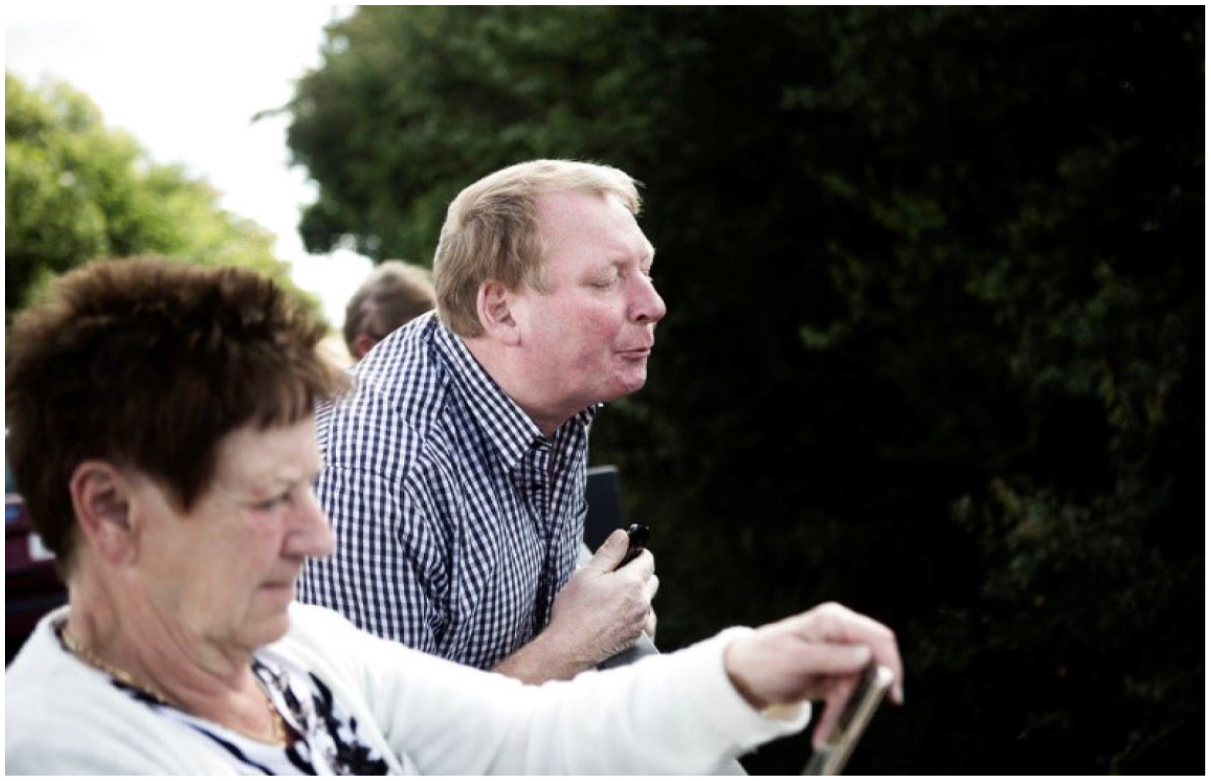
Man spitting at refugees (Sigrid Nygaard, 2015, with permission).
The photograph, in other words, required a significant amount of contextualization in order to actually become a photograph of a man spitting at refugees. This contextualization was provided mainly by the photographer herself, but also by anonymous witnesses to the scene (e.g. Mølgaard, 2015a). It was, however, countered by the man himself after he was identified and contacted by journalists. In the conversation, he recognizes himself as the person in the frame, but denies having spat at the refugees (Madsen, 2015). Despite these denials and despite the limited information provided by the actual photograph, Nygaard’s interpretation ended up as the dominant one, with the photograph widely accepted as one of an angry man spitting at refugees in order to demonstrate his indignation at their presence in Denmark (Nygaard, interview).
If one accepts this overall understanding of the photograph, the next question becomes: What made it resonate so strongly? Its resonance, I argue, stemmed from a specific combination of act and author. While spitting does not cause physical harm, it does contain an act of symbolic violence. Poyatos (2002, pp. 132–133), for example, describes spitting as a nonverbal expression of anger and/or aggression. 2 As reported by Nygaard, the man also shouted ‘fuck off’ and gestured aggressively towards the refugees. It seems, however, that spitting generates a different and more forceful moral reaction than the more common repertoire of shouting and making threatening gestures. Spitting, in other words, seems a particularly powerful way of placing its target in an inferior social position and to deprive it of the right to respect, recognition and hospitality. In his treatise on The Expression of the Emotions in Man and Animals, Charles Darwin (1872/1989, p. 259) thus describes spitting as ‘an almost universal sign of contempt or disgust’. While spitting directly at someone is in many ways more aggressive and disrespectful, the fact that, in this case, it was done from a bridge carried its own symbolic weight. Spitting down on unsuspecting targets who have not had any direct encounter with the perpetrator and find themselves in a state of extreme exhaustion and vulnerability is degrading in a different kind of way. The man’s position on the bridge (elevated, safe, distanced) becomes a symbolic representation of the deep social and economic chasm between Danes and refugees (Nygaard, interview).
Just as the act mattered for the subsequent resonance, it was not unimportant who its author was, or rather, looked like. The man appears middle-aged, is red-haired and light-skinned, well-groomed, and wears an ‘ordinary’ clean shirt. While we should be aware of stereotyping, these traits did facilitate his categorization as a ‘typical’ Dane. His age and respectable physical appearance carries with it some implicit assumptions about expected behaviour. Spitting, as noted above, is seen as an expression of anger and aggression; a loss of temper that for many stands out as primitive, even childish. It becomes difficult, as a result, to excuse or explain his behaviour with reference to a marginal and/or non-socialized position, as would have been possible if, to take two extremes, the spitting had been done by an adolescent or a person with a swastika on their jacket. The fact that the degrading spit came from this kind of visual ‘middle-Denmark’ made it especially pressing for some to strongly dissociate themselves from it.
This debate began and to a large extent took place on Facebook. The early Facebook post by Peter Falktoft, a Danish television and radio personality, provides the most concentrated and extensive debate with around 1200 comments, 2200 shares and more than 20,000 likes. 3 Falktoft sets the scene for the debate with his original, highly indignant, post from 7 September at 22.15. In it, he describes the behaviour of the spitting man as a ‘stain of shame on Denmark and all that we have historically stood guard over. Danishness is many things, but it never has been and never will be this form of pathetic [my emphasis] behaviour.’
It is noticeable how a significant number of the comments that follow also gravitate around the notion of Danishness and the values associated with being Danish. In one immediate reaction from 7 September at 22.44, one user states how ‘I am so ashamed [my emphasis] of being Danish, where is the empathy, the sympathy . . . for our fellow human beings.’ She contextualizes by noting how Danes ought to react differently because they come from ‘a well-educated and resourceful country’. This combination of a perceived set of Danish values (empathy, sympathy, solidarity, etc.) and a privileged material and social position in the world serves for many as a moral imperative to aid those in need. In these comments, and in a kind of reversal of post-colonialism’s focus on ‘strangers’ as Others (e.g. Ahmed, 2000), this man’s behaviour towards the strangers turns him into an ‘internal’ Other, a symbol of ‘who we are not’ as a community. The othering is conveyed in language structured around emotionally powerful adjectives in which the man is morally ostracized through labels such as ‘pitiful’, ‘shameful’, ‘sick’ and ‘despicable’.
These sentiments had a deeper political soundboard. Only a few months before the September events, elections for the Danish Parliament on 3 June had propelled the Danish People’s Party into becoming the second-largest party with 21.1% of the vote. The Danish People’s Party achieved its electoral success on a platform of anti-immigration and Islam-critical policies. For many commentators, it was an easy match to associate the man with the party and its rhetoric. While the Danish People’s Party did not become a part of the new right-wing minority government established in June 2015, the latter was dependent on it for its parliamentary majority. For many, the appointment of Inger Støjberg (from the party Left), a well-known hardliner on issues of immigration, as Minister of Integration was perhaps the clearest sign of the party’s significant influence on the new government. Numerous commentators, including visual comments, thus viewed the spitting man as expressing a hostile position nurtured and legitimated at the highest level of political office. This is evident, for example, in Rasmus Balstrøm’s painting where the man is seen spitting at Inger Støjberg instead of refugees (see e.g. Mølgaard, 2015b). Balstrøm’s painting further represents an increasingly prominent genre in the history of political and injustice photography in which original photographs are more or less immediately subjected to memetic, amateur-driven re-contextualization (Bayerl & Stoynov, 2016; Olesen, 2018) and re-mediation (Bolter & Grusin, 1998) on, especially, Twitter and Facebook. In the case of the spitting man, these predominantly took the form of meaning jamming and reversal, where the man’s aggression is turned into something positive and humorous; playing welcome music, blowing balloons, kissing doves, serving cake. 4
Turning from Falktoft’s post to another important online forum of public debate, the tabloid Ekstra Bladet’s commentary tracks, the reactions to the photograph are starkly different. In Ekstra Bladet’s first article on the incident (Larsen, 2015), from 8 September, the commentary track drew no fewer than 225 comments in only a few days. While some users are critical of the man and his reactions, the overall impression is of strong anti-refugee sentiment. In contrast to the Falktoft post, we find very few direct references to a perceived Danishness. Issues of Danishness and national identity are nonetheless strongly at play. Several comments thus express understanding for the man’s hostility as they view refugees as a threat to Danish identity, national coherence, security and economic well-being. The act of spitting, in other words, is seen as a way of standing up to these imminent threats. There are several active strands within this frame, but it is particularly interesting to note how, for many, the opposition towards refugees is legitimated by ‘their’ acts of violence against ‘us’. In a Danish context, the so-called Muhammad Cartoons crisis in 2005–2006, where the Danish embassy in Damascus was set on fire in response to a Danish newspaper’s publication of a set of cartoons depicting the prophet Muhammad, often serves as a backcloth for such observations. As one commentator notes: ‘REMEMBER: 5-2-2006! The Danish embassy in Damascus is burned down. They are the ones he is spitting at.’
‘Gentle cop’
The gentle cop photograph (Image 2) was taken two days later on 9 September by freelance photographer Michael Drost-Hansen and published in the Danish daily Jyllands-Posten on 10 September (Drost-Hansen, interview). While the location is different from the spitting man photograph (this time, highway E45 near the land border between Denmark and Germany), the circumstances are similar: groups of refugees walking along the highway. The refugees were accompanied by Danish police in order to prevent security issues for refugees and drivers on the highway. In the photograph, we see a Danish police officer (his identity has never been made public) playing with a young refugee girl, later identified as six-year-old Noor Al-Saedi from Iraq, in the middle of the road. In the blurry background, one sees more police officers and refugees. Drost-Hansen’s photograph won the 2015 News Photograph of the Year award in Denmark (freelance photographer Claus Fisker took a series of very similar photographs at the scene).
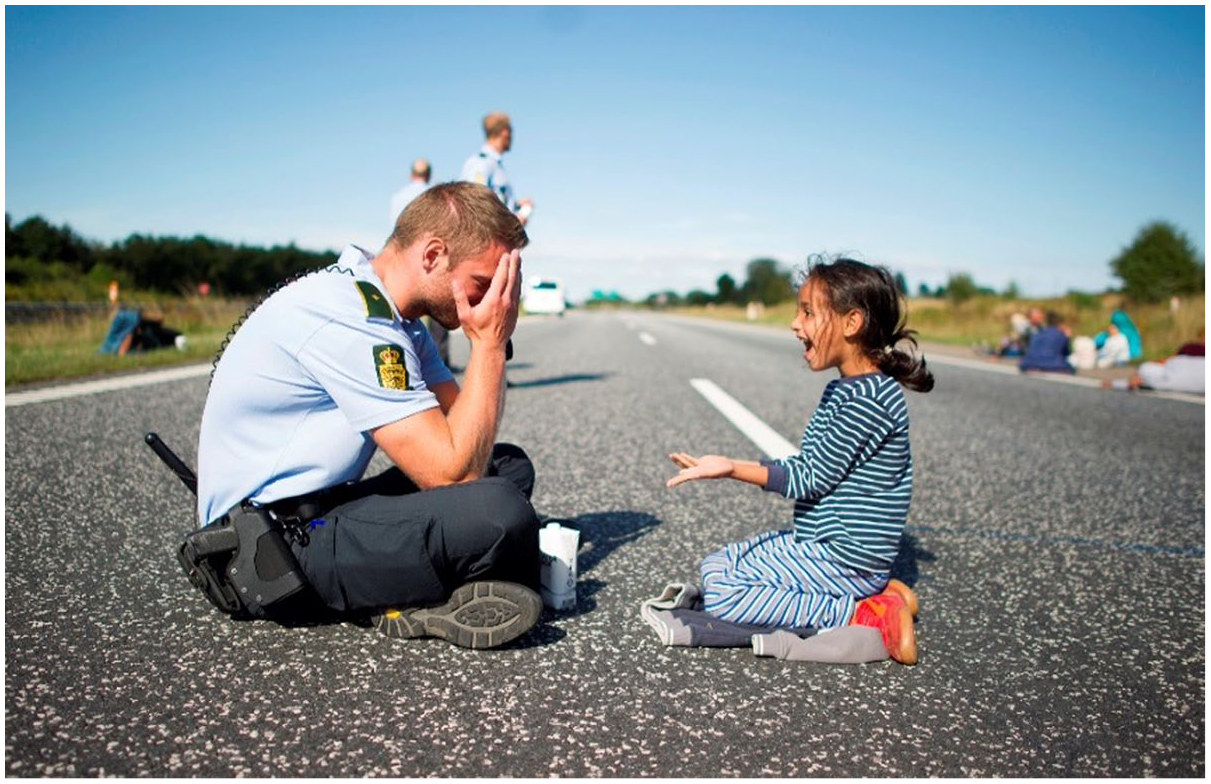
Police officer plays with refugee girl (Michael Drost-Hansen/Ritzau Scanpix, with permission).
According to Benjamin Rud Elberth, a digital expert at communication bureau Geelmuyden Kiese, around 2 million Danes had seen the photograph in the first day after its publication (Zahle, 2015). The resonance of the photograph at least partly resided in its role reversal. Violent police and security officers, as noted earlier, is a distinct sub-genre within the wider category of political and injustice photography. Not only did the photograph offer a powerful contrast to this cultural reservoir of injustice photographs, it also stood out against other photographs of police–refugee encounters across Europe (Drost-Hansen, interview). Several such photographs show beatings or other forms of force directed towards refugees in, especially, Hungary and Greece. It was evident that the Danish police had decided upon dialogue and the use of minimum force (Nielsen & Møller, 2015). The fact that the police officer’s approach was in line with this overall strategy was testified some days later when his employer lauded the officer for his ‘fine police work’ (Thorsen, 2015).
Apart from thus ‘recoding’ the well-known theme of police violence, the photograph also acquired its resonance from the fact that the officer so conspicuously stepped out of his professional role (Drost-Hansen, interview). All professional roles are imbued with certain expectations about role-consistent behaviour. In line with Weber’s (1978) emphasis on ‘detached bureaucracy’, public servants in particular are associated with objectivity and distance towards the issues and individuals they come into contact with. When a public servant breaks with this code to demonstrate sympathy, love and compassion, it elevates him/her to a different moral plane and, for some at least, engenders admiration and surprise. At the time, there were numerous photographs available of ‘ordinary’ Danes supporting refugees, applauding them, providing clothes and food, etc. (Drost-Hansen, interview). The gentle cop photograph thus drew its power not (or at least not only) from the expression of sympathy and compassion per se, but from the fact that this was unexpectedly demonstrated by an authority figure.
The role reversal theme in the gentle cop photograph can only be properly understood in connection with that of the spitting man. The spitting man photograph also deviates from the classical injustice plot in that it depicts a civilian perpetrator of (symbolic) violence against other civilians. The fact that only two days separate the incidents made it inevitable that their interpretations became dialogically intertwined, with the two role reversals powerfully amplifying each other. While for many, the gentle cop came out on the hero side and the spitting man on the villain’s, the ensuing debate had several complexities that escape such a simple dichotomy. Comments on Jyllands-Posten’s Facebook page were divided between users expressing admiration for the police officer and others criticizing the scene. 5 Several critical comments highlighted how the scene expressed an unacceptable differential treatment. As one user remarked: ‘Since when has it become legal to walk around on the highway? If a Dane had done that, I don’t think the police would have sat down on the pavement for a chat.’ Another user, in a similar vein, indignantly laments how the police officer plays with the girl while ‘thousands of law-abiding Danes’ wait in traffic jams caused by the refugees.
For many, the scene almost signals a breakdown of order and balance, where ‘undeserving’ refugees are aided and treated with respect, while ‘deserving’ Danes are not offered the same kind of understanding. As noted above, the officer’s stepping out of his professional role is viewed by several as a sympathetic trait. For others, it rather represents an illegitimate displacement of professional responsibility, a reversion to, as one user angrily notes, ‘the state of a banana republic’. Indignation, in other words, emerges not only from the officer’s friendly approach, but just as much from the fact that it happens on a highway. Well-ordered highways and an unimpeded and safe flow of traffic is, it appears from many comments, one thing that sets Denmark apart from ‘banana republics’. Comments in relation to both the spitting man and gentle cop thus often remark on the fact that the refugees come from disorderly societies. The rag tail army of refugees walking on the highway symbolically imposes this disorder on Danish society and, what is more, does so without sufficient intervention by the primary protectors of law and order, the police.
A significant element in this understanding of ‘imposition’, ‘invasion’ or ‘infection’ was to consider the refugees to, potentially, harbour future terrorists. In a painting by Uwe Max Jensen in response to the gentle cop photograph, the girl is thus replaced by a Muslim terrorist. 6 The painting not only parodies the highway scene, but also engages in an inter-iconic (Hansen, 2015) dialogue with the Muhammad Cartoons discussed earlier. The most famous and provocative of these (painted by Knud Westergaard) depicts the prophet Muhammad with a bomb in his turban in order to draw a direct line between Islam and terrorism. The officer’s indirect acknowledgement of the little girl’s innocence and humanity is turned around to become an expression of naivety and, again, a displacement of responsibility. ‘A suitable caption to the image’, writes one commentator, ‘could be: Does Danish police play with the children of ISIS fighters instead of looking after Denmark and the security of Danes?!!’
Positively inclined comments view the incident not as a breakdown, but rather restoration of moral order. ‘In a time’, notes one user, ‘where everything is more or less chaos, there must also be room for a smile and humanity.’ It is consistently emphasized how the officer’s behaviour emotionally ‘warms the heart’, ‘makes me smile’, etc. More importantly, however, it is held up as a demonstration of how ‘not all Danes are egoistic and insensitive people’ and as something we should be proud ‘can happen in Denmark’. These emphases indicate a deep concern about the way Denmark and Danes had acted during the refugee crisis. The image of the spitting man was powerfully present in these reflections. In a tweet (389 retweets and 460 likes) from 10 September, one user says: ‘Let us rather spread this image than the one of the spitting man.’ In these readings, the police officer thus becomes the unexpected carrier and defender of a set of Danish values profaned two days earlier by the spitting man.
Concluding remarks on the democratic potential of photography
The case of the spitting man and the gentle cop provides compelling evidence of the power of photography to shape and organize public debates. There are perhaps even reasons to expect this power to increase in the new media ecology of Web 2.0. While they do not explicitly discuss photographs, Bennett and Segerberg’s (2012) observation that personalized and compressed symbolic packages travel more easily through the extensive inter-personal networks of Twitter and Facebook can easily be extrapolated to visual messages (see also Mortensen, 2016). The extraordinary capacity of photographs and other visual representations to condense a wide array of emotions and interpretations in a single frame provides them with a high degree of dynamism in communication platforms that favour short and condensed messages.
As a whole, these developments raise a thorny question: Are affective publics (Papacharissi, 2016) generated or supported by photographs and images a democratic advance? The question is obviously too large to be conclusively tackled here; yet, some key positions may be sketched for the purpose of future discussion. On the one hand, photographs serve a democratic role in their ability to capture complex themes in ways that affect viewers emotionally. This can help move important issues higher up on the political agenda, as well as motivate people who never or rarely engage in public debates to participate. On the other hand, the same qualities also contain a risk of polarization and simplification of public debates that is perhaps even exacerbated by the affective potential in the new media ecology. As shown in the article, interpretations of the spitting man, for example, often became extremely dichotomous and derogatory. By labelling him as ‘sick’, ‘deranged’, ‘despicable’, etc., the man and his actions were largely expelled beyond the realm of language and rational debate. Similarly, support for the gentle cop was routinely ridiculed and attacked with terms such as ‘stupid’, ‘naïve’, ‘dangerous’. It becomes difficult to envision how collective orientations and democratic deliberation can emerge from and across such polarizations and negativity (Hannan, 2018). Putting it somewhat starkly, the affective potential of photographs, which historically has ensured them a prominent place in public debates about justice and injustice (Hariman & Lucaites, 2007; Sontag, 1977; Zelizer, 2010), is perhaps at risk of being tabloidized and diluted in and by the new media ecology of Web 2.0.
The polarized debate surrounding the two photographs would, however, be a greater problem if it occurred mainly in echo chambers (Sunstein, 2007) and was only driven by negativity. Yet, the article has also shown how opposing positions in fact often ‘met’ in the debates. For example, if we look at the debate on Jyllands-Posten’s Facebook page about the gentle cop, opinions were very diverse and often interacted with each other. And while Ekstra Bladet’s commentary track was reported to be mainly negative towards the gentle cop, such comments were regularly interspersed with more positive readings that ensured some degree of exchange, debate and variation. While negative and emotional responses that tend to dismiss and degrade others abound in the material, they do not always short-circuit the debate, but are also animators for back-and-forth argumentations where participants present and weigh claims and evidence. To conclude that affective debate was central in the negotiation of the role reversals in the gentle cop and spitting man photographs is therefore not to indicate a fundamental and mutually exclusive opposition between affective and deliberative modes of communication (as Papachirissi herself sometimes seems to do; see e.g. Papacharissi, 2016, p. 320). Rather, the analysis should be seen as a call to further investigate how affective and deliberative forms of debate and exchange interact in the new media ecology of Web 2.0. Heeding Chadwick’s (2017) advice to look more systematically at the relationship between ‘old’ and ‘new’ media, future research could usefully begin by exploring how and to what extent the online debates presented in this analysis were reflected in newspapers and television.
Footnotes
Funding
The author received no financial support for the research, authorship, and/or publication of this article.