




Abstract
Among the different theories used to explain social change, the transition theory holds a special place. It has been applied to subjects such as demography, epidemiology, nutrition, etc. and most often from a multidisciplinary perspective. However, beyond the apparent uniqueness of the transition label there are quite different theoretical frameworks and presuppositions, which can be a source of misunderstanding. A first perspective considers change as the transition from one stable state to another and concentrates on the processes at work in the transition phase. It focuses attention on the interactions between cultural and biological variables and tries to take into account the consequences of the fact that they move at different rates. A second perspective conceives change as a series of stages (more or less stable situations) and proceeds to analyse the structural transformation of the organisation at each stage. The emphasis is placed on the transformations that take place during these stages. This brings us closer to the theory of stages. Finally, a third perspective combines stages and transitions. Change is seen as part of an evolutionary and progressive movement and as being reversible or not. This article studies the cognitive organisation of the different theoretical variants of the transition model in which food plays a more or less important role.
Keywords
Since it was first formulated in the 1940s, the concept of transition has seen many variations in fields as diverse as demography, epidemiology, nutrition, food and economics. Its development has continued, and its applications have extended to the fields of energy, agriculture, climate, tourism, etc. This success has led to the notion of transition being used in political language as a synonym for ‘gradual and necessary change’. But behind the apparent homogeneity of the way transition has been shaped lie several theoretical frameworks. This article aims to explore the contribution of ‘transition’ theories to the analysis of social change. In order to do so, we will first study the variations the theories have undergone in the different scientific fields related to food and health issues. Then we will look at how, as empirical contexts have changed, the theoretical ‘framework’ of the transition has been reorganised and how its epistemological ambitions have been transformed. Three main attitudes and ambitions can be identified. The first emphasises the temporal shift in the evolution of biological and cultural variables and its consequences (Notestein, 1944). The second focuses on the descriptive power of the model by showing the transformations at work at different stages of change (Omran, 1971; Popkin, 1993). The third views change as a sequence of stages and transitions (Popkin, 2002; Poulain, 2009). To this extent it is now possible to identify three categories of theories according to whether one or the other of these ambitions supports them. The epistemological originality of the concept of transition and its heuristic dimension undoubtedly lies in the possibility it offers to articulate and create a dialogue between different levels of a phenomenon. Regardless of the version chosen, transitional shift theory or stage theory, this theoretical framework is at the heart of interdisciplinary dialogue. This article focuses on the various formulations of the model that have a direct connection with food. After clarifying our scientific perspective and our approach, we will describe the different versions of the transition model in their historical order of appearance. We will then try to see the place of food within each of them. Finally, we will focus on the explanatory schemes used, the pragmatic horizons and their connections with the issues on the social agenda.
Theoretical framework and method
In spite of vigorous and regular criticism, 1 the demographic, epidemiologic and nutritional uses of the concept of transition have been considerably popular. A systematic review done in 2014 on PubMed with the keywords ‘epidemiological transition(s) or epidemiologic transition(s) or demographic transition(s) or health transition(s)’ and ‘mortality’ published in English between 1 January 1971 and 31 December 2013 generated 547 articles, which were then reduced to 210 after excluding a number of irrelevant articles and commentaries, reviews and editorials (Santosa et al., 2014). Barry Popkin, who has made nutrition transition his main research topic and has attached his name to this theory, has more than 150,000 citations in Google Scholar. Even if this literature is willingly presented as interdisciplinary, it is however mainly produced under the authority of authors from the health sciences, or who identify themselves within this scientific field, although they sometimes come from other disciplines, such as agronomy or psychology. In this context, part of the conceptual framework is sometimes based on implicit assumptions (like evolutionism, auto-regulation or irreversibility of change) particularly for those dimensions of the problem that concern social changes or social determinants of complex phenomena. More surprisingly, there are relatively few critical debates despite the fact that a rather large part of the literature raises the question of why the empirical evidence does not support the theory. . . It is therefore necessary to explore these assumptions further in order to get a better understanding of the epistemological and cognitive organisations of the theoretical models.
The analysis in terms of ‘thematisation’, which we will use, seeks to describe the cognitive organisation of a scientific question, i.e. its implementation in the disciplinary and paradigmatic organisation and its developments. This matches the ways of analysing, explaining or interpreting empirical data. The thematisation approach is in line with the epistemology initiated by Gerald Holton (1975, 1988) and developed in the social sciences by Jean Michel Berthelot (1990, 1996, 2002).
Our objective is to understand how cognitive organisation evolves according to the empirical questions it claims to address and to the contexts in which the work was developed. The study of thematisation attempts to see how this cognitive organisation is influenced by and echoes the contexts in which it was formulated. In this instance, the term ‘context’ covers: the transformations of the organisation of societies, the positions of actors in academic systems, their interchanges with political or industrial organisations, as well as the social problems that receive the most attention or aspire to do so.
In terms of method, we will try to identify the theoretical backgrounds and explanatory patterns. As transition theories are multidisciplinary approaches and as they were developed most of the time by non-sociologists, it is a matter of uncovering the more or less explicit explanatory patterns on which they were based. The work will use the results of an extensive literature review carried out as part of a collective expert study on obesity, for INSERM, the French Institute for Medical Research (Poulain, 2000). 2 In relation to food issues, the thematisation approach has been used on several occasions to study how taste and food pleasure have been problematised in French social sciences (Dupuy, 2014; Dupuy & Poulain, 2012; Poulain, 2008, 2009, 2020; Poulain & Corbeau, 2012) and to compare the development of ‘food studies’ in the English-speaking world and ‘sociology of food’ in the French one (Poulain, 2018). It has also been used in the study of obesity (Poulain, 2009) and advances of knowledge in nutrigenomics (Fournier & Poulain, 2017, 2018).
The successes of the theoretical framework
The theoretical matrix of ‘transition’ has been broadly successful during the twentieth century through four versions that are more or less closely connected with food: the demographic, epidemiological, nutritional and food transitions. With emerging work on protein transition, this matrix it is now undergoing a new development.
Demographic transition
This model was conceptualised during the 1940s by the demographer Frank Notestein (1944, 1945, 1948) (see Figure 1). From an evolutionary perspective, it describes the structural transformations that populations undergo during the development process. In particular, it describes the transition from a so-called ‘traditional’ stage, in which mortality rates are very high, life expectancy is short and demographic equilibrium is maintained by a high birth rate, to another stage, that of ‘modern’ societies, where life expectancy increases sharply at the same time as mortality decreases, demographic equilibrium being achieved with low birth rates. In the ‘transition’ phase, which gives its name to the model, birth rates fall less than death rates. As the balance between birth and death is positive, the population increases. During the transition, there is therefore a marginal increase in the population, the so-called ‘population push’. Finally, after the transition, birth and death rates stabilise, at a low level, but sufficient to ensure the renewal of the population. A situation of demographic equilibrium then emerges, bringing the process to an end. It is worth recalling that Adolphe Landry was interested in the question of the gap between death and birth rates long before Notestein formulated the idea of demographic transition. Landry attributed the decline in mortality rates to ‘medical and hygienic progress’ and the disappearance of famines, and that of fertility to what he called the ‘rationalisation of reproduction’, i.e. to its adaptation to the demographic context (Landry, 1934/1982).
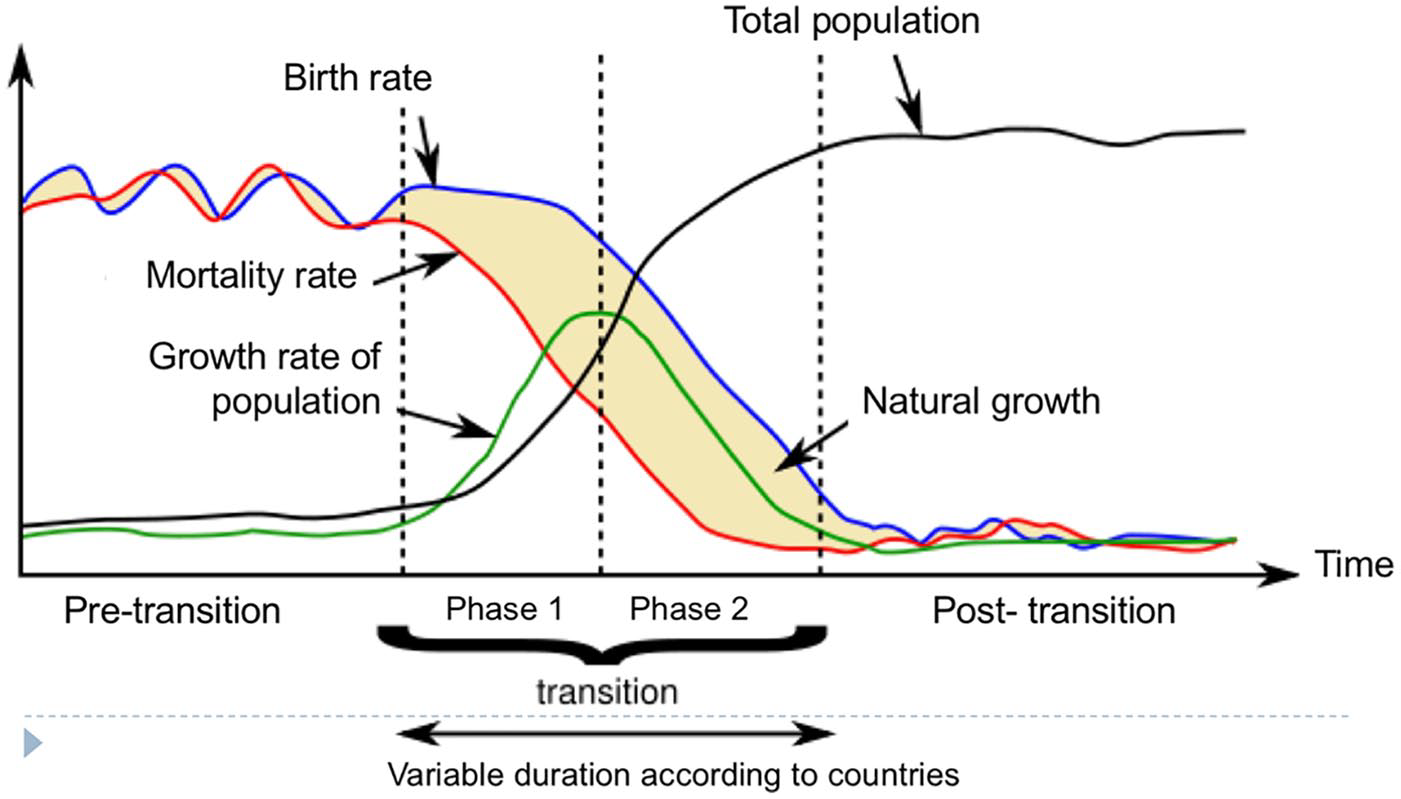
Model of demographic transition.
The contributions of Notestein were to focus on the delaying effects of cultural regulation mechanisms in situations of interaction between biological and social parameters. Indeed, at the beginning of the transition phase, birth rates remain at high levels while their demographic ‘usefulness’ is no longer required. The system of values that govern procreation, such as family conception, values associated to the number of children and parental social roles, changes slowly, while the determinants of mortality, which have a stronger biological component, such as the medicalisation of pregnancy and childbirth or hygiene, move swiftly. Value systems in ‘traditional’ contexts had some ‘adaptive’ advantages like the involvement of children and adolescents in agricultural work and the guaranteed care for the elderly by the youngest by repartition on a big number of children.
The model was born in a context where international policies of development aid were facing problems, notably what economists refer to as ‘stop and go’, i.e. a succession of phases of growth and recession over a short time scale. Notestein suggested that marginal population growth due to the time lag between morality and birth rates could be the cause. His professional context, at the Milbank Memorial Fund at the end of the Second World War, placed him on a macro scale of analysis and led him to look at the dynamics of societies. He used a functionalist interpretative framework, assigning, more or less explicitly, the evolutions of value systems and norms that control the social roles of men and women as the cause of the modernisation of societies. This evolutionary perspective is also not devoid of a certain amount of Western-centrism.
This model was a considerable success, establishing itself as a theoretical benchmark for demographic services in the United States in the late 1940s and for most of the rest of the world in the following decade. Although the notion of post-transitional demographic equilibrium (i.e. the idea that societies would spontaneously regain population stability by adjusting mortality and birth rates) was the subject of fierce criticism (Sauvy, 1952, 1954), the heuristic interest of the model does not disappear once we rid it of a certain self-regulating conception of demography. The theoretical dispute around this model concerns the existence of a post-transitional demographic equilibrium. The presupposition of demographic self-regulation has some similarities with that of market self-regulation found in the classical liberal economist theory. Adam Smith’s ‘invisible hand’ would not only watch over the market, but also over demographics and birth and death rates. Thus, the Notestein version of the model could be seen as an avatar of liberal ideology. For Sauvy (1952, 1954), several post-transitional scenarios are possible, and he supports the idea of having a political management of the post-transition. The diversity of current situations in Western European societies, with a lot of countries that, according to CIA World Factbook (2018), are below equilibrium like Germany (1.46), Belgium (1.78), Portugal (1.39), and with only France above (2.06), shows that demographic equilibrium does not happen spontaneously and clearly calls for consideration of Sauvy’s proposition.
Epidemiological transition
Abdel Omran (1971) set out to describe and analyse the transformation of the causes of mortality during the transition process, thus proposing the ‘epidemiological transition’ model. He introduced a new demographic parameter, life expectancy, and developed an internal point of view of societies by studying the variations of this indicator for females and males, at different ages. In doing this, he opened the door for the introduction of sociological matters into the model. The three stages of the basic model correspond to three stages of the epidemiological transition. In the first stage, which he calls ‘the time of epidemics and famine’, the main causes of mortality are infectious diseases, nutritional deficiencies and parasitosis. Life expectancy is low and infant mortality rates are very high. During the ‘transition phase’, these causes of mortality regress at the same time as the appearance of degenerative diseases (heart disease, cancer, etc.). Life expectancy then begins to rise. Finally, during the third phase known as the ‘installation of degenerative diseases’, infectious mortality almost disappears, and lethal diseases become the first cause of mortality. Life expectancy is still increasing, and the population is growing, particularly by increasing the highest age groups. The development of this theory can be traced back to the WHO policy of the 1960s and 1970s. It was a controversial policy that sought to align family planning and birth control with health promotion. At that time, it was only relatively successful (Weisz & Olszynko-Gryn, 2010). It was with the development of chronic diseases at the end of the 1980s and during the following decades, after several ‘redesigns’, that the model gained notoriety. Supplements to this model have been proposed in the form of adding a fourth stage, that of the ‘decline of chronic diseases’ (Picheral, 1989), and extension to a fifth stage, that of ‘sociopathies’ 3 (Druhle, 1996), in which suicides, violent deaths and certain pathologies with strong social components become increasingly important. When the other causes of mortality stabilise and regress, the visibility of ‘sociopathies’ becomes strong, as if, from phase to phase in the course of the epidemiological cycle, the share of social factors in health becomes more visible. Other authors have also proposed two additional phases more or less in line: ‘The age of declining CVD mortality’ and ‘The age of aspired quality of life with persistent inequalities’ (Barrett et al., 1998). The experience of COVID-19, of which H1N1 and SARS were precursor events, introduced a new stage, which we could call ‘the return of the great epidemics’. In globalised societies, where millions of people move around the world for work or tourism, the risks of epidemics have also become globalised. And these epidemics have revealed the fragility of social and political organisations. At the same time, health institutions have had to reorganise themselves to deal with these types of risks, thought to be part of history.
Food in transition
Right from the start, food has had a prominent place in transition theory. One of Notestein’s first publications appeared in a collection entitled Food for the World (Schultz, 1945). This is effectively a continuation of the scientific vein inaugurated by Malthus, both in terms of its macro scale framework and temporality. But while Malthus warned of misery, the theory of transition is more optimistic. The causes of the demographic transition are threefold: agronomic progress, which allows for an increase in the amount of food available; organisation of the food chain, which improves its accessibility; and spread of hygiene and medical practices. When we look at the causes of mortality at the different stages of the transition, food is omnipresent. Famines that kill, lack of food that weakens individuals and makes them more vulnerable to epidemics in the early stages of the transition, and ‘bad’ food together with quantitative excesses and qualitative imbalances generate diseases that have been called ‘civilisation’ diseases.
Nutrition transition
Popkin (1993) seems to be the first to use the term ‘nutrition transition’ and to have proposed several forms of the transition model. From the many publications he has authored, solely or in collaboration, two theoretical forms can be identified. The first focuses on the influence of economic conditions on food styles (amount of energy ingested and structure of the ration). The second is more in line with epidemiological transition by describing, for each stage, the transformation of certain nutritional parameters of the populations. The conceptual framework of the first formulation comes from a publication of the Food and Agriculture Organization of the United Nations (FAO-UN) dated 1969 (Périssé et al., 1969). Using 1962 data from FAO for food availability and the World Bank for Gross National Product data (GNP), for 85 countries, this paper showed a link between GDP and structural transformation of the food available per capita, as well as a switch from plant to animal products. Fourteen years later, Drewnowski and Popkin compared these data with an equivalent set from 1993 and thus confirmed the links between economic factors and structure of the diet, by adding a dynamic dimension (Drewnowski & Popkin, 1997; Popkin, 1993, 1998). On a practical level, they looked at the consequences of these transformations, in particular the increase in energy intake, which they linked with the development of obesity. They suggested the described phenomenon be designated as ‘nutritional transition’. This first model (see Figure 2) is therefore a linear causality between social-economic variables and nutritional variables. It is part of an evolutionary and progressive vision. Although these authors cited Omran, this version of the nutrition transition concept is related neither to the epidemiological transition (succession of stages) nor to the demographic transition (time lag). The formulation of nutrition transition approaches the question of changes at a macro international scale and describes transformations of food availabilities per capita under some modernisation factors (economic development and urbanisation). Several modifications are brought to light. The first is the increase of the energy intake associated with the rise of GNP. The explanation comes both from the fact that the quantity of food available (and therefore probably consumed) increases, and also from the inversion of the proportion of carbohydrates and lipids in favour of the latter. Due to the higher energy content of fats, this change increases the energy density of the ration. The proportion of proteins remains more or less stable. Another series of food changes happen within the nutrient categories. The carbohydrates of cereal or root origin decrease when fast sugars increase. Vegetable fats are partly replaced by fats of animal origin. Finally, protein intake also undergoes a structural transformation with the replacement of plant proteins by proteins of animal origin. This version of the nutritional transition provided the framework for several publications analysing the consequences in terms of public health like obesity (Drewnowski & Darmon, 2005; Huang et al., 2009). It offered a systems-oriented multilevel framework for addressing obesity in the twenty-first century.
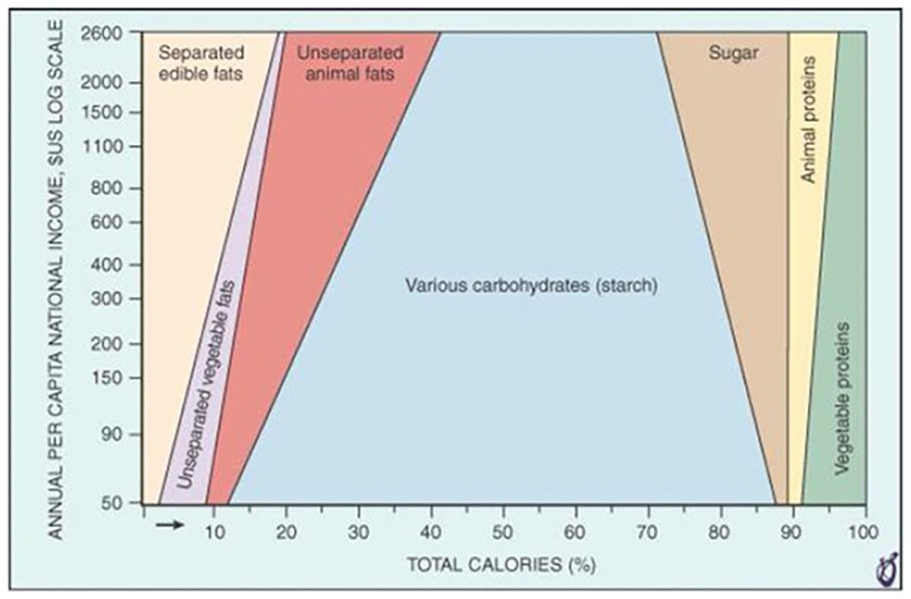
Nutritional transition 1.
This first version is quite far from the demographic transition model. The meaning of transition here is not the passage from one state to another, but a kind of continuous change of the food availability under the influence of economic factors. This first formulation is part of an evolutionary vision and more or less explicitly supports the idea of a convergence of food consumption patterns.
The second version was formulated explicitly on the basis of the epidemiological transition model in 1993, but it was not until the 2000s that Popkin and colleagues deployed it and attempted to base it on empirical data (Caballero & Popkin, 2002; Popkin, 1993, 2006). It consists of five successive stages and introduces nutritional variables (see Figure 3). The schema undergoes several qualitative evolutions in the diet, stage by stage. Five dietary patterns are described that correspond to the stages of the epidemiological transition. (1) ‘The time of harvest’: during which the diet consists essentially of carbohydrates and fibre, generally low in fat, which is unsaturated, originating from wild meat. (2) ‘The time of famines’: with a decline in varieties of food, especially meat, populations are subject to nutritional stress. The increasing population density causes famines, and social stratification appears during this period. (3) ‘The receding of famines’: through the increased consumption of fruits, vegetables and animal protein the consumption of starchy foods decreases. (4) ‘The appearance of degenerative diseases’: occurs with a diet high in fat (especially from animal products), sugar and processed products; low in fibre. Along with a sedentary lifestyle, a characteristic of societies with high standards of living, these in combination result in the prevalence of obesity. (5) ‘The change in dietary behaviour’: the development of a new food model, which is associated with the desire to protect against degenerative diseases and prolong life. During this phase, the consumption of fats and processed products decreases while carbohydrates, fruits and vegetables increase. This model has undergone several reformulations and has correspondingly become more complex over time. The perspective is always evolutionary but in comparison with the first version of the concept of nutrition transition, there is an introduction of a certain dose of optimism in the final phases, even if largely disconnected from empirical data.
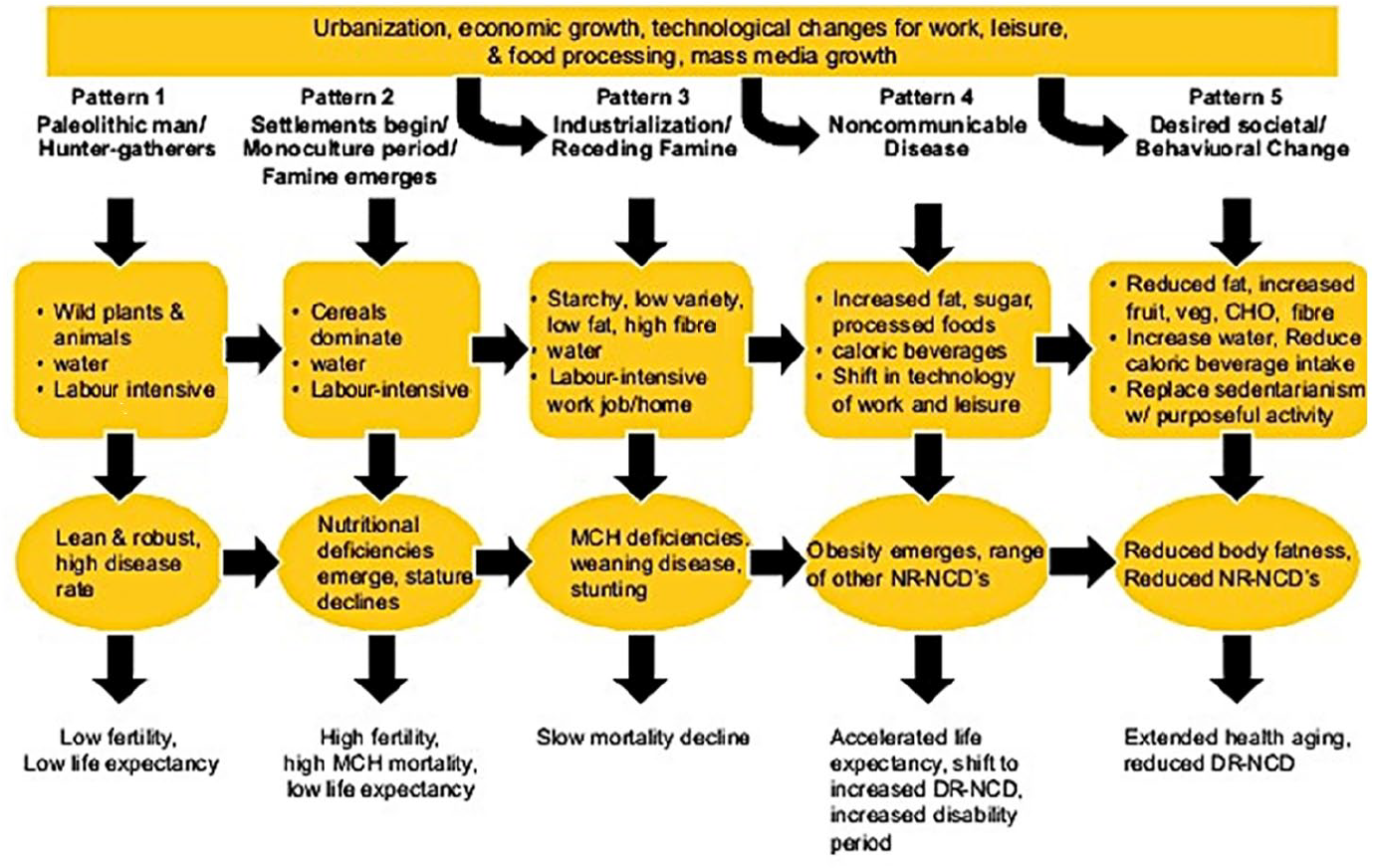
Nutritional transition 2.
The limitations of this work are twofold: the reliability of availability data at the state level and the blind spot of infra-national inequalities. With these data, it is difficult to account for informal exchanges and self-consumption, which can be important in developing countries where the share of the active population in agriculture is high. For example, self-produced proteins largely escape these calculations, as is the case for poultry, eggs, milk, fishing products, hunting, etc. Secondly, using mean per capita erases internal social differences linked to hierarchy, age or gender.
Food transition
Before the nutrition transition was formulated by Popkin (1993), a reflection was under way among the European food historians and sociologists, about what they referred to as the ‘food transition’. This notion arose from a controversy launched by food historians who questioned the ‘globalising’ reading of demographic and epidemiologic transition models, based on European empirical material (Livi Bacci, 1987). Beyond this question, it opened up a debate on the place of food in the processes of internal social differentiation at the different stages of the epidemiological transition (Poulain, 2000) (see Table 1). Indeed, some contributors to the debate consider that a part of the empirical data tends to show that the transformations of the seventeenth to eighteenth centuries in Europe in no way correspond to an improvement in food intake, as claimed by the models of demographic and epidemiological transition, but, on the contrary, to its deterioration (Aymard, 1997; Collomb, 1989; Livi Bacci, 1987; Montanari, 1993). Indeed, if the total quantity of food available increases as a result of the introduction and acclimatisation of food products from the New World as well as of agronomic progress, the simultaneous development of the population would have led to a qualitative impoverishment of availabilities at the individual level.
Roles of food in the epidemiological transition. From Poulain (2000).

The transformation of agricultural production patterns from subsistence polyculture to monoculture changes popular food styles. Monoculture is accompanied by a gradual reduction in the register of the edible, with the consumption of a core food, very often cereals. These changes have contributed to a reduction in dietary diversity and a qualitative impoverishment of the ration. Deficiency diseases would have appeared or reappeared, of which pellagra, the consequence of a mono-feeding with maize in Italy, is an example. Mono-feeding would also have increased dependence on climatic and agronomic hazards, sometimes triggering even more terrible famines than before, such as the one experienced in Ireland with the potato. The weight of proteins of animal origin – considered by these same historians as an indication of the quality of the food ration – also decreased considerably in the middle of the eighteenth century (Montanari, 1993). For Livi Bacci, who is the most radical opponent of the demographic transition thesis, the supposed link between food and population growth should distinguish between the short term where clear causality can be established and the long term where it cannot be established. The effectiveness of the food–population ratio would be limited to short-term phenomena only, i.e. acute mortality crises. These crises have a major impact on demographic trends. In times of scarcity, mortality is caused partly directly by hunger, but more often by malnutrition that creates a greater sensitivity to epidemic infectious diseases (Livi Bacci, 1987; Montanari, 1993).
This position merits further discussion. Highlighting the paradox of the simultaneity of population growth and the qualitative impoverishment of the food ration is based on data of an uncertain nature. These are above all urban statistics, which do not adequately capture rural and informal economies. Working with this type of data, despite the meticulous work and talent of these historians, proves to be challenging. The figures cannot be used as proof, but only as clues to be taken into consideration when reformulating the epidemiological transition hypothesis.
It is possible to get out of the apparent paradox between population growth and ‘impoverishment of the food ration’ not only by separating the short and long term, but also by distinguishing between nutritional energy needs and qualitative macro-nutrient needs. Accepting a hierarchy of these two dimensions of needs and the priority of energy over quality can get us out of this contradiction. Cereal monoculture has increased overall energy availability and allowed population growth. Admittedly, the reduction in dietary diversity has been able to maintain – and in some cases even increase – qualitative imbalances in the supply of macro-nutrients. However, since the negative effects of these were only felt later on, with the body itself drawing the resources so as to adjust, they would not have affected population development.
In order to strengthen the sociological perspective, Poulain (2000) suggested observing the roles of food in intra-social differentiation in the epidemiological transition model. During the first phase, ‘the time of epidemics and famines’, food availability is highly dependent on biotopes: on soil characteristics and the effects of climate. When food is scarce and production is local, social differentiation is achieved by staging abundance and by consuming products from elsewhere, such as spices, oranges, lemons, etc. The eating habits of the aristocracy show abundance and a certain relocation of food. The products that come from afar are regarded as valuable. This appearance of abundance is also present at exceptional meals in a more popular setting. In this context, body size is not a positive value for the aristocrat and the beautiful woman is thin.
During the second phase, progress in agronomy, in terms of species improvement, cultivation techniques, and – in a very diversified manner in pace and geographically – acclimatisation and cultivation of food products from the New World (maize, beans, potatoes, tomatoes, etc.), contributes to increasing food availability. State organisation allows the implementation of stockpiling and programmed redistribution policies that partially erase the effects of climatic fluctuations and differences in soil yields. In this context, social distinction comes to be based on an aestheticisation of the taste of products, which then becomes the axis on which French gastronomy developed (Mennell, 1985). Being ‘fat’ slowly becomes a positive sign of social position, both for the aristocrat and the bourgeoisie. The diet of the working class is characterised by greater differences than in phase one. They are linked to the very wide variation in the acceptance of food products from the New World. During the third phase (if we treat the two periods of world conflicts during which there were severe food restrictions separately) food abundance becomes almost permanent. In this context of abundance, thinness becomes a mark of social distinction. New body aesthetics develop, privileging slender shapes, which at first mainly affect women, but later also men. For phase four, known as ‘decline of chronic diseases’, the development of nutritional knowledge could have contributed to the prevention of degenerative diseases. From then on, thinness is associated with the idea that being thin is being healthy. This could be classified among the ‘sociopathological occurrences’ of the fifth phase. From this point of view, it is seen as the consequence of a series of transformations in food practices and the social environment of food. Obesity. More broadly still, eating disorders – bulimia, anorexia, compulsive eating, as well as the range of fears and anxieties triggered by food today – may be included in the category of ‘sociopathies’.
From food transition to obesity transition
The version of the transition model, with a time lag between variables, has been used to analyse the rise of obesity in developed societies. Obesity can be seen as the result of a mismatch between energy needs and intakes. Indeed, these have fallen rapidly due to the transformation of social organisations and lifestyles (nature of work, physical activity, transport, etc.). Whereas the latter, largely controlled by cultural factors, such as conviviality and values associated with food, are decreasing but more slowly. We can thus establish a correspondence with the Notestein model.
So obesity can be viewed as the momentary consequence of a gap between energy needs, over-determined by systems of action (tertiarisation of jobs, mechanisation of work, transport, heating and air conditioning of premises, etc.), and consumption that is still controlled by value systems and cultural norms (Ascher, 2005; Poulain, 2009, 2012). From this perspective, population may be seen to increase during the demographic transition because of the time-shift between death rates and birth rates. Birth rates are determined by a series of cultural factors, which give priority to procreation and a large number of descendants. Value systems like this may have emerged in a variety of demographic contexts, but always ones in which they provided adaptive advantages. Indeed, in economic and social contexts where there is no old-age pension and where the labour needs in the household are high and seen as a production unit, a large progeny is both a guarantee for old age and a short-term advantage.
If we pursue the analogy with the obesity transition model (Figure 4), energy needs diminish on account of lifestyle shift. A modern lifestyle requires less energy due to the mechanisation of work, transformation of transportation, heating of accommodation, and so on. Energy intakes are controlled by a series of cultural factors which, in pre-modern contexts, place abundance and quantity in the foreground and associate copious eating with social progress, celebration, etc. These value systems are then transformed to integrate health concerns and the consequences of diet on weight and health. Little by little, there is a shift from valuing quantity to a more qualitative approach to food. Numerous anthropological studies highlight the slow pace of these transformations in societies in transition and the persistence of interest in quantity at the lower end of the social scale (Serra Mallol, 2008; Tibère, 2006). These changes happen more or less quickly, according to the position in the social hierarchy, gender and age. The differentiated decrease in energy intake according to social position can then explain the social differentiation of the prevalence of obesity.

Obesity transition: energy needs and intake during the nutrition transition.
This version makes it possible to take advantage of the abundant theoretical heritage of demographic studies on the factors that control the decline in the birth rate. This could lead to a better understanding of the social and economic conditions that could determine the transformation of eating habits. However, post-transition developments remain controversial. Two competing interpretations are available. The first, following Notestein, considers that one has only to wait for the social and cultural processes that accompany and control nutritional models to adjust to the energy needs that correspond to the new lifestyles. From this point of view, obesity is only a temporary problem concerning three or four generations at most and will resolve itself with time. They could be seen as the lost generations of nutritional transition. The ‘best way’ to manage the problem would be to wait for the values system that controls food intakes to change. The second attitude does not ‘believe’ in the principle of self-regulation and is in favour of health policies that encourage new eating habits adapted to ‘modern’ life. Two attitudes to public health for obesity are found here: one is more ‘liberal’, the other more ‘interventionist’.
Protein transition: Plant and animal origin in human food
Numerous datasets, collected at the level of consumption or of culinary practices, question the vision of an economic determinism that guides societies in a unilateral way. If, at a macro scale perspective, some data seem to support the idea of converging modernity as developed by Mahbubani (2013) or for food by Drewonwski and Popkin (1997), at a smaller scale, like the national one or like the subpopulations one, there appear a lot of ‘local’ particularisms that are quite distant from the global trends (Esnouf et al., 2011; Fourat, 2018; Lepiller et al., 2016, Poulain, 2018).
The flattening of differences and nuances does not come only by using the macro scale, but also from the use of large food categories, like ‘animal origin’ versus ‘plant origin’. For example, some differences in terms of sources of nutriment and of speed of change fade or become invisible. Some substitutions in term of sources of proteins can happen inside a category, such as, for example fish and red meat or between poultry and beef and may then go unnoticed. Behind protein consumption lie socio-cultural determinants: food taboos and bans on certain animals, the relationship to animal death and, more broadly, the organisation of the social space of food. These examples lead us to look more closely at the analysis of protein sources to see the dynamics of consumption by category of animal. These choices are largely determined by socio-cultural factors, but their environmental impact, which varies with the types of animals consumed and the types of farming, tends to become a factor as ecological awareness grows (see Figure 5).
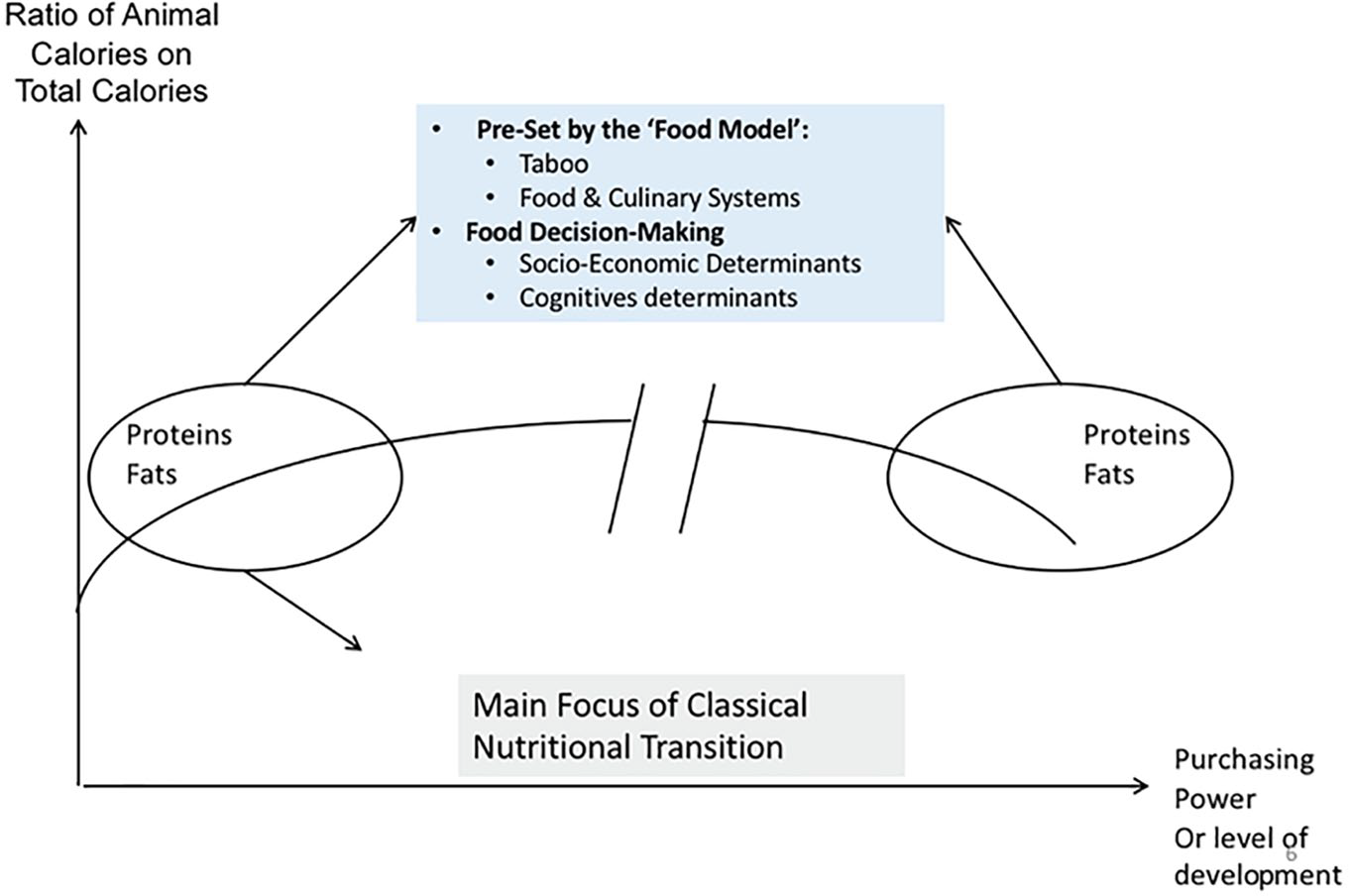
Protein transition.
Protein transition corresponds to the replacement of plant proteins by animal proteins and vice versa. Whereas in early versions of nutritional transition it was considered a one-way movement from plant to animal, it is now posited as a reversible process (Drewnowski & Poulain, 2019). Early reflections on protein transition emerged, without being designated as such, as a subset of the nutrition transition approach. They are now developing as a result of the articulation and convergence of three complementary theoretical frameworks:
- Nutritional transition (Drewnowski & Popkin, 1997; Périssé et al., 1969).
- Anthropology of food, which tackles the management of animal death for food purposes (killing for food) (Fourat & Lepiller, 2017; Harris, 1966).
- Connection between sustainability and food choices (Aiking et al., 2003; Hambræus, 2011; Hinrichs, 2014; Spaargaren et al., 2013).
Protein transition goes through several stages. The first has been described in the literature based on macro-economic and nutritional data. It consists of a transfer from plant products to animal products; this concerns both fats and proteins. The observation of consumption in developed countries shows a second phase of stabilisation of consumption at the national level. This phase can last quite a long time and masks two main types of transfers. The first between categories of products, for example from beef to poultry or to dairy products or from fish to meat, and the second type of transfer involves contradictory movements within the same society; for example, groups at the top of society for which the consumption of animal products is declining, while at the same time certain groups at the bottom of the social scale are increasing theirs, thanks to better access to certain categories of meat. Finally, there are clear signs that a third phase could occur with a decline in the share of animal products. This point is the subject of debate and even controversy, with some authors suggesting a ‘second transition’ in protein, while others, based on projected consumption data, predict a further increase (de Boer & Aiking, 2018).
The interest in studying protein transition is therefore twofold. On the one hand, it makes it possible to identify the risks of amino acid deficiencies and, on the other hand, it makes it possible to consider the environmental consequences of certain consumptions. Ultimately, it is the question of hunger across the world and the capacity of the earth to feed humanity.
The theoretical traditions behind the theories of transition
Transition theories, which are sometimes seen as simple variations, are truly different in terms of epistemology. Table 2 presents an overview of the theoretical traditions underlying these transition models.
Theoretical background to the transition models.

A distinction can be made between those that highlight the switch between two stages (Demographic transition and Food transition), the ones that focus on describing change as a succession of stages (Epidemiological transition and Nutrition transition 2) and the others that describe a linear evolution (Nutrition transition 1). Some use international comparison and see societies as a whole (Demographic transition and Nutrition transition 1), others include national variations to take into account differences in social categories (Epidemiological transition, Food transition and Protein transition).
The model of demographic transition treats changes as the passage between two stable states: from A to B. It looks at the dynamics of two variables during the transition phase, and the effect of the time lag on the population. This model attempts to understand the interaction between socio-cultural and biological determinants that influence birth and death rates. In doing so, it helps identify levers for action. This perspective is, more or less explicitly, an extension of the ‘cutural lag’ theory, developed by William Ogburn. It attempts to account for the lag in the adaptation of cultural systems when a society is confronted with technological innovations and the social problems caused by this lag (Ogburn, 1922). Anchored in a positive and somewhat naïve reading of technological progress in its early formulations, it was later refined, distinguishing between material and immaterial culture. Material culture corresponds to objects and artefacts created by humans in a given historical, social and cultural context and which by their uses, but also their form and aesthetics, participate in the social life and expression of that culture. They are therefore more or less complex material things which have a physical dimension, and which can be the object of a sensory experience. Technology is therefore not totally disconnected from the cultural system – it is even part of it, but it has a physical dimension. Intangible culture refers to abstract, non-physical entities such as ideas, values, beliefs, social norms or routines that make up the cultural system. It is articulated through ideological and religious systems. This non-material culture evolves and transforms, but at a slower pace than material culture, hence the notion of ‘displacement’ (Brinkman & Brinkman, 1997; Ogburn, 1957). In the demographic transition model, the explication of the time lag is sought in value systems and the functions that high birth or low birth rates can play respectively in a traditional or in modern society.
In order to better describe the transition itself, it has sometimes been presented in two phases (phase 1: the increase of the gap between mortality rates and birth rates; and phase 2: the reduction of the gap), with the purpose of creating a magnifying glass effect. But this led to shifting concern towards a new framework: stage theory.
The model of the epidemiological transition is part of this logic of division into phases. At each stage, new variables were introduced. Then new stages were added to follow the transformations linked to modernisation. The new model kept the demographic descriptors and added some epidemiological ones, mainly qualitative (causes of death). As it became more complex, the mathematical formulation disappeared, but the descriptive power of the theory was increased.
Stage theories are based on the idea that it is possible to identify several more or less stable stages in a process of change, which can be described according to their own characteristics. There are several famous examples in the history of the social sciences and humanities. Comte’s theory of the three states of knowledge or Duvall’s ‘life cycle’ are two of them. In psychology, the stage model has been successful to the point of becoming a common background for the variant theories of child development: the ‘intellectual’ one with Jean Piaget, the ‘affective’ one in Freudian psychoanalysis and ‘socialisation’ with Henri Wallon. In public health, this interpretation enjoys a certain prestige in the field of addictive behaviours (Prochaska et al., 1992).
From the perspective of global health this new version of the model allows for a typology of societies, from the less developed to the modern ones and the introduction of a stronger sociological perspective through analysing the characteristics of the cycle (life expectancy and causes of mortality) at different social strata for the same society. If we are still within the frame of an evolutionist perspective, the conception of change is nevertheless different.
The nutritional transition approach has undergone two developments. In the 1999 version it presents a linear covariation between socio-economic factors and structural changes in food intakes. Here there is no time lag. The variability is attributed to GDP and urbanisation. It is an evolutionary model, which in this first formulation attempts to identify simple laws behind the development of obesity. The second theoretical vein favours instead the analysis of the process of change itself and its characteristics. It focuses on the structural transformations of epidemic phenomena (share of the population concerned, prevalence, mortality rate, life expectancy) and on the structural transformations of the diet (relative shares of macro-nutrients and distribution by subpopulations). Although both veins think about changes in a more or less evolutionary way, behind the common use of the concept of ‘transition’, the theoretical backgrounds are not the same. They both fall within the context of an obesity ‘epidemic’ and focus on the supposed causes of its development. The nutritional transition approach has become an essential element in the world of epidemiology, where it has guided reflection on the development of obesity and non-communicable diseases. More broadly, it has contributed to an evolution of the problem of hunger across the world.
The notion of ‘food transition’ first emerged as a critical reaction to demographic transition theory. It questioned the food components supposed to initiate the transition process. It showed the blind spots of the model and its incapacity to take into account the variability of national situations and social hierarchies. In the beginning, it was not an alternative or competing model, but simply a way of designating the food part of the demographic transition. Several historians have shown that the model was hardly compatible with most empirical data on the diet of the nineteenth century, especially in Europe. Some agro-economists have also extended the model and identified no fewer than five transitions.
The nutrition transition approach must be also restated in the context of the ‘protein plan’. For the three decades following the Second World War, it promoted the idea that protein deficiency was one of the most serious worldwide nutritional issues. At the same time, the superiority of animal proteins was asserted despite some controversies between supporters of plant and animal proteins. So, improving protein share in the diet was a priority for UN agencies (Waterlow & Payne, 1975). The realisation was that if the share of food of animal origin (fats and proteins) increased with development and if this consumption pattern became widespread, humanity would not be able to feed itself indefinitely. Undoubtedly, because of their simplified dimensions, these analyses have resulted in resuscitating the nagging question of world hunger and the relationship between population and food resources.
One of the reasons for the success of the transition framework is undoubtedly the multifocal length that it allows. Although they have the label of transition in common, these different ‘theories’ do not view change in the same way. This is a confusing factor. By bringing to light the explanatory diagrams on which they are based, this article contributes to the clarification. Two main patterns emerge: change seen as the passage from one state to another, with time lags in the transition phase, and change seen as a succession of more or less stable stages. Under the influence of the diffusion of sustainability theory, some authors have more or less explicitly tried to match nutrition transition and food transition (Biesalski et al., 2017; Martin-Prével & Maire, 2018; Poulain et al., 2015; Strigler, 2019). The empirical field of diet, especially protein, introduced the idea of the reversibility of change (Drewnowski & Poulain, 2019). Concerning the second model, sociological studies have already shown an interest in looking at the pivotal phases, in particular the role of food policies (Winson & Choi, 2017). These are steps towards an articulation of the two theoretical forms. But to advance towards synthesis, it is necessary to deconstruct the evolutionary ideological presuppositions which pose the ‘changes’ described as more or less ‘inevitable’ – presuppositions that serve as a justification for public health actions often thought out in a ‘liberal’ vision of the ‘sense of history’ that macro readings tend to impose. To get out of it, it is also necessary to strengthen the link with the empirical world to take into account economic, social and cultural contexts at ‘sociologisable’ scales. That is to say at the infra-national level where we can see the social dynamics. So, we will stop being surprised that certain regions or certain populations do not follow the predictions of the model. . . and we will be able to develop the transition model(s) to take the variety of empirical situations into account.
Footnotes
Funding
The author declared receipt of the following financial support for the research, authorship, and/or publication of this article: This research was supported by the International Associated Laboratory LIA-CNRS: “Food, Cultures and Health” (CNRS = French National Centre for Scientific Research).