



Abstract
Embracing the manifesto for a ‘live’ sociology, I included portraiture into the research design of an ethnographic study into women’s lived experiences of French suburbia and organised an exhibition entitled Habitantes d’Hier and d’Aujourd’hui: exposition sociologique et photographique. This was a personal project in the neighbourhood of my youth and was motivated by the intention to shine some light on the invisible stories of women living in lower-middle and middle-income suburbs in France. In this article, I reflect on the use of portraiture for the possibility it offers in capturing the ethnographic encounter as well as in giving saliency and offering a visual representation of the sociological analysis. I also discuss the exhibition of these portraits as a moment of conviviality grounded in the endeavour of writing differently from hegemonic modes of academic communication and dissemination allowing for a sharing and sharpening of the sociological imagination. It represents an opportunity to think beyond some of the more neoliberal imperatives that govern academia today and shape our sociological craft. I argue for the value of creating a moment of conviviality, that is a space challenging modes of dissemination, engagement and even impact to some extent, as well as modes of knowledge production: broadly opening up more possibilities for a truly public sociology to continue to exist.
Introduction
Embracing the manifesto for a ‘live’ sociology (Back & Puwar, 2012), I decided to include portraiture into the research design of an ethnographic study into women’s lived experiences of French suburbia and organised an exhibition entitled Habitantes d’Hier et d’Aujourd’hui: exposition sociologique et photographique 1 (Women Residents of Today and Yesteryears: a sociological and photographic exhibition). This was a personal project in the neighbourhood of my youth in Blagnac, a suburban town of Toulouse (South West France). Growing up, my main goal was to escape the boredom that characterised life in a French residential suburb: at first in the more exciting life of the city centre of Toulouse and later by moving to England where I had always sustained the ‘exotic’ fantasy that this is where I would find existential purpose. I have however always maintained a persisting attachment to, and curiosity for the neighbourhood where my mother had chosen to raise my brother and I, following the death of our father. Equipped with some feminist acumens garnered along my academic journey in the UK, this home coming was not only to be an introspective journey into my own suburban background. It also was an exploration of the generally invisible experiences and stories of women making a home in France’s lower-middle and middle-income suburbs where a large proportion of the population live (Cartier et al., 2008; Dodier, 2012; Vieillard-Baron, 2011).
With an emphasis on the suburbs of the cités (suburban high-rise estates of social housing), residential suburbs of private housing stocks (banlieues pavillonaires) in France, have not been at the forefront of academic research and have generally received little political and media attention. The ‘Gilets Jaunes’ more recently have conferred some visibility to the periphery notably through their occupation of the many roundabouts present in peri-urban landscapes. However, the demographic make-up of ‘la France des ronds points’ as ‘low earners’ (Fernbach, 2018) is again different from the middle-income participants in my study. The term periphery represents a multifaceted geography of class and, in relation to the ‘Gilets Jaunes’, is be understood as covering small cities and territories situated at some distance from larger and more prosperous metropolises such as the one my neighbourhood is part of (Guilluy, 2014). This piece of ethnographic fieldwork explored the everyday lived experiences and meanings of home and home-making for women in middle-income suburbs. The research questions also considered the lifecycle dimension of the suburban experience.
To hear the stories of the women that I already knew, wanted to know better, or get to know, I conducted, during the summer of 2014, participant observation recorded via a diary, and semi-structured in-depth interviews with an intergenerational group of 16 women aged between 45 and 93. The biographical approach to the interviews provided a rich account of different trajectories that had led to suburbanisation as well as the strategic reasons to remain in the suburbs. Although this was a small piece of ethnographic research, the diversity of voices recorded and analysed offered a heterogeneous and complex picture of the experiences of women in French suburbia that disrupted some of its misconceptions. The narratives and practices of suburban home-making and living were particularly revealing of the complexity of maintaining a form of ontological security for the women’s families negotiating the imperatives of family life, their working lives and in later years the exigencies of growing old with as much autonomy as possible. These complex stories offered in turn a trope into the difference between the practice and the ideology of suburban living (Raymond et al., 2001) and its generalised pre- and misconceptions.
The project also employed portraiture using digital photography with the aim to organise a portrait exhibition as an original way of communicating and disseminating sociological research. The intention of showing the work at an exhibition was presented as key to the aims of the research and I asked each participant if I could take their portrait as part of the interview. They were however all informed that this was in no way mandatory and although the majority embraced the initiative, three participants declined for their portraits to be taken for a range of reasons that were never challenged. Portraiture was envisaged as a medium that would have the potential to showcase lived experiences marginalised by their preconceived banality, especially as they were to be accompanied by a sociologically grounded commentary presented alongside the portraits. Large display boards were put up around the exhibition presenting the aims and objectives, the methodology and the emerging themes of this ethnographic piece of research. In combination with the portraits, they offered a medium that was accessible to the wider public and most importantly was communicated back to the women who took part in the study. The exhibition Habitantes d’Hier et d’Aujourd’hui: exposition sociologique et photographique can be described as a moment of ‘creative public engagements’ (Puwar & Sharma, 2012, p. 41, italics in the original) and of ‘sociological sociability’ (Back, 2012, p. 28). Amidst ongoing discussions of sociology’s existential introspection (Levine, 1995) and at times crisis (Burawoy, 2005; Osborne et al., 2008; Savage & Burrows, 2007, 2009), some voices have emerged arguing for a ‘live’ (Back & Puwar, 2012) and more lively (Burton, 2016) form of sociology that will not be shaped and repressed by impact agendas and an increasingly oppressive audit culture (see also Gill & Pratt, 2008; Sparkes, 2007). The idea of a ‘live sociology’ has been getting some traction and a number of academics have embraced its manifesto by adopting a range of multi-media, multi-modal and multi-sensorial methods of data collection as well as by communicating their work through different outlets (Back & Puwar, 2012; Jungnickel, 2020).
The article is aimed as a contribution to a discussion on ‘live sociology’ and does so by reflecting on the experience of using portraiture as an artful form of representation and part of the process of writing sociology. I also examine the process of continuing to write and communicate sociology in a moment of conviviality at the stage of data dissemination. Analysing the endeavour of bringing people together at an exhibition, I highlight the possibility of a sociological imagination that is communicated and shared more widely, but also able to be sharpened as a result of an expansion of the field of communication of the ethnographic practice in a space of dialogue and reciprocity. In an academic context, the idea of conviviality has been central to a body of work concerned with everyday expressions and urban encounters of cultural diversity and ethnic pluralism (Gilroy, 2004; Karner & Parker, 2011; Wise & Velayutham, 2014). In this project, conviviality was not a phenomenon to be studied but an endeavour to partake in and therefore to craft into the research design. Conviviality is furthermore grounded in the feminist endeavour of writing outside of the academic canons of an audit culture (Burton, 2018). It represents an opportunity to think beyond some of the more neoliberal imperatives that govern academia today and shape our sociological craft. I argue for the value of creating a moment of conviviality, that is a space challenging modes of dissemination, engagement and even to some extent impact as well as modes of knowledge production in the feminist tradition (Pereira, 2012), and thus opening up more possibilities for a truly public sociology to continue to exist.
Portraiture and the ethnographic encounter: Alternative ways of writing sociology
The design of this project is situated within a growing and emergent body of work that has explored curatorial practices as part of their dissemination outputs (Neyts, 2015; Tolia-Kelly & Nesbitt, 2009/10; The Mystreet Project at UCL; 1 The Beacons for Public Engagement 2 ) and notably portraiture (Back, 2007). It has also been inspired by artistic focus on the home and domesticity from a feminist perspective (Women House, 2018). Recognising the value of an artful approach, I adopted portraiture as another way to write the field. It is therefore important to first reflect on the issue of representation in ethnography more broadly as well as in portraiture more particularly.
The ‘crisis of representation’ in ethnography (Clifford & Marcus, 1986) has led to a questioning of the relationship between observer and observed and has contributed, through critical reflection, to a re-evaluation of, and experimentations with, textual conventions. In this, and in its many guises, the writing of ethnography is considered an integral constitutive part of the production of knowledge. Atkinson argues that: ‘The ethnographic enterprise is not complete until it has been transformed into representations of the social world’ (2015, p. 153). Ethnography has embraced a range of writing forms which in some cases have worked in dialogue with other genres, i.e. ethnodrama (Mienczakowski, 2001) and performance art (O’Neill et al., 2002), ethnopoetics (Hymes, 1981) as well as ‘graphic ethnography’ (Theodossopoulos, 2016). In this hotchpotch, visual research methods and modes of representation remain the area that has expanded the most, constantly pushing the envelope of its epistemological and methodological precepts. Working visually contributes to giving vitality to the representation of everyday life in a way words alone cannot achieve as ‘seeing with visual methods imposes the situated-ness, the embeddedness of social life’ (Halford & Knowles, 2005).
Using portraiture for this project, I also question the representation contained within the singular orthodoxy of this photographic genre and acknowledge its role in capturing the ethnographic encounter as well as in portraying women in the social context of the suburban home that was the subject of the research. The realist potential of portrait photography enshrined in a technological promise of likeness has been the preoccupation of many theorists of photography such as Bazin, Barthes or Krauss (see Kriebel, 2007, pp. 17–28). Despite accepted recognition of the unrealistic potential of portraiture as realistic, there is a persistent attraction for photographic portraiture to be seen as a revelation of the ‘true’ character of an individual (Sutton, 2010). The question of identity more broadly remains closely linked to the reading and interpretation of portraits (Pointon, 2013). As a genre, modern photographic portraiture in its different forms should however be dismissed for its perceived ability to display ‘physiognomic likeness’ (Woodall, 1997, p.1) or to grasp the intimate reality of the self with authenticity and objectivity (Maresca, 1998, 2011).
In a project using street portrait photography, Back and his colleagues aimed to ‘open up a space of exchange and engender a reciprocity between research subject and observers’ (Back, 2007, p. 98). Back argues that the ‘lens is not always about the control and fixing of subjects (p. 104) and ‘[t]o see the photography as merely a governing technology misses the instability and complexity of the drama that unfolds on either side of the lens’ (p. 104). Similarly, Maresca (1998, 2011) understands the performance relative to ideas of identity as ongoing performances of the self. Drawing on Goffman’s theatrical metaphor, Maresca (1998, 2011) points out that portraits must be recognised for their mise-en-scene (staging) where the subject is active, one in agreeing to be photographed, two in being able to perform in front of the lens. For Back, this agency notably exists in the discreet act of ‘speaking into the lens’ (Back, 2007, p. 100).
Instead of being conceived as realistic expressions of the participants’ identities, the portraits, taken during the ethnographic fieldwork, are envisaged as the representation of an ethnographic exchange (Back, 2007) and performance (Maresca, 1998, 2011) capturing a sense of ethnographic emplacement while translating the triangular relationship present in portraiture (photographer, photographed and audience). Thinking further about the relationship between photographer, photographed and eventually audience, portraits, in this study, are therefore seen as a representation of the ethnographic encounter where participants are not simply seen as ‘voiceless objects’ (Atkinson & Coffey, 1995, p. 48, italics in the original). The staging was not prescriptive, and participants had the choice to decide how and where the portraits would be taken as long as it was within or outside their home in order to reflect the research questions regarding suburban home-making. Around half of the portraits were taken on doorsteps or front yards (e.g. Figures 1 and 2) and could, as such, be considered to be reminiscent of the American documentary photography tradition of ‘the doorstep portrait’. This tradition can be criticised for its apparently normative set up and therefore relationality between photographer, subject and audience (Aubert, 2009). In the context of the research, the portraits, if they were indeed to some extent metonymic (Aubert, 2009), also symbolically translated the research objectives of acquiring access and insight beyond the facades of suburban homes while leaving it to the participant to decide how much they were prepared to reveal in this non-verbal exchange: The threshold, the porch, the front yards, are areas in which people can actually compose and manage their public presentation of privacy. (Aubert, 2009, p. 12, italics in the original).

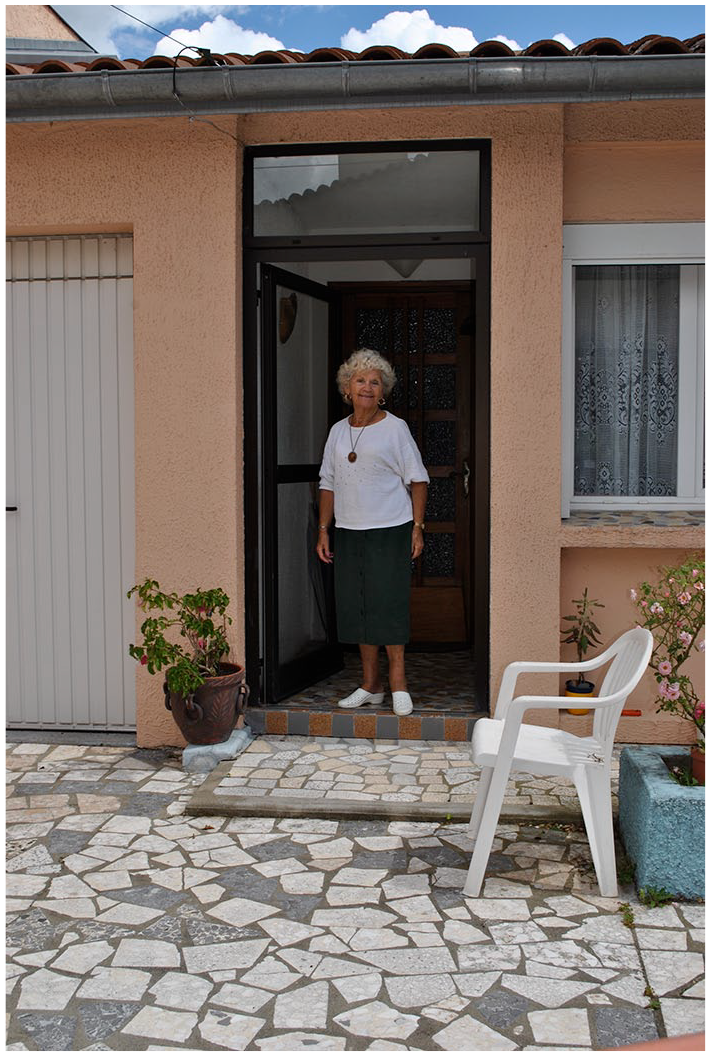
Interestingly, the doorstep portraits were in general with participants I had more recently met for the purpose of the study. Pre-existing relationships with other participants meant that more photographs were taken and sometimes in different locations of the house (inside or outside in the garden where a lot of home life also takes place in the summer; e.g. Figures 3 and 4). In all cases, it must be mentioned that the success of this kind of approach is dependent on the ability of the researcher to never force the matter and to take the time to get to know the participants and for the participants to start sharing the enthusiasm for the project, in some instances with one another as a collective endeavour. I dedicated time that went beyond the three principal months of ethnographic fieldwork coming back and visiting the participants regularly.


This also meant that the conviviality that I am expanding upon in the following section at the stage of data dissemination at an exhibition was preluded during the fieldwork before, during and after the interview took place.
Greater familiarity implied that we were both more comfortable with the visual and sometimes playful performance of taking a portrait. In the cases where different portraits were taken, I consulted with the participants to choose the one to be exhibited. This was the case with Madame L.
Madame L recognised that most of her life was spent outside the house, but at 90 she enjoyed the comfort of her own home and, despite some health issues, refused to live anywhere else. She and her husband with her sister-in-law and brother-in-law spent most of their working lives travelling across the region from market to market as fishmongers. As a result, she had very little time and interest in home decoration. Her attachment to her home was strongly linked to the memories she had of her husband and her family. In this respect, she was particularly proud of the purpose-built washtub (lavoir) that came handy for the amount of washing she had to do while working as a fishmonger. The washtub stood as a material and biographical signifier of Madame L’s busy life as a market fishmonger. When we had a discussion about which photograph should be included in the exhibition, we agreed that the washtub was signifying of her life story while being symbolic of our existing relationship (Figure 5). My friendship with Madame L and her now deceased husband started many years ago and notably because I used to like to come and use the washtub for large items of clothing. Furthermore, this portrait as the others, also constituted a visual representation of an ethnographic moment that was to be exhibited in order to support the communication of the sociological knowledge that was born out of the ethnographic encounter in all its intersubjectivity.

In the next section, I develop the idea that these portraits were not simply intended as a mode of representation and communication with the potential to give saliency to the women’s stories. The portraits organised as an exhibition also contributed as a social event to a ‘live’ and public sociology. I expand on Back and Puwar’s (2012) call for a live sociology by beginning to include the idea of conviviality in the way we aim to disseminate, communicate and discuss research beyond academia. The intention is however not to be prescriptive and the approach is not suited to all research contexts and research questions.
A live and convivial sociology: Writing and exhibiting sociology as a social event
The exhibition took place from 19 December 2015 till 7 January 2016 at the Espace Germaine Chaumel, a municipal exhibition space situated on the market square of the town where the research took place. The launch gathered most of the women who took part in the study, their families and other members of the public who came because they had seen the exhibition advertised in the local or regional press or seen the posters in the local shops or because they were passing by as the art space was situated on the market square and the opening took place on a Saturday, market day. The Espace Germaine Chaumel is managed by the municipality and offers free exhibitions mostly by local artists. It is also a space where art classes are organised for members of the community. As a space the participants were familiar with, it presented itself to be the perfect setting to showcase their stories via the display of their portraits. It is accessible and inclusive but still carries a sufficient amount of cultural value that was considered to strengthen the significance of the portrait exhibition without being exclusive. The portraits and their exhibition were conceived as an alternative way of writing sociology in aiming to ‘write it right’ (Back, 2007, p. 4) and offered the possibility of expanding the field of communication of ethnographic practice and the promise of a more public sociology.
Writing sociology differently: Expanding the sociological craft
In my project, I photographed, curated and set up the exhibition of the portraits. I considered all these aspects integral to the process of doing and writing ethnography, and part of the sociological craft of refining and acquiring ‘new strategies for telling society and for affecting and persuading audiences’ (Puwar & Sharma cited by Back & Puwar, 2012, p. 10). Despite my enthusiasm for an artful approach, I became, as the project developed, increasingly aware of the interdisciplinary challenges that working with photography and portraiture in particular entailed. These challenges were identified as practical, epistemological and methodological as well as ethical. I cannot expand in sufficient depths in this article on these interdisciplinary challenges. However, the craft of ethnographic writing must always be honed and in choosing photography as a medium, I realised that it was essential to master some key technical and technological tools. Paying attention to the aesthetics was to do justice to the stories that were told through these portraits. Tolia-Kelly (2007) also points out that it is essential to take this aspect of the craft seriously as it validates its intention to the public it is aimed at. At the stage of editing, I enlisted the support and expertise of the digital dark room technical staff in the School of Art and Design at Middlesex University. They helped organise and edit the portraits.
I also felt the necessity to enrol on an MA in Photography at that time. It was essential to improve my technical skills but also my understanding of photography as a discipline with its own epistemological and methodological particularities. Puwar and Sharma argue for a ‘live sociology’ built from ‘curating sociology’ and developed around ‘cross-disciplinary collaborations that engage in creative knowledge practices’ (2012, p. 41). This approach has its merits in guaranteeing the quality of the work communicated, but in my case I argue for the possibility to explore different ways of writing through training and developing skills. It is however not just about skills and knowledge acquisition in another mode of representation. Working with photography has also meant that I could explore further the idea of a sociological imagination creating new images and new forms of representation while keeping to the sociological concerns of linking individual biographies to structures. As an ethnographer and a feminist, I see that my role is to be attentive, to listen to the social world and to think about the best and most appropriate way to do so (Back, 2007).
From the art of listening to the art of telling, Smart invites us to be ‘story-tellers as well as sociologists’ (2010, p. 5) and to think of a way of writing qualitative research ‘that captures the imagination of, and engages, the reader’ (Smart, 2014, p. 14). In light of Smart’s invitation and adopting Gordon’s idea that research can ‘haunt’ (2008), Wilson considers ‘how longer, text-based publications, but more specifically small-scale visual representations of research, can ‘haunt’, in part by communicating absence and highlighting complex personhood’ (2018, p. 1210). In this regard, Wilson makes a particularly essential point regarding the ethics of working with visual data and suggests that an ‘“ethics of recognition’, rather than one of concealment, may be appropriate’ (2018, p. 1220). Similarly, Sinha and Back have ‘[opposed] the “ethical hypochondria” characterising qualitative research culture, where “automatic anonymity” is limiting the potential of research to travel, connect people and engage the public imagination’ (2014, p. 473). Ethically, we have to manage this recognition in dialogue with the participants. In my case, the portrait exhibition was built into the design of the project as one of its aims, but images in a research project may ‘serve a range of different personal and ethnographic uses’ and travel through different outlets (Pink, 2013, p. 74). As such the pictures from the exhibition have been used at academic conferences as well as in this academic paper. These uses had been anticipated at the stage of informed consent but not the way they each time took different meanings in dialogue with the audience they were presented to. The framed photographs were also handed to the participants as gifts.
Exhibiting a live and convivial sociology
In order for the exhibition to go ahead at the Espace Germaine Chaumel, I put a proposal forward to the mayor and the elected representatives of cultural affairs of the town. They expressed an immediate interest in the project as they had been keen for a long time to engage with the residents of the area who were considered hard to reach. The project was supported without intervention and exigencies. I was able to remain independent keeping in mind a feminist ethic of care that instead ‘gives rise to multiple academic and non-academic outcomes that “resist auditability”’ (Evans, 2016, p. 214). To some extent the project played a role in re-establishing a link between some of the residents and the municipal authorities but this was never an intended outcome and cannot and will not be demonstrated as impact.
The exhibition ran for three weeks and I tended the welcome desk during most of that period. This gave me the opportunity to continue engaging with members of the public and their reactions to the work. The exhibition created a space for dialogue and exchanges that offered another dimension to the process of dissemination in line with the ethos and ethical principles that had motivated the research design in the first place. These moments of exchange and discussions took place on different occasions.
On opening day, the meaning of such an endeavour took its full dimension as the participants walked around the exhibition space, exchanging warm conversations about their and each other’s portraits as well as the sociological commentary (Figure 6). The months of preparation and organisation were worth this moment of togetherness and dialogue between researcher and participants but also between participants as well as between participants and members of the public. On the subject of communicating ethnography differently the work of Willim, which he defines as ‘art probing’, is informative of the way in which an artful approach to ethnography as ‘more-than-academic practice’ can conjure up thoughts and discussions (Willim, 2017). As we shared some finger food and a glass of wine, the participants expressed a sense of pride and saluted the event for shining some light on their life experiences and the diversity of their life trajectories.

Residential suburbs indeed tend to be affected by a kind of snobbery towards their perceived petit-bourgeois aspirations (Raymond et al., 2001, p. 15) when as evidenced in the narratives of my participants the reasons for moving in were more nuanced. And even though, they had arrived in the neighbourhood at different stages in their life cycles, moving into the area was never expressed as an aspiration but more as a necessity. They insisted during the interviews and again at the exhibition on the importance and the opportunity to become homeowners in a housing market that has over the years remained difficult to navigate. Testimony to the scarcity of housing on a national scale in the 1960s, for the older participants who bought the houses off-plan, there were, at the time, few opportunities in Toulouse to become homeowners. The housing crisis in the 1960s in France is notorious and notably resulted in state-led large-scale developments of high-rise blocks of flats on the periphery of medium sized and large cities. The history of the neighbourhood is instead rooted in a parallel history of urban expansion of private housing development (Raymond et al., 2001, pp. 31–53).
With an emphasis on the accessibility to homeownership of private individual housing, its construction was organised around a cooperative scheme allowing people on low-middle and middle-income to become homeowners in instalments over a few years. Many of the older participants worked as civil servants, key workers for the health care or education systems, or owned a small business. The more recent residents, who mostly worked in managerial and professional occupations, settled in a period when the housing market in Toulouse was saturated and house prices boomed. As a result of the expansion of Airbus 3 (the main employer in the area), the demand for housing had grown exponentially and they were left with fewer choices. In their narratives however, they too expressed the importance of becoming a homeowner and in particular of owning a house. The house was not necessarily seen as a dream house but it offered them the opportunity to live and work in an area that would not otherwise be affordable. Through various practices of home-making they were nonetheless able to individualise their homes to their own tastes and needs as families.
Overall, the area was also described as safe and secure in the interviews and the participants thought that it was important that this had been raised at the exhibition. While conveniently situated in close proximity to the city, it had a number of parks and recreational areas. It also offered its residents a range of retail, community and cultural amenities as well as highly rated services for childcare and care for the elderly. Their roles as mothers, wives or grandmothers and the imperatives of family life were understood in relation to, in time and space, the strategic maintenance of an ontological security (Saunders, 1990) that is to be understood beyond the tenure of the house, and considered as context specific and processual through home-making (Dupuis & Thorns, 1998). Looking at the psychosocial benefits of home, Hiscock et al. (2001, p. 62) argued that other factors such as ‘having wealth, living in a nice area, living in a larger and better quality of dwelling and being settled in relationships and work’ matter as much as the tenure of the house. The narratives and practices of mothering in this study were revealing of the ways in which everyday agentic strategies of home-making in the suburbs were organised within the structural constraints of housing, employment, health and education provisions alongside the everyday imperatives of caring for a family.
The exhibition was a key moment in further discussing this relational aspect between agency and structures and forced me to expand the sociological imagination to consider how important it was for them to portray their working identities alongside other identities in home-making practices and thus to be recognised, across generations, for their roles as nurses and health workers, school teachers, scientists, engineers, trade unionists, market traders alongside their roles as mothers, grandmothers, wives. . . I believe that compared to other means of dissemination the exhibition especially on the day of the launch was conducive to dialogues that confronted my analysis notably regarding the importance to insist on the multiplicity of these roles and how they mattered in home-making in suburbia. The summary analysis offered in the paragraphs above is a sharpened version of what was presented at the exhibitions on the display boards thanks to what we discussed together in a sociable but also convivial atmosphere.
I argue that the interactions we had during the exhibition and afterwards were possible through conviviality which I have defined with a cultural inflection in line with the French definition: ‘1. The capacity of a society to encourage tolerance and reciprocal exchanges between people or groups of people that constitute that society. 2. The taste for joyful gatherings, meals taken together’ (translated from the French, Le Petit Larousse, 2002). On a small scale, the exhibition and its launch operated both aspects of the definition of conviviality, which can also be envisaged for its conceptual potential in the way we approach our sociological craft.
Deegan (1989, p.87) put forward a short but poignant argument in its favour: Sociology is mired in a world of professionalism, discipline boundaries, expertise, bureaucratization, capitalism, sexism, and racism that is quite overwhelming. It is often difficult to believe during my daily practice of sociological labor that this is the work that I found initially liberating, challenging to everyday life, and ‘convivial’ (Illich, 1973). Humanist sociologists are committed to this initial promise of social freedom and praxis as a voice of and for the community, but as we all know, we are a minority voice in the wilderness of positivist technique and technology (Habermas, 1970).
She argued for a sustained conversation across the different rungs of the academic hierarchy and for the recognition of sociological works, past and present, that have informed the discipline. For her this conversation had the potential to effectively address questions of oppression and repression by refusing to accept a ‘hegemonic elite’ through collegiality (Deegan, 1989, p. 87). It is difficult not to see the persisting pertinence of this argument as sociology ought to continue to exist in a critical dialogue with itself, especially in the face of changes taking place in the institutions we work at and practise our sociologies through teaching and research. We should not however forget the importance of its public role and should not lose sight of a public sociology that ‘strikes up a dialogic relation between sociologist and public’ (Burawoy, 2005, p. 9). I build on the promises advanced by Deegan by considering the possibility to extend the idea of an academic conversation or dialogue outside of academia by inviting social scientists to create or to continue to create spaces and moments of conviviality in the research process.
Distilling the essence of the work of Illich on the notion of conviviality for the purpose of this argument, conviviality can be valued for carving out spaces of togetherness and dialogues against the isolationist and individualising imperatives of a neoliberal academia. For Illich, conviviality was a way to re-envisage our relationships to the tools of productivity and to value interdependence rather than dependence with regard to these tools. He argued that conviviality was ‘to designate the opposite of industrial productivity’ and ‘to mean autonomous and creative intercourse among persons, and the intercourse of persons with their environment’ (1973, p. 11). He notably warned against the isolation incurred by the disastrous effects of industrialisation and mass production, including in education. In our case, conviviality conveys the idea of embracing collectivity and connectivity in opposition to the individualising effects of a neoliberal university that thrives on competition and metrics of measurement of our academic worth. Groups of academics have found ways to carve out spaces of resistance and at times to reclaim the space through different projects and endeavours that facilitate collaboration and collectivity (see Res-Sisters; 4 and examples of collective biographies, e.g. Davies & Gannon, 2006; Kern et al., 2014). These inspirational collaborative works and collective practices are particularly vibrant in feminist circles (Taylor & Lahad, 2018) where living together, writing together, creating together are valued. What has been applied as tools of conviviality in academia can also be envisaged in our interaction with the public and notably the participants to our research: researching and disseminating with, rather than about, in an effort to write outside of the canons of academia as well as responding to it at other times, maintaining some form of independence and freedom as resistance to the imposed hegemony of knowledge dissemination and production but also impact.
This approach can expand our conceptualisation of impact, which we can reclaim within the ethical boundaries that govern our work (Evans, 2016) and the broader framework of our sociological imagination, even though it is not easy to evidence the impact of conviviality against the parameters of the impact agenda in the British neoliberal academia. The exhibition created the potential to share, express and experience emotions with one another. Based on existing or developing relationships as a result of the ethnographic fieldwork, it became a safe space in the feminist ethos mentioned above where affect was recognised to play a role – to have an impact even if it was not directly or tangibly measurable. The gratitude expressed by the participants during and after the exhibition surpassed my expectations. In conversations or in written messages to me afterwards, the participants shared positive feelings regarding the exhibition and the fact that their stories mattered in being anchored in the social history of the place as well as in showcasing stories that demonstrated agency outside the confines of domesticity. This was something that also mattered to some of the visitors, who commented on the importance of telling that story especially as they could see their trajectories mirrored in the ones presented at the exhibition. Their reactions to and comments on the exhibition and its content ultimately fed back into the sociological imagination and what I should stress in the analysis.
The exhibition also captured the neighbourhood at a transitional moment, gathering the stories of women who had been living in the housing estate since its construction as well as of women of the next generations who had settled more recently and in a different socio-economic and cultural context. Since the exhibition took place, the situation of some of the older residents has changed as they have had to move to a retirement house: a move they were always reluctant to make and had for many years been able to delay thanks in part to the municipality’s range of services of care within the home. Their stories in being exhibited were rendered the value of a socio-historical footprint in the making, an ‘epitaph to the living’ (Back, 2007, p. 106) that was communicated, shared and discussed further confronting the initial analysis of the data to the audience. These women suburbanites lived separately from one another. But, all of these portraits, assembled as an exhibition, told a story that was to be collectively read with a sociological imagination that is dismissive of a suburban ideology stereotypically conceived as the golden cage of a petit-bourgeois ideal of women’s domesticity in a French context (Lambert, 2015), and thus highlighted further the problematic tension between the practice and the ideology of what living in a suburban home meant (Raymond et al., 2001).
A convivial sociology presents an alternative to the imperatives of the audit culture that we are subjected to. Academia is evidently concerned with the issue of impact and public engagement and of its definition. In many ways, it forces us to be attentive to this essential aspect of our research but there can be a risk of falling into the trap of an instrumentalist approach where impact becomes an exercise in box ticking and can act as ‘a filter for our sociological attention’ (Back, 2015). In one of the most recent definitions of impact for the REF 2021, one can however read a number of key words that can encourage us to adopt a broader definition of impact in the way we do research and the way it should be validated. There is indeed an insistence on the idea that our work should reach ‘beyond academia’ (REF, 2018, p. 83) and the necessity to recognize the less tangible ‘effect on, change or benefit to: the activity, attitude, awareness, behaviour, capacity, opportunity, performance, policy, practice, process or understanding’ (p. 83).
More broadly, avoiding the white noise generated by the audit culture of the REF and other agendas that determine the direction taken by academia against neoliberal imperatives, a convivial sociology instead implies an intellectual as well as an affective response and dialogue that should define the formation of knowledge and its dissemination. In the conviviality of the moment, we can envisage a more engaged form of sociology where an affective, intellectual and ethical response continues to constitute the research process: ‘A sociology with and for the public, . . . one that is humble, collective, dialogic, inventive, artful and trans-disciplinary’ (Back, 2015). A public sociology, notably favoured by Bourdieu, that ‘requires the translation of professional sociology into an accessible language’ and ‘also requires an accountability achieved through dialogues’ (Burawoy & Von Holdt, 2012 p. 166).
Concluding remarks
The article reflected on a research project that was about ‘going back home’ and held at its core the intention to shine some light on and raise awareness of the seemingly banal experiences of suburbia from a gendered perspective. The voices of the women who participated and their life stories offered a unique insight into different modes of urban living, which interestingly also captured the interest of the local and regional press present at the event. The value of these portraits resided in the saliency they gave to the so-called mundanity of suburban everyday life as well as in being representations of the ethnographic encounter. Organised as an exhibition, they also offered the opportunity of a convivial social event with the aim to create engagement and togetherness. Adding to the discussion and the manifesto of a ‘live sociology’ set up by Back and Puwar (2012), this article indeed introduced the idea of a convivial sociology recognising that impact can be the less tangible and measurable aspects of the affective and as well as the intellectual and ethical response of the audience to the research in its different modes of representation (here qualitative in words and images). In being convivial, this kind of sociology is overall more public, offering a space shared by the participants as well as inviting others.
Sociology as a discipline should remain dialogical as its unifying force amidst empirical and theoretical differences. Since its inception as an academic discipline, sociology has been engaged in an introspective and existential ‘crisis’ defining itself in relation to epistemologies, methods of investigation and more generally the nature of its knowledge production in relation to the reality of the social world and its modes or representation (Wagner, 2009). Levine for instance identified the historical fragmentation of sociology as a discipline defined by dissensus for which he prescribed dialogue as an alternative narrative to the sociological tradition, ‘a way of imagining sociology that gives it a vibrant role: a preeminent host, by virtue of its classic tradition, of the social science dialogue’ (1995, p. 299). To sustain its existence and its place in the public debate it also needs to consider its role in relation to the dissemination of knowledge and public engagement. Conviviality is the possibility to continue claiming as sociologists and also as feminists a collective space of resistance to and freedom from the dictates of more hegemonic modes of engagement and communication and ultimately modes of knowledge production in a truly public sociology.
Footnotes
Funding
This research and its exhibition were supported by a Middlesex University Small Research Grant.