



Abstract
Local urban greenspaces connect issues close to everyday life, such as recreational value, attachment to place and civic engagements, with broader questions of city planning, economy, climate change and social class. Responding to recent warnings against reductionism in critical studies of cities’ new claims to sustainability, the article mobilizes the recent ‘moral turn’ in the Bourdieusian literature on classed politics to explore these interlacing layers and themes in the politics of the urban green and to relate them to broader sociological questions about morality and politics. Based on a national survey among urban dwellers in Denmark designed specifically for this purpose, the analysis reveals a space of local urban greenspaces issues in two dimensions contrasting, respectively, (a) concerns for nature versus economy and (b) preference for planning versus grassroots modes of governance. Further analysis reveals a homology with social class and with more abstract political attitudes on how to square environmental and economic sustainability. However, the space of issues also displays traits unique to local urban greenspaces, while different positions in the space correlate with different combinations of personal attachment and civic engagement. In mapping the politics of the urban green along these lines, the article suggests new analytical avenues for moral-political sociology more broadly.
Introduction: Class and the politics of the urban green
Since at least the late nineteenth century when the hygienic movement responded to public health calamities resulting from industrial mass-urbanization (Møller, 2010), greenspaces have played important – albeit changing – roles in Western cities. While often promoted as spaces for the formation and recreation of the democratic public in the postwar era (Angelo, 2019), the dominant imaginary of urban greenspaces today relates to nature and the environment – in particular to climate change (Béal, 2012; Wachsmuth & Angelo, 2018). Indeed, while accounting for more than 70% of global fossil fuel CO2 emissions, urban areas are often also vulnerable ‘hotspots’ of climate change impact (Intergovernmental Panel on Climate Change [IPCC], 2017, p. 26). Nonetheless, according to critical urban scholars, widespread discourses on cities’ potential sustainability often serve as a rhetorical smoke-screen for more complex and less affirmative political realities (Béal, 2012; Wachsmuth & Angelo, 2018). Specifically, the ‘greening’ of cities in various forms – new parks, urban agriculture, rooftop gardens, etc. – is often market-driven and targeting the middle class, potentially increasing marginalization of other groups via gentrification and other dynamics (Haase et al., 2017; see also Paton et al., 2017). For these reasons, urban greenspaces today deserve increased sociological attention – in particular with regard to the question of how environmental concerns enter into the classed politics of everyday life.
I respond to recent analytical developments in this field of research (e.g. Angelo, 2019; Franklin, 2017; Tzaninis et al., 2021), using an original empirical approach to address the wider theoretical stakes for a moral-political sociology sensitive to new questions of classed environmental concerns. I particularly address the tendency in the literature to focus on the hegemonic discourses of city planners (and, occasionally, on marginalized counter-discourses), arguing for an increased attention to the nodal character of urban greenspaces at the intersection of ‘large’ problems, such as climate change, public health, social justice, and ‘small’ concerns related to urbanites’ everyday lives. To this end, I mobilize what has been labelled the moral turn in the study of classed politics in the tradition that builds on Bourdieu’s work (Jarness et al., 2019; Sayer, 2005; Lamont, 1992). So far, this literature has played only a minor role in urban and environmental sociology, but its multidimensional approach to moral-political sociology contains the potential for overcoming what some (Angelo, 2019) criticize as insufficiently nuanced analytical tendencies within the field. Studies from the Nordic countries in particular have demonstrated the emergence of ‘nature’ and ‘environmentalism’ as clearly positioned in the classed political spaces of attitudes and concerns to national issues (Jarness et al., 2019; Schmitz et al., 2018) as well as in classed access to urban nature (Rosenlund, 2017). Nevertheless, while the multidimensional methodology practised in the classed-politics literature is well-suited for the study of intersecting scales, issues and concerns without losing sight of social class and social structures, it remains committed to Bourdieu’s original class schema and has a tendency to emphasize a single plane of analysis.
Thus, the present study makes a two-fold contribution to the existing literatures. To critical urban studies (and beyond), it draws on Bourdieu’s methodology and concepts of habitus and practical sense – as developed in the moral turn – to address the multidimensionality of (contested) moral concerns in relation to urban greenspaces, thus advancing an emerging agenda. In relation to the Bourdieusian literature on classed moral politics, reciprocally, the study extends – and marks the limits of – the traditional analytics and exemplifies how focusing more on the specific connections between scales, issues and concerns in relation to a particular issue (urban greenspaces) affords both elaborations and corrections to the study of morality – even when applying the same overall methodology. The focus on Denmark facilitates the discussion with recent studies in the tradition from Bourdieu, many of which are based on data from the Nordic countries, while the use of a representative survey pushes analytical focus beyond the largest cities (such as Copenhagen) to include also smaller provincial cities.
Specifically, based on a unique survey from Denmark (N = 1,130), I use multiple correspondence analysis to construct a space of urban greenspace issues, demonstrating the existence of a traditional Bourdieusian homology with social class. However, the intersections of global, national and local scales, of environmental, economic, governmental and civic concerns, and of political attitudes, civic engagements and personal attachment to place also produce effects and dynamics beyond such a traditional scheme. The analysis of interlacing scales, issues and engagements thus unearths the urbanites’ own intricate moral-political concerns as inscribed in a space of critique and struggle.
The article begins with a discussion of urban greenspaces in relation to classed politics. Then, the questionnaire, survey design, methods and data are presented. This is followed by the analysis, beginning with the constructions of a space of issues related to local urban greenspaces (Analysis 1), then the homologies with social space (class) (Analysis 2), and, finally, with the national political space, civic engagement and personal attachment to place (Analysis 3). The article ends with a conclusion and discussion of the broader implications for moral-political sociology.
Theoretical framework: Political space and urban greenspace issues
Studies of the urban classed demography have paid sparse attention to greenspaces (Cunningham & Savage, 2015; Paton et al., 2017; Rosenlund, 2017), while studies of urban greenspaces tend to focus on isolated aspects, such as their popular meanings (Burgess et al., 1988), or to position them within broader perspectives, such as the (contested) roles of nature in cities (Blok & Meilvang, 2015; Franklin, 2017). Taken collectively, the research indicates that a broad variety of moral-political issues intersect around city greenspaces, connecting scales ranging from local and global politics – such as urban planning, gentrification, economic competition, public health, environmental sustainability and city resilience to the effects of climate change – to personal attachment and recreational value in everyday life.
As Angelo (2019) observes, much critical literature on urban greening neglects this complexity by framing questions in simple dichotomous terms, such as whether community gardens can be counter-hegemonic or represent instantiations of neoliberalism. As an alternative, she emphasizes the often-conflictual coexistence of competing moral visions organized under the same ‘green is good’ hegemonic imaginary. In a related move, Barnett and Bridge (2016, p. 1187) suggest turning away from critique as correction towards studies of ‘the contested fields of practice’, appreciating that ‘the heightened concern with urban issues might be better thought of as a symptom that remains to be diagnosed properly’. These developments reflect broader ambitions in sociology of moving beyond unidimensional forms of critique which run the risk of reproducing the very logics they enquire into, rather than affirming the ongoing struggles and plurality of situated practices (e.g. Skeggs, 2014). They also relate closely to developments in the sociology of morality concerned with struggles over the proper classification, conceptualization and symbolic boundary-drawing in relation to moral-political concerns (Hitlin & Vaisey, 2013).
However, empirical focus in the literature remains primarily on the hegemonic (in a Gramscian sense) discourses of planners and – occasionally – on the more marginalized counter-discourses, typically of various civic actors (Angelo, 2019; Barnett & Bridge, 2016; Wachsmuth & Angelo, 2018; see also Atkinson et al., 2014). This focus misses one of the distinctive features of urban greenspaces as nodal points of ‘large’ political problems and ‘small’ personal and everyday concerns and concrete moral engagements (Blok & Meilvang, 2015; Macnaghten, 2003). Indeed, this aspect – the politics of the urban green – warrants broader interest in urban greenspaces from moral-political sociology. The difficulty lies in addressing the intersection of scales, issues and concerns empirically in ways that are also analytically and theoretically stimulating for the emerging orientations and ambitions in the field and beyond.
To this end, I mobilize recent works on classed politics in the tradition originating with Bourdieu, even if only indirectly related to urban greenspaces. In this tradition, there is not a single way to construct political space – Harrits (2013) uses political participation, Jarness et al. (2019) use attitudes, and Schmitz et al. (2018) concerns (angst). Nevertheless, this perspective has produced a strong multidimensional account of classed politics with environmentalism (among other issues) dissociating the liberal (‘progressive’) left of the cultural upper middle class from the traditional (social democratic, working class) left which, in turn, is closer in some respects to the new (‘populist’) right (Jarness et al., 2019; Schmitz et al., 2018). Schmitz et al. (2018) find that the cultural upper class in Norway fears greenhouse gases almost four times more than the economic lower class, whereas the fear of unemployment exhibits almost the exact reverse distribution. Similarly, self-defined environmentalists from the middle classes in Norway struggle with moral concerns about promoting their views in social life without condemning the lifestyles of others – especially from less privileged classes (Jarness & Hansen, 2018). In this way, these studies also update the original insights from Bourdieu’s (1984) analysis of France to the contemporary Nordic context of the present study.
Here, politics functions much as do cultural tastes in Bourdieu’s (1984) original analysis, insofar as the ‘right’ attitudes serve to distinguish some social classes from others in moral and ethical terms (Flemmen & Haakestad, 2018; Harrits, 2013). Thus, classed politics reflects interests, but in addition it implies moral concerns and problems on the part of individuals to manage their ideals, conduct and relationship to both ingroups and outgroups (Harrits & Pedersen, 2018; Jarness & Hansen, 2018). Reflecting a broader ‘moral turn’ in the literature on classed politics (Lamont, 1992; Sayer, 2005), Bourdieu’s notions of habitus and practical sense recover their heuristic value. Emphatically, habitus in Bourdieu signifies more than a coherent worldview, namely a certain classed set of concerns and problems – including morally framed problematics – with which people struggle (Silva, 2016; Wacquant, 2016). Similarly, the notion of practical sense instructs us to consider abstract political attitudes as more than the expression of classed interests and values and to enquire about their rootedness in the closer and more concrete concerns of each class (Krarup & Munk, 2016).
While empirically salient in themselves, urban greenspaces also provide a privileged object for furthering the analytical development of the study of the moral aspects of classed politics. They allow closer inspection of the relationships between more abstract political attitudes – say, to global issues such as climate change – and more concrete local issues, such as recreational value, gentrification, pollution, unemployment and the effects of more extreme weather. Moreover, struggles over greenspaces and broader environmental objectives in contemporary cities forge inherently conflictual links, for example, between city planning and familiar attachments in the everyday lives of urban dwellers (Blok & Meilvang, 2015; Wachsmuth & Angelo, 2018).
Against this background, the present study seeks to combine sensitivity to different scales of concerns, personal attachments to place, civic engagements and political attitudes, on the one hand, with, on the other, an ambition to empirically cover a broad variety of interlacing themes in the classed politics of the urban green. Based on the above discussion and on existing literature on especially Danish urban greenspaces (Blok & Meilvang, 2015), I summarize the relevant themes and scales as follows:
Recreational value, including social life and mental and public health (e.g. related to pollution)
Nature in terms of either local biodiversity, global environmental and climate sustainability, or the attribution of value to ‘wild’ nature (i.e. unaffected by humans)
Economy as either market competition and pricing or the instrumental use of nature in cities (e.g. to attract tourists)
Culture, understood in either historical, artistic or social terms (e.g. as concerts and other events)
Urban planning, implying either technocratic rule, professional discretion, elite politics or big business – all of which may equally be seen as just (e.g. in pushing structural change) or unjust
Democracy, either representational, deliberative or grassroots-based (e.g. in the design and management of local greenspaces).
Building on this list in the survey design below and subsequently mapping a space of issues in relation to urban greenspaces in such empirical breadth and detail, the present study simultaneously advances the empirical study of the politics of the urban green as well as the theoretical debate in moral-political sociology, exploring the links between broader public issues (global, national, local) and personal concerns and engagements of everyday life, all the while maintaining awareness to classed politics.
Questionnaire design, research materials and analytical strategy
Constructing a space of moral-political issues, specifically in relation to urban greenspaces, imposes certain requirements on the questionnaire design. The general interest is to connect more abstract political attitudes to concrete concerns that respondents associate with these local spaces across the different themes and scales listed in the previous section, documenting the relationships between them in political space. In order to present respondents with issues in a concrete and situated way, the questionnaire generally employs two strategies: using vignettes and prioritizing nominal (qualitative) response categories.
Vignettes are short descriptions of hypothetical scenarios establishing a problematic situation in the respondent’s local urban greenspaces; for example, a scenario might be based on the formula ‘Imagine that your city . . .’. Whereas questionnaires for national surveys are necessarily generic (applying to respondents across cities), vignettes can thus be used to activate the concrete concerns and practical sense of respondents in relation to specific places and situations (Finch, 1987). In addition, prioritizing qualitatively different (nominal) response categories over Likert-type response scales helps to emphasize contrasts – including moral contrasts – among the themes and scales of greatest concern to different respondents. Indeed, when a respondent picks response A rather than B or C, a relationship between A, B and C is implied. This is not the case if respondents are asked about their degree of agreement with A (or not-A). As can be seen from the following example, combining vignettes and nominal response categories emphasizes morally loaded contrasts between issues across different themes and scales.
Vignette
Imagine that your city is negotiating a large investment in the green area. What should the money be spent on in your opinion (please choose only one response)?
Response categories
More cosy greenspaces, for instance, parks
New options for experiencing nature in and around the city, for example, a nature centre
A more varied flora and fauna, for example, hibernation places for insects
Reduction in the city’s total use of resources, for example, through more recycling
Creation of a city more resilient to extreme weather, such as cloudbursts or storm surges
Support for local green initiators, associations and business
I don’t think the money should be spent on the green area
I have no opinion on the question
I don’t know.
When combined with other questions approaching urban greenspaces from different angles, multiple correspondence analysis maps political space based on the main contrasts in the data. Specifically, the eight variables in Table 1 enter into the construction of a space of urban greenspace issues. These variables articulate different combinations of the six themes laid out in the previous section across personal to global scales: democracy (variable 1); recreation, nature, economy, culture, planning and democracy (2); recreation, nature and economy (3); economy, planning and democracy (4); nature and economy (5); planning and democracy (6); recreation, nature, economy and democracy (7); and culture (8). In this way, the questionnaire supports the exploratory and multidimensional mapping of moral-political relationships.
Active variables.

Notes: aUGS = urban greenspace; bPassive: Make no green investment (n = 21) and Other (n = 12). cPassive: Local business (n = 5) and Other (n = 11).
The questionnaire was tested on 22 individuals of different ages and in different cities and professions, contacted via the author’s extended network. The survey was conducted by the state-owned company Statistics Denmark, which holds a complete database of all Danish residents identified by an individual social security number, along with extensive socio-economic register data on each citizen. The population was specified as Danish residents in cities with more than 10,000 inhabitants and the metropolitan area of Copenhagen (the capital) aged between 18 and 84 years, totalling 2,673,852 persons (about half of the total population of Denmark). A sample of 3,850 persons was selected randomly, including 99 persons (2.6%) with address protection who could not legally be contacted. Queries were thus sent to 3,751 persons with a link to the online survey via the special public sector emailing service (E-boks, through which people receive all electronic correspondence from the public sector). Follow-up with non-respondents and dropouts involved further contact by email and then by phone (when a phone number was available). The full survey was completed by 1,130 persons (29.4%). While this rate is fairly low, it is comparable to that in related studies (Jarness et al., 2019). In the analysis, respondents are weighted by gender, age, family income, immigration status, region and education to match population distributions according to Statistics Denmark.
The convention today in Bourdieu-inspired political sociology is first to map social class structures and only subsequently to analyse the homology between these and political space (Harrits, 2013; Jarness et al., 2019). By contrast, the present analysis returns to Bourdieu’s (1984) more exploratory sequence of first mapping the space of lifestyles (here: of issues) and subsequently searching for analytically relevant homologies, including but not limited to social class. The latter approach is more useful in cases such as the present one where the aim is not to test the sociological relevance of Bourdieu’s theory, but rather to explore the dimensionality and layers of the politics of the urban green.
Table 1 presents the active variables used in the multiple correspondence analysis with a total of 31 modalities (response categories). Very small modalities (n < 25 ~ 2%), along with all ‘No opinion’ and all ‘Don’t know’, are set as ‘passive’ (not contributing to the construction of the space) in order to avoid outlier effects and divided clouds, respectively. Only the first (59.3% explained variance, modified rates) and second (14.4%, cumulative 73.7%) dimensions are deemed analytically significant and retained for further analysis. The cloud of individuals is nicely circular (Figure A1 in the Appendix).
Analysis 1: The space of urban greenspace issues
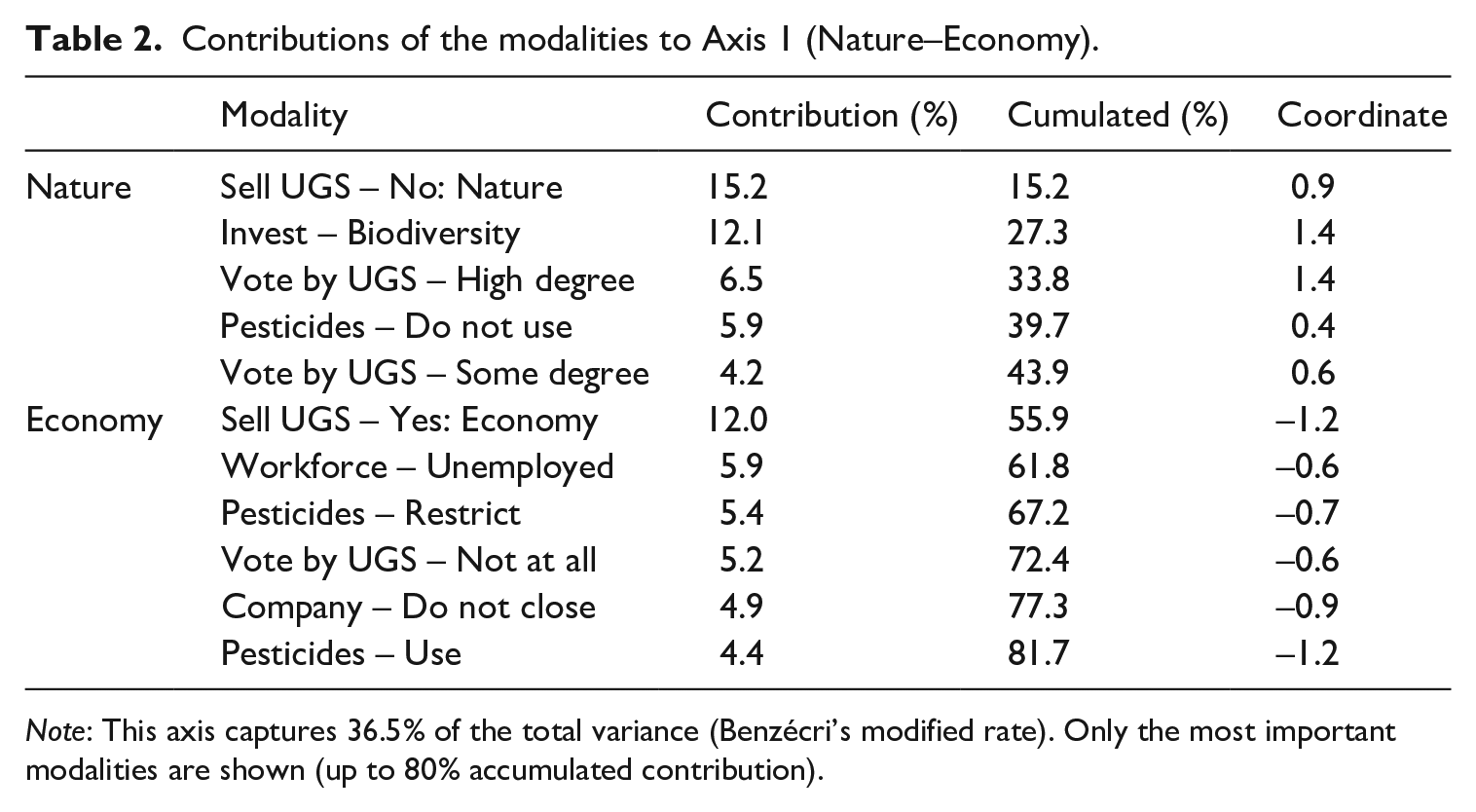
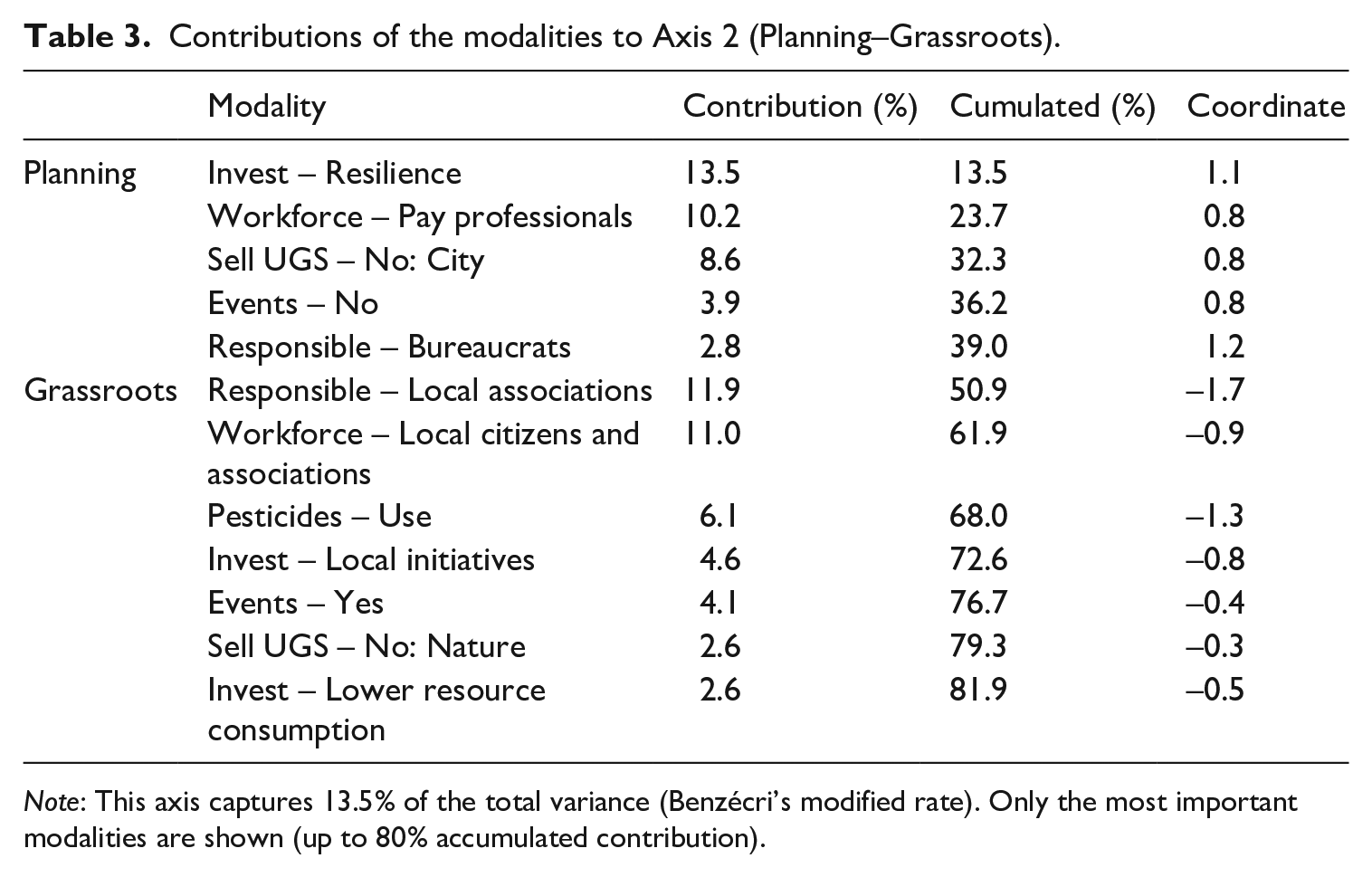
Figure 1 presents the space of issues resulting from the multiple correspondence analysis of the eight active variables. Tables 2 and 3 facilitate the deciphering of the dimensions in that space by grouping the modalities by the closest pole on each axis (i.e. positive or negative sign) and sorting them by contribution to (i.e. importance for) that axis. Correspondence analysis is relational so it is important to not look at each pole in isolation, but to take into account the contrasts (axis) and dimensionality (space).
Contributions of the modalities to Axis 1 (Nature–Economy).
Note: This axis captures 36.5% of the total variance (Benzécri’s modified rate). Only the most important modalities are shown (up to 80% accumulated contribution).
Contributions of the modalities to Axis 2 (Planning–Grassroots).
Note: This axis captures 13.5% of the total variance (Benzécri’s modified rate). Only the most important modalities are shown (up to 80% accumulated contribution).

The space of urban greenspace issues (the cloud of modalities Axes 1–2).
Axis 1 concerns the use of city resources and contrasts ‘Nature’ (positive coordinates) with ‘Economy’ positions (negative coordinates). For instance, at the Nature pole, we find the modality ‘No: Nature’ of the ‘Sell UGS’ variable. The vignette of this variable establishes a situation where ‘your city’ considers selling a large urban greenspace on its periphery for the construction of affordable housing as a way of relieving its financial situation. Yet, one environmental organization resists because there is a protected species in the area. The ‘No: Nature’ modality resists the sale on account of our ‘responsibility not to destroy nature around us’ (as opposed to the alternative reason: ‘the inhabitants of our city need the greenspaces’). At the Nature pole, we also find modalities expressing support for investing in biodiversity; the respondent’s vote in the most recent municipal election being influenced by issues related to urban greenspaces to a high degree; and an opposition to the use of pesticides. Thus, the pole represents a particular notion of ‘nature’ concerned with biodiversity and environmental protection.
By contrast, at the Economy pole we find the modality ‘Yes: Economy’ of the ‘Sell UGS’ variable. This response category agrees with plans to sell the area because ‘a large construction project sustains business and the influx of residents going for the benefit of the city’ (as opposed to the alternative reason: ‘More cheap housing affords a more socially just city’). The other Economy modalities include supporting a policy of making the unemployed serve in urban greenspace stewardship (although they are not educated in the field); approving the use of pesticides when this can save money or is restricted to areas that no one usually frequents; considering one’s personal vote in the most recent municipal election to be not at all influenced by urban greenspace issues; and approving the statement not to shut down a major local company despite its polluting. The recurrent theme here is the subjection of urban nature to considerations of economic cost and efficiency and not, for example, of ideas about clean energy or sustainable production. Thus, the axis contrasts relative concerns with the competing issues of economy and nature in the city.
Table 3 provides the main modalities contributing to the second axis. Axis 2 concerns the preferred mode of government and contrasts ‘Planning’ (positive coordinates) with ‘Grassroots’ (negative coordinates) approaches. Among the Planning modalities are the following: invest in the city’s ‘resilience’ against extreme weather; pay professionals to conduct stewardship in urban greenspaces; do not sell an urban greenspace for residential construction because citizens need the space; and assign primary responsibility for urban greenspaces to bureaucrats. Combined, these modalities represent a priority for institutionalized responses across issues related to urban greenspaces. By contrast, at the Grassroots pole, the modalities are the following: local associations should assume primary responsibility for urban greenspaces; local citizens and associations should be given responsibility for urban greenspace stewardship; pesticides should be used when they can save money; and the city’s planned green investment should go to local initiatives. Thus, Axis 2 captures a contrast between two opposing forms of greenspace governance.
Figure 1 provides a visual representation of the space of issues. Both dimensions are recognizable from the existing literature – while the Nature–Economy contrast resembles the widespread neoliberal-sustainable divide, the Grassroots–Planning contrast bears a similarity to Wachsmuth and Angelo’s (2018) distinction between ‘green’ (natural) and ‘grey’ (high-tech) sustainability (see also Blok & Meilvang, 2015). However, Figure 1 emphasizes the importance of not reducing the space to a single dimension of planning and economy pitted against environmentalist grassroots. Indeed, Figure 1 shows that ‘planners’, too, can be environmentalists, just as ‘grassroots’ can be anti-environmentalists. Rather than hegemony, the space reflects interlaced issues of concern – what Barnett and Bridge (2016) call problems (see also Krarup, 2021).
Analysis 2: The role of social class
Figure 2 plots the modalities of these variables onto the space of issues in order to identify possible homologies between the space of issues and social class, alongside other likely relevant socio-demographic characteristics. Each modality is plotted at the mean point of respondents belonging to that (income, educational, etc.) group using register data from Statistics Denmark about respondents’ educational level and direction, family income and city size, along with survey data on their age and primary occupation. Educational level and type are combined into a single fine-grained typology reflecting Bourdieu’s double emphasis on the volume and composition of capital.
Before discussing the details of social class (education, occupation, income), notice that city size largely follows the first axis (bigger cities closer to the Nature pole) while age follows the second axis (the young closest to the Grassroots pole) – although only the youngest and the oldest respondents occupy positions away from the centre of the space. These purely demographic differences serve as a first indication of the connections between political-moral concerns (the space of issues) and concrete life situation. It also reveals non-trivial associations, as the two demographic variables follow different dimensions in the space of issues.

Social class and demography (Axes 1–2).
Overall, the distribution in Figure 2 reflects a social space in two dimensions: (a) volume of capital (along the Grassroots–Planning axis) and (b) relative composition of economic and cultural capital (along the Nature–Economy axis). In the Nature–Planning quadrant, we find indicators of high volumes of cultural capital in particular: public sector employment (especially of managers); higher education (notably in social science and technology) and further education in humanities and communications; as well as medium-high income. Thus, the cultural upper middle class is disposed towards environmentalism but it also tends to favour established institutions, of which they themselves are often part or even manage (Jarness et al., 2019; Schmitz et al., 2018).
In the Nature–Grassroots quadrant, we likewise find indicators of a relative surplus of cultural capital, but with lower total volumes: higher education in humanities and communications, further education in social science and high school exams (which may be taken as an indicator of students in further education); low incomes; and unemployed, private-sector employed and middle managers. These groups are generally more removed from the field of power. In the Economy–Planning quadrant, we find high volumes of predominantly economic capital: the highest incomes; private-sector managers and self-employed; along with vocational business and training, short further education in technology and other further education (including short further and higher education). In the Economy–Grassroots quadrant, we find socio-economic backgrounds reflecting lower total volumes and a relative surplus of economic capital: compulsory school; students (all levels); further education in technology; and no occupation (distinguished from the job-seeking ‘unemployed’ in the Nature–Grassroots quadrant).
The classed distribution buttresses the impression of a moralized space interlacing concrete everyday experience of local urban greenspaces with more abstract politics. Institutionalized governance is mainly for those rich in capital and environmentalism for those with a preponderance of cultural capital. For example, the Economy–Planning quadrant corresponds not so much to a neoliberal laissez-faire attitude as to a classed (and age-dependent) sense of responsibility based primarily on economic and citizenry issues. This is reflected, for instance, in how this quadrant exhibits the choice of investing in city resilience and using pesticides ‘where people do not move about on a daily basis’ (whereas to use pesticides ‘if it can save money’ is found in the Economy–Grassroots quadrant) (Figure 1). Complementarily, in the Economy–Grassroots quadrant, the preference for cosy parks and large events and the relative concern with the survival of a large local company rather than the possible negative health effects of using pesticides in public greenspaces reflect a classed belonging to smaller and less advantageous socio-demographic positions. Thus, ‘Grassroots’ here seems to carry quite different connotations from those marking positions further towards the Nature pole (richer on cultural capital and more closely affiliated with big cities), as people tend to care more about their local community than about participatory democracy and environmentalist action.
There is one important caveat to the above analysis, however. While the pattern of issue–class homologies is an easily recognizable one, the strength of the correlations underlying it turns out to be only moderate upon closer inspection. For example, as can be seen in Table 4, income follows the second axis (Planning–Grassroots), and its correlation with support for politicians or bureaucrats being primarily responsible for local urban greenspaces is clear; contrary to what we may expect, however, income does not display a linear correlation with the support for professionals and for citizens or local associations. Rather than a termination of the analysis, the classed aspect is thus an opening towards the political-moral layers of the space of issues.
Family income and who should be primarily responsible for the management of local greenspaces. a

p = .002 (χ2 test). Categories have been merged to avoid cells with low n. Local business (n = 5), Other, Don’t know and No opinion are set as Other due to low n. bIn 1,000 DKR (~£120 as of June 2020).
Analysis 3: Politics, engagements, attachments to place
In this section, the roles of national political structures, personal attachments to place and civic engagements are unfolded in relation to local urban greenspaces. Figure 3 plots supplementary variables concerning these three scales on the space of issues. First, the space reflects a broader national political space irreducible to a simple left–right scale (Harrits et al., 2010; Jarness et al., 2019; Schmitz et al., 2018). Party vote at the most recent Danish general election in 2015 follows the first axis – as indicated by the shaded areas – with a concave bend on the second axis. The two liberal parties (the old centre-right Liberal Party and the new anti-egalitarian Liberal Alliance) are positioned farthest to the Economy pole, while the conservative parties (the old Conservative Party, the small Christian Democrats and the populist Danish People’s Party) are closer to the centre. By contrast, the parties with strong environmental profiles (the extreme-left Red-Green Alliance, the centrist Social Liberals and the newly formed green party, The Alternative) are positioned farthest to the Nature pole, while the more traditional left-wing parties (the Social Democrats and the Socialist People’s Party) are closer to the centre. Moreover, the two new parties at the extremes (Liberal Alliance and The Alternative) are markedly towards the Grassroots pole, while the traditional left parties particularly tend towards the Planning pole. Indeed, there seems to be something of a political protest typifying the grassroots in the space of issues – an attempt at a moral distinction from the planners of established (urban) government.

National politics, place attachment and civic engagement.
Plotting attitudes on national environmental policy further emphasizes the moral character of the space of urban greenspace issues. At the Nature pole we find the modality ‘Too Unambitious’ in response to the government’s current environmental and climate policy, whereas towards the Economy pole we find ‘Balanced between different considerations’, ‘Too Ambitious’ and – at the extreme – ‘Unjust to certain groups (such as homeowners or farmers)’. Likewise, at the Nature pole we find the modality ‘Abstain from economic growth and change our lifestyle’ as the preferred strategy for a ‘green transition’ to markedly lower the emission of greenhouse gases. Closer to the centre, we come across the view that the green transition is a ‘Possibility for growth in the economy and development of environmentally friendly technology’. At the Economy pole we find that we should ‘Avoid excessive regulation’ in the pursuit of a green transition and that the transition should not stand in the way of resolving ‘Other more important problems’.
Two important insights may be derived from the above results. Firstly, the space of more concrete moral-political issues related to local urban greenspaces also reflects more abstract structures in political attitudes on a national and even global scale. However, this homology concerns primarily the Economy–Nature dimension, whereas the Planning–Grassroots dimension represents a contrast more specific, it seems, to the local urban setting. In other words, class and broader (national) political structures are closely related to, but do not exhaustively account for, the politics of the urban green. Secondly, the charted space is inherently moral, as is evident especially in the structured distribution of modalities in relation to the environment. This distribution marks assessments such as ‘unjust’ and ‘balanced,’ as well as concerning the degree to which some groups can legitimately prescribe the lifestyles of others. Thus, when enquiring into political space, it is important to seize the (classed) moralities underpinning differences in more abstract political attitudes.
We may further elaborate on the interlacing scales by turning to personal attachment to place and civic engagement. Attachment to specific local urban greenspaces is measured by the following question: ‘Are there greenspaces in or around your city that are irreplaceable to you, for example, because you feel particularly connected with the place or feel at home there?’ The term ‘irreplaceable’ goes beyond people’s simply enjoying certain greenspaces, emphasizing their affective uniqueness and the impossibility of replicating them. The modalities of this variable follow the first axis, so that more attachment correlates with more nature-oriented positions in the space of issues (not shown in Figure 3).
Civic engagement is measured by a battery of 12 questions concerning whether or not the respondents have been active (by organizing or helping out) or have participated in (by showing up) public local community life related to urban greenspaces. This variable also follows the first axis: respondents who have been active tend more towards the Nature pole (not shown in Figure 3). However, when the two variables – Irreplaceable and Active – are combined, a new and less predictable pattern emerges, as can be seen in Figure 3. For people with some or a high degree of place attachment, civic engagement indeed follows the first axis. However, for the somewhat smaller group of people with a low or no degree of place attachment (20.3%), civic engagement follows the second axis, in that more engagement tends towards the Grassroots pole.
The result is quite striking for two reasons. Firstly, as confirmed by Table 5, personal attachment to specific greenspaces correlates with more concern for nature locally as well as with environmentalist attitudes in general. Among those who exhibit civic engagement in local urban greenspaces, the assessment of the government’s environmental and climate policy as ‘too unambitious’ varies between 44.3% for those with a high or some degree of personal attachment to a local greenspace and 25% for those without or with a low degree of attachment. Similarly, the assessment of the policy as ‘unjust’ varies between 3.5% and 9.9% for the two groups. In other words, political attitudes are not merely moralized (and classed); they interact, too, with such personal features as civic engagement and place attachment.
Civic engagement and place attachment with government environmental policy. a

p = .000 (χ2 test). n = 1,055.
Secondly, these interactions generate quite different logics – different kinds of habitus and practical sense – in different (classed) positions within the space of urban greenspace issues. Indeed, the importance of singling out the civic engagement of the group with a low or no degree of place attachment concerns its quite distinct logic. For this group, civic engagement is reversely correlated with environmentalism – and the group is substantially more likely to have no opinion on environmental policy (around 23.8%, even among those who are civically engaged). Instead, civic engagement correlates with support for grassroots, indicating that local community tends to trump other concerns. In fact, it is not the assignment of responsibility to local associations and citizens or the investment in local initiatives that distinguishes this group, but rather other modalities like acceptance of large events in greenspaces, ‘such as jogging events, sports gatherings or concerts’ (38.4% versus the average of 29.0%).
Age plays an important role, too, as 18- to 29-year-olds are considerably overrepresented in the group of civically engaged citizens with little place attachment (42.2% versus a 22.8% average). This is also reflected in a considerable overrepresentation of students (21.2% versus 13.4%), persons with the lowest family incomes (29.8% versus 15.9%) and people who have lived only 0–4 years in their present city (42.2% versus 19.5%). Thus, a good part of the logic characterizing this group may be attributed to a young urban lifestyle – a lifestyle which also has its own distinct moral and political characteristics. In this way, the complex of homologies is not simply a question of overlapping scales of analysis (from the personal to the global), but also of different compositions of elements from the different scales into different social, moral and political logics.
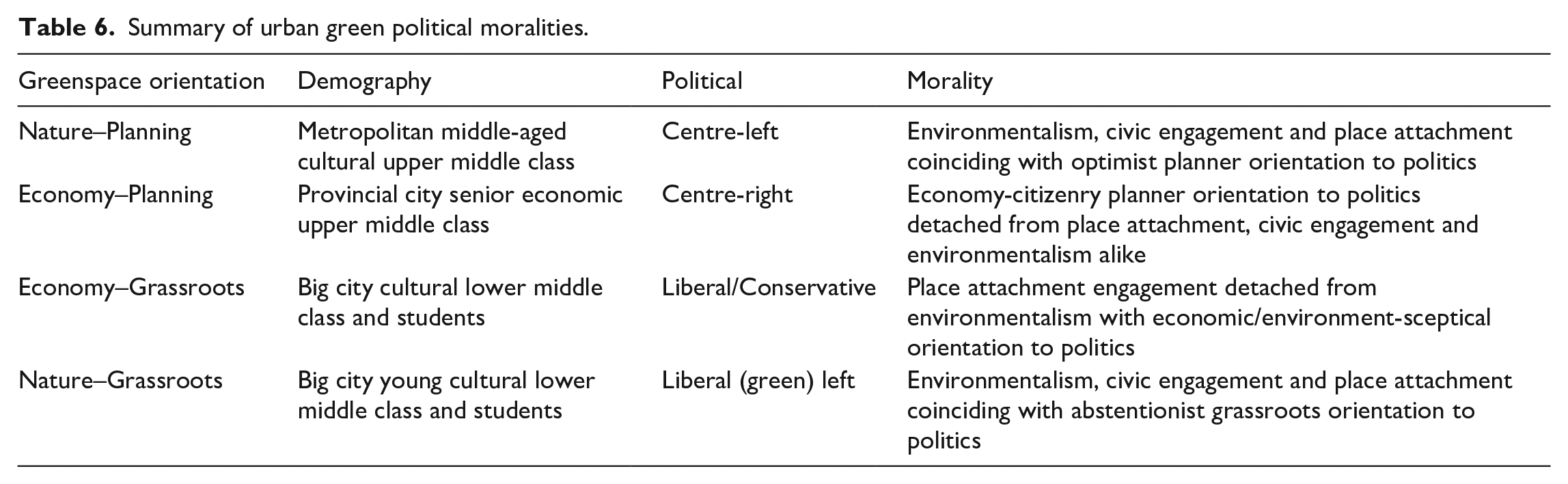
Bearing in mind the complexity of interlacing themes and scales, and acknowledging the (sometimes significant) variation at the level of individuals, Table 6 summarizes the results into four urban green political moralities.
Summary of urban green political moralities.
Conclusion and discussion: Morality, politics and the urban green
With cities accounting for large proportions of greenhouse gas emissions and representing hotspots of climate change impact (IPCC, 2017), new layers of environmental protection, city resilience and sustainable transition have been added to older aspects of urban greenspace, such as recreation, public health, gentrification and civic engagement. Reflecting broader endeavours in moral-political sociology, urban scholars have warned against reproducing a simplistic discourse of sustainability potential, calling for more attention to the multiplicity of problematics around the urban green. However, this field has arguably lacked the necessary analytical and methodological tools to integrate morality and classed politics, all the while maintaining openness to the multiplicity of interlacing scales, issues and concerns.
This article adapted the approach to the moral aspects of classed politics developed in the Bourdieusian tradition (identifying homologies between moral-political concerns and capital possessions in a multidimensional space using correspondence analysis) to better seize the multiplicity of scales, issues and concerns interlacing around the politics of the urban green. Specifically, the analysis stressed the importance of not reducing the politics of the urban green to a conflict between neoliberal planners versus environmentalist grassroots, revealing equally important combinations of environmentalist planners and grassroots dispositioned to favour the economy over nature. Moreover, while the space of urban greenspace issues is classed in ways resembling both Bourdieu’s original schema, as well as more recent analyses of classed politics in the Nordic countries, other homologies equally demand attention – together forming a complex of interlacing scales, issues and concerns. First, class is complemented by other demographic factors (age, city size) and lifestyle. Second, local greenspace issues and national environmental politics exhibit homology along one dimension of analysis (Economy versus Nature), while the other dimension (Planners versus Grassroots) seems unique to urban greenspaces. Finally, and perhaps most importantly, overlapping local concerns and attachments, civic engagements, broader political orientations and classed lifestyles form different complex profiles organized by divergent social logics.
The last point reinvigorates Bourdieu’s notion of practical sense as a valuable one for moral-political sociology more broadly, as the concept helps emphasize how political attitudes – with their moral and classed aspects – interact with civic engagement, place attachment and other local and personal features. Moreover, the article demonstrated how correspondence analysis (used extensively in the Bourdieu tradition) provides a useful methodological tool for unpacking such interactions in a systematic fashion. The article thereby opens an avenue for designing and exploiting surveys to complement the overwhelming dominance of qualitative methods in critical urban studies and, more broadly, in moral-political sociology. The combined analytical and methodological approach may avoid dichotomies of ideology (or ‘illusion’; Wachsmuth & Angelo, 2018) and reality, as well as reductions to a single plane of homologies between class and (abstract) political attitudes, by conceiving enquiry in terms of issues and a multidimensional space of interlacing concerns, problems and controversies, traversing local to global scales. The approach may prove particularly fruitful in future research on environmental crisis, sustainability and climate change where citizen concerns, orientations and engagements play a role and where manifest or latent moral-political conflicts between different citizen groups relate directly to their local engagements and personal attachments.
Footnotes
Appendix
Declaration of conflicting interests
The author has no conflicts of interest to declare
Funding
The work was funded by the Velux Foundation (grant number 14421).
