



Abstract
A growing body of work has problematised how global epistemic inequality is reproduced in contemporary university settings and epistemic cultures – thinking through the lens of Eurocentrism and utilising the language of a Global North and South. However, the extent to which a relationship between geopolitical and epistemic inequality is woven into knowledge production within Europe has received less attention. Rising EU funding opportunities have facilitated a corresponding climb in transnational European social science collaborations, in concert with an expansion of empirical locations with which these projects engage. Still, increases in member state participation do not necessarily contribute to a more balanced epistemic landscape for knowledge production. Not all countries are treated equally as cases and often, these patterns of inequality reflect what Maria do Mar Pereira calls the epistemic status of nations: the idea that certain countries and continents are considered more or less likely to produce valuable or exportable scholarly knowledge. In this article, Pereira’s theory of epistemic status is extended in its implications to study choices for the selection of countries as cases. We use both quantitative data from the EU CORDIS register and ethnographic data exploring academic and collaborative practices in transnational EU-funded projects. The article addresses the ‘where’ of collaborative research by focusing on epistemic attributes rather than participatory optics. In doing so, we reflect not only on the structures and strategies of science funding in Europe but also further unsettle discussions around global epistemic inequality within academic theory and practices.
Introduction
The production of organised social science is continually shaped by global inequalities. Over the last few decades, a growing body of work has problematised the Global North hegemony and Eurocentrism that is ubiquitously present in the studying, theorising and teaching of the social sciences (Chakrabarty, 2000; Connell, 2011; Go, 2016; Santos, 2018). This work most often takes place through the lens of post- and anti-colonialism, rightfully identifying and critiquing the pervasive ways in which global epistemic inequality is reproduced in contemporary university settings and epistemic cultures. As Raewyn Connell et al. (2018) acknowledged, ‘a global economy of knowledge centred on the elite institutions of the metropole is a massive fact [and] it shapes both established disciplines and new domains’ (p. 54).
However, associations between geopolitical and epistemic inequalities within this global knowledge economy are not limited to post-colonial countries and regions – areas frequently referred to as the Global South. Within Europe, the extent to which these relationships are woven into social science knowledge production has received less attention. Regions such as Central and Eastern Europe (CEE) and parts of Southern Europe represent historically complicated geopolitical spaces that include colonisers and colonies, aggressors and victims, and countries that have occupied both positions, sometimes at the same time (Boatcă, 2015; Müller, 2020). These regions are conspicuously absent from the Global South category in ongoing discussions around geopolitically shaped epistemic inequality. This is to say, despite the continually developing critique of Eurocentric epistemic hegemony, social science knowledge produced across Europe continues to function within broader socio-historical and geopolitical relations of power – reproducing relatively well-established geographic asymmetries. Often, these reflect what Maria do Mar Pereira (2014, 2017) refers to as the epistemic status of nations: the idea that certain places, countries and continents are seen to be more or less likely to produce ‘proper’ and valuable scholarly knowledge that is exportable and ubiquitously applicable.
Critical discussions and interventions related to where European social science takes place frequently centre on the national or university affiliations of participating academics and their mobility, rather than the countries and regions with which the research empirically engages (Chessa, 2013; Nedeva, 2013; Primeri & Reale, 2012; van der Meulen, 2002). Consequently, the roles that geopolitical and socio-historical inequality play in shaping the epistemic attributes of the research process, such as theoretical and methodological choices, often go overlooked. The repercussions of this can be seen as reflected in trends of privileging certain research objects or places over others (Krause, 2016, 2021). Here, we take our point of departure in the idea that the production of academic inequalities cannot be understood without also exploring the epistemic and disciplinary choices made throughout the entire process of collaborative research – from formulating a research project and choosing a consortium to the production and reporting of data and findings. We show how the concept of epistemic status can be extended in its implications to consider the selection and exploration of empirical country cases in large-scale social science research collaborations funded under the European Framework Programmes (FPs).
The FPs stand out not only as the EU’s main tool for science funding but also as a component of the wider political strategy, along with policy initiatives such as the European Research Area (ERA), intended to facilitate, inter alia, free circulation of researchers and knowledge, better cross-border cooperation, and geographic inclusion in European research (Benner, 2018; Chou, 2012; European Commission, 2020; Nedeva, 2013). In this way, EU research funding often carries the overall dual ambition of not only funding useful scientific knowledge for European societies but also fuelling cross-border academic cooperation and transnational research networks. This means that when it comes to awarding funds, the European Commission (EC) has increased vested interest in the national affiliations of participants in collaborations – monitoring where researchers and institutions are located and creating incentives to include countries and regions within Europe that are frequently peripheralised. Thus, the FPs are especially interesting for exploring how countries are taken up as cases, due to the underlying aim and incentives to support geographic inclusion and balance in European research.
Our analysis is divided into two parts. By coupling quantitative and qualitative data, we examine how geopolitical relations within Europe, which can be mapped across heterogeneous epistemic terrains, manifest themselves and become articulated throughout the research process itself in EU-funded collaborative projects. First, using quantitative data, we analyse the significant discrepancies between regions in Europe that are selected as country cases, with wealthy Western European nations more frequently studied as singular cases and researchers from these areas better positioned to obtain grants for researching their own contexts. Then, using ethnographic data exploring academic practices in large-scale transnational projects, we show how these geopolitical inequalities within Europe are reproduced by researchers during the collaborative process.
In questioning how researchers within Europe are participating in the global knowledge economy, and by shining a critical light on academic dynamics in the European periphery, this article takes steps towards unsettling and problematising how epistemic inequality is often considered and studied on a global scale. How are geopolitical inequalities built into European science funding at a structural level? How does a primary focus on participants and their geographic affiliations tell only a partial story of the epistemic consequences that geopolitical inequalities have for the production of social knowledge? Through these questions, the article offers a breadth of issues for social scientists to consider, both intellectually and from a practical perspective, by exploring the ‘where’ of science through the selection of countries and regions as empirical cases.
The epistemic status of nations and model systems in the social sciences
The movement towards internationalisation of science in Europe, in addition to the increasing significance of European scientific institutions, evokes a foundational discussion in the sociology of knowledge and science: that is, how practices of knowledge production relate to the institutional and structural configurations of scientific and political institutions (Mannheim, 1997). It is a discussion that invites connections between the European geopolitical landscape and epistemic inequality in European social science. To understand and inform this relationship, we draw on two novel sociological concepts from feminist post-colonial theory (epistemic status) and the sociology of knowledge (model systems).
On a global scale, the decisive relationship between geopolitically shaped locales and epistemic authority is conceptualised by Maria do Mar Pereira’s theory of epistemic status, which stems from her work exploring how global patterns of epistemic hegemony become localised and take shape in everyday academic practices. Pereira (2017) suggests, ‘[w]hat brings geography and epistemology together . . . is the notion that places, countries, and continents have what I want to call epistemic status. That is, they are seen to be more or less able and likely to produce proper and valuable scholarly knowledge’ (p. 148).
Her theory builds on Foucault’s concept of epistemes (Foucault, 1976/1980, p. 112), by employing feminist epistemologist Lorraine Code’s (2006) approach to everyday knowledge production, emphasising ‘situations and interconnections of knowers and knowing’ (p. 6). However, where Foucault’s focus is on which claims are acceptable in given settings, Code’s work centres on whose statements are accepted, putting the focus on who is speaking and where they are located. That research is also grounded in a major legacy of post-colonial and feminist theory – that epistemic status is unequally distributed across the globe, with proper scholarliness and science usually being associated with Western countries (Pereira, 2017, p. 630). By weaving together theoretical strands addressing STS-inspired attention to institutional and professional hierarchies and relational academic capital (e.g. Bourdieu, 1988; Gieryn, 1999), Pereira stresses that epistemic status is formulated not as something statically owned by scholars or nations but as continually recognised and negotiated with respect to academic context and relational professional power. For example, the country from which a researcher comes might be overshadowed by or considered in relation to where they currently work or how recognised they have become in their field.
We suggest that Pereira’s theory, though most often employed in discussions about intersectional inequality among academics, can be thought with to explore internal epistemic and disciplinary choices in academic work – for example in the selection of country cases and how they are studied. Through a repurposing of the concept of model systems, borrowed from biological studies, Monika Krause (2016) asserts a link between the inequality of nations and the continual implicit privileging of places, topics and theoretically canonised objects of study. A model system, Krause observes, is thought to limit the variation among objects studied and allows researchers to link observations by different researchers in different sites. The literary canon fulfils an analogous role in literary studies (Poovey, 2001). These model systems often serve as a helpful tool and a means by which to pragmatically abstract and thus link up observations and particularised cases between researchers in different sites.
Model systems play an analogous role in the social sciences but can often work, for example, to reproduce a veneration of what are considered the classics in social theory or focus a disproportionate amount of attention on some research objects over others (Guggenheim & Krause, 2012). Notably, Krause relates the discussion of model systems with a critique of Eurocentrism, echoing scholars such as Boatcă (2015), Wallerstein (1997), Chakrabarty (2000) and Go (2013, 2016) in writing that the West has served as the model system for ‘modern’ or developed’ societies. She goes on to say that even within Europe, particular countries have served as models. This means that cases from these countries (and institutions associated with them) command attention and consequentially, science from and about these places are often considered to be ubiquitously applicable. Although many smaller European nations and post-Soviet member states were not faced with colonisation, they are still differently positioned in the European science landscape and tend to have a harder time contributing to or taking part in model systems – with knowledge from or about these spaces considered less generally applicable. Here we link the idea that countries as cases, specifically wealthy Western European countries, can act as privileged objects of study and suggest that this privilege is exemplified on a wider epistemic terrain coinciding with established asymmetries existing in European social science.
Contextualising the EU Frameworks Programmes
The ‘Framework Programmes’ (FPs) are a fitting avenue through which to study a relationship between geopolitics and epistemic inequality in Europe due to the underlying political intentions and the evaluative criteria they carry for winning large-scale collaborative research grants. The programmes were first established in 1981, with the latest iterations introduced in 2014 and 2021 as Horizon 2020 and Horizon Europe, respectively. They were originally designed for integrating and coordinating the many research activities funded by the EU, increasing European capacities in different applied fields of research related to central policy areas and ensuring the diffusion of knowledge and technologies to all member states (Guzzetti, 1995). Over the years the FPs have expanded to become one of the world’s largest research and innovation funding schemes, with a total budget for Horizon Europe at 95.5 billion Euro, and research and innovation has become a cornerstone in EU policies focused on European integration and economic growth and development.
From their start, the programmes have carried the dual function of supporting European scientific activities and ensuring integration across member states – addressing European-specific issues in research. Hence, throughout the history of the FPs, different implicit and explicit requirements were put in place to ensure participation from all member states. However, the most significant catapult promoting European integration in research came with the introduction of the European Research Area (ERA), a political initiative intended as a scientific equivalent of the European Single Market. The ERA was not only aimed at improving the conditions for science but also aspired to integrate EU and member state research systems to promote economic growth through inventions and innovations (Chou, 2012; Chou & Gornitzka, 2014; de Elera, 2006; Nedeva, 2013).
Among the actions promised by the ERA were clear goals to support member states that were ‘below the EU average level of research and innovation [and] that have lower performance in training their researchers to access and develop excellence and increase their number of highly cited publications’ (European Commission, 2020). In addition, there was the aim to develop concrete plans with member states to ‘promote gender equality, as well as diversity and inclusiveness, in science, research and innovation’ (European Commission, 2020). Ultimately, the normative ideal purported was that better participation, cooperation and geographic distribution of funds would lead to more useful scientific knowledge production in Europe, securing its place as a top competitor in the global knowledge economy. Subsequently, the FPs are known to explicitly fund large-scale, transnational research collaborations with consortia that include researchers and institutions scattered across the EU.
Still, despite implicit and explicit actions taken by the EC, much of this strategising and attention in the FPs were directed at balancing participation, and ‘widening’ 1 distribution of funding and aid to researchers and universities in countries considered to be ‘lagging behind’ (European Commission, 2017a). Indeed, scholars studying EU social science and funding have increasingly pointed out (Gengnagel et al., 2019; Hoenig, 2017; Kuzhabekova, 2020; Pereira, 2014) that the expanded geographic participation in regions such as Central and Eastern Europe or Southern Europe does not necessarily equate to a more balanced epistemic landscape for knowledge production. Meaning, although a central goal of the FPs and the ERA is disrupting patterns of inequality in European research, much of the social science knowledge produced within EU funding schemes is still embedded within broader socio-historical and geopolitical relations of power, reproducing relatively well-established geographic asymmetries when it comes to how these projects form and function.
Methods and data
The article draws on a mixed methods approach, employing quantitative data from the CORDIS database and qualitative ethnographic data.
The CORDIS database contains all EU-funded research projects funded through the FPs and the European Research Council (ERC). 2 The register is maintained by the EC and is publicly available. Our initial sample covers more than 80,000 projects and 43,500 participants from the first Framework Programmes until the H2020 projects, which were funded since early 2019. From this sample, we identify 2,829 social sciences projects. We base our selection of the social science and humanities (SSH) projects on reports produced by the Directorate-General for Research and Innovation since FP 4 and the committees in the ERC. The EC collects projects funded under calls or schemes designated specifically for SSH projects with the assumption that these calls are not ‘polluted’ by non-SSH projects. In using the list provided by the EC of SSH projects, we miss out on those SSH projects that are undoubtedly present among other funding calls. However, this approach gives us a relatively stable and consistent sample covering an extended timeframe (1988–2019) across considerable institutional changes. The number of projects that explicitly mention country cases in their objectives rises markedly in FP 7 and Horizon 2020, due mainly to the FPs integrating with the ERC, which makes up 64% of all SSH projects.
To show which research projects include a given country as a case we searched within this database for country-related terms in the objectives of the social science projects. The objectives of EU research projects resemble an abstract and are publicly available in reports from the EC and on the CORDIS website. The research objectives are English texts of varying length (median: 1,915 characters), with the longest nearing three pages of text. The contents deal with the aim of the project and do not usually include findings, schedules, work packages or similar. The texts do not necessarily mention the countries that are used as cases – but they are likely to do so when they are essential to the research design – such as single-country case studies of political institutions or cross-country comparative studies. In each project, there is a coordinating institution, most often a university, and participant institutions, again primarily universities but may include private businesses, interest groups municipalities, etc. Although a project may include a participating institution, this does not mean the country where it is located will be studied as a case in the research. As we will show – a country is also likely to be a case in the research but not a participant, a relation which is notably overlooked in research addressing collaborative participation and networks across countries. To find the projects within our sample that mention specific countries, we construct a search string for each country that consists of the country name in English and in the Romanised native language and then the demonym in English. See Appendix A, Table A1 for a complete list of search terms. While it is beyond the scope of this article to look at end reports and published research for all projects included in the sample, the objectives provide us with a representative approximation of patterns and structures.
We turn now to the ethnographic fieldwork, conducted over a two-year period from 2019 until 2021. Because our focus was on how transnational collaborations formed and functioned, the scope of potential projects was limited to ongoing projects within Horizon 2020 which typically include several affiliated partners and institutions across Europe. Additionally, it was critical to both conduct interviews and visit a select number of universities to consider the context and conditions shaping the participation of each partner and the relationship to the project. Multi-sited fieldwork was not only a methodological necessity for providing a fuller depiction of individuals in a transnational institution, but also itself became a form of participant observation by virtue of the research having similar characteristics as the participant’s (Clifford, 1992; Falzon, 2015).
Three different social science projects funded under Horizon 2020 were selected from the list of SSH projects made public by the EC. The criteria shaping project selection included country of coordination, number and geographic distribution of partners, main disciplinary alignment of the proposal, and progress of the ongoing research. See Appendix B, Table A2 for a more detailed list of selection criteria. The fieldwork involved visiting five different institutional and country contexts and conducting approximately 50 semi-structured interviews with scientific coordinators, project managers and researchers, both virtually and in person. Additional interviews were also conducted at the EC with policy officials involved in formulating the position and funding values for aspects of the FPs. The fieldwork took place at the height of the global Covid-19 pandemic, hence participant observation was limited, but took place both on and offline.
Patterns and frequency of countries studied as cases: A quantitative analysis
In the following analysis, we map out patterns of inequality when it comes to which countries are studied as cases in EU-funded projects. Then, we zoom in on two negative implications that this inequality amongst nations may have for participants in collaborative projects: (1) poor fit between a research approach and a country case and (2) representation of countries without prioritisation of knowledge from and about them. We argue that for the social sciences, the epistemic status of countries as cases can be partially seen through both the number of projects featuring a given country in their research objectives, and the role in the projects played by researchers from that country. For example, is a country studied as a singular case or is it more often one among many in large collaborative projects? Are the coordinators of a project designing a project around their own country context? How often is a country case studied without including any participants from the country at all? In the following analysis, we show how these figures look for countries participating in the EU FPs. For our purposes, we have colour-coded European countries into three groups, a northern, western set of countries that are primarily Protestant and wealthy and form the geopolitical core of the EU, southern countries which are located proximally to the Mediterranean Sea, and central and eastern countries, primarily from the former Eastern Bloc.
Table 1 shows the divide between regions and countries located at the top and bottom of the table, indicating the average amount of countries a given country is studied together with. We show at the top of the table the countries that are most often studied as single-country cases or with few other country cases. At the bottom, we show countries that are most often studied as just one of, on average, six other countries. These numbers indicate that many countries from the former Eastern Bloc, such as the Baltic countries, Romania, Slovakia, Croatia and Bulgaria, are never or rarely studied in and for themselves and most often become relevant in comparative projects among several other country cases.
Average number of partner countries studied in conjunction with a given country.

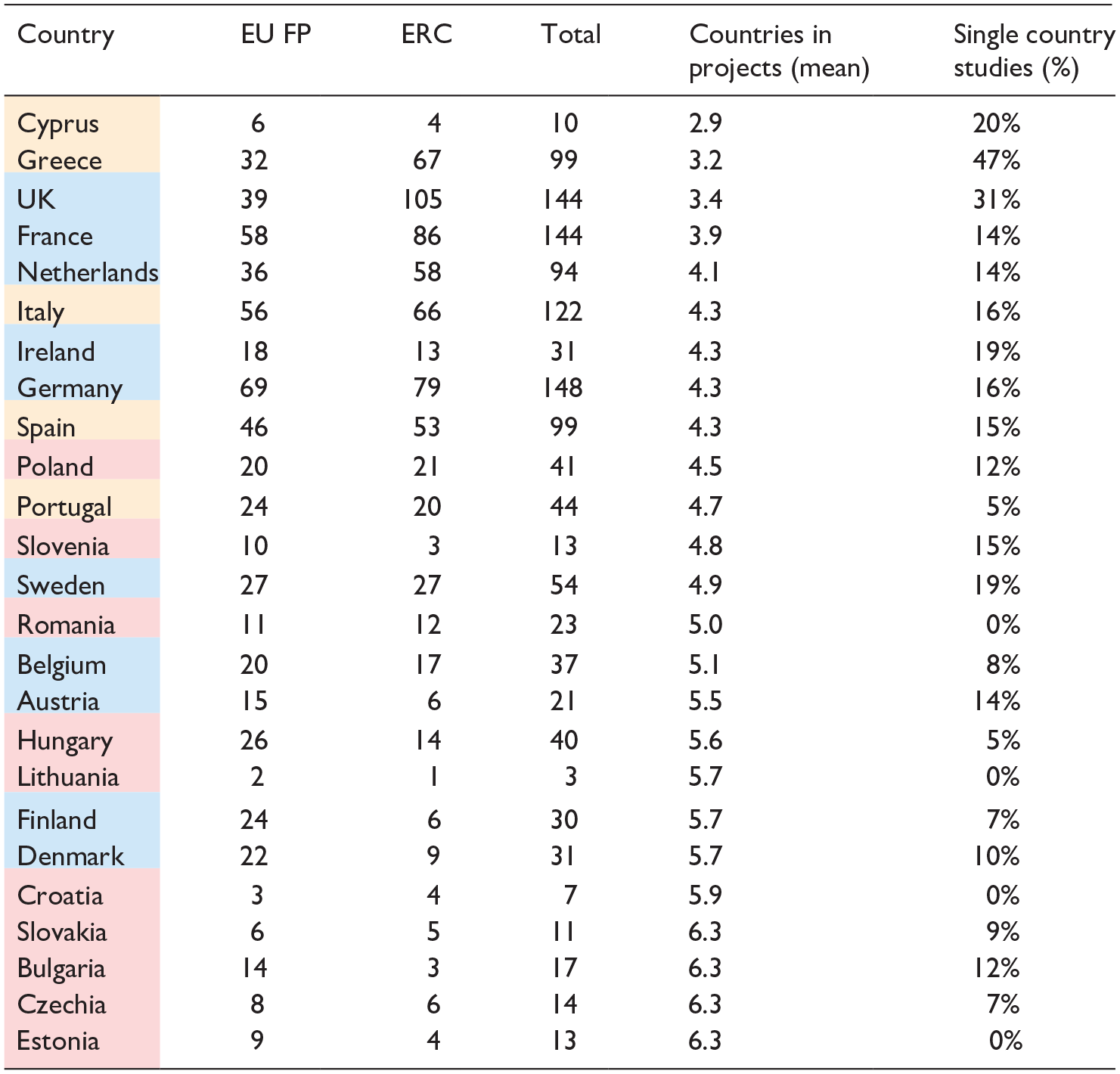
The table is sorted by the number of countries mentioned in the project objectives and coloured by their region: West  , South
  and East
  .
.
As shown, there are some countries included as cases with a much higher frequency in addition to having a particularly high rate of being a single-country case. For example, France is part of 312 projects and 40% of those projects are singularly studying France as a case. For some countries such as Greece, this is in part explained by the ‘intrinsic’ relevance of their histories. For example, ancient Greece was often the focal point of many projects that included Greece as a single-country case. However, the dynamics at the top of the table are not universally applicable. A high-status country considered to be a model case can often be valuable in a comparative project as well as being a single-country case.
In Table 2 we turn to the role that countries play in projects about their own context. This table shows how often a country is the coordinator, participant, or not involved at all in a project where it is mentioned as a case. Frequently, countries positioned with higher status will take a prominent role in the project, along with academics from these country contexts. Conversely, the opposite is true for countries positioned with less epistemic status. Some countries are often the coordinator (Netherlands, UK), while others have never coordinated a project about themselves (Slovenia, Serbia, Estonia, Croatia, Czechia).
Frequency of roles as coordinator, participant or non-participant for countries mentioned in projects as case studies.

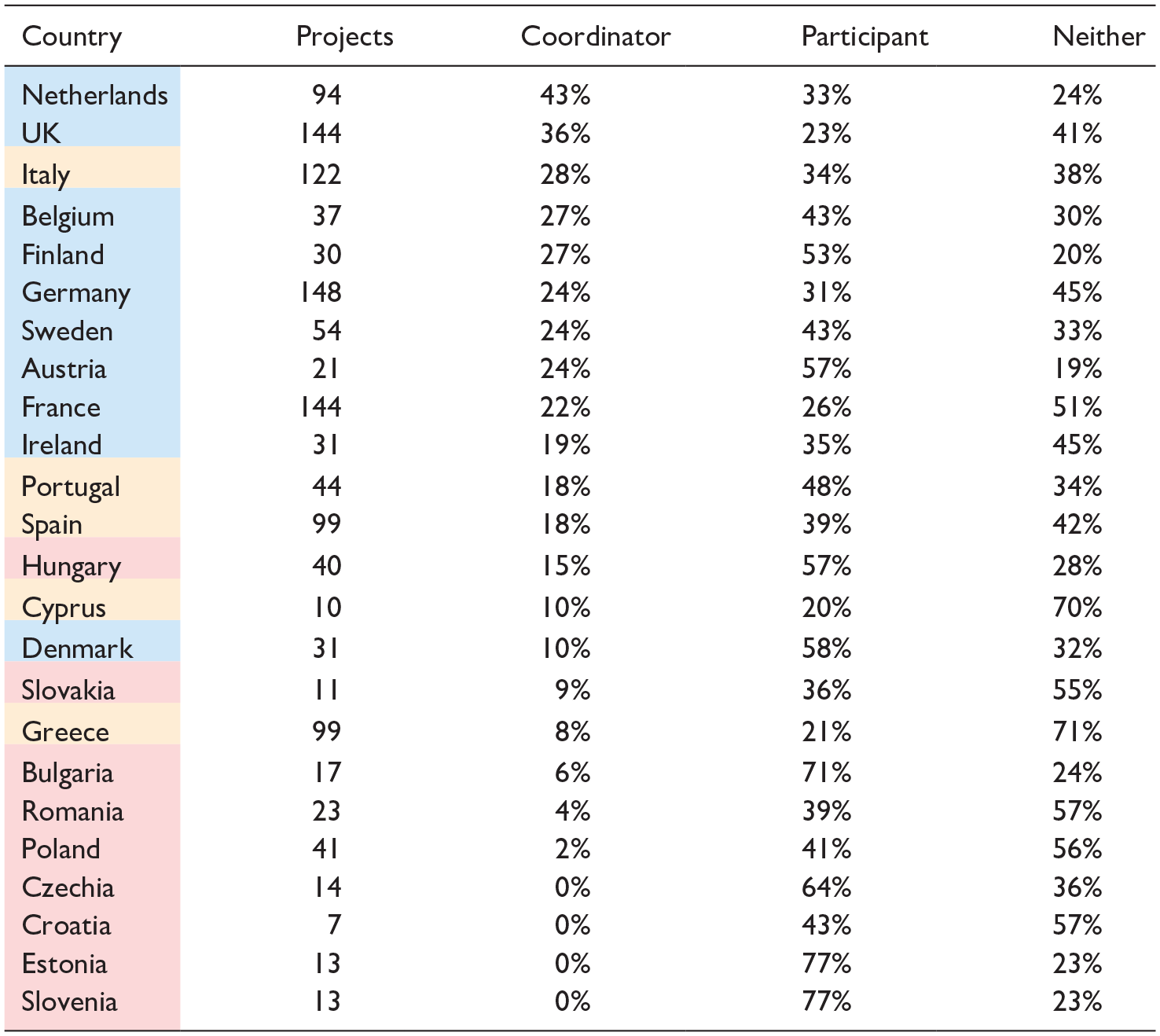
The countries are sorted by the share of coordinator roles in projects that mention that country. Region: West , South and East .
Here, the colour-coded geographic regions make visible some important divisions within Europe that, in themselves, represent a stake in the struggle over status in the global knowledge economy. The share of coordinator roles most clearly represents regional East/West European divides, with all the lowest scoring countries located in the former Eastern Bloc. Poland, which is a case in 41 projects, has only once been the coordinator for a single project about Poland, and in more than half of projects including Poland, the country is neither coordinator nor participant. This does not mean that there are no Polish researchers in these projects, but that they are not located at institutions in Poland. The Netherlands is in the reverse position – Dutch institutions are often coordinators and only rarely not participating in projects about the Netherlands.
In some instances, countries that are highly valued as model cases can also have a low degree of coordination and participation in projects about their own cases. For example, France and ancient Greece are frequently studied by other countries that do not include French or Greek project members. This is most likely because expertise on their institutional history and culture is spread across Europe, indicating that the study of places such as France or Greece is no longer uniquely relevant to French and Greek research institutions but is instead considered to be ubiquitously interesting. The same is true for many other parts of the world, exemplified by the historical relationship between colonies and metropoles or area studies (Duller, 2015). Countries that rarely or never coordinate projects in which they are cases are in this light in danger of experiencing a poor case fit. As we discuss in part 2 of this analysis, because these countries tend to be one case among many, country-specific details about these cases may have limited influence on the methodological and theoretical framework of the research design in comparison to other countries positioned with higher status. This may be the case for the eight Eastern European countries at the bottom of Table 2.
Shown in Table 3 are patterns of co-mentions for each country, organised by region. Across all three regions, countries with the highest share of mentions come from within their own region. However, the degree of regional clustering varies significantly within each region. Some countries develop epistemic bridges to other regions while others do this less often.
Patterns of country co-mentions, organized by region.

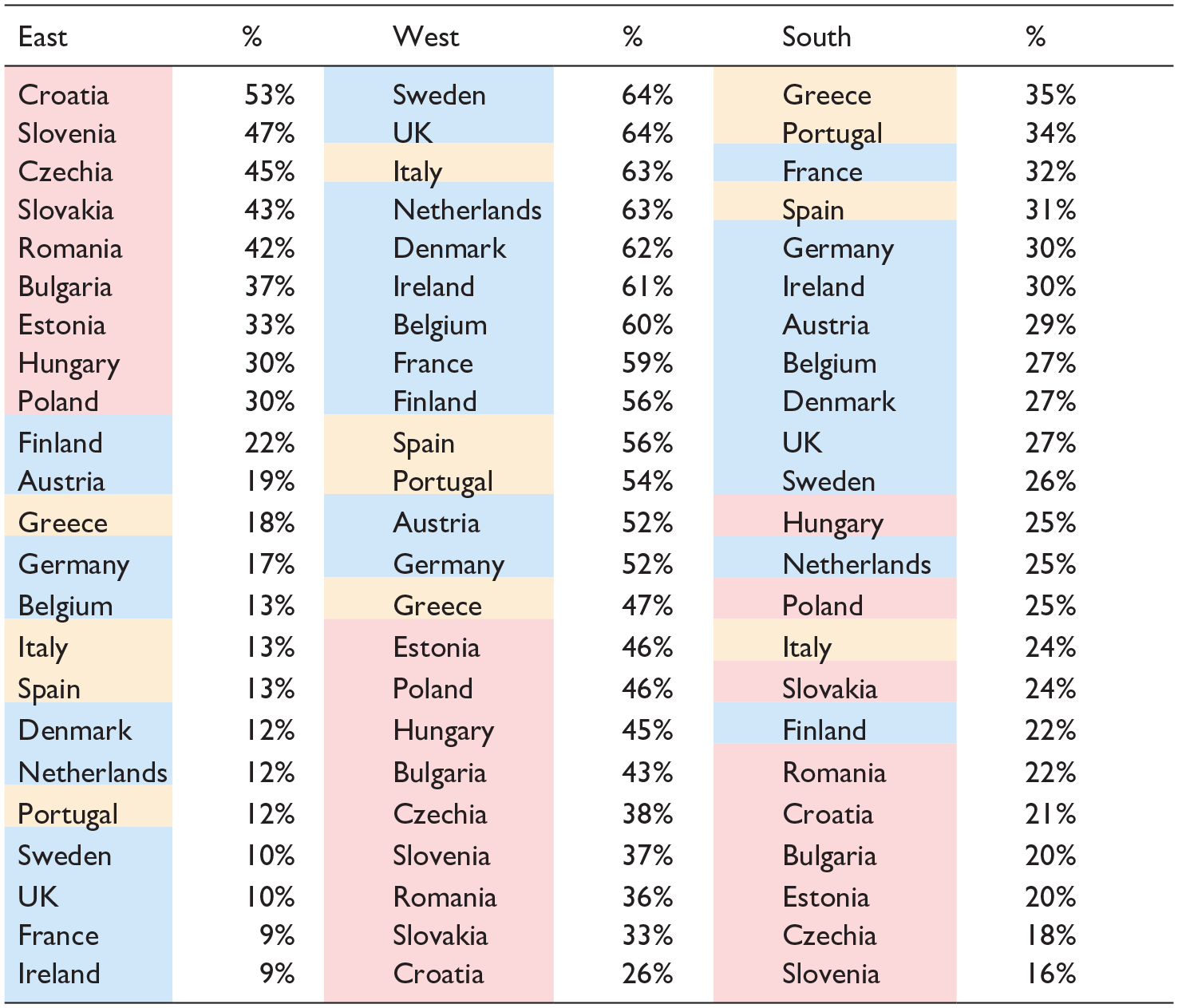
Region: West , South and East .
Turning to Central and Eastern European co-presences, the variation is substantial. For example, 53% of multi-country projects that mention Croatia also mention other Central and Eastern European countries, while only 9% of the projects that include France mention countries located in these regions. Of the Western European countries, it is Finland that has the highest (22%) share of co-presence with the former Eastern Bloc countries, followed by Austria, Greece and Germany – indicating that these are the countries in Western Europe which are studied most often with countries from Central and Eastern Europe. For Western Europe, Norway has the strongest regional preference with 70% of its ties within the region. 3 Italy is the country outside of Western Europe studied most often with countries which are part of Western Europe, and Estonia is the country with the highest share of western ties among Central and Eastern European countries with 46%. The difference between the regions is not entirely driven by geography. Geographically there is little distance between Slovenia and the southern countries, but along with the other Eastern European countries they are rarely mentioned together.
Finally, in Table 4 we can see there are 290 projects mentioning at least two countries as cases – of these, 106 consider only a single region; 23% of projects are solely within the west region and 85% of the projects include at least one western case, while 34% include a case from Central or Eastern Europe and 20% of the cases are between all three regions.
Regional patterns of co-mentions in projects featuring multiple countries as cases.

From the table, we can see that East–South relations are rare – with only 2% of projects studying country cases from the east and south together and only 16% are without a western case. This is to highlight that while the EC has clearly promoted and endorsed international comparisons and collaborations, there are still substantial patterns of inequality in how regions are compared and studied as country cases. And, while we note that the western region contains much of the population in Europe, Western Europe is still largely overrepresented based on size alone.
In short, based on a quantitative analysis of countries represented as cases in the FPs, clear signs of a differentiated Europe emerge with patterns showing certain countries and regions with more or less status. Throughout the analysis we found a clear dominance of Western European countries over both Southern and Central and Eastern European regions. This was true in relation to how often Western European country cases are studied, patterns of other countries they are studied together with, and how often researchers from these countries can design and coordinate projects about their own context. In line with this analysis, we also find that countries are most often analysed together with other countries from the same region, suggesting specific social issues are allocated to individual regions and that countries serve as model cases for region-specific scientific questions.
Unequal status of nations and implications for knowledge production: A qualitative analysis
While a macro analysis provides a picture of patterns and frequency at which countries are included as cases, it also raises questions about the implications of these results. In other words, how do these imbalances in country cases and their status shape the process and outcomes of European social science research? Building on our quantitative analysis, the following sections expand on these results by exploring the construction and collaborative practices taking place within EU FP projects. First, we consider the consequences of a poor fit between cases and project design, showing how knowledge production can be distorted when projects and epistemic choices are inadvertently built around model countries. We then turn to the misconception that simply the inclusion of certain countries as a case or participant will necessarily facilitate more nuanced knowledge that better represents these spaces. In this, we highlight how the relative ‘weight’ or value of knowledge from and about certain countries is not only tendentially built into EU research designs, but also continually reproduced throughout the research processes through assessments of empirical insights as more or less analytically relevant.
Poor case fit
Particularly within the FPs, the EC makes the ambition clear for social science projects to produce knowledge that leans towards broad applicability rather than conditional or overly context-specific research (European Commission, 2016). These expectations from the EC and evaluators are subsequently built into research designs by scientific coordinators, often as implicitly understood conditions for successful proposals. Consequentially, these circumstances manifest in similar project designs that unite the various partners and disciplines under an overarching theoretical framework and employ cross-country comparisons or multiple country cases with distilled and concrete applications and outcomes. This means FP projects are habitually designed to produce knowledge about different country cases whilst utilising uniform or comparable methods. Participants in several projects discussed how this worked when dealing with multiple country cases: What needed to be done was [to] think methodologically on how to get 27 reports from 27 member states about [topic of the work package]. I developed some guidelines for these 27 reports [and] it was a great responsibility to be working on something that really needs to be workable in 27 different contexts. What [the coordinator] stressed in the very beginning is that what matters is having the deliverables in good quality and having 27 comparable reports that kind of talk about the same thing.
Another researcher describes the comparable approach used: The [work package] goal is to code and analyse [government forum deliberation] from the different countries and identify the different [topic] dimensions in there and in the country case studies, but also be able to compare the different countries with regard to [themes and discussions in the work-package].
This commonly used research design in FP projects works not only to create synergy across different work packages in punctuated projects that span multiple years, but also to ensure that partners and teams within work packages who collect, code and analyse data on various country contexts have clear and uniform epistemological and methodical guidelines and a shared coordinating language (Fishberg, 2022). However, while uniformity works well to explore various contexts, we echo Law (2004) in claiming that standardisation in both theory and methods can be poorly adapted for studying deviation from the ‘normal’. This means that certain cases or country contexts will have a better or worse ‘fit’ when employing uniform methods.
One researcher described such an instance of poor ‘fit’ when faced with adapting the project methods to his context of Poland. The work package was built around the different partners finding, coding and analysing a particular formalised national genre of EU debate in each country context. He explained that the type of debate being studied is rarely formalised in the Polish context and had a more difficult time finding comparable data to analyse in comparison to his colleagues working on other country cases: The problem and the frustration here when we’re looking at our national context is that it’s not mapped, because it’s not a part of the country discourse to speak about [this political issue]. I mean, it seems very distant. I guess, other countries might have [these formal debates] more, but in Poland, there are not many of these [. . .] it could be considered a flaw in the project design, and [also] methodologically because it’s difficult to define [this genre of debate], but once [the project] defines it clearly, then a lot of things that might be in there [in the Polish context] won’t get in . . . but this is the project that got funding and we have to get the deliverable. It won’t be mapping it fully . . . it won’t be answering all the questions.
By underlining a poor fit between project methods and the case, this researcher illustrates the potential for standardised or uniform methodological approaches intended for creating comparable data to produce a type of skewed knowledge. While this project may have been formulated without a specific country as a model, it was designed to better capture or ‘fit’ country contexts that are positioned more centrally in the EU epistemic landscape. And, as we found in the first part of this analysis, most FP projects include at least one or more country cases from the northern/western region, meaning it may happen that methodological specificity for other regions will be limited. This exemplifies how some country cases can become model cases, while more peripheral EU countries, in this case Poland, can be less accurately represented by the methodological approach – incidentally (re)producing a relative epistemic positioning of nations and compelling knowledge production about a given country context to fit the standard methodological approach.
In addition, the researcher quoted above alludes to the power of a contractually binding grant agreement made with the EC that works as a relatively strict roadmap for the research and concretises the research problem, methods and planned deliverables at the start of each project. Though there is usually an amount of interpretive space allowed by the EC and project evaluation boards, the possibility of deviation from the original grant agreement is limited. This means that if the research design or methods are found to be ill-fitting for certain country cases during the project, it is unlikely that significant changes will be made – as this scholar explains, this is the project they received funding for, so this is the deliverable they will write up. His account acts as a window into the ways that the relative epistemic status of nations, and the value of knowledge about them, can be built into a research design at the outset, and the consequences this can have for large-scale EU research.
Representation without prioritisation
The general policy ambition of the EU to produce scalable EU solutions tends to materialise in projects as a north–east or north–south ‘balance’ in the selection of country cases. This can also be seen reflected in country-case selection from our quantitative analysis, showing that although western country cases are overrepresented, several projects still appear to consider a geographically well-represented Europe. Still, the notion that the epistemic status of nations, and the relational status of country cases, can impact the ‘weight’ or value of knowledge suggests that simply including peripheralised countries as cases (and associated scholars to advocate for these cases) does not naturally or necessarily lead to more representative knowledge. This is to say, even when peripheralised countries are selected as cases in large collaborative EU projects, the value and specificity of knowledge about these cases tends to be overshadowed, or even dominated by knowledge for and about cases which are more centrally positioned and more likely to be considered generally relevant and applicable.
Here, a researcher responsible for producing qualitative interview data about her own country context explains that coming from an Eastern European country means she approaches the work-package topic in a specifically critical way: I’m coming from a small country outside the euro-zone, which is not very well represented in the executive level of these agencies or structures that we are looking at. Perhaps I think I have a specific take on the research topic . . . – someone from the [agency] told me, ‘you people from Eastern Europe are always so critical of [us]’ and we both laughed . . . So, it’s a completely different perspective . . . And usually, in interviews I’m the one pushing [critical questions about Eastern European countries], because I’m the one who’s interested in it.
However, when it came to the FP project interviews, she was hesitant about a critical approach and asked for feedback on her interview guide and style. She recounted her work-package leader advising: . . . ‘give [the critical questions about the topic] a little bit less, and then perhaps if there’s time you can comment on it because I understand that its interesting for some of the publications that you might want to do in [an Eastern European journal] later on’. Not directly stemming from the project but like a by-product of the project. Just give them less weight and concentrate on [the work-package and deliverable] because this is very important.
Here, her work-package leader signals that the potential critical and topical knowledge contribution, coloured by experiences from an Eastern European context, is better suited for a separate publication in an Eastern European journal rather than as a valuable contribution to the deliverable. And, while the EU project explicitly includes country cases in Eastern Europe, his recommendation implicitly places critical knowledge about the eastern context into a category that is interesting and relevant specifically for Eastern Europe, rather than the EU deliverable which is intended to represent generally applicable or abstractable knowledge which is useful for the EC.
Notably, the inverse process can also occur. Certain knowledge about peripheralised contexts can be privileged as ‘good’ or ‘proper’ when it aligns with empirical material coming from more central contexts. Such was the case with the researcher quoted below coming from another CEE country, who was tasked with conducting interviews for a CEE context. He said: [Another project member did similar interviews] and you can really hear the same things, like how [our data] reflects the thoughts of for instance of [participants] in the Netherlands or [participants] in Germany, and you can see they all have the same similar doubts or think [that] the system has weaknesses in similar points and then you’re kind of encouraged to say ‘okay then I’m doing good’. It seems really that there’s some consistencies not only in the approach but in the results we’re getting from the research activities.
This researcher assessed the quality of his work in relation to his colleagues, reproducing the notion that countries such as the Netherlands and Germany might be considered model countries. Thus, when the results pertaining to his own context aligned with these countries, he evaluated this to mean that his work was going well.
Important to note here is the means and process through which certain knowledge becomes peripheralised within EU FP collaborative project work. Like the previous example, where a rigid grant agreement and pre-promised deliverables were used as justification for overlooking a later found ill-fitting methodology, the work-package leader referred to above points towards a similar explanation for advising this scholar to put ‘less weight’ on the critical questions she might have. The interaction between this researcher and her work-package leader, and the advice she was given, illustrates how the relative value of knowledge produced about different cases is not only concretised at the start of the work in the project design but can also be habitually reproduced and reinforced during the process of research by continually returning to the grant agreement and inadvertently deeming some empirical data or case deviations more relevant than others. Further, while it is a generally applicable issue to face discrepancies between contractual agreements to funders and the actualities realised during the research process, we maintain this is a uniquely urgent matter in large, multi-partner and multi-case transnational research projects. These projects tend to have large budgets and stricter evaluation processes, meaning a high degree of rigidity when it comes to the agreed-upon project design and little room for deviation during the research process.
By introducing the concepts of a poor case fit and representation without prioritisation, the qualitative portion of our analysis provides insight into how imbalances in the epistemic status of nations work to shape the practices of social science collaborations and ultimately the potential knowledge produced. The consequences of certain country cases having a poor fit with the research design, theory or methods stem from a tendency for projects to be designed by and about dominant European countries which are disproportionately and often inadvertently studied as model cases. These countries are considered to have wider relevance and applicability, resulting in distorted or simply excluded knowledge about less privileged cases in order to fit a comparative research design – as was the case for the researcher quoted above. We emphasise that representation of a country, as a case or through the inclusion of participants, does not necessarily remedy this skew towards dominant countries or equate to better knowledge about these cases. Relayed in the experiences of participating researchers, the devaluing of particularised knowledge from and about certain countries or regions can be continually reinforced during the entire research process, justified by reliance on a fixed project design, formulated with consideration for more privileged country cases.
Conclusion
Drawing on both quantitative and qualitative data, our analytical findings are twofold. We show that certain countries and regions across Europe are most often neither studied in and for themselves as single-country cases nor do scholars in institutions from these countries have as many opportunities to design or coordinate projects about their own contexts. We also point out how these geopolitical imbalances can manifest at the everyday collaborative level and how this can work to shape the process and outcomes of the research produced.
By raising questions about the ‘where’ of EU transnational collaborations, focusing on epistemic attributes rather than the participatory optics of projects, we aim to not only reflect on the structures and strategies of science funding in Europe but also to further unsettle discussions around global epistemic inequality within academic theory and practices.
Though it is undeniable that the global knowledge economy is centred on elite institutions and metropoles, thinking with the frequently used notions of a Global North and Global South in discussions about geopolitically shaped epistemic inequality can be limiting. This language, which is often a helpful heuristic tool, can also explicitly and implicitly work to neglect the acknowledgement and study of epistemic inequalities for people and institutions across Central, Eastern and many Southern European countries that do not fit clearly into this division – both in where they are located and how epistemic imbalances materialise. Throughout our analysis, we show that epistemic inequality and the many ways it goes overlooked can distinctly manifest in academic practices in relation to these socio-historically specific spaces. We suggest taking this seriously means incorporating a more intra-regional focus into discussions about an unequal global knowledge economy and finding appropriate language for studying how this shapes knowledge production. For example, this would mean considering intra-European inequalities or inequalities between different countries in the Global South, rather than placing primary focus on macro-divides between the Global North and Global South.
Here, we return to a normative critique of EU research funding – specifically the kind of large, collaborative social science projects that have unmistakably become characteristic of the Framework Programmes and other comparable research funding instruments. Efforts aimed at measuring and addressing inequality in transnational research collaborations are primarily directed at the exterior-level optics of projects, e.g. monitoring which countries receive funds and the countries and institutions that are included in consortia. Consequently, researchers adjust for this, and checking a symbolic box for ‘geographic balancing’ has come to be an implicit consideration for winning funds.
With growing national and institutional management demands for researchers to show they are ‘collaborative’, ‘multidisciplinary’, and above all ‘international’, these buzzwords have become both implicit and explicit means by which to evaluate social research and researchers. To de-naturalise and de-neutralise these vague evaluative criteria is to recognise the tendency of research funders to focus on the checking of participatory boxes and call attention to the various epistemic choices made throughout projects – privileging specific countries or regions in the various aspects of research designs and causing real consequences for the social knowledge being produced. Within the European context, these oversights can leave us lacking profound knowledge about the diversity of European societies and their common and individual concerns. In turn, the possibilities for social science to inform ongoing conversations become limited, both within Europe and globally.
Large-scale transnational collaborations, like those supported by the EU, are a lasting fixture. These funding initiatives serve as arenas where researchers confront the intricate interplay of socio-historical assumptions and geopolitical dynamics perpetuated by institutional structures and global academic practices. However, for notions of equality, diversity, inclusivity and internationalisation to become more than superficial rhetoric, meaningful participation in these endeavours demands critical engagement with politically shaped evaluative criteria and procedures. This involves more than just fostering balanced participatory perspectives at project initiation; it necessitates a continual and deliberate consideration throughout the entirety of the collaborative knowledge production process.
Footnotes
Appendix A: Data selection
For each Framework Programme, we identify the calls, funding schemes or groups of funding schemes that are specifically for the social sciences or with a clear majority of SSH projects. The selection criteria for each Framework Programme are based on reports that collect and monitor the inclusion of SSH in the Framework Programmes. Note that we did not harvest the projects directly from the reports but used the reports to navigate the CORDIS register. We have provided a small R-code snippet to illustrate the selection. The high number of ERC projects reflects a longer time period.
Appendix B
Project selection for ethnographic work.

| Geographic location(s) | The geographic location(s) of the coordinating and participating countries was an essential consideration in project selection. To the best of our ability, projects were chosen that included a wide spread of national affiliations and differing regional collaborative patterns. |
| Prestige of coordinating institute + partners | Institutes and partners were considered with regard to their varying ranking and professional and academic capital. This was important for exploring differing collaborative relations between researchers and institutions. |
| Degree of pre-established collaborative relationships | To help inform our selection, we conducted a preliminary internet-based search to assess whether the researchers involved had publicly worked together on previous EU projects or had published together in the past. |
| Number of project members | The number of project members was considered both to assess the practicalities of ethnographic work and to choose projects that were of different sizes. |
| Disciplines included | Based on a preliminary internet-based search, we considered the disciplinary makeup of each project before selection and how this might affect how different social science disciplines work together in the separate EU projects. |
| Empirical subject matter | The empirical subject matter was considered in the selection of projects to assure the study of different kinds of research. Additionally, we considered how empirical subject matter might influence members or institutions included and how collaborations unfold; e.g. a project about MENA might include and involve a different partner network and dynamic than an EU governance project. |
Appendix C
Search terms for each country.

| Country (EN) | Country | Demonym |
|---|---|---|
|
|
Österreich | Austrian |
|
|
Belgien | Belgian |
|
|
Bǎlgariya | Bulgarian |
|
|
Republika Hrvatska | Croatian |
|
|
Cyprus | Cypriot |
|
|
Czechia | Czech |
|
|
Danmark | Danish |
|
|
Eesti Vabariik | Estonian |
|
|
Suomi | Finnish |
|
|
République française | French |
|
|
Deutschland | German |
|
|
Ελλάδα/Hellenic Republic | Greek |
|
|
Magyarország | Hungarian |
|
|
Ísland | Icelandic |
|
|
Éire | Irish |
|
|
Yisra' el | Israeli |
|
|
Italia | Italian |
|
|
Lietuva | Lithuanian |
|
|
Lëtzebuerg | Luxembourger |
|
|
Nederland | Dutch |
|
|
Norge | Norwegian |
|
|
Rzeczpospolita Polska | Polish |
|
|
República Portuguesa | Portuguese |
|
|
România | Romanian |
|
|
Republika Srbija | Serbian |
|
|
Slovensko | Slovak |
|
|
Slovenija | Slovenian |
|
|
España | Spanish |
|
|
Sverige | Swedish |
|
|
Schweiz | Swiss |
|
|
Türkiye | Turkish |
|
|
England | English |
For the United Kingdom we also include the terms: Scotland, Wales, Northern Ireland, British and Britain.
Acknowledgements
We would like to thank the research group Global Political Sociology for productive comments on earlier drafts.
Funding
The research was conducted as a part of the research project ‘The European Field of Social-Scientific Knowledge Production: Explaining Emergence, Structure and Outcomes’ funded by the Independent Research Fund Denmark (grant no. 7024-00054B).