



Abstract
This article explores epistemic injustice in the context of border crossings. In many contexts around the world borders are fortified not only through walls, fences and guards, but also through knowledge claims about human mobility. We can conceptualise these types of claims as ‘epistemic borderwork’. This article discusses 39 semi-structured interviews with people who crossed the English Channel irregularly, primarily in small boats. These testimonies are less heard in public debate on irregularised Channel crossings. In making such voices visible and audible, we can create an imminently productive dynamic: epistemic friction. Coming from a position of epistemic injustice, we argue that such border knowledge has the potential to act as a powerful tool of disruptive epistemic friction.
Introduction
In many contexts around the world borders are fortified not only through walls, fences and guards, but also through knowledge claims about human mobility. For example, government ministers might consistently represent refugees as criminal ‘illegal immigrants’ ‘breaking into’ a country, or smugglers as causing rather than facilitating cross-border movements. We can conceptualise these types of claims as epistemic borderwork (Davies et al., 2023; Tyerman & Vaughan-Williams, 2025). Epistemic borderwork serves to amplify perspectives which are consistent with state interests and policy agendas, while ‘silencing unwanted voices, and shutting out perspectives that expose the injustice of the border itself’ (Davies et al., 2023, p. 169). In this article we centre the ‘silenced, unwanted voices’ of people by focusing on one particular borderzone, the English Channel. We do this not only to add novel empirical data, but furthermore to advance the theorisation of such testimonies beyond ‘giving voice’. Building on earlier work undertaken by our team (Davies et al., 2023), our contribution is to situate the testimonies of people who have crossed borders irregularly in the context of ‘epistemic injustice’, and argue for theorising such interventions as opportunities for ‘epistemic friction’, and political possibility.
Important research in recent years has foregrounded the role of agency in shaping international migration, in a context where critical migration scholars have tended to overemphasise the power of states (see for example De Genova, 2017; Scheel, 2019). Migration, then, is a complex process which is in no small part driven by the agency of individuals, within a constrained set of choices. People play an active role in shaping their own mobility projects, and in navigating systems of control, as well as resisting them (see for example Squire et al., 2021). Fundamentally, this perspective shifts the focus from people on the move as passive in the face of authorities, to active participants in the dynamics of migration. As active participants, people produce and share knowledge, and contingently trust and use the knowledge of people they encounter, including those popularly framed as ‘smugglers’.
At the same time as being active participants, people on the move are nevertheless actively silenced in state accounts of migration. Epistemic borderwork serves the status quo, and shapes the ideological and material functions of the border. For example, Davies et al. (2023) show how violent pushbacks on the Croatia–Bosnia border are hidden, in part, by framing people who are seeking asylum as ‘illegal’ and therefore criminal, meaning that their testimonies of torture and forced expulsion can be readily dismissed as untrustworthy. We conceptualise this as a practice of politically implemented ‘muteness’ and ‘unhearing’ – a kind of testimonial deprivation – of unwanted voices and knowledges which is predicated on a representation of racialised refugees as unthinking and irrational. As Bergholm and Toivanen (2022, p. 54) write of the European Union, ‘the practice of ignorance towards refugees’ own forms of knowledge stems from a specific understanding of migration and refuge that concentrates on the lack of something, be it knowledge, skills or even capability’. In this article we reject this racist tautology by recovering and giving authorial voice to ‘refugee knowledge’ (Bergholm & Toivanen, 2022): that is, the archive of knowledge, experience and skills that refugees possess.
Fricker (2007, p. 1) argues that epistemic injustice is ‘a wrong done to someone specifically in their capacity as a knower’. This is where ‘social disadvantage can produce unjust epistemic disadvantage’ (Fricker, 2007, p. 2). She identifies two types of epistemic injustice: testimonial, where people are not seen as credible, and hermeneutic, where their account conflicts with collective understandings and as such they cannot be understood as knowers. Both might apply to people who cross the Channel irregularly (more of which below), who find themselves in a situation of epistemic injustice, alongside many other material injustices. Fricker’s framework is important for understanding how epistemic borderwork acts to produce epistemic injustice. However, just as the agency of people on the move can disrupt the overdetermination of state power, we argue that their testimonies can disrupt the episteme of the border. In foregrounding the counter-hegemonic truth claims of our research participants, we thus hope to create ‘epistemic friction’.
Medina (2019) draws on the case of historic racist lynchings in the USA, to understand epistemic power. He writes that ‘there are epistemic distortions that render phenomena of racial violence relatively invisible or excusable, as unavoidable aspects of social reality’ (p. 22). While focused on a different context, insights aptly apply to the case of borders and international migration. Those who seek to cross borders are often ‘rendered invisible and inaudible . . . and their epistemic agency is diminished in practices of public deliberation’ (Medina, 2019, p. 24). In making such voices visible and audible, we can create an imminently productive dynamic: epistemic friction. Epistemic friction entails ‘turning the spectacle against itself and forcing viewers to inhabit it differently, critically’; forcing people to ‘step out of the perspective of the mere spectator’. This means comprehending people’s experiences and embodied perspectives or sensibilities, seeing from the perspective of ‘those who have different sets of eyes and bring with them different sets of experiences’ (Medina, 2019, p. 31).
What kind of knowledge is ‘lived experience’ in this context? It is a racialised experience, and a subordinated experience. In another context Al-Saji (2024, p. 121) argues that the lived experience of colonialised peoples was ‘not simply a description of racialised or colonialised experience’, but a way of being and knowing that is structured by the ‘racist everyday of the colony’ (Rajaram, 2022, p. 39). Echoing this, we argue that people’s hopes and memories of crossing the Channel are not merely descriptive accounts of their lived experiences. Through creating epistemic friction, they hold the potential of resistance and transformation.
In the next section we introduce the English Channel case study, following which we describe our research methods. In the subsequent sections we show how the narratives of irregular Channel crossers have the potential to create epistemic friction in a context of epistemic injustice.
Small Boat Channel Crossings
Small boat Channel crossings have become a key political issue in the UK. Irregular journeys via the sea route became the dominant route of people seeking to cross from France to the UK to claim asylum in 2018 (though they have a longer history). In the years since, politicians have competed to propose a mixture of ‘solutions’ to the phenomenon, from the performative cruelty of sending people to Rwanda, to technocratic fixes to the asylum system, and criminal justice responses to those who facilitate the crossings (popularly known as ‘smugglers’). There is a growing body of social science research, including within sociology, which has sought to understand this phenomenon. That includes analysis of the policy and legal dynamics, the political discourse, the situation in Northern France, the political economy of the borderzone, and media representations (e.g. Benson & Sigona, 2024; Bonansinga & Forrest, 2025; Borelli, 2021; Davies et al., 2021, 2024; Dobbernack, 2025; Mayblin, Davies, et al., 2024; Mayblin, Turner, et al., 2024; Neylon, 2025; Parker et al., 2022; Shepherd, 2025).
Epistemic borderwork serves to present a narrative about the Channel crossings in which a set of truth claims have become self-evident. These include: France is a safe country; people who seek to cross the Channel have no logical reason to do so; they are therefore in fact criminals; smugglers are ‘evil’ and profit from human misery; states have moral obligations to intervene to save refugees; smuggling is a driver of irregular migration; and criminal justice solutions and fortified borders are the solution to Channel crossings. Such accounts have been framed as ‘fantasies’ (Mayblin, Turner, et al., 2024; Taggart et al., 2025), ‘spectacles’ (Dobbernack, 2025; Neylon, 2025; Parker et al., 2022), discourses of ‘risk’ centring threats to the state (Jacobs, 2020) and situated against the backdrop of Brexit (Benson & Sigona, 2024), racism (Lewicki, 2024; Mayblin, Turner, et al., 2024), and right-wing populism (Bonansinga & Forrest, 2025).
The less heard and unwanted voices are those with different accounts. This might include aid workers, activists (see Scharenberg & Rees, 2024), academics and left-wing journalists, but most centrally it relates to those who cross the Channel by small boat. Within this article, we explore counter-knowledges of the border from the perspective of those who have crossed the Channel in small boats or lorries. This knowledge presents a completely different reality to that which is described by political elites and policymakers. In this account, France emerges as a dangerous country for people of precarious immigration status; people attempting to travel to Britain to seek asylum have no choice but to cross the Channel irregularly; they are seeking asylum from tyranny and conflict; smugglers provide a service to cross in the absence of more safe and desirable alternatives; and criminal justice solutions and fortified borders are the cause of small boat Channel crossings and concomitant deaths, not a means of stopping them.
Empirically, this article therefore offers an important contribution to research on irregularised Channel crossings, which disproportionately centres the policy and political sphere. While other research has centred the experiences of irregularised migrants who have encountered this borderzone, especially on the French side (for example, Davies et al., 2017; Godin & Donà, 2021; Welander, 2021), as far as we are aware, only one other team has interviewed small boat Channel crossers. López and Ryan (2023) included some people who crossed via this route within their larger sample of Afghans who travelled to the UK, and some of our findings align with theirs. Nevertheless, our exclusive empirical focus on the experience of crossing the Channel irregularly is novel. We make not only this specific empirical contribution, but more significantly a theoretical contribution: situating such testimonies in the context of epistemic injustice. We furthermore foreground the potential ‘epistemic friction’ created by such testimonies as a tool for political resistance, as well as scholarly knowledge production. Indeed, we contend that important research such as that of López and Ryan (2023), and others who centre the journey narratives of people on the move in different contexts, could be read as and mobilised for epistemic friction. How to make public debate beyond academia more frictionful is then another challenge.
Methodology
This article is part of a broader project, funded by the UK’s Economic and Social Research Council which explores UK government responses to small boat Channel crossings. The project ran from 2022 to 2025, but incorporated analysis of a longer time period – both in terms of policy analysis, and in relation to learning about the lived experiences of people who have crossed the Channel irregularly. This article focuses on one part of the project, interviews with people who have crossed the Channel irregularly, mainly using small boats.
The research reported here was reviewed prior to commencing by the University of Liverpool ethics committee. The interviews were conducted by a team of five research assistants and a postdoctoral researcher, who interviewed people in their first languages (co-authors of this article). All research assistants have lived experience of forced migration and extensive work experience in the UK refugee and migrant sector; three were also doctoral researchers with a focus on migration. In this way, the researchers were not recruited merely for their linguistic skills and social connections with the communities focused on in this research, but also for their practitioner and academic expertise in migration and refugee studies. In the context of this article, it is important to stress that we do not use ‘community researchers’ to describe the team of researchers who conducted the interviews. Instead, we refer to them as ‘research assistants’; and where we use ‘community researchers’, it is simply to highlight it as the dominant phrase in the literature, but not one we are applying to describe our team of research assistants.
‘Community researchers’ are able to communicate with people in their first language, which makes it easier to articulate complex experiences and feelings, removing the need to work with an interpreter who may not have research experience. They can aid in accessing ‘less heard’ voices, in developing interview schedules and offering relevant, culturally specific advice on both the types of questions asked, and the answers provided (Goodson & Phillimore, 2012). But at the same time, there are potential ethical issues raised in research involving ‘community researchers’. Important critical work has been written on the exploitation of ‘local’ researchers in Global South contexts, where researchers can be used for their linguistic skills but are then left unacknowledged in publications (Kaplan et al., 2020). Cognisant of this, we sought to draw upon the expertise of the research assistants in a meaningful way, and to ensure that they were appropriately remunerated for their input, and named on publications emerging from their work.
The research assistants in this project gave feedback and translated the interview questions, information sheet and the consent form for participants into their first languages. They also contributed to whole team discussion and planning sessions, where proposed interview schedules were debated and the translatability of concepts and questions into different languages discussed. But just because someone speaks the same language as another person, that does not mean that they have anything else in common or will automatically build rapport. Alongside bespoke research training and ethical practice discussions, the research assistant members of this team were also experts in refugee and migrant rights issues, with existing knowledge and experience of high relevance to the topic at hand.
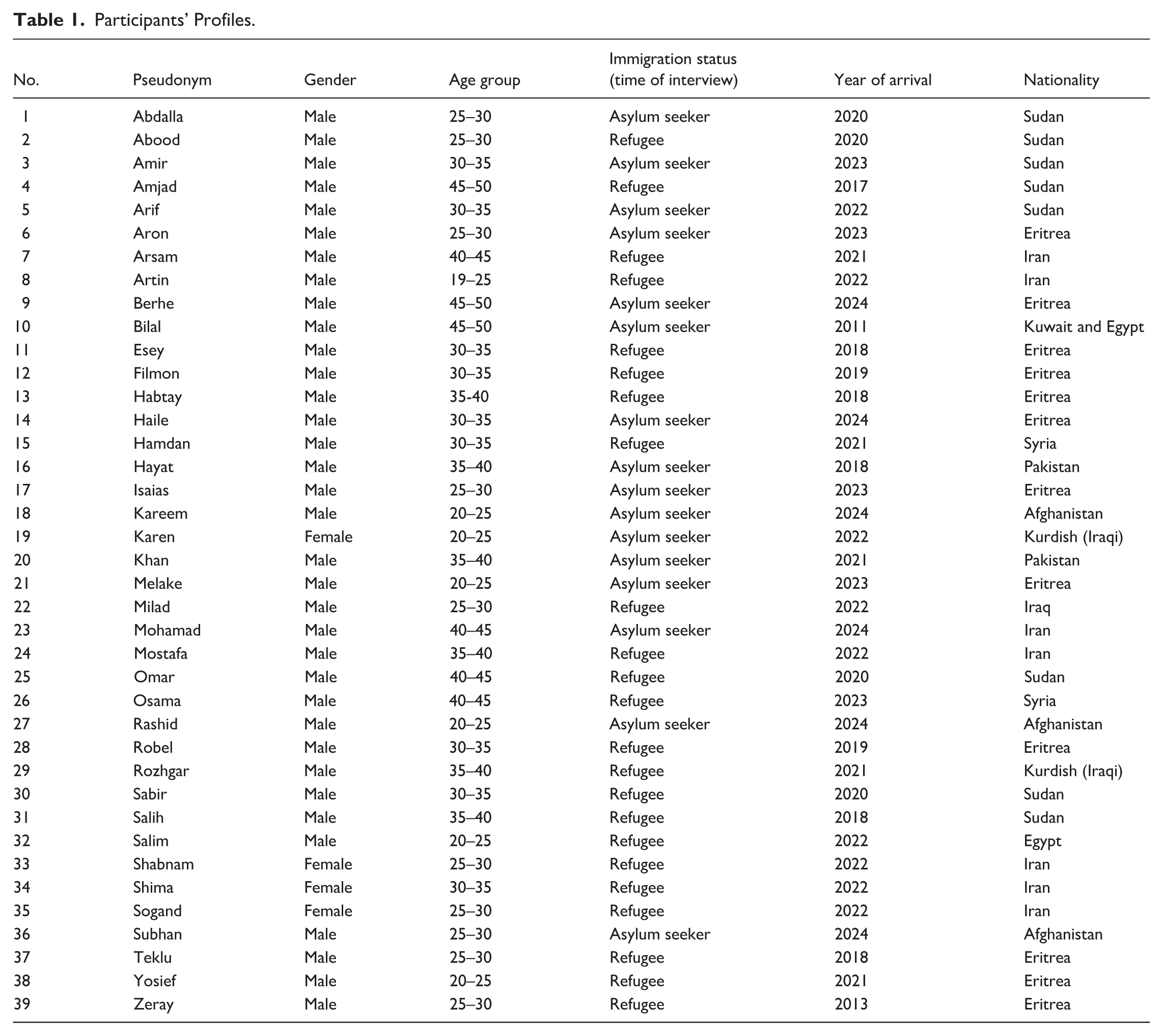
Interviews were conducted in Farsi (6), Arabic (12), Tigrinya (9), Blin (2), Pashto (5), Kurdish (4) and English (1), and lasted on average one hour. Information about the participants is showing Table 1. Thirteen crossed the Channel by lorries, while the majority (26) arrived by small boat. Informed consent was sought, both written and verbal, in interviewees’ first language. All names in this article have been changed.
Participants’ Profiles.
Because of the size of the team, the interview schedule was structured, but inevitably the interviews did not always address items in their set order. The interviews were simultaneously transcribed and translated into English. In addition to this, five other interviews were transcribed and translated by a translation company. All interviews were coded thematically and inductively by the lead author, using Atlas.ti software. We followed Braun and Clarke’s (2021) six-phase, reflexive method for identifying, analysing and reporting themes in qualitative data. Coding was completed by one team member for consistency, but discussed and sense-checked with the team as a whole.
Our intention was to understand the experience of crossing the Channel in small boats or lorries within the wider context of people’s longer journeys from home and transit countries. We were also interested in people’s knowledge of borders and of destination contexts and policies (such as, at the time, the Rwanda Plan). Perhaps most importantly for this article, we were interested in the emotional and affective experiences of crossing the Channel, and the determined struggle to navigate the dehumanisation manifested through relentless border violence and the necessity of taking this dangerous route to reach the UK. Across the coming sections we discuss the experiences of our interlocutors.
Findings
Knowing the Border, and How to Cross it
In order to successfully cross borders, knowledge, information, resources and expertise are needed. In part, this is the ‘refugee knowledge’ that Bergholm and Toivanen (2022) write about. Refugee knowledge includes knowledge of routes, of prices (and how to negotiate them and arrange payment), of options, of authorities, of geographies, of shipping routes, of policy, of law, of languages, of weather, of seamanship, of swimming, of life saving, of wound care, of camping, of death and of survival. In other words, a vast pool of knowledge is necessary. As Mengiste (2018, p. 57) elaborates, migrants produce a ‘collective system of migratory knowledge’ in which smuggling is used as a vehicle for movement. This knowledge is collectively held and collaboratively shared, but sometimes it comes with a price tag. Some knowledge is gained via friends, some via social media, some via people popularly known as ‘smugglers’ but referred to by participants as agents, brokers, mediators or facilitators (henceforth we use ‘facilitators’), and some through lived experience.
All the people who participated in this research had been on long journeys. These journeys started in Sudan, in Eritrea, in Iran, and elsewhere. So, when we asked them about their journeys to the UK, they did not begin from Northern France, they first told us stories that covered the treacherous Sahara Desert, forced labour in Libya, deadly borders across the Afghan–Iran border areas, Turkey–Greece borders, in the Balkan region and crossing the Mediterranean. In fact, the journeys across North Africa were the experiences most talked about at length as the most difficult experiences that they had faced. It was here that facilitators were consistently described as a source of real and imminent violence, though border and coastguard agents also played some role. Within Europe violence was associated more with agents of the state, such as border guards and police.
Fear, of course, was the reason for embarking on the journey in the first place. But the journeys themselves were then also fraught with fear. Participants told us many stories of the things that they saw on their journeys which still haunt them, and of the terror experienced in different borderzones. Often these stories involved babies, children and women in very difficult situations, extreme cruelty and violence, and encountering many dead bodies or seeing people die along different routes. For some, this made the Channel crossing seem much less scary. Melake, for example, said, ‘for me crossing the Channel was like a piece of cake compared to my experience of the Mediterranean Sea. I was not even scared.’
The most trusted sources of knowledge and information about the UK/French border in Northern France are families, friends and facilitators. The last of these may not always be trustworthy, yet nonetheless are important sources of information. While epistemic borderwork entails representing facilitators as ‘evil’ and a danger to people on the move, it was agents of the state – police or border guards – who were also understood to be a source of repression and violence amongst our participants. This is an important counter-narrative to the claim that France is a ‘safe country’ and people therefore have no reason to leave. The contradiction foregrounds hermeneutic injustice because it conflicts with collective understandings of ‘smuggling’ as a practice and ‘smugglers’ as a group. In this context, the question of who one could trust, and when contingent or reluctant trust was necessary, was central to projects of survival. Here, facilitators were cautiously trusted for their knowledge of the border.
Left with no choice for safe routes to enter the UK, many people reluctantly put their trust in facilitators with their money, but also with their lives, and the idea of facilitators as the holders of key knowledge was central to this. For some people, this trust was built through living with the facilitators (usually fellow irregularised people temporarily working to fund the next part of their journey) and having long discussions with them about the journey ahead. For example, as Amir explained of his experience in Calais:
The mediator himself may be one of the guys who lives with you in Calais, maybe a [. . .] national or any other nationals who stay in Calais, he lives in the same situation as you live in Calais, who gives you full details about the means and quality of rubber boats. [. . .] I have received information regarding when you choose the suitable time, and the weather, and the sea waves’ level, [. . .] more than 70cm, the mediator won’t allow you to go.
Some participants, then, expressed a deep trust in the facilitators as the only people who had the correct and reliable information that they would need to succeed in crossing the Channel. In other words, their counter-knowledge of the border held epistemic value. This extended to providing information about the UK, as Rashid explained:
I didn’t know much about that but how to cross the border, but my friend told me how they cross the border, and they introduced me to the agents. They told me how the UK is better than France. They were very aware of many things. We had to follow the agent only. They know how to cross the sea and from where they will arrange a boat for us [. . .] Those agents helped in everything. They know about the routes and police too.
Rashid shares the fact that the agents have ‘all of the information’, and help with everything, but it did take him nine months of attempting to cross to be successful. His in-laws made the payment, and it ‘was a huge amount’ (thousands of euros).
Some participants trusted the facilitators in Calais because they perceived them to be more professionalised, reliable, and less prone to violence than those in other border zones. Melake explained his experience:
Yes, they are different from the previous [in other borderzones]. When you get to Dunkirk, the agents themselves approach and ask you if you need their service. They are easily available like an open market. You try to make a deal and would ask them if their service is guaranteed. They try to reassure you that the deal is until you get to the UK and if you decide to stop, they refund your payment. You pay first and you try as many attempts as you can until you get to the UK. They told us that they can refund our payments if we decide to stop trying for any reason. This deal was guaranteed compared to the previous one.
Here we can see that facilitators are not understood by people who wish to cross the Channel as evil and violent villains, they are understood as both the holders of vital knowledge, the means to facilitate (albeit dangerously) a crossing, and businesspeople providing a service. This representation of facilitators is clearly in tension with the epistemic borderwork of states. Putting the two side by side creates epistemic friction whereby the role of ‘evil smuggler’, and the moral state, is no longer settled.
Preparing to Cross
The UK’s border with France in and around Calais was the final border in a long chain of border crossings. This means that many people approached this border already exhausted, with a raft of traumatic experiences behind them, and the mental and physical wounds to show for them. They had known danger, and to know this border was to encounter more danger. The episteme of the border is shaped by fear. Arsam articulated this succinctly:
The only reason for my journey was the presence of my family in the UK. If you are asking about the effect of these experiences on a person during such a journey, I would say you face death thousands of times along the way. You experience poverty, hunger, sleeping in forests, and witnessing how the police in most of these countries, countries that claim to uphold human rights, treat you.
Reaching Northern France exhausted, people then face the gruelling process of crossing the Channel. Preparing for this entails protracted periods of time at the land border in the Calais area. Contrary to popular representations of migrants being forced into small boats by evil smugglers (Dearden, 2024), people discussed with us their long decision-making processes. This drew on knowledge from friends and facilitators, who often offered multiple options, but at different price points. Decisions to travel in small boats are not taken lightly, then; they are rationally based on gathering information and weighing different options.
Rashid explained how some people tried to cross the border by hiding in containers, or in lorries. But he explained ‘a lorry is way more dangerous than a small boat. Many people died because of suffocation.’ Others pointed out that it has become almost impossible to cross in this way because of new security measures. The other option was to travel as a tourist on a ferry. In this case, Rashid recounts, ‘agents make your travel plan and everything, but it was very expensive for me. I had no other option but a small boat that I could afford. Those ferries were a safe way but too expensive for me.’ The small boat, for Rashid, was affordable but not too high risk. Based on careful evaluation of the options, he knowingly decided upon this strategy.
But the sea crossing terrified many. Hamdan explained that on his successful crossing there were 60 people who went down to the beach, but some people were so scared they went back to their camps. He said, ‘they were scared of the sea and that the French police may come and rip up the boat’. Sogand told us about her failed attempt at flying to the UK from Paris with the help of a facilitator. She chose this route because of a deep fear of the small boat option: ‘I was absolutely terrified of that route. I had always heard about how risky and dangerous it was, and the thought of crossing the sea in a rubber boat was extremely frightening.’ After the failed attempt to travel safely in an aeroplane, she was told by the smuggler that it could take six or seven months to set things up with false documents to try again. This induced a new fear:
. . . it was a huge risk because I had no legal status there [in France], and even stepping outside the building was dangerous – if the police caught me, it would be a serious problem.
It was then that she decided to travel with her friend by boat, liaising with the same facilitator.
Milad had a similar level of fear of the boat route but explained that he could not afford another route and he was even more scared of the ‘truck route’ than the small boat route. ‘So, the sea was the only option left. I had no other hope’, he said. He went on, ‘these days, when I think back to that journey, I have no idea how I made it through. At any moment, you could lose your life, never see your family again, and all your hopes could be destroyed.’
Everyone spoke of making multiple attempts (often 8–10) to cross and of living in precarious informal camps in extreme weather conditions and under constant pressure from the French police, for months, or even years. Refugee knowledge of this borderzone, then, is the knowledge that it is formed of structural violence and an absence of human rights. Understanding this means that the greatest risks on land in Northern France come not from facilitators, but from state authority representatives such as police.
In this context, exhaustion was one of the main lived experiences of preparing and trying to cross the Channel. All participants spoke of how the French police demolished their camps or tore up their tents on a regular basis, using exhaustion as an insidious tactic to wear them down and make them leave (see also Hagan & Bachelet, 2024; Welander, 2021). One participant said that when they returned to their camp after a police raid, the trees that they had been camping amongst had been cut down, a practice that has been reported by activists working in the area (see Davies et al., 2024). Sometimes these raids involved physical violence as well. As Aron explained:
This constant upheaval caused immense challenges and left us frustrated due to the discriminatory practices of the police toward migrants. Sometimes, they even forced us out of our tents during rainstorms, demonstrating a lack of sympathy for migrants in their actions. Furthermore, the French police used tear gas and struck people with batons. Consequently, some individuals ended up with disabilities.
The centrality of fear in the refugee episteme of the border is important to draw attention to because epistemic borderwork involves representing people crossing the Channel as people without normal emotions. They are ‘breaking into Britain’, ‘swarming’ or ‘flooding’, not normal people who are cold, afraid and deserving of respect and holding rights (Mayblin, Turner, et al., 2024). This dehumanisation is one of the ways in which their suffering can be ignored, enabled or accelerated. It is an epistemic injustice, but by foregrounding their accounts we create a vital friction with the dominant representations.
Most of this very legitimate fear related to the sea crossing, and fear of the authorities. These two things were intertwined since the police thwarted many people’s efforts to cross by small boat by slashing boats with knives. This led to chaotic embarkations, and many near death experiences. The intensity of the memories of these experiences was evident in the details that many could recall, as though fear had heightened their senses and laid down clear memories. They volunteered the times and dates of different crossing attempts, the time of arrival in the UK, the number of people in the boat, even years after the crossing had been made.
Aron vividly described his multi-layered fears from his time in Calais attempting to cross to the UK:
The challenges we faced were immense. The agents – often Arabs – recruited individuals like us, living in tents with little money, to act as facilitators. Our nightly attempts were relentless. However, danger lurked. Sometimes police drones tracked our movements, signalling the authorities. We spent the remaining hours of each night evading the police and their vigilant dogs. This routine persisted for several nights. Our path led us through thickets and bushes, carrying dingy plastic boats toward the seaside. The risk was palpable – the spiky branches threatened to puncture our flimsy vessels, potentially deflating them in the middle of the treacherous sea.
Channel Crossings
In the Channel the rules are different to on land: state authorities are the only people who might save you from drowning. Sometimes people made it into the sea, but their boat capsized, sank or ran out of fuel, and they were rescued. Khan explained his experience:
. . . water was coming into the boat at a very high speed. We were not able to stop that water from coming inside. It had its pressure and our boat had started sinking to the sea. We were almost in the water when the UK police came there. [. . .] that time we were scared to death. We were thinking that it was the end. We were frozen to death. I was not able to feel even my legs at all because my half body was in cold seawater.
If rescued in UK waters, the UK asylum system awaits (see Mayblin, 2019). If rescued in French waters, you survive but you are back in a precarious situation on land (see Davies et al., 2017).
Hamdan said his journey was expected to take two and a half hours but took nine. He described his fear: ‘I swear I sat down and I thought it was over. I mean, Allah knows, I was scared. I was living in a constant state of fear. It became a normal thing.’ He went on to explain how this experience changed him: ‘When I made the first trip, I was scared and valued my life. But after that, I became numb to my own feelings.’ This experience of praying for survival, and this being a way to convey how scared people were during the journey, was common. Isaias, for example, said ‘we were scared. I always pray to God to protect me. When we went to the water, I was scared and kept praying to protect us. The water was very rough and when you enter the sea you don’t know if you will survive or not.’ Kareem described a similar experience. Their boat lost direction, the person steering the boat was clearly scared and the other passengers, panicked, were shouting at them. He said, ‘that time I saw death standing in front of me’. As he was trying to stabilise the boat, he ‘was reciting Quranic verses and [I knew] it’s the end now. The boat front was upward towards the sky and there were so many people in the boat [. . .]’.
Most people said they did not know how to swim, and those who had lifejackets had mixed experiences with them. Many people had experienced boat sinkings and near drownings. Some of these were close to the shore, some out at sea. Subhan shared how off the coast of Dunkirk:
. . . when we were travelling by boat the police chased us and threw a net on us so that we couldn’t escape. They ruptured our boat with knives as well, and we were about to drown in the sea. Women and children were crying with fear, and I got injured on that trip too.
Subhan described how the French police rescued them in one crossing attempt,
. . . but we were badly treated by the police at that time. They were beating everyone with sticks in their hands and were shouting at us and arrested a few. But I was left due to my injury. I was bleeding badly at that time. I had a bruised eye, and my hand was bleeding due to that strike.
Highlighting these experiences is important because it creates friction with the dominant narratives surrounding irregular movement across the Channel. It shows how Northern France functions as a site of state violence for people on the move, and disrupts the epistemic borderwork of the state, which seeks to portray refugees as exploiting the UK’s goodwill, and represents facilitators as the primary source of border violence. In fact, as the participants’ stories show, the experience of the small boat crossing is one of fear, violence, exhaustion, even while, as we discuss below, it is also one driven by hope and resilience. These are important narratives which trouble the knowledge claims of the UK and French governments.
Determination as a ‘Fact of Life for Refugees’
All of the participants were travelling, they explained, for survival. Underlying this quest to survive was a hope – mainly of safety, of security and peace. The will to survive was explained by Habtay:
All the borders I crossed from Eritrea, to Sudan, to Turkey, to Greece, Albania, Bosnia, Montenegro, Croatia, Italy, France, Belgium, and the UK are guarded by human and technological power. And some of the treatments in the border areas are cruel; but I can tell you even if they put fire in these borders, migrants who are escaping persecution will not be deterred. [. . .] For example, I and many other Eritreans had to cross border areas which were infested with landmines and took the lives of many. This shows you that refugees who escape danger won’t be stopped from crossing these highly guarded borders as long as they are alive. What I want to tell you is that those governments who try to control the borders should try to understand this fact of life of refugees.
In spite of borders people will move, it is a ‘fact of life of refugees’. Across the experiences shared with us we found a complex interaction between hope, which invokes a more active aspiration for an imagined future life, and survival, which invokes necessary endurance of hardship which continues even in moments where hope is dwindling. To know the border is not only to access the right knowledge and information from the right people, nor to experientially know danger and fear, but also to know hope, and through doing so, to survive.
Survival was enabled through the support of charities who hand out food, clothing, toiletries and tents. Berhe explained:
. . . life in Calais was terrible, but the charitable organisations’ support, including food, was good. The weather was freezing, and there was terrible wind. [. . .] What makes this worse is that the authorities used to come and destroy our shelters when it was raining and bad weather.
Of course, mutual aid also plays a strong role – between people together in Calais and across transnational networks of family and community who offer support, money and love. Esey explained how in the harsh environment of Calais, with repeated failed attempts to cross the Channel, hope could dwindle ‘[Calais] is a dangerous place, and it makes many people lose hope. Trying non-stop to cross to the UK for about 6 months was tough. But I had the determination, and I kept trying until the last day.’
People on the move are not passive actors who are controlled by others, whether that be border security agents and technologies, or facilitators. They are the agents of their own lives (notwithstanding structural constraints), making carefully calculated decisions in order to reach a place of safety. Within a constrained set of choices, people play an active role in shaping their own mobility projects, and navigating (and circumventing) systems of control (Scheel, 2019). As researchers we can sometimes overplay the power of states to control the movement of people, and downplay the ability of people on the move to resist these controls. At times we risk victimising people where our real intention is to draw attention to the violence of border regimes. As this article shows, there is fear and violence at the border, but people on the move are not passive victims in the face of it.
Conclusion: Refugee knowledge as epistemic friction
This article has reported on the findings of 39 interviews with people who have crossed the English Channel irregularly. The article makes an empirical contribution to research on the French/British borderzone, and on the small boat Channel crossings phenomenon. This adds to the existing research (noted earlier) on the context of Northern France, and most notably on the experiences of people who have crossed into the UK – with López and Ryan (2023) being the only others to speak to people about this experience that we are aware of. More significantly, we have engaged these narratives as counter-knowledges which challenge ‘epistemic borderwork’ – the production of policy and political knowledge about the border (Davies et al., 2023; Tyerman & Vaughan-Williams, 2025).
Dominant representations of the people who are crossing the Channel in small boats cast them variously as dangerous or stupid (see Mayblin, Turner, et al., 2024). Here, the archetypes of the evil smuggler/trafficker, the criminal illegal immigrant, the innocent victim and the saviour state are represented as the key players engaged in a just battle for border control and border crossing (Sirriyeh, 2018). Counter-narratives are, as we noted in the introduction, ignored and silenced within these accounts. In this way, irregularised Channel crossers are not recognised in their capacity as holders of knowledge because of their social position. They are not seen as credible (they suffer testimonial injustice in Fricker’s terms) and in many cases are not even understood as knowers (they suffer hermeneutic injustice). Fundamentally, we understand this as part of a phenomenon of racialised border violence which is rendered invisible, unavoidable or excusable, by epistemic borderwork because of epistemic distortions (Davies et al., 2023). In order to achieve this, the knowledge and experiences, the epistemic agency, of people seeking to cross the Channel must be (and is) diminished in public deliberation fora.
In this article we have presented these alternative knowledges of the border, with the aim of creating ‘epistemic friction’ (Medina, 2019, p. 30). This entails comprehending people’s experiences and embodied perspectives or sensibilities, seeing from the perspective of ‘those who have different sets of eyes and bring with them different sets of experiences’ (Medina, 2019, p. 31). Adopting Vang’s (2020, pp. 6–7) notion of ‘refugee as a site of knowledge’, we have aimed to show how people crossing the Channel are knowing subjects and narrators on their own terms. We understand people crossing the Channel as knowing subjects who shift the frame of reference for understanding refugees and experiences away from state-led representations.
The value of this learned and embodied knowledge is not only in understanding people’s points of view and understanding their actions. More fundamentally, it is about learning from this knowledge: people are brought to the border by war, persecution, desperation and hope; violence at this border is perpetrated by state representatives; the violence has various temporal paces from the swift injury of a police baton, to the slow violence of destitution; facilitators are the only people who can help people on the move to circumvent this violence (but that does not mean they are the ‘good guys’); people who cross the Channel are rational evaluators of risks, possibilities and constraints based on the knowledge available to them; and they are human beings – fearful, hopeful, improvisational and resourceful, exhausted and determined. To recognise this knowledge is to uncloak the misrepresentations produced in policy and political discourse as part of epistemic borderwork.
Medina (2019, p. 23) writes that ‘in cases of structural racial violence, the activism needed is an epistemic activism’. That is, activism ‘that can wake people up from their epistemic slumbers, calling attention to how they are complicit with vulnerabilities to patterns of racial violence and how they can disrupt their complicity’. What this research shows is the need for much more epistemic friction in public debate on small boat Channel crossings in the UK, and other borders around the world, with the knowledge of people who have crossed at the centre of the discussion.
Footnotes
Acknowledgements
We would like to thank the participants of this research for generously sharing their time, stories, knowledge and experiences. Great thanks also to three anonymous reviewers, whose comments improved this article immeasurably.
Ethical Considerations
The study from which data for this article were generated was approved by the University of Liverpool’s Central University Research Ethics Committee on 3 April 2024 (Ref:12970).
Funding
This research was funded by the Economic and Social Research Council. Grant number: ES/W006170/1.
Declaration of Conflicting Interests
The authors declared no potential conflicts of interest with respect to the research, authorship and/or publication of this article.
Data Availability Statement
Due to ethical requirements, data for this research cannot be publicly available. The participants did not consent to their data being publicly available.