



Abstract

Three years ago we took over as editors of Sociology. In that time we have learned a lot about the challenges and the rewards of editing the BSA’s flagship journal.
As a reminder to our readers, at the start of our editorship we promised to replace the regular editorial foreword with an annual Editors’ Report which would outline the progress of the journal and increase transparency in the peer-review process. This is our third and penultimate Editors’ Report, as our editorship will come to an end in December 2012. We have very much enjoyed this opportunity and are a little sad to think that 2012 will be our last year.
2011 has been particularly memorable for us because it marked the 60th anniversary of the BSA itself. The highlight was undoubtedly the very well-attended BSA annual conference in London in April. In order to commemorate this, we are delighted to open this issue with Ulrich Beck’s inaugural address.
Overview
We are pleased to report that, similar to previous years, the journal statistics for 2011 indicate that Sociology remains a remarkably healthy journal in terms of sales. This is particularly encouraging given the current economic climate and the pressures this places on university libraries. With reference to ‘hard indicators’ of progress, there continue to be good numbers of subscriptions to the journal – in terms of individual ‘traditional’ subscriptions, consortia/collection packages to institutions, and international subscriptions. Impact factor analysis shows that we are holding our own. At the time of writing, the impact factor 1 of Sociology is 1.488, placing the journal 21st out of 129 journals in the Sociology Journal Citation Reports.
Rates of manuscript submission continue to be strong. Most of the submissions are articles (85%) or single book reviews (10%). Table 1 shows the submission figures for articles since 2005. 2 It is clear that submissions continue to rise year-on-year, and the total for the first nine months of 2011 has already exceeded the total for all of 2010. With reference to special issues in particular, our invitation for the 2012 issue on the Human Rights has received a total of 83 submissions over the summer of 2011. This is the largest number of submissions for a special issue during our term as editors.
Submission rates to Sociology since 2004

Raising the Profile of Sociology
Although we hold to a baseline commitment that Sociology is and must remain identifiably the journal of the British Sociological Association, we have explicitly sought to extend its impact such that it can make a distinctive contribution to international and comparative scholarship. To this end, we have actively been pursuing international contributions to the journal over the past year as well as encouraging UK contributors to locate their articles within an international context and increasing the number of peer-reviewers from outside the UK. We are pleased to report that this year nearly half (44%) of our submissions have been from overseas – this is the highest proportion we have received as editors. Not surprisingly, the majority of overseas submissions came from largely Anglophone countries, such as Australia (8%), Canada (4%) and the USA (3%). It is encouraging to report, however, that twice as many manuscripts were submitted to Sociology from authors in non-English speaking countries this year (83 compared to 37 last year).
We have also been working with our publishers at SAGE and the BSA to promote Sociology at a variety of conferences so that we can augment the number of high quality submissions to the journal. Amanda Coffey and Sally Power attended the BSA conference in London earlier in the year, celebrating 60 years of the BSA. They contributed to a BSA ‘meet the editors’ session, and also spent time meeting authors and potential authors at the BSA and SAGE stands. They had productive discussions with colleagues at SAGE at the conference; in particular, thinking about the ways SAGE could support the publicity and marketing of the journal. The conference also provided an opportunity to gather books and suggestions for review in Sociology. We should also formally note that the Sociology SAGE prize for excellence/innovation for 2010 was awarded to Simon Weaver for ‘The “Other” Laughs Back: Humour and Resistance in Anti-racist Comedy’, 44(1): 31–48.
BSA 2012 is being hosted by the University of Leeds with the theme of ‘Sociology in an Age of Austerity’. The editorial board of the journal is setting up a task group to consider ways in which Sociology can be showcased, including organizing sessions and events. We, as editors, will also be in attendance at the conference.
The Reviews Section
One of our initial ideas for the journal which we have most pleased to see come to fruition is the introduction of the Review Symposia. Since 2011, we have included one symposium review – three or four reviews of a single text selected by the editors, published together as set – in each issue and are busy commissioning ahead for 2012 and beyond. The review texts for 2011 were Max Weber: A Biography (Radkau), Ground Control: Fear and Happiness in the Twenty-First-Century City (Minton), Youth (Jones), The Aftermath of Feminism: Gender, Culture and Social Change (McRobbie), Securing and Sustaining the Olympic City: Reconfiguring London for 2012 and Beyond (Fussey, Coaffee, Armstrong and Hobbs), and Cultural Criminology: An Invitation (Ferrell, Hayward and Young).
The reviews section continues to feature review essays, now published regularly, one per issue of the journal; and we are busy commissioning more. Each issue of the journal also features a collection of single book reviews; these are an important part of the reviews section of the journal and will continue to feature in every issue. We have a healthy supply of single book reviews in preparation and are seldom short of offers to contribute, though offers are always welcome – and we particularly welcome offers to contribute review essays. Readers may have noticed that we have moved away from publishing regular lists of ‘books received’ as we have not found these to be the best spur to requests to review (nor are such lists all that representative of the range of sociological publications currently available). We prefer that potential reviewers contact us directly with requests to review any recently published book that has caught their attention, setting out briefly why it is that they think a review of the book would be appropriate for the journal and why they might make a useful reviewer. This new arrangement seems to be working well, though we will continue to monitor the flow of review requests.
Please do note that reviews submitted for publication receive editorial scrutiny and contributing reviewers can expect to be asked to consider revisions for style and substance if these are deemed necessary. This ought to go without saying, but you’d be surprised!
We would like to take this opportunity to thank all our many reviewers for their willingness to contribute their time and expertise writing such stimulating and varied reviews.
Transparency in the Peer-review Process
This report itself constitutes part of our commitment to increase transparency in the processes and practices of the journal. The anonymous peer-review process continues to be the principal vehicle which determines whether or not an article gets accepted for publication. In a significant minority of cases, however, editors take the decision that a submission should not be sent out for peer-review. In those instances, authors are given editorial feedback on why the article is not suitable for publication in the journal. The reasons for an ‘immediate reject’ vary considerably, but generally arise from a manuscript having little sociological content, being far too specialist for Sociology, being poorly written or not making any original contribution to sociological scholarship.
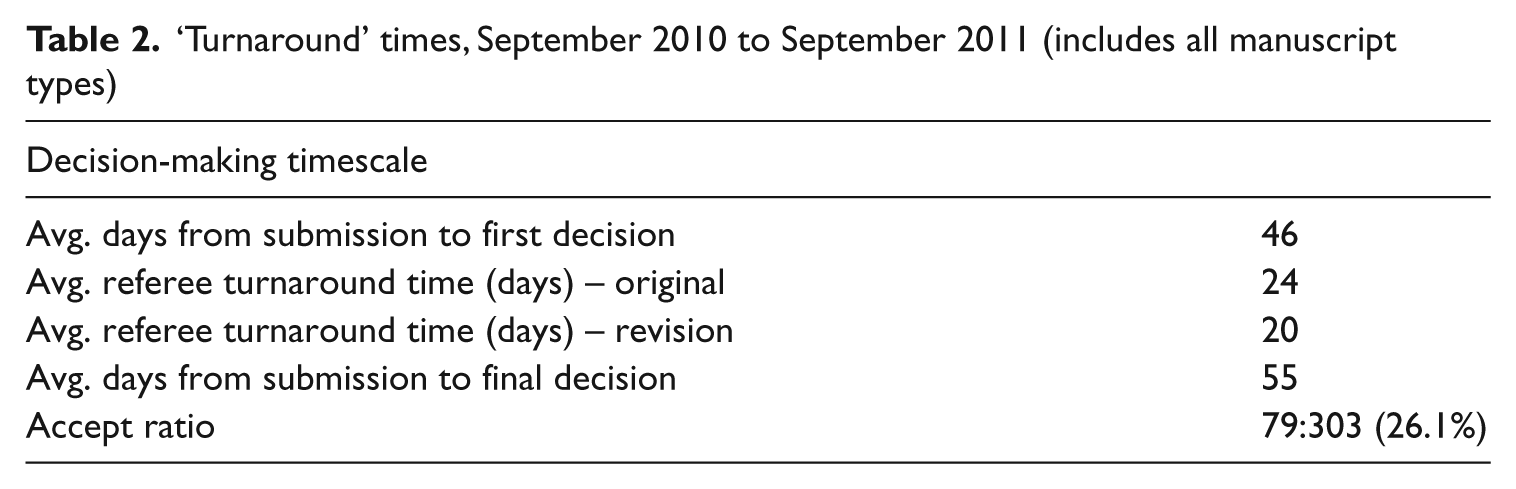
We believe that the peer-review process of the journal is operating not only fairly, but also efficiently. Similar to last year, the average time from submission to final decision is 55 days (see Table 2). Turning around manuscripts in less than two months remains impressive, in our opinion, and we wish to thank our reviewers and editorial board members for being so prompt and diligent in their responses. The ‘accept ratio’ of 26.1 per cent is lower than last year’s (44.6%), which is to be expected given that submission rates continue to increase (and we had a very large number of submissions to the special issue).
‘Turnaround’ times, September 2010 to September 2011 (includes all manuscript types)
In conclusion, we are moving into the final year of our editorship with a feeling of confidence that Sociology will continue to grow in influence and quality. The positive changes we have been able to achieve are in no small part attributable to the strong foundations we inherited when we took over and to the continued hard work of the BSA publications office, staff at SAGE and the scholarly judgment of our editorial board and invited reviewers.