



Abstract
Highly flexible workers such as freelancers are particularly exposed to insecurity. In this article I explore the role and relevance of insecurity and uncertainty in the lives of freelancers in Denmark and Germany and especially the marked difference I have found in freelancers’ narratives along national lines. Whereas insecurity and its related fear and anxiety played a huge role in the German interviews (‘German Angst’), the Danish freelancers attached less importance to the topic of insecurity and showed almost no sign of related anxiety (‘Danish Easy-going’). Some reasons for this can be found in the different social security backgrounds and welfare state programmes of the two countries, but these differences cannot explain the very different ways of talking about and dealing with the topic. Therefore, I suggest that the differences can be understood in the context of trust as a multi-dimensional concept.
Introduction
The transformation of work, including its deregulation and flexibilization, has been on the sociological agenda in recent decades (e.g. Boltanski and Chiapello, 2005; Sennett, 1998). Growing insecurity for the individual, as a result of the flexibilization of work and the erosion of the ‘standard employment model’, has been discussed as one of the consequences of these changes (e.g. Castel, 2002). Within this context, freelancers have often been seen as extreme cases of this ‘new’ work organization. Freelancers, or the solo-self-employed, who pursue a profession without any long-term commitment to any particular employer, constitute one of the most flexible parts of the workforce. As they have to sell their services on the market without being buffered by an employer, they are very directly exposed to market risks. Amongst other things, this can lead to ‘bulimic career patterns’ (Gill, 2002: 84); that is, a very unsteady workload and income. In some periods, freelancers literally have to work around the clock in order to meet their customers’ deadlines, at other times they are ‘forced’ to have free time and accordingly have to cope with a loss of income (Gill, 2002).
In this article I focus on the questions of insecurity and uncertainty connected to freelancing. I present findings from my PhD research project, which investigated the work and life patterns of freelancers in Denmark and Germany in the (new) media industry within a cross-national comparative framework by means of qualitative interview research. I focus on one difference I have found in the freelancers’ narratives along national lines. Whereas insecurity and its related fear and anxiety played a huge role in the German interviews (‘German Angst’), the Danish freelancers attached less importance to the topic and showed little sign of related fear and anxiety (‘Danish Easy-going’). I present and discuss these findings within the chosen comparative framework and argue that the difference in the freelancers’ notions of (in)security and related anxiety is not solely related to their different social security and welfare state frameworks, but is also a question of trust. A difference in ‘system trust’ (i.e. mainly trust in welfare state programmes) plays an important role in the individual freelancer’s life and his/her evaluation of the role and relevance of insecurity and anxiety in his/her life. After presenting the research design, methods and empirical basis of the article, I describe the kind of uncertainty freelancers are faced with and outline some of the reasons for it. Then I introduce the theoretical context of trust, including the notions used in the analysis. Finally, I present parts of the empirical material and its analysis.
Research Design and Methods
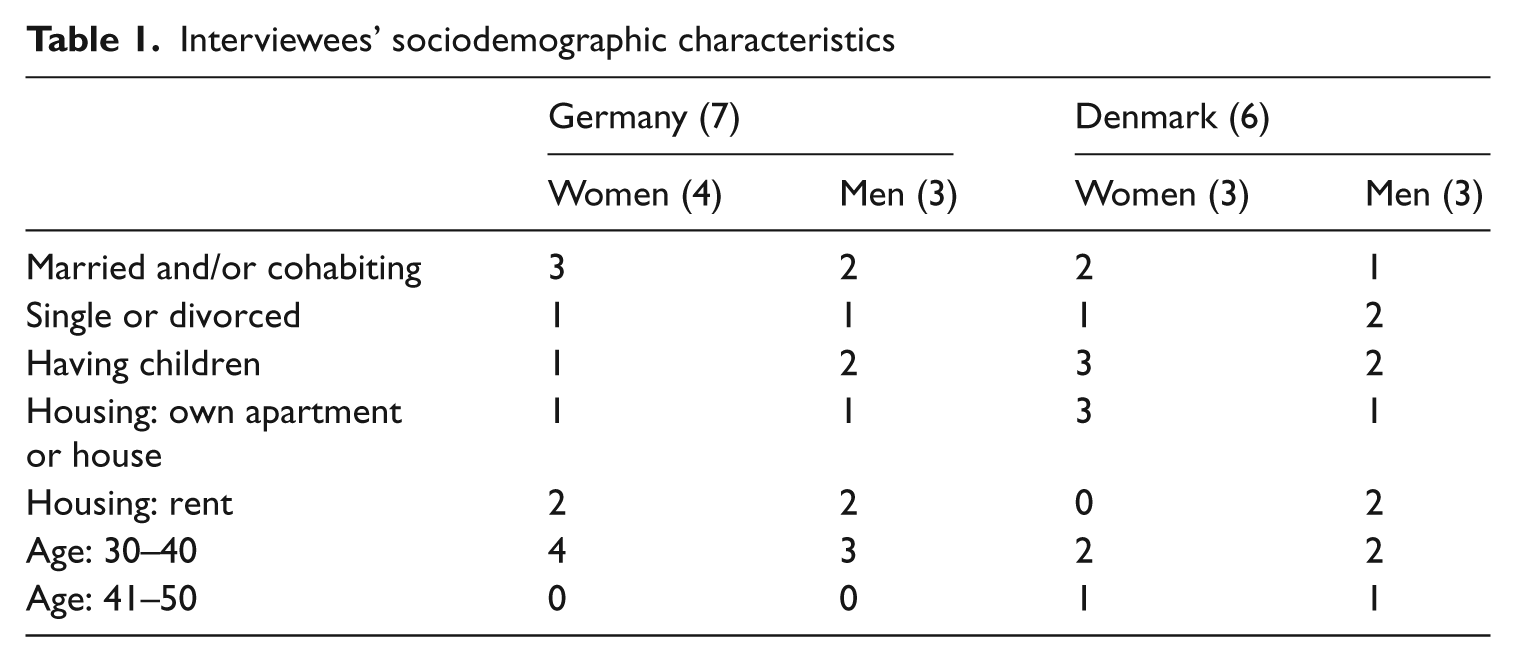
The empirical material consists of 13 work-biographical freelancer interviews, seven German and six Danish. Additionally, four expert interviews have been collected. 1 The following criteria were used to select the interviewees: they had to be freelancers in the chosen field of work (new media, graphic design and related work), with freelancing as their main job. The organization of work in this field is comparable, as freelancers in both countries have to compete in an unregulated market structured by informal networks. The guided interviews centred around work-biographical subjects and varied in length between 40 minutes and two hours. Table 1 provides an overview of the interviewees’ sociodemographic characteristics. The findings from the qualitative interview research have been analysed and compared within the framework of the different welfare state and labour market regulations. As freelancing is seen as an ‘extreme’ case of deregulated work, in that its challenges can be found (and studied) in a distinct way, generalizations in this research project are of an analytical nature. Thus, claims regarding the transferability of insights from the research to a more general level are made with the help of theory and contextualization. Following the logics of hermeneutics (e.g. Gadamer, 1989), those insights, however, are not seen as established once and for all, but might be altered in the light of new empirical knowledge or theoretical approaches. Taking into account the relatively limited number of interviews and the methodological perspective, the presented claims drawn from the empirical material are, of course, limited. The aim of this study is to reveal some (new) tendencies that can be investigated further by future research.
Interviewees’ sociodemographic characteristics
Two Dimensions of Insecurity and Uncertainty
I stated earlier that freelancers are highly exposed to insecurity and uncertainty. Reasons for this can be found in two aspects of their specific work form. The first dimension refers to the ‘bulimic career patterns’ – the fact that freelancers’ incomes are directly market dependent.
The second dimension is related to the ‘social security background’ provided by the welfare state. Here the conditions for freelancers in Denmark differ profoundly from the ones in Germany. In a conservative welfare state such as the German one, where the institutions are so much built on the ‘standard employment model’, being a freelancer can lead to serious exclusion from social security programmes such as health insurance or public pension funds (Castel, 2002; Esping-Andersen, 1999). Taking a closer look at the German situation reveals that under certain conditions freelancers can be included in the German public social insurance system through a special branch, the ‘artists’ social insurance’ (Künstlersozialkasse – KSK). Most of the German freelancers in this study were thus included in the public social insurance system. However, because of the low incomes and low contributions of this group, experts doubt whether freelancers could expect a sustainable level of pensions (Betzelt, 2002; Schnell, 2007)
The Danish welfare state, usually classified as a social-democratic welfare state (Esping-Andersen, 1990), is much more inclusive of freelancers (which can be explained by the fact that it is characterized by universalism). However, freelancers are excluded from the second tier pension system (‘labour market pensions’ – AMP), which is considered to be the most important pillar of the Danish social security system (Andersen, 2007).
To sum up, the first source or dimension of insecurity refers to the financing of everyday needs and stems from ‘bulimic career patterns’; the second to longer-term safeguards against ‘social risks’, stemming from the fact that freelancers tend to be faced with exclusion from welfare state programmes as non-standard workers. Whereas the market conditions for freelancers in the chosen field are comparable in both countries, the social security frameworks vary profoundly. I have assumed that these two dimensions of insecurity are interlaced in the individual evaluation of personal (in)security, but nevertheless in what follows I try to distinguish them analytically, in order to reach differentiated conclusions.
A Question of Trust?
The topic of insecurity is closely connected to the question of (future) risks and how people evaluate them in the here and now. This also entails the question of how people deal with future planning. Following, for example, Ulrich Beck (1992), the process of individualization suggests an increased need to plan one’s own life path because of a certain liberation from traditional bonds. This has also been shown by empirical studies (e.g. Anderson et al., 2002). Devadason’s (2008) study of young adults’ life planning in Bristol and Gothenburg finds a marked distinction between the young adults’ way of dealing with planning in the two cities: while vague hopes dominated in Gothenburg, in Bristol the majority of interviewees reported detailed precise future plans, a finding the author relates to the different national frameworks.
Including the concept of trust can add some analytical insights, especially in the context of a comparative study, as different levels of trust can be found in different countries (e.g. Levinsen, 2002; Rothstein, 2005). Trust (and distrust) in a positive future would certainly impact on the way we deal with insecurity, future risk and planning – if we trust in a positive future, would we still need to plan it?
Within sociology, trust is often viewed as a concept applied to explain and understand human agency in situations, or under conditions, of uncertainty and vulnerability (Möllering, 2006a). Luhmann (1979) states that it is trust that makes it possible for individuals to act in insecure and uncertain situations. The literature generally distinguishes between interpersonal trust and ‘system trust’, as Luhmann (1979) coined it, which refers to impersonal, institutional trust. Khodyakov (2007) describes a ‘great divide’ amongst scholars of trust, namely concerning the question of whether trust should be conceptualized as a process in the context of social practices or as a more static variable, mainly referring to its functional properties with respect to social cohesion. Möllering (2001) and Brownlie and Howson (2005) have argued in this journal for an interpretive approach to the concept of trust. Like Brownlie and Howson, in this article I view trust as a ‘complex […] practice happening within particular socio-political contexts’ (Brownlie and Howson, 2005: 222).
In the context of the freelancers’ perception of insecurity and uncertainty in their work and lives, I am interested in a very specific form of trust which is connected to institutional trust or trust in welfare state programmes, but also refers to more general, positive expectations of one’s own individual future. Therefore I approach trust as a theoretical concept in a twofold manner: first, what trust means on the sociological micro-level, i.e. what role trust plays for individuals and social interaction, how it is used, how it can potentially emerge, and consequently what it means for individual’s perception and their scope of action in the context of uncertainty and vulnerability; second, the embodiment of trust as institutional or system trust and, more precisely, institutional trust in the form of trust in the welfare state and/or welfare state institutions as the chosen comparative context of the study (i.e. its sociopolitical context). I argue that this twofold focus makes it possible to both interpret the individual freelancers’ narratives on the micro-level, and to contextualize them within the structural ‘social security framework’ that serves as the framework for this study. Thus, I try to integrate both a micro- and a macro-societal perspective of trust.
How trust works on the micro-level has been discussed from various perspectives within sociology. Rational choice theorists have focused on rational reasons for trusting, seeing trust as a decision made out of rational considerations (e.g. Coleman, 1990). A different understanding of trust can be found in the micro-sociological tradition of Schütz (1967), with taken-for-grantedness and routine as sources of trust. Giddens (1994) understands trust as part of an active reflexive process, which is necessary to developing trust, involving communication and openness. In his account of trust, Möllering (2001, 2006a) adds another element, a moment of irrationality that he considers as crucial for the development of trust, and this draws on Simmel, who states that trust contains a ‘further element of socio-psychological quasi-religious faith’ (1990: 179). This ‘leap of faith’ is an essential feature of trust for Möllering, which he calls ‘suspension’, and describes as the:
… ‘leap of faith’ that brackets ignorance and doubt, thereby enabling the trustor, at least momentarily, to have expectations as if social vulnerability and uncertainty were resolved. (2006b: 372)
In this article I use Möllering’s conceptualization of sources of trust on the micro-level, which include rational reasoning, institutionalized routine and experience-based reflexivity, as well as his emphasis on adding a Simmelian ‘leap of faith’ as a crucial element to enable trust.
To also discuss the comparative context from a trust perspective, I include Rothstein’s (2005) assumptions on trust and welfare states. Here the interest lies more in the societal macro-level or rather in the question of how the micro- and macro-level interact: what features of the welfare state as a political institution make it trusted (or not) by individuals? Rothstein identifies one main feature of the welfare state which he believes to be crucial for the creation of trustworthiness – namely universalism in terms of legitimacy (2005). Esping-Andersen (1999) and others have argued that universalism is (still) a dominant characteristic of Scandinavian welfare states. The Danish welfare state is indeed more inclusive for atypical workers, such as the freelancers in this study, than the German welfare state, mainly because of its universalist features. On the other hand, several Danish welfare state reforms have dismantled universalist features in some areas of the welfare state, especially in the field of security in old age, and it is here that the freelancers are also faced with exclusion (Greve, 2004).
Within this twofold perspective, I now discuss the individuals’ narratives and their respective sociopolitical contexts in relation to trust. In what follows I first describe the empirical findings of the study and then later return to the topic of trust.
The Role and Relevance of (In)Security and (Un)Certainty in the Freelancers’ Narratives: ‘German Angst’ vs ‘Danish Easy-going’?
Early in the research process, at the interview stage, I was already confronted with the ‘insecurity-difference’. Collecting interviews in Germany first, I received the impression that insecurity was an important topic for freelancers, an expectation that did not hold in the case of the Danish freelancers. The difference between the Danish and German freelancers’ narratives concerning the topic of insecurity and uncertainty not only could be traced contentwise but also manifested itself in the organization of the interviewees’ speech, thus leading to very different interview structures. The main difference in the organization of speech and narration was that the German freelancers (in contrast to the Danish freelancers) brought up and problematized the topic of insecurity very early on in the interviews and this was largely unsolicited. Subsequently, the German freelancers described the strategies and actions they undertake in order to deal or cope with this problem. And they actually do ‘do’ a lot in order to cope with it. For example, Madhi,
2
a freelancer located in the Ruhr area, talks about several dimensions of the ‘insecurity problem’. In one part of the interview, he speaks at length about his coping strategies and states:
You know, it is all about emotional states, right? […] If you do something like that [freelancing] I think you have to bring with you a portion of stupor, as I would call it, and maybe as well a bit of (.) trust in God or something, you know, accepting your fate or something like that, by saying ‘oh, every cloud will somehow have a silver lining’ and so on; […] If you take everything too seriously […] I don’t think you are going to be happy with it.
3
As this example illustrates, the question of insecurity is a big issue, which obviously requires a lot of ‘work’ or activity from the German freelancers to deal with it. This problem and all its consequences can be found in different ways or embodiments in all the German cases. Nina and Elena (both freelancers from Berlin) stress, for example, the existential nature of this problem of insecurity: Nina describes how she learned to live with the constant fear of losing her livelihood (Existenzangst), while Elena discusses how this problem of insecurity recently became one of existence for her whole family.
While interviewing the Danish freelancers, however, the topic was almost never mentioned unsolicited. With growing bafflement over the fact that the interviews did not ‘function’ in the way I expected, I started to ask directly about insecurity. When explicitly asked, some of the Danish freelancers talked about the first dimension of insecurity outlined above and the strategies they applied to safeguard against it. However, the topic was never assigned the relevance, gravity and importance for existence that it commanded in the German cases. Furthermore, and despite being directly asked about it, the Danish freelancers did not talk very much about the topic. For instance, Morten, a freelancer based in Århus, describes how he always has a financial cushion of a few months’ income in his bank account. However, he emphasizes that this is not in any way a conscious or active strategy:
I have actually not thought so much about that, so, it is actually a bit unconscious, I think. […] It runs how it is running, on a somewhat subconscious level. So it’s not like I actively think a lot about how much [money] it should be because of this and that.
When it comes to the question of whether this financial insecurity and uncertainty makes him feel afraid, he strongly denies it.
The only Danish freelancer who brings up the topic of insecurity and uncertainty herself is Susanne, a 43-year-old freelance graphic designer living in Copenhagen. At the time of the interview she had only been working as a full-time freelancer for six months. This could be one possible reason why the topic of insecurity plays a bigger role in her account than in the other Danish freelancers’ accounts, as she does not have a long experience with ‘bulimic career patterns’. Although she has 15 years’ experience of freelancing as a side job, she lacks long-term experience of being dependent on the unstable income which characterizes freelance work. She mentions the topic of insecurity when being asked about the advantages and disadvantages of being employed in contrast to freelancing:
So, the advantage of being employed clearly is that you get the feeling of having a secure framework. Whether this is false or not does not matter. It is a secure framework you are in. Your pension is taken care of. This and that. But I had been working as an employee at the theatre for 12 years when they closed down the department I started in. So in this way I would say I don’t trust the […] ‘employee labour market’ very much. For me, in the graphics field, it is just as unstable as freelancing.
Thus, Susanne suggests that a (feeling of) security is indeed of relevance for her, and that it is in some way missing for her as a freelancer. Aside from that, based on her experience, she does not view ‘employee-security’ as ‘real security’ any more, as she defines instability and insecurity as something inherent to the industry and not to the work form.
In other parts of the interview it again becomes clear that it is the ‘bulimic career patterns’ which are a source of insecurity for her. In contrast to Morten, for example, she has installed some thought-through security mechanisms: she pays herself a form of salary and keeps the rest of her income as savings. In this manner she has already accrued an amount equalling three monthly incomes. Another source of security is her big apartment in the centre of Copenhagen, which she could easily divide into two parts, renting out one half in times of financial difficulties. By reporting all these reflected safeguards against periods of low orders or job offers, her interview differs from the other Danish interviews. We can see that insecurity indeed constitutes a problem for Susanne, and that she has created several safeguards against it. Nevertheless, when asked if this insecurity is also connected with fear or the feeling of being afraid, she states:
I am not afraid of sinking into poverty. I am afraid because it is so difficult to come back […] in such a creative industry. If you have dropped out, if you get on the wrong track, then there is not so much that sticks to you. And then that’s just how it is.
Thus the fear Susanne is expressing does not refer to the risk of losing one’s livelihood, but to the risk of becoming excluded from the creative industry. In her presentation the problem of insecurity appears to be less dangerous, and the connected fears appear to be less serious, than in the case of the German freelancers. Therefore, even though insecurity plays a role in her account of working and living with freelancing, the difference presented previously (though maybe in an alleviated form) between the Danish and German freelancers’ accounts on the topic of (in)security remains in her case.
Summing up, within the interview material a difference between German and Danish freelancers could be found. Whereas the German freelancers report a great deal of insecurity connected to a strong feeling of being afraid, sometimes even in existential terms, the Danish freelancers in general attach less importance to the topic of insecurity, and the fear emphasized in the German cases is either not there at all, or is not assigned such gravity.
Thus, the question arises of how this difference can be understood. The different welfare systems outlined earlier are, of course, not the only possible sources of security for the freelancers: another source appears to be housing (Watt, 2005). Some of the freelancers use their ownership of a flat as a source of security, and Elena from Berlin explicitly mentions the lack of flat-buying opportunities open to her because of her financial situation in the context of (missing) social security and pensions:
There is almost no chance of buying a flat or investing in anything that would mean you could say ‘O.K., I won’t get any pension, but I can at least ensure my own four walls’ or something like that …
Another very common form of risk-(or insecurity-)management amongst the freelancers, especially in the context of ‘bulimic career patterns’, was the ability to pool their incomes with their partner or spouse. Their partner frequently had a regular income, which provided them with some reliability in terms of being able to plan. This was mentioned explicitly by Jan (Germany) and Lise (Denmark). And it was, again, Elena who emphasized the problems that arise from a sudden lack of the ability to pool incomes, as her partner has recently become unemployed. She states that previously his income:
… was always there, and that makes a difference, right? Seen from the family’s perspective, there was not really a hole, right? Your stressful thoughts were only concerning your own business, right? But now these thoughts become existential, that is the difference.
These two ‘instruments’ (owning property and pooling resources) were used to reduce insecurity for freelancers in both countries. Despite this, the German freelancers were still haunted by feelings of insecurity and related anxiety whereas the Danes where not.
Differences in the freelancers’ narratives, on the other hand, could be found in the way they talked about the welfare state in general and social security it is supposed to provide for individuals (especially as concerns old age/pensions). In the next section I describe this difference and discuss it in the context of trust.
The Freelancers’ Views on Collective Social Security and the Welfare State
Elena from Berlin refers to the topic of her own social security as a ‘black hole’ and evaluates it very negatively. This pattern can be found elsewhere, for instance in Madhi’s account. He states when asked about his own social security:
Very, very exasperating topic. Actually I don’t want to talk about it, it’s always really very depressing somehow.
In general, the German freelancers speak very positively about KSK, which provides them with access to the public social security system. Elena, for instance, defines KSK as her family’s ‘rescue, right? Without it, it would be really bad.’ And on the topic of social security Nina says:
In my opinion, social security is essential. Everyone who does not have health insurance is nuts. On the other hand, if there wasn’t KSK I would have to pay 280 Euro per month just to be insured [Here she refers to health insurance only]. I find the regulations in Germany pretty bad concerning this. KSK is a real blessing, as it buffers the amount the state requests by being a virtual employer.
What is also remarkable in this quotation is how well Nina is informed about KSK and how it functions. The German freelancers are all really well informed about their social security in general and about KSK in particular.
Another doubt the German freelancers raise is whether the public pension system as it exists (in which most of them are included via KSK) will be able to provide sufficient pensions (or even whether it will provide pensions at all) in the future – that is, by their own retirement age.
For instance, despite her very positive opinion of KSK, Elena is very sceptical about how far KSK can provide adequate social security:
And concerning old age provisions, the feelings that you get from everywhere… No matter what you read, that practically everything, even the KSK contributions, goes into the normal pension system, which presumably will not have anything.
And Nina states quite bluntly:
I have mentally bidden farewell to the thought that this state will give me anything in old age. In my opinion it is just a question of time before the whole thing collapses.
In summary, the German freelancers’ attitudes towards the subject of social security paint a very pessimistic picture. Not only are most of them quite downbeat as concerns their own social security status, but they also raise doubts about the general functionality of the public social security system in the future. These doubts refer mainly to the pension system. Therefore most of the German freelancers in this study have tried to establish private social security in the form of pensions or other saving schemes, which are, because of their low incomes, quite limited.
Thus, not only is the German freelancers’ view of their own social security very pessimistic, but this attitude also applies to their view of the welfare state (as the system of collective social security). Möllering states:
[…] trust is essentially not so much a choice between one course of action (trusting) and the other (distrusting), but between either accepting a given level of assurance or looking for further controls or safeguards. System trust (and also personal trust) fails or cannot even be said to exist when this state of suspending doubt is not reached. (2006a: 72)
In some ways this describes the German freelancers’ view of their welfare state very well. The German freelancers, who are very well informed, do not accept the assurance that the welfare state, via KSK, provides them with and try to put some further safeguards in place. We can quite clearly see that doubt is not really being suspended in the German cases, at least not as concerns old age security.
The picture is quite different for the freelancers in Denmark and their opinions on the topic of social security. First, let us look at how the Danish freelancers in the study ‘organize’ their own social security (concerning those elements which are voluntary for them).
In Denmark, freelancers are excluded from the second tier pension system. Thus, voluntary inclusion in this pension scheme could be of great importance for the freelancers’ individual social security. My aim in the following discussion is not to evaluate the freelancers’ measures taken to avoid the risk of poverty in old age, but to analyse the way they talk about the topic, which differs profoundly from the German accounts.
Amongst the six Danish freelancers in this study, there is only one, Signe, a 34-year-old graphic designer, who pays into a private labour market pension scheme. Signe is a special case amongst the freelancers in this study: suffering from a chronic disease, which is not officially recognized as a disease on the one hand and which makes continuous contact with other persons (e.g. in the workplace) very difficult for her on the other, freelancing constitutes the only chance to stay in the labour market for her, as it allows her to work in (relative) isolation at home. The story of her illness has influenced her views of the welfare state and especially her view of bureaucratic rules, procedures and the actors connected to it. She describes, for example, the conflict with her unemployment fund, after she had left her job because of the disease, as a hard struggle:
I had tried to secure myself, I had also taken out unemployment insurance and I fought with them for over a year before I got the money, right? Because well, it is not a recognized disease. […] And well, they had their own psychologists, who said what they wanted to hear. That’s how it is, if you have one of those diseases which is not recognized and not on their ‘pay out’ list. […] well, that’s just something people make up, that’s what they make their psychologists say. And so you don’t get anything, right. […] The whole thing went through the appeals board.
These experiences have tainted her opinion of the welfare state and the social security system and therefore her evaluation is quite negative. However, it does not lead her to express problems of insecurity or anxiety, although it must be mentioned that she is well safeguarded through the ‘pooling-of-incomes’ dimension, as her husband works as a well-paid engineer. In terms of building trust in the system, Luhmann (1979) and Giddens (1990, 1994) both emphasize the importance of experience with ‘access points’, as Giddens calls them – that is, encounters with individuals representing the system or the institution, who are usually experts. Sitkin and Stickel (1996) analyse the opposite, the emergence of distrust, as ‘the road to hell’ in an organizational context. Signe’s disappointing encounters with welfare state institutions during the story of her chronic disease can thus be seen as similar ‘dynamics of distrust’.
Ole, a freelance illustrator and graphic designer based in Aalborg, at 49 is the oldest freelancer in this study, and thus the one closest to retirement age. Nevertheless, he does not pay into any pension scheme at the moment and he also states that he cannot expect to get much from the labour market pension he was contributing to during his employment prior to freelancing. When it comes to his general opinion of the welfare state, Ole criticizes current reforms and politics very strongly:
I am sure that with the government we have at the moment, they are turning off the lights […]. So they have reaped enough for themselves in one way or another, no matter what you sign.
We can clearly see that Ole is not content with current welfare state politics. However, these negative expectations about the future of the welfare state do not lead him to insecurity or even fear. He states several times that he did not really think a lot at all about the subject of social old age security. As an old age safeguard he names his (and his ex-wife’s) house, which is clear of debt and was, at the time of the interview, soon to be sold, which will bring Ole a certain financial cushion.
The ‘paradoxical case’ of Ole can be understood with the help of trust, as his statements concerning current welfare state politics appear, at first glance, to be quite contradictory to his described actions. However, it might be that trust in the welfare state even survives negative expectations of political actors and leaders. Luhmann (1979) states that in the case of system trust, the trustor presumes that a system is functioning, and that he/she then places trust in its functioning and not in people. Ole may still trust the system in general, despite his very negative evaluation of current politics.
At first glance, this statement by Luhmann seems to be inconsistent with the emphasis on experience with ‘access points’ to which I referred earlier. However, we have to keep in mind the difference between the two dynamics: the latter (Ole’s example) refers to more abstract evaluations of actors, in this case political leaders, whereas the former (Signe’s example) refers to concrete experiences with the institution in question.
This definite ‘relaxedness’ over their missing pension schemes very much characterizes all the freelancers’ interviews in Denmark. Although some of them admit to certain problems when asked directly about their lack of pension schemes, they do not seem too bothered about it. Even Susanne, who, as described previously, is the only one of the Danish freelancers who introduces the topic of insecurity herself and mentions the pension question in this context, states that she has until now not taken care of a new pension scheme and reports that she has actually never really looked into it either. This is quite surprising when we take into account how well and thoroughly she has installed safeguards to protect her from the insecurity stemming from the ‘bulimic career patterns’ inherent to freelancing.
Neither Morten nor Christian are members of an unemployment fund, nor do they have any pension scheme. The reasons behind why they chose not to be included in these two safeguard mechanisms show some individualistic values. Morten stresses that the reason he does not want to become a member of a pension fund lies in his wish to have self-determination, to be in charge of his savings and not hand them over to others. In accordance with this, he is accruing savings in the form of, he claims, his collection of old electric guitars and an investment account.
In the context of social security, Christian makes some interesting remarks about Denmark and the Danish welfare state in general. This is better illuminated against the background of his work biography: Christian has recently lived in New York for six months, and, when asked about the differences between Denmark and the USA, he states:
Well, in Denmark we are so damn spoilt, and we are doing extremely well, and we all have this security net, and this is not right, in principle. An awful lot has to go wrong before you can become totally screwed in Denmark, because we have all of these security arrangements, and that’s why we are also a little bit spoilt and lazy. And that’s something, where you really could learn something from the USA, where they really are sharper and they are ‘on’ all the time.
Thus, he buys into the argument that too much social security causes the individual to give a lesser performance. What is interesting, in the context of this article, is how he characterizes the topic of social security and the welfare state in Denmark: in his view, there is a lot of social security in Denmark. For him, social security in Denmark is too generous, to the extent that, he believes, nothing can go wrong in Denmark in any way. Because of the perceived connection between (a lack of) achievement and (too much) social security, Christian has chosen not to become a member of an unemployment fund:
So, I want to have a little bit of a dagger to my throat, and to say […] in this area there is no security. I think this also gets you going and makes you a little sharper. A little bit like in New York, where it is more difficult to get these security arrangements. So, no, I dropped that.
When it comes to the question of the lack of a pension fund, however, Christian states that he is planning to pay into one in the future.
We can conclude then, that the Danish freelancers do not bother themselves too much with questions of social security, or old age security, which is where they are excluded from an important feature of the pension system (i.e. the labour market pension).
What is very interesting here is that even their quite different political or moral perspectives do not in the end lead to different views on personal social security issues. Not only are they quite ‘relaxed’ about their social security arrangements in old age (despite the fact that it is doubtful that their current provisions are sufficient for securing their livelihood in retirement), they are also ill informed about it (especially in comparison with the German freelancers). In their narratives they evoke the understanding that everything will turn out fine, a notion that Christian describes more explicitly in his view of the Danish welfare state.
Comparing the German and Danish freelancers’ statements and evaluations of the topic, we can see a strong contrast. The German freelancers are very pessimistic about their own social security and the collective system of social security in general (mainly concerning the pension system): they are generally well informed about their social security options; they express great insecurity and anxiety connected about this; and they try to take measures to safeguard themselves. In contrast, the Danish freelancers do not seem too bothered with these topics: they show almost no sign of insecurity and virtually no anxiety; they are quite ill informed, especially as concerns their own old age security; and they do not in general take a lot of measures to organize their own old age security. Despite not having any rational evidence regarding their old age security, they seem to evaluate the prospects for it as good, or at least good enough to not think about it further. Not least because of the latter findings, which appear at first glance as a rather naïve handling of their situation, I have assumed that the ‘insecurity’ difference found along national lines in this study is only partly grounded in differences in the freelancers’ social security backgrounds, but also includes differences in trust, or, more specifically, differences in institutional or system trust. Conceptualized as the suspension of doubt, i.e. the bracketing out of potentially negative future events, a certain amount of ignorance is an inbuilt element of trust: trustors (in this case the Danish freelancers) do not need to be informed because they trust; distrusters (the German freelancers) tend to be very well informed, as they want to know about future risks and are looking for further safeguards.
There is one quite remarkable aspect in the statements of the German freelancers which I have not addressed in more detail so far: namely, the somewhat catastrophic expectations of Elena and Nina, which include the notion that the German public social security system will collapse completely in the future, or in any case will not be able to provide any pensions by the time they reach pensionable age. Amongst the generally very negative evaluations of the German freelancers, these stand out as seemingly exaggeratedly negative. Elena’s account gives us a hint of where this opinion stems from, by stating that one can read this everywhere, thus referring to some kind of public or media discourse. There are several analyses of the public discourse on the pension system in Germany, which come to the conclusion that this expectation of a ‘future collapse’ of the public pension system is a scenario being launched in the context of a neoliberal reform agenda (Christen, 2008). This continuing public discussion on the functionality, or rather the proclaimed disfunctionality, of the public pension system can be thought to have an influence on how the individuals evaluate their own pension prospects.
In contrast, a similar evocation of a catastrophic future scenario concerning parts of the welfare state or the pension system did not take place in the Danish interviews. From the Danish value survey, with data collected in 1981, 1990, 1999 and 2008, we can see that trust towards the public system as a whole remained stable, and even rose during that period (Gesis, 2008; Levinsen, 2002). Considering these findings, the assumption that Danish welfare is generally more trusted than German welfare appears to be convincing and we can interpret the Danish interviewees’ statements on the topic as trustful.
Conclusions
In conclusion, the marked difference along national lines concerning (in)security and (un)certainty and their meaning for freelancers’ practices cannot be solely understood by the different welfare state frameworks (and an implicitly ‘rational’ attitude towards them from the interviewees). I have introduced the concept of trust in order to interpret the freelancers’ narratives regarding this question, and to discuss the differing societal frameworks from a trust perspective. Both perspectives fit together fairly well in the case of the given research project. Trust appears to be a useful concept in the context of highly flexible workers and their handling of such a form of work. In this article I have focused mainly on the welfare state (as a [possible] provider of social security) as a source of trust. However, it may of course not be the only one: several other sources of trust are relevant to the situation of freelancers, such as housing and the pooling of incomes in a family, and to the economic situation in the respective countries at the time of the study. However, the chosen focus on welfare state frameworks can contribute to understanding at least part of the puzzle.
Footnotes
Acknowledgements
An earlier version of this article was presented at the ISA World Congress of Sociology 2010 in Gothenburg. Warm thanks to Antje Gimmler for thorough reading and constructive comments on earlier versions of this article. I am also very grateful to the two anonymous reviewers for their helpful comments.