




Abstract

This editorial report marks the end of our four-year term of office as editors of Sociology. We are delighted that this issue – our final issue – contains a hitherto unpublished contribution from Pierre Bourdieu. This comprises Bourdieu’s acceptance speech for the Gold Medal of the Centre national de la recherché scientifique (CNRS) which he was awarded in 1993. As Loïs Wacquant argues in his accompanying article, the speech marks a landmark in Bourdieu’s intellectual evolution and contains compelling advocacy for the indispensability of a reflexive sociology.
Bourdieu’s arguments are as valid today as they were 20 years ago and we believe that Sociology provides evidence of the enduring relevance of the discipline for the intellectual and political life of society. During our term we have certainly learned a lot about the challenges and the rewards of editing the BSA’s flagship journal. Overall we have enjoyed the privilege of editing such an important publication and we leave the journal in a strong and vibrant state. The positive changes we have been able to initiate are in no small part attributable to the robust foundations we inherited when we took over as editors and to the continued support of the BSA publications office, staff at SAGE and the scholarly judgment of our editorial board and invited reviewers. We are confident that we leave the journal in safe hands with a new editorial team from the Open University.
At the beginning of our editorship we made a decision, with the support of the editorial board, to replace the regular per issue editorial foreword with an annual Editors’ Report which would outline the progress of the journal and increase transparency in the peer-review process. This is our fourth and final report.
Overview
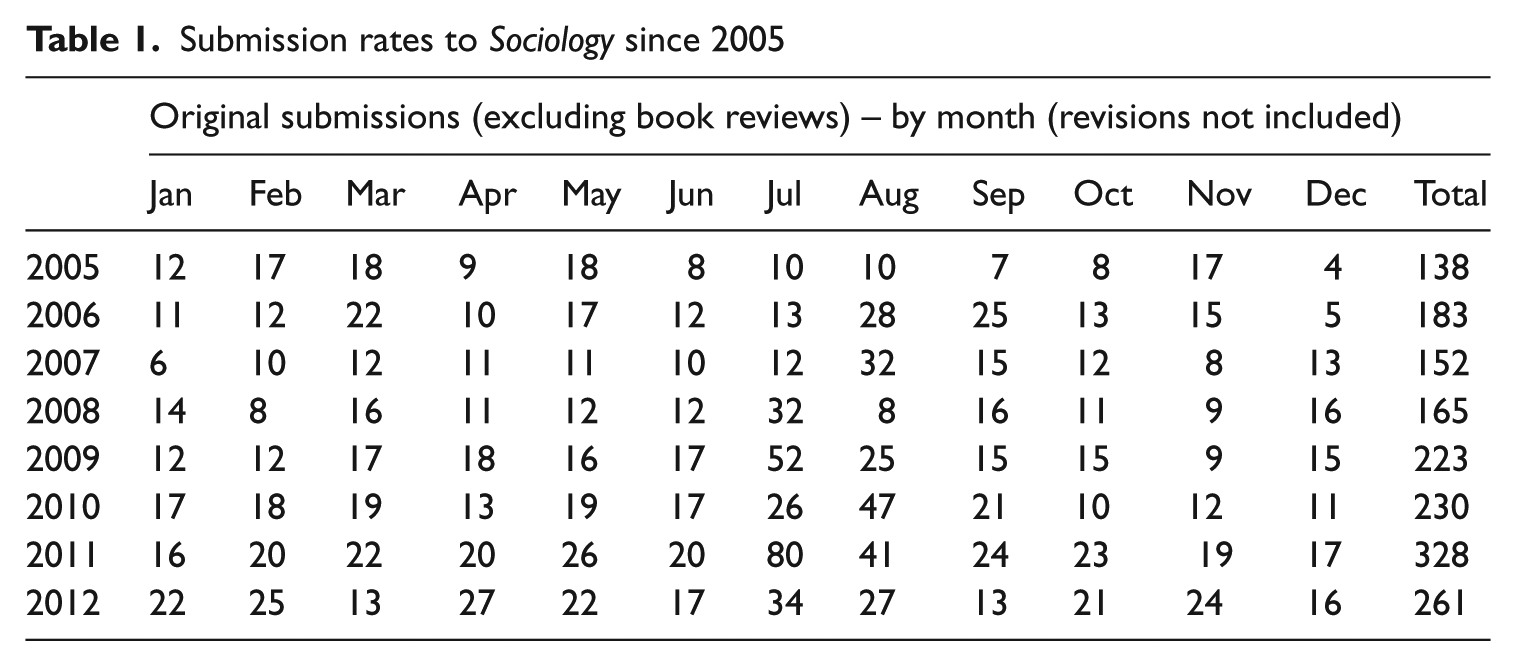
The journal statistics for 2012 indicate that Sociology remains a remarkably healthy journal on a variety of indicators. For example, rates of manuscript submission continue to be strong, with submissions continuing to rise year-on-year. Table 1 shows the submission figures for articles since 2005. 1 In 2009, our first year as editors, we received 223 new article submissions, in 2010 it was 230. In 2011 the total was a whopping 328, in large part due to the large number of submissions received for the special issue on human rights. The number of original article submissions in 2012 was 261. Based on these figures, it seems reasonable to expect well over 200 new article submissions each year.
Submission rates to Sociology since 2005
The journal also continues to occupy a respectable ranking in the field of sociology. At the time of writing, the impact factor 2 of Sociology is 1.352, placing the journal 29th out of 137 journals in the Sociology Journal Citation Reports. During our time as editors we have been particularly mindful of the need to maintain and improve the ranking of the journal. Among other things this has meant ensuring that the journal has international contributors and an international readership, and has a profile that welcomes both established international sociologists and new scholars.
Raising the Profile of Sociology
While it is important that Sociology is identifiably the journal of the British Sociological Association, we have explicitly sought to extend its impact such that it can make a distinctive contribution to international and comparative scholarship. During our tenure as editors, we have actively pursued international contributions to the journal, with the full support of the editorial board. We have also sought to encourage all contributors to locate their articles within an international context and to increase the number of peer-reviewers from outside the UK. Our rate of international submissions has for the last couple of years been around 40 per cent. The spread of countries and the proportion of authors that are not first language English-speaking continues to increase.
We have also continued to work with our publishers at SAGE and the BSA to actively promote Sociology at a variety of conferences so that we can augment the number of high quality submissions to the journal. We have become increasingly convinced that approaching and working with potential contributors to the journal is an important part of being active and effective editors. As such, conference attendance is vital to the future support and success of the journal.
The Reviews Section
In our original bid to become editors we indicated that we wanted to ensure that the reviews section became a more dynamic and important aspect of the journal. The changes we have made here represent, perhaps, the single most visible change to the content and format of the journal under our editorship. The organization of the review section (one review symposium, one extended review essay, four or so single reviews per issue) is better balanced and established as a standard format with which the readership is now familiar. We hope this new format and approach will be carried on as a key part of consolidating the reviews section as an intentional and strategic section of the journal.
We introduced a new category of review symposium under our editorship. This sees single texts, selected by the editors, concurrently reviewed by three or four senior and/or specialist colleagues, with the reviews then published as a set at the front of each issue’s reviews section. The symposium reviews not only make for a more sustained consideration of a selected text, but allow readers to see the same text from different sides, as it were – introducing an element of debate perhaps. Since making this change to the reviews section we have been pleased to have commissioned collective reviews on a number of important texts, including, in 2012:
Peace Processes, by John Brewer
Identities and Social Change in Britain since 1940, by Mike Savage
Naked City: The Death and Life of Authentic Urban Places, by Sharon Zukin
Climate Change and Society, by John Urry
Ernest Gellner : An Intellectual Biography, by John Hall
Review symposia scheduled for the current volume include John Scott’s Conceptualising the Social World, Stefan Collini’s What are Universities For? and Situating Everyday Life by Sarah Pink. We believe this collection represents an excellent array of texts, all of which are of international sociological significance and readership, though not all simply or narrowly sociological. The same could be said of the reviewers: internationally recognized scholars but with different and distinctive sociological contributions to offer.
Additionally, during our term as editors we have shifted to a commissioning process that facilitates publication of a review essay in every issue. Some of these have been really outstanding, sustained pieces reflecting on contemporary work and fields of study. Recent review essays include Mike Bracher on Autism, Robin Smith on the Sociology of Pedestrianism, Finn Bowring on Hannah Arendt and, in this issue, Stina Lyon on Structure, Biography and Values in the History of Sociology.
We have been able to hand over to the new editorial team a healthy, but not burdensome, level of single reviews, review essays, and symposia, and look forward to continuing to enjoy the review section of the journal, as readers. We would like to take this opportunity to thank all our many reviewers for their willingness to contribute their time and expertise writing such stimulating and varied reviews.
Transparency in the Peer-review Process
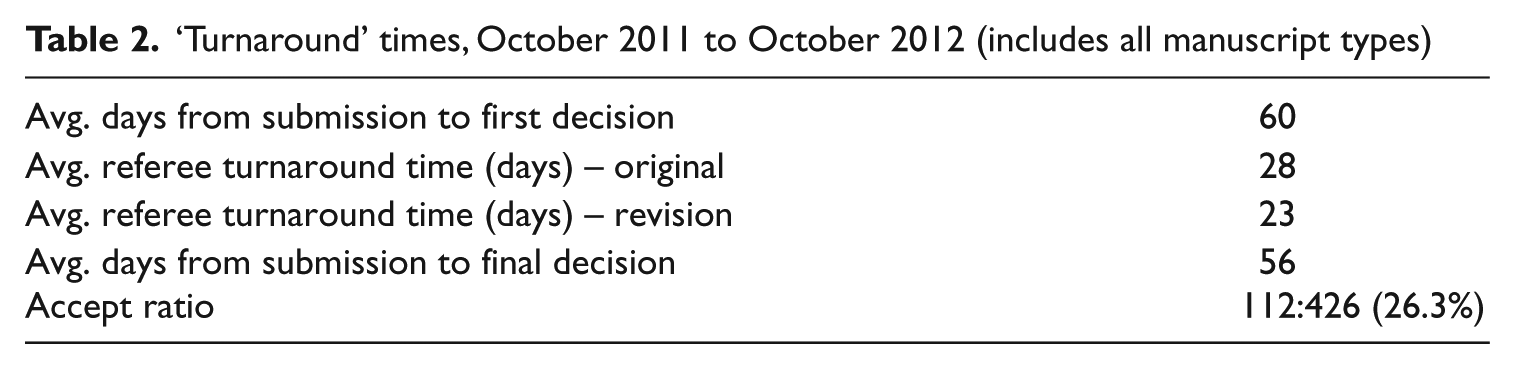
We continue to have confidence in the peer-review process of the journal, which we believe operates fairly, but also efficiently. Similarly to last year, the average time from submission to final decision is 56 days (up by one day from last year). Turning around manuscripts in less than two months remains impressive, in our opinion, and we wish to thank our reviewers and editorial board members for being so prompt and diligent in their responses.
The anonymous peer-review process continues to be the principal vehicle which guides the editorial decision of whether or not an article gets accepted for publication. In a significant minority (i.e. fewer than 10%) of cases, however, we as editors have taken the decision that a submission should not be sent out for peer-review. ‘Immediate reject’ is an option that we introduced to deal with manuscripts that have little or no sociological content, are far too specialist for Sociology, are very poorly written or that do not make an original contribution to sociological scholarship. We believe this option is an important part of keeping the flow of manuscripts moving, and ensuring that the time and expertise of editorial board members and specialist reviewers are put to good use. Table 2 summarizes the turnaround times during the last year.
‘Turnaround’ times, October 2011 to October 2012 (includes all manuscript types)
In conclusion, our term as editors has been both an honour and a privilege. We were particularly pleased that the BSA’s 60th anniversary occurred during our watch. Timing was in our favour again with another landmark celebratory event on our watch: ‘the Olympics’ was the theme we chose for the special issue we edited in 2011. We have also seen the journal move to online advance publication of accepted papers. We have confidence that Sociology will continue to grow in influence and quality under the direction of the new editorial team, and we wish them every success in the task they are about to undertake.