




Abstract
This article uses theories of practice to offer new lines of analysis of distinction through food. Middle-class households typically consume more vegetables than lower-class households. We examine aspects of vegetable consumption practices that might explain this fact. After briefly presenting theories of practice, we define vegetable consumption as a practice. We use household purchase data collected in 2007 for 2600 French households to address two questions: (1) is this theoretical framework relevant in accounting for the determinants of fresh and processed vegetable purchases, and (2) how do commitments to cooking and shopping intervene in the relationship between class position and vegetable consumption? We conclude that distinction occurs through modes of engagement in vegetable consumption. Because the practice’s teleoaffective structure is consistent with middle-class notions of health and proper food, these households engage more in fresh vegetable consumption, even though their commitment to cooking is rather low.
Introduction
In France, among other locations, the relationship between food consumption and social position is a well-established fact (Caillavet et al., 2009; De Saint Pol, 2008; Herpin and Verger, 2008; Warde, 1997). Typically, high-status households consume larger quantities of vegetables (Hunt et al., 2000; Plessz and Gojard, 2013; Roos et al., 2001). Most analyses of this empirical fact refer to Bourdieu’s theories elaborated in La Distinction (1979; Warde, 2008): preferences for specific food groups are manifestations of taste, and displaying ‘good taste’ by eating foods considered superior is a source of distinction. However, debates over the ‘death of class’ (Pakulski and Waters, 1996) have produced other lines of analysis in which consumption is interpreted as part of a lifestyle. Individuals, it is assumed, are capable of choosing lifestyles that manifest their identities without referring to class positions. This should be especially true of food since food is more accessible and cheaper than ever in developed countries (Fischler, 1988; Mennell, 1985). Empirical studies of food consumption do not give much credence to this ‘de-differentiation’ thesis (Chauvel, 1999; Régnier et al., 2006; Warde, 1997). In any case, while both of these theoretical frameworks question social differentiation in food purchases, they do not say much about the process of consumption.
Qualitative monographs have provided rich and comprehensive accounts of food practices. They describe their organisational, normative, and emotional dimensions as well as the mundane aspects of food provisioning, storage, preparation, serving, and tasting (Bove and Sobal, 2006; DeVault, 1991; Short, 2006; Wheeler and Glucksmann, 2013). Theories of practice provide theoretical frameworks for a range of studies (Evans, 2011a; Halkier, 2009b; Holm, 2003; Southerton, 2001). According to such studies, food purchase is one element among many that must be combined to form food consumption practices. 1 However, one sociological question seems missing from this promising perspective: how might we connect food practices with consumers’ social positions? Some studies that embrace the practice-theoretical perspective suggest that a practitioner’s characteristics are irrelevant (Halkier, 2009a; Shove, 2003). Other studies, however, indicate that theories of practice might add value to investigations of the social stratification of lifestyle. Warde (2005) and Southerton (2006) demonstrate that social position impacts individuals’ commitments to specific practices and their modes of engagement in given practices. However, this type of analysis has not yet been applied to domestic food practices.
This study seeks to better understand why certain practices attract practitioners in specific class positions. We attempt to link studies on food distinction with a conception of food consumption based on theories of practice. We borrow various notions from theories of practice. First, practice theories assert that practices are blocks of interconnected activities and meanings. We therefore examine vegetable consumption alongside activities connected to it, namely shopping and cooking. Second, in a practice-theoretical perspective, the teleoaffective structure is the set of norms framing a practice. We describe the teleoaffective structure of vegetable consumption and the different moral values attached to fresh and processed vegetables. Third, the mode of engagement in a practice is an important level of analysis since it differentiates the ways individuals understand the meanings of their own performances. We use this notion to differentiate the meaning of a performance from its intensity. Empirically, this is denoted through the difference between the types of vegetables purchased (fresh or processed) and the quantities purchased (in kilograms/year).
We examine vegetable consumption using purchase data collected from a sample of 2600 French households during 2007. We analyse the quantities of fresh and processed vegetables purchased in relation to social position and commitment to cooking and shopping. How does an examination of cooking and shopping alter, strengthen, or alleviate the impacts of individuals’ social positions on vegetable purchases? How can the acknowledgement of some ‘practical’ aspects of food consumption improve our understanding of the relationship between social position 2 and food consumption? We discuss the theoretical framework below, followed by a presentation of the data and analyses of the results.
Theoretical Framework
Here, we briefly introduce theories of practice. Then we show how vegetable consumption is a practice that relies on a specific teleoaffective structure. Lastly, we consider how vegetable consumption practices might be connected to practitioners’ class positions.
Theories of Practice
In a practice-theoretical approach, the relevant units of analysis are not individuals or macrosocial objects (e.g. ‘society’ or ‘culture’) but practices. Such practices form ‘blocks’ that result from the specific interconnectedness of several elements (Reckwitz, 2002: 249–50). These elements and the factors that connect them are rather loosely defined (Warde, 2005). They could be activities, objects, or infrastructures, but also norms, goals, emotions, and competences. For instance, someone who consumes vegetables must at least buy or produce vegetables, prepare them, and eat them. It is also necessary to view them as appropriate or attractive foods. Thus, in the framework of theories of practice, one cannot separate a practice from the norms, values, and meanings that accompany it.
Norms, representations, and emotions are elements of the definition of a practice. Schatzki adds that they combine to form a ‘teleoaffective structure’ (1996). The term ‘teleoaffective structure’ implies that (1) the goal of the practice is contained in the practice (not, or not only, an individual’s project or choice); (2) the goal is not a planned behaviour but a mix of rational motives and less rational incentives, such as the will to conform to social norms; and (3) the set of norms, goals, and meanings embedded in the practice is structured – it is organised in terms of oppositions or hierarchies.
Theories of practice also suggest that performances of the same practice differ among practitioners in two dimensions: degrees of commitment and modes of engagement. An individual can be more or less committed to a practice (Southerton, 2006). The degree of commitment refers to the value a practitioner attaches to the practice. Warde (2005: 138) states that the degree of commitment refers to ‘different levels of investment’. However, people can engage in the same practice in different ways. These different modes of engagement differ not only in how the practice is performed but also in how they connect to the teleoaffective structure of the practice. Halkier (2009a: 361) defines engagements as ‘emotional and normative orientations related to what and how to do something’. Her analysis of cooking shows that it can convey many different meanings depending on the context (rather than on the person). In some cases, cooking is a chore but it can open a space for creativity. The mode of engagement in the practice on a specific occasion implies different product uses and different feelings of complying with the expectations of ‘suitable cooking’.
Vegetable Consumption as a Practice
Although practice theories are increasingly used in empirical studies, methodological indications of how to identify and define a practice at the empirical level are rare (Dubuisson-Quellier and Plessz, 2013). Identifying a teleoaffective structure connected to specific activities could be a good starting point to define a practice. At the turn of the century, a set of prescriptions and norms about food consumption was stabilised (Plessz et al., 2013). This set can be described as the teleoaffective structure of the practice of consuming vegetables.
Nutritional prescriptions have been widely diffused in the media since the early 2000s. In France, the first two National Nutrition Programmes (2001, 2006) included media advertisements and nutritional education policies that promoted eating ‘five fruits and vegetables a day’. This has raised fruit and vegetable consumption to the status of both a major health issue and a moral imperative (World Health Organization, 2003). It may also have changed the definition of ‘vegetables’, although this definition varies by country. In the USA, potatoes are classified as vegetables while in France and many other European countries they are classified as ‘carbohydrates’ (Agudo, 2004). French nutritionists also exclude legumes from the vegetable group (Amiot-Carlin et al., 2007). This definition markedly differs from horticultural definitions (which include the potato) and gastronomic definitions. In a French restaurant, for example, the word for vegetables (légumes) may also refer to any side dish such as potatoes, rice, or pasta (CNRTL, 2012).
However, these nutritional prescriptions mix with another set of norms about ‘proper food’. Using fresh foods, preparing ‘homemade food’, and cooking ‘from scratch’ entail additional symbolic and moral values (Halkier, 2009a; Moisio et al., 2004; Short, 2006). Processed foods are advertised as ‘convenient’ since they usually require less time and labour; they can be used to avoid tedious or difficult culinary tasks (Carrigan et al., 2006). As Warde (1999: 518) notes, despite this convenience (or maybe because of it), ‘the idea of convenience food is tinged with moral disapprobation’. This opposition between fresh and processed products is especially relevant for vegetables (as opposed to fruits) because most vegetables must be cooked. Today, processed vegetables exist in a wide variety of forms. Frozen or canned vegetables can be included in complex food preparations, or they can be warmed and served; ready-prepared dishes may include a serving of greens, and so forth. Thus, people can cook at home, or they can ‘outsource’ cooking by buying such products, even if it still entails some work (Wheeler and Glucksmann, 2013).
Thus, we can identify a body of structured norms related to vegetable consumption and offer the following conceptual framework (summarised in Table 1). We consider vegetable consumption as a practice. Cooking and buying are two important activities involved in this practice. The practice comes with a teleoaffective structure that makes vegetable consumption desirable because of health imperatives. The teleoaffective structure also implies that purchasing fresh vegetables is better aligned with moral definitions of proper food than the consumption of processed vegetables. Hence, we can identify two modes of engagement: one is to purchase and use fresh foods and the other is to purchase and consume processed vegetables. The first is considered as more ‘suitable’ (Halkier, 2009a) than the second. This theoretical framework helps us understand that there are different ways to consume vegetables. These differ not only from the standpoint of required activities (fresh vegetables might require more cooking, while processed vegetables might require more shopping) but also in terms of how they might relate to practitioners’ definitions of health and proper food. This framework remains silent, however, on how vegetable consumption might pertain to social position.
Conceptual framework based on the theories of practice.
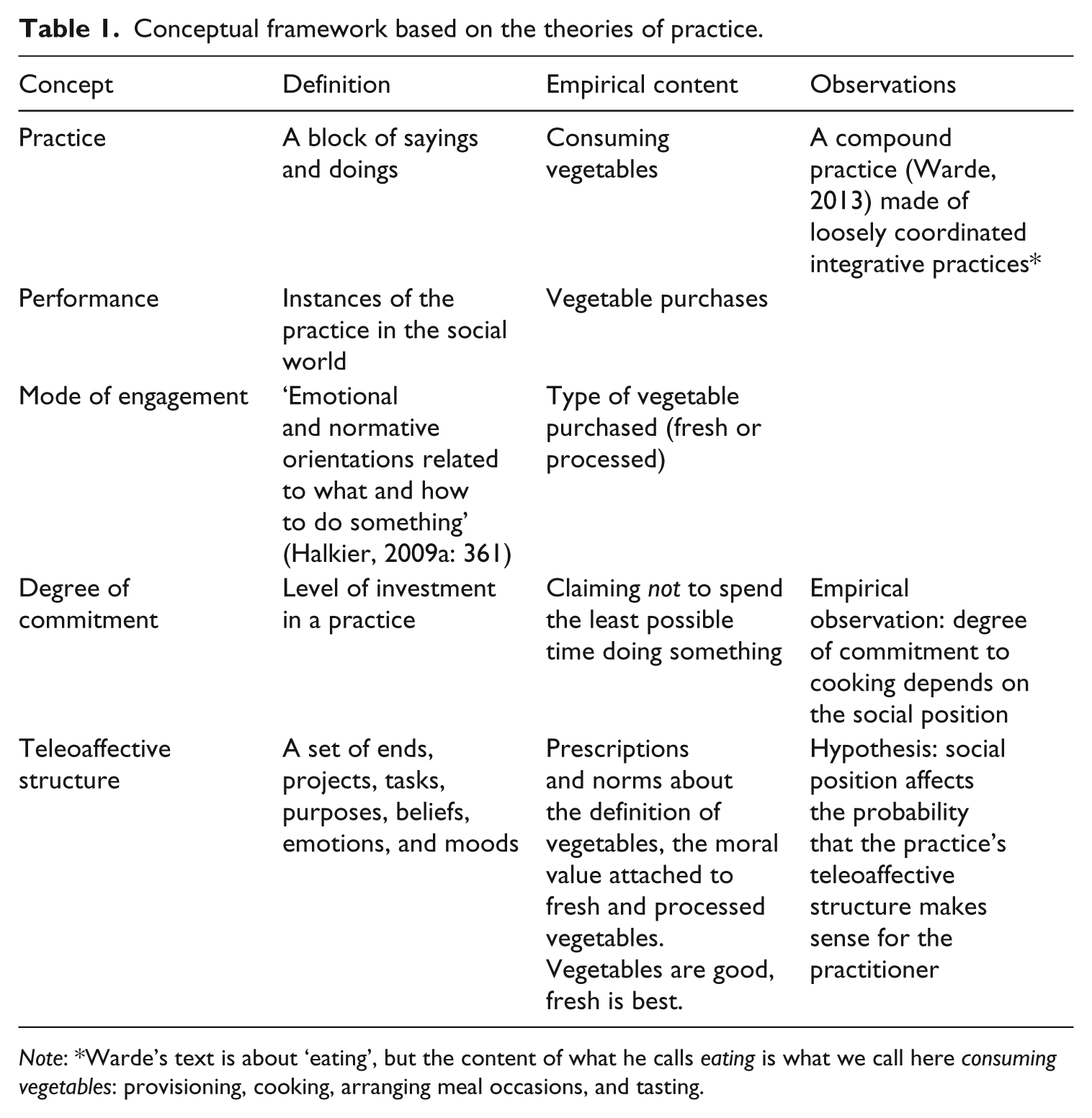
Note: *Warde’s text is about ‘eating’, but the content of what he calls eating is what we call here consuming vegetables: provisioning, cooking, arranging meal occasions, and tasting.
Connecting Vegetable Consumption Practices with Social Position
Households with higher socioeconomic status consume more vegetables (Hunt et al., 2000; Plessz and Gojard, 2013; Régnier et al., 2006; Roos et al., 2001). This is even truer for fresh vegetables (Plessz and Gojard, 2013). Eating foods prepared outside the home is also connected with class. In France, Grignon and Grignon (1980) found that middle-class households bought more ready-prepared meals than working-class households. This result, however, dates back to the 1980s when the supply of convenience foods was still limited and expensive. James (1997) suggests that the notion of authenticity – relying on domestic cooking as opposed to takeaway food – had become increasingly distinctive in the UK by the end of the 20th century.
Only a few papers that employ theories of practice try to connect practices with social position. We rely primarily on Southerton (2006) and Warde (2005). Southerton investigates the temporal organisation of non-work activities in households from different socioeconomic backgrounds. He demonstrates that the performance of a given practice differs according to the individual’s degree of commitment to the practice: ‘The consequence of a high degree of personal commitment is that it fixes a practice within a daily or weekly schedule’ (2006: 450). Southerton connects an individual’s commitment to specific practices, to social characteristics such as gender and life-course position.
Another element connects practices and social position: ‘being highly educated did not relate to degree of commitment, but it did affect type of practices and mode of engagement’ in leisure practices (Southerton, 2006: 450). Southerton relates the mode of engagement to each interviewee’s educational level, suggesting that the pursuit of self-improvement is characteristic of highly educated people. Individuals with less education seek pleasure in participation (2006: 450).
The two modes of engagement with vegetable consumption presumably connect differently with social position. Indeed, the acknowledgement of food and health prescriptions depends on the household’s socioeconomic status (Caillavet et al., 2009; Plessz et al., 2013; Régnier and Masullo, 2009; Régnier et al., 2006; Roos et al., 2001; Tomlinson, 2003). It is likely that prescriptions about food consumption share features with middle-class practices because they are produced by experts who themselves are members of the middle class (Boltanski, 1971).
However, fresh vegetable consumption also requires a stronger commitment to cooking than processed vegetable consumption. Lack of time has frequently been mentioned as a barrier to healthy eating (Jabs et al., 2007; Welch et al., 2009). This applies to the consumption of vegetables (Crawford et al., 2007). The persistent lack of time, which has occasionally been labelled ‘time squeeze’ or ‘time famine’, primarily affects economically active middle-class people (Linder, 1970; Schor, 1991; Southerton and Tomlinson, 2005). In France, members of the middle class spend more time working (Chenu and Herpin, 2002) and less time cooking (Kan, 2008; Larmet, 2002; Lemel et al., 1998) than members of the working class. However, in a study that examined cultural consumption outside the home, Sullivan and Katz-Gerro demonstrated that individuals who possess more educational and financial capital ‘have less free time and still engage in a wider range of out-of-home leisure activities’ (2007: 131). They conclude that the propensity for ‘being harried, keeping busy, multitasking and embracing a diverse cultural consumption pattern’ (2007: 123) is a better indicator of social status than the time actually spent on these activities.
Ultimately, we assume that the consumption of vegetables can be considered as a practice. This practice rests on a teleoaffective structure whose main elements are the following: (1) vegetable consumption is valued in widely diffused public health prescriptions, and (2) fresh vegetables have higher symbolic and moral value than processed vegetables. Therefore, we believe fresh and processed vegetable consumption can be considered as two different modes of engagement in the practice of vegetable consumption. These two modes of engagement connect in different ways to the teleoaffective structure of the practice. They also connect in different ways to the cultures and practices of social classes: the upper strata of French society adhere to notions of preventive health and value vegetable consumption and fresh produce. However, they simultaneously spend less time in unpaid domestic labour than members of lower classes.
This article has two main objectives: (1) to test whether our theoretical definition of ‘consuming vegetables’ as a practice with two possible modes of engagement (through fresh or processed vegetable purchases) is relevant for quantitative analyses of vegetable purchases; and (2) to investigate how commitment to cooking and shopping intervenes in the relationship between class position and fresh and processed vegetable consumption. We examine these questions after describing the methods we used.
Methods
Data
We used data from the Kantar Worldpanel for 2007. This dataset records household food purchases for at-home consumption throughout the year. The respondent, defined as the household member usually responsible for shopping, recorded every food purchase and its price on a weekly basis. The data provided a large set of product attributes that helped us identify processed vegetables. We excluded households that failed to respond, households that failed to provide at least 44 weeks of purchase data, and some outliers (five households whose total vegetable purchases exceeded 450 kg/year). Therefore, the final sample size was 2614 respondents. The very detailed information on purchased food items allowed us to compare fresh and processed vegetables. On the other hand, using household purchase data prevented us from studying gender differences (except in the case of single-adult households).
Outcome Variables
The main outcome variable is the amount of fresh vegetables purchased over a year measured in kilograms. Vegetables were defined based on the standards of French nutrition science (potatoes and legumes were excluded). In addition, we examined the amount of processed vegetables purchased, selecting every processed food that might be considered an opportunity for each household to practise vegetable consumption. We included minimally processed ‘fresh-cut’ vegetables, frozen vegetables, and tinned vegetables. We also included ready-prepared meals and baby food (in jars) if they contained at least the equivalent of one vegetable serving per person, according to the terms used to describe each dish. We excluded tomato sauces, pizzas, tarts, and pies because the French do not consider these items vegetables. In 2007, each French household included in the sample bought almost 70 kg of fresh vegetables and 44 kg of processed vegetables (see Table 2).
Amount of vegetables purchased by households (in kilograms/year).

Note: Sample: households included in the regressions (N = 2614).
Control Variables
Because the amount of vegetables purchased was calculated at household levels for the regressions, we chose the following control variables: we computed at_home to control for each household’s propensity to eat outside the home (or, conversely, each household’s tendency to invite people over regularly). We defined at_home as the ratio of the average number of meals eaten at home to the number of household members. 3 Garden is a dummy we used to identify households that consumed home-grown vegetables. To capture the size of each household, we included the number of adults, the number of children under the age of six, and the number of dependent children between the ages of six and 24. In addition, for single-person households, we distinguished between male and female respondents (De Saint Pol, 2008). 4
Age is a major predictor of fresh vegetable consumption (Plessz and Gojard, 2013). However, until recently, the legal retirement age in France was 60. Consequently, it can be difficult to pinpoint the respective effects of the respondent’s age and employment in the regression results. Therefore, we controlled those two characteristics using the following series of dummy variables: 20-40 years of age and employed, 41–65 years of age and employed, 20–40 years of age and unemployed or inactive, 41–65 years of age and unemployed or inactive, and 66 years of age and above. 5
Covariates
The covariates analysed in this study pertain to respondents’ social positions and commitments to food-related activities. The measures for each household’s social position were based on educational attainments (i.e. middle school, high school, higher education) and income. Income per consumption unit was coded into four categories: 6 poorest 15 per cent, next 40 per cent, next 30 per cent, and richest 15 per cent. Those two variables permit the measurement of two different dimensions of social position: cultural and financial resources (Yaish and Katz-Gerro, 2010).
The Worldpanel questionnaire offered two statements to respondents to estimate their commitments to food-related practices: ‘I spend as little time possible cooking’, and ‘I try to spend as little time possible grocery shopping’. 7 We collapsed responses of ‘I strongly agree’ and ‘I agree’ as well as ‘I disagree’ and ‘I strongly disagree’. We regarded these answers as indicative of respondents’ degrees of commitment to cooking or shopping. Only a limited number of respondents (27%) reported spending ‘as little time possible cooking’. In other words, more than two out of three respondents were committed to cooking. In contrast, more than half (57%) reported low degrees of commitment to shopping.
We performed linear regressions to predict the amount of vegetables purchased for at-home consumption. We present unstandardised coefficients that can be read as extra or missing kilograms of vegetables included in the total amounts purchased in a year by households with given characteristics, in comparison with baseline characteristics. We determined the following baseline characteristics: two adults, zero children under six years of age, zero children over six years of age, no garden, income among the 15 per cent poorest, respondent’s education is at the middle-school level, respondent did not spend the least possible time cooking and shopping, and respondent is aged 20–40 and is employed. The distribution of the control variables and covariates appears in the first panel shown in Table 3.
Regression results: amount of vegetable purchased (kilograms/year).
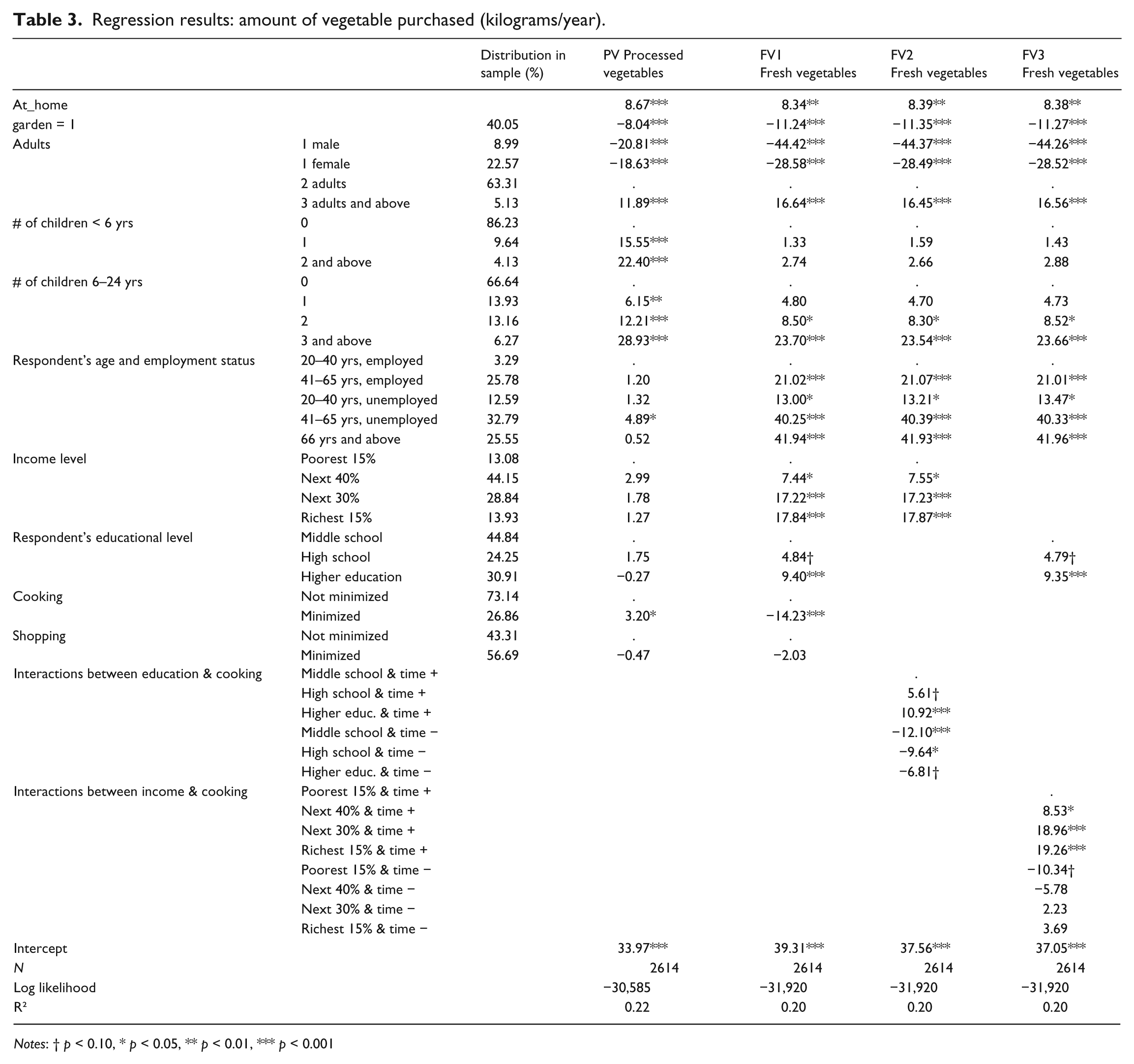
Notes: † p < 0.10, * p < 0.05, ** p < 0.01, *** p < 0.001
Delineation of a Practice: Vegetable Purchases and Cooking
To define the practice of consuming vegetables, our starting point was the teleoaffective structure of the practice. In this section, we test how this theoretical framework can account for empirical descriptions of the performances of the practice. The performances studied are the acts of purchasing vegetables, fresh or processed. We ran linear regressions predicting the quantities purchased and examined whether we could delineate a practice that operates as a block containing interrelated components. The regression results appear in Table 3. Most households purchased both processed (model PV) and fresh vegetables (model FV1), combining both modes of engagement in the practice of vegetable consumption. However, the amounts purchased differed. We were curious about how respondents’ commitments to cooking and shopping related to these two modes of engagement.
Shopping
Respondents’ degrees of commitment to shopping did not exert significant effects on the amounts of vegetables purchased, either processed (in model PV) or fresh (in model FV1). Notably, respondents who purchased large amounts of processed vegetables did not spend more time on these purchases. Yet, this does not imply that the conditions related to food provisioning have no bearing on vegetable consumption. On the contrary, respondents who had vegetable gardens bought significantly fewer vegetables of all types, probably because they consumed home-grown produce instead. However, the model demonstrated that the degree of commitment to shopping did not affect vegetable consumption.
Processed Vegetables
In the PV model, the outcome variable is the amount of processed vegetables purchased. After controlling for factors that exerted mechanical impacts on the overall amount of food purchased (household size, potential reliance on home-grown produce, frequency of meals eaten outside the home), processed vegetable purchases were not dependent on age or household social position. They were dependent on gender to a very limited extent. The fact that respondents spent as little time possible cooking slightly increased their use of processed products (+3 kg/year). Shopping did not exert significant effects.
The fact that commitment to food-based activities exerted a limited impact on processed vegetable purchases suggests that the convenience provided by these products goes far beyond timesaving during food preparation. Convenience foods may also eliminate unpleasant or complex culinary tasks (Carrigan et al., 2006), and they facilitate the individualisation of meal times and content within each household (Southerton et al., 2011; Warde, 1999). In this study, respondents who explicitly neglected cooking resorted more frequently to this mode of engagement in vegetable consumption. However, processed vegetable consumption could be connected to other practices and meanings that could not be captured in this study.
Fresh Vegetables
The effects of demographic variables on fresh vegetable purchases contrasted with the results observed for processed vegetables. The presence of children, especially very young children, did not substantially increase fresh vegetable purchases, but age and employment exerted an impact. The peak effect for employment occurred among people aged 40–59.
Additionally, at baseline, fresh vegetable purchases declined by 14 kg/year if respondents did not commit to cooking. The extra 3 kg of processed vegetables bought by those respondents did not outweigh this decrease. Overall, the results corroborate the idea that vegetable consumption is a block-like practice (Reckwitz, 2002): that is, vegetable purchases are not solely dependent on the objective characteristics of each household. When they bought vegetables, individuals may have already anticipated the ways those vegetables might be prepared; respondents who minimised cooking bought less fresh produce and slightly higher amounts of ‘convenient’ processed vegetables.
Based on these findings, we can delineate the practice as follows. Two modes of engagement are nested within the practice of ‘vegetable consumption’: the purchase of fresh vegetables and the purchase of vegetable-based processed foods. Households combine such purchases in varying degrees. Neither mode of engagement seems dependent on the commitment to shopping. However, the mode of engagement that relies on the purchase of fresh vegetables creates a block in conjunction with the commitment to cooking because these two activities are connected. Engagement in vegetable consumption through the purchase of processed foods (including tinned vegetables that might be used in complex preparations) is inversely and much more weakly related to cooking. It can be sustained without a high degree of commitment to household chores, and it is equally appealing to individuals with high or low levels of income and education. This confirms the notion that purchases of fresh or processed vegetables are two different modes of engagement in vegetable consumption. The teleoaffective structure of the practice makes fresh foods highly desirable for the middle class.
More generally, respondents’ practices depend on social position because, according to their values and culture, different modes of engagement in the practice make sense to them. The practice’s teleoaffective structure thus not only hierarchises modes of engagement (using fresh vegetables is ‘more suitable’ than relying on processed food) but also recruits practitioners with higher social status into the more valued mode of engagement.
Social Position, Commitment to Cooking and Fresh Vegetable Purchases
We now focus on fresh vegetable purchases to gain a better understanding of how this mode of engagement connects with social position and how commitment to cooking can intervene in this relationship.
Commitment to Cooking and Social Position
Only a limited number of respondents reported the allocation of ‘as little time possible’ to cooking. The percentage of individuals who devoted as little time possible to cooking was significantly lower among poor households (see Table 4). This result could be interpreted as the manifestation of the opportunity cost of cooking for households that reached certain levels of earnings because cooking is an unpaid time-consuming activity (Gershuny, 2000).
Income level (per consumption unit) and commitment to cooking.
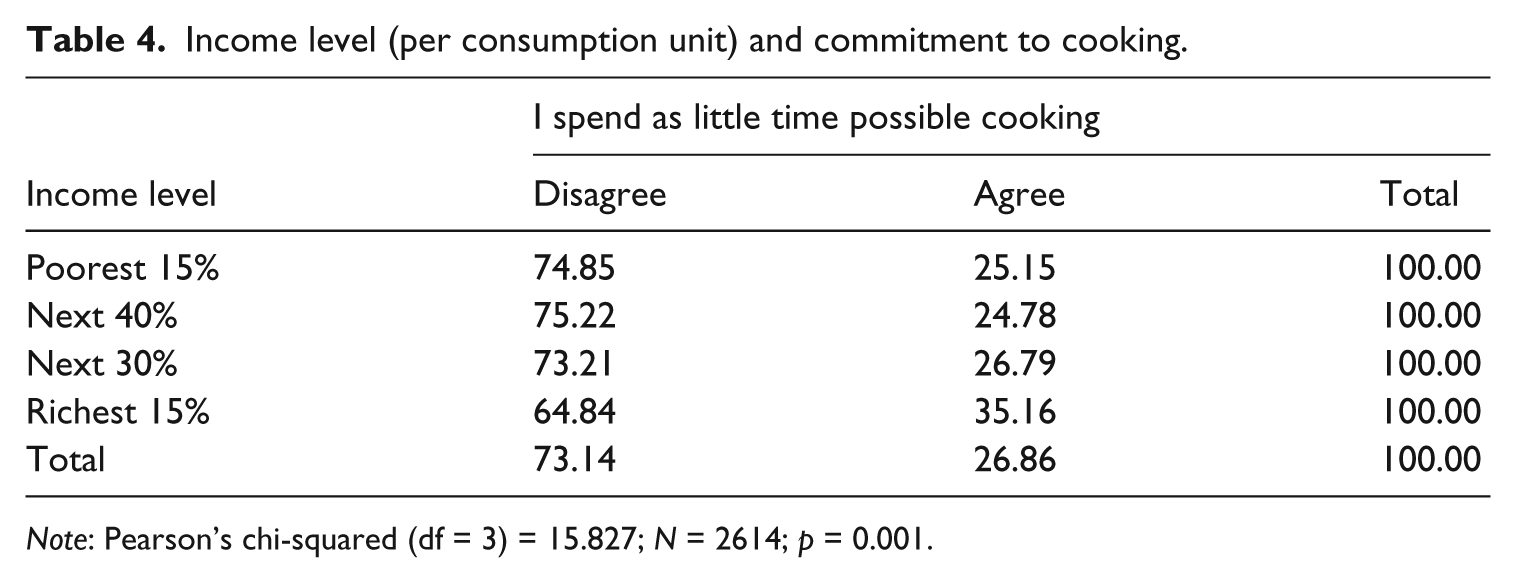
Note: Pearson’s chi-squared (df = 3) = 15.827; N = 2614; p = 0.001.
The link between time devoted to cooking and education level was also significant (p = 0.026). Men who lived alone, rather than women, more frequently reported spending as little time possible cooking. Employment status and age seemed unrelated to time devoted to cooking, at least when cross-tabulations were considered.
Social Position and Engagement in Fresh Vegetable Consumption
Social position, whether measured by income or education, affected fresh vegetable purchases. The FV1 model revealed that the richest 15 per cent of households (as opposed to the poorest 15%) tended to buy an additional 17.8 kg of vegetables at the baseline. In addition, having successfully completed secondary education or more was associated with a 9.4 kg increase in purchased products. This occurred after we controlled for the degree of commitment to cooking. However, Table 4 shows that the commitment to cooking was significantly stronger among the poorest households. Model FV1 rests on the assumption that the two effects are additive. In other words, the model hypothesises that the effects of cooking will be the same across income and education groups. Therefore, in models FV2 and FV3, we add the interaction terms between social position and commitment to cooking. For the sake of simplification, we computed new variables as combinations of the original variables. The results appear in Table 3 while Figure 1 provides graphs of the related interaction effects.
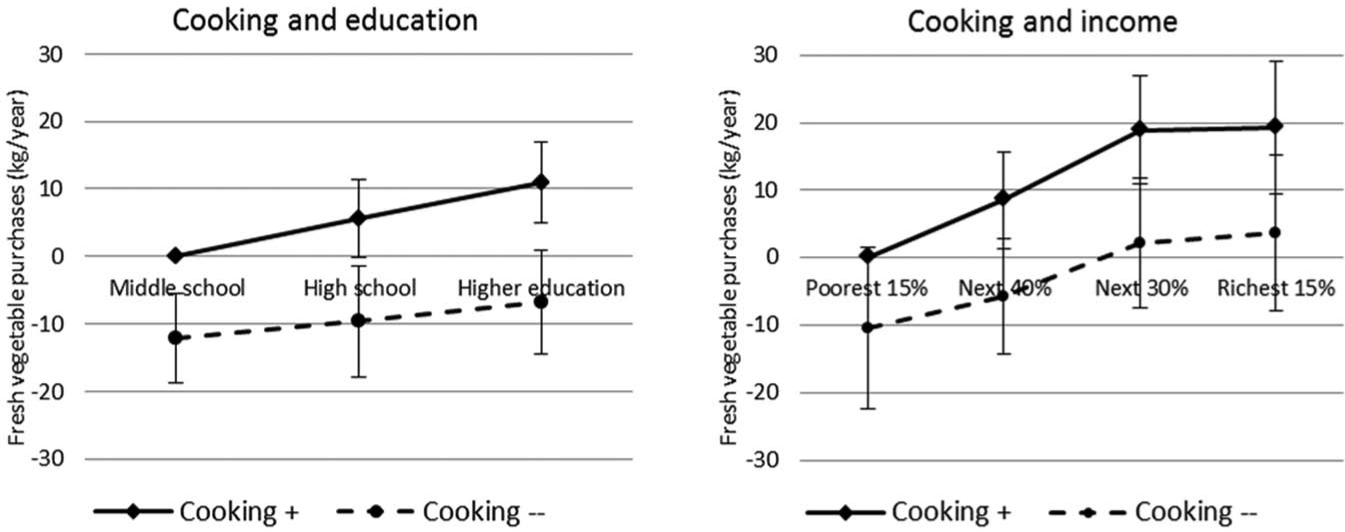
Interaction plots for commitment to cooking and education (left) and cooking and income (right) that predict fresh vegetable purchases (with confidence intervals at 95%)
Coding the effect of commitment to cooking and income (respectively, the effects of cooking and educational level) as an interaction term did not alter the significance or the value of the coefficients for other variables introduced in the model. Notably, the effect of income (respectively, of education) did not change after the introduction of cooking-education (respectively, cooking-income) interaction. In addition, the R-square and log likelihoods for models FV2 and FV3 were almost identical to those of the FV1 model. Therefore, the introduction of interactions did not improve the quality of the model, indicating that the hypothesis of additive effects was realistic.
Next, no significant interactions appeared to have occurred between the two variables. The illustration in Figure 1 clarifies this. The effects of cooking times did not vary significantly as respondents progressed up the social scale. The effect of social position did not differ significantly based on the degree of commitment to cooking.
However, according to Figure 1, income effects appeared to plateau for incomes above the median. No significant differences occurred between the richest 15 per cent and the next 30 per cent, regardless of cooking times. Thus, extremely low income could be considered a limiting factor. Once income increased past a certain threshold, it did not appear to impact on fresh vegetable purchases.
Therefore, commitment to cooking was associated with increased consumption of fresh vegetables. This result was not affected by income or education. Conversely, educated respondents consumed more vegetables than those with less education. The case of income differed slightly. Although poverty obviously limited fresh vegetable consumption, a change from a comfortable to an affluent life appeared to have no effect.
Conclusion
In this article, we attempted to build on theories of practice to better understand the links between social position and food consumption through the example of vegetable consumption. We selected vegetables because prescriptions have designated them as desirable and healthy. Nutritional and moral norms regarding proper foods build the teleoaffective structure, which is our starting point for defining vegetable consumption as a practice at the theoretical level. We used a dataset containing detailed information on food purchases, which allowed us to separate fresh and processed vegetables. Our empirical results suggest that vegetable consumption was loosely related to the respondents’ degrees of commitment to grocery shopping, even though we measured their performances in terms of purchases. Vegetable consumption was strongly connected to the commitment to cooking, though not merely reducible to it. We examined the differences between processed and fresh vegetable consumption. We interpreted this difference as indicative of two modes of engagement in vegetable consumption. The consumption of processed vegetables is a widely diffused mode of engagement, while consuming fresh vegetables is more selective. Most households buy some processed vegetables as well as varying amounts of fresh vegetables. Social position affected fresh vegetable consumption through two channels: first, the richer (and to a lesser extent, the more educated) respondents were less committed to cooking. Low degrees of commitment to cooking induced lower levels of fresh vegetable purchases. Second, despite their lower commitment to cooking, respondents with above-median incomes, as well as the highest educational levels, engaged in higher levels of fresh vegetable consumption. This might have resulted from their stronger acknowledgement of, and adherence to, nutritional prescriptions and their association of vegetables and fresh foods cooked ‘from scratch’ with notions of health and of proper cooking. This implies that a connection exists between enrolment in a practice (in this case, vegetable consumption) and social position. As suggested by Southerton (2006), the mode of engagement functions as a vehicle for social distinction within a given practice.
We can suggest hypotheses about how households with higher education and income managed to consume fresh vegetables despite their lower commitment to cooking. First, although lower-class people cook more, they might cook meals with fewer vegetables (they cook dishes based on other food groups). Second, people who might be especially willing to engage in fresh vegetable consumption without having to cook more might develop specific strategies. They might eat raw vegetables as appetizers or side dishes. Indeed, they consume more fresh-cut salads (Plessz, 2013; Plessz et al., 2013). Finally, Evans (2011b: 47) suggests that households might ‘provision food in line with the imperative to eat healthily. However, … buying healthy food does not necessarily mean that healthy food is eaten.’ It is possible that affluent households can afford to purchase foods they might ultimately discard, while low-income households cannot take that risk.
Our study had certain limitations. The data allowed us to conduct separate examinations of fresh and processed foods that were vegetables or were made of vegetables. The main limitation of this dataset was that it did not allow the investigation of what happened to those foods once they were purchased. We could not determine who ate the vegetables in each household. Therefore, we were unable to draw conclusions related to individual food intake. This implies that dimensions such as gender could not receive much attention here. Additionally, we had no information on out-of-home food consumption. Similarly, it would have been interesting to obtain information related to each respondent’s opinion of nutritional prescriptions and the links that connect food and health.
Despite these caveats, our study suggests that it is necessary to employ both theories of practice and social stratification approaches to account for the links between consumption and social position. Thus far, distinction through food consumption has been analysed mainly through the study of which foods are consumed. This amounts to studying ‘how much’ the practice is performed. By studying how people consume, practice theories can potentially explain how distinction is produced during the consumption process. In this article, we open up the space for such analyses. We suggest that it is possible to link a practice-theoretical approach with the analysis of the selection process that causes a practice to recruit more members in specific social groups. Further, we suggest that the teleoaffective structure contains elements (norms, meanings) that together introduce a hierarchy of the modes of engagement in the practice (fresh is best) and increases the chances for high-status individuals to be recruited into the most desirable modes of engagement, even though their commitment to connected activities (cooking) is not that high. This framework could be applied to other fields of practice and enrich practice theory by offering a deeper view of how degrees of commitment and modes of engagement relate to the social properties of practitioners.
Footnotes
Acknowledgements
We would like to thank Christine Boizot for assisting in the analysis of quantitative data and Tally Katz-Gerro and Sophie Dubuisson-Quellier for helpful suggestions.
Funding
This research is part of the research project entitled ‘Governing Consumption Behaviours, the Cases of Obesity Prevention and Sustainable Consumption’ (coordinator Sophie Dubuisson-Quellier, Centre for the Sociology of Organizations, CNRS/Sciences Po). It was funded by the French National Research Agency [ANR grant ANR-08-GOUV-013] and by the French Agency for the Environment [ADEME grant 058250].