



Abstract
What is the relationship between social stratification and arts participation? Because the barriers to both participation and consumption vary, the relationship between the social strata and arts participation may differ from the relationship between social strata and arts consumption. Using three pooled waves of the Taking-Part survey (N = 78,011), I estimate latent class and multinomial logistic models to examine the association between education, social status, social class, and income with patterns of arts participation. Five latent clusters are observed and both social status and social class are insignificantly associated with each cluster. In contrast, education remains strongly correlated with most forms of arts participation. These results indicate that arts participation, as a constituent part of ‘lifestyle’, is not primarily explained through social status or social class but rather through education.
Introduction
The ‘cultural turn’ in stratification studies has highlighted both the ‘cultural politics of class’ and the cultural processes that produce social inequality (Savage et al., 2010). The social gradient in cultural engagement has been widely documented (Bennett et al., 2009; Chan, 2010) and these cultural inequalities are the product of and also contribute to broader social and economic inequalities (Lamont et al., 2014). Cultural engagement, and in particular cultural participation, is used as a sign of shared interests in hiring decisions made by elite firms; suggesting that cultural engagement may serve as a barrier to social mobility (Rivera, 2012). Cultural practices and preferences are also valuable as markers of social position (Reeves, 2012; Savage et al., 2010). Inequalities in cultural participation can be translated into economic and social inequalities.
Yet, these cultural inequalities remain unclear because many of those studies that have documented the social gradient in cultural engagement have failed to distinguish arts participation (i.e., the personal practice of art making) from arts consumption (e.g., attending art events) (Yaish and Katz-Gerro, 2012). This distinction matters because arts participation requires different cultural resources from arts consumption, implying that the social gradient in arts participation may be different from the social gradient in arts consumption (Yaish and Katz-Gerro, 2012). Previous research indicates that arts consumption and arts participation may have a similar relationship with social status because both forms of cultural practice are components of lifestyle (Chan, 2010). Yet, others argue that the social class gradient, rather than social status, will explain patterns in both cultural consumption and arts participation (Bennett et al., 2009). Finally, arts participation may be unrelated to both social class and social status because cultural participation requires different cultural resources than consumption (Yaish and Katz-Gerro, 2012); resources that are not necessarily acquired through occupational class or status group membership. To develop a more rounded picture of the inequalities within cultural engagement (or lifestyle) as a whole, both arts consumption and arts participation should be studied together and separately (Bunting et al., 2008). Further, documenting the associations between cultural inequalities and the social strata will also point toward how cultural inequalities are translated into other forms of inequality.
Unlike arts consumption, neither social class nor social status is strongly correlated with arts participation. Instead, education is the principle dimension along which arts participation is stratified. These findings shed light on potential mechanisms through which social position shapes inequalities in cultural engagement.
Defining Participation and Consumption
Arts participation and consumption have been conceptualized in different ways (Bennett et al., 2009; Tepper and Ivey, 2008). Taste and consumption have often been elided in previous research (Chan and Goldthorpe, 2007b) and this is also true of the distinction between consumption and participation (Bennett et al., 2009). In part, this reflects how the original meaning of arts participation – ‘to take part’ – has been replaced by an increasingly passive meaning which suggests ‘to have a part or to share something’ (Tepper and Ivey, 2008: 5). In this vein, there is a distinction between the culture we create (participation) and the culture we take in (attendance or consumption). Attending Wagner’s Tristan und Isolde is consumption while performing in that opera is participation. Of course, there are activities that are not so easily categorized on this basis; listening to music and playing a musical instrument at home. Despite their similarity these activities imply varying degrees of physical involvement both before and during the action itself. Playing a musical instrument involves different types of practice and the sustained act of learning to play a musical instrument cultivates skills and dispositions that are distinct from merely listening to music. Likewise, being able to attend a gallery often requires less time and a lesser degree of physical activity than creating an oil painting. This approach has similarities to the cultural capital indicators used by Dumais and Ward (2010) to assess university enrolment and graduation.
Cultural Consumption and Social Stratification
Studies of cultural engagement are not only concerned with documenting associations with the social strata but they also intend to examine whether social position influences cultural practice or whether cultural practice facilitates social mobility (Goldberg, 2011). For example, both Bennett et al. (2009) and Chan et al. (2010) develop theories which explain ‘the social processes, or mechanisms, through which the stratification positions held’ by individuals ‘actually condition and motivate their actions as consumers’ (Chan, 2010: 20). Lamont and colleagues (2014), in contrast, have documented how the cultural process of sorting (or categorizing) individuals according to cultural practices reinforces the pathways through which positions in the social strata are attained.
For those who accept that social position shapes cultural practice, debate continues regarding whether cultural consumption is shaped by social class or social status. Chan and Goldthorpe (2007a, 2007b) use Weber’s distinction between social class and social status to explain both lifestyle and economic life-chances. While social status is correlated with cultural consumption (i.e., one facet of lifestyle) but not economic life-chances; social class is a far better predictor of economic life-chances than social status (Chan and Goldthorpe, 2007a). Social status is closely associated with the stratification of cultural consumption because consumption is more explicitly grounded in specific ‘status concerns’ and because it is a product of the social and symbolic barriers which shape lifestyle (Chan, 2010: 15). These ‘status concerns’ suggest that the social gradient in cultural consumption is produced by individuals responding to the status position (and, by implication, the social networks) in which they are currently embedded. This measure of social status draws on differential associations of occupational friendship networks and measures the structure of perceived superiority, equality, and inferiority that is observable through stable associations: i.e., ‘status equals’ are more likely to associate (Chan and Goldthorpe, 2007a).
In terms of music consumption in the UK, the effects of social class on whether an individual is a musical omnivore (i.e., they consume a wide variety of musical genres) are non-significant at the α = 0.05 level (Chan and Goldthorpe, 2007b). Whereas ‘the higher an individual’s status, the more likely they are to be a true omnivore rather than a univore’, i.e., individuals who consume only one music genre (Chan and Goldthorpe, 2007b: 10). Social status, but not social class, has a similar association with various other domains of cultural consumption.
Contrastingly, for Le Roux et al. (2008) the implications of the status scale are unclear because the measure of occupation used to derive social status is also used to measure social class. In contrast, they find that occupational class is a good predictor of cultural engagement and conclude that ‘class matters, but only when measured in a particular way’ (Le Roux et al., 2008: 1066).
This methodological critique has substantive implications for how the relationship between cultural and economic inequality is conceptualized. For Le Roux et al. (2008), cultural and economic positions are intimately connected and not wholly separable, suggesting reciprocity between cultural and economic inequality. In contrast, for Chan and colleagues, cultural inequality is a consequence of the cultural homogeneity within friendship networks located at a particular point in the status hierarchy. While there is disagreement about the influence of social class and social status on patterns of cultural practice, both research streams consistently observe that education is a good predictor of various modes of cultural consumption.
These associations between social class, social status, and education matter because they point toward possible mechanisms through which arts participation is cultivated and, by implication, how the social gradient in cultural engagement is produced.
Cultural Consumption and Arts Participation
Despite this growing interest in cultural engagement and social inequality, the relationship between arts participation specifically and the social strata is uncertain. A clearer picture of cultural engagement will only be possible through examining the impact of social status and social class on both consumption and participation. Part of this uncertainty is because arts participation could be associated with both social class and/or social status.
If consumption and participation are similar aspects of lifestyle, then the relationship between arts participation and social status should be consistent with the previously observed association between social status and arts consumption (Chan, 2010). In other words, while the strength of the relationship may vary, high-status individuals should have a higher likelihood of being an active arts participant while those in professional occupations should not. The weak association between class and arts participation is plausible because the net effect of occupation on arts participation is unclear once education, family background, income and friendship networks have been taken into account.
There are also reasons to be cautious about the status–arts participation hypothesis. First, social status does not have a unitary relationship with all forms of cultural consumption. ‘Theatre, dance, and cinema’, for example, is not as closely associated with social status as other cultural practices; suggesting that the nature of the activity moderates the strength of the association between social status and lifestyle (Chan, 2010). If some cultural activities are more susceptible to the impact of status hierarchies than others, then social status could have a distinct relationship with cultural participation and cultural consumption.
Social and symbolic barriers to participation partially explain why social status may be weakly associated with arts participation (Lamont and Molnar, 2002). The barriers to cultural practice include: time, cost, ‘ease’, and acculturation (Bourdieu, 1984). Although these barriers are common to both participation and consumption (Fenn et al., 2004) they impact cultural practice in distinct ways. Participation involves different, very often greater, financial and temporal costs than consumption (Charlton et al., 2010; Fenn et al., 2004). First, those with more financial resources (e.g., higher incomes) (Le Roux et al., 2008) and those with greater disposable time or more flexible work schedules are more likely to be arts participants (Charlton et al., 2010). Painting, for instance, will often require more time and money than going to a gallery. Second, if people are uncomfortable in a cultural setting, i.e., they do not feel at ‘ease’, then they rarely participate (Bourdieu, 1984). Parental encouragement to consume or participate can cultivate the cultural resources to feel at ease (Bourdieu, 1984). Third, acculturation through educational attainment may transfer cultural resources and may also increase this feeling of ‘ease’ in certain cultural milieux (Stevens et al., 2008). The barriers to participation (in terms of time, cost, ease, and acculturation) are different from the barriers to consumption and navigating them requires different resources.
Yet, if arts participation requires distinct cultural resources from arts consumption, how might these differences moderate the specific association between social status and arts participation? The status scale implies that cultural engagement is more homogenous among status equals but these barriers to participation may minimize this homogeneity. Anxiety concerning appropriate social etiquette associated with some forms of arts consumption can be alleviated through friends (Charlton et al., 2010) but with arts participation the impact of friends is likely diminished. Friends also are unlikely to increase financial resources, disposable time, or other cultural resources that may make participation possible. These barriers to arts participation make these activities relatively less transferrable as social practices than consumption, thereby reducing the degree of homogeneity expected along the status scale. The social and symbolic barriers (Lamont and Molnar, 2002) to arts participation suggest that social status will have a weaker, albeit positive, association with being an active arts participant.
In contrast, the association between educational attainment and arts participation should remain because attending university involves two selection mechanisms that favour those who are more likely to be arts participants later in life. First, those with higher information-processing capacity are more likely to enjoy highbrow cultural practices, such as arts participation, and be university graduates (Notten et al., 2014). Second, universities make admissions decisions using information on extracurricular and cultural activities, increasing the likelihood that university graduates are culturally active (Boliver, 2013; Stevens et al., 2008). Education also cultivates arts consumption and participation (van de Werfhorst and Kraaykamp, 2001). In short, university graduates are more likely to possess the cultural resources necessary for both arts consumption and arts participation.
Arts participation, as a component of lifestyle, is unlikely to be strongly correlated with social class (Chan, 2010; Reeves, forthcoming). Because the barriers to participation are not the same as the barriers to cultural consumption, social status is anticipated to have a weaker relationship with arts participation. Similar to arts consumption, education will be a good predictor of arts participation. By examining whether education, social status and social class have a consistent influence on arts participation, this article contributes toward understanding how cultural inequality is produced and, by implication, how economic and social inequality can be mitigated (Lamont et al., 2014).
Method
Data Analysis
Many concepts in the social sciences are not directly observable. Latent Class Analysis (LCA) posits that an unobserved (latent) categorical variable explains responses among a set of observed (manifest) variables. LCA studies the responses among these observed variables and constructs a typology of the dominant patterns of arts participation. LCA is an excellent tool for capturing and testing assumptions regarding the composition (or pattern) of cultural engagement because it allows these latent patterns to come to the fore (Chan and Goldthorpe, 2007b).
In LC models, once the latent variable is defined, each respondent is assigned to one of the categories in the latent variable using the posterior probabilities; i.e. the probability that person i will be a member of cluster 1 given their outcomes in each of the manifest variables. This probability is calculated for each latent cluster and then, when using modal assignment (Magidson and Vermunt, 2004), person i is assigned to the latent cluster with the highest probability. These classifications become the basis for the Multinomial Logistic Regression (MLR) analysis (Vermunt, 2010). This classificatory process reintroduces measurement error because the posterior probabilities cannot always be clearly classified into a single cluster. Classification errors in this study (which represents the estimated proportion of cases that are potentially misclassified) are small and account for 12.27 percent of modal cluster assignments (Magidson and Vermunt, 2004).
Having generated the latent clusters, MLR analysis estimates which variables best predict membership in different latent classes using one of the latent classes as a baseline. These LC models do not violate the assumptions of MLR (Vermunt, 2010). 1 A three-step approach to modelling the latent variable and its covariates has been adopted because potential sparseness in both the latent class model and the explanatory model indicate that a one-step approach would be inappropriate (Vermunt, 2010). Further, using a large number of covariates with this one-step approach leads to substantial instability in the estimated coefficients (Chan and Goldthorpe, 2007b). Despite concerns about the potential for bias in the standard errors in the three-step approach, recent simulation studies indicate that when the sample size is large (n > 10,000) and where the classification errors are small (~10%) – as is the case here – the estimated standard errors approach the true values (Vermunt, 2010).
Data
Data are taken from three pooled waves of the Taking-Part survey (2005–6, 2006–7, 2007–8) (N = 78,011). The survey consists of a representative sample of face-to-face interviews with people aged 16 or over in private households in England with a booster sample of adults from non-white backgrounds. Details of the survey are published elsewhere (Aust and Vine, 2007). Weighting for the combined sample has been used.
There are 17 variables included in the LCA (Web Appendix 1), each a binary measure of arts participation over the previous 12 months. Some of these measures of arts participation are arguably arts consumption. However, most of the activities included in the LCA have clear consumption counterparts: reading poetry is consumption while writing poetry is participation. Analysing these activities in one LC model avoids making assumptions about which activities fit in particular domains of cultural practice. This approach is not without some potential costs because combining all these variables in one LC model could introduce some instability in the estimates due to sparseness, even with a large sample. One implications is that χ2 measures of fit are unreliable. To address this instability, the L2 statistic is used to measure the amount of the variance accounted for by the latent class model and also other measures of fit, including the AIC, BIC, and dissimilarity index. As a robustness check, additional iterations of the latent class model are estimated which exclude variables with low levels of participation (which therefore greatly increase sparseness) in order to examine the stability of the prior and conditional probabilities (Magidson and Vermunt, 2004; Vermunt, 2010). These models show that the conditional and prior probabilities of the latent classes do not qualitatively change when excluding such variables (see Web Appendix 2 and 3).
Explanatory variables included in the MLR model are: gender; age; highest education level (No qualifications, less than 5 GCSEs or O Levels, more than 5 GCSEs or O Levels, Apprenticeships, A Levels, Other Further Education, and Higher Education); 8-category NS-SEC; occupation of the chief income earner when the respondent was 16; parental encouragement as a teenager to read, play a musical instrument, draw, and play sport; whether a parent took the respondent as a teenager to libraries, the theatre, heritage sites, and art galleries; and the income level of respondents. This set of variables follows closely those control variables included in previous studies. One important addition is the parental encouragement and parent-led consumption variables which capture the impact of cultural socialization as a youth on patterns of arts participation as an adult. The final explanatory variable is Chan and Goldthorpe’s status scale (Chan, 2010).
Measuring social class through occupation or income inadequately captures how social class has been conceptualized in the work of Bourdieu (1984) and others (Savage et al., 2013). Despite this inadequacy, occupational measures of class have been used to document the homology between cultural consumption and occupational class (Bennett et al., 2009). This article follows this approach for consistency with those previous papers but also as a test of the homology between occupation and arts participation.
Results
The first section of the results outlines the 5 primary clusters of arts participation. This analysis will lay the groundwork for the MLR.
Latent Class Analysis
Exploratory LCA proceeds iteratively through hypothesis testing. The latent variable is hypothesized to possess a particular structure (1 cluster, 2 clusters, etc.) in order to observe whether the correlation among the manifest variables is attributable to the hypothesized latent variable. Each model is assessed using the fit statistics in Table 1.
Fit statistics for latent class analysis of arts participation.

Notes: L2 is the likelihood ratio χ2 statistic. BIC(L2) is the Bayesian Information Criterion derived from the likelihood ratio χ2 statistic. AIC(L2) is the Akaike Information Criterion derived from the likelihood ratio χ2 statistic. df lists the degrees of freedom; d is the dissimilarity index.
In large samples (N = 78,011), χ2; measures of local independence are unreliable for LC models (McCutcheon, 2002) and so the L2, BIC, AIC, and Dissimilarity Index (d) were used to assess the model fit (Magidson and Vermunt, 2004; McCutcheon, 2002).
In Table 1, the BIC and AIC get successively smaller when an additional latent cluster is included in the latent variable. The dissimilarity index (d) 2 for the 5-cluster model is 0.059. In large samples if d<≈0.05 then the model approaches local independence, i.e., a good fit for the data (Biemer and Bushery, 2000). This is supported by the BIC and the AIC which indicates that improvements in the 6-, 7-, and 8-cluster model offer negligible gains in terms of model fit (Magidson and Vermunt, 2004). Consequently, the 5-cluster model has been selected for further analysis.
The conditional and prior probabilities of each latent cluster are listed in Table 2. 3 The first and largest cluster has been labelled ‘None’; it has low conditional probabilities for all the arts activities. The ‘Artist’ cluster has higher probabilities of participation in activities such as painting and photography. The ‘Dance & Art’ cluster is characterized by fairly low probabilities of participation in dance, painting, and working with textiles. ‘Musicians’ are a small cluster with high conditional probabilities of playing a musical instrument. Finally, there is a very small cluster with high probabilities of participation in almost all the activities: this is labelled the ‘Omnivore’ category. 4
Prior and conditional probabilities for the 5-class latent class model for arts participation.
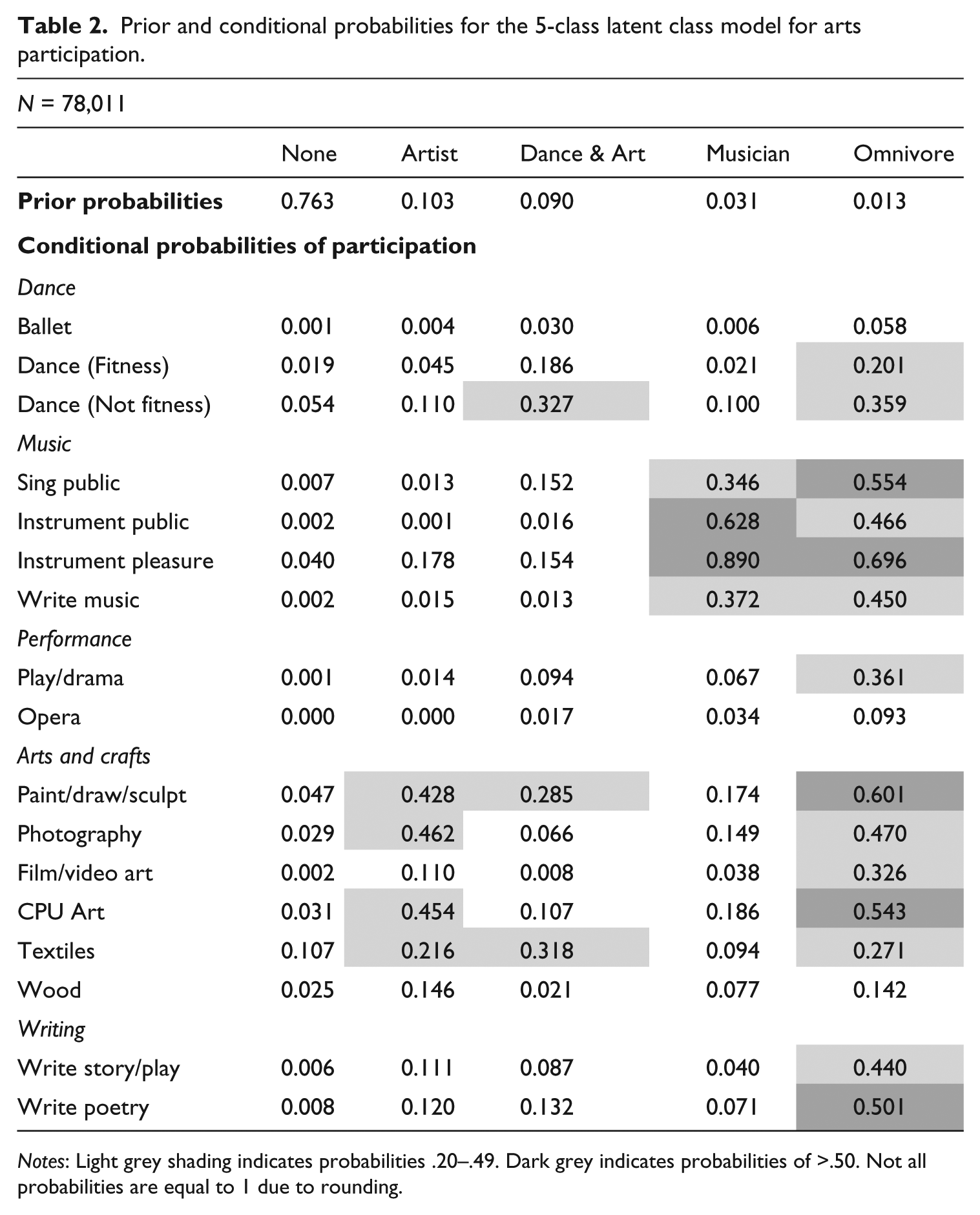
Notes: Light grey shading indicates probabilities .20–.49. Dark grey indicates probabilities of >.50. Not all probabilities are equal to 1 due to rounding.
Multinomial Logistic Regression
Using the ‘None’ category as the baseline, the association between education, NS-SEC, income, and social status is estimated, controlling for other socio-demographic factors (Table 3). All results are relative to the None cluster.
Weighted multinomial logistic regression model: Odds ratio of being an Artist, Dance & Artist, Musician or Omnivore over being None.

Notes: Control Variables: Gender, age, parental encouragement of cultural engagement, and parental class.
No qualifications is reference category.
Routine occupations is reference category.
Income bracket £0-9,999 is reference category.
p < .05; ** p < .01.
Women are three times more likely to be in the Dance & Art cluster than the None cluster (OR 3.00: 95% CI: 2.13 to 4.22). Men are twice as likely to be in the Artist (OR 0.47: 95% CI: 0.38 to 0.59) and the Omnivore cluster (OR 0.43: 95% CI: 0.26 to 0.73), and three times as likely to be in the Musician cluster (OR 0.19; 95% CI: 0.14 to 0.29) than the None cluster. There is not a consistent pattern between age and being a member of any of the latent clusters. The youngest age category (ages 16–29 years) is the most active but older age groups are not demonstrably different. High levels of parental encouragement increase the probability of being an arts participant. Further, being ‘self-employed’ significantly increases the odds of being an ‘Artist’ compared to the None cluster.
Those who have a degree have higher odds of being a member of all arts participation clusters over being a ‘Non-participant’ in almost all clusters. The only exception is the Enthusiast category. The odds ratio of being in the Omnivore cluster if respondents are full-time students is very high (OR: 4.94; 95% CI: 0.85–28.77) albeit marginally insignificant (p = 0.075); possibly due to a small sample in this cluster. This Omnivore group may be dominated by undergraduates or other students and, therefore, educational attainment is weakly correlated with this category. The data may indicate that being a full-time student, regardless of your age, increases your likelihood of participating in various forms of arts activities.
Social status is not a good predictor of arts participation and the measures of social class are almost always insignificant at the α = 0.05 level. Those with higher incomes tend to be less likely to be arts participants (Table 3).
Robustness Checks
To assess whether sparseness influences the latent class model I re-estimated the LC models excluding Ballet, a particularly sparse variable, and the results do not qualitatively change (see Web Appendix 3). Additionally, following Vermunt (2010), bootstrapped models were used to estimate goodness of fit statistics. While sparseness in the LC model is likely, there is a high degree of stability in the structure of the latent variable. Using various software to estimate latent class models can produce different results (Haughton et al., 2009). Additionally, when the size of a latent class is small (<5%), there can be instability in the latent variable. Using poLCA in R, I have re-estimated the models to ensure stability across these software packages and found almost identical results (see Web Appendix 4) (Linzer and Lewis, 2011).
Discussion
Social Class, Social Status and Arts Participation
What do these results say about the relationship between social class, social status and arts participation? Neither social class nor social status have strong associations with any of the clusters of arts participation. Occupational classes are descriptive indicators of positions within the labour market and these descriptions (e.g., whether you are self-employed or not) are not coherent groups of people with shared interests or dispositions. It is therefore unsurprising that, after adjusting for education, they are not strong predictors of arts participation. These findings are consistent with studies that examine specific domains of cultural consumption, like music (Chan, 2010), but differ from those that analyse both consumption and participation together (Savage et al., 2013).
Social class cannot be discounted entirely because occupation is not equivalent with social class as defined by Bourdieu, Savage, and others (Bennett et al., 2009; Bourdieu, 1984; Savage et al., 2013). Social class is often conceptualized as the accumulation of differing forms of resources or assets. Culture is one of these forms of capital that, along with occupation, are constitutive of social class (Savage et al., 2013). As such, regression analyses where culture is placed on the left-hand side of an equation and occupation is placed on the right may artificially divide two sets of interrelated social resources. What then, can this analysis say to notions of social class conceptualized as something more than occupation? Bourdieu recognized that economic and cultural resources were divided along two axes, and his theoretical framework predicts a degree of homology between economic resources and cultural resources, a homology that has been observed using measures of occupational class in previous studies (Le Roux et al., 2008). There is little evidence of this homology in these findings suggesting the association between occupational resources and arts participation is not entirely clear. Hence, while social class may remain important when measuring general patterns of taste and cultural consumption, there is less evidence that class is directly associated with arts participation.
Like occupational class, social status is not strongly associated with arts participation. This result deviates from the expectation that, because cultural consumption is grounded in concerns around social position and status boundaries, it will be closely associated with social status. Arts participation, like other forms of cultural engagement, remains stratified but it is not as responsive to those ‘status concerns’ shaping cultural consumption. Social and symbolic barriers to arts participation may explain these findings. For example, the nature of the activity itself may moderate whether a particular activity can be re-appropriated as a status marker: an individual may only become marginally more likely to play the guitar because they have a friend who also plays. Because the barriers to participation are quite different from the barriers to consumption the strength of the association between social status and arts participation is different from the association between social status and arts consumption.
Unexpectedly, those with higher incomes are less likely to be arts participants. Previous research demonstrates the opposite; those with more financial resources are more likely to be cultural consumers (Bennett et al., 2009). Interpreting these results is difficult because the measure used in these models captures income and not disposable income or wealth. Given this measurement error, assuming that income is not associated with the cost of participating (as documented here), what then is driving these results? Gershuny has observed that the privileged work longer hours than the less privileged, and as a consequence ‘busyness’ (and not leisure) is the new badge of social prestige (Gershuny, 2005). Participation is more common among those with flexible working schedules and more disposable time (Charlton et al., 2010), and so those who are both objectively and subjectively ‘busy’ may opt for less time-consuming forms of leisure. Although the measure of income used here is not necessarily associated with disposable income, it is likely that income signifies social privilege and prestige, which may be associated with a particular set of priorities with respect to cultural engagement. These priorities may favour those activities that are less time-consuming.
The focus of this article is social stratification, but these results also suggest gender differences in arts participation. In these data, men are more likely to be arts participants than women. This is striking because much previous research has found that women are more likely to be arts consumers (Bunting et al., 2008). Higher rates of female cultural activity have been attributed to a domestic division of cultural labour where women were more responsible for the inculcation of aesthetic dispositions (Tepper and Ivey, 2008). However, these findings problematize that narrative, suggesting that in the UK, this division of cultural labour has been between the public performance of culture (e.g., participation) and the private consumption of culture, which may be grounded in cultural consumption shared with children (Lareau, 2003). These ideas need to be discussed more fully in future research.
Education, Arts Participation and Cultural Inequality
Education remains a good predictor of arts participation in all but the Omnivore cluster, controlling for the role of family background, such as parental occupation and parental encouragement to participate. These findings confirm previous studies which demonstrate that education is one of the primary factors shaping cultural inequality in the UK (Chan, 2010).
A clearer picture of the impact of both social status and education on arts participation is obtained by considering the joint association between them. Plotting the marginal probabilities of being a member of a particular cluster of arts participation, I find that social status still only has a minor influence on arts participation (see Figures 1–3). The Artist, Dance & Art, and Music clusters are reported here because they are the only clusters where having a degree has a significant effect on the probability of being a member of a latent cluster at the α = 0.05 level. As suggested in the MLR models, having a degree is the primary driver (among the indicators of social position examined here) of whether a respondent is an arts participant. Although in some of the latent clusters (e.g., the Artist cluster), there is a small rise in the probability of being an arts participant as social status increases, the effect size is negligible. Even where the effect of education is slightly attenuated, e.g., in the Musician cluster, the influence of social status remains negligible. In fact, while previous research suggested that education and social status both influence cultural consumption, indicating that there may have been an interaction effect between them (Bunting et al., 2008), these results shows that it is educational attainment alone, and not social status, that is shaping the probability of being an arts participant.

The marginal probability of being a member of the Artist cluster given education and social status.
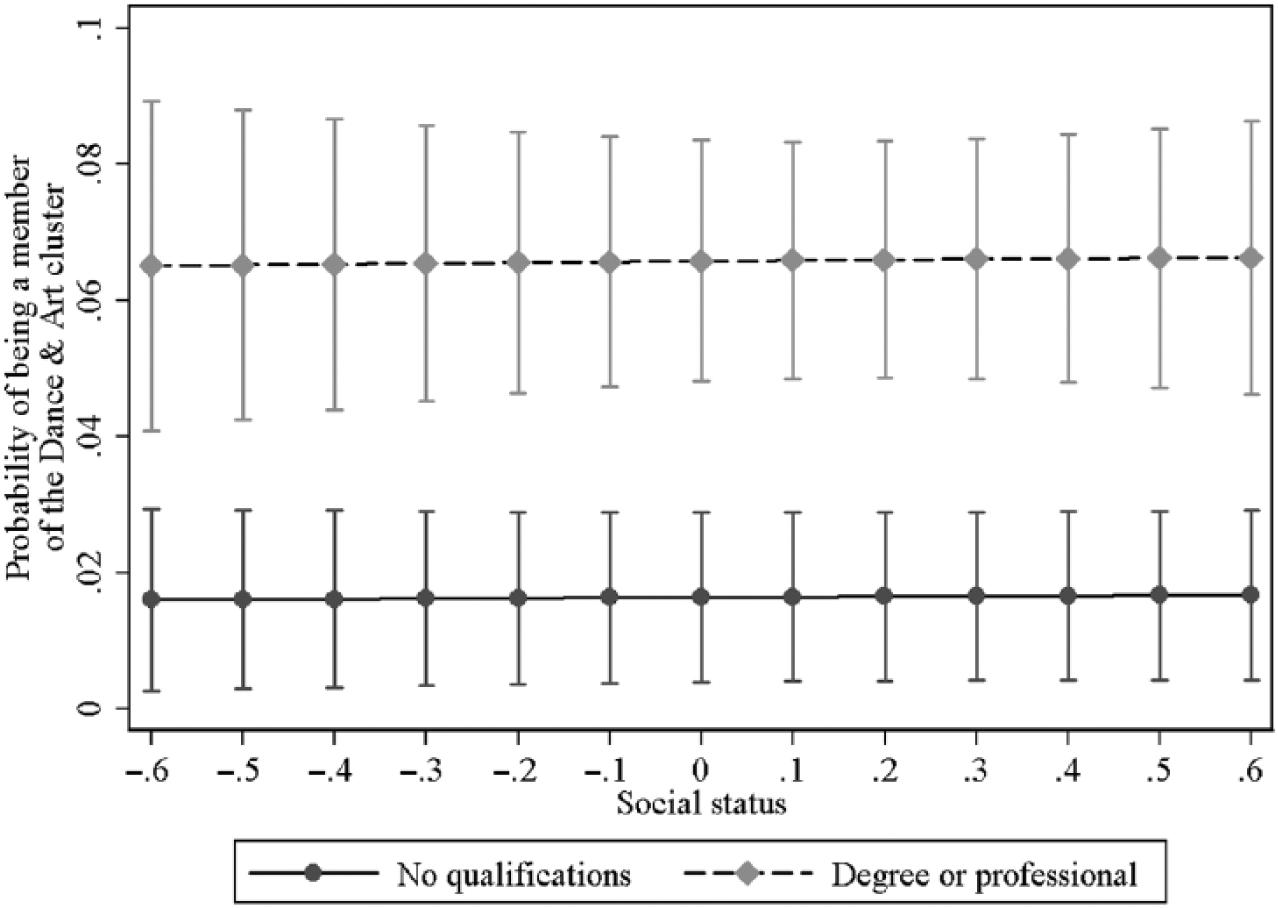
The marginal probability of being a member of the Dance & Art cluster given education and social status.
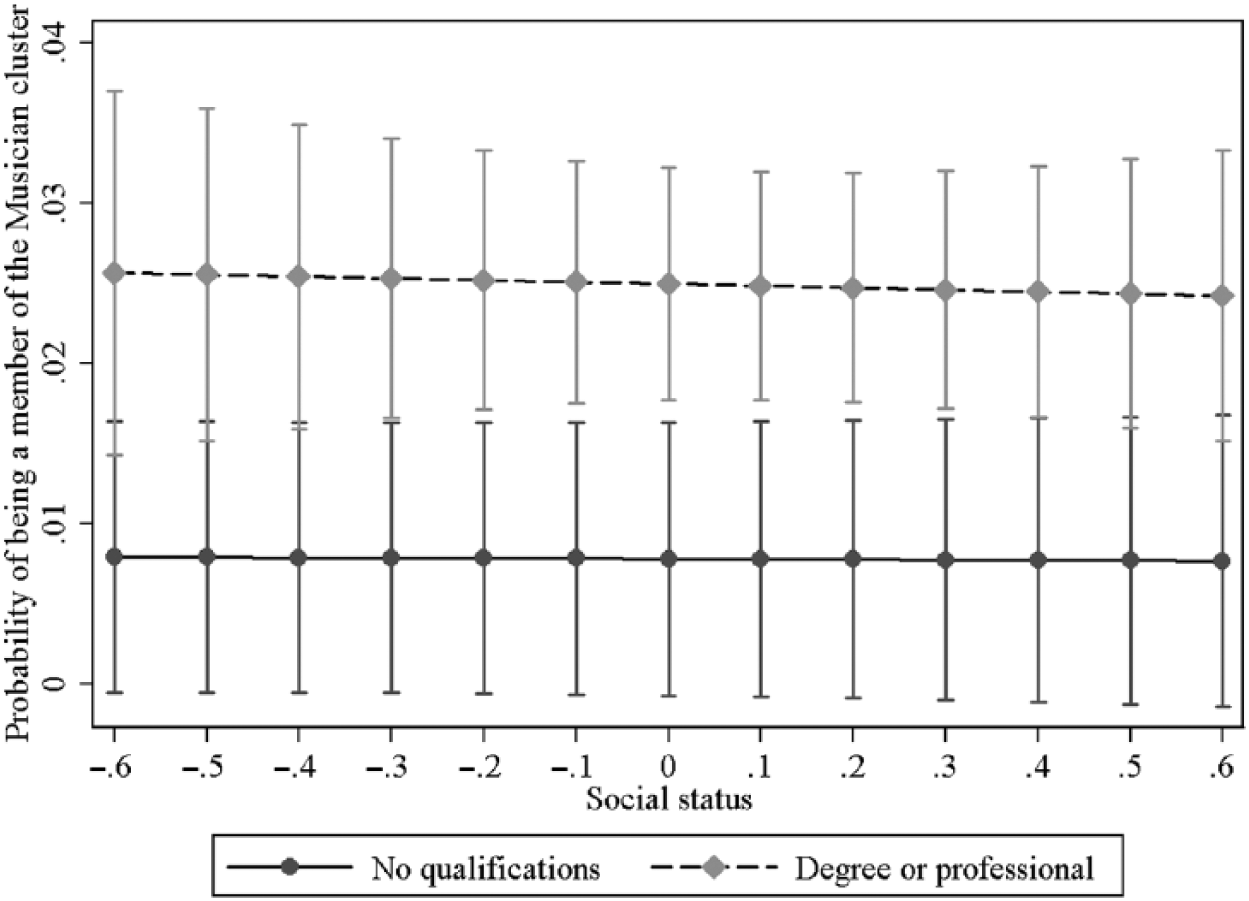
The marginal probability of being a member of the Musician cluster given education and social status.
Education, then, has a net effect on arts participation over and above social class and social status, which are both on the possible causal pathways between education and arts participation. That neither of these are strongly associated with arts participation indicates that the mechanism(s) through which the social gradient in arts participation is produced is linked with education.
There are a number of plausible mechanisms that link both education and arts participation (Nagel, 2010). First, Bourdieu argues that education both reveals and cultivates particular forms of cultural capital which enable graduates to engage with cultural products. Yet, because the weight of Bourdieu’s explanation rests on the role of family it is not clear how education (over and above the influence of parents) would cultivate arts participation (Bourdieu, 1984). Second, higher education may work as an incubator for cultural activity but it is not clear how this might occur for science graduates in UK universities. Third, education may also serve as a proxy for and increase the information-processing capacity of graduates (Chan, 2010). Recent cross-national evidence has found that information-processing, independent of education, increases arts participation (Notten et al., 2014). Fourth, greater exposure to the Arts over longer periods of time might contribute to this effect but there is also inconsistent evidence in this area (Nagel, 2010). Studies of exposure have not yet been able to disentangle the different effects of specific types of undergraduate/graduate courses on arts participation or indeed the role of sustained social networks (van de Werfhorst and Kraaykamp, 2001). Arts graduates may be driving the association between graduates and arts participation.
Education remains an important predictor of many aspects of cultural engagement but it is, to a large extent, a ‘black box’ because clear evidence of how or why education has this influence is lacking. Putting this mechanistic ambiguity aside, these results also offer insights into how the social gradient in cultural engagement is produced. While there is evidence that cultural consumption is partially the product of social mobility and current social position (i.e., through friendship networks), those same mechanisms are less influential with respect to arts participation. Instead, the social gradient in arts participation appears to be shaped by dispositions and skills (cultural resources) that have been cultivated over an extended period of time, possibly before entering higher education. Cultural inequality – arts consumption and arts participation – are the product of both current social position and acquired cultural resources.
This second mechanism, which links education and arts participation, also has implications for the reproduction of cultural inequality. Cultural processes produce social inequality through ‘identification’ (the action of recognizing others as part of a larger collective) and evaluation (assessing others based on these identifying practices) (Lamont et al., 2014). Identification and evaluative processes occur in both educational institutions and the workplace, thereby constraining social mobility. First, elite universities select those students through processes of identification (‘they are one of us’) which is demonstrated, in part, by cultural activities (Boliver, 2013). Second, cultural fit is a prominent criteria used by those hiring candidates in elite firms (Rivera, 2012). In this environment, ‘not all extracurricular’ activities ‘are created equal’; culturally exclusive sports and activities are preferred by these elite firms. Both elite educational institutions (Boliver, 2013) and elite firms (Rivera, 2012) use cultural participation as an identifying sign and an evaluative criterion, which facilitates cultural inequality.
Conclusion
Three primary conclusions can be drawn from these findings. First, arts participation, unlike arts consumption and cultural engagement generally, is not closely associated with either social class or social status. Second, education remains a strong predictor of the likelihood of being an arts participant. Third, the shape and structure of arts participation is different from arts consumption. This variation appears to be partly due to the nature of the activity (e.g., the relative difficulty of transferring arts participation between peers), which shapes the stratification of cultural engagement.
Both social position and the nature of the activity itself are constitutive components of the patterns of arts participation. This may be due to the different cultural resources that participation requires compared to consumption. The role of early socialization may also be more important in becoming an arts participant than in becoming an arts consumer. These differences help explain why social status is strongly associated with cultural consumption but not arts participation. In others words, because the barriers to participation are different from the barriers to consumption, social status is less able to explain the social gradient in arts participation. Rather, patterns of arts participation are the product of a competing set of factors, which may foster cultural engagement in one setting but not necessarily in another.
This study has important limitations. First, relying on self-reported indicators of arts participation involves measurement error. LCA is one way of addressing this because such models are used to adjust for measurement error across a series of correlated categorical variables. Second, using cross-sectional data undermines causal claims. However, because our models have been able to adjust for a series of factors that cause, for example, both educational attainment and arts participation, these models have been able to remove some possible sources of confounding. Third, despite the large sample size, there is still sparseness in the latent class models. To ensure that this has not impacted these results, I have conducted robustness checks demonstrating that these results are consistent in different specifications of the latent class model. Fourth, there are instances where the distinction between consumption and participation is not always clearly demarcated. Yet, because such instances are uncommon among the variables included in this analysis, it is unlikely that such conceptual ambiguity would substantively undermine the results. Notwithstanding this, more work is needed to think through the empirical and theoretical implications of this distinction between consumption and participation. Fifth, from a Bourdieusian perspective, occupation is not an ideal measure of social class, especially with respect to testing claims regarding the association between social class and cultural participation. Sixth, the influence of education on arts participation may be moderated by ethnicity. Very few ethnic minorities were active arts participants, making it difficult to estimate the association between these groups and the outcomes of interest here. A different approach will be needed to examine how ethnicity and education shape cultural consumption and cultural participation.
These findings also have implications for other areas of stratification and social mobility studies. First, cultural inequality is not produced through a single process and these disparities are potentially linked with both the transmission of these cultural resources as well as current economic and social resources (Lareau, 2003). Second, upward social mobility may increase the likelihood of cultural consumption but the influence on arts participation remains less clear. The upwardly mobile non-graduate may become an active arts consumer but not necessarily an arts participant. Third, there is reciprocity in the relationship between economic and cultural inequalities (Bennett et al., 2009). If higher education is a selection process through which elite universities use extracurricular activities to make decisions, then arts participation may work as a gatekeeper to greater economic rewards and social mobility (Stevens et al., 2008). In turn, those in privileged social positions may be more likely to be active cultural consumers. These areas will need to be examined in greater detail in future research but these results are suggestive of potentially fruitful avenues to explore how social inequalities are produced and maintained.
The social gradient in cultural engagement suggests that arts participation, like arts consumption, is associated with broader inequalities within society. These inequalities may signal social position but they may also provide access to elite occupations and are one channel through which social mobility is achieved (Rivera, 2012). Addressing social inequality requires deeper examination of how education and arts participation coalesce and also how these contribute to social inequality. While social class and social status may drive inequalities in arts consumption, arts participation is most closely associated with education.
Footnotes
Acknowledgements
I am grateful to the Economic and Social Research Council for funding this research. For helpful comments and advice, I thank Nick Allum, Malcolm Brynin and the anonymous reviewers.
Funding
This research is funded by a grant from the Economic and Social Research Council [ES/I902341/1]
Notes
References
Supplementary Material
Please find the following supplemental material available below.
For Open Access articles published under a Creative Commons License, all supplemental material carries the same license as the article it is associated with.
For non-Open Access articles published, all supplemental material carries a non-exclusive license, and permission requests for re-use of supplemental material or any part of supplemental material shall be sent directly to the copyright owner as specified in the copyright notice associated with the article.
