




Abstract
The starting point for this article is a contribution to qualitative research methodology published in 1981 called ‘Interviewing women: A contradiction in terms?’ This was based on the experience of interviewing women in a longitudinal study of the transition to motherhood – the Becoming a Mother (BAM) study (1974–79) – and was subsequently much cited as helping to establish a new paradigm of feminist research. This article re-appraises the arguments put forward in ‘Interviewing women’, discusses its incorporation into a narrative about feminist methodology and presents and comments on new data collected in a follow-up to the BAM study conducted 37 years later. It argues that the complex political and social relationship between researcher and researched cannot easily be fitted into a paradigm of ‘feminist’ research, and that the concepts of a gift and of friendship as components in this relationship deserve more attention.
In 1981 I published a contribution to discussions of social research methodology called ‘Interviewing women: A contradiction in terms?’ (Oakley, 1981). This was based on my experiences as a social researcher, particularly in a project concerned with longitudinal interviewing of women becoming mothers for the first time. The Becoming a Mother (BAM) study (1974–79) included four interviews each with 55 women from early pregnancy through to five months post-birth. 1 I carried out and transcribed most of the interviews, attended six of the 55 births and was wholly responsible for the design and data-analysis. Study publications included two books: Becoming a Mother (Oakley, 1979) (later retitled From Here to Maternity), and Women Confined: Towards a Sociology of Childbirth (Oakley, 1980). The chapter on ‘Interviewing women’ evoked a wide range of responses in the social research/feminist social science community. This article re-appraises the arguments put forward in ‘Interviewing women’, discusses its incorporation into a narrative about feminist methodology and presents and comments on new data collected in a follow-up to the BAM study conducted 37 years later. It suggests that some aspects of the researcher–researched relationship remain insufficiently acknowledged and explored, and that more attention should be given to the roles of time and memory in qualitative longitudinal studies and to the notion of the ‘gift’ as a framework for research participation.
‘Interviewing Women’ the First Time: The Original Chapter
The Argument
‘Interviewing women’ was originally a commissioned chapter in a book edited by Helen Roberts called Doing Feminist Research. In a revised edition issued in 1990, Roberts describes the genesis of the book, which was a response to Bell and Newby’s earlier (1977) Doing Sociological Research (and an intentional play on its title). Roberts pointed out that the Bell and Newby volume ignored feminist social science and contained no contributions by women. With eight chapters authored by eight women and one man, Doing Feminist Research set out to address these omissions. My chapter dissected the model of interviewing outlined in the social science textbooks of the time, arguing that admonitions about objectivity and the need to view the interview purely as a tool of data-collection suggested a masculinist mechanistic attitude which treated the interview’s character as social interaction as an inconvenient obstacle to the generation of ‘facts’. I suggested that this approach to interviewing was incommensurate with the practice of feminist social science, and was ineffective in terms of the purpose of interviews, namely to produce valid, trustworthy data. I drew on my experience of interviewing women to propose that such interviews incorporate elements of a ‘transition to friendship’, based on shared gender subordination – ‘sisterhood’.
‘Interviewing Women’: The Context
In the early 1980s when ‘Interviewing women’ was published, social science was emerging from a period of masculine domination (Halsey, 2004; Oakley, 1974). The politics of second-wave feminism brought a new perspective into this ‘gentlemanly social science’ (Savage, 2010: 93). Conventional subject-definitions were queried, with the development of new ‘sociologies of’ – housework, childbirth, feelings, emotions, everyday and personal life (see, for example, Bendelow and Williams, 1998; Hochschild, 1983; Oakley, 1974, 1980; Smart, 2007; Smith, 1988). Sociologies ‘of’ were reframed as sociologies ‘for’ – specifically for women, with the construction and communication of knowledge about their lives and experiences treated as an emancipatory act (Hartsock, 1987; Smith, 1979).
My arguments about interviewing women were intended as a modest contribution to this developing debate about the gendering of social science. Like others subsequently, I wanted simply ‘to contribute to discussion about what goes on in interviews with women’ (Cotterill, 1992: 604), to document the ‘actual experiences’ of women engaged in research (Limerick et al., 1996: 459). The BAM study brought into sharp focus for me several central issues of social research practice. The two basic questions were about power and reciprocity. In the conventional approach to interviewing, the person asking the questions dictates the framework of the dialogue and the form of its analysis. The person answering the questions is relatively powerless. It is not a reciprocal relationship: information passes one way only. The textbook advice for interviewers at the time was that they must work at something called ‘rapport’, which is a technical device that aids in the production of data. Yet in the BAM study this was not my experience: I did not have to labour at establishing rapport, since in the main women were enthusiastic about taking part in the research and did not apparently find it difficult to talk extensively to me. In her study of clergymen’s wives, Janet Finch (1984: 72) made the same observation: ‘Women are almost always enthusiastic about talking to a woman researcher, even if they have some initial anxieties about the purpose of the research or their own “performance” in the interview situation.’
Another interesting methodological aspect of the BAM study was the many questions the women asked me about pregnancy, health care, childbirth and its aftermath, or baby care, and/or about my own experiences of motherhood. Emblematic of these enquiries (in the narrative of my memory now) is the woman who asked me, a few weeks before her baby was due, if I could tell her ‘which hole the baby comes out of’. Her painfully articulated inquiry spoke, of course, to the prevailing inadequacy of antenatal education and the cultural and material poverty of her own working-class rural Irish background. The conventional methodological advice would have been that I should not answer her question because this would bias the data. In the ‘Endnote’ to Becoming a Mother, ‘Being researched’, I recorded a total of 878 questions asked by the 55 women in the interviews; 76 per cent of these were requests for information, mainly about the process of reproduction and/or its medical management. In ‘Interviewing women’ I set out my decision to answer these questions (referring the questioners to other information sources as appropriate) on grounds of both ethics and efficiency: that refusing to answer was exploitative of interviewees and counterproductive in terms of gaining full and honest accounts.
‘Interviewing Women’: The Responses
Among the responses to ‘Interviewing women’, Joanna Malseed (1987), in a comment entitled ‘Straw men’, argued that I had misread the textbook advice on interviewing, and that this did in fact recognise, under the rubric of ‘informal interviewing’ concerned with ‘complex subjective’ phenomena, some of the issues I outlined in my chapter. As I replied to Malseed’s observations at the time (Oakley, 1987), the dichotomous formal/informal, objective/subjective, structured/unstructured distinctions are precisely those that inhibit a fuller understanding of the interactional politics of research.
Many commentators on ‘Interviewing women’ made important and valid points about the limitations of my argument. They pointed out my failure to acknowledge the complexity of the interview process, especially in relation to the dynamics of power and social divisions between women. As Phoenix (1994: 50) has said, notions about feminist interviewing as a ‘cosy enterprise’ based on shared gender understandings ignore differences between women in terms of race, class, status, sexual orientation, politics, age and so forth. The appeal to the concept of ‘sisterhood’ contained in my piece was naïve (a particular child of the politics of the time). The sample studied in the transition to motherhood project was chosen ‘to ensure a degree of cultural homogeneity in cultural attitudes’ (Oakley, 1980: 99); the women were all young (18–31 years) and partnered; most had professional, managerial or skilled non-manual occupations. The two interviewers 2 were themselves both young, partnered and middle class. ‘Cultural homogeneity’ did not dissolve the power imbalance inherent in the interview situation, but it did, in some cases at least, reduce social distance. My use of the BAM interviews to construct a case against the exploitative nature of conventional interviewing practice may have exaggerated the similarities in the position of interviewers and interviewees, in contrast to other accounts of female researchers interviewing women which have aimed to argue the opposite case in highlighting dissimilarity (see, for example, Cotterill, 1992; Edwards, 1990; Riessman, 1987; Tang, 2002).
If ‘Interviewing women’ over-simplified the implications of shared gender subordination, it also did not interrogate sufficiently the idea of friendship. Probably the most sustained case against the simplistic notion of friendship among women interviewing women was made by Dunscombe and Jessop (2002: 111), who turn it into a question of research ethics: If interviewees are persuaded to participate in the interview by the researcher’s show of empathy and the rapport achieved in conversation, how far can they be said to have given their ‘informed consent’ to make the disclosures that emerge during the interview?
As Ribbens (1989: 585) observes, I did not in ‘Interviewing women’ discuss which women I became friends with, or what this might have meant for the research, and I did not mention whether there were women I did not like or who did not like me, or whose perceptions of their lives were very different from mine. Did my ‘forays into friendship’ mean that I would do nothing, for example, about evidence of misbehaviour, for instance suspected child abuse (Wise, 1987)? Over a 50-year ‘career’ in research I have interviewed many people in many different research projects whose values, lifestyles and backgrounds are unlike my own; the point about the professional practice of interviewing (whether self-avowedly ‘feminist’ or not) is that its starting point is interviewers’ interest in other people’s lives, responsiveness to their stories about these and a responsible attitude towards the data and the participants. 3
A third point made in responses to ‘Interviewing women’ is that the case I put for non-hierarchical relationships did not acknowledge the vulnerability and social isolation of some new mothers who are likely to welcome the presence of a friendly and knowledgeable listener (Ribbens, 1989). The women’s involvement in the research could thus be interpreted as yet another index of powerlessness (McRobbie, 1982). Another perspective on this comes from the general literature on social support and health outcomes (Madge and Marmot, 1987). The experience of the ‘social support effect’ recounted in ‘Interviewing women’ was subsequently built on in experimental studies with pregnant women and new mothers (Oakley, 1992; Wiggins et al., 2004).
The timing of my observations in ‘Interviewing women’ – during that moment when feminism began to establish a foothold in the academy – led the piece to acquire a status I did not intend as a ‘classic’ or ‘seminal’ statement about the practice of feminist social research (see, for example, Dunscombe and Jessop, 2002: 109; Luff, 1999: 693; Reinharz, 1993: 72; Webb, 1993: 416), and about the intrinsic superiority of ‘qualitative’ methods (Finch, 1986: 5; Jayaratne and Stewart, 1991: 89–90). This interpretation was in turn rapidly written into a narrative about the emergence of a new feminist paradigm prioritising ‘qualitative’ research. More recently, the case laid out in ‘Interviewing women’ for non-exploitative research relationships has been hailed as establishing the credentials of ‘friendship as method’: the explicit use of friendship ‘as a kind of fieldwork’ in conducting qualitative interviews (Owton and Allen-Collinson, 2013; Tillmann-Healy, 2003). Such a framing of ‘Interviewing women’ accounts for its status as my most often-cited publication (3278 citations at the latest count on google scholar). However, the incorporation into ‘paradigm warfare’ of the case laid out in ‘Interviewing women’ has produced a certain discomfort among some commentators, who have found it difficult to square their interpretation of the chapter as a celebration of qualitative methods with the position I have outlined in other publications (see, for example, Oakley, 1998, 2000a, 2000b), that any emancipatory social science needs also to embrace both quantitative and experimental methods.
Interviewing Women Again: The Follow-Up Study
‘Looking Back at Becoming a Mother’ (LBBAM) (2012–13) was funded by the same body as the original study – then the Social Science Research Council, now the Economic and Social Research Council. Unlike the original study, LBBAM was undertaken by a team of four researchers in the Social Science Research Unit at the Institute of Education in London; it was led by one of the other researchers, and I played a subsidiary role in its design and analysis. The purpose of LBBAM was to trace as many as possible of the 55 women who took part in all four interviews in the original study, and interview them again about their memories of first childbirth, their experiences since, and their long-term assessments of their participation in the research (Wiggins et al., 2013).
After what was often extensive detective work involving the NHS Information Centre’s Medical Research Information Service and internet searches, we located and re-interviewed 36 of the 55 women. Twelve women could not be located or did not reply to the addresses we found; two had died, one agreed but then postponed participation, and four said no. A greater proportion of the LBBAM participants than in the original study were in professional or managerial occupations (42% versus 31%, occupation as classified in the BAM study). The women ranged in age from 55 to 67 years (mean 63 years). I did 17 of the 36 interviews, with the remaining 19 divided between the other three members of the research team. The semi-structured interview schedule we developed contained 90 questions covering many aspects of the women’s lives including perspectives on being a research participant. The interviews were digitally recorded and transcribed; I also took detailed notes on my observations of the re-interviews for which I was responsible.
Feelings about Taking Part in the Study
At the end of the fourth interview in the BAM study the women were asked the question, ‘Has the research affected your experience of becoming a mother?’ Most (73%) said it had, either by making them think about it more, and/or by providing reassurance or relief through talking; only a few (7%) considered that it had changed their attitudes or behaviour. We asked the women at the end of the LBBAM interview the following question: ‘Looking back to your experience of taking part in that first study, what impact if any would you say now being in the study had on your experience at the time or since?’ This was followed by a further question about the impact of the LBBAM interview itself.
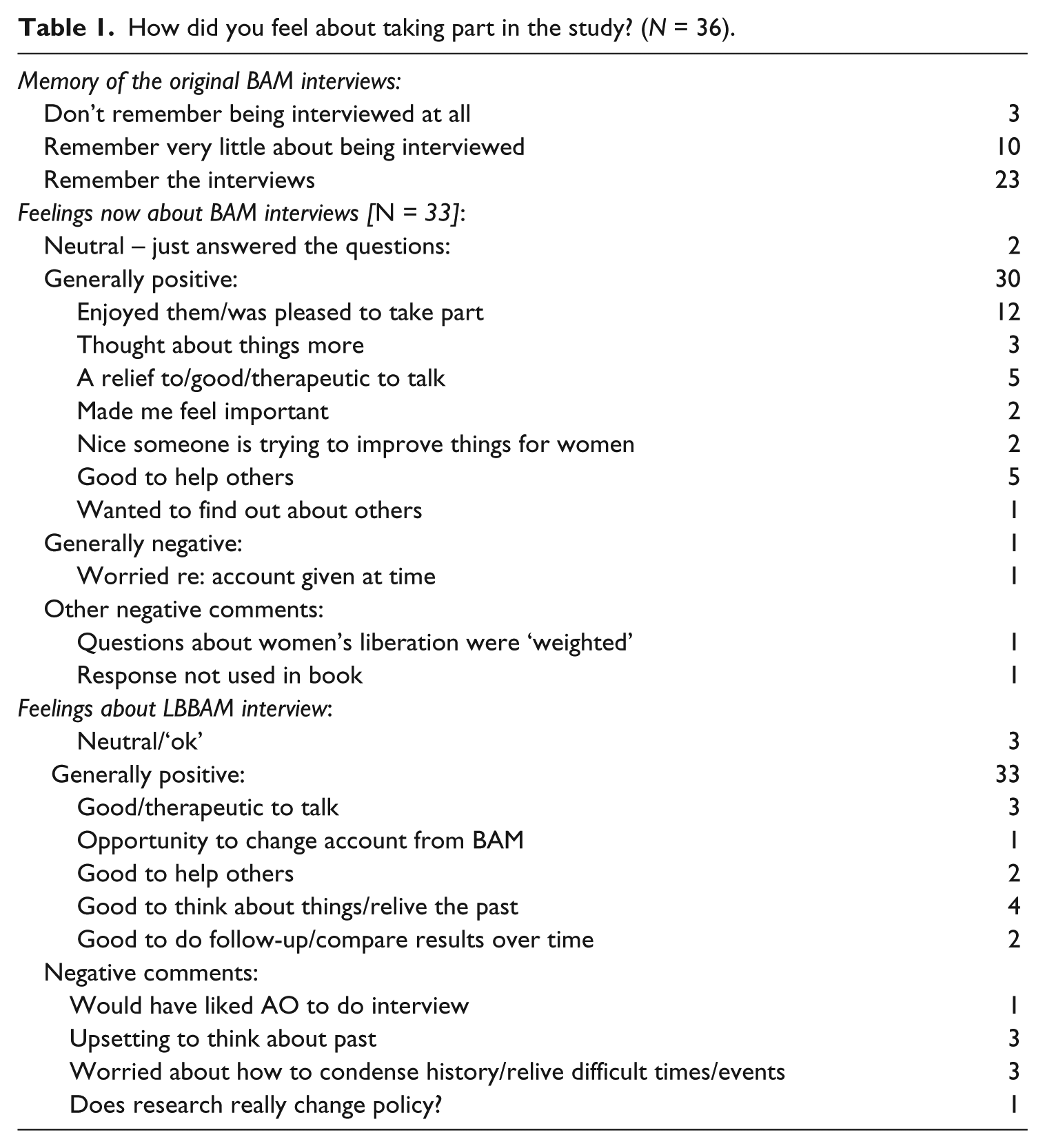
Table 1 shows the women’s answers. About a third (13/36) of the women either did not remember the original study at all, or remembered very little and/or did not remember all four interviews. Most of the women who did remember taking part in the study recalled this positively, saying that they had been pleased to talk about their experiences, had valued the effort to think things through, contribute to a study that might help others as well as making them feel more important and have an opportunity to find out about other women’s experiences.
How did you feel about taking part in the study? (N = 36).
Are You Sure It Was Me? Memorial Practices
Table 2 shows five examples of ‘failed memory’ responses, juxtaposed with the women’s original comments. It is clear that even a positive experience of research participation can fade with time. The time interval between the answers in columns 1 and 2 – 37 years – was filled with major life events – births, deaths, illnesses, job and relationship changes, domestic relocations.
Looking back and not remembering.

The last comment in Table 2 was from Nina Brady,
4
the young Irish woman who asked me in 1975 to enlighten her about the physiology of reproduction. At the time of the original study, she was working as a cashier in a shop and her husband was a pipe jointer; they lived in two furnished rooms. She asked me many questions in her interviews, expressing a high level of anxiety about the birth and fear of pain and medical intervention. When I went back to see her in 2012, she and her husband owned their own house and several other properties in the neighbourhood. She had five adult children and seven grandchildren. My notes of that encounter include the following: She says she has no memory at all of my visits. We discuss it later and she decides it may be because that whole period of her life was so traumatic for her … Later I hear my voice on the tape when I asked her what work she does now and she says she’s a psychotherapist in private practice. It isn’t the answer I expected, and you can hear it in my voice …
My presence at six of the births was remembered in five instances. The exception was Elizabeth Farrell, a 65-year-old part-time tour guide, married to an accountant. When I met her husband in their home after the interview, and he said it was nice to see me again, she looked surprised and asked me how I had met him before. I told her I was there at the birth, as he was. She said she had no memory of my presence. At the time, about this, she had said: I know I felt so pleased you were there, because I’d expected Robert not to stay. And it made me feel much more secure that you were there, I felt they wouldn’t try to pull any fast ones or anything like that … And so it had a good effect on me. But I forgot you were there, because I couldn’t see you.
Christina Lynch, a 65-year-old retired administrator, also married to an accountant, whose birth I also attended, was interviewed by one of the other researchers in the LBBAM project, who asked her our standard question about the impact of the original study. Christina answered: I don’t think it made any difference at all, no none whatsoever … I can’t remember now how many times we met but I do remember, ‘Don’t forget as soon as you go into labour give me a call’, and then she was there, Keith rang her and she was there and I don’t remember exactly everything but she was there at the vital moment, at the sharp end [both laugh], and then don’t remember her going but obviously she just wanted to go quietly, which was nice … I only told a few people about it but … it was nice, I enjoyed doing it … I didn’t think of anything of it sort of thing, and Keith … I think he might have been quite relieved that there was going to be somebody there with me. I’ve never actually talked to him about it.
Critical Remarks
There was no apparent difference in the likelihood of positive or negative comments according to which researcher did the LBBAM interview, but some women whom I did not re-interview expressed regret. The following exchange was part of Christina Lynch’s interview, and is interesting in its self-conscious reflections on some of the methodological issues raised in this kind of follow-up study:
And has it been, and I’m not in the slightest bit offended by it, we’re just quite interested, you know, would it have been, would you have liked it to have been Ann that had interviewed you?
In a way, yes, but obviously I realise that there’s a lot of research to do and other people, you know, she needs to delegate, so I’m very pleased to meet you. And likewise, likewise [both laugh]. I know, I think she thought at first that she was quite happy to take a complete back seat in this… I’m getting all emotional now, that’s just me [both laugh].
That’s fine, I’m quite an emotional person as well, I can remember thinking she said, ‘Yes, you three go off and do these interviews and I’ll be in the background and I’ll be really interested to hear everything, and then the first ‘yes’ came in and somebody remembered something and she couldn’t bear it and she had to go and do the interview.
Oh no!
I think that in the end she’s done more than she really expected to, so she’s had to be really strict with herself … I think she’s found it much more compelling than I think she thought she would.
She thought she was going to be detached from it after all these years.
Other women used the LBBAM interview to record concerns about having taken part in the original study:
Last question … how do you feel now about the fact you were part of the research project back then, how do you feel about the visits that I made asking all those questions?
I was relatively interested but I’m much more interested now because then I felt some of the questions were very weighted.
Which ones?
The ones on women’s lib
5
I felt they were very weighted and didn’t agree with that at the time, I’ve got a better perspective now. (Mary Rosen, 62 years, retired estate agent, married to company director)
While most of the women did not mention any impact other than their short-term reactions to study participation, others recalled how the interview process had caused them to reflect in a different way: I mean, one of the things I do remember all these years later, when you came up here, must have been the fourth interview.
It was the fourth, yes.
Looking back, how old would he have been?
Four or five months.
And he was managing to push himself around by using his heels, he was on his back and he was spreading things and you said it looked as if a one-year-old had been playing.
Did I … well, I probably did. At that age, babies … well, at any age … particularly around that age, babies do vary a lot, some are completely stationary and some hardly sitting up and others are on the move.
One of the other things that remains in my mind, I don’t know where you’d classify this, you were asking me about the difficulties of the birth and all that, when I got David to the baby clinic his head was on the 90th percentile. (Juliet Morley, 65 years, retired teacher, married to retired teacher)
So looking back at the experience of taking part in this original study when I first came to see you, what impact if any would you say being part of the research had?
I think it made me think about … I remember you coming round and Christian was on the floor in a sort of baby bouncer and I thought … I don’t cuddle him all the time … I remember sitting there and I was just sort of patting him and thinking … so you coming round made me think about my relationship with my child, yes … and I remember thinking that at the time. (Jane Tarrant, 66 years, part-time teacher, married to retired chartered accountant)
Textual Reminders
I did not make any systematic attempt to tell the women who were interviewed in the original study about the publications that resulted. A number of women brought up the issue of ‘the book’ (Oakley, 1979), and how they felt about the way in which their original interview material had been used:
Just a couple of very brief questions, looking back on your experience of taking part in the first study, what impact do you think, if any, did that have on your experience of becoming a mother, do you remember those interviews with Ann?
I do remember them and I do remember her asking me a question … how would you sum up having a child … and I said … it’s a labour of love … but she never used that quotation … (Barbara Hood, 65 years, part-time legal secretary, divorced)
Finally, looking back to you taking part in that first study, what impact did that have on what was going on at the time, if any, my coming to see you?
I enjoyed it … I mean, you know, I did find it sort of a very sort of positive sort of nice thing to be able to do, everybody likes talking about themselves so there was plenty of opportunity to do that … I really enjoyed reading the result of it, especially the names … we had fun with the names you had chosen. (Alison Mountjoy, 64 years, retired librarian, divorced, living with new partner)
Seeing their words in print not only brought back the stresses of early motherhood but sometimes stood as unwelcome testamentary evidence for others: I felt I’d let them [her partner and child] down actually, because I was so screwed up after I’d had her, I felt really bad, and then when the book came out and I’m looking at comments I’ve made, I’m thinking ‘Oh shit’, really I wasn’t happy with that.
Did you recognise yourself?
Oh yeah … I knew, I knew it was me.
And re-reading it now?
I think it was on the fifth day of her crying and screaming, it just went right through me and I couldn’t cope. I got hysterical in the end, it was awful, I really hated her and wished to God I’d never had her. That’s how I felt, yeah, and looking back on that, you imagine when she was five and reading that and thinking ‘Oh shit’. I really shouldn’t have, but then I look back on it now and think ‘Well for God’s sake, Nancy, cut yourself some slack’, you know?
Exactly, that was your experience.
‘You went through a hard time and you came through it, that’s what counts.’ I’m glad actually, I got so excited when I got that letter [about the follow-up interview]. Oh good [laughs]. Jumping up and down, ‘Ooh, a chance to redeem myself’, a chance to say ‘Well look, I went through all this, I said all these things, and hey, it turned out fine.’ If that can help someone else then that’s good, isn’t it? …
How do you feel about taking part in this interview?
Good, I’ve had a chance to redeem myself … I’m a survivor, I am a survivor, and I’ve only realised in the last 10 years quite how tough I am, and I’m glad. If I hadn’t had all these shitty experiences they wouldn’t have made me the person I am, would they? (Nancy Carter, 63 years, retired secretary, married to warehouse worker)
The LBBAM Interview: Difficult Stories
In asking women to recall their transitions to motherhood and tell us about the decades of life that followed, we were inviting them to remember what had sometimes been a difficult period in their lives. Most of the 36 women who were interviewed said they were glad of the chance to take part in the follow-up (Table 1). Our questions called on some kind of narrative about what Marris (1996) has called the ‘clothes horse’ of identity, but stories of successful lives are more easily told than stories about lives that did not go according to plan, and/or were marred by negative events. Barbara Hood’s reservations about agreeing to the LBBAM interview may have been shared by others who did not agree to be re-interviewed:
What about this interview, what do you feel about taking part in the follow-up study?
Bit apprehensive because I feel I’m talking about a disastrous marriage rather than the joy of motherhood so to speak so I was a bit reluctant to be honest but I felt … well, I can’t say no … you know, after all these years so I was a bit thinking … oh, do I want to do it?
Because of that?
Yeah.
Has it been okay talking?
It’s been fine, yeah … I knew it would be.
It’s just thinking about it?
I’m glad that it happened quickly … I might have got a bit edgy by the end of September. (Barbara Hood)
As Kate Prince notes in the extract below, the timing of the re-interview can be crucial in determining what kind of story is told: I said to Gillian [her daughter] this morning, she said ‘oh have a nice time, you know, when you go to see her’ and all that … and I said ‘you know, I’m quite’, what was the word I used? I’m quite, not anxious but quite apprehensive …
Why?
… about the questions that you might ask me because now they’re grown up and … you think ‘all this time’s gone by and what am I going to say? How am I going to, you know … condense, how do I get across or is it possible to get across all that?’ Because there’s just so much in there isn’t there, in the sort of however many, how many years is it?…
Yes. And I think, you know, it’s really hard to ask someone sort of, you know, to summarise those 37 years of their life in an hour and a bit, and in some ways an insult I suppose?
But I’m not worried now. Now we’ve done it I’m not …
So how …?
I’m not upset. I mean those tears are the tears that come from …
Remembering?
… a long, long [sighs], it’s in there, you know, they’re in there.
So this interview’s been all right?
Oh gosh, yes. Absolutely, and very valuable, you know.
Does it help you? I mean what impact does it have on you to have to think about the story of your life, as it were?
It’s, I mean I’m quite relieved actually because it’s been okay and I think that if you’d had come 10 years ago I would have been much more furious about how my life was turning and had turned out and how much had sort of gone to, not gone to waste because you can’t say that because of, you know, the achievements with the children, but me going to waste …
It can be very upsetting …?
Have other people cried at all? (Kate Prince, 66 years, retired teacher, divorced)
Discussion: Time, Power and the Gift
As the LBBAM interviews show particularly starkly, what and how people remember is a feature of the stories they put together about their lives and is thus embedded in the data researchers collect. There are few analyses in the literature of the particular challenges posed by longitudinal qualitative research, especially over such an extended time period as in the BAM and LBBAM studies discussed in this article. Thomson and Holland’s (2010) suggestions that such research entails ‘genuine familiarity’ with research participants, and ‘a high level of reflexivity’ on the part of both researchers and researched are certainly echoed in the themes of this article. My notes on re-interviewing women in the LBBAM study are powerful vignettes about familiarity and strangeness, about memory and time, about resilience and coping, about struggle and success and, above all, about a quality of the interview process that is rarely commented on in the methods literature – what Limerick and colleagues have called ‘the gift’. They suggest that researchers need to accept as a gift ‘of time, of text and of understanding’ material provided by the researched, because the product of the research is ‘our story of their story’ (Limerick et al., 1996: 458, 450).
The transactions of the gift relationship (Mauss, 1954; Titmuss, 1970) are present when social researchers ask people to answer questions about their lives; the agency of the questioned, hidden in the textbook prescriptions of hierarchy and unequal power, resides at least partly in their ability to choose to answer researchers’ questions and donate research material. Like other forms of donation (see, for example, Fielding et al., 1998; Low et al., 2007; Nuffield Council on Bioethics, 2011), the motive can be a combination of altruism and selfishness. Altruism, a common motive identified by blood donors, in the donation of body tissues (Shaw, 2008), or by donors of reproductive material (Bahadur, 2001; Daniels et al., 1996; Fielding et al., 1998), also features in the repertoire of reasons for research participation (see, for example, Fry and Dwyer, 2001; Warburton and Dyer, 2004); altruism may even be the ‘main motivation for generic research participation’ (Peel et al., 2006: 1336). As Peel and colleagues have pointed out, the motive of self-interest can also flourish in interview-based research, especially when this involves repeat interviews, and when participants experience sharing life stories as therapeutic. The conditionality (or otherwise) of giving is much discussed in the literature on ‘the gift’: applied to research, one essential question is whether the researched agree to take part on the understanding that they will not be given, in return, the chance to control the research product. Research interviews are governed by external academic structures: what Reinharz (1979: 95) has pejoratively called the ‘rape’ norm in social science entailing the career advancement of researchers and the instrumental place of research in the value and evaluative systems of the academy. The fate of research participants’ narratives in academic publications was highlighted in some of the LBBAM interviews. Responses to the Becoming a Mother book were uneven: some women were happy to find themselves in its pages, while others noted that extracts from their interviews showed them in a poor light or omitted points they thought should have been included. The issue of ‘negotiating’ publications with research participants has generated sporadic discussion, especially in feminist academic circles (see, for example, Gatenby and Humphries, 2000), and remains one of the unsolved methodological/ethical issues of qualitative research (Goldblatt et al., 2011). I debated it at the time, but in the end faint-heartedly withdrew from the challenge of discussing with 55 women the use I decided to make of their stories. Perhaps the notion of the gift is helpful here, since giving is generally not conditional on the uses that the receiver makes of the gift.
Gifts made by research participants take place within a context of inescapably unequal power, although, as Collins (1998) has observed, there are effective counterbalances: for example, interviewees may develop their own ‘narrative threads’ almost regardless of the questions asked; they may resist closure, wanting to continue the relationship beyond the end of the research. Alternatively (and most appropriately humbling for researchers) research participants may write the researcher and her/his research out of history by excluding both from their memories, as happened in some of the LBBAM interviews. It seems patronising to propose, as do Dunscombe and Jessop (2002), that interviewees are somehow forced by researchers’ ‘faked’ friendship into disclosures they would rather not make. The concept of friendship in this context needs much more analysis. The distinctions between ‘rapport’ and ‘friendship’ in research are unhelpfully blurred (Glesne, 1989). Friendship is not a simple or unitary phenomenon in any context: there are varieties of friendship, overlapping with other types of social connection such as kinship and community (Adams and Allan, 1999; Fehr, 1996; Spencer and Pahl, 2006; Tillmann-Healy, 2003).
Conclusion
This article has taken as its starting point a contribution to the research methods literature published over 30 years ago which drew on research with women becoming mothers for the first time to raise issues about the politically exploitative nature of textbook models of interviewing. The article has revisited these arguments, in the light both of subsequent responses to them, and the findings of a follow-up study of the mothers originally interviewed. It suggests that the eponymous status acquired by the original ‘Interviewing women’ chapter probably owed more to the context of an emerging feminist social science than to its substantive content. The original observations in ‘Interviewing women’ were naïve on certain features of the researcher–researched relationship, particularly with respect to the complex conditions that shape familiarity and friendship.
Since the 1970s the research methodology literature has hugely benefitted from researchers’ willingness to confront and discuss the ethics and practical realities of social research; this is a discussion that needs to be pushed further. The basic lack of congruence between the mission of constructing meaningful, trustworthy and authoritative stories about people’s lives and the task of living those lives and developing consistent narratives about them is akin to the dilemma at the heart of experimental research which I have discussed elsewhere (Oakley, 1990): that randomisation as an efficient technical device for improving the scientific quality of research is ultimately at odds with the ethical obligation to give the researched choice. Such ironies call for reflection, negotiation and discussion, rather than simplistic solutions. The complex political and social relationship between researcher and researched cannot easily (or helpfully) be fitted into a paradigm of ‘feminist’ research. The notion of friendship and its applicability to research relations, particularly in longitudinal studies, requires more exploration. The article offers the concept of a gift relationship as another potentially fruitful framework for understanding this essential component of an empirical social science – the dependence of researchers on what research participants are willing to contribute from the memories and stories of their lives.
Footnotes
Acknowledgements
Thanks to Graham Crow and Robin Oakley for their comments on this article, and to my colleagues on the LBBAM study, Meg Wiggins, Mary Sawtell and Helen Austerberry. We are grateful to the women in the BAM and LBBAM studies for their participation in the research.
Funding
The BAM and LBBAM studies were funded by the Economic and Social Research Council.
Notes
References
Supplementary Material
Please find the following supplemental material available below.
For Open Access articles published under a Creative Commons License, all supplemental material carries the same license as the article it is associated with.
For non-Open Access articles published, all supplemental material carries a non-exclusive license, and permission requests for re-use of supplemental material or any part of supplemental material shall be sent directly to the copyright owner as specified in the copyright notice associated with the article.
