




Abstract
This article seeks to re-invigorate debate about how we theorise inequalities in higher education. The work of sociologist Basil Bernstein has not yet been brought to bear in this area, despite the affordances it brings in teasing out the implicit rules that perpetuate inequalities in higher education. Drawing on empirical findings from a qualitative study into the impact of university-led ‘outreach’ work in the UK context, the article applies and tests the work of Bernstein. It is argued that his framework offers the analytical precision to expose the implicit rules and principles that underlie young people’s encounters with higher education.
Introduction
In the UK, despite increases in lower social class groups entering higher education (HE), there has been little relative change in participation rates across the social classes, with HE and the most prestigious HE destinations remaining the preserve of the most advantaged (Boliver, 2011). Researchers have wrestled with trying to better understand how these relatively intractable inequalities are shaped as well as how they are subjectively experienced. In sociological research, Pierre Bourdieu’s rich set of theoretical concepts have often been usefully deployed to illuminate the mechanisms by which education is implicated in the reproduction of social inequalities within society. Specific to the issues explored in this article, there exists a substantial literature on the qualitatively different experiences of young people applying to university drawing on a Bourdieusian lens (Donnelly and Evans, 2016). The work of Basil Bernstein has rarely been used in this area. Indeed, more generally, very few studies in higher education have engaged with Bernstein’s ideas, compared to the almost ubiquitous citing of Bourdieu (Power, 2010).
This article addresses this gap in the application of Bernstein’s theoretical ideas, highlighting the usefulness of his framework for understanding the relationships between families, young people and HE. The article begins by reviewing existing research that has drawn on a Bourdieusian perspective, introducing some of his key concepts and ideas. Moving on to consider Bernstein, his work on the sources of consensus and disaffection in schools is examined closely in terms of its relevance for studying inequalities in HE. Drawing on qualitative research which explored the impact of university-led ‘outreach’ work, the article tests empirically Bernstein’s theoretical ideas, in order to explore their usefulness and potential contribution.
The Dominance of Bourdieu
Studies that have explored issues of equity in HE have overwhelmingly drawn on Pierre Bourdieu’s concepts and ideas (Bourdieu, 1977, 1986). Bourdieu’s (1986) work on ‘forms of capital’ sought to explain how dominant groups in society appropriate and monopolise certain resources in order to maintain processes of social reproduction. Cultural capital is defined by Bourdieu as ‘subtle modalities in the relationship to culture and language’ (Bourdieu, 1977: 82), which can reveal itself in the form of linguistic styles, mannerisms, tastes and preferences. These elements are said to have an embodied, institutionalised and objectified form. Early childhood socialisation is important in the formation of its embodied form, with parents key figures in sensitising children to certain dispositions and ways of being. Bourdieu shows how cultural capital is evident institutionally through formal qualifications, as well as in its objective state in relation to cultural goods and artefacts. The framework is premised on a notion that educational institutions are not based on the culture of all students, but embody the cultural capital of dominant groups in society. Bourdieu’s concepts have been applied in a number of studies to elucidate the subtle and highly subjective forms of character and manner that come to matter in how young people understand and respond to education (Archer and Leathwood, 2003; Archer et al., 2007; Ball et al., 2002; Bathmaker et al., 2013; Christie, 2009; Maxwell and Aggleton, 2012; Power et al., 2003; Pugsley, 2004; Reay et al., 2001, 2005, 2010). Applying Bourdieu’s framework, Maxwell and Aggleton (2012) show how practices at home and school were reproductive of various forms of ‘privilege’ for the elite and upper-middle class girls in their study. The framework allowed them to capture a taken for granted sense of ‘surety’ these young women exhibited, not only about their present selves, but also about their future self; that involves attending elite universities and spending time in both the country and ‘town’ (London) where they would be employed in high status roles and be connected to others with similar orientations. Conversely, other studies have shown how working class young people can sometimes lack a sense of entitlement to HE study, and the transition process is more often than not fraught with fears and anxieties about the choice process and ‘fitting in’.
Associated with the transmission of cultural capital, Bourdieu’s (1990) concept of habitus describes the totality of dispositions, tastes, styles and behaviours which predispose individuals and groups to think and act in particular ways. Habitus has been extended by others and applied to educational institutions (‘institutional habitus’). Like the individual, institutions have also been found to vary in their level of cultural and social resources (or capitals) which in turn play a part in shaping young people’s engagement and experiences of both the choice process and experience of university (McDonough, 1997; Morrison, 2009; Pugsley, 2004; Reay et al., 2005; Thomas, 2002). The concept of institutional habitus implicitly assumes that a kind of social class consciousness is embodied within educational institutions, which is directly linked to the social class characteristics of its students and staff. Applying this concept to the study of higher education institutions (HEIs), Reay et al. (2010: 3) have identified some of its key elements, including: academic status of an HEI (its position in the university hierarchy) ... other interrelated elements, most notably, curriculum offer, organisational practices, and less tangible, but equally important, cultural and expressive characteristics. These latter aspects, ‘the expressive order’ of institutions, include expectations, conduct, character and manners. (Bernstein, 1975)
This is the first and only reference to Bernstein made by the authors here, and the applicability of Bernstein’s ‘expressive order’ is not elaborated on, reflecting what Power (2010) might regard as a ‘mentioned in passing’ reference to his work. In earlier work, I have made the case that in some ways the concept lacks theoretical precision, and its assumption that intake necessarily always shapes institutional processes may not be true in all cases (Donnelly, 2015a, 2015b).
Given that Bernstein has not yet been used in this area of research, which is so dominated by Bourdieusian frames of analysis, there exists great potential to explore the affordances of a Bernsteinian approach.
Basil Bernstein’s Theoretical Contribution
Basil Bernstein’s (1975, 1996, 2000) work on sources of consensus and disaffection in education offers an alternative approach to conceptualising and analysing the relationship between social class and education, as mediated by educational institutions. An important distinction between Bourdieu and Bernstein can be found in the direction of their theoretical gaze, which gives rise to a very different take on the reproductive/disruptive dimensions of education. Bernstein was concerned that a cultural reproduction approach directed our gaze towards external forces which drove internal pedagogical processes in what may be considered deterministic ways: ‘it is often considered that the voice of the working class is the absent voice of pedagogic discourse, but we shall argue here that what is absent from pedagogic discourse is its own voice’ (Bernstein, 1990: 165). Bernstein’s issue was that a preoccupation with the ‘classed’ nature of pedagogies actually undermined the pedagogies themselves. He sought to bring some analytical precision to our understandings of pedagogy and family relations, enabling us to understand pedagogy as a thing in itself. Central to this aim was the development of more refined analytical tools to expose pedagogical relationships, understanding their nature and seeing how they relate to the people who encounter them. In this vein, his framework allows us to view the curriculum (at least in theory) as a potentially autonomous structure.
Bernstein’s framework offers a more precise conceptualisation of the relationship between home and educational institution by foregrounding the elements and properties of institutions themselves. While Bernstein was writing about schools, the abstractness of his framework makes it applicable to other pedagogical relationships and settings, including the HE context. In relation to the culture of the school, Bernstein conceives of two separate, but in practice inter-related, kinds of behaviour that are ingrained within the fabric of the school. The first is that concerned with the conduct, character and manner of pupils, known as a school’s ‘expressive’ order. In this sense, the expressive order might also be applied to understand the images of conduct, character and manner transmitted by universities. What it means to demonstrate ‘appropriate’ conduct is likely to differ between school and university levels (e.g. independence might be valued to a greater degree at university than school where compliance may be regarded as more important), but the abstractness of his concept can account for these particularities of context. The second, known as the ‘instrumental’ order, includes aspects of the school that relate to the acquisition of specific skills and knowledge, which can also be extended to the university level. At both the university and school levels, the concept accounts for processes of knowledge acquisition as well as outcomes in the form of educational credentials. Given that universities are likely to have a greater degree of segregation between subject areas than is the case with schools, it could be that the expressive and instrumental orders may differ within universities more than within schools.
Bernstein attempted to classify families according to the extent to which they accept the ends of both the ‘expressive’ and ‘instrumental’ orders, as well as understand the means by which they are transmitted. According to his framework, this will tend to shape their child’s initial involvement in their schooling. The ends of the instrumental order might be the acquisition of particular qualification levels, while ends of expressive order may be the demonstration of particular dispositions, values and orientations. Means of transmission refers to education at the micro level, including all of the organisational practices and processes of educational institutions; for example, the organisation of schools into ‘league tables’ and pupils into ability groups. In other words, a family’s understanding of the ‘rules of the game’ and valuing the outcomes of schooling as important (whether these be educational, social or affective) shapes the pupil’s initial level of engagement and involvement in school life. Bernstein sketched out these relationships depicting the learner’s engagement with the school as shaped by institutional properties and elements (shown in Figure 1, adapted from Bernstein’s (1975) original diagram). The thick black line in Figure 1 is a continuum running from high (‘+’) to low (‘–’), representing the pupil’s school involvement as initially shaped by the school. When families understand the means and accept the ends of each order, this generates a greater level of involvement. Lower involvement is created from a lack of understanding and/or acceptance of these orders.
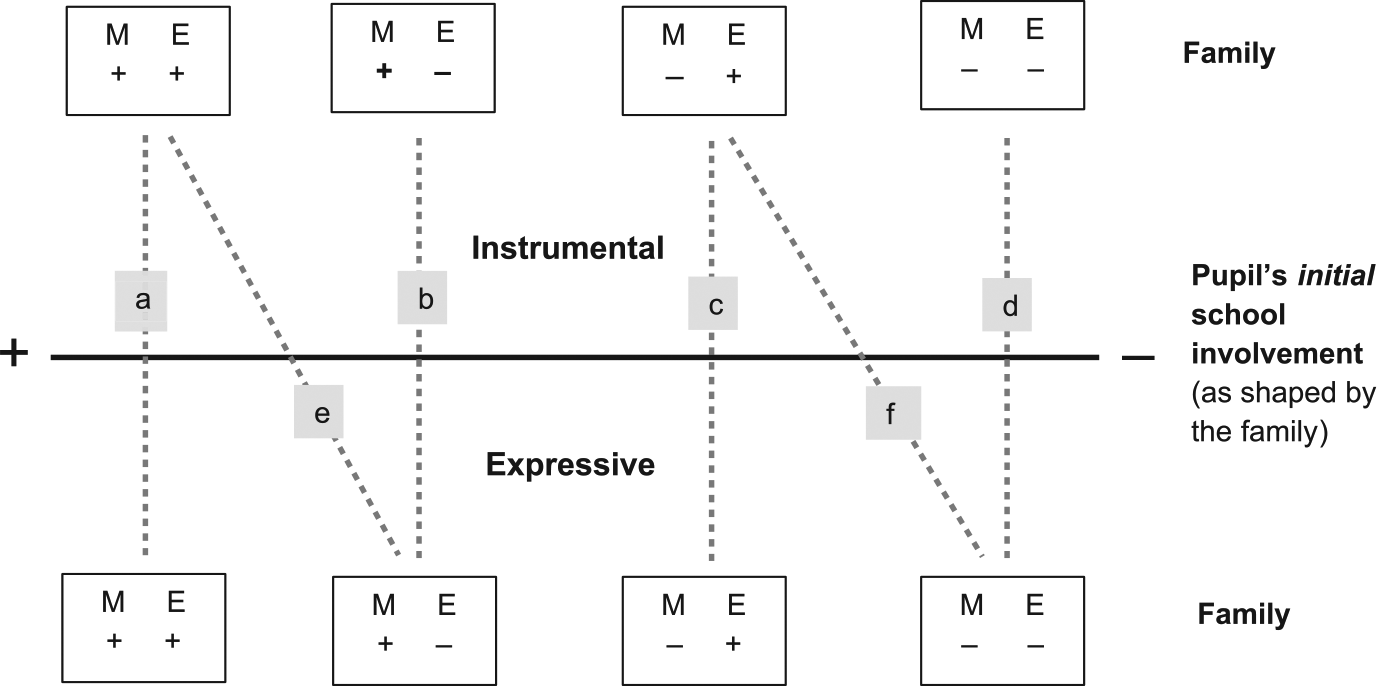
Modelling young people’s initial school involvement.
The pupil at position ‘a’ is highly involved in school (initially at least), owing to their family’s understanding of the means of both orders and acceptance of their ends. In contrast, at the other end of the continuum, pupil ‘d’ is the least involved in school initially, due to their family not understanding the means of both orders nor accepting their ends. It is important to note that this framework describes pupils’ initial involvement. Over time, this could shift as pupils may challenge the ends of schooling (the emergence of counter-cultures) or become more aligned towards them. Position ‘c’ is interesting, particularly in relation to inequalities in HE and the stated intentions of widening participation initiatives. Bernstein (1975) characterises this group as the aspirational working class; families who accept the ‘ends’ of schooling (or HE) and want their children to succeed educationally, but at the same time are unable to provide them with the support that would bring this about owing to their lack of understanding of the means by which the expressive and instrumental orders are transmitted. In other words, they are unfamiliar with the mechanisms of schooling, the processes of acquiring knowledge (instrumental order) and the appropriate ways to conduct oneself to comply with the school’s image of appropriate pupil conduct, character and manner (expressive order). Bernstein complicated the model further by showing how some families may understand the means and accept the ends of the instrumental order but not accept the ends of the expressive order (position ‘e’). This could depict some families who value educational qualifications but do not agree with the kind of personal qualities the school aims to inculcate in young people.
A key advantage of Bernstein’s framework is the level of analytical precision afforded to understanding the institutional properties themselves, and how these are implicated in the nature of the pupil’s initial role involvement. The ends which schools promote, and their internal mechanisms and organisational processes for achieving these, are given salience in the (differential) engagement of pupils. For Bernstein, central to the means of schooling are hierarchical, sequencing and criterion rules, which characterise the pedagogical relationship, the pace of educational transmissions and what is expected in terms of acquisition. Hierarchical rules describe social order within a context, and are the rules that govern what is considered appropriate conduct, character and manner; in this way, they establish and maintain identities of the ‘acquirer’ and ‘transmitter’; for example, the ‘doctor’ and ‘patient’ or ‘teacher’ and ‘student’. Universities, like schools, are governed by hierarchical rules that maintain social order and positionality, and are predicated on learning how to be an ‘acquirer’ in terms of appropriate conduct and behaviour. For example, students have to learn to be a ‘student’, including all of the appropriate means of conducting oneself, behaving and relating to others (including those holding different positions and status) within the context. Universities can also be understood in terms of their sequencing rules, which maintain an order (and pace) by which content should be acquired. Bernstein also explains that pedagogical relationships are governed by certain criterion rules, which control what criteria the acquirer is expected to take on and so what counts as ‘legitimate’ within a context. As a practical example, applicants to university are often asked the question ‘why do you want to study this course?’. Various answers to this question, and different forms of knowledge drawn upon here, are likely to carry differing degrees of legitimacy in terms of what counts as valid within the particular situation and context.
Singh (2001) has applied Bernstein’s framework in her study of the educational inequalities faced by Samoan children in Australia (a community formed during the 1990s, mainly by immigrants from New Zealand). Bernstein’s framework elucidated here the differences that the young people experienced in the varied modes of social control (in terms of the nature of parent–child and teacher–pupil relationships) evident in their homes, community and school environments. At home and in their community, relations between the young people and their family/wider community were governed by positional modes of social control, i.e., social control underlying interactions between community members and young people was overt and explicit. At school, these young people were often exposed to the very different personal modes of control, where control underlying interactions was implicit and covert. In other words, it was very clear to the young people how they were expected to behave and conduct themselves and relate to others at home or in their community (e.g. respecting elders within the community), but at school, teachers did not make clear such expectations to the same degree. This was a disorientating and confusing experience, causing them to take up defiant and disrespectful positions in school. In exposing these very different modes of social control evident here, Bernstein’s framework enabled very detailed and compelling explanations for precisely how these inequalities came about, especially in terms of the hidden institutional properties which appear important in maintaining them. His framework had particular affordances here in capturing the distinct values and social relations of cultural groups such as the Samoan community, which are only elucidated by studying in detail the nature of interactions and relationships between educational institutions and social formations (such as the family or cultural groups).
Bernstein’s conceptual framework captures the domination and subordination of different social groups through education. In many ways, this is aligned with Bourdieu’s concept of habitus, in terms of the sorts of dispositions shared by social groups. However, Bernstein’s framework offers a more delicate and precise language by which to analyse relationships between families and education. Indeed, criticism has often been levelled at Bourdieu’s concept of habitus in terms of its vagueness (e.g. Goldthorpe, 2007), which can make it difficult to bring to the surface the exact nature of relationships between families and educational institutions, in terms of the mechanisms that shape educational success or failure. Bernstein’s framework enables us to understand the different elements and properties of educational institutions, as well as how, theoretically at least, it can be assembled in ways which bring about a greater social and cultural congruence between home and school. In many ways, his conceptual tools might be seen as holding a greater degree of neutrality in the sense that they do not assume or normalise particular pedagogical forms or educational aims. For instance, many schools will differ in the image of conduct, character and manner they espouse, and these varieties are readily captured by the framework. By implication, his framework offers us the potential to see how changes in the ends that schools promote, and the means by which they transmit them, can impact (and potentially change) pupils’ engagement. It is therefore aligned with the aim of critical theorists who advocate radical pedagogies in order to allow oppressed groups a voice within the curriculum (Freire, 1996). Indeed, in many ways, Bernstein’s framework offers us a theoretical vision for how educational institutions might be re-aligned to match the familial cultures they serve.
In exploring the relevance of Bernstein’s work in making sense of inequalities in HE, the next section draws on a qualitative study of widening participation interventions at a UK university.
Applying a Bernsteinian Lens
The usefulness of Bernstein’s ideas for making sense of social class inequalities in HE are explored here through drawing on a piece of research which examined the impact of university-led outreach work. The research drew upon a case study of a research-intensive university (those consistently ranked highly in league tables) based in the north of England. ‘Outreach’ work describes the activities universities carry out to encourage underrepresented groups to progress to HE. As well as generic ‘outreach’ programmes, the university runs a number of subject-specific programmes for Architecture, Law, ‘STEM’ (Science, Technology, Engineering and Mathematics) and Social Sciences, each of which run for two years, as well as Medicine and Dentistry which both run for seven years. There are several common aims across all of the programmes, which include raising awareness and knowledge of HE study and the professions (e.g. knowledge of student finance, content of degree courses, how subjects are taught and assessed, and the professions), addressing low ‘aspirations’, increasing levels of confidence, improving attainment, as well as supporting students complete their university application form/personal statement. In addition, the more subject-specific programmes have the intention of developing understanding and motivation to study particular subjects. The programmes each consist of a series of planned events and activities, which encompass talks from academics and professionals, ‘taster’ lectures and practicals, summer schools (staying in university accommodation), outdoor activity events and revision sessions. Student ambassadors were involved in the majority of these activities, helping the event organisers to support the young people. In all cases, there is a formal application process to each ‘outreach’ programme, with applicants carefully screened before being accepted. Participants have to meet one or more selection criteria, the most important of which is being the first generation in their family to enter HE. In addition, the subject-specific programmes are selective in terms of the academic ability of participants.
The research presented here draws on data collected across five of the university programmes covering Medicine, Dentistry, Law, ‘STEM’ and Architecture. It explores the experiences of 36 young people between the ages of 16 and 18 who were in full time education and at the same time took part in one of these programmes. Rich and detailed qualitative accounts were collected from these young people through a mixture of both focus groups and individual interviews, which were carried out between December 2012 and August 2013, at various times, as and when they took part in events and activities at the university. In addition, a focus group was held with 10 parents of the participants. The aim of the research was to explore the nature of their experiences on the programmes as well as their thoughts and feelings about the transition to HE more generally. Interviews followed a loosely structured thematic guide, covering experiences before and during the programme, while also giving opportunity for participants to express their own thoughts and feelings in their own way.
Taking a Bernsteinian perspective, the experiences of the young people who took part in these outreach programmes are explored here. The concepts instrumental and expressive orders are applied here to capture the underlying processes of acquiring knowledge (‘instrumental’) as well as images of ‘appropriate’ conduct, character and manner (‘expressive’). Governing a family’s degree of alignment with these orders are the hierarchical, sequencing and criterion rules which are also applied. These describe the nature of the pedagogical relationship, the pace of educational transmissions and what is expected in terms of acquisition.
Families and Higher Education
In applying Bernstein’s framework here, it is position ‘c’ (Figure 1) which most closely matches the experiences of the young people taking part in these outreach schemes. The families of the young people clearly valued a university education; in Bernstein’s terms they accepted the ‘ends’ of the expressive and instrumental orders, however, at the same time, they had a very weak understanding of the ‘means’ by which these are transmitted. The value placed on HE participation by these families was clearly evidenced in the narratives of the young people and parents alike: I don’t know, I don’t talk about it too much to my Mum and Dad, I know they want me to go, and my family want me to go, but I end up getting like – if I talk about it a little bit sometimes my Dad, if I say I have doubts about it, he’ll be like you don’t want a dead-end job, just all that kind of lecture stuff and persuade me to go; I think they just want rid of me. (Mark, year 12 participant (aged 17), Law outreach programme) Obviously I’ve got aspirations of them both going to university, both my boys. (Lucy, parent of year 10 participant (aged 15))
It is not always clear precisely what aspects of the expressive and instrumental orders of university their families privileged. In many instances, it was clear that the young people’s families privileged the acquisition of new skills and qualifications (instrumental order), in the belief that these would lead to high status professional jobs. But it could be that some families also desired the kinds of dispositions and more social and cultural characteristics associated with a university education (expressive order). This orientation towards education markedly differs from that found in other research exploring families with little or no experience of HE (Heath et al., 2008). Of course, it could be that the high academic achievement of these young people played a part here in shaping their parents’ high aspirations for their future success.
Unpacking parental expectations further, underlying many of the accounts was a sense of regret on the part of parents in terms of their own educational biographies. In many cases, parents’ sense of failure in relation to their own education figured heavily in the advice they gave to their own children.
My Mum always wanted something better than what she had ’cause she didn’t even try at college, didn’t go to university and then she’s got a crap job and she always wanted better for me, to go to university ’cause she knew I had the intelligence to do at least all right in my exams and get that. And she always like ... she taught me from when I was like at least about 15 months to like just do everything, reading and stuff like that, just constantly reading to me. And she tried, and I was constantly encouraged to do well and then given the idea to be a doctor, was always a dream for me. (Sarah, year 12 participant (aged 17), ‘STEM’ outreach programme)
Parents exhibited a strong belief in the education system delivering for their children, in terms of securing success in the graduate labour market. However, the underlying procedures of schools and universities, as governed by hierarchical, sequencing and criterion rules, were a mystery to these parents. They were unable to support their children in understanding the nature of educational participation, both at school and beyond to university. University was a closed book to these families, as evidenced in many of the young people’s accounts: My parents didn’t go to uni, they never went to sixth form so they don’t really like understand, like, how hard A-levels are or like how hard it is to get into university or they don’t understand like university life or even student loans or anything so it has been helpful coming here in that respect. (Sam, year 13 participant (aged 18), Medicine outreach programme) My family are the last people I would ask, they can’t do much for me like .... (Tom, year 12 participant (aged 17), Architecture outreach programme)
The young people did not perceive their parents to have the familiarity and confidence with what Bernstein refers to as the hierarchical rules of educational institutions, including the rules of social order and rituals that characterise schools and universities. These sorts of rules include the nature of power relations between the transmitter and acquirer and also the sorts of expectations placed on each. For example, on a practical level, in terms of what are considered appropriate behaviours of prospective university applicants, what kinds of questions or queries might be permissible? What are seen to be the expectations of students in how they conduct themselves and relate to different kinds of individuals who they might encounter in the university setting? Bernstein’s framework can illuminate these expectations and mechanisms operating at the micro level, providing a greater degree of theoretical precision when interpreting data. Furthermore, the conceptual distinction made by Bernstein between families’ understandings of education and expectations for their child is an important one: it avoids some of the more fatalistic interpretations of young people’s experiences and trajectories.
The young people also did not feel that their parents could facilitate an understanding of what was considered as ‘legitimate communication’ in the educational context, in terms of the sorts of knowledge and understandings seen as appropriate, what Bernstein describes as the criterion rules governing pedagogical relationships. One of the ways in which this manifested itself was parents’ perceived inability to confidently guide their children through the application process. Their unfamiliarity with the setting meant they did not know what kinds of criteria their child should demonstrate and practise in their application. For example, there is often an implicit notion in HE admissions that applicants should demonstrate their passion for a subject, but what is meant by this within the context of HE, and in what valid ways might it be evidenced? What counts as a valid or legitimate expression of passion for a subject is one element of the kind of criteria the potential acquirer (i.e. university applicant) is expected to embody.
The families’ ignorance of these hierarchical and criterial rules produced a kind of fear of the unknown that was experienced as disempowering by parents. Parents failed to direct and guide their children not because they lacked the ability to do so, but because the strangeness of the HE setting paralysed them. Indeed, during one of the focus groups with parents, they expressed a strong desire to increase their knowledge about HE and even suggested that they themselves should have a kind of ‘mentor’, like their children had. They felt that they needed somebody themselves to help them support their child in their transition to HE. As Bernstein (1975) points out, isolation from this aspect of their child’s life can be a painful and distressing experience for some parents, as evidenced by some of the emotional responses from parents in this study.
Exposing Higher Education
The various outreach programmes in which the young people were engaged worked to make explicit the rules of social order within the HE context. That is to say, they exposed the hierarchical, sequencing and criterion rules that characterise the pedagogical relationship. While often left hidden and implicit, it was made explicit what it was like to be a student, or ‘acquirer’, in terms of appropriate modes of conduct, character and manner (hierarchical rules). One of the ways in which this tacit knowledge was revealed to young people was through their day-to-day interactions and casual conversations with the student ambassadors. The young people talked to student ambassadors about their hopes, fears, concerns and generally what was on their mind as they experienced the outreach programme and were thinking about their transition to university.
... if I do have a problem, I will say [to a student ambassador] – hey, I am a bit worried about my fifth choice. Does it seem like a legitimate choice? And she will go, yeah, yeah – I think that’s – you know – a sensible option ... and then that stops me from worrying then, because otherwise I wouldn’t know where to go because no-one in my family has been – what am I meant to do? (Laura, year 13 participant (aged 18), Medicine outreach programme)
These sorts of interactions exposed the young people to otherwise implicit knowledge about how to conduct and behave within the setting in terms of what characterises appropriate behaviour, encapsulated by Bernstein’s concept of hierarchical rules. It gave them glimpses into these hierarchical rules that operate between the ‘acquirer’ (i.e. the student) and ‘transmitter’ (i.e. the university) in terms of power relations and appropriate modes of behaviour and conduct. This kind of knowledge, being tacit in nature, is difficult for the young person to describe in explicit terms, but it is revealed in their general sense of familiarity and confidence within the setting, as they come to know and understand the ‘means’ of educational transmissions. At the same time, given that student ambassadors are purposefully selected based on being first generation HE students themselves, it could be questionable how familiar they are with the tacit rules of social order within the context. As a select group of first generation students, it could also be argued that these ambassadors may give the young people an unrealistic picture of the student body as a whole.
Participating in the outreach scheme gave the young people first hand contact with sequencing rules governing educational transmissions in HE, defined by Bernstein as the selection and organisation of knowledge in terms of when, and at what pace, content is expected to be acquired. The young people were directly exposed to the sorts of knowledge and understandings they would be expected to take over and master at university.
So what do you think has been the most memorable activity that you’ve done that’s kind of made the biggest difference to you?
I can’t think of a specific example but I think talking to medical students and medical professionals about what they do because I think, I mean there was a time when I wanted to do medicine but I was considering other things, such as biomedical science and looked at pharmacy. But listening to that sort of made me think no, I want to do medicine.
(Year 12 participant (aged 17), Medicine outreach programme)
Doubts about the nature of medical education, and the sequential ordering and pacing of this knowledge in relation to their past learning experiences, can be seen here to have affected the young person’s decision making. Gaining greater clarity and exposure to medical knowledge through their contact with students and professionals appeared to have influenced their course choices. Pacing and ordering of medical knowledge extended beyond the educational phase and into professional practice, with young people taking part in the scheme given access to important ordering and sequencing of roles and positional levels in the medical profession. While it is difficult to say precisely where they gained such knowledge, it is likely that the talks from medical professionals, taster lectures/practicals and talking to ambassadors at different stages in their studies were important sources. Unfamiliarity with the kinds of learning that happen at university, and how this differs from that which they have experienced earlier in their educational journey, can provoke a sense of fear and anxiety in young people. They were unable to gain these tacit understandings from family members, unlike their peers with familial experience of HE, who are often better positioned to glean these implicit understandings about the ordering and pacing of knowledge across the different phases of education.
The young people’s experiences on the outreach scheme also exposed the young people to what Bernstein refers to as criterion rules, defined as rules governing the successful acquisition and demonstration of content. In any strongly classified and framed educational context, such as the UK HE system, where strong boundaries separate distinct knowledge bodies, specific and explicit criteria emerge which acquirers are expected to master in order to succeed. In the educational context and the body of knowledge known as ‘medicine’ there are defining traits, behaviours and manners that are deemed appropriate. The ‘ideal’ medical student will be expected to demonstrate aspects of these criteria through the ways in which they present themselves in terms of their behaviour, conduct and manner. These criteria were gradually revealed to the young people through their time on the programme, attending talks and lectures, taking part in activities, talking with HE staff and student ambassadors and from their general immersion within the setting: We met a lot of like ambassadors as well that helped us, I know that in the end it got so that I sent one of my personal statements to one of the ambassadors and like they helped me with what to write, and like proof read it, because obviously I can’t send it to my parents, but yes I think it’s like been really good. (Jo, year 13 participant (aged 18), Medicine outreach programme) You might really, really love Architecture but you wouldn’t be able to get that across without the understanding that we’ve gained from this [programme]. (Martin, year 13 participant (aged 17), Architecture outreach programme)
The many conversations and interactions the young people had with student ambassadors, university staff, as well as professionals in their chosen field enabled them access to a diverse range of criteria. The participants above describe how they came to be familiar with appropriate forms of presentation in terms of the kinds of behaviours, attitudes and perspectives they should convey within their university application. For example, in rationalising their choice of degree course, particular rationales and the norms, understandings and perspectives underlying them, will be differentially judged according to the criterion rules. In affording the young people access to these criteria, the outreach programme increased the chances that they would be able to present themselves in ways that were deemed appropriate and ‘legitimate’.
Identifying with Higher Education
Experiences on the outreach programme not only revealed the means of educational transmissions, in terms of hierarchical, sequencing and criterion rules, but also, crucially, the young people appeared to begin identifying with what was expected of them. This can be understood in terms of the young people’s identity, and specifically the ways in which they viewed their own identity in relation to the modes of behaviour, conduct and manner they were presented with during their time on the outreach scheme. A number of the young people in this study recalled how, prior to their outreach programme, they had struggled to imagine themselves studying at university, as they perceived there to be a gulf between their own identity and the image they had of those studying at university.
I don’t know, I just didn’t know – I thought they’d all be like, amazing students, again it doesn’t say that but, kind of had an idealistic view point that everyone’s going to be really great and you’re not going to compete with that type of person at all. It can seem more down to earth than you’d imagine at first. (Ben, year 12 participant (aged 17), ‘STEM’ outreach programme) ... about what medicine entails ... I think many people don’t realise. There are a lot of myths and misunderstandings about it and about what it takes to get there as well. And so like before, I thought it was unsuitable, and I thought that perhaps I should lower my standards ... but now, obviously, I think it is more achievable, and now I can picture myself as doing medicine now whereas before it was kind of not really that much of an option but now it is really something that I hope will happen. (Vicky, year 12 participant (aged 17), Medicine outreach programme)
The previous doubts these young people had about studying Medicine can be understood in terms of their fear of not knowing what was ‘legitimate’ and expected of them within the context, as governed by criterion rules. These unknown expectations, and criterion rules by which they would be evaluated against, encompass not only the forms of knowledge prioritised at this higher level of education, but also modes of behaviour and conduct within the setting. In bringing the young people closer, and exposing them to these criterion rules, the outreach scheme demonstrated to them that Medicine was in the realms of the possible. Bernstein’s framework offers explanatory power here in terms of showing how those who previously may not have identified with HE study could begin to see themselves as fitting this identity. While social reproduction theorisations provide compelling explanations for how the status quo is maintained, Bernstein’s framework has the additional affordance of explaining precisely how exceptions to this may come about.
There was also a critical identity component at play here, in terms of the ways in which the scheme affirmed the young people’s sense of fit within the educational context. In the context of strong classification within HE, where closed boundaries tend to separate fields of knowledge into tightly defined disciplines, a strong sense of membership to particular ‘subjects’ and knowledge domains can emerge. These divisions can produce powerful and defining academic and disciplinary identities within the student body, such as the ‘medic’. I’m suggesting here that doing ‘medicine’, which Vicky refers to in the above extract, is envisioned by her as not only gaining new knowledge about medicine, but is also a process of becoming a ‘medic’ and thereby having to embody all of the ritualising and social practices that this identity encompasses. In identifying with the people they encountered on the outreach programme, the young people began to shift in the way they saw themselves and their fit with the student identity. The student identity became something different to what they had originally envisaged.
Yes, university is one of those things where you know you want to go but it’s, kind of, just outside your reach. You know, like myself, I don’t really know many people that are at university or anything like that, so I didn’t really have anybody to talk to about it or anything like that, but, coming here, you see students and they’re working and they’re doing things and you’re talking to them, you really ...
You wonder if you can fit in or not.
I feel, like, ’cause at first, I thought I was like, if I ever did go to university, I’m like, ‘well I’m a bit of an outsider. You know, I’ll never fit in or anything’, but now that I’m here and I’ve seen the students, we’re like them.
Just us, but a couple of years older.
It makes it more like, ‘this is more achievable really’, when you see the real people that are working here.
(Year 12 participants (aged 16/17), Law/Architecture outreach programmes)
I don’t think I’d have been confident enough when I first came. I wouldn’t have known what to expect. I’m not a naturally confident person and this has just shown me that I can do it and it is like, you can do it if you try and you’ve just got to put yourself forward and make an effort to join in and talk and contribute to discussions. (Richard, year 13 participant (aged 17), Law outreach programme)
It might be that the participants were more likely to have identified with the student ambassadors given that they themselves were often first generation HE students. Indeed, the HE students they encountered may have had a greater level of awareness, and lived experience, of what the transition experience is like for them. Having parents who also did not progress to university, and attending similar kinds of schools, could have put them in a better position to relate to the participants.
Concluding Remarks
This article set out to re-invigorate debates about how we theorise inequalities in HE participation through exploring the relevance of Bernstein’s theoretical ideas. His work has been shown to be valuable in exposing the subtle underlying mechanisms and processes that are ingrained within the very fabric of the institution, illuminated by the concepts of expressive and instrumental order as well as hierarchical, sequencing and criterion rules. The institution is brought to the surface by these concepts, with its microscopic elements revealed in terms of the sorts of behaviours that are prioritised and the ways in which they may be legitimately demonstrated.
Bernstein’s framework allowed a rich theoretical understanding of how the families in the research drawn on here came to be in the painful position of encouraging their child to progress to HE but at the same time being unable to help them achieve this goal. In Bourdieusian terms, the forms of capital these families held did not mirror those embodied within the ‘institutional habitus’. Bernstein’s perspective, on the other hand, begins with the institution and maps out the underlying forces which shape the young person’s engagement. From a Bernsteinian perspective, the parents in this study did not facilitate an understanding of the forms of conduct associated with hierarchical rules of the institution, such as how to be a ‘learner’ or indeed what an ideal learner was considered to be. The sorts of learning which happen at university and knowledge acquired, and how this relates to that earlier in their educational career, illuminated by Bernstein’s sequencing rules, were unknown to these families. They were at a loss to help their child in demonstrating mastery within the context through their display of legitimate forms of behaviour and communication, which Bernstein’s criterion rules expose. There is an important distinction here between the Bernsteinian perspective and the Bourdieusian inspired concept of ‘institutional habitus’. Bernstein’s framework is not laden with the same kind of class-based assumptions, and so allows for a greater level of neutrality within any analysis. It does this by contributing very precise conceptual tools which can be used to unearth the rules and principles that underlie relationships between individuals and HE. In foregrounding the institution, there is not the same focus on what individuals ‘lack’, but instead how institutions may be (mis)aligned with the understandings and expectations held by different groups and individuals. This, in turn, could lend the conceptual framework to capturing a greater degree of fluidity in social class, cultural and ethnic identities as well as the variety of institutional contexts that exist. Singh’s (2001) study of the Samoan community in Australia clearly illustrated this possibility from a Bernsteinian vantage point. Importantly, the framework has the capacity to capture exceptional cases where institutional properties do not necessarily match closely on to their intake characteristics (e.g. Donnelly, 2014, 2015b). In other words, it offers the potential to make sense of institutional differences independent of the social class characteristics of their intake.
The sophistication of Bernstein’s framework enables the development of more fine-tuned implications for policy and practice. For example, the research drawn upon in this article suggests that taken for granted knowledge about the workings of universities needs to be made available to families and young people in more easily accessible ways. Developing a higher level of familiarity would appear to be important in easing the transition for these kinds of academically able young people. At a practical level, examples of how to do this might be showing young people and their parents how lecturers and students relate and communicate with each other, giving them access to knowledge about ‘legitimate’ dialogue and communication.
Footnotes
Acknowledgements
Thanks go to the young people and their parents who generously gave up their time to take part in the research drawn on here. I would also like to thank Parlo Singh, Hugh Lauder and the two anonymous reviewers for their helpful comments and suggestions on earlier versions of this article.
Funding
This research received no specific grant from any funding agency in the public, commercial or not-for-profit sectors.