




Abstract
This article examines the biopolitical footprint of a new wave of non-governmental organization (NGO) interventions which conjoin the futures of youth with that of the nation, and which thereby seek to naturalize an institutional sovereignty over moral temporalities of future-making. By inverting the political onto the personal, these unorthodox interventions challenge extant sociological constructs of development, and further affirm the salience of an ethnographic turn in NGO scholarship. To this end, I trace the quotidian coordinates of such a moral politics out of the Right to Dream Academy, Ghana, which serves as a prototype for NGO interventions concerned not solely with locating the ontological limits of self-transformation but in redeploying such limits to address Africa’s development crises. Opening up novel theoretical directions for NGO scholarship, I propose an extension of the concept of the reinventive institution, positing a sociologically informed reframing of NGO interventions connected to interdisciplinary work on youth, morality and futurity.
Youthful Futures
‘OP-POR-TU-NI-TY’, I repeated slowly, directing 11-year-old Ousmane’s gaze to the scrap of paper on which I had scribbled the English translation. 1 ‘Repeat after me’, I requested once more: ‘I am very happy – for the opportunity – that Right to Dream are giving me – and I will do my best – to become – a better student – a better football player – and a better person.’
It was early 2012 in the green-canvassed hills of Ghana’s Eastern Region, and Ousmane and I had spent the morning preparing a short speech to honour his five-year scholarship award at the Right to Dream Academy – a much-revered development non-governmental organization (NGO) which seeks to discover and nurture ‘the leaders of the future’ through the education of youth and what its founder describes as ‘Africa’s passion – football’. Just a month prior, Ousmane’s remarkable journey began on a dusty pitch near his home in the Ivoirian capital, Abidjan, when he and three compatriots were hand-picked from over 30,000 young hopefuls across West Africa and invited to showcase their talents over an extended trial at the Academy’s fully residential campus. Like many of his peers, Ousmane had long dreamt of such an opportunity, but even he was visibly overawed by his early days ‘on trial’. He struggled with the language barrier and homesickness, watching on as two of his peers were promptly rewarded with scholarship offers. The tearful departure of the third did little to quell the intense pressure on his adolescent shoulders.
News of Ousmane’s scholarship award, however, put an end to such fears. ‘I am an Academy boy’, he excitedly announced as the afternoon’s scholarship ceremony got underway in the open-air dining hall. A joyous outpouring of pride marked the moment among the Academy cohort, each of whom understood the magnitude of the moment and the journey that lay ahead for Ousmane. Over the next five years, he would learn fluent English, receive a Cambridge-accredited primary education and train twice daily under the tutelage of West Africa’s most-acclaimed youth coaches. Beyond the immediate horizon, there was also the more millenarian prospect that Ousmane might follow in the footsteps of the Academy’s ever-expanding cluster of graduates, many of whom hold professional football contracts at elite clubs across Europe and command prestigious educational scholarships at North American universities. Yet as Ousmane concluded his short acceptance speech and formally received his scholarship from the Academy founder, he was reminded that such privileged opportunities come with a responsibility – a responsibility to realize his ‘true potential’ not just as a scholar or an athlete but as a ‘role-model’ who will inspire and lead the future transformation of his community and continent.
‘That’s what he said to me too!’, declared 12-year-old Adama – a fellow francophone from neighbouring Burkina Faso – as we joined in the chorus of applause in the moments that followed. ‘He asked me if I should become successful in my future, what am I going to do for Africa?’, Adama continued, before recounting the extraordinary promise he made to the Academy founder as he accepted his own scholarship offer a year earlier: He said that my character is most important and that I must give back if I have the opportunity in my future, and if I have the money. I promised him that I will want to build hospitals, schools, and academies and help the community to become better for people. He told me that he is picking me because he needs me to work hard to do it for Africa.
In recent decades, sociologists have observed a gradual shift – a ‘quiet’ revolution (Fisher, 1997: 440) – in the terrain of the biopolitical across postcolonial Africa. Bound up with the legacies of colonial encounter and the destabilizing effects of neoliberal reforms, this shift hinges on the effective withdrawal of the African state from the development field in the 1990s (Bernal and Grewal, 2014; Piot, 2010). Where once the heroic age of African independence signalled hope for a radical break with European empire (Ake, 1996; Rodney, 1972), the turn of the century saw a new wave of international non-governmental organizations (NGOs) assume responsibility for the vital material and political processes of African life. This NGO revolution – which Piot (2010: 135) also demarcates as a ‘revolution in the biopolitical’ – has seen international agencies hailed as the ‘new sovereign’ across the African postcolony, their raison d’etre defined by a collective quest to alleviate widespread crises in healthcare, education and social welfare. Some, like humanitarian agency Médecins Sans Frontières, operate in declared ‘states of emergency’ (Fassin and Pandolfi, 2010) where a shrinking temporal horizon and a catastrophic near future demand what Redfield (2005: 344) terms a ‘minimalist biopolitics’ – namely the temporary administration of survival through basic medical treatment. Others, which are brought into sharp focus in this article, serve as projects of social repair, reconciliation, education and empowerment, operating within an expanded time horizon as they promise to address Africa’s long-standing development crises and redeem utopian visions of the future reconstructed, even reinvented.
I share the opening vignette as an entry point onto this latter form of development praxis, one in which youthful actors such as Adama and Ousmane are lauded as the new agents of social renewal – their latent potential as role-models-in-the-making routinely synchronized with national imaginaries of future time (Cole and Durham, 2008; Shaw, 2014). It is they more than the postcolonial state who now anchor the moral and political telos of development, for it is through them – as ‘emblems of futurity’s unquestioned value’ (Edelman, 2004: 4) – that international NGOs such as Right to Dream seek to affirm their right of intervention in the biopolitical life of African communities. To invest in the potential of Adama and Ousmane, however, is not merely to redeem or redirect an individual future-at-risk; rather, as their peculiar promise laid bare, it is to enact and naturalize an outsourced institutional sovereignty over a moral politics of future-making. By virtue of their entry into the enclosed programme of life at Right to Dream, it is now they – rather than the postcolonial state or the international NGO – who are charged with a responsibility to ‘work hard’ for the future of Africa, and to build the schools, hospitals and academies that have long figured as the infrastructural fount from which alternative futures might be forged.
Departing significantly from its Foucauldian origins, such a biopolitical reading of development examines the modes of sovereign power which govern vital assemblages of human and non-human life. In sociological shorthand, it asks how development interventions enact particular visions for the forms of life that can and should be supported into the future, and how such visions implicitly legitimate that others, in Foucault’s (1978) own terms, may be ‘let die’. By bringing vital assemblages of life, community and the nation ‘into the realm of explicit calculations’ (Foucault, 1978: 143), NGO interventions exercise sovereign power over who and what are valued, and what kind of futures are deemed desirable for the collective body politic. But what, I ask, does the unfolding encounter between Right to Dream and Adama and Ousmane reveal about the shifting biopolitical form and footprint of such NGO interventions across Sub-Saharan Africa? And how are we to make sense of the extraordinary role afforded to youth in such encounters?
I deploy these questions both as a point of departure from long-standing sociological tendencies to typecast NGOs in morally dichotomous terms of ‘good’ or ‘bad’ (Murdock, 2003), and as an organic entry point onto the veritably diverse socio-historic and political coordinates in which their institutional remit and performative character take shape – and shape-shift – across time and space. To this end, I seek to extend and reorient Scott’s (2010, 2011) concept of the reinventive institution in dialogue with interdisciplinary work on youth, morality and the politics of future-making in postcolonial Africa. Aligned with Fisher’s (1997) still prescient call for an ethnographic turn in NGO scholarship, the article draws on extensive fieldnotes, interviews and participatory observations 2 to elucidate the lived dramaturgy of such a ‘reinventive’ politics in situ, at its institutional point of production within the Right to Dream Academy, Ghana. Engaging with the quotidian perspective of the ‘mundane, everyday worlds of NGO’s in action and on the ground’ (Elyachar, 2015: 860), I thus attempt to reconstruct the long-term social and material encounters through which Right to Dream – as a prototype for the NGO as reinventive institution – not only unmoors its youth recruits from the cultural commons of African life but seeks to nurture a ‘total’ overhaul of the self as the future fount of moral reform across the continent.
The New Sovereign: NGOs as Reinventive Institutions?
Over a half-century on from Erving Goffman’s (1961) Asylums, much has changed in sociological thinking about institutional forms of sovereign power. Most notably, the late 20th century saw a shift away from the coercive authority of Goffman’s total institution, with state-run prisons and psychiatric hospitals gradually replaced by a curative assemblage of healthcare centres, rehabilitative clinics and self-help groups (Gubrium and Holstein, 2001). As forced confinement gave way to these institutions-without-walls, so too the figure of the passive-self under-threat – formerly at-risk of a ‘mortifying’ erasure of identity within austere institutional regimes – transitioned towards that of a consumer-subject responsible for seeking out new techniques of reinventing the self (Rose, 2007).
For Scott (2010: 218), this inversion of power did not signal the demise of social control in late modern societies; rather it engendered the proliferation of a ‘new type of total institution’ – what she terms reinventive institutions. Ranging from therapeutic clinics and religious cults to utopian social movements and elite educational academies, Scott (2010: 226) defines the reinventive institution as a ‘material, discursive or symbolic structure through which voluntary members actively seek to cultivate a new social identity, status or role’. Under the guise of voluntary self-transformation, individuals not only embrace reinventive regimes of institutional life, but actively submit to mechanisms of performative regulation in the belief that they have a moral responsibility to realize their ‘true potential’ – whether by means of education, therapy or healing. It is the more opaque regulatory authority of these reinventive institutions, Scott (2010) argues, which now govern the authorship, modification and transformation of the late modern self. But how, I ask, does Scott’s (2011) rigidly western framing of the reinventive institution articulate with the ‘NGO revolution’ sketched in the introduction – namely, that which has seen international agencies emerge as the driving force of development across postcolonial Africa?
After all, while beyond Scott’s original schema, this ‘revolution’ of African civil society challenges extant sociological constructs of development praxis. Bankrolled by distant international agencies, yet advertised as more democratic and localized than what came before, Ferguson (2006: 103) argues that this new breed of grassroots agencies are best ‘conceptualised not as “below” the state, but as integral parts of a new, transnational apparatus of governmentality’. In bypassing – rather than replacing – the African state, the scope and authority of these new international organizations now extends to a vast assemblage of health, education and social enterprise initiatives, humanitarian and human rights programmes (McGee and Pelham, 2018), peace and reconciliation schemes (Shaw, 2014; Shepler, 2014), as well as reformist community groups and feminist social movements (Alvarez, 2009; Roy, 2011; Sharma, 2008), while a trend towards corporate social responsibility has fuelled the expansion of elite leadership and sporting academies (Darby et al., 2007). Collectively, I argue, in their differentiated efforts to empower, protect, educate and transform, this new breed of non-governmental actors might be read as a hitherto unexplored archetype of Scott’s (2011) reinventive institution.
My argument is founded on three revisionary propositions. The first is to suggest that such NGO interventions collectively register a novel form of ‘reinventive’ politics – a politics concerned not solely with locating the ontological limits of self-transformation but one which seeks to deploy such limits in reshaping utopian timelines of the future. Unlike Scott’s (2010) reinventive institution, then, these NGO interventions can be said to invert the political onto the personal, thereby constructing moral temporalities not only through their investments in youth but in their institutional commitment to alleviating underdevelopment across Africa. Take, for example, Oprah Winfrey’s US$40 million investment in a Leadership Academy for girls in South Africa, who – ‘by virtue of their unique education’ therein – are expected to transcend patriarchal structures to ‘lead a positive and enduring transformation of their communities and country’. 3 Or, take the child protection agencies of post-civil war Sierra Leone whose psychosocial interventions seek to ‘retemporalise’ child ex-combatants – and with it, their nation – towards a reconciliatory post-conflict timeline (Shaw, 2014: 318). Animated by altruistic logics of ‘restoring’ and ‘unlocking potential’, these NGO-led projects claim to magnify the agency of youth such that they become the moral bearers of responsibility for futures as yet unknown.
By the same token, these institutional encounters with resource-rich NGOs are highly coveted among African communities. For youth, in particular, the vernacular import of international NGOs has long been tied to aspirations of social mobility and material prosperity, if not the more transcendent prospect of migration. Mobilizing affects of hope and opportunity, the NGO-as-reinventive-institution thus inspires imaginaries of ‘agentic, voluntary self-improvement’ (Scott, 2011: 40), its localized authority amplified by the generalized abjection faced by African youth demographics. Ready and willing to ‘discard their old selves in the hope of finding something better’, such youthful subjects embrace institutional rhetorics of reinvention, with the ‘real, authentic self’ perceived to reside ‘not in the person who went into the total institution, but in the one who might come out’ (Scott, 2010: 219). Conditional in nature, this ideal-type projection of self derives its allure from the exceptionality it signifies; that few will ever realize it serves only to valorize institutional ethics of commitment, sacrifice and devotion. Thus, while outwardly voluntaristic, this new breed of development organization is not without hierarchy or surveillance; rather, authorship of the self can be said to be agentic only insofar as one remodels their identity, values and aspirations to fit with the enabling dictates of the NGO in question.
And so, even as youth have come to embody such a moral politics, their reinventive potential is rendered dependent on the direct intervention of the NGO, and their power to redirect temporal sequences punctuated by the perceived lack, absence, abjection or trauma of life on the postcolony (Manzo, 2008). While widely hailed for its localized ethos, the development horizon today is dominated by more elitist modes of intervention. As Piot (2010: 161) cautions, a growing portion of NGOs can be said to be ‘neither place-based nor place-reifying’: rather, driven by distant international agendas and run out of exclusive institutional facilities, many interventions not only target specific individuals but hinge on their ‘total’ withdrawal from community life. Akin to Coser’s (1974) ‘greedy institution’, these NGOs are exclusive and demand absolute commitment, creating a symbolic if not physical boundary between insiders and outsiders, and often expecting inmates to weaken existing ties beyond the institution.
Ultimately, then, these processes whereby local attachments are supplemented by trans-local forms of dependency demand a recalibrated reading of the reinventive institution; one which is attentive to (post)colonial genealogies, and the inherited legacies they bring to bear across Sub-Saharan Africa. In these revised terms, the sovereign power of the NGO-in-Africa, notably its ‘right’ to intervene in the lives of Others, must be read against a long lineage of colonial endeavours related to health, education and missionary societies – precisely those which Ake (1996) holds accountable for the underdevelopment of Africa at large. Only against the macro-historical injustices of colonial domination, it follows, may we judiciously appraise the biopolitical footprint of the NGO-as-reinventive-institution in Africa’s postcolonial present.
Rights, Dreams and Responsibility for the Future
Africa needs more role models: Role models who understand the challenges faced by Africans; Role models who have the talent and opportunity to express it; Role models who have the ability to inspire, create and lead positive change. Right to Dream exists to discover and nurture role models. We provide young, talented Africans with the opportunity to fulfil their potential and the capacity to claim a better future for their communities and country. (Mission of Right to Dream)
4
In 1999, distressed by the dire predicament of youth in Ghana’s capital city, Accra, British social entrepreneur, Tom Vernon, established a small-scale development charity, Right to Dream. Founded on a shoestring budget, Right to Dream began life as a non-residential initiative run out of a dusty training field – popularly known as ‘Last Chance’ – that doubled as an open-air classroom for a handful of youngsters recruited from nearby settlements. Like many of the ‘grassroots’ organizations that mushroomed across West Africa in the 1990s, Vernon’s ethos was guided by a conviction in the need for more localized interventions, the kind which could offer Ghanaian youth tangible pathways towards education, employment and social mobility. And so, believing – as its mission states – that ‘the greatest natural resource Africa possesses is young people’, Right to Dream set about nurturing a new generation of role models through a unique programme combining intensive schooling, football and character development.
Nearly two decades later, Right to Dream has grown into an internationally acclaimed non-profit organization with registered charity arms in the USA and the UK, and a US$2.5 million academy campus – including a Cambridge-accredited school and state-of-the-art football training centre – located in Ghana’s Eastern Region. By now, they have awarded five-year scholarships to almost 100 student-athletes – both boys and girls, aged between 10 and 18 years old – from across West Africa. Yet the phenomenal growth of Right to Dream is best captured by the global reach of its graduate pathways, which have seen 34 graduates become professional footballers at elite clubs across Europe, and 44 awarded over US$11 million in educational scholarships at schools and universities in Europe and North America.
Thus, where once it was sustained by affect-filled origin stories of a one-man humanitarian mission, Right to Dream today functions as a transnational sovereign apparatus. In particular, the political networks and commercial revenue streams of their charity arm, Right to Dream USA, have been fundamental to the growth – even survival – of the organization in the aftermath of the global financial crisis of 2008. In a shrinking funding landscape, Right to Dream consolidated links with North American educational institutions, secured lucrative partnerships with Tullow Oil, Mantrac and Nike, and led the pioneering establishment of a girl’s academy. As something of a prototype for NGOs that attempt to mobilize the ‘power’ of sport in humanitarian, development and peace-building interventions, Right to Dream today operates under a self-ascribed authority derived largely from its own moral insistence on a child’s ‘right’ to dream. Yet if Right to Dream can be said to depoliticize the responsibility of its youth recruits in relation to the endemic problems of Africa’s present, it magnifies to an extraordinary degree their agency in claiming a ‘better future’. Not unlike Goffman’s ‘moral career’ – as a ‘sequence of stages’ through which inmates’ identities were institutionalized (Mouzelis, 1971) – Right to Dream affords hope only to those willing to serve as the moral fount of a redemptive African timeline. For Adama and Ousmane, then, any claim to moral membership therein must begin with a loosening of attachments to family and place as they seek to demonstrate their right to belong, let alone their right to dream.
A Moral Education
As I made my way to breakfast this morning, 11-year-old Adama again recounted his ‘difficulties’ upon arriving from Burkina Faso a year ago. ‘I had zero English and when I saw the boys all playing, I saw that my level is too low. It was very hard to say “this one is the strongest boy”. They were all very good and training hard. At school, I could not understand anything. I knew they [the academy staff] were not happy with me…’ ‘I was very afraid’, Adama continued. ‘Before I go to sleep I was crying because I was thinking they will not pick me… And in the morning I couldn’t even give a good pass.’ It’s not until we approach the dining hall that there is a turning point in Adama’s story arc. ‘Something was telling me if I stay here, I can be somebody… So I read many books and started to learn the language. But the thing that really changed my life was the Character programme. I learned how to behave in a different way, to be self-disciplined and to approach challenges with a growth mindset.’ (Fieldnotes, April 2012)
For Adama and his peers, arriving at the Academy meant more than acclimating to the unfamiliar rhythm of life in Ghana’s Eastern Region. Almost without exception, young recruits recounted stories of how they struggled to adapt to Academy life – to the separation from family, the exacting standards of new peers and the intense daily pursuit of excellence. What surprised me in these tales was not the private admission of fear, nor of needing time to adjust to the unrelenting demands of Academy life. Rather, I was struck by the way these retrospective tales of adversity routinely served as but a biographical prelude to more agentic, institutionally mediated narratives of self-transformation. Replicated across its maturing scale of youth recruits, Adama’s ‘life changing’ story arc actively draws from a newly acquired ‘universe of discourse’ (Becker et al., 1961) as it upholds and magnifies the moral charisma of Right to Dream, and reaffirms his commitment to becoming a ‘learned’ member of its totalizing yet transformative community.
Although oft-neglected within his sociological tour de force, Emile Durkheim (1961/1925) argued earnestly for the possibility of Moral Education as a secular means for reform in early 20th-century France. He argued for a ‘secular socialisation’ anchored in the practical site of the classroom, which – by virtue of its ‘methodical socialisation of the young’ (Durkheim, 1956/1911: 71) – would serve as the instrument and fount from which a rational morality could be instilled in the nation’s next generation. Divorced of religious credence, Durkheim’s (1961/1925) morality was to be sustained through the obligatory social authority of the ‘conscience collective’, and through the triadic inculcation in others of a spirit of discipline, attachment to community and autonomy of will. Such a moral manifesto resonates strongly with Adama’s early socialization at Right to Dream, which exemplifies the ‘weighty authority’ (Dill, 2007: 230) that Durkheim (1961/1925: 90) argued was fundamental to ‘molding us morally’.
Right to Dream might even be said to function as a Eurocentric school of morality; that is, an institution which not only comes to stand in for family and state, but one whose strict moralism and transformative ethos are designed to fabricate a holistic overhaul of the African self. Not unlike Scott’s (2011) portrayal of the ‘insular local worlds’ of elite educational institutions, the road to ‘academic and sporting success’ at Right to Dream is said to be known only to ‘strong, self-disciplined characters’. Once inside, he who aspires to ‘be somebody’ is expected to embrace the moral authority of the institution, to learn its ascendant values, norms and rituals, and to demonstrate ‘total’ commitment to its regimented programme of life: Each morning a similar scene unfolds: the boys wake before dawn for morning devotion, when the rhythmic uproar of the Djembé drum and their collective chanting can be heard across campus. Just after daybreak, the first on-field training sessions begin with repetitive technical practice and team drills sandwiched between tactical and fitness work. After the completion of chores, the boys collectively report for breakfast at the ‘school side’, where formal classes run from 9.30am until 3pm, breaking only for a hearty lunch in-between. By 4pm, the focus shifts back to the ‘football side’ with the day’s second training session, its focus and intensity carefully tailored to collective energy levels. Afternoon training typically concludes with young recruits scattered across the training fields, some finely honing their technical conditioning while others work on specialist techniques. By sundown, the boys are off for dinner, before the formal day ends with personal study. Where requested, this study period is shortened to allow the cohort to watch live coverage of professional games which are deemed constructive to the learning process. Lights out by 10pm. (Fieldnotes, February 2012)
Subject to this highly temporalized regulation of bodily action, young recruits must adhere to designated times for eating, sleeping, studying and training across each day of the week, with ‘batch living’ (Goffman, 1961) arrangements in open-plan dormitories ensuring that private space is minimized, and that all ‘inmates’ move en masse across the Academy campus. Voluntarism is further limited by the geographical isolation imposed by the rural campus – its perimeter patrolled day and night by private security guards – and by strict rules mandating high standards of cleanliness and punctuality, formal greetings to all staff, as well as the meticulous upkeep of standard-issue academy clothing.
Beyond these formal sanctions, the ‘performative regulation’ (Scott, 2011) of Academy culture was also tangibly evoked amidst the informal sociality of meal-times, when the maturing scale of the academy cohort eat in the shadows cast by mounted wall-boards (Figure 1), each inscribed with chronological listings of former academy captains and high-flying scholars, as well as the names of all those who graduated to become professional players, or to receive academic scholarships in Europe and North America. Yet such images mark not one’s original point of entry into the inner workaday universe of the Academy, for adorning the top of the entrance archway is a distinctly Durkheimian quotation (Figure 2) that reminds one and all of the shared, almost sacred ‘conscience collective’ that undergirds the Academy’s moral mission: ‘Do not expect to accomplish your dreams if you are not willing to help others accomplish theirs.’
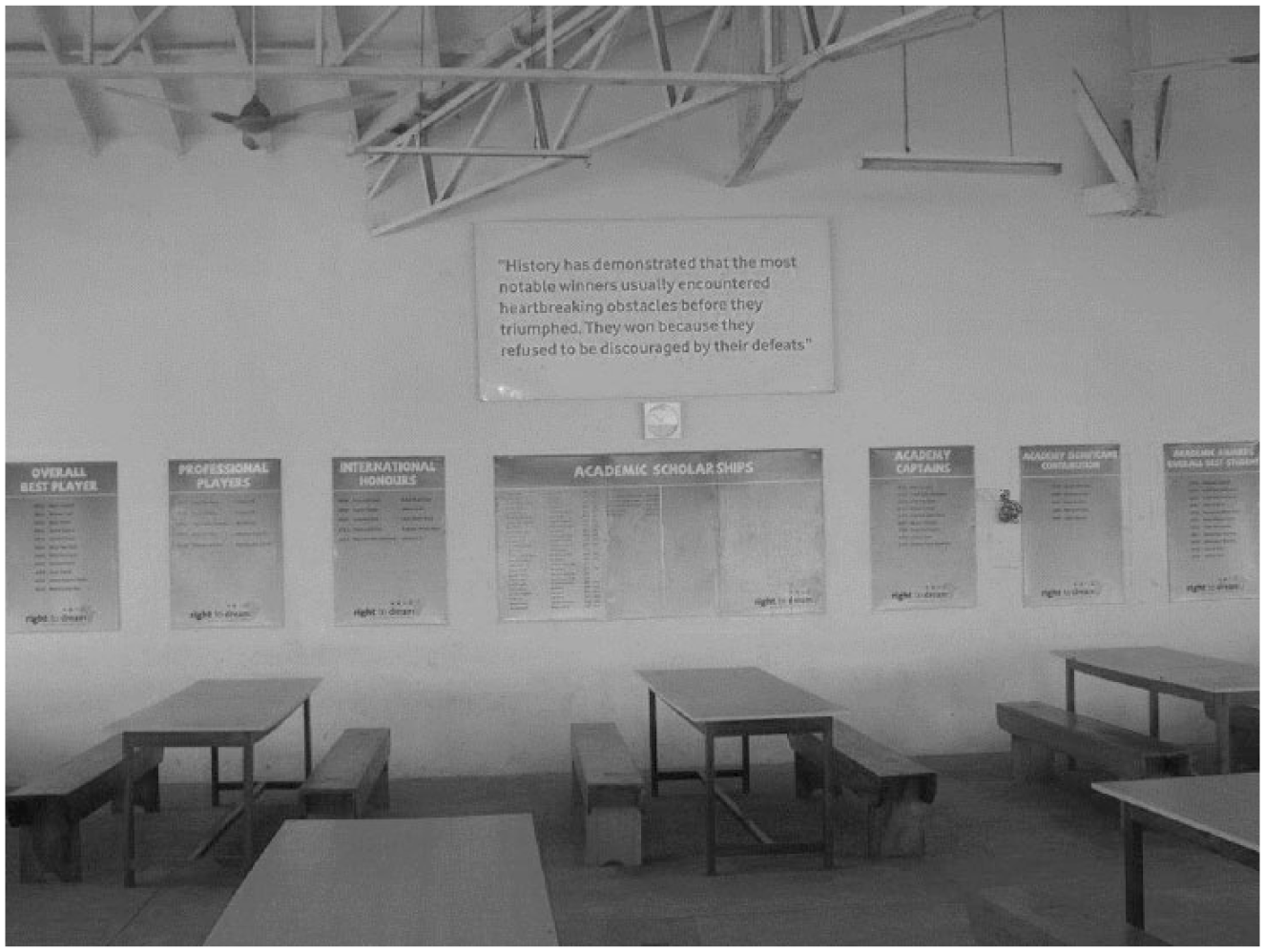
The open-air dining hall lined with mounted wallboards inscribed by student achievements in education and football.
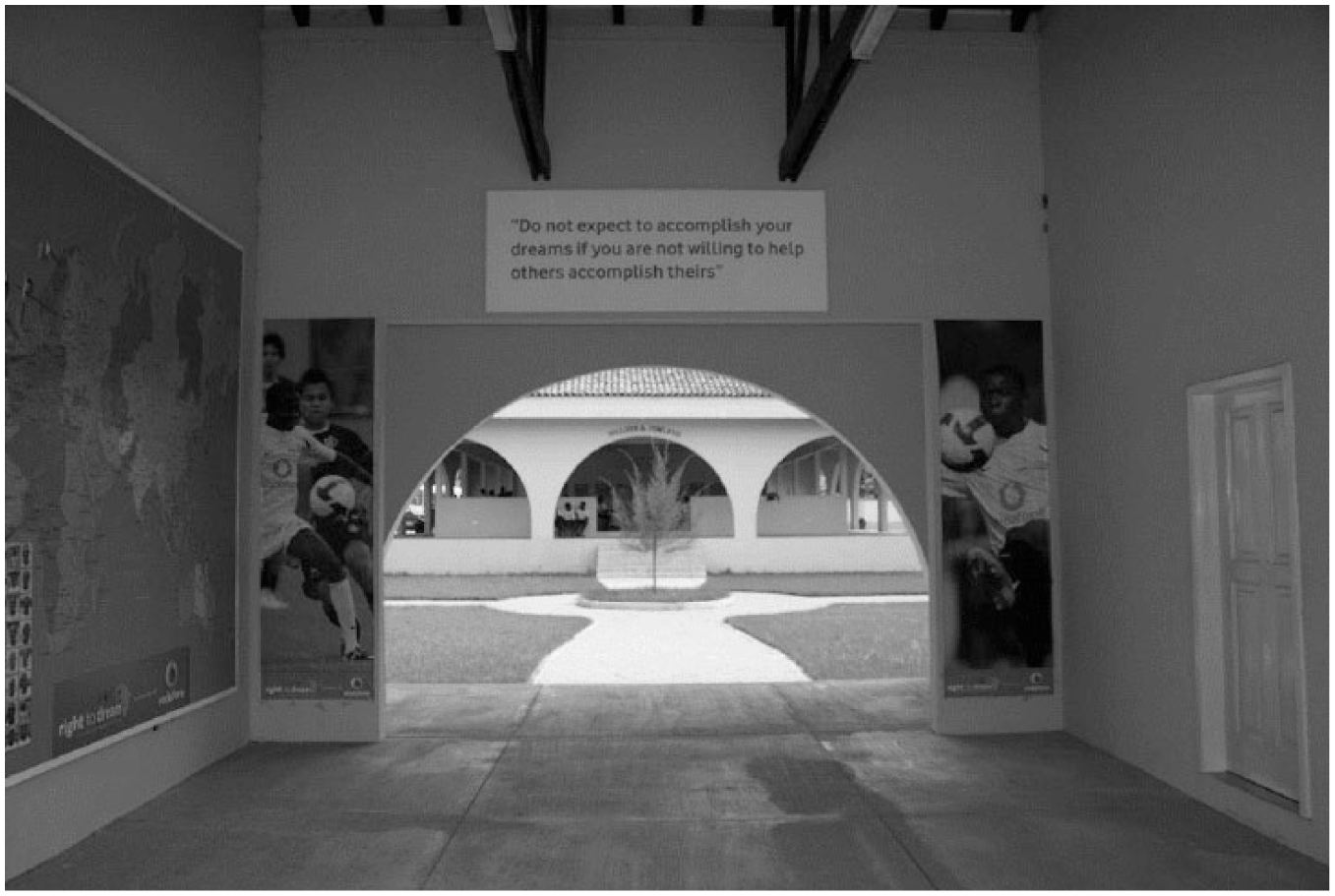
‘Do not expect to accomplish your dreams if you are not willing to help others accomplish theirs’ – the quotation which adorns the archway entrance to the Right to Dream Academy.
In the symbolic interactionist tradition (Goffman, 1983; Scott, 2011), daily rituals such as meal-times and evening study periods (Figure 3) also serve as essential sites of peer socialization and surveillance – a time when young recruits could be heard rehearsing the tacit codes of Academy culture as they exchanged stories of individual progress, and collectively reaffirmed their peculiar bond as part ‘surrogate family’ (Wulff, 1995), part ‘virile fraternity’ (Wacquant, 2004: 15). Beyond that, the quotidian rhythm of life at Right to Dream was also punctuated by the heightened dramaturgy of ‘institutional ceremonies’ (Goffman, 1961: 89), none of which ranked more symbolic than Monday morning assembly: Lined across tiered benches in the open-air dining hall, the cohort fell into a hushed silence as the Head of School entered. As always, an overview of graduate achievements overseas opened proceedings, including a celebratory toast to the latest graduate to secure a university scholarship in North America. An upsurge of clapping marked the moment among the Academy cohort, whose deeply visceral, shared elation at the success of one of their own was palpable. Moments later, this emotive energy was amplified ten-fold as the cohort united in an impassioned rendition of the academy song – its lyrics suffused with affecting notes on the valour of Africa’s youth, and their moral mission as ‘future’ leaders:
Arise the youth of Right to Dream
The nation cries for us
Arise the future leaders
To serve our motherland
We shall use our hands to write and work
We shall use our legs to run and play
We shall fight and sweat for victory
In the name of Right to Dream (Fieldnotes, March 2012)
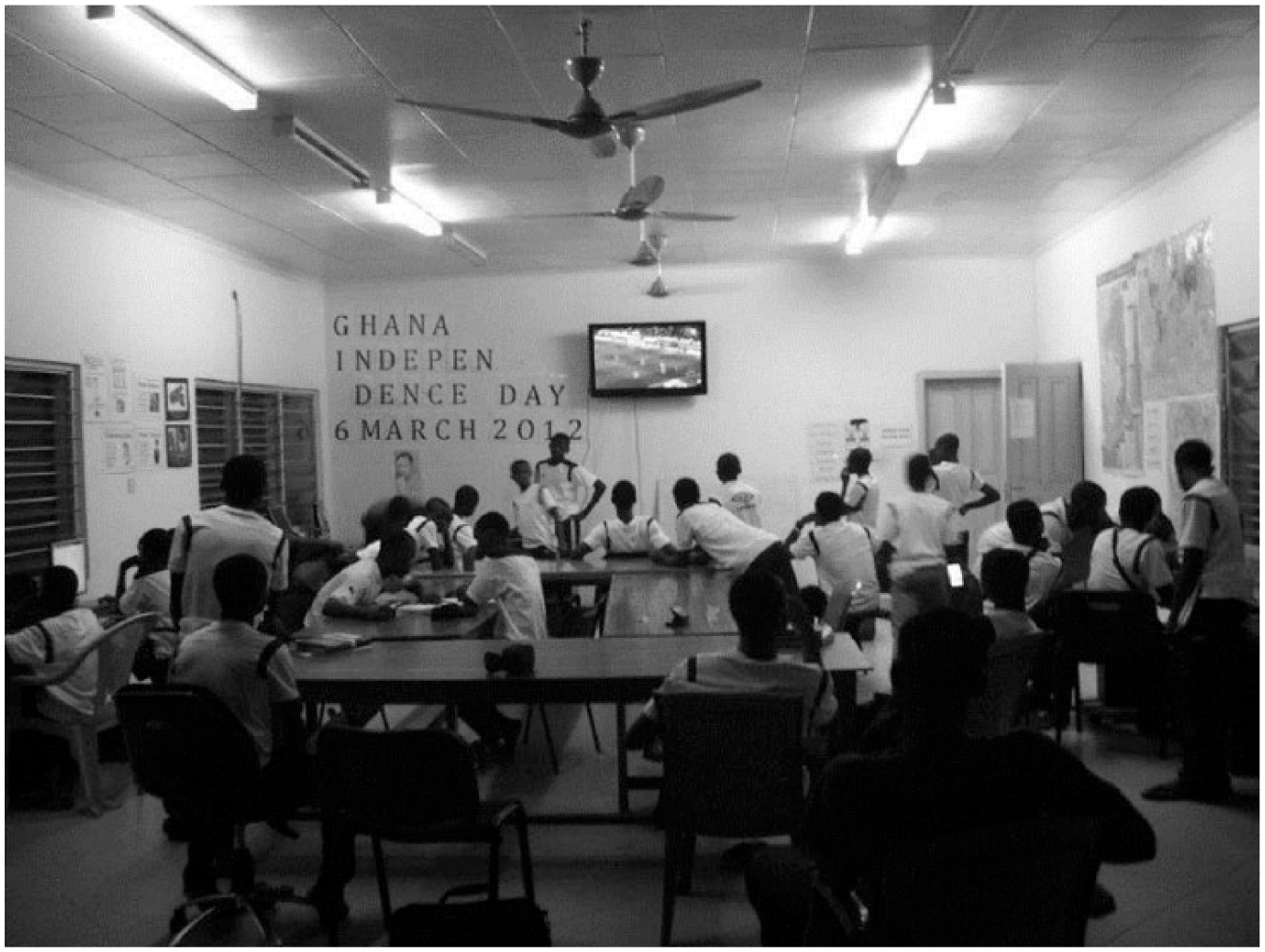
Evening study period in the Obama library at the Right to Dream Academy.
More than routinized gestures of institutional conformity, these dramatic performances play a powerful role in generating ecstatic experiences of self-renewal, and of conveying how the social character of morality is cultivated, enacted and regulated in and through the interaction order. Through a language that replicates the valorized labour of national service, duty and honour, to ‘act morally’ is – à la Durkheim (1961/1925: 79) – ‘to act in terms of the collective interest’, to subordinate one’s egoistic impulses in favour of collective cooperation and to arise reinvented as a ‘future leader’ of country and continent. Uniquely, however, this moral vocabulary of motive is also formally rooted in what Right to Dream define as the seven ‘key character traits’ – self-discipline, passion, initiative, integrity, social intelligence, winning and giving back. As the ‘building blocks’ to the ‘daily pursuit of excellence’, each form part of a predictable frame of reasoning among the Academy cohort, with weekly classes deemed essential to the holistic resocialization of young recruits as would-be ‘role models’ capable of ‘positively influencing the lives of those around them’.
Progress here, it follows, is not defined by ‘doing conformity’, nor is it inextricably bound to performance-related metrics such as exam grades or goals scored. Rather, much like Wacquant (1998: 346) observed of the ‘practical, enacted ethics’ which upheld the ‘sphere of recognition’ in a Chicago boxing club, the ideal-type academy recruit is initially distinguished by his total commitment to an institutional curriculum of pedagogic codes, character traits and moral principles – all of which must in time coalesce in a progressively habitual, self-surveillant ‘growth mindset’. From the training field to the classroom, he must become ‘his own arena of challenge’ (Wacquant, 2004: 15), with the quotidian labour of school-work, fitness-work and foot-work collectively woven into a long-term project of self-reconditioning. In annual awards for ‘best overall player’, ‘highest academic achievement’ and the ultimate honour of being named as Academy captain, only the chosen few receive formal recognition of their elevated rank – their character heroized not purely for its commitment to the craft, but to the ‘cries’ of the nation and the call to ‘serve’ in the remaking of African futures. Viewed in such terms, these young recruits can thus be said to reveal in actu how we learn morality in and through the material entailments of institutional life, and by remoulding the self in accordance with the moral authority of the conscience collective.
Unlike the passive ideal of Durkheim’s moral self, however, the unfolding trajectories of Adama and his peers also exhibited a purposive agency – a ‘social shape shifting’ (Shaw, 2014: 320) – in negotiating the ever-fluctuating horizon of opportunity at Right to Dream, and its much-coveted pathways out of Africa.
Futures Unforeseen
In August 2015, after just three years at the Right to Dream Academy, Adama boarded a transatlantic flight destined to begin an exciting new chapter in his young life. Just weeks prior, at an emotionally charged graduation ceremony, he was announced as the latest recipient of an educational scholarship to study at a prestigious college on the East Coast of North America. While still shy of his 16th birthday, Adama’s award came as little surprise at Right to Dream, where his striking maturity and intellectual curiosity had long since earned him a glowing reputation among students and staff alike. Read from a distance, however, the news sparked memories of a conversation we had shared years earlier in March 2012, when Adama – speaking fluent English just months after his ‘difficult’ arrival from Burkina Faso – voiced his hopes for the future: The only thing I wanted to do in my life, and I am still young, is to play football. For all of us here we want to be a professional but I don’t know if that can happen… At school, I have seen that I like to learn, and I know that God can help me to get better. I can learn something about life, about society, and science is now more interesting! My mother told me that there are many small boys who are playing football so I should look at every one of them before I stop my schooling… because they are all praying to God that they can be the one to be a professional.
Like Adama, the early biographies of most young recruits indexed little tangible connection to the linear track of education. When asked to describe the localized perception of Right to Dream, recruits instead directed conversation towards the gendered import of football as a vehicle of social mobility, even transcendence, for male youth across West Africa (McGee, 2012). Moreover, in spite of the Academy’s notably western, secular ontology, young recruits typically articulated their entry and progress therein as a matter of God’s will, often invoking wider Pentecostal discourses which emphasize one’s divine path to moral and material salvation (Freeman, 2012). Such sentiments were apparent in a conversation with another young recruit, Ibrahim, who – having already declared his faith in ‘what God wants’ – went as far as to express fear at the prospect of being channelled towards an educational pathway: ‘If I do well in school, I am afraid that they will bring me to university, because I want to be a professional footballer. So sometimes something is telling me that I should not work so hard in school.’ Fast-forward to December 2015, and Ibrahim had also departed Right to Dream as the much-celebrated recipient of an educational scholarship to a North American high school.
Taken together, the unanticipated scholarly trajectories of Adama and Ibrahim might be said to embody Right to Dream’s reformatory ethos. Certainly, their much-revised outlook on education could be read as a noteworthy commendation of its institutional capacity to ‘nurture’ and ‘restore’ African youth towards a morally agreeable future-track. That said, however, to privilege the identity-fixing mechanics of Right to Dream would be to risk reifying the passive typecasting of youth, much as it would be to flatten out the complex politics of youth engagement with NGO interventions at large (Piot, 2010). Amidst the radical uncertainty of neoliberal, ‘structurally adjusted’ West Africa, young people have long practised a ‘judicious opportunism’ (Johnson-Hanks, 2005) in their active reshaping of identity and ambitions to align with international NGOs, particularly those – like Right to Dream – who possess the institutional power to reroute individual biographies towards mobility and material prosperity beyond African borders (Shaw, 2014). Under such an optic, the ‘shape shifting’ trajectories of Adama and Ibrahim – both of whom spoke candidly about negotiating the rivalry of peer group competition and their relative prospects of ‘making it’ via the sporting or scholarly pathways – might be seen as a pragmatic yet purposive attempt to gain greater self-determination over the material returns of their much-espoused ‘right’ to dream.
These stories also laid bare the unequal encounter through which Right to Dream and its young recruits each sought to achieve a desired future through the other. Much more than a ‘forcing house’ (Goffman, 1961) for producing sporting or scholarly talent, let us not forget, Right to Dream affords hope only to those, like Adama, who are willing to assume a life-long responsibility to ‘inspire, create and lead positive change’ across Africa. Beyond that, however, such a politics of future-making ultimately hinges on the rerouting of individual biographies away from localized attachments to family, community and place at the same time as it declares them accountable for addressing long-standing crises of development therein.
What impact, we must ask, will Adama’s effective withdrawal from the cultural commons of African life at 12 years old have on his inclination as a role model for future generations? After all, Adama’s initial presence – much less his remarkable progress – at Right to Dream is a striking commendation of his individual ability to outperform the tens of thousands of youth who attended trials across West Africa, while his subsequent achievement therein served only to reward his singular commitment to a ‘growth-mindset’. That Adama then departed the Academy to join a growing pool of internationally mobile Academy graduates who have attained work, wealth and respectability in the African-American diaspora surely extends this progressive dislocation from community and continent. A ‘homecoming’ lunch for one returning graduate, Kofi, offered scant evidence to the contrary: The dining hall was a hive of activity this morning. Taking a seat next to me was Kofi, a first-generation academy graduate, now in his early twenties, who was soon to earn his undergraduate degree. In his notably Americanized accent, Kofi described the shock of adapting to the alien food culture and his ‘new family over there’ – a reference to the satellite family who served as his guardians when he arrived as a teenager to begin high school. Most intriguing, however, amid the sheltered uniformity of the Academy, was Kofi’s admitted passion for fashion, and his upcoming summer internship at a fashion outlet in New York. Indeed, as Kofi goes on to describe a life-world that is now thoroughly anchored in the cultural throes of contemporary America, I struggle to imagine him at the same age as the current generation. Taken together, the absence of any detectible Ghanaian lilt, the street-wise swagger and the polished repertoire of African-American cultural idioms create a sense of dislocation from the younger Academy recruits. Unexpectedly, Kofi confirmed as much in the moments that followed as I inquired as to whether he had any plans to return to Ghana: ‘maybe one day… but I’m pretty happy over there. I’ve been there for some time now so I don’t know. We’ll see what happens… where I meet a girl, that’ll be the issue!’, he exclaimed as laughter broke out around the table. (Fieldnotes, May 2012)
Between the fictional youth enshrined in the moral mission of Right to Dream and the unfolding trajectories of Kofi, Adama and their peers lies a politics of futures unforeseen. Much less the abstracted custodians of a redemptive liberal Africa, Kofi speaks to the temporal and spatial limits of a morality worn down by years of cultural dislocation, teenage adaptation and material abundance in contemporary America. Far from a betrayal of the conscience collective, such conflicting sentiments are characteristic of a youth cohort who find themselves paradoxically wedged between ‘African reality and the Euro-American dream’ (Diouf, 2005: 231). For them, Right to Dream has always been a vehicle through which to instigate a material ‘break’ from the temporalities of crisis, and from the exclusionary politics of a postcolonial moment which offers limited means by which to achieve respectful adulthood (Honwana and De Boeck, 2005). That said, they understand the terms of their moral exchange vis-a-vis Right to Dream, and remain poised to serve as leaders elect in a more prosperous narrative of African futures. Until then, however, they want to safeguard their own inclusion – better yet, to reorganize the material terms of their incorporation – in this unfolding timeline. Only the onward flow of time will tell of the veritable impact of this experiment in ‘what can be done to the self’ (Goffman, 1961: 12) in the name of society.
Coda: On Postcolonial Futures
In concluding Nostalgia for the Future, Piot (2010: 160) reveals a ‘sober truth’ about the latest era of democratic development in postcolonial Africa. Taking aim at the ‘NGO fervor’ that fills the development landscape today, Piot (2010: 160) concludes that while signs of sustainable change – that is, ‘development that raises the living standards and advances the material life of communities’ – have been ‘negligible’, ‘dramatic shifts’ are underway in how social and political life is organized and reproduced. Almost a decade on, the ethnographic insights I have related here similarly foreshadow limited cause for optimism in this most recent ‘revolution’ of postcolonial African futures.
Above all, I urge a sense of caution in appraising the moral politics which conjoin the futures of children and youth with that of the nation, and which thereby seek to construct the development landscape as more democratic and localized than what came before. In Right to Dream, after all, we are confronted with a Western European NGO which stands socially and symbolically sequestered from the cultural commons of African life – cherry-picking only the most ‘talented’ youth as the purported fount of moral reform across the continent. Not only does this invert the political onto the personal in a way that outsources moral responsibility for African futures back onto its youth, but just as importantly, it does so while disrupting their personal ties to community, family and tradition. In thus extracting those deemed ‘worthy’ of development, and in rerouting youthful biographies towards market-driven opportunities for mobility, education and accumulation, this new breed of NGOs can be said to foster trans-local modes of belonging – the kind of which, in Right to Dream’s case, replace African cultural ties and the African parent with surrogate membership in the affluent echelons of a middle-class African diaspora. The sovereign prerogative here, it seems, is firmly anchored in a neoliberal politics of future-making – a politics which, in its relentless incentivizing of self-growth and entrepreneurialism, appears to prefigure social change as a by-product of individual transformation.
Scaling out further, however, the marked ascendance of such neoliberal discourse has not only accelerated the fetishization of market-based solutions to Africa’s development impasse, but done so in ways that depoliticize and contort the enduring dependency relations of earlier colonial regimes. Put plainly, more than a half-century on from independence, much of Sub-Saharan Africa remains a laboratory of sorts – its human and non-human life perpetually exposed to the experimental vagaries of a development project which has always been administered from above and from outside. From within, too, recent narratives of an ‘Africa rising’ – typically founded on fleeting capital gains from foreign financing and extractive industry – have masked neither the elite hijacking of the state for private accumulation, nor the neo-colonial and capitalist logics which have driven such rapacious enterprise (Comaroff and Comaroff, 2012). Paradoxically, then, as a product of this broader biopolitical ‘revolution’, the NGO-as-reinventive-institution can be said to both fight against and feed upon the endemic underdevelopment of the African postcolony – at the same time as it valorizes the unprocessed potential of its youth and constructs a redemptive liberal timeline of national futures, it further reifies the demonization of the ‘corrupt’ and ‘incapable’ African state as the anti-thesis to its own moral politics of future-making.
However one elects to politicize this latest era of grassroots hegemony, its profound biopolitical footprint remains evident. In a matter of decades, international NGOs have collectively refigured the moral politics of time and tradition for African communities, many of which are stripped of their next generation and left to adapt to newly transformative regimes of hope, morality and futurity. Equally uncertain are the long-term implications of such interventions on the ‘golden generation’ of youth whose assumed responsibility it is to realize the liberated timeline of Africa’s postcolonial futures. For now, however, early forecasts suggest that the veritable ‘drama’ of this development moment shall manifest not in the evacuated cultural commons inhabited by the collective African Other, but in the global mobility of a chosen few – their ‘true potential’ reinvented on African soil, but realized amidst the commercial spectacle of Europe’s elite football stadia and the late modern academe of North America.
Footnotes
Funding
This research received no specific grant from any funding agency in the public, commercial or not-for-profit sectors.
