



Abstract
The symbolic categorisation of social groups has become prominent in studies of social class. This article addresses a tension in this research regarding the relationship between different symbolic categories. We argue that the potential of moral categorisations to change or oppose the order of socioeconomic or cultural categorisations depends on whether moral categories are subordinate in a hierarchy or co-exist in a heterarchy of multiple symbolic categories. We explore the relationship between cultural, socioeconomic and moral categorisations by combining focus group and survey data among Danish citizens in a mixed-methods research design. Our study shows that moral categorisations are opposed but also subordinated to socioeconomic categorisations. Such categorisations therefore serve to legitimise rather than transform class inequality. This has important implications for understanding class relations in modern societies as well as for the study of symbolic categorisations, and it highlights the importance of studying the interrelationship between multiple symbolic categories.
Introduction
In recent years, class analysis has returned to sociological discussions, and strong theoretical and empirical contributions to the study of class have been made (Flemmen and Savage, 2017; Mckenzie, 2017; Savage, 2016; Savage et al., 2015). In these discussions, symbolic dimensions figure prominently, exploring how categorisations, hierarchisation and cultural processes of valuation and stigmatisation contribute to distributions of opportunities, resources and worth (Lamont, 2012; Lamont et al., 2014; Sachweh, 2012; Skeggs, 2015; Tyler, 2015).
However, there is a tension between approaches in this discussion. On the one hand, we have approaches seeing symbolic class struggles as socially structured and as contributing to the reproduction and legitimation of power, class and dominance (Jarness, 2017; Mckenzie, 2017; Skjøtt-Larsen, 2012; Tyler, 2015). On the other hand, we have approaches claiming that symbolic categorisations may transform social hierarchies and change relations of dominance and power across social groups. In particular, moral categorisations may be used to oppose or transform different forms of oppression, hierarchisation and stigmatisation (Lamont, 2012; Lamont et al., 2014, 2016). This tension suggests a need for further exploration of the intricate and interlinked symbolic processes of production, reproduction and transformation of class.
We argue that existing studies focus too much on isolated processes of categorisation and hierarchisation, which leads to a potential overestimation of the transformative potential of symbolic processes in general and moral categorisations in particular. Following this critique, we suggest examining in more detail how people themselves negotiate the relationship and order between different symbolic categories. Doing this, we integrate new approaches on the symbolic dimensions of class with traditional questions in class analysis focusing on power, dominance and the possible legitimation of inequality. To illustrate the relevance of our approach, we present a Danish study demonstrating that even though moral categories are often constructed in opposition to both economic and cultural categories, moral categories are still considered secondary and non-transformative.
Our contribution to the literature is threefold. First, we make a theoretical contribution to the study of social categorisation by suggesting the need for a more nuanced study of the intersection of symbolic categories. Second, we make an empirical contribution by demonstrating that even though moral categorisations in Denmark are made in opposition to the logic of socioeconomic and cultural categorisations, moral categorisations are constructed by people as having a subordinate value. Finally, we make a methodological contribution by suggesting the use of focus groups and survey data to the study of symbolic processes of categorisation and hierarchisation instead of the more common semi-structured interviews of individuals (Jarness, 2017; Jarness and Friedman, 2017; Lamont and Swidler, 2014; Skjøtt-Larsen, 2012).
The Tension between Existing Approaches
The symbolic categorisation of social groups can be defined as the ways in which people continuously construct and negotiate identities and belongings to groups, as well as how they reconstruct the existence of groups, categories, hierarchies and value by connecting to and distancing themselves from other people (Bourdieu, 1984; Lamont, 1992, 2000). Two approaches dominate the study of symbolic categorisation, namely Bourdieu’s approach to social and symbolic space (Bourdieu, 1984, 1985, 1996) and Michelle Lamont’s symbolic boundary approach (Lamont, 1992, 2000, 2012; Lamont and Molnár, 2002; Lamont et al., 2014, 2016). We follow Lamont by distinguishing between different types of categories: socioeconomic categories focusing on people’s income, possessions and occupations; cultural categories focusing on knowledge, taste and manners; and moral categories focusing on people’s values and ethics (Lamont, 1992). Additionally, we follow Bourdieu by expecting that categories can be constructed both as distinct groups with clear boundaries (us/them) and as blurrier hierarchical orderings (above/below) (Bourdieu, 1985).
There are, however, tensions between these two approaches. First, Lamont argues that the drawing of symbolic boundaries is a primary, although open-ended, causal process with regard to the production of inequality (Lamont et al., 2014), and she thus focuses on how symbolic processes produce social distributions of resources. Bourdieu, on the other hand, focuses more on how symbolic processes are constituted within and thus limited by social distributions themselves. This includes limitations in the structured distribution of symbolic capital as a resource that enables one to engage in symbolic processes.
Second, Lamont suggests reconsidering the primacy of socioeconomic symbolic categories – a primacy she considers inherent to traditional approaches such as Marxism, Rational Choice and Pierre Bourdieu’s theory. Lamont (1992, 2000; Lamont et al., 2016) insists on the ways in which, for example, moral categories provide alternative criteria of success and competing hierarchies of worth, which may also affect the distribution of resources. However, Bourdieu seems to assume the dominance of socioeconomic and cultural symbolic categories over moral categories, which, in addition, are considered to be compensatory strategies used only by people with no resources (Bourdieu, 1984; Lamont, 1992: 184–185).
In this way, the tension between the two approaches not only relates to the degree to which symbolic processes have causal primacy; it also relates to the degree to which especially moral categorisations work as reinforcement and legitimation of power structures and relations of dominance or have genuine transformative potential.
Many empirical studies have grown out of these two dominant approaches. Following the symbolic boundary approach, several studies have demonstrated the dynamic construction of different types of symbolic boundaries and their importance for identity formation as well as understandings of societal inequalities (for an overview see Pachucki et al., 2007). Following mainly the Bourdieusian approach, other studies have demonstrated how lifestyles and symbolic categories are structured homologously to distributions of resources, most importantly economic and cultural capital (Bennett et al., 2009; Prieur et al., 2008). Most recently, Lamont has explored how responses to stigmatisation can contribute to the transformation of group boundaries and the reproduction of inequality (Lamont et al., 2016). Here, the possibility of reproduction of power is clearly recognised, but the overall claim still remains ‘that micro struggles for gaining respect and recognition add up and are likely to have substantial impact on both de-stigmatisation and how groups coexist’ (Lamont et al., 2016: 282).
Only a few studies directly address how categories are related. One is Skarpenes and Sakslind, who claim that moral categories are the most salient feature of middle class identities in Norway, since egalitarianism there privileges moral categories over socioeconomic and cultural categories (Skarpenes, 2007; Skarpenes and Sakslind, 2010). However, Jarness (2017) and Skjøtt-Larsen (2012) demonstrate how the existence of moral categories works to reinforce rather than transcend cultural and socioeconomic categories, including in egalitarian societies such as Norway and Denmark.
The lack of studies explicitly focusing on the relations and possible intersection between different types of symbolic categories is problematic since it leaves us unable to assess the transformative potential of symbolic processes altogether – both in general and with respect to the specific issue of moral categorisation. It is possible that moral categorisations have genuine potential to counteract socioeconomic and cultural categories and disrupt existing power and class relations. However, if we study different categories in isolation and not how they are interlinked, we will not be able to answer this question.
The Conditioned Transformative Potential of Symbolic Categorisations
The two approaches also differ markedly in their understanding of how categories are interlinked. Lamont (2012: 202) suggests that different categories result in the construction of heterarchies as ‘multiple hierarchies of worth or systems of evaluation’. This idea draws on insights from theories on functional differentiation, regimes of worth and justification, and institutional logics, which all point out how modern society seems to establish subsystems with autonomous rules, norms and structures. Thus, heterarchisation underlines the expectation that people construct and negotiate distinct categories and hierarchies that they see as unrelated and of equal worth. Accordingly, the mere construction of a distinct set of categories will lead to a counteraction and potential transformation of other sets of categories.
In contrast, Bourdieu claims that even in societies dominated by a logic of functional differentiation, the production and reproduction of inequality can be seen not only as the internal struggles of different subsystems (fields) but also as the negotiation of value between subsystems (e.g. Bourdieu, 1996). Bourdieu argues that hierarchies between the different subsystems and homologies of hierarchies will most likely be established. In this way, hierarchisation points to processes in which people construct and negotiate links between different sets of categories and, for example, construct these as more or less important or valuable.
The balance between hierarchisation and heterarchisation is an empirical question. Theoretically, however, we argue that the transformative potential of symbolic processes of categorisation is higher when categories are constructed as heterarchies, whereas strong hierarchies between different sets of symbolic categories limit the transformative potential of the subordinated set of categories. The transformative potential of symbolic processes is therefore conditioned on the existing interrelationship between different sets of categories. If one set of categories dominates across social fields, the overall social status of groups in society as a whole will not be influenced by a potentially contrasting but subordinate set of categories.
To understand whether moral categorisation holds transformative potential (as suggested by Lamont) or works as reinforcement and legitimation of existing power relations (as suggested by Bourdieu), we need to study the relative salience and importance ascribed to different sets of symbolic categories that people construct, as Lamont (1992: 6) rightfully suggests. However, we also need to study how people themselves negotiate the internal order of these symbolic categories. To illustrate this, we present an empirical analysis of symbolic categories in Denmark. As a small, prosperous, homogenous, egalitarian and high-trust country (Dinesen and Sønderskov, 2012; Svendsen and Svendsen, 2016), we expect this to be a country where different types of categories can be given equal worth, and a high degree of heterarchisation could therefore strengthen the transformative potential of moral categorisations.
Data and Methods
Exploring symbolic processes of categorisation and the relationship between different sets of categories requires data that allow for in-depth interpretation of subjective and intersubjective meaning-making as well as data that allow for assessment of categorisations in some breadth. Following Lamont (1992, 2000), many studies choose individual, semi-structured interviews (Lamont and Swidler, 2014). However, there are some limits to this design. First, symbolic categorisations are not made by individuals in isolation. The use of focus groups allows us to go beyond individual perceptions to a study of how groups of individuals negotiate and collectively establish categories (Barbour, 2007; Morgan, 1997). Second, the study of the salience and the internal relationships of different symbolic categories may be quite sensitive to the specific wording of questions and the ways in which questions allow for contradictions and deliberations (Jarness and Friedman, 2017). Here, the use of exercises in focus groups allows for a phrasing of questions even more open-ended than in semi-structured interviews (Colucci, 2007), as well as for informal deliberations among participants that are difficult in a one-on-one interview setting. Nevertheless, both semi-structured interviews and focus groups entail limits with regard to statistical inference. Therefore, we combined focus group discussions with a survey among a representative sample of Danish voters, asking them to evaluate people from different social classes and describe these social classes in their own words through open-ended questions.
Focus Group Design
We conducted five focus group discussions, using group exercises to reduce the risk of forcing theoretical concepts or assumptions onto the discussion, to limit the risk of social desirability bias, and to allow for open deliberations and negotiations (Colucci, 2007). To begin discussions, the focus group participants were asked to draw Danish society as they saw it. We carefully avoided words such as ‘class’ or ‘power’, and we responded to insecurities by explaining that participants should think about people living in Denmark and how they could draw a picture of them. After agreeing on one or sometimes two drawings, groups were given short case stories, each presenting a fictive person. Participants where then asked to position these case stories in their drawing. Following this, we further explored categorisations and hierarchies by asking participants to discuss which types of people (including the fictive persons) they would like to invite to a party and which they could see as potential neighbours (the guide with questions and exercises, including case descriptions, is available in the online Appendix).
Case stories were designed strategically to facilitate different types of categorisations and possible negotiations of the relationship between categorisations. We combined several cues relevant for socioeconomic, cultural and moral categorisations with cues for traits such as gender and age. The idea was not to introduce a controlled variation of these different elements (as one would do in a vignette experiment); rather, it was to create ‘real-life’ people who could function as a point of departure for the discussion. In the analysis below, we only include discussions of two case stories, representing the two most ‘extreme’ cases. The first story is about Morten, a middle-aged, divorced father with a very high income. The second story is about Maja, a middle-aged, married mother receiving sickness benefits because of a serious illness (see Appendix for full-length case stories). The multiple differences across these case stories, such as variation in marital status, may lead to moral categorisations unrelated to socioeconomic or cultural resources. However, the main purpose of this study and design is to investigate how the mixture of various characteristics influences overall evaluations of people and how categories possibly intersect. Therefore, we deliberately described ‘Morten’ as divorced, arguing that if moral categorisation has the potential to transform social positioning, ‘Morten’ is a more likely case to show this. Moreover, here we take advantage of our mixed-methods design, since – as described below – respondents to the survey only learn about the class positions of the people they are asked to describe, hereby holding all other factors constant.
To facilitate productive discussions, focus group participants with similar socioeconomic and cultural backgrounds but varying age and gender were recruited (Morgan, 1997). This follows a Bourdieusian understanding of social space and classes as constituted by both economic and cultural capital (Bourdieu, 1984). Some participants were recruited from a previous survey, some were recruited based on a new random sampling of telephone numbers, and one group (working class) was recruited using a consulting agency with a large panel of respondents (see Appendix for details on the five groups; see also Harrits and Pedersen, 2018). Whatever the source, participants were selected based on information about their education, income and occupation as a proxy for their class position in the Danish social space as developed in previous analyses (e.g. Harrits, 2013). For practical purposes, we recruited participants in Aarhus, Denmark and neighbouring smaller cities. As can be seen in the Appendix, the recruitment procedure resulted in fairly homogenous groups with respect to both cultural and economic resources, although the group we label working class is somewhat heterogeneous with respect to economic resources.
The focus group discussions were conducted in February and March 2015 and lasted two hours. They were audio and video recorded and transcribed verbatim by two student assistants. Focus group data were systematically coded focusing on categorisations as well as hierarchisation and heterarchisation.
Survey Design
Respondents for the survey were sampled from the Danish Civil Registration System and interviewed from May to July 2015. In total, 1227 Danish citizens above the age of 18 returned the questionnaire (response rate 51%). Variation between the sample and the population in terms of age, gender and place of living is very limited.
We used two sets of questions. First, we used open-ended questions where respondents were asked to describe different socioeconomic classes in their own words. The questions read: ‘When you hear someone described as “working class” [“middle class”] [“upper class”], what sort of person do you think of? Please describe the person.’ With this open-ended question, we can evaluate how frequently different categories are mentioned when people from different socioeconomic classes are described.
Answers to the open-ended questions were coded by student coders using an overall coding framework related to categories of class, income, education and employment. If the statement was not related to one of these categories, they added codes to the framework. These open codes were categorised and condensed, leading to a final coding framework that also included codes related to personality, lifestyle, family background, political engagement, vulnerability, hierarchy and an ‘other’ category. Each description given by a respondent could be ascribed up to four codes. We use each of these codes as units of analysis and reshape the dataset so that respondents appear four times (once for each description code).
Second, we used a set of questions developed to measure dimensions of stereotyping (Fiske et al., 2002). Here, we are not directly interested in stereotyping, but the questions related to the dimension of warmth fit our definition of moral categories focusing on qualities such as honesty, work ethic, personal integrity and consideration for others. By using these questions, we obtain a direct comparison of socioeconomic classes and ascription of moral qualities. However, we also risk forcing logics of categorisation upon the respondents. This is exactly why we utilise a mixed-methods design where the more explorative research setting of the focus groups informs us whether and to what extent these categorisation processes take place. The questions in the survey read: ‘How caring/sympathetic/kind does society generally find people from the working/middle/upper class?’ Principal component factor analyses including the three items related to each social class reveal one factor with an eigenvalue above 1 and loadings above 0.6 for all items. We construct three additive indices that only include the respondents who provided answers to all questions relevant for each social class. The indices potentially range from three (low warmth evaluation) to 15 (high warmth evaluation). It should be noted that respondents were asked how people in general evaluate social classes. This formulation is used to reduce social desirability concerns (Fiske et al., 2002: 884–885) and to tap the collective cultural process of categorisation.
Overall Salience and Relationship of Symbolic Categories
The first step of the analysis is to establish how different types of categories are related in terms of salience and logic. As explained above, we focus on socioeconomic, cultural and moral categories. For a rough understanding, Tables 1 and 2 show the frequency with which the different categories are used. Table 1 is based on focus group discussions and shows that participants tend to use socioeconomic categories to describe society more often than cultural and moral categories, although these categories are definitely also present in the data. Table 2 is based on the open-ended survey questions and shows a similar pattern. In the survey, each statement could be assigned up to four codes, as explained above. In total, 6206 associations were coded. Among these, references to socioeconomic categories (income, job, social class position) constitute the major part (63%). In contrast, about one-quarter of the associations are related to cultural categories, and only 8% are related to moral categories. In the survey data, the absolute levels may be inflated by making respondents think of people in terms of class, which may be especially associated with socioeconomic categories, but the ranking is so evident and the patterns so similar across the two types of data that we find it reasonable to conclude that socioeconomic categories carry more weight relative to cultural and moral categories (Harrits and Pedersen, 2018).
Categorisations made in focus groups.
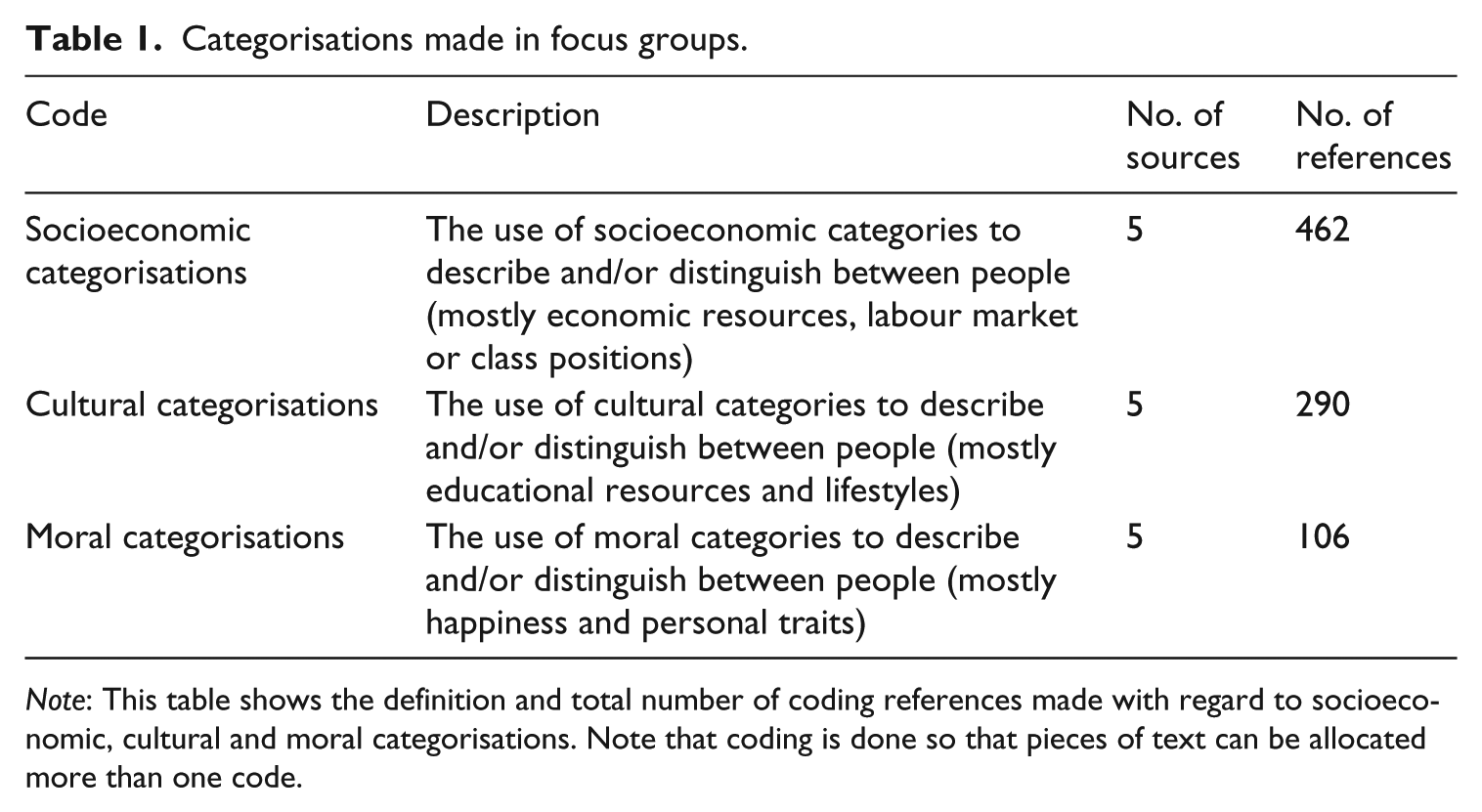
Note: This table shows the definition and total number of coding references made with regard to socioeconomic, cultural and moral categorisations. Note that coding is done so that pieces of text can be allocated more than one code.
Class associations in open-ended survey questions.
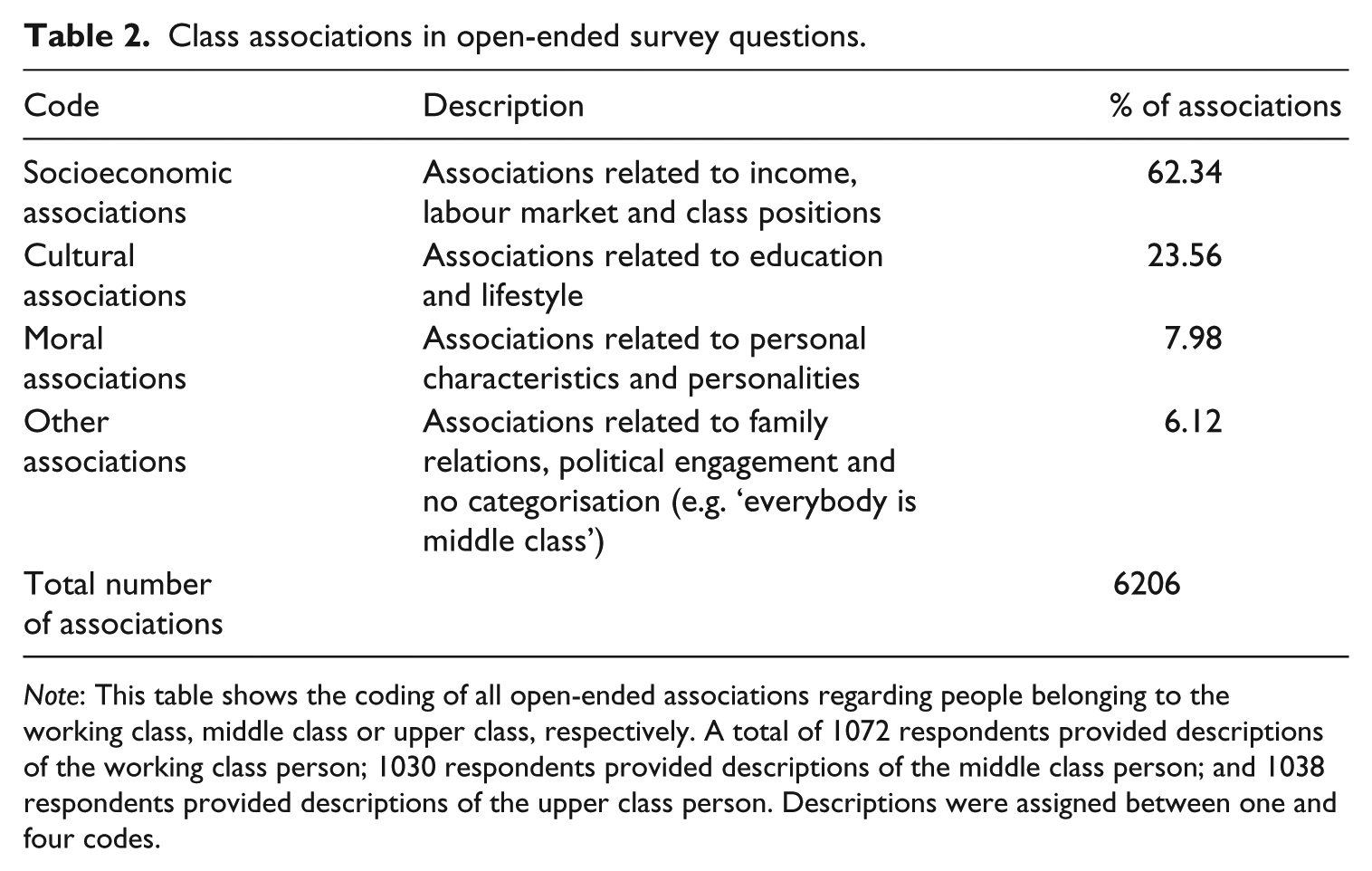
Note: This table shows the coding of all open-ended associations regarding people belonging to the working class, middle class or upper class, respectively. A total of 1072 respondents provided descriptions of the working class person; 1030 respondents provided descriptions of the middle class person; and 1038 respondents provided descriptions of the upper class person. Descriptions were assigned between one and four codes.
The qualitative and quantitative analyses also suggest that the categories do not follow the same logic. In particular, the moral categories suggest an alternative order or hierarchy compared to the hierarchy established by socioeconomic categories.
Table 3 shows this contrasting order based on the survey data. 1 It shows that the mean value of warmth drops as we move up the socioeconomic ladder. On average, the working class person is assigned a mean value of 10.01, while an upper class person scores significantly lower with a mean value of 7.68. Further, Table 3 shows the extent to which this differential evaluation of warmth appears when comparing across different groups of respondents. The last three columns of Table 3 show that only respondents placing themselves in the working/lower middle class adhere to a reverse hierarchy of moral evaluation. Respondents placing themselves in the middle or upper middle class find middle class people to be perceived as equally or even more warm than working class people. However, independently of class placement, respondents agree that upper class people are perceived as the least warm. When comparing (horizontally) across respondents, it appears that respondents who place themselves in the working/lower middle class are significantly more positive towards the working class but less positive towards the middle class. However, there are no statistically significant differences in how different groups of respondents evaluate the perception of upper class people in terms of warmth.
Mean (and Standard Deviations) of evaluations of warmth across socioeconomic classes (survey data).
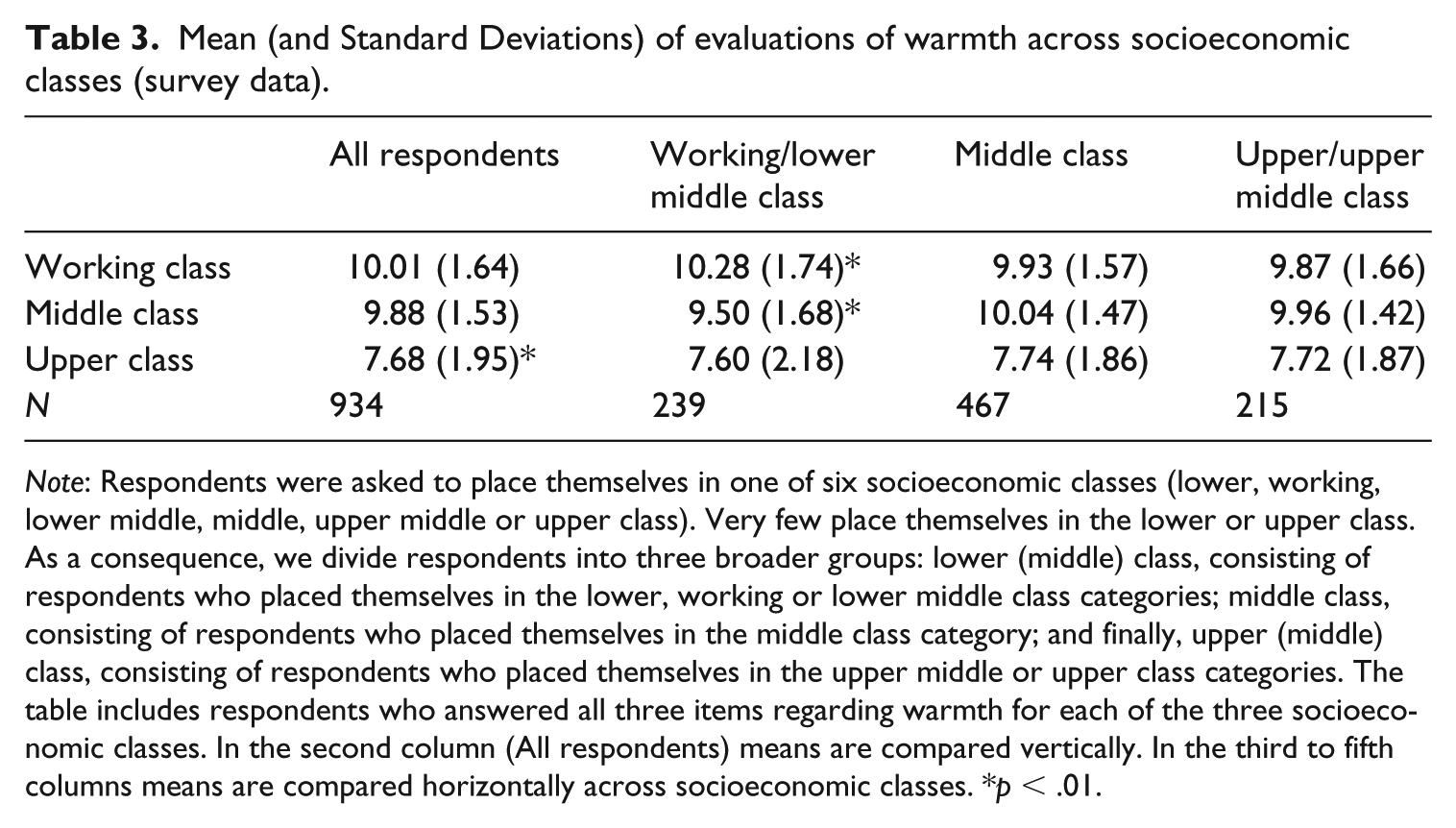
Note: Respondents were asked to place themselves in one of six socioeconomic classes (lower, working, lower middle, middle, upper middle or upper class). Very few place themselves in the lower or upper class. As a consequence, we divide respondents into three broader groups: lower (middle) class, consisting of respondents who placed themselves in the lower, working or lower middle class categories; middle class, consisting of respondents who placed themselves in the middle class category; and finally, upper (middle) class, consisting of respondents who placed themselves in the upper middle or upper class categories. The table includes respondents who answered all three items regarding warmth for each of the three socioeconomic classes. In the second column (All respondents) means are compared vertically. In the third to fifth columns means are compared horizontally across socioeconomic classes. *p < .01.
The focus group discussions revealed the same contrasting order of moral categorisation. This is especially evident when participants distance themselves from rich people, which suggests that the logic of socioeconomic categories opposes the logic of moral categories. Several of the focus groups discussed how they would not like to move to a very rich or privileged neighbourhood and how children from privileged backgrounds are often spoiled and selfish: If you think about the top of society with a lot of money and material possessions: they work a lot. Then they have spoiled children who do not get any attention from their parents, and they may then start to act out. So one could imagine a big, expensive school in a nice, expensive neighbourhood where all the children are bullying each other, because they are only used to taking care of their own needs. I would not want my children in a school like that. (FG Students)
The same contrast appears in the discussions of the two case stories representing two rather distinct socioeconomic positions; that is, the stories of Maja and Morten. Table 4 summarises an interpretive analysis of the discussions of the case stories and the ways in which the case stories are positioned by each group. As can be seen, there is a high degree of consensus when it comes to the overall social positioning of the case stories. Morten is described by all focus groups as belonging to the upper class, and Maja is described as lower (middle) class. However, discussions of the two case stories also revealed strong moral categorisations and seemed to quickly establish consensus among most participants. A few people suggested that Morten was interesting, responsible and courageous. However, in all focus groups, strongly negative evaluations were made regarding the likelihood that he was uncaring, selfish and boastful. In comparison, all focus groups attributed the most positive moral characterisations to Maja. Many positive statements were made about her; for instance, that she is most likely a very caring mother, not only for her own children but also for other people’s children. She was also described as a ‘fighter’ despite her tough conditions, with ‘smiles through the tears’ (FG Lower middle class). 2
Evaluation of case stories, focus groups.

Note: See Appendix for the wording of case stories on Morten and Maja.
Taken together, the analyses suggest that moral categories carry a logic opposite to that of socioeconomic categories in particular but possibly also cultural categories. However, as we find fewer references to cultural categories altogether, the opposition between moral categories and socioeconomic categories stands out most clearly in the data. Additionally, although we do find some scepticism towards lower/working classes – our survey data reveal that this is most prevalent among people who are outside of this class – we mostly find that people (especially from lower socioeconomic classes) try to establish a competing hierarchy of moral worth.
Thus far, our analyses support Lamont’s idea that different categories are constructed which include different logics of worth and that moral categorisations, with their opposition to the socioeconomic order, may therefore hold transformative potential. However, this conclusion is not supported when we take a closer look at how people negotiate the relationship between the different categories and hierarchies.
Negotiating Relationships between Categories and Hierarchies
The focus group discussions facilitated an analysis focusing on how participants negotiated the relationship between different categories; that is, whether or not they saw categories as coexisting and equally important (heterarchy) or as having some form of internal hierarchical order of super- and sub-ordination (hierarchy).
As can be seen from Table 5, we find examples of the construction of both heterarchies and hierarchies between categories, with references to hierarchies predominating.
Relations between symbolic categories as established by focus groups.
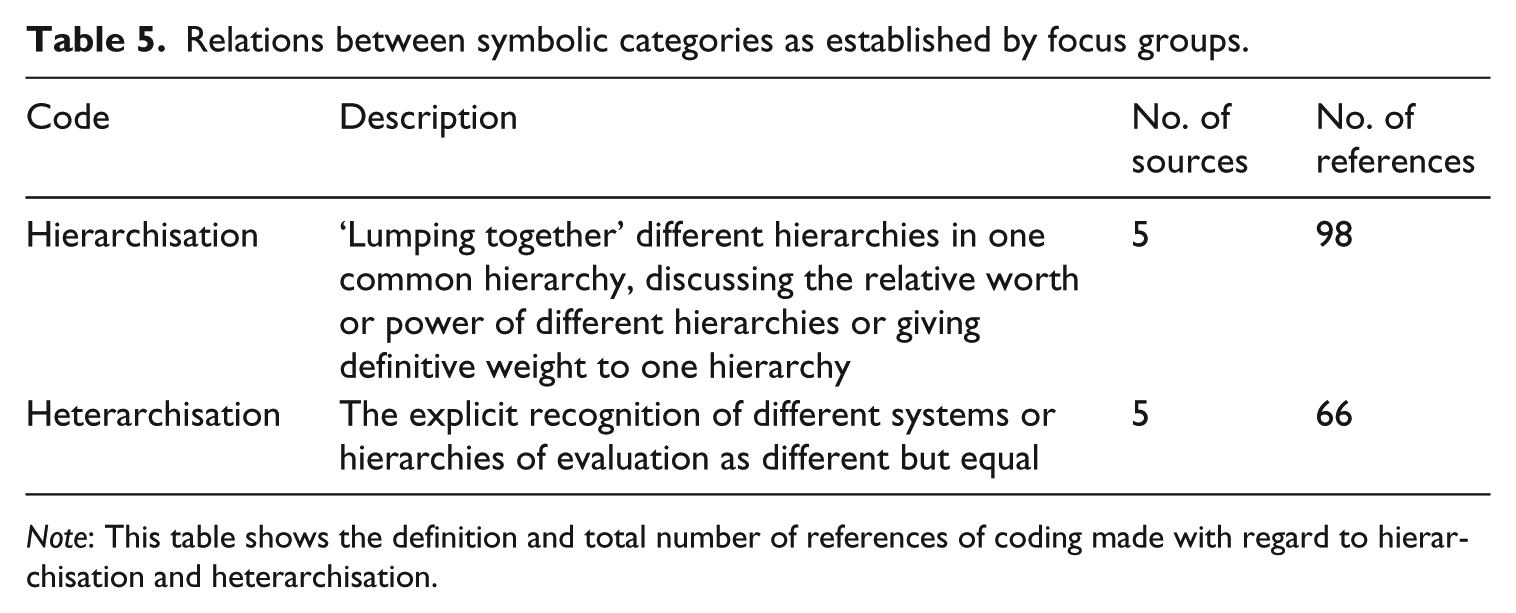
Note: This table shows the definition and total number of references of coding made with regard to hierarchisation and heterarchisation.
In many instances, we find that focus groups establish an overall societal hierarchy consisting of different types of categories but with the clear dominance of one, typically socioeconomic, category: Because we all know that as a group, we have a totally unequal distribution regarding a lot of factors in life, be it financial standing, health, housing, income, average lifespan. (FG Upper middle class) And maybe they [different categories] weave into each other. So something very important is financial standing (FG Middle class) It’s also interesting that research shows that if you are in the higher economic layers and the well-educated layers, then you also basically have better health. (FG Lower middle class)
As these quotations illustrate, there is wide agreement on the existence of multiple categories of people and multiple hierarchies in society, but there is also an agreement that these hierarchies relate to each other in a specific way, typically with socioeconomic categories and hierarchies as dominant.
In the discussion of the two case stories, we find the same kind of lumping together of hierarchies and the dominance of the socioeconomic hierarchy. As evident in Table 4, there was a widespread consensus on the positioning of the two case stories in an overall societal hierarchy – a consensus that also included the other case stories not discussed here. In all focus groups, however, negotiations were made between participants (sometimes arguing aloud with themselves) on the relative positioning in what is best described as a multidimensional hierarchy where different dimensions can be more or less easily added together. Despite the strong moral categorisations made in each of the case stories, the stories were finally positioned and categorised with regard to economic and cultural resources, with economic resources having the most weight: Which of those two has more status? [Morten and Maja] Well, that is what we’re all being measured on, right? And it is quite clear that society points towards Morten. We do it ourselves […] Yes, we do it ourselves. Well, I don’t know. I just put them into boxes […] But is it economic boxes? Economic, occupation and so on. But we did it sort of the same way without having agreed upon it beforehand [Broad agreement around the table]. (FG Middle class)
This hierarchisation across categories is only disrupted in relatively isolated instances of explicit construction of heterarchies, which we also find across all groups, although it is somewhat less significant in the working class group. In these instances, participants argue that different categories and hierarchies work independently from each other. We especially find the argument that Danish society has ‘many tops’, meaning that it is possible to be valued and successful in many ways in Danish society: ‘We are talking about something [trying to draw the map of society] which is very multidimensional. Maybe you are upper class in one dimension, but that doesn’t mean you can’t be lower class in another dimension’ (FG Upper middle class). Heterarchies are also made by explicitly differentiating between socioeconomic and cultural hierarchies (which go together) on the one hand and moral hierarchies of happiness and human worth on the other. As explained above, this is particularly evident in the discussions of the case stories (Table 4), where the moral categorisations of the fictive persons are the inverse of this overall status hierarchy.
However, upon further analysis, it becomes apparent that moral categorisations – although opposing the logic of socioeconomic categorisations – are also seen as somewhat ineffective or subordinate by focus group participants. It is only in very few instances that moral categories are used to renegotiate positioning in other hierarchies or in the overall societal status hierarchy. In fact, the opposite is the case, since some participants express a ‘wish’ to position Morten lower in the overall status hierarchy because they disapprove of his values. However, they end up arguing that they have ‘no choice’ but to put him at the top of a societal hierarchy because of his economic and cultural resources: Well I actually put him a bit lower, but I moved him a little bit up, because in my own personal perspective, I think Morten is not necessarily doing that well, but that may be because my personal preferences are somewhat different. (FG Upper middle class)
Several participants also argue that ‘society’ will evaluate Morten very positively even though they themselves dislike him. To us, this indicates that although moral hierarchies represent an alternative to socioeconomic and cultural hierarchies, moral hierarchies are not effective in challenging society’s overall status hierarchy. In other words, moral categorisations often function as subordinate to (especially) socioeconomic categorisations.
This lack of effectiveness is supported by the ways in which focus groups put forward critiques of socioeconomic hierarchies but still find it easy to navigate within such hierarchies. This is present in all focus groups but especially vivid in the lower middle class group. Here, at one point in the discussion, one member sharply opposes the whole exercise of describing hierarchies, arguing that it is actually morally indefensible since no person is better than another. This basic egalitarian value quickly finds support in the group, and the group handles the disruption by establishing a very clear hierarchy of happiness that goes against the already established socioeconomic and cultural hierarchies. However, in the discussion that follows, the participants end up agreeing that the hierarchy of happiness is an ideal, whereas the socioeconomic and cultural hierarchies are how society ‘works’.
Furthermore, in a discussion of how to label different groups (given an exercise with categories typically used in surveys), the group ends up agreeing that as long as socioeconomic categories and hierarchies are kept exclusively and transparently economic, they are ‘morally neutral’: If it [the survey categories] was economic, then it would be better if it said that […] because it [upper class] is such a value-laden term. […] Then it would be very concrete. Well, that is also what is sometimes done in these surveys, then you look at it very prosaically, then you do not look at the ‘upper class’ but the ‘top 1%’ and so on. So there you categorise people in purely economic categories, and that makes a whole different kind of sense, because then it is not negatively laden. (FG Lower middle class)
This explicit distinction between the logic of moral categories and the logic of socioeconomic categories – with an explicit legitimation of inequality in socioeconomic categories – was less pronounced but nevertheless present in all focus groups. Across all groups, there was an explicit resistance against labelling social groups in a way that implied moral judgement (especially ‘lower’ class).
Unfortunately, we cannot explore this question using our survey data, and generalisations should therefore be made with caution. Still, the findings from the focus group discussions suggest that even though moral categories and hierarchies tend to contradict the order of the socioeconomic hierarchy, they do not change the fact that socioeconomic hierarchies are seen as constitutive of an overall status hierarchy. People with money and higher levels of education may be morally dubious, but they are still placed ‘highest’ in a social status hierarchy. Additionally, moral categorisations functioned as a legitimisation that allowed the focus group participants to rank people even though they liked to think that all people are equal. In other words, it seemed as if socioeconomic (and cultural) hierarchies could be described with a certain facticity (‘this is how society works’) at the same time as moral categories worked as a way for participants to deal with this. Thus, egalitarianism was demanded in the use of moral categories but not in the use of socioeconomic or cultural categories. Together, these results from the qualitative analyses support Bourdieu’s expectation that symbolic categories may be hierarchically linked and that the transformative potential of moral categorisations may therefore be seriously limited.
Conclusion
Throughout this article, we have argued that the transformative potential of moral categorisations in relation to social hierarchies depends on the relationship between different symbolic categories and therefore highlighted the need for studying multiple categorisations and how they stand in relation to each other (in a heterarchy or hierarchy). Specifically, we have suggested studying how people themselves construct and relate social categories and hereby explore the tension within the literature. As an illustration, we presented a study of Danish symbolic categorisations, drawing on both focus groups and survey data.
We found that socioeconomic categories are more prevalent than both cultural and moral categories. Further, we found that the logic of moral categorisations contradicts the logic of socioeconomic categorisations in particular. Rich people are placed highly on the socioeconomic dimension but are also ascribed less positive moral value, and sometimes are judged rather harshly. However, when we explored how people link different sets of categories, we found that the impact of this competing moral logic on overall status positioning is limited. The ‘selfish’ upper class man in our study was still ‘up’ rather than ‘down’ in the social order. Thus, even though moral categorisations are seemingly drawn to challenge the social order, they seem to carry a legitimising rather than a competing function since they allow an opportunity to negotiate inequalities without actually being critical of these distributions. For instance, this was the case with the ‘caring’ lower class woman in our study; she was held to be happy and kind even though she was poor.
In this way, our finding provides more support for Bourdieu’s claim that even though different systems, fields or orders of worth will develop, they tend to be homologous and ordered hierarchically rather than establishing a heterarchy of multiple and equally important orders of worth, as suggested by Lamont. In the context of egalitarian societies, our findings are more in line with the conclusions of Jarness (2017) and Skjøtt-Larsen (2012) than those of Skarpenes (2007) and Skarpenes and Sakslind (2010). Indeed, it is tempting to attribute the low level of inequality in Danish society to the ‘opposite’ logic of the moral categories found here. However, our findings suggest that this link may not be as strong as one might think. Like Jarness and Skjøtt-Larsen, we find that moral categorisations do not profoundly challenge the socioeconomic order of society; rather, they seem to legitimise economic and cultural inequality by establishing an alternative hierarchy on which lower socioeconomic groups can base their worth.
Regarding the generalisability of our results, additional studies are needed to understand how the interaction between multiple symbolic categorisations plays out in different contexts. We can think of two competing expectations. First, the transformative potential of moral categorisations may be even smaller in less egalitarian societies, where the evident socioeconomic inequalities make moral evaluation powerless in terms of transforming the social hierarchy. Second, it is also possible that intensified conflict due to socioeconomic inequalities makes moral evaluations more important to people with fewer resources. This could potentially increase the transformative potential of moral categorisations among a subset of people in less egalitarian societies. Future studies may reveal which expectation is more correct.
Regarding the methodological approach of our study, some of the differences between our conclusions and the work of Lamont may be caused by differences in methods and aim. We are especially interested in how multiple categorisations challenge or enforce each other in social processes of hierarchisation. We argue that scholars who share this interest benefit from a research design sensitive to the intersubjective and collective aspect of categorisation. Focus group discussions of vignette material are helpful in this regard and hold great potential for further investigations of social status and categorisation. Focus group discussions specifically enable us to move beyond self-categorisations and status legitimisation by asking participants to collectively evaluate (fictive) persons who are not present in the group. Participants are hereby encouraged to explicitly negotiate various categories and their relative importance. Hereby we are able to study how worth is assigned and defended in a social group and how categories of worth are negotiated against other symbolic categories. Combining such collective data with survey data including multiple dimensions of categorisation strengthens the external validity of our conclusions, and we strongly encourage similar mixed-methods designs in future studies. Most importantly, future methodological strategies in studies of symbolic class should be able to explore how people themselves use and negotiate the relationship between different symbolic categories, and how these negotiations may impact the ascription and distribution of value and resources.
Finally, our study underlines the importance of including symbolic and cultural dimensions, as has been done in the recent literature on social class. However, when studying these symbolic dimensions of class, one must remember that this does not mean diverting attention away from thinking of class as connected to distributions of material and economic resources and power. First, socioeconomic categories are a key part of symbolic class relations, and they seem to hold both a certain facticity and legitimacy. Second, our studies suggest that we need to be careful about separating symbolic and social relations too starkly, as they are interlinked in complex ways. Therefore, class must definitely be studied as both a social and a symbolic phenomenon. This suggests that studies of identity politics and politics of recognition should be integrated carefully with more traditional analyses of class relations and politics of redistribution.
Supplemental Material
826016_Online_Only_Appendix – Supplemental material for Symbolic Class Struggles and the Intersection of Socioeconomic, Cultural and Moral Categorisations
Supplemental material, 826016_Online_Only_Appendix for Symbolic Class Struggles and the Intersection of Socioeconomic, Cultural and Moral Categorisations by Gitte Sommer Harrits and Helene Helboe Pedersen in Sociology
Footnotes
Acknowledgements
We would like to thank Professor Rune Stubager and Assistant Professor Joshua Robison for making survey data available to us and for commenting on earlier versions of the manuscript. We would also like to thank the three anonymous reviewers for careful reading and challenging comments helping us to strengthen the manuscript.
Funding
The research in this article is conducted in relation to the PERSOS project, directed by Professor Rune Stubager and funded by the Independent Research Fund Denmark (DFF – 1327-00113).
Supplemental material
Supplemental material for this article is available online.
Notes

References
Supplementary Material
Please find the following supplemental material available below.
For Open Access articles published under a Creative Commons License, all supplemental material carries the same license as the article it is associated with.
For non-Open Access articles published, all supplemental material carries a non-exclusive license, and permission requests for re-use of supplemental material or any part of supplemental material shall be sent directly to the copyright owner as specified in the copyright notice associated with the article.
