



Abstract
Recessions appear to coincide with an increasingly stigmatising presentation of poverty in parts of the media. Previous research on the connection between high unemployment and media discourse has often relied on case studies of periods when stigmatising rhetoric about the poor was increasing. We build on earlier work on how economic context affects media representations of poverty by creating a unique dataset that measures how often stigmatising descriptions of the poor are used in five centrist and right-wing British newspapers between 1896 and 2000. Our results suggest stigmatising rhetoric about the poor increases when unemployment rises, except at the peak of very deep recessions (e.g. the 1930s and 1980s). This pattern is consistent with the idea that newspapers deploy deeply embedded Malthusian explanations for poverty when those ideas resonate with the economic context, and so this stigmatising rhetoric of recessions is likely to recur during future economic crises.
Introduction
The global financial crisis of 2008 seemed to coincide with a rise in stigmatising rhetoric about people in poverty and welfare recipients across a range of print and television media outlets (Harkins and Lugo-Ocando, 2016; Tyler, 2008, 2013). This language legitimised welfare retrenchment by ‘othering’ (Lister, 2015) people in poverty and representing them as part of an outgroup who were lazy, immoral and living fraudulently at the expense of hard-working taxpayers (Jensen, 2014). Anti-welfare narratives permeated public discourse over this period and in some cases even had a demonstrable impact on attitudes towards welfare recipients (Reeves and De Vries, 2016).
This latest crisis is one recent example of how parts of the media stigmatise the poor during periods of rising unemployment. A number of studies have argued that media rhetoric about the poor responds to macroeconomic conditions, becoming more stigmatising when times are hard (Golding and Middleton, 1982; Macnicol, 1987). However, the existing quantitative evidence linking economic crises and newspaper rhetoric about the poor remains limited. Existing work relies on time-consuming hand-coding (Gilens, 1996; Misra et al., 2003), which limits the ability of researchers to examine long-term trends in the language newspapers use to describe the poor. We know of no quantitative studies that investigate whether the prevalence of stigmatising language about the poor is affected by underlying economic conditions. 1 Case studies have generated crucial insights into how the print media frame poverty during economic downturns and periods of high unemployment but they have done so by examining precisely those periods in which stigmatising rhetoric increased. This logic of case selection may inadvertently overlook periods when, for example, unemployment rises but there is no change in stigmatising rhetoric (Deacon, 1976).
We address this gap in research on the link between economic crises and newspaper rhetoric about poverty by drawing on a unique dataset measuring how often five right-wing and centrist British newspapers and periodicals use stigmatising language about people in poverty throughout the 20th century (1896–2000). We find that stigmatising rhetoric about the poor becomes more common when unemployment increases, but this association weakens when unemployment rates are especially high (>10%), such as during the 1930s and the 1980s.
Outside these exceptional periods, we conclude that British centrist and right-wing newspapers deploy deeply embedded Malthusian anxieties about the behaviour of the poor when unemployment is rising. In doing so they draw on a powerful set of ideas to explain an economic phenomenon that by itself might threaten the hegemony of individualistic interpretations of unemployment and poverty. Adopting an historical perspective reveals how deeply embedded ideas, such as Malthusian explanations for poverty, are deployed when they resonate with the structural context. Media stigmatisation of the poor following the global financial crisis was consistent with how our sample of newspapers responded to changing economic conditions across the 20th century.
Recycling Malthus: Media Responses to High Unemployment in Historical Context
While the media reaction to the global financial crisis in the UK intensified anti-welfare rhetoric (Jensen, 2014; Jensen and Tyler, 2015), such concerns about the numbers and morality of the poor and the unemployed are not new, and can be traced back over many centuries (Day, 2001; Welshman, 2007). 2 Thomas Malthus’ Essay on the Principle of Population (2008), first published in 1798, has had an enormous influence on how poverty is understood in British society (Golding and Middleton, 1982; Harkins and Lugo-Ocando, 2016; Macnicol, 1998).
Malthus argued that providing welfare is counterproductive because it breaks the natural check that starvation places on the numbers of the poor. In his view, the poor would not work if they are not required to do so to survive, and so providing them with food would erode their work ethic. Furthermore, their inability to exercise sexual restraint means that their numbers would inexorably increase, leading to collective immiseration and eventual societal collapse. When people refuse to work, unemployment rises, and so rising unemployment becomes a symptom of the moral decay that will make societies unsustainable, unless action is taken to reduce welfare uptake and dis-incentivise welfare dependency. To this end Malthus argued that welfare receipt should be stigmatised: ‘hard as it may appear in individual instances, dependent poverty ought to be held disgraceful’ (Malthus, 2008: III.VI.5).
Malthusian ideas have had a profound influence on public and policy discourse over the last 200 years, shaping the Poor Law debates of the 1830s (Malthus, 2008; Polanyi, 2002), the welfare reforms of the 1980s and 1990s (Somers and Block, 2005) and austerity policies following the Great Recession (Harkins and Lugo-Ocando, 2016; Jensen and Tyler, 2015).
Malthus’ influence can be clearly seen in media responses to unemployment. Public debates about poverty during the 1890s and early 1900s – an economically turbulent period when unemployment fluctuated wildly – were dominated by concerns about the spread of a ‘degenerate nature’ among the worst off in society, the ‘social residuum’ or ‘unemployables’ (Welshman, 2007: 2, 21; see also Day, 2001). In 1894, only a year after the peak of a recession, Geoffrey Drage (1894: 142) (Secretary to the Labour Commission) argued that unemployment was mostly attributable to ‘faults of character – habits of intemperance, idleness, or dishonesty’.
When the Great Depression hit, parts of the press blamed ‘dole’ abusers for the country’s economic difficulties rather than speculators or financiers (Deacon, 1976; Golding and Middleton, 1982). In August 1931, the Daily Telegraph called on the government to ‘not be moved by the threatening invective of those who … [cry] “Hands off our dole”’. The government cut unemployment benefit by 10%.
Between 1973 and 1976, a moral panic about welfare fraud coincided with a doubling of unemployment rates from 1.9% to 3.9%. On 15 July 1976, the Daily Express’ front page read ‘Get the scroungers!’ This war on benefits cheats was widespread enough that around 30% of all social policy-related news stories in 1976 were concerned with welfare abuse. Such stigmatising rhetoric punctured the thin ‘veneer of an apparent “welfare consensus”’ that had existed since the Second World War (Golding and Middleton, 1982) and legitimised major cuts to public spending.
Ideational Embeddedness and the Media
These historical episodes make it clear that the print media has repeatedly played a crucial role in framing recessions in Malthusian terms, raising the question about why journalists recurrently deploy this language amid rising unemployment. Part of the explanation seems to be that Malthusian ideas have been ‘ideationally embedded’ in the culture of Anglophone countries: they have become central features of the narratives and explanatory systems that social actors use to explain the world, often without realising their source (Somers and Block, 2005: 264). The success of Malthusian explanations of poverty is rooted in the capacity of this theory to make itself true by changing the features of the world that appear salient to people, including journalists (Bourdieu, 1998: 95). For example, living in a society where Malthusian explanations are central to how people understand poverty means people can now see the perverse effects of welfare almost everywhere they look. Despite the fact that there are vanishingly few people who actually refuse to work, the dominance of the Malthusian narrative makes it possible for people to believe that such behaviour is commonplace (Macdonald et al., 2014). By ‘making themselves true’, Malthusian ideas have become a form of common sense, accepted across society. So deeply embedded are these narratives in the Anglophone world that even those in poverty often deploy such images and tropes (Shildrick and MacDonald, 2013).
From this perspective, journalists are not the sole creators of stigmatising rhetoric, they are simply one set of actors who are ‘engaged in the production and maintenance of meaning’ and who are part of a discourse that renders some kinds of occurrences more meaningful than others (Benford and Snow, 2000). Like politicians and the general public, journalists deploy Malthusian ideas because they are engaged in a process of reproducing and recirculating widely accepted ways of understanding the social world (Couldry and Hepp, 2016). Journalists also possess a high degree of power to shape public opinion and government policy through the way they deploy these discourses in framing the issues of the day. 3 Therefore, it is worth considering how journalists’ relationship to their readers, and the economic context, may make them more or less likely to draw on Malthusian explanations for poverty.
Why Newspapers Use Malthusian Ideas in Recessions
Whatever their goal or agenda, journalists need to effectively communicate with their readers. To do so, journalists draw on evocative and recognisable tropes, metaphors or images. As described above, Malthusian ideas provide a rich and compelling set of narratives journalists can use to frame their explanations of social phenomena (Gamson and Lasch, 1983; McKendrick et al., 2008). 4 Malthusian ideas will not be ever-present in media discourse, rather, journalists are more likely to deploy them when they resonate most strongly with readers’ experiences and the broader context (Benford and Snow, 2000; Gamson, 1992). Rising unemployment is a set of circumstances that Malthusian ideas explain well by providing a simple theory whereby an increasing population in poverty is a natural result of the immorality of the poor (Somers and Block, 2005). As a result, when unemployment rates go up, stigmatising rhetoric in the print media should increase because this is when Malthusian ideas are at their most relevant as a way of making sense of changing economic conditions. By contrast, when unemployment declines, and the Malthusian explanation of poverty becomes less relevant to the circumstances, stigmatising rhetoric should decline as well.
This ‘Malthusian’ theory has never been tested quantitatively. Thus it is also possible that when unemployment is rising it becomes harder to maintain that ‘faults of character’ (Drage, 1894) are the cause of joblessness, and as a result structural explanations of poverty may resonate more strongly with economic context and newspaper readers’ experiences (Benford and Snow, 2000; Van Oorschot, 2006). From this perspective, when unemployment rates go up stigmatising rhetoric in the media will decline, reflecting the increased resonance of structural explanations of poverty.
The central question of this article is thus whether newspapers use stigmatising rhetoric about people in poverty more frequently when unemployment rates go up, or when they decline. Our analysis addresses this question by drawing on a novel dataset covering the entire 20th century, allowing us to connect macroeconomic conditions with how newspapers talk about people living in poverty.
Data
Stigmatising Rhetoric in Newspapers
We construct a unique dataset measuring the frequency of stigmatising language about people in poverty over the 20th century. The Gale NewsVault database contains archives of five British newspapers from their inception to the present day: the Mail (daily and Sunday editions); the Telegraph (daily and Sunday editions); The Times (daily and Sunday editions); Financial Times; and The Economist. While there is some diversity among these papers in their political alignment and readership demographics, they are all are predominantly centrist or right-wing in orientation and are read by a largely middle-class audience (see Web Appendix 1 for further information). Unfortunately, the Gale NewsVault database does not contain any left-wing newspapers. As a result, we are unable to say whether left-wing newspapers are more likely to use stigmatising language when unemployment increases.
We restrict our sample to 1896–2000, when all five newspapers are available. To calculate the frequency of stigmatising language about people living in poverty we utilise Gale NewsVault’s search function. This returns the frequency of articles containing specific terms by year. 5
Word Choice
Stigmatising language about the poor frames people in poverty as members of an outgroup and associates poverty with negative stereotypes asserting immoral behaviour. The specific language used to describe the poor has changed substantially over time; words used frequently in one period, such as ‘unemployables’ or the ‘residuum’ in the late 19th century, later drop out of common usage. Political entrepreneurs create new terms, such as the ‘underclass’ in the 1980s, to express a set of ideas that remains fairly static (Gamson and Lasch, 1983; Welshman, 2007). We select words following earlier research on how poverty is presented in the media (Day, 2001; Golding and Middleton, 1982; Tyler, 2013; Welshman, 2007), choosing a large number of words (28) on the assumption that historical idiosyncrasies in usage should average out. Our set of words includes terms which are used to describe people in poverty in a stigmatising or demeaning manner such as ‘scrounger’, ‘skiver’ or ‘underclass’ (Golding and Middleton, 1982) and terms that denote negative attributes that are commonly asserted to be associated with poverty such as ‘lazy’, ‘feckless’, or ‘unemployable’ (Welshman, 2007). When such terms are used they invoke negative stereotypes linking poverty with deviant and immoral behaviour, thus presenting poverty as shameful and othering the poor (Lister, 2015).
Our focus is on measuring the prevalence of stigmatising and othering rhetoric about the poor. We are not trying to measure the net ‘mood’ (balance of positive vs negative coverage) of print media discourse about the poor (Rose and Baumgartner, 2013) because apparently positive words about poverty can be used with a stigmatising intent (consider the negative connotations of the word ‘benefits’ in contemporary political discourse), and the framing of articles can provoke stigmatising reactions in their readers even if the words they use are generally neutral (see Gilens, 1996 for evidence of how ostensibly neutral images change perceptions of welfare recipients).
We use the frequency (the absolute number of uses) of each word rather than a measure of popularity (the proportion of articles published in a year in which a given word appears), in both descriptive statistics and the regression models. This is because the total number of articles fluctuates substantially from year to year (including a drop at the start of the Second World War because of paper rationing) and so artificially shifts the relative popularity far more than the absolute frequency.
Table 1 provides descriptive statistics for our set of words. We include sparklines to show differences in how often these words are used over the period. Some words are used fairly consistently, such as ‘tramp’. Others are popular only in the early 20th century, such as ‘deserving poor’, while others gain in popularity such as ‘underclass’, which was unused prior to the late 20th century.
Descriptive statistics for words measuring stigmatising rhetoric about the poor.
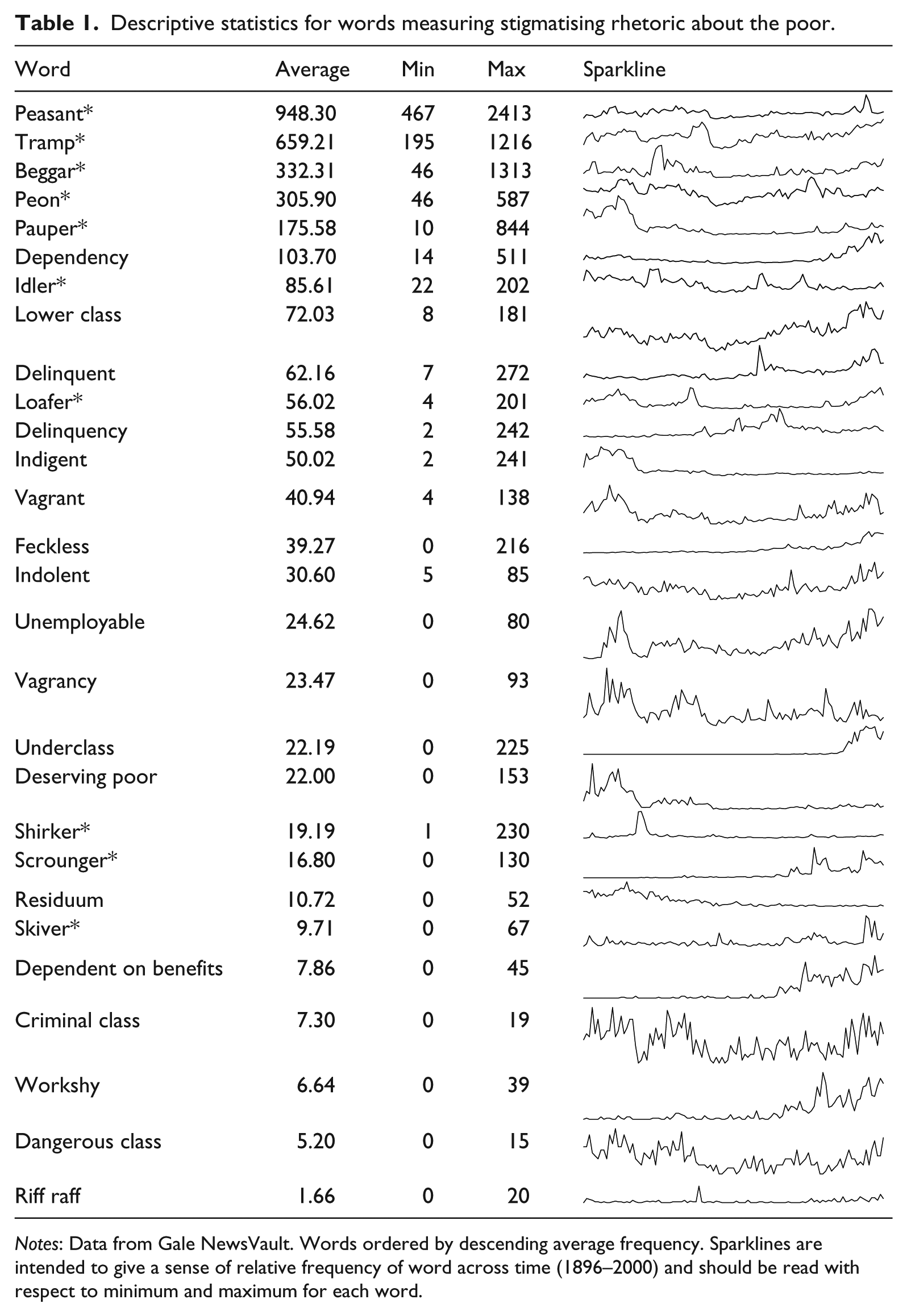
Notes: Data from Gale NewsVault. Words ordered by descending average frequency. Sparklines are intended to give a sense of relative frequency of word across time (1896–2000) and should be read with respect to minimum and maximum for each word.
Newspaper Rhetoric and Unemployment over the 20th Century
Unemployment rates are a major driver of hardship for which measures are available covering the entire 20th century (unlike measures of poverty, which are not regularly available until the mid-1960s). Furthermore, the morality and behaviour of the unemployed is central to how poverty has historically been discussed in the British print media, as the case studies cited above indicate. Therefore, we focus on the relationship between unemployment rates and stigmatising rhetoric to understand how newspaper rhetoric about the poor depends on levels of poverty and hardship.
In Figure 1 we plot the average frequency of stigmatising rhetoric against unemployment rates across the 20th century, taken from the Bank of England’s ‘Three Centuries of Macroeconomic Data’ series (Thomas and Dimsdale, 2016). Across much of the 20th century these two lines seem to move together, suggesting that as unemployment rises so does stigmatising rhetoric (r = 0.705), providing some evidence in support of the ‘Malthusian’ hypothesis.
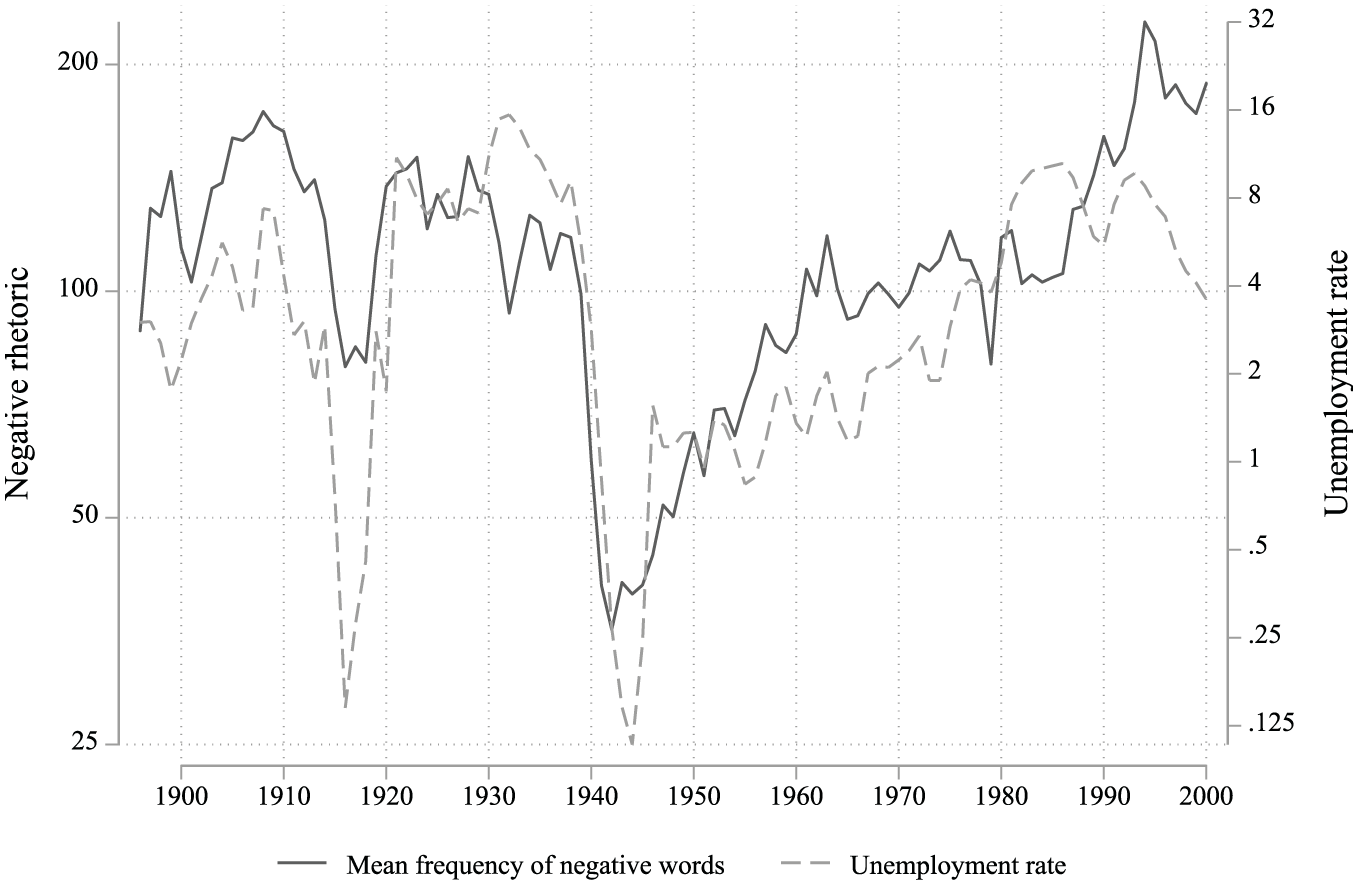
Unemployment rates and stigmatising rhetoric about the poor in Britain, 1896–2000.
Looking more closely there are periods when this relationship does not hold. For example, at the beginning of the 1930s there is a sharp rise in unemployment that coincides with a reduction in the amount of stigmatising rhetoric. Then as unemployment rates gradually fall through the middle of the 1930s stigmatising rhetoric rises again. Similarly, during the 1980s we see this relationship become less clear. As unemployment rates rose between 1979 and 1980, there was a sharp increase in stigmatising rhetoric, but as unemployment continued to increase throughout the middle of the 1980s, stigmatising rhetoric seemed to decline, before rising steadily as unemployment fell.
Are Changes in Unemployment Associated with Changes in Stigmatising Rhetoric?
We further investigate the association between unemployment rates and stigmatising rhetoric using regression models (full details in Box 1). As our theory suggests, stigmatising rhetoric should respond to changes in unemployment because journalists and editors are probably more responsive to short-term changes in the economy (e.g. 2% rise in unemployment) than long-term structural conditions (e.g. low unemployment over the last 10 years). We estimate whether annual changes in unemployment are associated with annual changes in stigmatising rhetoric. This ‘first difference’ approach reduces the risk of identifying a spurious relationship, especially if long-run trends in our key variables are correlated with other macroeconomic or political variables. We therefore model the response of the print media to changes in economic conditions rather than the underlying levels, taking into account the total number of articles published in any given year.
Statistical analysis.
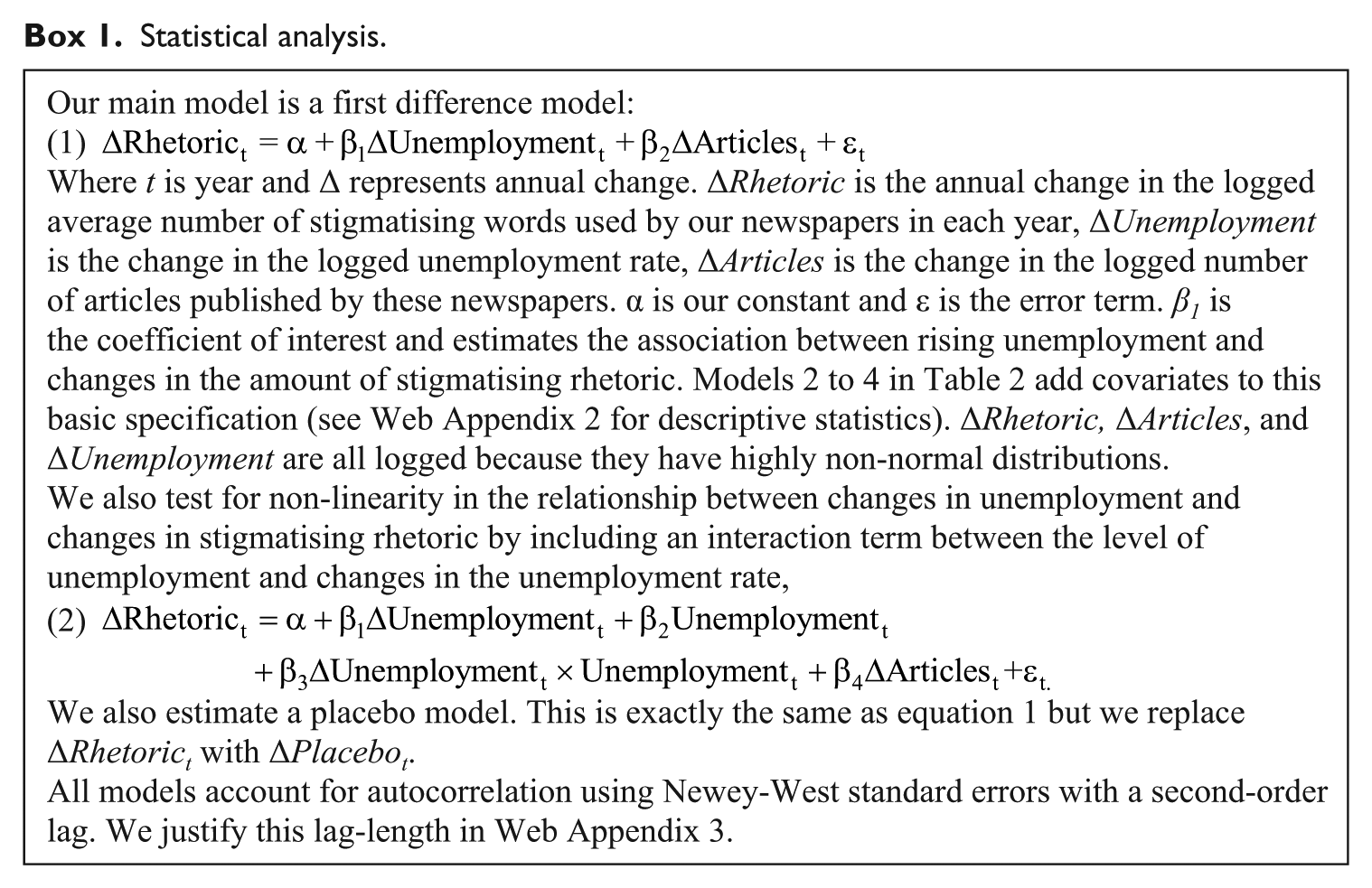
This analysis provides evidence for the ‘Malthusian’ hypothesis. Rising unemployment is positively correlated with rising stigmatising rhetoric even after accounting for the number of articles published in that year (model 1: Table 2). Other variables may potentially explain this relationship: in Figure 1 unemployment and stigmatising rhetoric both dramatically decline during the First World War and the Second World War and so we include government spending on defence (% of GDP) in our models (Mitchell, 2007), but this does not substantively alter our main finding (model 2: Table 2). Political factors, such as the party in power, may shape media rhetoric during times of rising unemployment through their ‘agenda-setting’ capacity (Tyler, 2013). However, we see no clear change in our results once we control for the political party composition of government (model 2: Table 2). See Web Appendix 4 for evidence that these results are robust to alternative measures of wartime, and controls for election year.
Association between unemployment rate and stigmatising rhetoric adjusting for covariates, 1896–2000.

Notes: Standard errors in parentheses. *p < .05, **p < .01, ***p < .001. All models estimated using Newey-West standard errors which are adjusted for heteroscedasticity and serial correlation up to the second lag. Descriptive statistics for control variables in Web Appendix 2.
The health of public finances is another possible confounder: during the Great Recession conservative media often blamed welfare recipients for high levels of public sector debt. Therefore we add measures of public debt, tax revenue and non-defence public spending, all as a proportion of GDP, to our models (Thomas and Dimsdale, 2016). The coefficient on unemployment remains positive and statistically significant, although there is some evidence that increased non-defence public spending is associated with increased stigmatising rhetoric. Taken together, the stability of our regression results offers further evidence in favour of the ‘Malthusian’ hypothesis that stigmatising rhetoric becomes more common when unemployment rises.
Why Does the Relationship between Unemployment and Stigmatising Rhetoric Weaken in the 1930s and 1980s?
Figure 1 shows that the association between unemployment and negative rhetoric breaks down in periods of especially high unemployment rates, potentially suggesting some non-linearity in the association between unemployment and stigmatising rhetoric. Stigmatising rhetoric may not increase with rising unemployment if the starting level of unemployment is already very high.
To test this, we re-estimate model 1 from Table 2 with an interaction between the change in the unemployment rate and the level of unemployment (see Box 1, Web Appendix 5 for details). Figure 2 plots the estimated effect of a 1% increase in unemployment on changes in negative rhetoric, at a variety of different starting levels of unemployment. A 1% increase in unemployment is associated with a greater increase in stigmatising rhetoric when the initial level of unemployment is low. At higher rates of unemployment, the effect of an increase in unemployment on stigmatising rhetoric gets smaller. At levels of unemployment above 7% the association between change in unemployment and stigmatising rhetoric is not significantly different from 0. In fact, at very high levels of unemployment, an additional increase in unemployment – for example, from 13% to 14% – may even reduce the amount of stigmatising rhetoric (although the confidence intervals cover 0). This is the situation we see in the early 1930s when the use of stigmatising rhetoric falls once unemployment rates became exceptionally high.
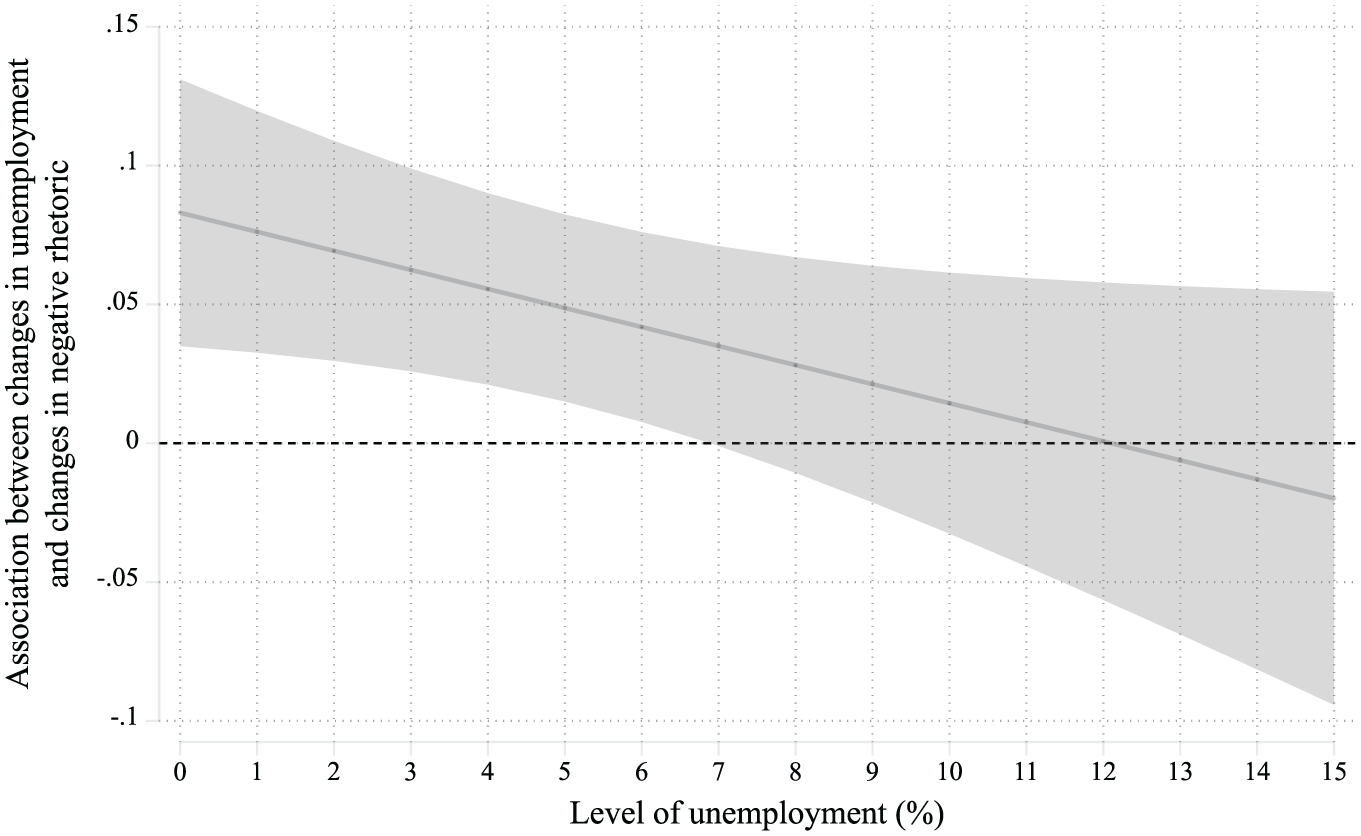
Increases in unemployment are associated with increases in stigmatising rhetoric only when the level of unemployment is low.
Is Rising Unemployment Associated with Changes in Words Unrelated to Poverty?
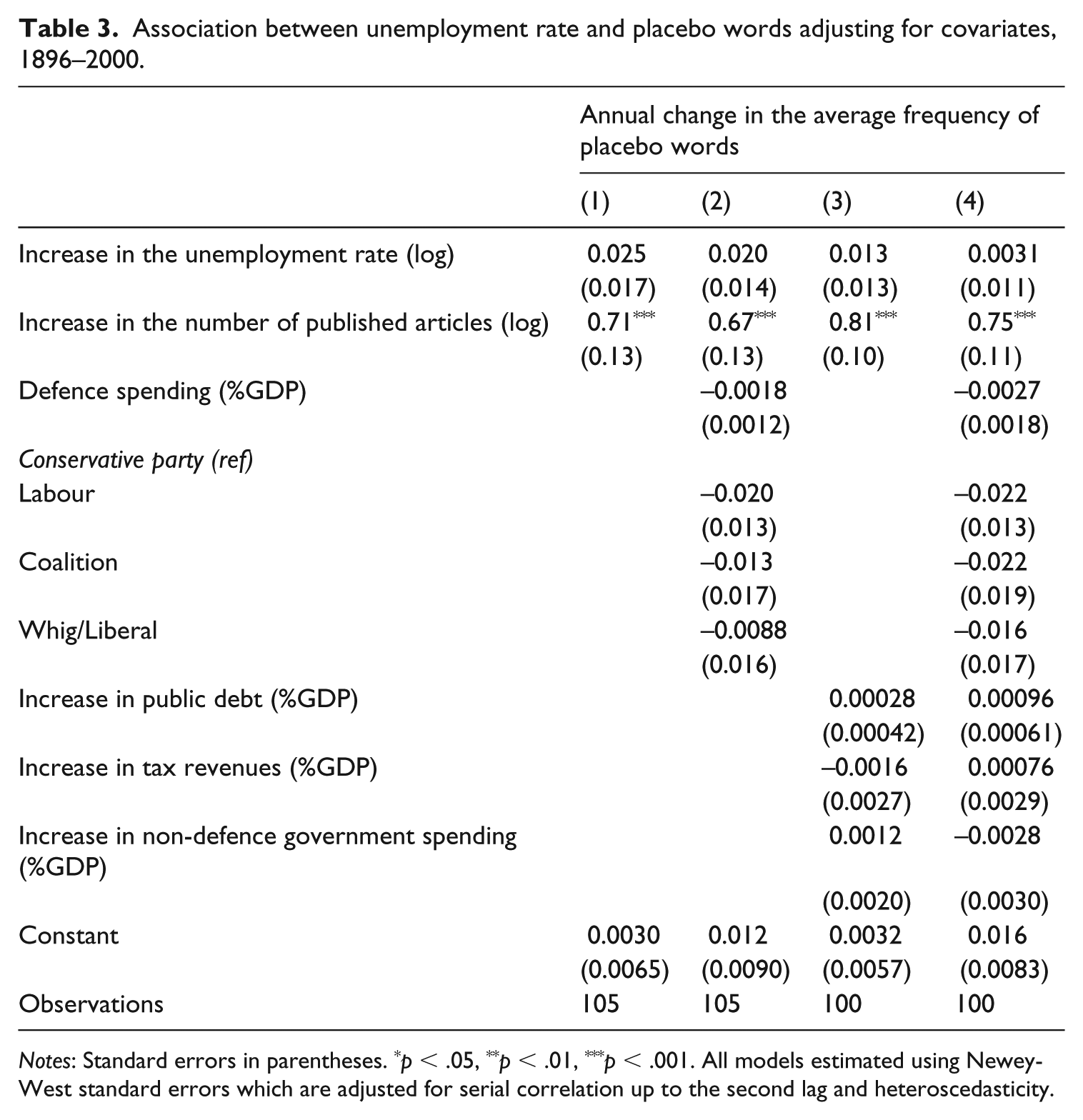
It is possible that the association between unemployment and stigmatising rhetoric could be spurious and driven by some unobserved factor that affects the words newspapers use unrelated to changes in unemployment rates. We explore this possibility by testing whether our measure of unemployment is correlated with a set of placebo words that we would not theoretically expect to be associated with changes in unemployment. Using the same data and method described above (see Box 1), we construct a sample of 12 commonly used words in four categories: historical figures (Shakespeare, Mozart); past-times (football, cricket, opera, theatre); countries (France, Germany, the USA); and rooms of the house (bedroom, bathroom, kitchen). We hypothesise that changes in the logged frequency of these ‘placebo’ words should not be associated with changes in logged unemployment rates. If they were, this would raise serious doubts about our argument. Table 3 replicates models from Table 2 with logged mean frequency of placebo words as the dependent variable. In each model the relationship is positive but statistically insignificant. Moreover, the size of the association is far smaller. For example, in the fully adjusted models (model 4 in Tables 2 and 3), the coefficient for stigmatising rhetoric (βstigmatising = 0.033) is 10 times larger than the coefficient for the placebo words (βplacebo = 0.0031). These models increase our confidence that the relationship between unemployment and stigmatising rhetoric is not spurious.
Association between unemployment rate and placebo words adjusting for covariates, 1896–2000.
Notes: Standard errors in parentheses. *p < .05, **p < .01, ***p < .001. All models estimated using Newey-West standard errors which are adjusted for serial correlation up to the second lag and heteroscedasticity.
Are Our Results Robust to Measurement Error?
Measuring stigmatising rhetoric about the poor by counting the number of times particular words or phrases are used will necessarily entail measurement error. In this section we explore whether and how measurement error may bias our results.
We first investigate whether a few specific words are driving our results by estimating regression models where the frequency of each individual word is treated as a separate response variable. Figure 3 presents the association between logged unemployment rates and each of the 28 words we use to measure stigmatising rhetoric (see Table 1). 6 Of the 32 words analysed, 30 (94%) have positive associations with unemployment – meaning they are used more often in years when unemployment is higher. Moreover, the confidence intervals around the coefficient for logged unemployment do not include zero for 28 of the 32 words (88%). The vast majority of the stigmatising words in our sample are used with higher frequencies in years with higher levels of unemployment, providing evidence their usage is driven by a common underlying process.
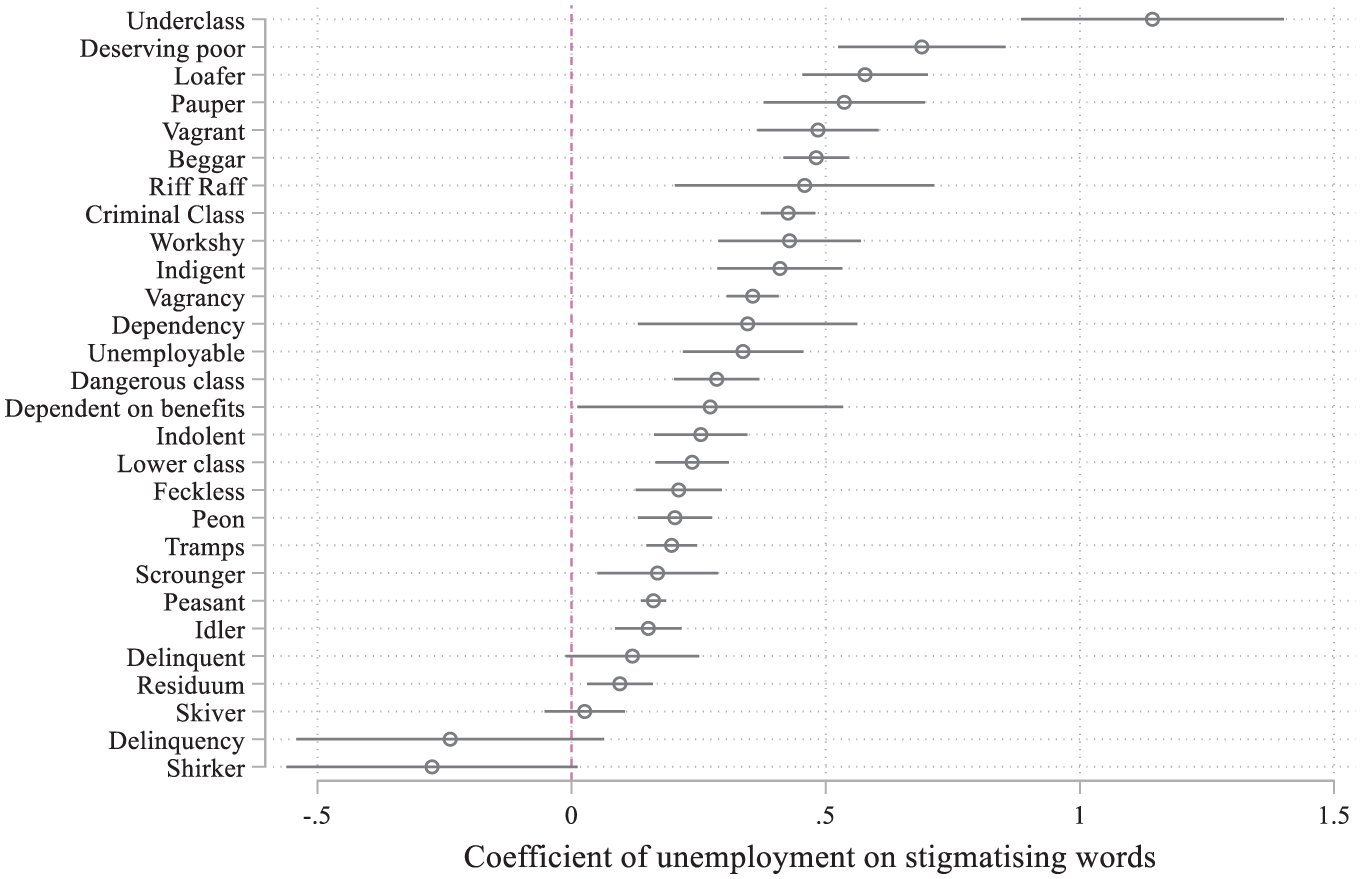
Association between unemployment and the frequency of stigmatising words or phrases, 1896–2000.
Frequency of word use is an imperfect measure of stigmatising rhetoric because all of the words used in this analysis are polysemic, even if they are primarily recognisable as words associated with poverty. Ambiguity of meaning creates some uncertainty in our results: perhaps the correlations we observe are driven by uses of words that are unrelated to poverty. To address this concern, we conduct a content analysis of newspaper articles in years where our regression model fits well (i.e. typical cases) and years where our model fits poorly (i.e. deviant cases). Typical case analysis is primarily confirmatory – exploring whether the words and phrases used in our measure of stigmatising rhetoric are in fact being deployed in a poverty-related context. Deviant case analysis, however, is particularly good at discovering measurement error or omitted variables (Seawright, 2016).
We identify two typical (1901 and 1991) and two deviant (1934 and 1980) cases using the absolute value of the residuals from model 1 in Table 2 and we selected words for further analysis based on whether they were rising in that year or were unusually elevated in that period. We also chose a variety of words to ensure our results are not driven by idiosyncrasies of any particular term. In each year, we read the first 100 randomly selected articles or, if there were fewer than 100 articles, we read every article. The second author then coded each usage of each word according to whether the word was used in reference to the poor (if it was not it was classed as ‘irrelevant’) and if the word was used in reference to the poor, we then determined whether the word was used in a stigmatising, sympathetic or neutral way. The first author also coded half of these cases to check intercoder reliability. We provide some illustrative examples of this coding in Table 4. Further details are provided in Web Appendix 6, including statistics on intercoder reliability.
Examples of newspaper word usage by relevance and sentiment.
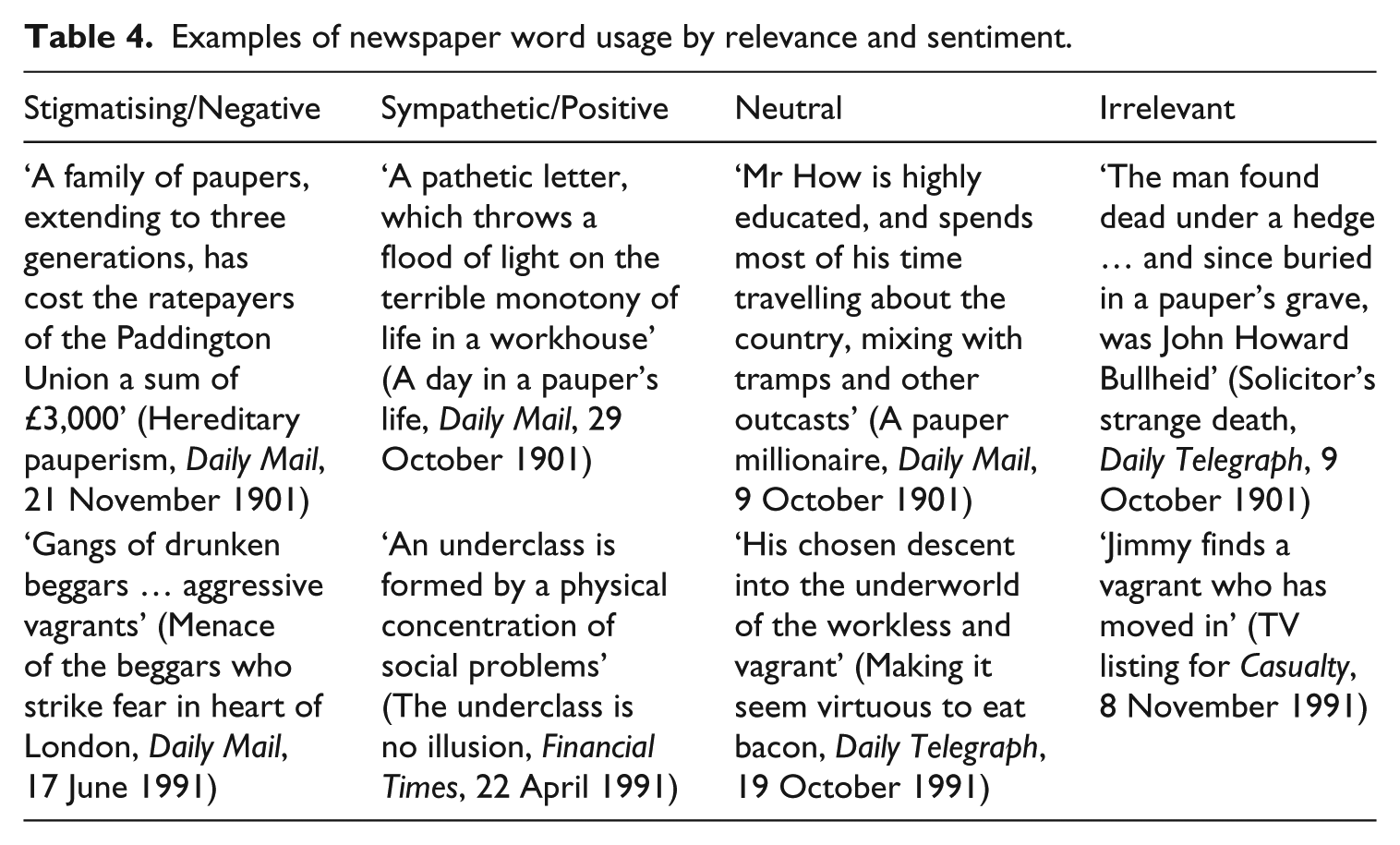
The typical case analysis confirms our main findings, but it also highlights some of the challenges with this approach to measuring stigmatising rhetoric. Both ‘pauper’ and ‘underclass’ were almost always used in relation to issues of poverty but this was not always true of ‘loafer’ and ‘vagrant’, where around 40% of mentions were not directly related to poverty. Importantly, of the uses of ‘loafer’ and ‘vagrant’ that pertain to poverty, the majority are negative (40%–50%, compared to 0%–18% that are sympathetic). This suggests that increases in stigmatising words are a good measure of increasing stigmatising rhetoric, and do not simply capture increasing discussion of poverty in general at times of high unemployment.
The deviant case analysis brings out a different but equally important perspective. In those years where our model fits poorly there are a higher number (30%–70% of all uses) of ‘irrelevant’ uses of tramp (e.g. ‘tramp shipping’), beggar (e.g. ‘The Beggar’s Opera’) and workshy (e.g. the name of a race-horse). These cases fit our model poorly because the words are not being used to describe the poor at all, confirming the presence of measurement error in our dependent variable (Seawright, 2016).
Our content analysis of typical and deviant cases provides additional evidence supporting the ‘Malthusian’ hypothesis that stigmatising rhetoric increases when unemployment rises. Counting word frequencies is not a perfect strategy for measuring negative rhetoric. It clearly captures both signal (uses of the words in relation to poverty) and noise. The noise that we measure, however, seems more likely to be random (uses of the words unrelated to poverty) rather than biasing our results.
Discussion
This analysis draws on a dataset measuring how often five centrist and right-wing newspapers used stigmatising language about people in poverty across the 20th century. Case studies of media rhetoric have often argued that the poor are stigmatised more by the media during recessions because the media frame unemployment through a Malthusian lens (Harkins and Lugo-Ocando, 2016). Consistent with this argument, we find that when unemployment increases so too does the frequency of stigmatising rhetoric about the poor. This association is not explained by other political, economic or fiscal variables. Our content analysis of articles suggests that the words we selected are used in a predominantly stigmatising or negative way in years where unemployment is increasing.
Stigma and Attitudes towards People on Benefits
One possible consequence of the recurrent stigmatisation of the poor is its effect on public attitudes towards people in poverty and welfare recipients. Media framings have a great deal of power to ‘construct’ and ‘normalise’ certain ways of viewing poverty (Gamson et al., 1992). Unfortunately, data on public opinion towards welfare is too sparse before the 1980s to systematically investigate whether shifts in media rhetoric influenced attitudes (Hudson et al., 2016). Looking just at attitudinal shifts towards welfare recipients since the start of the British Social Attitudes Survey (covering 1987–2000), we find increasing stigmatising rhetoric about welfare recipients in the media during the late 1980s and 1990s appears to have preceded increasingly negative social attitudes (Figure 4). This trend is consistent with a wide body of empirical evidence documenting the effect of the media on attitudes (King et al., 2017) and political outcomes, like voting (Reeves et al., 2016).

Trends in the frequency of stigmatising rhetoric and welfare attitudes in the UK.
Causality, Mechanisms and Media Production
The temporal reach of our analysis allows us to avoid relying on case studies of specific periods when media stigmatisation of the poor was highly salient. Our modelling attempts to address both long-term confounding through first differencing, and short-term confounding through our control variables – a strategy which is reinforced by our placebo analyses. However, we are still cautious about a causal interpretation of our results, in part because of the usual difficulties involved in causal inference from observational data, but also because the account we provide does not fully specify or test the mechanisms involved in producing articles about people in poverty. The content and tone of newspaper articles are determined by a complex set of interactions among journalists, editors, newspaper proprietors and the perceived or actual response of readers; these are processes our results do not address (Gamson et al., 1992; Golding and Middleton, 1982; Herman and Chomsky, 1994).
An additional reason for caution is that our theory does not fully account for those periods when the relationship between unemployment and stigmatising rhetoric weakens. When unemployment is already very high (e.g. the 1930s and 1980s) then further increases in joblessness do not necessarily lead to more stigmatising language. One possible explanation is that structural understandings of poverty may become more plausible in periods when unemployment is exceptionally high and it becomes difficult to blame the moral failings of the unemployed. It is also possible the economic situation of journalists might affect the content of their articles. If journalists become at particular risk of losing their jobs during extremely deep recessions, they might become more sympathetic towards the poor.
Given these caveats, we argue future research should trace how processes of media production affect the way people in poverty are presented. This work could deploy detailed discourse analysis or archival research to unpick how actors such as proprietors or editors shape journalistic decisions about how to cover stories about poverty, and how they respond to changing economic conditions (Baker, 2007).
History, Context, and Ideational Embeddedness
One insight we gain from our historical approach is the degree to which Malthusian explanations of poverty have become ‘ideationally embedded’ in British politics and culture (Somers and Block, 2005). The very fact that we observe a relatively stable association between rising unemployment and the frequency of stigmatising rhetoric is indicative of how particular ideational regimes are redeployed to ‘construct, … explain, and normalise market processes’, particularly in moments of ‘crisis’ when the logic of Malthusianism might be dislodged by some other ‘more compelling public narrative’ (Somers and Block, 2005: 264, 271). For example, the experience of personal or family unemployment may lead individuals to support greater redistribution if they are not countered by a narrative that blames the crisis on the immoral behaviour of the poor. The ideational embeddedness of Malthusian ideas may help us explain why people living in poverty deploy stigmatising language themselves: their interpretation of the social world is framed by, and draws on, the same set of narratives, symbols and discourses.
Our article has broader theoretical relevance beyond poverty stigma because it provides an account of the conditions under which deeply embedded cultural understandings are differentially activated when they resonate with the structural context. This theoretical apparatus, when combined with our long historical focus, might prove useful for understanding the resurgence of anti-immigrant sentiment and nationalism in the press, and how these trends may reflect longer processes connected with imperialism, decolonisation, and mass immigration to the UK (Bonikowski, 2017).
Limitations
Error in our measure of stigmatising rhetoric is a limitation of our analysis. There will be occasions when we count the usage of a word as ‘stigmatising’ even though it is being used in another context; this issue is exacerbated by the way that the language used to talk about poverty changes over time. However, our content analysis suggested that measurement error predominantly occurred in years where model fit was poor, implying that error in our measure of stigmatising language likely undermines our ability to observe a relationship between economic conditions and stigmatising rhetoric. Another concern is the generalisability of our results, which are limited because the archive used in our analysis only provides access to a set of centrist and right-wing publications. We cannot draw any conclusions about how left-wing papers respond to rising unemployment. We are also unable to address the extent to which journalists are responding to the attitudes of their readers. While we cannot rule out this possibility entirely, it is unlikely during the first three-quarters of the 20th century because newspapers did not have access to regular and consistent polling data on the attitudes of their readers towards welfare recipients (Hudson et al., 2016). This may change in the future as such data have now become far more readily available.
Conclusion
The rise in stigmatising media rhetoric about the poor following the Great Recession was consistent with a pattern we observe across the 20th century: as unemployment increases so does newspaper stigmatisation of the poor. Although our data end during the earliest years of New Labour, there is little reason to expect that much has changed since then. The Blair government presented itself as no soft touch on welfare, a trend that was only amplified by the Conservative-led coalition. The Cameron government attacked ‘scroungers’ and ‘skivers’, language that was also picked up by newspapers (Jensen and Tyler, 2015). The phenomenon of ‘poverty porn’ too is symptomatic of the ideational embeddedness of Malthusian ideas, revealing how producers, viewers, and to some extent, subjects of these ‘documentaries’ draw on and reproduce these narratives (Jensen, 2014). These ideas are deeply rooted in the British cultural imagination and so such language will return in the future, likely in a different form, but with the same purpose of ‘holding dependent poverty disgraceful’ (Malthus, 2008: III.VI.5). Though the specific words used might vary, the rhetoric of recessions among centre-right British newspapers is unlikely to change in the near future.
Supplemental Material
Supplemental_Material – Supplemental material for The Rhetoric of Recessions: How British Newspapers Talk about the Poor When Unemployment Rises, 1896–2000
Supplemental material, Supplemental_Material for The Rhetoric of Recessions: How British Newspapers Talk about the Poor When Unemployment Rises, 1896–2000 by Daniel McArthur and Aaron Reeves in Sociology
Footnotes
Acknowledgements
We would like to thank Imogen Tyler, Jonathan Mijs, Robert De Vries and the members of the LSE’s writing group in the Sociology Department for helpful comments on earlier versions of this article. We would also like to acknowledge the reviewers and editor at Sociology, whose comments have helped us to improve the article.
Funding
Aaron Reeves was supported by the Joseph Rowntree Foundation’s programme on poverty and inequality for this project. Daniel McArthur was supported by an ESRC PhD studentship during the writing of this article. The funders had no influence on the design of this study, the interpretation of the results or the decision to publish.

Notes
References
Supplementary Material
Please find the following supplemental material available below.
For Open Access articles published under a Creative Commons License, all supplemental material carries the same license as the article it is associated with.
For non-Open Access articles published, all supplemental material carries a non-exclusive license, and permission requests for re-use of supplemental material or any part of supplemental material shall be sent directly to the copyright owner as specified in the copyright notice associated with the article.
