



Abstract
Using the Baltic states as an empirical example of a wider social problem of categorization and naming, this article explores the statistical categories of ‘international migrant/foreign-born’ population used in three major cross-national data sources (Organisation for Economic Co-operation and Development (OECD), Eurostat and The World Bank Indicators (WBI)). We argue that these seemingly politically neutral categories ignore historical processes of state formation and migration, and privilege the current ethnonational definition of the state. We demonstrate how, in regions with recent geopolitical changes, the international migrant category’s spatial and temporal constraints produce distorted population parameters, by marking those who have never crossed sovereign states’ borders as international migrants. In certain social contexts, applying the international migrant category to those who have never crossed international borders shapes and legitimizes restrictive citizenship policies and new forms of social exclusion. We further argue that, when uncritically adopting this category, transnational institutions assert territorial imaginaries embedded in ethnonational political discourses and legitimize exclusionary citizenship policies.
Keywords
Introduction
The present article begins with a sociological riddle: in 2010, Estonia and Latvia were among the poorest countries in the European Union. Yet, according to three major cross-national data sources, namely, Eurostat, The World Bank Indicators (WBI) and the Organisation for Economic Co-operation and Development (the OECD), these Baltic states were among the European countries with the highest shares of international migrant/foreign-born population – higher than Germany and Sweden (Figure 1). These findings are quite puzzling, as according to sociological theory, migrants are expected to be attracted to rich countries with abundant economic opportunities and a high demand for labour (Castles et al., 2013; Massey et al., 1993). How can we make sense of these unexpected findings?
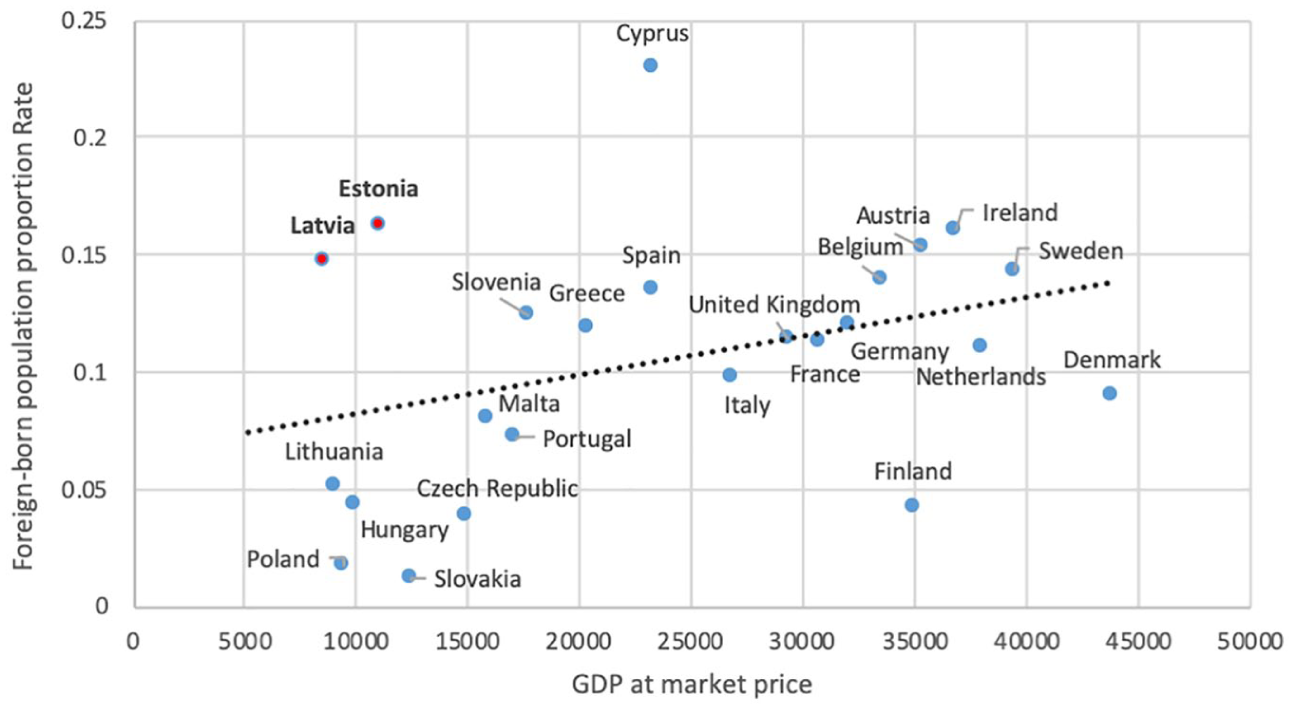
EU countries, 2010.
To solve the riddle, we focus on the statistical categories of ‘international migrant’ and ‘foreign-born’ population, which are used interchangeably by the three major cross-national data sources. We suggest that an uncritical administrative use of the categories, as defined by these data sources, may lead to inaccurate and distorted population parameters because it classifies individuals into social categories in which they do not belong. Using the Baltic states 1 as an empirical example of a wider social problem of categorization and labelling, we plan to demonstrate how these statistical categories misrepresent a large share of the population, marking those who have never crossed international borders of sovereign states as international migrants. We argue that the problem is grounded in the static nature of the statistical categories of ‘international migrant’ and ‘foreign-born’ population, which makes them blind to the historical processes of state formation and migration in the region. The article explores this static nature and demonstrates how, despite their perceived political neutrality, these categories reflect political discourses that privilege an ethnonational definition of the state. Aside from the obvious practical implications for comparative research, the use of such categories might legitimize exclusionary citizenship laws and affect the life chances of the individuals who have been turned into international migrants.
The Baltic case is far from unique; shifting classifications of countries’ residents have been integral to modern nation-state-building processes worldwide. Residents who have never crossed international boarders but are classified as international migrants can be found in Slovenia, Ukraine, Kazakhstan, India and Bangladesh – to name just a few. We will return to these and other examples in our concluding remarks. Here, we use the Baltic states as but one salient historical example of the phenomenon to launch our sociological examination of the qualities of the statistical categories of ‘international migrant’/‘foreign-born’ population.
The article engages with two bodies of sociological research. First, by critically assessing the processes of construction and bureaucratic application of the international migrant category in the context of geopolitical change, we contribute to the research on the politics of naming. Specifically, we expand the theoretical discussions of the role of statistical categories in creating social hierarchy and new forms of social exclusion.
Second, adopting theoretical concepts from the study of politics of knowledge and naming, the article seeks to contribute to the sociological research on migration and citizenship. While major trends in sociological research are concerned with the patterns of international migration and migrant integration, our article takes the next logical step and discusses who is defined as an international migrant, as well as the social implications of these definitions in different geopolitical contexts.
In addition, we aim to make a wider theoretical contribution to the sociological debates concerning methodological nationalism. We do so by focusing on the role of cross-national data sources in constructing and disseminating the category of ‘international migrant’ that privileges an ethnonational definition of the state and reaffirms the reasoning behind the nationalism of research methods and knowledge production.
In the following pages, we first briefly discuss definitions and empirical data related to the international migrant population in the Baltic states as presented in the Eurostat, WBI and OECD data sources. Then, using individual-level data for Estonia, Latvia and Lithuania, obtained from the European Social Survey, we estimate the proportion of so-called international migrants who, in fact, have never migrated from one sovereign state to another. Here, we highlight the international migrant category’s insensitivity to temporal changes and geopolitical transformations. In the next section, we contextualize the findings in relation to the countries’ specific citizenship laws that reflect the prevailing ethnonational political discourse of the region. We elaborate on the broader sociological significance of our analysis by considering the political implications that the use of the seemingly neutral category of international migrant might have for the constitution and implementation of new forms of social exclusion. In the concluding remarks, we demonstrate the wider comparative significance of our findings, beyond a specific region and period. Finally, we emphasize the article’s contribution to the debate on methodological nationalism by discussing the role of transnational political institutions in reproducing statistical categories, insensitive to geopolitical changes and state formation in the region.
Who is an International Migrant?
In this section, we discuss the definitions of the international migrant category and further demonstrate the ways in which it leads to distorted estimates of the size of the international migrant population.
OECD, Eurostat and WBI Definitions
Let us return to our riddle. According to Eurostat (2018), in 2010, the international migrant population constituted 16.3%, 14.8% and 5.1% of the total population in Estonia, Latvia and Lithuania, respectively. The estimates provided by the WBI (2018) for the same year are quite similar (16.3%, 15% and 5.1% for Estonia, Latvia and Lithuania, respectively). The OECD (2018), likewise, estimated in 2010 the foreign-born population in Estonia as 16% and in Latvia 14.5%. 2 As mentioned above, considering the relatively poor economic conditions in the Baltic states as compared to other countries in the European Union, these numbers appear extraordinarily high (Figure 1).
To understand the nature of these outliers, we looked at how the above-mentioned data sources define the category of international migrant/foreign-born population. Eurostat defines international migrants as ‘persons born abroad (according to present time borders)’ (Eurostat, 2018); the OECD as ‘people who have ever migrated from their country of birth to their current country of residence’ (OECD, 2018); and WBI as ‘people born in a country other than that in which they live’ (WBI, 2018). In a more extended definition of the category, WBI adds an important qualification: ‘After the breakup of the Soviet Union in 1991, people living in one of the newly independent countries who were born in another were classified as international migrants’.
Whether they state this upfront, bury it beneath a lengthy definition or leave it unsaid, all three data sources operationalize international migrant/foreign-born population according to the current territorial borders of independent nation-states. In fact, the WBI qualification explicitly states that the category disregards the historical context of migration occurring prior to 1991. In what follows, we will reconstruct the category of international migrant/foreign-born population to show how this constraint distorts population parameters.
Category Reconstruction Based on the European Social Survey
Using individual-level data obtained from the European Social Survey for Estonia, Latvia and Lithuania, we reconstructed the population that comprises the ‘international migrant/foreign-born’ category. The European Social Survey (ESS) is a biannual survey that was launched in 2002. Since then, around 30 European countries have taken part in the survey. In each country participating in the survey, the information was gathered from a representative national sample of the resident populations aged 15 years and above (for detailed information, see http://www.europeansocialsurvey.org/). For our analysis, we utilized all data gathered from 2006 to 2014 for the three Baltic states (European Social Survey (ESS), n.d.). We do not use data obtained in 2002 and 2004 because the data do not provide all the necessary information for the present analysis.
While Estonia took part in all five rounds during this period (2006, 2008, 2010, 2012 and 2014), Latvia took part only in two rounds (2006 and 2008) and Lithuania in four rounds (2008, 2010, 2012 and 2014). 3 The analytical sample in each year for each country ranges from 1517 to 2379 respondents. The ESS includes information on whether the respondents were born in the country where the interview took place. For those not born in the country, it provides information on their country of birth and the number of years since arrival to the country of residence. In all five rounds of the ESS we have used, the survey question about respondent’s country of birth was open-ended. In 2010, 2012 and 2014, the respondents were asked, via an open-ended question, about the exact year they first came to live in the country. In 2006 and 2008, the respondents were asked how long ago they first came to live in the country and were given a number of categories to choose from. 4
Thus, within the group of respondents
Respondents who were born in the USSR and migrated to Estonia/Latvia/Lithuania from other Soviet republics during the period when the Baltic states were part of the Soviet Union. 5 At the time of their migration, these respondents moved within the borders of one sovereign state (the USSR) and, thus, we call them historically internal migrants.
Respondents who migrated to Estonia/Latvia/Lithuania from former Soviet republics before 1941 or after 1990 (for Lithuania after 1989), when Estonia/Latvia/Lithuania were not yet part of the Soviet Union or already started in the process of regaining independence. This sub-category also includes respondents who migrated to Estonia/Latvia/Lithuania during any historical period from any country outside of the former USSR borders. At the time of their migration, these respondents moved from one sovereign state to another and, thus, they were indeed international migrants. 6
Based on the operationalization described above, Figure 2 displays the percentage of international migrants and historically internal migrants in a country. Together, they compose the percent of those

Percent not born within current borders of a country.
Take Estonia, for example: our calculations, using the ESS individual-level data, show that the percent of those not born within the current borders of Estonia ranged from 15.2 to 21 during the period under examination. In 2010, the share of Estonian residents who were not born within the present-time borders of the state resembled the share of international migrant/foreign-born population reported by OECD, Eurostat and WBI in the same year. However, the results reveal that only a tiny portion (one-tenth) of those who were not born within the current borders of Estonia were indeed international migrants. Specifically, in 2010, respondents who migrated to Estonia from another sovereign state comprised only 1.6% of the country’s total population. At the same time, in 2010, respondents who arrived in Estonia as internal migrants from other Soviet republics, when Estonia was part of the USSR (1941–1990), comprised 13.8% of the country’s total population. The latter did not move from one territorially defined state to another. They never identified themselves as international migrants and were not defined as such upon their arrival (i.e. between 1941 and 1990). This is why we call them historically internal migrants.
The data for Latvia show a similar pattern. Thus, in 2008, the percent of those not born within the current borders of Latvia was 13.8. However, only 1.5% of the country’s total population migrated to Latvia from another sovereign state (i.e. crossed international borders at the moment of migration). The rest moved to Latvia within the borders of the USSR between 1941 and 1990 and thus should be considered historically internal migrants.
The results for Lithuania are similar, although on a much smaller scale because, unlike Latvia and Estonia, Lithuania was never a popular destination for internal migration during the Soviet period (Brubaker, 1997: 284). In the period 2006–2014, the percent of those not born within the current borders of Lithuania ranged from 3.0 (in 2012) to 5.1 (in 2010). In 2010, the percent of Lithuanian residents not born within the current borders of the state was identical to the percent of foreign-born/international migrant population reported by Eurostat and WBI (5.1%). However, only 0.8% of the country’s total population in 2010 migrated to Lithuania from another sovereign state. The rest migrated to Lithuania internally, within the borders of the USSR between 1941 and 1989, and, thus, should also be defined as historically internal migrants.
When the share of historically internal migrants is subtracted from the category of international migrant/foreign-born population as defined by Eurostat, OECD and WBI, the share of international migrant population in Estonia and Latvia appears to be quite small – around 1.5–2.9%. It is even smaller in Lithuania – around 0.6–1.3%. Unlike information retrieved from Eurostat, OECD and WBI, these proportions are compatible with the proportions of international migrant/foreign-born population in most Eastern European countries with similar economic conditions (Figure 1).
Although recent border changes in several other Eastern European countries influenced the composition of the so-called international migrant/foreign-born population as well, the proportion of historically internal migrants in these countries is usually much smaller than in the Baltic states. For example, in 2010, residents of Slovakia who moved there internally from the Czech Republic before the dissolution of Czechoslovakia comprised 1.6% of Slovakia’s total population. In the same year, residents of the Czech Republic who arrived there from Slovakia during the time of Czechoslovakia comprised 1.2% of the Czech Republic’s total population (authors’ own calculations based on the ESS).
The findings presented above reveal the methodological limitations of data and the ‘presentist’ nature that characterizes the international migrant category. We borrow the concept of presentism from scholars who criticize the lack of historical consciousness in social research and indicate the inadequacy of scholarly analyses resulting from the tendency to interpret the past using contemporary concerns and present-day points of view (Inglis, 2013). We suggest that such ‘presentist’ nature of the international migrant category prevents it from being sensitive to the historical processes of migration that occurred in the region over the last century. Indeed, in the operationalization of the international migrant category (in the three cross-national data sources), any past movement of people is always determined according to the current territorial state borders.
Our reconstructive analysis clearly demonstrates that the category of international migrant/foreign-born population cannot differentiate between the movement of people across borders (i.e. international migration) and the movement of borders (i.e. geopolitical changes and state formation). We suggest that this temporal and spatial bias can be consequential to different degrees, depending upon the particular political and social context. As we will show in the following pages, this effect is most significant in political contexts where newly independent states justify restrictive citizenship laws by applying the definition of international migrant to individuals who never intentionally changed the country of their residence.
Historically Internal Migrants and Citizenship Laws
It is important to consider the category of historically internal migrants, who, as we have shown, constitute the majority of so-called international migrants in the Baltic states, against the backdrop of legal and political processes occurring in these countries in the wake of the breakup of the Soviet Union. The territorial imaginary that informs these processes privileges the ethnonational definition of the state that conflates culture, territory and the state with a core ethnic group (Dzenovska, 2018; Feldman, 2005). Nation, in this imaginary, is perceived ‘as a community of culture, imagined descent, and destiny that has a right to self-determination’ and does not necessarily coincide with the resident population of a state where this nation is dominant (Bauböck, 2005: 685). Institutional arrangements in the new Baltic states reflect this ethnonational imaginary as they were designed, particularly in Latvia and Estonia, to attend to the interests of the dominant ethnic group (Agarin, 2013; Cheskin, 2015).
The new citizenship laws adopted following the Soviet Union’s dissolution serve as a prime example of these new institutional arrangements. Latvia, Estonia and Lithuania were annexed to the Soviet Union in 1940 following the Molotov-Ribbentrop Pact, and gained independence after the breakup of the Soviet Union in 1991 (Lithuania declared its independence in 1990) (Smith et al., 2002). With the Soviet collapse, while seeking to gain control of the core ethnic group over state institutions, the new independent Baltic states acted as ‘nationalizing states’, granting protection to the language and culture of core ethnic groups (Agarin, 2018; Brubaker, 1996, 1997). As part of ‘nationalizing’ processes and in line with the principle of legal continuity, at the beginning of the 1990s, Latvia and Estonia adopted laws that granted automatic citizenship rights only to the residents who had been citizens of these countries before the countries were annexed by the Soviet Union in 1940, and to their descendants.
According to the new citizenship acts, all residents arriving in Estonia and Latvia after 1940 (including those migrating from other parts of the USSR), as well as their descendants who were born in Estonia and Latvia, became non-citizens or aliens (Krūma, 2015; Priit and Poleshchuk, 2013). The result was that in Latvia, following the 1991 Citizenship Act, there were about 740,000 non-citizens, constituting 28% of the total population of 2,651,000 (Krūma, 2015; Muiznieks et al., 2013). In Estonia, a similar citizenship law was adopted in 1992 and resulted in 32% of the total population being defined as aliens (500,000 out of the total population of 1,533,000) (Muiznieks et al., 2013; Priit and Poleshchuk, 2013: 4). The overwhelming majority of these non-citizens were what we have called historically internal migrants, many of whom were sent there by the Soviet state or recruited by factories and collective farms but all of whom arrived in Latvia and Estonia from other Soviet republics when the Baltic states were part of the Soviet Union (Brubaker, 1997; Krūma, 2015; Muiznieks et al., 2013; Priit and Poleshchuk, 2013).
From a sociological perspective, these non-citizens (the majority of whom are historically internal migrants) in both Latvia and Estonia can be described, following Kate Nash (2009), as ‘quasi-citizens’. Nash expands the legal definition of citizenship and considers it through access to material and symbolic resources it affords. The legislation of international human rights in relation to citizenship, she argues, blurs the distinctions between citizens and non-citizens, creating a variety of citizenship statuses that cannot be reduced to a simple legal definition. One such status group is ‘quasi-citizens’, who although enjoying access to employment and long-term residence, have no political rights, cannot vote in national elections and have less protection from the state than full citizens (Nash, 2009: 1076–1078). Latvia, for example, restricts the non-citizens’ political rights by not allowing them to vote in either national or municipal elections. Estonia, on the other hand, allows its non-citizens to elect but they cannot be elected in municipal or regional elections (Agarin, 2018: 43–44). Moreover, in Latvia and Estonia, while enjoying access to certain social resources, these ‘quasi-citizens’ nevertheless hold a precarious position in terms of employment opportunities because they are barred from practising certain professions related to public and civil service (Dzenovska, 2018; Krūma, 2015; Weissbrodt, 2003). In addition, while the state provides its full citizens with social protection, these ‘quasi-citizens’ are often dependent on international human rights and non-governmental organizations for similar services (Agarin, 2018).
Unlike Latvia and Estonia, Lithuania adopted a ‘zero option’ citizenship policy in 1989, which granted citizenship to all people who were legal residents of the state on the day the law was adopted, regardless of their place of birth and ethnic belonging (Kūris, 2010: 12–21). The marked differences in citizenship laws in the Baltic countries ought to be understood in light of their different ethnic composition on the eve of the Soviet Union’s collapse. In 1989, Latvia and Estonia had a considerable Russian-speaking minority, with only ethnic Russians constituting 34% and 30% of the total population in Latvia and Estonia, respectively (Matulionis and Frėjutė-Rakauskienė, 2014: 90). 7 In Lithuania, by contrast, ethnic Russians constituted only 9.4% of the total population, with ethnic Poles constituting another significant minority (Matulionis and Frėjutė-Rakauskienė, 2014: 90).
These historical legacies influenced how the nation and its relationship to minorities were imagined. Thus, the visible presence of a large, culturally homogenous, Russian-speaking minority in Latvia and Estonia engendered fears of ‘cultural extinction’ (Duina and Miani, 2015). In the wake of the Soviet Union, the perceived threat to the indigenous culture, language and national identity was translated into restrictive and exclusionary citizenship policies in Latvia and Estonia (Agarin, 2018; Brubaker, 1996, 1997; Dzenovska, 2018; Feldman, 2005). A smaller share and a higher heterogeneity of non-Lithuanian population (with a large Polish minority) curbed the perceived sense of threat and facilitated the adoption of more inclusive citizenship laws (Brubaker, 1997; Duina and Miani, 2015; Kūris, 2010).
The differences between citizenship laws in the three Baltic states have had enduring effects on their population composition in terms of citizenship status. Thus, in 2010, the percent of ‘non-citizens’ in Lithuania was only 1.1 (Eurostat, 2018). In contrast, the percent of ‘non-citizens’ in Latvia and Estonia was the highest in the European Union (excluding Luxembourg) at 17.5 and 15.8, respectively (Eurostat, 2018). Unlike in Lithuania, the share of non-citizens in Latvia and Estonia is quite similar to the share of international migrants in these countries as defined by the OECD, WBI and Eurostat data sets. These shares of ‘non-citizens’ in Latvia and Estonia reflect not only the exclusionary citizenship laws in these countries but also their relatively restrictive naturalization policies (Agarin, 2018; Priit and Poleshchuk, 2013).
The Political Implications of Naming
In this section, we suggest that in the case of Latvia and Estonia, the seemingly politically neutral category of international migrant used by cross-national data sources reflects the dominant political ideology that transformed Soviet internal migrants into international migrants and in some instances to ‘quasi-citizens’. Naming Soviet internal migrants ‘international migrants’ created a discursive foundation for denying them citizenship.
Representing populations through the act of labelling is in itself a form of political intervention that shapes ‘what counts as real’, as statistical categories can have material effects on what they aim to describe (Kreager 2004: 41). Such classification can inscribe cultural identities and normalize new forms of social inequality (Greenhalgh, 2003; Hacking, 1986; Hirsch, 2000; Kreager, 2004). As Hacking forcefully argued, statistical categories, under the auspices of the state and in its service, create and maintain people’s social identities by naming them and ordering their relationships with the rest of society (Hacking, 1986). Classificatory systems used by the state often become a template for any further official collections of data, as was the case with ethnicity categories, constructed by the national census agencies in the UK (Aspinall, 2012; Peri-Rotem, 2012). Yet, far from being passive recipients of these categories, minority communities often use them in their efforts to achieve official recognition from the state (Aspinall, 2012; Middleton, 2011; Rodríguez-Muñiz, 2017; Urla, 1993). James Scott has shown that the categories used by the state can become ‘categories that organize people’s daily experiences precisely because they are embedded in state-created institutions that structure that experience …’ (Scott, 1998: 81; for the French case, see Blum, 2002). Furthermore, authoritative categories that ‘make up people’ tend to influence individuals’ representations of themselves and others (Hacking 1986: 226; see also Kreager, 2004).
Departing from these theoretical arguments, we contend that under certain political circumstances, the above-mentioned category of ‘international migrant’/‘foreign-born’ population can sustain new types of social and political exclusion. The category of ‘international migrant’, when attached to those we have called historically internal migrants, has particular significance. For instance, after gaining independence, Estonia considered all post-1940 settlers and their descendants as citizens of the illegally occupying foreign state (the Soviet Union). Once Russia became the legal successor of the Soviet state, these settlers and their descendants came to be seen as labour migrants from the Russian Federation continuing to live and work in Estonia for decades. The Estonian authorities insisted on presenting Russian-speakers as international migrants rather than as national minorities. They articulated their nationalizing policies as compatible with migration policies in other European countries, comparing the circumstances of historically internal migrants to those of international labour migrants in post-war Europe. This, of course, ignored the fact that from the perspective of the Russian-speakers who arrived in Estonia during 1940–1991, they were not moving to a different state (Smith et al., 2002: 75–76).
The efforts to represent Russian-speakers as international migrants, rather than as a national minority, have also been evident in Latvia (Dzenovska, 2018: 62–69). Representing Russian-speakers in the Latvian public discourse as international migrants marks them as a social group that cannot be fully incorporated into the nation because it does not fully confirm to the constitutive relationship between territory, individuals and culture. The distinctions between national minorities and international migrants, which is by no means unique to the Baltic states, shaped popular imagination and the course of the national politics in these countries (Dzenovska, 2018; see also Feldman (2005) for the Estonian case).
The Estonian and Latvian cases exemplify how the processes of classification and naming can institutionalize and reproduce socially constructed categories. The process of naming sustains normative and bureaucratic measures through which seemingly neutral categories turn into real social identities with different life prospects and different levels of material and symbolic capital. In Latvia and Estonia, using the category of international migrant/foreign-born in relation to the population of internal migrants who moved within the borders of one state, namely, the Soviet Union, legitimizes the exclusion of this population from the systems of rights and privileges to which the polity members are entitled. Essentializing the distinction between the foreign (i.e. international migrants) and the domestic (i.e. national minorities) sustains the countries’ exclusionary laws that denied citizenship to a large Russian-speaking minority. Cross-national data sources borrowed – without much critical assessment – the category that the state used when justifying its exclusionary citizenship policies.
Furthermore, disfranchising policies towards historically internal migrants (viewed as international migrants) persisted during the EU accession process, with the EU playing a decisive role in perpetuating these policies (Agarin, 2018; Dzenovska, 2018; Feldman, 2005). Although the European Union, the Council of Europe and the Organization for Security and Cooperation (OSCE) expressed concerns over the nature of integration policies in Latvia and Estonia, even after the completion of the accession process, the share of ‘non-citizens’ in these countries was disproportionally high compared to other countries in the EU (Galbreath, 2006). The share of ‘non-citizens’ in Latvia and Estonia neatly corresponds to the share of historically internal migrants, who were viewed by the states as international migrants. From a practical point of view and despite its commitment to international human rights pertaining to citizenship, the EU adopted such a view. 8
The political implications of naming and categorization that extend beyond the nation-state level require us to engage with the concept of methodological nationalism, perceived as an ideological orientation that limits the unit of analysis to the boundaries of the nation-state (Chernilo, 2006; Wimmer and Glick Schiller, 2003). One of the core arguments challenging the nationalism of research methods and theory has been that the nationally produced statistical information contributes to the naturalization of the nationally bounded entities as the most basic social form and the primary unit of analysis (Calhoun, 1999; Wimmer and Glick Schiller, 2003). The blindness of the categories of international migrant/foreign-born population to historical transformations in a larger post-Soviet region, which we have uncovered, reveals methodological assumptions comparable with what the scholars have dubbed methodological nationalism. These statistical categories used and disseminated by transnational data sources, such as the OECD, WBI and Eurostat, are founded on the perception of the world neatly divided into stable (in terms of time and space) territorial units of nation-states. By doing so, these data sources continue to reproduce and legitimize the territorial imaginaries embedded in ethnonational political discourses and in the course of minority politics in the region.
Concluding Remarks
In this article, we have examined the ‘international migrant/foreign-born’ category used in three major cross-national data sources (Eurostat, WBI and the OECD). Comparing the findings based on the ESS individual-level data with the numbers presented by the major aggregative data sources, we showed the category’s spatial and temporal constraints and its failure to account for the historical dynamics of recent geopolitical changes. The political implications of these constraints, as we have demonstrated, are contingent upon specific social contexts. Yet, the uncritical administrative use of the category inevitably produces distorted parameters of migrant population in any region that witnessed recent changes in international borders.
Our analysis has clearly demonstrated that the category of ‘international migrant/foreign-born’ population (as defined by the present time borders) gets distorted when applied to the situations of relatively recent changes in international borders, such as the dissolution of the Soviet Union and the subsequent establishment and re-establishment of newly independent nation-states. In the case of the Baltic states, a substantial portion of the countries’ residents, whom we have called historically internal migrants, were defined as international migrants. They were named international migrants not because they moved from one sovereign state to another but because the international borders moved around them when new nation-states were established (re-established). When viewed from a historical perspective, it becomes evident that the category of international migrant/foreign-born population (as operationalized by the major aggregative data sources) is suitable only for sovereign states with clearly defined territorial borders, which have not changed for a considerable period of time.
However, changing national borders is a much more frequent occurrence than has been popularly imagined. In fact, the history of the modern world could be viewed as a tumultuous process of changing and receding borders accompanied by categorization and re-categorization of countries’ residents. The case of the Baltic states is but one recent historical example of international migrant populations created by the borders moving around them (Laitin, 1998). For example, in 2015, India and Bangladesh exchanged ethnic enclaves created by the previous partition of India and the nation-state building in the region: Indian ethnic enclaves in Bangladesh were swapped for Bangladesh enclaves in India (Shewly, 2016). Under the definition used by the major cross-national data sources, certain residents of the enclaves on both sides of the border would be marked as foreign-born/international migrants although they have never migrated across international borders. The newly independent states on the territory of former Yugoslavia provide us with another vivid example of the phenomenon. Residents of these countries who migrated internally from other states of the Federal Republic of Yugoslavia before its dissolution are classified by the cross-national data sources as international migrants. 9
Looking further back in time, the history of Sudeten Germans or Magyar minorities in the interwar Europe, with its often changing borders, also reflects shifting classifications of belonging in the region, in terms of the country of birth (Kamusella, 2009). The case of the Alsace region residents is another example of the phenomenon as the foreign-born status of some of the residents was produced by shifting borders rather than by the movement of people during the long century of European nation-state building (Carrol, 2013).
Despite considerable differences in the social and political contexts, the particular qualities of the statistical category of international migrant/foreign-born population (used by the cross-national data sources) make it insensitive to the above-mentioned movements of state borders. These examples strengthen our argument that the main weakness of the category of international migrant/foreign-born population (as defined in the major aggregative data sources) derives from its presentist and static approach to the borders of sovereign nation-states. Imagine, for example, if Eurostat defined the category of international migrant as persons born abroad according to the borders at the time of migration rather than as ‘persons born abroad according to present time borders’. Had that been the case, only those who had crossed international borders at the time of their migration would have been considered international migrants, and future border changes would not have affected the status of the internal migrants or non-migrants. Granted, it is impossible to create a definition of the international migrant category that is equally suitable for every geopolitical and historical context, as well as implementable in large-scale cross-national comparative data collection. Nevertheless, our findings indicate that before using any definition of the category of international migrant and data produced by it, it is crucial to reflect on the historical and geopolitical processes that may change the meaning of that category.
The social implications of the temporal and spatial constraints associated with the ‘international migrant/foreign-born’ category (used by the cross-national data sources), as we have demonstrated, are contingent upon specific social and political contexts. Latvia and Estonia instilled ethnonational political meanings within the administrative category of international migrant, as applied to historically internal migrants. This resulted in long-lasting, tangible consequences for the lives of the individuals involved. In contrast, in Lithuania, because the state automatically granted citizenship to all its residents after the dissolution of the Soviet Union, the category of international migrant concerning historically internal migrants remained technical. It signified the place of birth according to the present-time borders of the newly independent state only. Being born outside the current borders of Lithuania was not translated into the status of international migrant/foreign-born in the full sense, with all its relevant social and political implications. The translation of seemingly technical categories into citizenship policies in Latvia and Estonia has had tangible social consequences for people being defined as international migrants. In other words, under certain political conditions, categorizing those who have never crossed international borders of sovereign states as ‘international migrants’ might legitimize excluding a sizeable portion of the country’s residents from its citizenry.
Based on our investigation, we believe that sociological research on migration and citizenship should address the sensitivities of the categories of international migrant/foreign-born population (e.g. to historical dynamics of state formation) and the power of these categories to generate and govern social hierarchy. Here, we have analysed the impact of the international migrant category (as defined by specific data sources) on the life chances of individuals within the context of the newly independent Baltic states. As a future line of research, it would be interesting to reconstruct the international migrant category in additional geopolitical contexts that have witnessed recent border changes (some of them briefly mentioned above) and to compare the political implications of the construction and the use of the category in different social settings.
The unpacking of the statistical categories with which both researchers and national and international policymakers operate might help to overcome the ‘nation-state boundedness’ (Castles, 2003: 30), as well as possible spatial and temporal biases in social research. Thus, contributing to the debates on methodological nationalism, our examination has revealed the important role played by the statistical categories constructed and disseminated by transnational data-producing institutions. In practical terms, the Baltic states, for example, are often included in European cross-national comparative migration research. Without critically assessing the categories used for the analysis, data on international migration population related to these countries might easily skew the results of the comparative research.
In broader theoretical terms, our research has challenged ethnonationally bounded categorizations embodied in the seemingly politically neutral statistical categories of international migrant/foreign-born population. It has shown how data constructed and circulated by transnational institutions might, in fact, feed and fuel the ethnonational foundations of state political discourses. Challenging the nationalism of knowledge production, we have demonstrated the power of transnational political institutions to legitimize exclusionary national minorities and citizenship policies.
Footnotes
Acknowledgements
We are very grateful to Shir Caller for her excellent research assistance, to Neringa Klumbytė for providing us with excellent sources on citizenship in the Baltic states and to Moshe Semyonov for his insightful comments. We also thank the Editors and three anonymous reviewers for their very helpful comments and constructive suggestions.
Authorship Note
The authors are listed alphabetically. They contributed equally to this work.
Funding
The authors received no financial support for the research, authorship, and/or publication of this article.