



Abstract
Nationalism is back with a renewed force. Hungary is a virulent example of the new nationalist ascendancy. As the country was a former liberal star pupil, Hungary’s neo-nationalist turn has been puzzling researchers for years. This study goes beyond the entrenched polarisations in the literature by highlighting the dynamic interplay between culture, structure and identity. It proposes to conceptualise Hungary’s neo-nationalist turn as a Polanyian countermovement against commodification, globalisation and deindustrialisation. The article presents the results of a thematic analysis of 82 interviews with workers in four towns in Hungary’s rustbelt and highlights how the multiscalar lived experience of commodifying reforms violated an implicit social contract and changed workers’ narrative identities. In the absence of a class-based shared narrative and lacking a viable political tool to control their fate, working-class neo-nationalism emerged as a new narrative identity to express workers’ anger and outrage.
Keywords
Introduction
For two decades after the fall of socialism, Hungary was heralded as a champion of liberal reforms. Nationalist mobilisation before the second half of the 2000s remained outside of the mainstream. Centrist parties dominated the political landscape. The Hungarian Socialist Party (MSZP) represented the left, while Viktor Orbán’s party, the Alliance of Young Democrats (Fidesz) the right. Changing the party’s name to Fidesz Hungarian Civic Alliance, it gradually took over the place of the Hungarian Democratic Forum (MDF), the party that led the first right-wing coalition government after the fall of socialism. Despite the existence of a nativist undercurrent harking back to the dissolution of the Hungarian Kingdom and the Austro-Hungarian Empire, the majority of workers did not embrace it until the second half on the 2000s. However, in 2010, following eight years of Socialists–Liberal coalition, Orbán conquered the parliament with a sweeping electoral success, building a regime that he infamously labelled the ‘illiberal state’, elevating neo-nationalism to the centre stage of politics as a crucial component of the new right hegemony (Fabry, 2019; Kalb, 2018; Szombati, 2018).
Debates on the rise and mainstreaming of neo-nationalism in Hungary follow the divisions of the broader literature, which can be divided into culturalist, political elite-oriented and economic strands. The cultural approach (e.g. Skidelsky, 2019) faces the most significant challenge explaining the nationalist-populist revolt in Hungary. Table A1 in the online appendix shows that even though the support for capitalism declined profoundly in Hungary, survey research also found strong support for liberal values before 2010 (Pew Research Centre, 2009), exceeding the levels of every other country in East-Central Europe. However, Hungary has witnessed the most severe nationalist backlash in the region. Although nationalist undercurrents were pre-existing, theories that describe nationalism solely as inherited cultural baggage cannot account for the dynamism and mainstreaming of neo-nationalism.
Accounts focusing on the political elite provide a better understanding. Research has demonstrated that Fidesz had an active role in elevating neo-nationalist discourses to the centre of politics in the second half of the 2000s (Bocskor, 2018; Buzogány and Varga, 2018; Halmai, 2011). Competing with the radical right-wing Jobbik (The Movement for a Better Hungary), Fidesz learnt to use the nation as a mobilising framework to attract rural and urban, middle-class and working-class constituencies (Szombati, 2018). However, some elite-oriented accounts focus solely on the modes of behaviour of political actors and conclude that fearmongering demagogues, informal politics or the lack of a liberal commitment among the elite are the primary cause of the neo-nationalist turn, whereas perceived social problems are only constructed from above (Dawson and Hanley, 2016; Rupnik and Zielonka, 2012).
Finally, historical-structuralist political scientists have linked voters’ disillusionment with the transition to liberalism’s failure to deliver (Ágh, 2016; Krastev, 2016). However, economic processes never produce nationalism automatically. We have to trace the mechanism of identity construction and the multiscalar lived experience of class carefully to link the global to the local. Qualitative sociologists and economic anthropologists have offered in-depth insight into this mechanism (Hann, 2007; Kalb, 2009; Kalb and Halmai, 2011; Szalai, 2002; Szombati, 2018). They highlighted how the political weight of the working class eroded with the transition from socialism to capitalism. Analysing interviews conducted with workers in the early 2000s, Bartha (2014) showed that workers grew suspicious of foreign investors as well as domestic political elites involved in the privatisation of socialist companies. Bartha (2011a: 97) also argued that this experience rendered workers ‘susceptible to neo-nationalist populism’.
Despite the significant headway that the research has made, a large part of the literature remains polarised into elite, culture and economy-oriented camps without paying enough attention to how working-class identities and the economy are dynamically interlinked (Ausserladscheider, 2019). Dominant approaches are ill-equipped to account for the depth and stability of neo-nationalism and might yield misleading political conclusions. Simply denouncing ‘populist demagogues’ and popularising liberal political culture are ineffective strategies against the pervasive neo-nationalist challenge. In response to this hiatus, the present study extends on the existing qualitative sociological scholarship through analysing the neo-nationalist turn of working-class voters in Hungary’s rustbelt.
Although the article focuses on the working class in Hungary’s rustbelt, other classes also played a role in the rise of neo-nationalism. First, Fidesz facilitated the emergence of a new hegemonic class alliance between the national bourgeoisie, transnational capital and the state, using neo-nationalism as a legitimation strategy (Scheiring, 2019). However, to explain the stability of this new hegemony, we have to take into account that it is rooted in the lived experience of the working class. Second, between 2006 and 2010, the post-peasantry and the rural middle class in villages and small towns also embraced neo-nationalism (Szombati, 2018). However, except for 1994, when the right was very fragmented, the left never dominated villages, whereas the industrial working class was historically the political backbone of the left, and industrial towns acted as its regional strongholds. The changing narrative identity of the working class in regional centres of the Hungarian rustbelt is thus a critical factor, though not the only, behind the rise and stability of neo-nationalism.
The Cultural Political Economy of Neo-Nationalism
To grasp the mechanism that links the experience of global economic change to neo-nationalism, this article proposes to start with Karl Polanyi’s (2001 [1944]) notions of embeddedness, commodification and countermovement. Polanyi’s theory can be adapted to the context of contemporary financialised capitalism at Europe’s eastern periphery to explain the tensions of dependent capitalist democracies (Scheiring, 2016). However, the functionalist traits of Polanyi’s reasoning (Hann, 1992) led to a lack of a middle-range theory between his grand narrative of the countermovement and his detailed historical analyses. In his debate with orthodox Marxism, Polanyi was also too quick to eschew class theory. This deficiency of Polanyi’s theory was mirrored in the majority of the literature on post-socialist democratisation, which neglected the aspect of class and rejected class analysis (Gagyi and Éber, 2015; Ost, 2015). Remedying this gap, the article combines Polanyi’s ideas with recent insights from cultural political economy (Sum and Jessop, 2013) and relational class theory (Kalb, 2015).
The integration of former socialist economies into the global capitalist economy fragmented the national solidarity community socially and geographically. This social fragmentation entails a rise in income inequality as well as cultural differentiation, which undermines the stability of democracy (Tilly, 2007). Globalisation increases the distance between the working class and the credentialed, liberal and cosmopolitan elites who can integrate into the global networks of production, while less skilled and manual workers remain entangled in localised modes of production and the concomitant closed lifestyles (Friedman, 2003). Globalisation also polarises in a spatial dimension, increasing the concentration of capital in the new growth centres of metropolitan areas (Smith, 2010). These ‘urban vortexes’ (Hall and Savage, 2016) suck human, physical and financial capital out of old industrial areas. Deindustrialisation erodes working-class industrial lifeworlds, which affects workers’ identities both immediately and in the long run (McQuarrie, 2017; Strangleman, 2017). In short, workers experience the social disintegration induced by globalisation, deindustrialisation and commodification as a class dislocation.
As Polanyi’s theory predicts, commodification triggers a countermovement. However, we cannot deduce the specific form of the countermovement from Polanyi’s abstract historical-functional framework. The countermovement is rooted in the lived experience of the working class, a group of people defined by their position in the social division of labour with continually changing and renegotiated but shared interests and experiences. Contemporary theories of class do not assert that economic structures fully determine political and cultural processes, although they are strongly influenced by material class relations (Devine et al., 2005).
Workers make sense of global economic integration through the symbolic field, which provides the framework for the expression of the lived experience of class dislocation. The histories of local political struggles define the availability of shared narratives and collective identities which shape how workers react to the erosion of their class status. In the absence of a deeply rooted working-class political culture, it is challenging to express the lived experience of class dislocation in a class-based language. The availability of different political symbols is, therefore, one of the critical mediating mechanisms between global economic change and working-class responses.
To analyse how the experience of class is translated into different countermovements, this article proposes the notion of the ‘implicit social contract’. As defined by Barrington Moore (1978), the ‘implicit social contract’ comprises moral codes about the hierarchies of authority, the division of labour and the distribution of goods and services. The implicit social contract refers to informal, everyday moral codes that represent changing, contested, fragmented, but genuine and agonising aspects of lived class. People interpret the antagonistic class relations they inhabit via these ethical standards inherited from the past as moral memories. The violation of the implicit social contract leads to anger and outrage that can be expressed in various forms (Moore, 1978). This multiscalar experience of class provides the context of workers’ changing narrative identity, formed in a ‘network of relations that shift over time and space’ (Somers, 1994: 607). The rise of neo-nationalism is rooted in this multiscalar experience.
Following Gingrich and Banks (2006), this article uses the term neo-nationalism to denote a contemporary form of nationalism that uses old nationalist notions of kinship and cultural sameness to construct identity but emerges in reaction to the current phase of globalisation. As opposed to traditional nationalism, neo-nationalism is not bound to the project of state-building but to the project of protecting the state against globalisation. Neo-nationalism is less inclusive than classical nationalism and operates along a ‘tripartite ideological hierarchy’. Neo-nationalism’s culturally essentialist form of ‘us’ is positioned in the centre and is contrasted against two groups of ‘them’: internationalised power-holders ‘above us’, and lower-status socioeconomic, cultural and ethnic minorities ‘below us’ (Gingrich and Banks, 2006). Neo-nationalism also differs from other forms of right-wing ideologies in its rejection of neoliberalism and support for the welfare state, at least for the ethno-national ingroup. This ideological mixture is particularly attractive to those below-the-middle working-class electorates who fear downward mobility (Eger and Valdez, 2014).
Data and Methods
I selected four towns that experienced varied but significant levels of deindustrialisation: Ajka, Dunaújváros, Salgótarján and Szerencs, as shown in Figure 1. Online Table A2 presents a summary of the towns’ basic socioeconomic characteristics. Ajka is a town in north-west Hungary with a long tradition in coal and bauxite mining and related industrial activities. In the 1990s, the town could attract some new private investors mostly due to its geographical location. Its ‘moderate’ level of deindustrialisation (moderate by Hungarian standards) encompassed a 36.1 per cent decrease in industrial employment between 1989 and 1995. Dunaújváros is a town south from Budapest. It is the youngest of the four municipalities, the home of the last significant ironworks still operating in Hungary. Dunaújváros also experienced ‘moderate’ deindustrialisation in the 1990s (27.6%). Salgótarján is a town in the north of Hungary, a regional centre with significant glass industry and machinery plants. It experienced a 50 per cent loss in industrial employment between 1989 and 1995. Finally, Szerencs is a town in eastern Hungary, the smallest town in the sample, a regional centre of sugar and chocolate manufacturing. Szerencs also underwent severe deindustrialisation during the 1990s (51.2% decrease between 1989 and 1995).
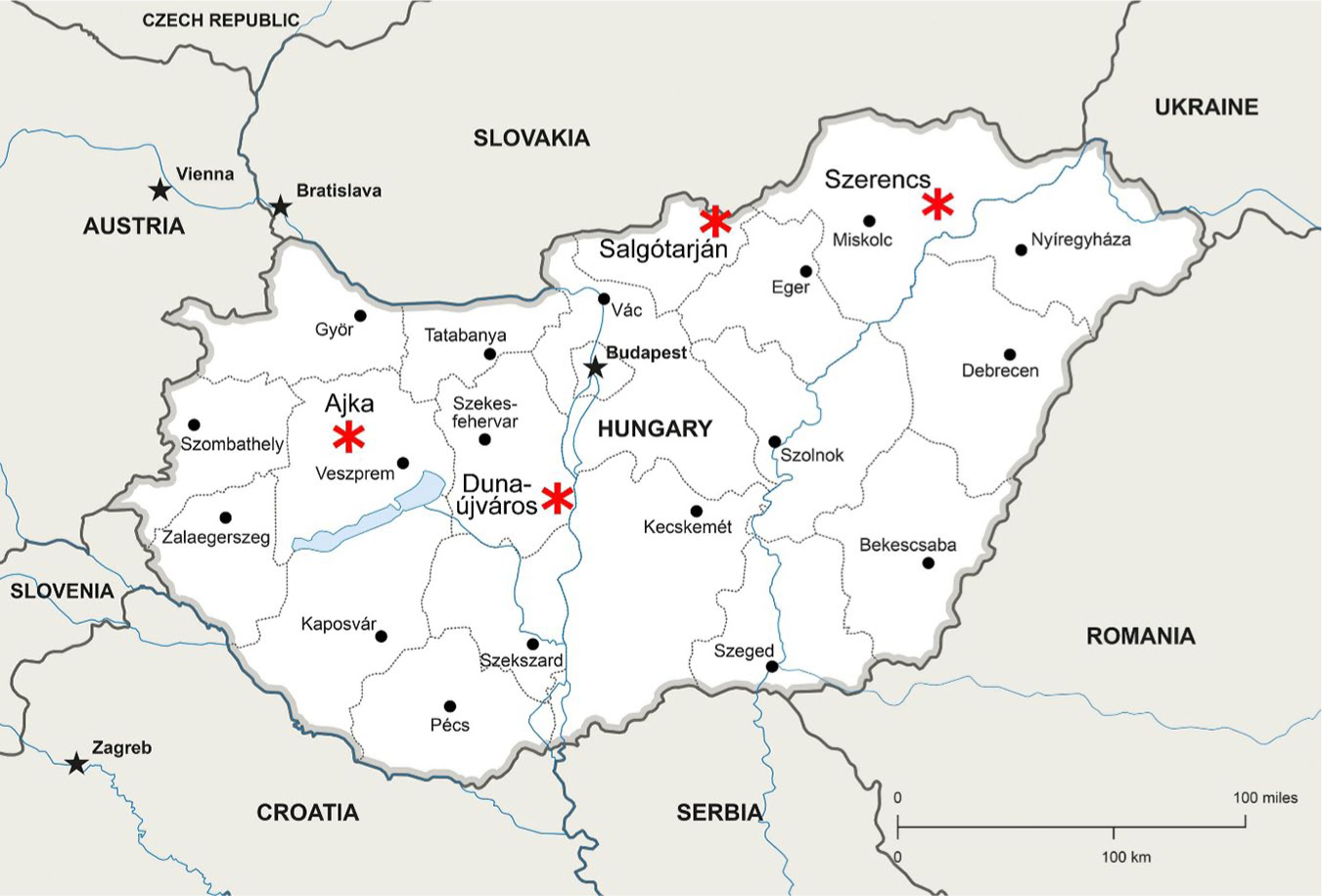
Fieldwork map.
Deindustrialisation in Hungary was massive by international standards. The most severely deindustrialised US towns, such as New York, Philadelphia, Cleveland and Chicago, lost around 30 per cent of their manufacturing labour force between 1972 and 1987 (Wallace et al., 1999: 115). In Western Europe, the most severe deindustrialisation was observable in the UK, with a 25 per cent loss of total manufacturing employment in the 1980s. In Hungary, over a few years after 1988, employment in manufacturing fell by 40 per cent cumulatively on average nationwide. Thus, the scope of deindustrialisation in Hungary is comparable to the worst regional cases in the north of the UK and the Midwest of the USA, albeit at a much faster pace. This deindustrialisation amounted to a massive social shock leading to an increase in unemployment, mortality and a decline in population. The Socialist Party dominated these towns until 2006 in national elections relying on the industrial working class. However, from the end of the 2000s, Fidesz and the radical right (Jobbik) made significant advances, and the Socialists never gained a seat in the parliament in these electoral districts since then.
With the help of research assistants, I conducted 82 interviews with workers in these four towns between September 2016 and January 2017. The goal was to have a reasonable variation in individuals’ demographic and economic characteristics and compare their experiences before and after the transition. As a result, those born in the 1980s or later were excluded. This strategy follows Bartha’s (2011b) selection of interviewees. We established contact with interview subjects through interpersonal networks, mainly using the snowball method, with additional interviewees solicited randomly at local markets and pubs and interviewed later in their homes. The interviews were based on a semi-structured questionnaire and lasted 120 minutes on average. Online Table A3 provides an overview of the questions. The total corpus of the 82 interviews is 816,118 words long encompassing 2000 typed pages. Interviews were conducted and analysed in Hungarian; only selected interview quotes are translated into English.
Table A4 in the online appendix provides an overview of the interviewees’ demographic characteristics. The majority of them are skilled manual workers; we conducted no interviews with farmers, high-level managers or technicians. Most of the interviewees fit Goldthorpe and Erikson’s (1992) class category III (routine non-manual workers), V (lower grade technicians), VI (skilled manual workers) and VII (semi- and unskilled manual workers). Interviewees are better educated and have higher than average social capital compared to the national population average. However, this means the results are conservative estimations; the shock of the transition affected less educated and more isolated people more adversely.
I analysed the interviews with computer-assisted qualitative thematic analysis (Guest et al., 2011) using NVivo 11. Following multiple rounds of reading and keyword-based text search, I applied theory-led coding, identifying the most important themes, topics and sub-topics in the interviews. Figure 2 provides a thematic map of the interviews. I identified every section of the transcribed interviews that revolve around the topics and sub-topics shown in Figure 2. The frequency refers to the percentage of the interviewees that discuss the topic or sub-topic. The thematic units and the quotes are not random or marginal; they represent significant elements of workers’ experience based on the 82 interviews. In addition to the quotes below, the online appendix provides a further 25 interview quotes.
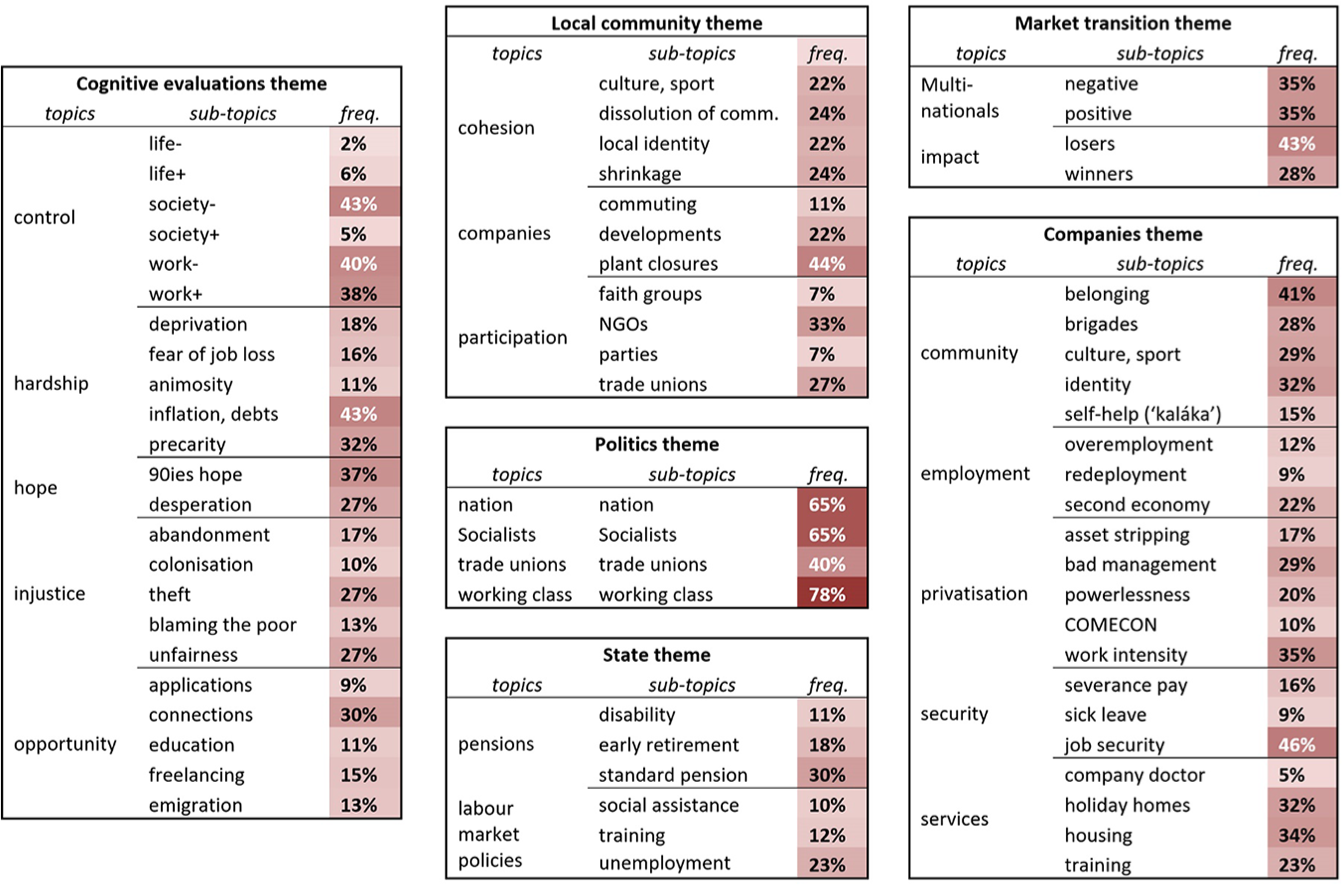
Thematic map of the interviews.
To provide an overview of how workers talk about commodification, I analysed the frequency of words in the parts of the interview corpus that revolve around the theme of the market transition. After eliminating filler words (such as connectives, prepositions, pronouns), I created unified concepts for words that have a similar meaning. For example, the words ‘worker’, ‘labourer’, ‘employee’ and so on are condensed into a single word, ‘worker’; words referring to the new economic system are condensed into the concept of ‘capitalism’. The actual interviews thus rely on less abstract concepts. I then counted the occurrence of each condensed concept using NVivo and created a word frequency table to quantify the way interviewees talk about the transition.
The Experience of Class Dislocation
Late socialism in Hungary was a welfare dictatorship based on a redistributive mixed economy (Bartha, 2011b; Szelényi, 1991). Growing incomes and extensive redistribution pacified the working class after the 1956 revolution. Economic reforms also introduced a degree of marketisation allowing for additional incomes, but market exchange remained a secondary social coordination mechanism, embedded in redistributive social institutions. This strategy allowed for a stable, predictable environment, the fulfilment of basic needs and low inequalities (Hann, 2019). Socialism, especially in the regional industrial strongholds, resulted in a complex industrial lifeworld with the working class at its core, which institutionalised a particular implicit social contract. This encompassed norms about authority (caring management and the symbolic appreciation of workers), the division of labour (workplace security, mutual trust between workers, communities, right to work) and the distribution of goods and services (equality, state redistribution and social security). These moral memories serve as the benchmark against which workers evaluate the transition from socialism to capitalism.
The interviews revealed that workers despised the lack of political freedom under state socialism. The majority also had the unambiguous opinion that the economic model was not sustainable (theme companies, sub-topic overemployment). However, interviewees also pointed out many positive traits of state socialism, without regard to their age. Permanent employment, low inequality, company and council housing provided for a solid material base of life (theme companies, topics employment and security). Beyond the material side of security, interviewees frequently talked positively about local and company communities, company and local identity and a less top–down, more caring leadership style (theme companies, topic community).
However, Hungary’s mixed-economy socialism could not compete technologically with advanced market economies; thus, the programme of radical marketisation prevailed over gradual reforms at the end of the 1980s (Fabry, 2019). As reforms emancipated the market from its secondary role and Hungary integrated into the global capitalist economy, social relations were profoundly commodified. Some interviewees recalled new opportunities (theme cognitive evaluations, topic opportunities). Political democratisation, getting closer to the West and joining the EU evoked hopes (theme cognitive evaluations, topic hope). Many expected that the situation of their company would improve with the market transition. Many regarded foreign investors with positive expectations: When Nestlé arrived in 1990, buying the local chocolate factory, everyone was celebrating. Everyone believed they would earn 300 thousand forints [around 1000 euros] a month. There was this street festival welcoming the company with bouncing castle and whatever. There was a massive march, Mayday, everything you can imagine. (Secretary, Szerencs, OTP Bank (National Savings Bank))
Despite this, the market transition was a negative experience for the majority of interviewees. The loss of jobs or the fear of job loss were not the only problems (theme cognitive evaluations, topic hardships). Even those who did not lose their jobs talked about a decline in their living standard. Negative experiences related to the market transition go beyond material deprivation, and encompass insecurity and the loss of subsidised services, such as company housing or holidays: Before the regime change, life was better (laughs). You knew you had a safe job, secure income, a way to make a living. You knew you could go on holidays. You were not stressed. You had no debt. Do you understand? You lived normally. I have not been on holiday for a long time; before the transition, we went on holiday each year from the Alumina Factory. To Balatonalmádi, or Balatonfüred. Yes, they had a holiday home, and we went on holiday twice each year, for two weeks. Since I became an entrepreneur, I have not even been on holiday. Nowadays, we are under tremendous stress. . . . I can hardly get any sleep these days. My hands, my feet are often numb. (Small business owner, one-time skilled manual worker, Ajka, Alumina Factory)
The collective stories affecting the towns or the companies represented another crucial issue (theme local community, topics cohesion and companies). Increased precarity and competition for declining resources contributed to the deterioration of company communities. Even those companies that survived the transition eliminated their cultural and sports facilities (theme companies, topic privatisation). Interviewees perceived privatisation as large-scale theft or pillaging of the company assets (theme companies, topic privatisation).
Interviewees are more lenient towards Hungarian capital and think the problems with Hungarian companies emanate from bad management, not from the fact that they pursue profit. By contrast, several interviewees talked about injustices, slavery and colonialism on a systemic level concerning the practices of foreign companies (theme cognitive evaluations, topic injustice). In the case of ‘multik’, the Hungarian short term for transnational corporations, it is not just bad management, but the very logic of their operation that interviewees see as problematic: Now the situation is that we were sold as cheap slaves to the West. Isn’t it us, who produce? What sort of transition is, and I mean economic, that before that 90 per cent of people worked for Hungarian companies? Now anybody, who can work, 90 per cent of them works for foreign firms. (Skilled manual worker, Ajka, Alumina Factory)
The fate of companies intertwined with the future of the settlements. Deindustrialisation caused the collapse of the identity of a whole town (theme local communities, topic companies). As the companies were shut down, children with families disappeared, restaurants and other entertainment facilities also closed down, while earlier iconic buildings became abandoned: ‘Children used to play football and hide-and-seek in the neighbourhood. You could hear children playing. Now it is entirely silent’ (Skilled manual worker, Salgótarján, Steel Factory).
The experience of injustices violated the implicit social contract; however, it did not result in wholesale desperation among the majority of the interviewees in the 1990s (theme cognitive evaluations, topic hope). For the accumulated experience of injustice to turn into hopelessness, workers also had to feel a complete lack of control, powerlessness against these injustices (theme cognitive evaluations, topic control). While some reported an increased control over workplace affairs, the perception of losing control over society is unambiguous (43 per cent reports lack of control at a social level opposed to the 5 per cent who felt having control). Interviewees often mention ‘conspiracy’ and ‘external powers’, demonstrating the experience of powerlessness.
In contrast to the mood of the 1990s, the majority of the interviewees recall the second half of the 2000s as a period of desperation. Several interviewees complained that without material security, the newly gained political rights do not mean much: Do you know what one of my elderly patients said? He was 92, the one I looked after the last. He said they unleashed the dog, but the dog hasn’t got any food to eat. That is freedom: no chains but no food either. (Salesperson in a pharmacy, caretaker for the elderly, Ajka)
Several interviewees reported that they got into severe debt to ensure their housing in the 2000s (theme cognitive evaluations, topic hardships, sub-topic inflation and debt). Although access to urban housing was also unequal before the transition, the socialist state invested significantly more resources into securing housing for the masses. This social policy intervention ceased to exist after the regime change.
As a summary of the topics discussed in the section, Figure 3 depicts the frequency of words used in relation to the transition from socialism to capitalism, as described in the methods section. Without expressing their feelings in ideological terms, workers readily connect their negative experiences to the economic transformation.
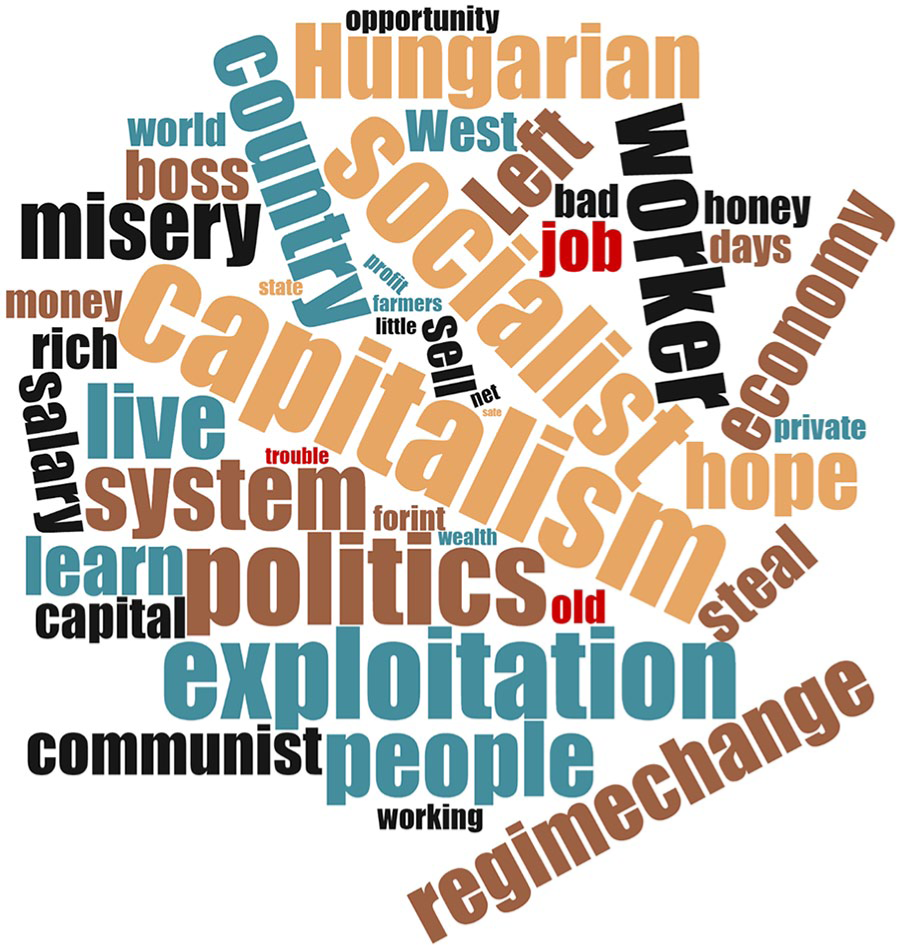
Capitalism word cloud.
The most frequent word in those paragraphs of the transcript that revolve around the market transition is ‘exploit’. Verbs like ‘sell’, ‘steal’ and ‘make (money)’ are also frequent, which shows the importance of the topics of privatisation and living standards. The most frequent nouns include ‘West’, ‘hope’, ‘people’, ‘slavery’, ‘misery’, ‘wages/salary’, ‘workers’, ‘peasants’, ‘capital’, ‘profit’, ‘rich’, ‘wealth/fortune’, ‘boss’ related to the new economic system. These words convey a message about the combination of high hopes and a variety of negative experiences described above.
The Rise of Neo-Nationalist Narratives
Although the majority of interviewees have a shared experience of class dislocation, there is no connection between individual fates and the problems affecting society on a systemic level. This lack of group identity is prevalent even among interviewees who were members of some non-governmental organisation, party or trade union. There is no intermediary collective identity covering the level between the totality of the nation and the individual.
The lack of shared identity is most apparent from the answers given to questions on the working class (theme politics, topic working class). The majority of interviewees knows precisely what the working class is, but thinks that as a class with a collective identity, it ceased to exist: ‘There is a working class, as I am part of it. However, we do not call it the working class. We do not call it like that’ (Skilled manual worker, Duna Steel Works, Dunaújváros). Many interviewees also connected the weakness of the working class to the fault of the trade unions: A long time ago, the trade union, the working class was more powerful. There was stronger cooperation, and they could enforce things. With strikes, and everything. Now there is no cooperation. This is the problem. Everybody is occupied with their little problems. Because people are afraid of losing their jobs. (Skilled manual worker, Ajka, Alumina Factory)
A final important factor behind the weakness of the working class according to several interviewees is the unwillingness of the Hungarian Socialist Party to represent workers (theme politics, topic Socialists). Some approached this from the organisational perspective: Practically there is no force that would hold workers together. For instance, within the Hungarian Socialist Party, when I look at Salgótarján, I don’t know, I will tell you a number, the organisation has 150 members, and there are about 10 workers in it, I don’t know. And even those, they are rather pensioners, so they only used to be workers. Those who are still working, they are not there. (One-time government middle manager, Salgótarján)
The majority of interviewees does not have such an insight into politics. However, they still connect MSZP to the ill-fate of the working class. There are two groups of those disappointed in the left. One group encompasses left-wing voters who are in apathy. The other group consists of workers who do not vote for the left anymore; they either turned to Fidesz or do not vote at all. They frequently express their view that the left is not left; it does not represent the workers: ‘You heard it well; there is no left. No left. The left says it represents traditional values, workers, the interests of ordinary people via democracy, so there is no left in Hungary’ (Skilled manual worker, Ajka, Coal Mine). Interviewees not only blame the Hungarian Socialist Party for abandoning the working class but also for their shady dealings during privatisation and their firm embeddedness in the economic elite: I voted for the, what’s their name, Socialists, because I thought as a worker, from birth and on a social level, erm, I am left-wing, and they were a so-called workers’ party. I went and voted for them. When I saw, and not mentioning, I got this book, about the oil mafia. These so-called socialists got into power, with what, erm, sort of money, well, I, from then. . . Moreover, most of all, in this town, which they destroyed, and what I experienced myself, personally. So, I turned away from them. And I didn’t find anybody else to vote for. . . . So, this was the first time I voted for Orbán. For Fidesz, not for Orbán, for Fidesz. (Skilled manual worker, Dunaújváros, Steel Works)
The significance of ‘stealing’ company holiday homes and community houses is more significant than we would first think: The Alumina Factory had a small wooden house. We worked a lot on it. The factory also had a trade union holiday home in Balatonvilágos that workers also helped to keep in shape. And then it was sold, and we were kicked out. What we built up, they destroyed. (Skilled manual worker, Ajka Alumina Factory, Ajka)
Interviewees mostly blamed MDF and MSZP for the failure of the transition. Fidesz formed a government for the first time in 1998, and many believed they had been left out from the accumulation of assets in the early years of the market transition. Therefore, many regarded Fidesz as a power that may be able to correct the failed transition.
In contrast to class, the nation frequently figures at the centre of a shared narrative identity. The nation acts as the prime subject of the traumas and the grievances and as a public narrative framework of a shared story about the transition, which relates the individual to the totality of the nation: I am saying to you if one can do that to a nation what they did in the past 20 years, it is not a nation anymore. When people are in such an impossible situation and praise those who made their situation impossible like sheep, this is not a nation anymore. (Skilled manual worker, Salgótarján)
The term nation evokes the ideas of integration, pride and solidarity. Several interviewees regard the nation as a large community suitable to overcome everyday divisions and animosity, to counterbalance the decline of communities and the lack of solidarity. For people feeling left behind, it also provides a sense of belonging. The concepts of the nation, the state and redistribution often mingle; that is, interviewees regard the nation as institutionalised solidarity: The nation is a special group of people with a shared goal and shared understanding in their souls, with love imprinted at its core. And loving means caring for the other. . . . The nation is like a giant chain. Every link in the chain has to be strong, and then even the weakest link is strong. This is what a nation is. (Former bank clerk, now social worker, Szerencs, Day nursery)
The nation is not an abstract cultural concept. It is about the economic security, cooperation and solidarity of those living within the borders of the nation-state. The purpose of the nation as a community is to protect and promote the material interests of its members. This type of nationalism with material overtones resonates even with ex-MSZP voters, especially those living in deindustrialised areas with a perception of being left behind: Well, at that time, I voted for MSZP. In 2008 and 2010 also, even until ’12–13, I voted for them. But . . . in 2014, I voted for Fidesz, yes, in ’14 I did. . . Orbán is right; we should not let people in from other countries. No matter what their religion is, or other, because what can we hear, what do they do? They steal even from each other. Initially, when they came, it was not so bad. . . . They say we should let in some, who could find meaningful jobs. But what jobs? There are no jobs for them here. Everything was destroyed here. (Unskilled manual worker, Miskolc Bus Factory, Szerencs)
Defending the nation as the guarantor of the implicit social contract, as a way to restore solidarity towards each other, is related to workers’ increased competition for scarce assets available within the borders of the country only: The concept of the nation? Our Prime Minister Orbán says power is in the nation, in unity. The nation is about solidarity; our strength lies in our unity as a nation. It’s about dealing with our own problems first, not with the world’s. First, improve our lives, and then deal with others. I have the same opinion. We should unite. People should keep together more. We are alienated. Nobody knows in the block of flats who is their neighbour. There is no contact. We are afraid of each other. (Miner, Ajka, Coal Mine)
Some interviewees not only see migrants as a threat to the nation but domestic minorities as well. That is, this type of nationalism is not universalist; it is tightly connected to a workfarist, welfare-chauvinist definition of a ‘good’ member of the nation: Well, those who did not want to find work, because their unemployment benefit was too high, almost 70 per cent of them became alcoholic. And to tell the truth, I do not feel sympathetic [towards them], to tell the truth, I was also unemployed for a month, but I didn’t drink, I sought work. There were people who did not want to work. (Skilled manual worker, Ajka, Alumina Factory)
As channels of mobility are blocked, the easiest way for workers to maintain their dignity is by distancing themselves from those below. This allows interviewees to represent themselves as ‘good’ members of the nation worthy of appraisal. Workers also very often criticise the corrupt elites formed during the transition, especially connected to the Socialist Party; as well as liberal intellectuals who only talk about rights without any meaningful assurance of actually being able to practise those rights.
Concluding Discussion
This article presented the results of a computer-assisted qualitative thematic analysis of 82 interviews in four mid-sized towns in the Hungarian rustbelt. Extending Polanyi’s theory of commodification and the countermovement, the study followed a geographically and culturally sensitive class concept and relied on Barrington Moore’s (1978) notion of the implicit social contract to capture the complex entanglement of economy, culture and changing narrative identity. The results show that socialism institutionalised an implicit social contract comprising morals regarding authority, the division of labour and the distribution of goods and services. This moral framework embedded workers’ everyday experience of class dislocation during the transition from socialism to capitalism.
Confirming existing research (Bartha, 2011b), the article showed that in the early 1990s, the majority of the interviewed workers accepted capitalism and expected their living standards to improve with the arrival of transnational corporations. However, the majority of the interviewees experienced commodification as a violation of the implicit social contract, including the relatively well off. Individual-level perceptions are entangled in the changing economic geography of particular locations, cross-cutting general perceptions of injustice in the context of geographically uneven development (Hall and Savage, 2016; Smith, 2010).
The liquidation of socialist companies hastened the dissolution of local communities, local cultural and sports life and eroded workers’ place-based identities. The long-lasting shock of the ‘half-life of deindustrialisation’ was strongly felt in the four towns even long after plants were shut down. This echoes workers’ experiences in deindustrialised towns in the West, where research has found a similar long-lasting degradation (Strangleman, 2018). The results are also in accordance with the research that has shown that the expansion of the private sector has led to a rise in income inequality (Bandelj and Mahutga, 2010; Mahutga and Jorgenson, 2016) as well as mortality inequality (Scheiring et al., 2018).
The interviews also revealed that workers’ sense of control waned. This is in accordance with the results of large-sample surveys carried out in the first years of the transition (Simon, 1993: 232–234). This sense of powerlessness is also similar to the experience of workers in Western Europe and the USA: for example, as the slogan ‘taking back control’ during the Brexit campaign shows. The combination of the multiscalar perceptions of injustice, the feeling of being left behind and powerlessness fuelled workers’ desperation and overall disappointment with the transition from socialism to capitalism in the second half of the 2000s (Pew Research Centre, 2009).
Several interviewees saw the working class as the victim of the transition, abandoned by the Socialist Party and trade unions. The collapse of companies and the concomitant erosion of place-based identities and company communities further contributed to the disintegration of the working class and the decline of the sense of control. As the Socialist Party was perceived to be deeply involved in implementing the commodifying reforms, trade unions were weak, and the symbolism of the class language lost its power, workers’ shared experience of class dislocation did not lead to the development of a shared class-based narrative about the transition.
The nation became the collective narrative identity that not only provided a sense of community and belonging for those feeling left behind but also gave workers a language to tell their stories about the transition in the first-person plural. The nation as a moral community involves rules about the distribution of power, assets, status and rewards, and thus has the potential to act as a discursive container to hold the elements of the implicit social contract. Therefore, the nation as a signifier has moral overtones that allow it to function as an outlet for the experience of class dislocation. Qualitative research among white Londoners has shown that English nationalism is also associated with a sense of cooperation and community (Leddy-Owen, 2014). Nationalism is a powerful tool to create a perception of commonality of interests and bridge working-class subcultures in different regions, acting as a robust master frame.
Despite the associations between nationalism and solidarity, the interviews revealed a two-pronged exclusion as proposed by the theory of neo-nationalism (Gingrich and Banks, 2006). First, different types of elites appear to threaten the nation as a solidarity community from above, such as transnational capital, liberal elites and corrupt politicians. Workers also assessed national and international capital differently. This moral double standard might explain why workers can empathise with the revolt of the national capital against transnational capital, even if it involves the redistribution of resources to the top at the expense of workers (Scheiring, 2019). The post-2010 alliance of transnational and national capital and nationalist politicians can exploit these ambivalences of working-class neo-nationalism.
This study showed that some workers grew increasingly hostile also towards the unemployed, migrants or various minorities. Leddy-Owen (2014) also found that distinctions along ‘race’ and class go against the more inclusive aspects of white English nationalism. Thomas et al. (2017) found a similar tension between inclusion and exclusion in white working-class communities in a small English town. However, as Flemmen and Savage (2017) also pointed out using survey data, the nationalism of the ‘disenfranchised’ is anti-establishment nationalism, which is not strongly racist. The interviews presented in this study also show that anti-elite sentiments and the experience of downward mobility are intertwined with the cultural distinctions that workers are making. The distinction between worthy and unworthy workers is a tool to achieve recognition.
Fidesz also had a constitutive role in creating a new hegemonic alliance between national and transnational capital and the state, exploiting workers’ disillusionment (Scheiring, 2018). Szombati (2018) highlighted that the competition between Jobbik and Fidesz profoundly contributed to the mainstreaming of avant-garde fringe-nationalism into a hegemonic culture in Hungarian villages. The migration crisis that hit the country in 2015 also provided an opportunity for Fidesz to connect global economic and migratory turbulences (Bocskor, 2018; Fabry, 2019). Workfare and pronatalist family policies also serve to entrench the moral hierarchies between ‘deserving’ and ‘undeserving’ citizens, undermining the emergence of a broad social coalition among the victims of Orbán’s authoritarian capitalism (Scheiring and Szombati, Forthcoming 2020). Finally, the favourable economic environment also contributed to the legitimacy of the new hegemonic alliance. However, the interviews presented in this study have shown that the neo-nationalism is an ‘emplotted narrative’ (Somers, 1994: 614) built on the lived experience of the working class as the implicit social contract was violated during the transition from socialism to capitalism. Neo-nationalism is not just constructed from above by demagogue politicians but is rooted in workers’ lived experience of class dislocation.
Kalb’s (2009) fieldwork among Polish workers uncovered similar factors behind working-class neo-nationalism, including the stress on community decline, outmigration, criminal privatisations, the perception of powerlessness and the betrayal by formerly trusted elites. Gökarıksel (2017) and Ost (2006) described the same process focusing on the increasing gap between trade union organisers and increasingly anti-labour liberal politicians. Shields (2014) also showed that neoliberal policies in Poland contributed to working-class populism and the rise of the illiberal right. These processes allowed for the upscaling of illiberalism and a shared East-Central European project against the liberal status quo (Kalb, 2018). A new strand of qualitative research in the wake of the Trump and Brexit shocks also showed that working-class populism in the USA and UK is connected to rising social and regional polarisation, the sense of being left behind as new regional economic centres emerge (Hochschild, 2018; McQuarrie, 2017).
At the intersection of global processes and local political-cultural path dependencies, local instances of the neo-nationalist countermovement take various forms. However, reading these works together, it becomes evident that Western and Eastern European neo-nationalist populisms share similar roots related to the lived experience of class in the context of globalisation. As most Eastern European states went further in adapting avant-garde neoliberalism (Appel and Orenstein, 2018), they are now the avant-garde of the neo-nationalist countermovement, but the roots are similar. Sadly, this makes the article relevant in many countries across the globe.
Footnotes
Acknowledgements
I am grateful to the Independent Social Research Foundation (ISRF) for their financial support that I received as a Political Economy Research Fellow at the Department of Sociology at the University of Cambridge. The European Research Council’s funding for the Privatisation and Mortality research project contributed to the costs of the fieldwork. The Reagan-Fascell Democracy Research Fellowship of the National Endowment for Democracy (NED) allowed me to spend half a year in Washington, DC, which proved to be an invaluable opportunity to discuss the rise of authoritarian nationalism with other experts and refine the theoretical framework. I would like to thank Milán Falta, Ágnes Fernengel, Péter Harsányi, Eszter Mátyás, Eszter Turai and Boglárka Vincze for their superb research assistance. I would like to thank all interviewees who spoke to us. I am also indebted to numerous colleagues at Cambridge and beyond who provided much appreciated critical feedback at various stages of my research.
Funding
The author disclosed receipt of the following financial support for the research, authorship and/or publication of this article: the project received funding from the Independent Social Research Foundation (ISRF) and European Research Council (Grant number 269036).

Supplemental material
Supplemental material for this article is available online.