




Abstract
Charitable responses to people experiencing poverty are often viewed as valuable community-led initiatives that address the support gaps created by a withdrawing welfare state. This perspective provides important insights into the culturally valorised nature of charity. The role of the mainstream media in cultivating and valorising charity, in contrast, remains relatively underexplored. Drawing on a framing analysis of Australian mainstream news reports published between 2014 and 2020, we analyse how the media frames charity as a response to people experiencing poverty. We demonstrate that the media frames people experiencing poverty as having a devalued identity, for which the remedy is the restoration of dignity through charity. Little attention is paid to the material inequalities that underpin people’s experiences of poverty; nor the role of the media as a body that reifies the interests of the powerful, who benefit from poverty and charitable responses to it.
Introduction
Providing charity to people experiencing poverty is a highly valorised activity in wealthy societies. People who provide charity are seen as selfless and benevolent, and are rewarded with the ‘good glow’ of social recognition and esteem (Dean, 2020). The practice of charity itself is perceived as symbolising important social values: from good citizenship, to community resilience, to social solidarity (Clarke and Parsell, 2021; Muehlebach, 2012). This celebratory view of charity persists despite research evidence indicating that charity often has negative impacts on its recipients. People who rely on charity due to poverty report experiencing shame, stigma and a loss of agency (Parsell and Clarke, 2020; Purdam et al., 2016; Smith-Carrier, 2020). Some research goes as far as suggesting that charity contributes to the perpetuation of the social inequalities that produce poverty, by ameliorating their worst effects and providing a sense that ‘everything is taken care of’ (Hackworth, 2012; Levitas, 2012).
Given charity’s demonstrable negative impact on people experiencing poverty, this article examines why and how charity continues to be valorised in the public consciousness. It does so through an analysis of media representations of charitable response to people experiencing poverty in Australia between 2014 and 2020. In focusing on the media, we take as our point of departure existing research that explores the role of the state and political discourse in the valorisation of charity in wealthy societies. Informed by prevailing neoliberal ideologies, governments promote charity as an example of bottom–up community ingenuity and resilience stifled by an overbearing welfare state (Clarke and Parsell, 2021; Hackworth, 2012; Muehlebach, 2012). They portray charity as more flexible and responsive to the needs of diverse modern communities than traditional welfare, and as a means of strengthening community bonds. These celebratory portrayals of charity are used by governments to legitimise welfare-state retrenchment and austerity (Hackworth, 2012), which, in turn, deepen poverty and increase the need for – and thus importance of – charity (Lambie-Mumford, 2019; Levitas, 2012).
This article contributes to this literature in two important ways. First, it demonstrates the role of the media in promoting charity as a response to people experiencing poverty. This aspect has been often overlooked in the state- and policy-focused work outlined above. Traditional media – that is, print and broadcast news – play an important role in framing how social problems are understood by society (Curran, 2002; Entman, 1993; Lukes, 2004). They also shape what counts as a legitimate response to these problems in the public imagination. As we show, the media goes to significant lengths to frame charity as a valuable and effective response to people experiencing poverty, thereby contributing to its social valorisation.
Second, we show how the celebration of charity corresponds with a broader shift in how social inequalities are understood in contemporary societies. Charitable initiatives are celebrated in the media for restoring ‘dignity’ to people experiencing poverty by helping them address the manifestations of their poverty (e.g. dirty clothes, hunger) and thus to pass as ‘normal’. Media representations of charity thus construct poverty as primarily a problem of recognition (Fraser, 2000); that is, as matter of the devalued social status or identity of people experiencing poverty. In doing this, media representations of charity contribute to the obscuring of the material/distributive inequalities that underpin contemporary experiences of poverty, and the role of welfare-state retrenchment and austerity in driving these inequalities.
The remainder of this article is structured as follows. We begin by outlining the role of the media in shaping understandings and responses to social problems such as poverty. We then outline how the concepts of ‘recognition’ (Fraser, 2000) and ‘social status’ (Weber, 1948) guide our analysis and connect our findings with broader shifts in how poverty is understood. After describing our methodology and the Australian media landscape, we present the findings of our analysis. We show how charity is represented in the Australian media as a means of achieving recognition by restoring dignity to people experiencing poverty and thus reintegrating them in the normative order of society. We also show how the media reinforces the privilege of mainstream society by conferring honour and esteem on people who provide charity. We conclude by reflecting on how media representations of charity perpetuate the economic injustices that characterise contemporary neoliberal societies and serve the interests of powerful elites.
Poverty and Charity in Mainstream Media
The mainstream media is a highly influential social institution with considerable power to shape social discourse and debate (Curran, 2002; Entman, 1993; Lukes, 2004). The media does not simply disseminate objective information about political and social issues. Rather, the media holds the power to determine which issues are given prominence in social discourse, and how they are portrayed (Curran, 2002; Lukes, 2004). As Curran (2002: 237) argues, decisions regarding how issues are framed in the media ‘always involves arbitrating between the discursive frameworks of rival groups. Which frameworks are included or excluded matter because over time it can affect collective opinion and, indirectly, the distribution of resources and life chances in society.’ Importantly, media outlets are run by elite members of society, affording them the power to make decisions regarding which discourses are favoured in their publications. Therefore, although the media often purports to be a voice for society, its framing of social issues predominantly reflects the views and interests of the elites (Curran, 2002). Media outlets are particularly powerful in contexts where media ownership is highly concentrated, as this concentration limits the public’s access to alternative discourses and ways of thinking about social issues.
The media’s ability to shape how social issues are presented to and understood by the public has significant implications for the way in which society chooses to respond to such issues. The media has long been recognised as a mechanism for social regulation, as it promotes shared understandings of desirable and acceptable behaviour and encourages particular responses to social problems (Curran, 2002; Entman, 1993). Indeed, as Lazarsfeld and Merton (2004) argue, the media has the ability to confer social status to particular social actors and enforce social norms by reinforcing the morality of those who uphold them and disparaging those who do not. When we consider these functions in the charity–poverty context, it becomes clear that an interrogation of the media’s framing of these issues is crucial for understanding how the media reproduces or challenges dominant political discourses about people who experience poverty and how individuals and society should respond.
The significance of media framings of poverty has long been recognised by social scientists. There is thus a well-developed body of literature that examines media framings of poverty and their potential effects (see, for example, Chauhan and Foster, 2014; Gavin, 2021; Hodgetts et al., 2005; Lepianka, 2015; Loseke, 1997; McArthur and Reeves, 2019; Smith-Carrier, 2020). This literature demonstrates that the media often frames poverty and the people who experience it in highly stigmatising ways that serve to reify their marginalisation. Several scholars, for example, find that the media has a strong tendency to portray the causes of poverty as embedded in personal failings and moral deviance (e.g. laziness, addiction, irresponsibility), thereby overlooking the broader social and structural factors that facilitate poverty (e.g. employment opportunities, access to affordable housing) (Chauhan and Foster, 2014; Gavin, 2021; Smith-Carrier, 2020). As a result, people who experience poverty are framed in the media as being entirely responsible for their undesirable circumstances and undeserving of state-provided support (Gavin, 2021; McArthur and Reeves, 2019).
Although the existing literature demonstrates that the media frames people experiencing poverty in highly stigmatising ways, comparatively less is known about how the media frames charity as a response to people living in poverty. Examining such framing is important for understanding the role of the media in perpetuating poverty and cultivating charitable responses to the issue. In this article, we present an analysis of Australian media framings of charitable acts towards people who experience poverty with the aim of addressing this gap in knowledge.
Recognition and Social Status
We contend that charity is valorised in the media for responding to poverty as a problem of ‘recognition’. The politics of recognition have come to dominate social struggles in contemporary societies thanks to a confluence of factors, ranging from the impact of ‘new social movements’ centred on issues of identity and difference (rather than class), to the depoliticisation of markets and political economy by neoliberalism (Fraser, 2000; Povinelli, 2002). Recognition is generally conceived as the acknowledgement and acceptance of social and cultural difference, and the right of marginalised groups to define their own identities. However, as our work shows, recognition plays out somewhat differently in the context of poverty and charity. While people experiencing poverty are marked as different, the aim of charity responses is not to recognise that difference. Rather, recognition is about acknowledging the sameness and normalcy of people experiencing poverty – or, more precisely, by providing marginalised groups with material and social resources that will enable them to be recognised as such.
To make sense of the specific form of recognition at play in the charity–poverty context, we conceptualise it in Weberian terms as a concern with inequalities in social status (Fraser, 2000; Weber, 1948). Weber (1948) famously argued that status inequalities are distinct from class inequalities. Unlike class differences, which are produced by people’s relationship to the market, differences in social status are the product of the unequal distribution of social honour and esteem. This honour/esteem is linked to a group’s embodiment of ‘a specific style of life’ as reflected in their comportment, social attitudes and consumption activities (Weber, 1948: 932). Recognition that one possesses status honour is associated with ‘a sense of dignity’ (Weber, 1948: 934), and inclusion in social intercourse with other members of esteemed groups. Conversely, a failure to be recognised as such is associated with experiences of shame and social exclusion.
Fraser (2000) draws on Weber’s analysis to argue that addressing inequalities in status/esteem through a politics of recognition is a necessary feature of the struggle for social justice. However, such struggles can only achieve social justice if they are coupled with a politics of redistribution, which tackles the material dimension of social inequalities and their basis in political economy. According to Fraser, the problem with contemporary approaches to recognition is that they tend to displace the politics of redistribution in favour of a reductive ‘culturalist’ understanding of inequality. This approach, which Fraser associates with identity politics, often ignores material inequalities and instead preoccupies itself with cultural/symbolic representations of disesteemed groups. When material inequalities are recognised, they are reduced to ‘a secondary effect of misrecognition’ and the inequalities in status and esteem that it entails (Fraser, 2000: 111). Crucially, this leads to a belief that material inequalities ‘can be remedied indirectly, through a politics of recognition’, thus eschewing efforts to tackle the political economic processes that contribute to maldistribution (such as unregulated markets or inadequate welfare safety-nets).
For Fraser (2000), the privileging of recognition over redistribution is problematic, as both modes of politics are required to achieve social justice. Recognition and redistribution correspond to different aspects of the social order – the status order and economic structure of society, respectively – which produce different forms of injustice. In the status order, injustice is the product of ‘status subordination’, wherein certain groups are excluded from equal participation in social life on the basis of their belonging to a socially devalued group (or groups) and/or their failure to conform to socially valued styles of life (Weber, 1948). The economic structure, in contrast, gives rise to maldistributive forms of injustice, ‘in which economic structures, property regimes or labour markets deprive actors of the resources needed for full participation’ in social interaction (Fraser, 2000: 117). These orders and modes of injustice are ‘imbricated and interact causally with each other’ (Fraser, 2000: 117); however, neither is fully determinative of the other, meaning that both must be reckoned with if social justice is to be achieved.
The framing of poverty primarily in terms of status recognition is, of course, somewhat counter-intuitive. By definition, poverty is a state of material deprivation – although it is today recognised as also including dimensions such as shame, alienation and violence (Lister, 2004; Walker, 2014). Our contention is that the celebration of charity as a practice through which recognition of people who experience poverty is achieved is linked to a broader shift away from the politics of redistribution and the associated concern with the economic structures of society. Several factors have contributed to this shift. The Third Way politics of the late 1990s and early 2000s sought to reconcile Left-leaning constituencies to globalisation and market-centric governance by reframing socio-economic inequality as a problem of ‘social inclusion’, or how to ensure that the benefits of market-led economic growth are shared with marginalised groups. The focus of social policy thus shifted away from redistribution and towards the normative reintegration of marginalised groups in market society through employment and reattachment to (local) community (Deeming and Smyth, 2015; Rose, 2000).
At the same time, the rise of the ‘consumer society’ also contributed to transforming how poverty is understood and experienced. As Bauman (2005) argued, consumer society elevates aesthetic self-construction through market-mediated consumption choices as a normative social expectation. In this context, people experiencing poverty become ‘flawed consumers’: people unable to meet prevailing aesthetic standards – which Bauman sees as not only about one’s appearance, but also about the accumulation of culturally valuable experiences, and thus as possessing devalued identities or social status. As Tyler and Slater (2018) remind us, it is important to think about how the celebration of charity vis-a-vis the stigmatisation of poverty sit within a political frame where the powerful groups benefit from the continuation of a hollowed-out welfare state and the charitable care that seeks to soothe its negative consequences.
Methodology
Data
Our research answers the question: how does the Australian media frame charitable acts towards people who experience poverty? To answer this question, we analyse news reports published in Australian mainstream news outlets – both in print and online – between 2014 and 2020. Although the view of charity as a desirable response to people who experience poverty is not unique to the Australian context (see, for example, Lambie-Mumford, 2019), Australia’s unusually high concentration of media ownership positions it as a useful case study through which to examine the media’s role in shaping public perceptions of charitable acts (Dwyer, 2014). In Australia, approximately 98% of print-media ownership is concentrated among the three most dominant media companies, compared with 62% in the United Kingdom and 26% in the United States (Dwyer, 2014). A high concentration of media ownership limits media consumers’ exposure to diverse or alternative perspectives and contributes to certain framings of an issue coming to dominate (Barnett, 2010). These dominant framings generally support the interests of powerful groups within society and limit the available perspectives upon which people can draw to shape their views of and responses to the issue (Barnett, 2010). The concentration of Australian media means that its ability to influence society through its framing of charitable acts may be particularly strong.
Australia has four mainstream national news outlets, all of which were included in the study. Two of these outlets, The Australian and The Australian Financial Review (AFR), are commercially owned. The remaining two outlets, Australian Broadcasting Corporation News (ABC) and Special Broadcasting Service News (SBS), are publicly owned and primarily funded through the Australian Government (Australian Government, n.d.). The SBS is funded through a public–private mix, although the public share is the greatest. Based on the criteria outlined in Table 1, and consistent with Joshi and Swarnakar (2021), we used the Factiva media database to search for all online and print reports published by Australia’s four national news outlets between 1 January 2014 and 31 October 2020. We conducted the search using the following Boolean search phrase, developed to reflect our inclusion/exclusion criteria through several rounds of pilot searches: (ATLEAST2 charit* OR ATLEAST2 volunteer* OR ATLEAST2 philanthrop*) AND (poverty OR ‘low income’ OR disadvantage* OR homeless*) NOT (animal* OR climate OR cancer OR investigat* OR tax OR trustee OR insurance). This search returned 1313 news reports of potential relevance to our study. To address gaps in Factiva coverage, we supplemented our Factiva search with additional searches of the SBS and AFR websites to identify any additional potentially relevant online news reports not accessible through Factiva. Although these searches were limited by the basic nature of the websites’ search functions, they resulted in an additional 66 potentially relevant reports being identified.
Inclusion and exclusion criteria.
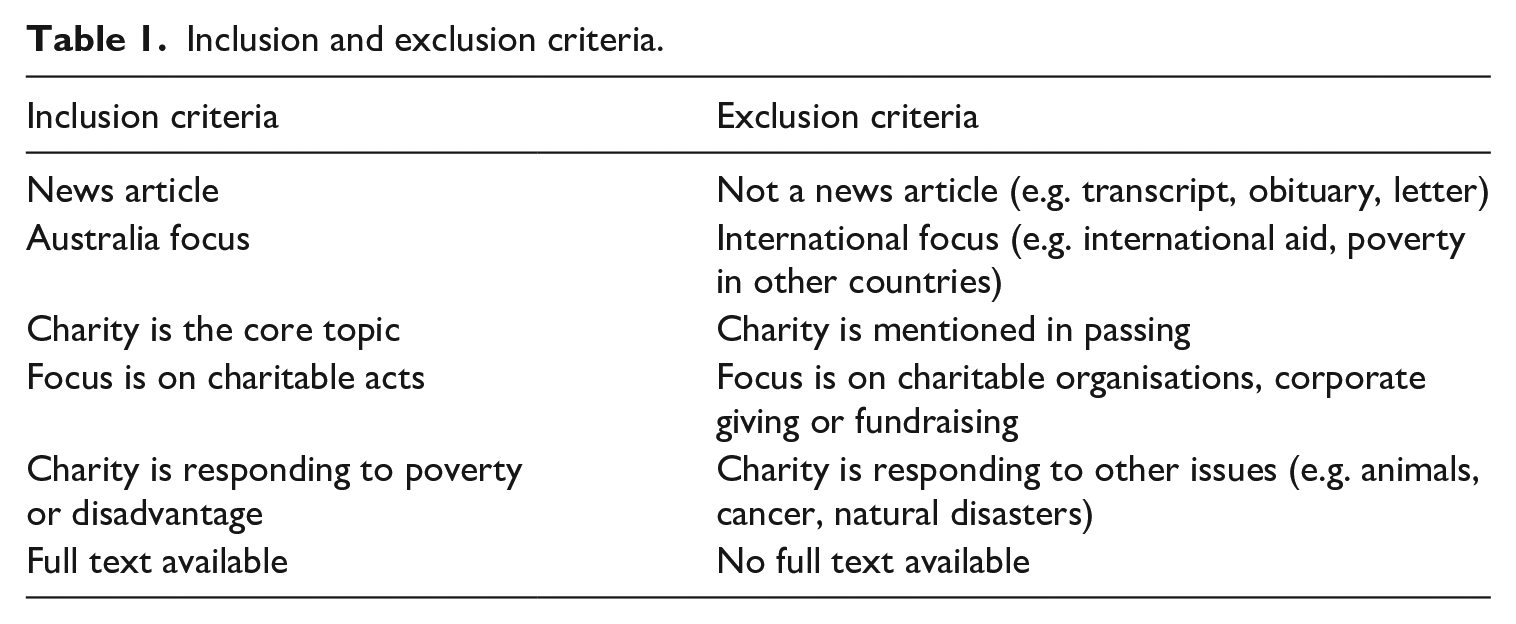
The 1379 news reports identified through these searches were then imported into the online screening platform Covidence. Through Covidence, two researchers independently screened each of the 1379 reports to determine whether they fulfilled the inclusion or exclusion criteria. All conflicts were resolved in discussions between the two researchers. A total of 111 news reports were ultimately included in the analysis (see the Online Appendix for a full list of included reports). The sample spread across news outlets and years is shown in Figure 1.
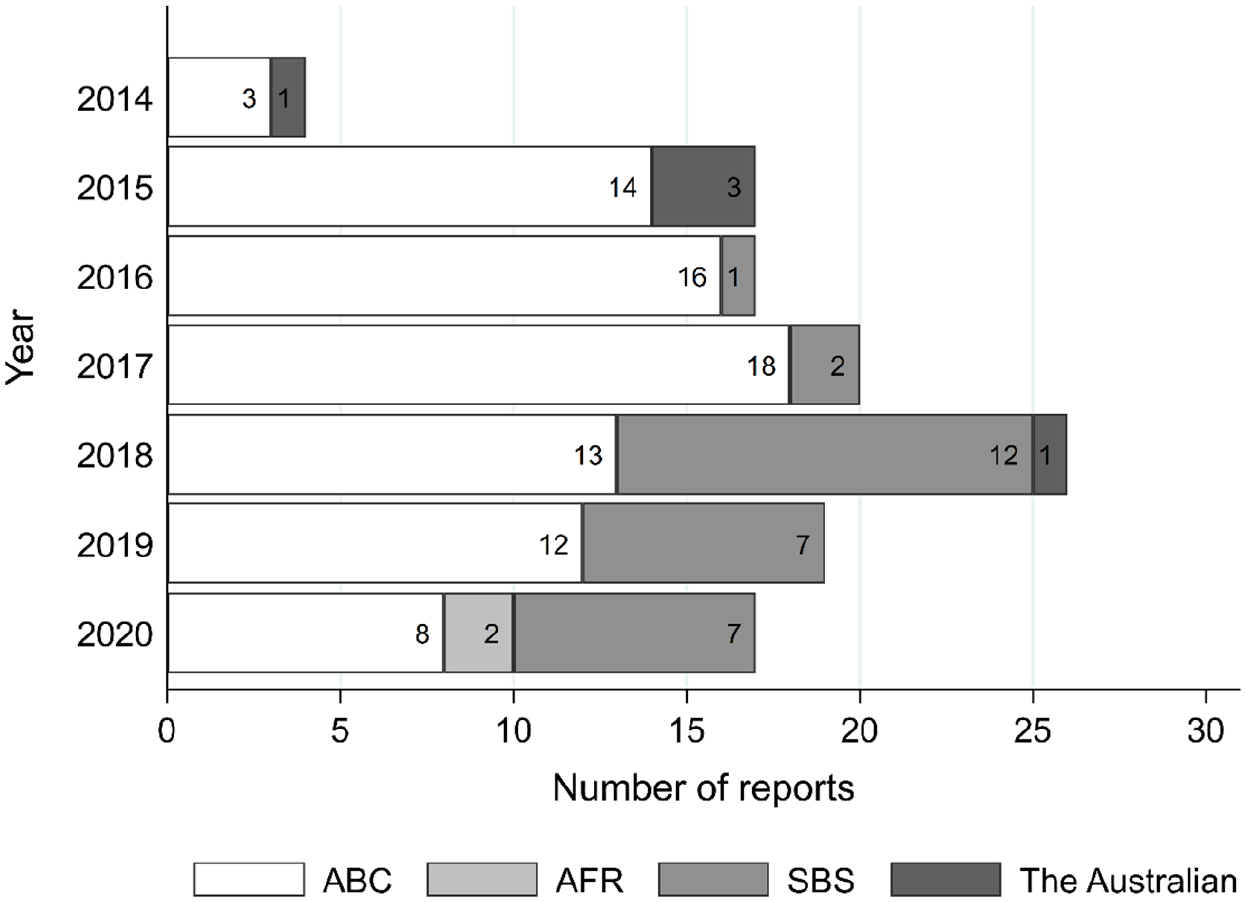
Sample spread.
Data Analysis
Our analysis of Australian media framings of charitable acts towards people who experience poverty draws on Entman’s (1993) framework. Entman uses the concept of ‘framing’ to explain the power that the mass media has to regulate and shape social life. By selecting and amplifying particular aspects of an issue, the media is able to frame it ‘in such a way as to promote a particular problem definition, causal interpretation, moral evaluation, and/or treatment recommendation for the item described’ (Entman, 1993: 52). Media texts therefore contain frames that may be analysed to understand the media’s representation of an issue, as well as desired responses to that issue. Such frames manifest in various ways, including through the use of certain words and phrases; the invocation of stereotypes and judgements; the type and source of the information presented; the exclusion of information; and overarching themes and arguments (Entman, 1993; Lepianka, 2015). These points of focus guide our analysis of the data.
To analyse the reports, we identified a list of key themes pertaining to the media’s framing of charity receivers, charitable givers and the charitable act itself. Using NVivo software, these key themes were turned into codes according to which the data were sorted. Additional codes and sub-codes were added based on the inductive analytical process. One researcher conducted the coding of all articles; to promote rigour (Padgett, 2017), this coding was then independently verified by two other team members to validate the coding strategy.
In the remainder of the article, we present our analysis of the 111 news reports included in the study. To support our arguments, we provide extracts from the news reports we analysed. These extracts are not exhaustive examples, and were selected to exemplify the themes that emerged from the analysis. We also made an effort to include examples from the range of media outlets included in our sample, although we recognise that there was an unequal distribution of reporting on charity in our four sampled media outlets (see Figure 1). As a result of this unequal distribution in reporting, the majority of the data examples presented are drawn from reports published by the ABC. This unequal distribution prevented us from comparing the framing of charity across media outlets. Such comparisons have been used by scholars to consider the influencing factor of the political stance of the outlet (Kim et al., 2010; McArthur and Reeves, 2019; Wells and Caraher, 2014). However, Gans and Leigh (2011) demonstrate that very few Australian media outlets can be statistically differentiated from the centre. This suggests that, even if the reporting were not skewed, a comparison across media outlets to examine the influence of political stance may not have made a particularly useful contribution to our understanding of media framings of charity in Australia.
Analysis
Restoring the Dignity of People Who Experience Poverty
The concept of dignity is a common theme throughout the media reports on charity. Thirty of the 111 reports specifically foreground the role of charity in restoring dignity to people who experience poverty by responding to their immediate basic needs. These needs include basic hygiene, food, clothing and shelter. In the following excerpts, the media quotes charity providers who discuss how their charitable responses provide dignity to people experiencing poverty:
We were just trying to restore some dignity by providing new clothing . . . The fact that the clothes are new and the fact that they have choice provides a sense of dignity. (AFR, 24 January 2020) ‘It will give them a sense of more dignity,’ he said. ‘Rather than sleeping rough, they can get their own meals, go to bed nice and warm, and dry . . .’ (ABC, 1 October 2018) It was just about how undignified it must be to not have sanitary items at ‘that time of the month’. We wanted it to be about sharing the information and sharing the dignity. (SBS, 11 July 2018)
The media positions the inability of people experiencing poverty to meet their basic needs as a significant threat to their dignity, and a threat that does – and should – motivate charitable intervention. In particular, the media positions poor hygiene as a physical manifestation of poverty that undermines the dignity and reinforces the marginalisation of those who experience it. The following excerpts are from the founders of three charities quoted in media reports. The first is a charity that provides laundry facilities to people in need; the second is a charity that provides sanitary products for disadvantaged women; and the third is a charity that provides mobile showers to people experiencing homelessness. The excerpts position hygiene as a human right that everyone should have access to:
Laundry can have a massive impact on anyone’s life . . . something that most people take for granted is putting a fresh clean set of clothes on every morning . . . we really want to restore that basic human right of clean clothes. (ABC, 30 March 2016) I can’t even imagine how I’d feel about myself; how embarrassed, how ashamed . . . I think it’s completely disgusting that women and girls in our community don’t have access to [sanitary] items. (ABC, 28 April 2018) With hygiene comes dignity . . . This is a basic human right we are talking about. (SBS, 21 June 2016)
Correspondingly, when charities provide people experiencing poverty with access to facilities and products that enable them to maintain their personal hygiene, the media positions this as a means through which people can feel ‘more human’ and their dignity can be restored:
It means a great deal to the homeless, the needy, people that don’t have a washing machine or dryer. It’s a service that makes people feel great. (ABC, 30 March 2016) We all feel a bit more human when we’re wearing clean clothes and [are] fully washed, and much better prepared for the day ahead. (ABC, 2 August 2016) [Having toiletries] makes you feel more human and if we can do that to the people that are on the streets, the people that are sleeping in their cars, the people that have fallen on hard times, that’s the reason we exist. (ABC, 25 June 2016)
The media’s preoccupation with issues such as personal hygiene reveals an assumption that the primary problem with poverty is its impact on how people experiencing it are perceived and evaluated by others. Poverty is thus framed as a problem of social status and recognition (Fraser, 2000). Charity is in turn framed as uniquely placed to address these status issues. This is seen in the media’s celebration of charity’s capacity to restore dignity through the provision of basic resources or amenities that enable people to feel and pass as ‘human’ – that is, as ordinary members of society. Importantly, charity is not presented as a means for people to meet their own needs on an ongoing basis; it is rather a temporary intervention that provides short-term relief from the effects of poverty. It is not only temporary, but it also focuses on the individual – addressing their immediate deprivation to achieve a degree of dignity – while leaving intact (and silent) the power imbalances and inequities that characterise the political and economic order (Tyler and Slater, 2018).
Reintegrating People Who Experience Poverty into Society
Another core function of charity, as portrayed by 53 of the 111 reports in our sample, is its ability to enable people to begin their journey out of poverty. Critically, charity’s ability to restore dignity is positioned as a key factor that enables people experiencing poverty to be accepted or reintegrated into society. The media portrays the restoration of dignity through charity as a means of addressing ‘social exclusion’ (Deeming and Smyth, 2015) by removing barriers preventing people experiencing poverty from fully participating in society.
In terms of social barriers, for example, the restoration of dignity through charity is framed as an important first step in facilitating social acceptance and human connection. Again, poor hygiene is foregrounded here as a barrier to social acceptance, largely due to the stigma and judgement associated with it:
We believe that one of the first indicators of homelessness is hygiene; the way you smell and the way you look. That’s going to affect the way people treat you. (SBS, 21 June 2016) Her damaged teeth became both a reminder of her past and a hindrance to her future, affecting everything from her self-confidence to her job prospects. (ABC, 8 March 2017) You get on the streets, you smell a bit after a few days if you don’t have access to a shower or you get on public transport, and people shy away. (ABC, 25 June 2017)
When these issues are addressed through charity, people experiencing poverty are portrayed as more confident and able to participate in society:
Mr Freeman said clean clothing gave him a confidence boost and encouraged him to seek out contact with others rather than hiding away. (ABC, 13 April 2016) It was just the dignity that they would get back [after a shower] and the feeling of community and not being judged. (ABC, 22 March 2018)
Dignity here is linked to social perceptions and acceptance. As it is easier for society to accept those who appear to be like us, making people experiencing poverty acceptable to us is positioned as important for fostering social acceptance. Restoring dignity is thus framed as a means of re-establishing the affective bonds and identifications of community (Rose, 2000), which are perceived as disrupted by the status inequalities produced by poverty.
In terms of structural barriers, the restoration of dignity, particularly through improved hygiene, is framed as important for overcoming barriers to education, housing, and employment. The following excerpts capture this sentiment well:
‘With dignity comes opportunity’ . . . something as simple as a shower has the ability to remove barriers relating to employment, access to housing and other pathways to advancement. (SBS, 21 June 2016) [Clean clothing] was vital when seeking a house to rent. ‘Half the time I’d turn up in old baggy clothes covered in dirt from where I was sleeping the night before and I just got turned away.’ (ABC, 13 April 2016) Just making tea and coffee and toast for someone can set them on a path where they feel better about themselves, and maybe able to engage in services – education and to find housing. (ABC, 2 August 2016)
In these excerpts, it is implied that the barriers people face to employment and other opportunities are addressed through the restoration of dignity and social status enabled by charity. This way of framing charity reflects the ‘culturalist’ understanding of inequality that Fraser (2000) associates with contemporary politics of recognition. Material inequalities are presented as an effect of misrecognition and the denigrated status of people experiencing poverty: a lack of dignity associated with bearing the physical markers of poverty. It is therefore assumed that these material inequalities can be addressed by re-establishing the conditions for recognition, which in the present case means the temporary erasure of those physical markers of poverty through charity.
With the (ostensible) removal of the barriers to exiting poverty through charity-enabled recognition, people experiencing poverty are positioned as responsible for changing their own circumstances. This can be seen in the following excerpts, which suggest that people experiencing poverty must actively lift themselves out of poverty:
The best option is to give people who are struggling a chance to improve their own circumstances. This makes them feel better about achieving something. (SBS, 7 August 2018) . . . giving people a gift of encouragement and lifting them up and helping them find a better way. (ABC, 2 August 2016) When we have that sense of safety, when we have food in our stomachs, we can start to solve problems . . . It was a hand-up, not a hand-out. (AFR, 5 June 2020)
The idea that poverty is a situation that people can escape with encouragement and skill development minimises the many structural barriers related to maldistribution that remain in place regardless of the sense of inclusion that the restoration of dignity might provide. Existing scholarship demonstrates that such barriers cannot be addressed simply by promoting inclusion and developing the capacities of individuals; robust social policy strategies and structural reform are critical for addressing the distributive inequalities that contribute to the issue (Bäckman, 2009; Bastiaensen et al., 2005). The need for such strategies and reform is largely silenced in the Australian media.
Reifying the Privilege of the Elites
Thus far we have shown that the Australian media frames charitable responses to people experiencing poverty as valuable for their ability to restore dignity and recognition to people experiencing poverty and facilitate social reintegration. Given these ostensibly positive functions of charity, it is perhaps unsurprising that the media focuses on the virtue and hard work of people who engage in charitable acts towards people experiencing poverty. Indeed, 87 of the 111 reports in our sample explicitly foreground the charitable work and perspectives of people who act charitably, rather than focusing on the needs and perspectives of people who receive charity. This, in turn and ironically, exacerbates status inequalities and resultant forms of misrecognition (Clarke and Parsell, 2021).
Contributing to this process is the conferral of honour and esteem on those who act charitably towards people experiencing poverty. Throughout the media reports, the virtues of charitable givers, including their generosity, community spirit, and dedication, are made particularly prominent:
The talented, generous, creative volunteers on the Gold Coast deserve to be acknowledged, recognised and praised. (ABC, 26 May 2019) ‘I want to thank particularly all of the wonderful volunteers here at the Wayside, it’s a wonderful exercise in unconditional love,’ [Prime Minister] Mr Turnbull said. (ABC, 25 December 2017) Henry hasn’t only succeeded in feeding hundreds, if not thousands, of people; she’s been a rock of support to a vulnerable and often marginalised community. (SBS, 26 May 2020)
Indeed, many of the reports are not focused on the charitable act itself, but rather on the people who are engaged in the act. This is exemplified in the following report headlines:
Volunteers organise Christmas feast for those doing it tough in Parramatta. (ABC, 24 December 2015) Supermarket philanthropist Spero Chapley helps unemployed youth find jobs through Youthinc Foundation. (ABC, 20 February 2016) These brilliant individuals are tackling everyday issues faced by homeless folk. (SBS, 7 August 2018) Meet the Sydney barber who gives free haircuts to the homeless. (SBS, 7 August 2018) Patties Foods chief has hunger to help the homeless. (The Australian, 6 June 2015)
By focusing on the stories of people who act charitably and highlighting their virtues, the media confers honour, esteem and social status not only to these individuals, but also to others in the community who similarly display charitable virtues. According to Lazarsfeld and Merton (2004), the conferral of status is an important social function performed by the media. By presenting charitable acts and actors in a favourable light and giving them prominence of place, the media indicates their importance and the value society ascribes to them. In doing so, the media helps to raise the social status of those who act charitably towards people experiencing poverty.
In contrast to the active and virtuous giver of charity, receivers of charity are constructed by the media as a passive, pitiful and thus disesteemed group through which givers may demonstrate their willingness to ‘do good’. The media reports present charity towards people experiencing poverty as a means through which the non-poor may improve the lives of others, and feel good about themselves in the process:
Blue Door coordinator Paul Potter said the program was all about ‘ordinary people helping other people that are in need . . . they help me do life better’. (ABC, 26 March 2015) Ms Judd said she derived great satisfaction from lifting the stress from other parents’ shoulders. (ABC, 15 September 2020) It’s hugely rewarding to know that you can get a bunch of people together from all walks of life to help . . . It’s a great opportunity to help people who really need it. (ABC, 21 July 2015)
For people on the receiving end of charity, on the other hand, charity is positioned as something for which to be grateful. Rarely are people who receive charity framed as anything other than passive recipients, whose agency is reduced to displays of gratitude for the generosity of others:
‘God bless these people,’ he said as he collected a swag that will make sleeping rough a little more comfortable . . . ‘I’m just overwhelmed by the kindness.’ (ABC, 21 July 2015) These are things people give me from the bottom of their hearts . . . It’s like a birthday present. (ABC, 23 November 2017) There are times when we see people in tears from gratitude, from humiliation, and tears of joy that they can take something home and sit around the table to eat with their family. (ABC, 28 October 2017)
Indeed, the only times charity receivers were given a voice in the media reports was either to talk of their experiences of poverty or to express their gratitude for the charity they received. Charitable givers, conversely, were given the power to identify the problems associated with poverty and decide on the most appropriate solutions, as well as to assess the impact of their own charitable acts:
We realised that a lot of the problem of Aborigines stemmed from lack of education and children not being able to go to school, so we thought the way to start was at the grass roots with a kindergarten. (ABC, 16 May 2016) I think for them it’s going to mean a lot and just to have those presents under the tree on Christmas day, they will be happy. (ABC, 17 December 2017) As I got to know these guys, I thought, ‘they don’t need hats and scarves, they need a good old fashioned, home-cooked meal’. (SBS, 26 May 2020)
Together, the above excerpts demonstrate that in its framing of charitable givers and charity receivers, the Australian media highlights the virtues of the former and the deficiencies of the latter. Further, the media’s portrayal of charity provides an additional avenue through which the non-poor may improve their social status. When considered in conjunction with the shame and stigma that often accompanies the receipt of charity (Parsell and Clarke, 2020), we can see that far from addressing inequalities in social status, charitable acts have the potential to reify and further entrench the devalued identities of people experiencing poverty and reinforce the power of those who act charitably towards them. Thus, when the media celebrates charity as a means of repairing the social status/identities of people experiencing poverty, it exacerbates the status inequalities between givers and recipients of charity and perpetuates devalued identities of the latter.
Conclusion
According to Entman (1993), the media has the power to promote certain definitions and understandings of social issues such as poverty. Throughout the media reports that we analysed, experiences of poverty are framed primarily in terms of an individual’s lack of the basic resources required to be recognised by society as a respectable and responsible citizen. In particular, the visible manifestations of poverty are positioned in the media as key barriers that prevent people experiencing poverty from participating equally and constructively in social life. Based on this ‘culturalist’ (Fraser, 2000) understanding of poverty as a barrier to social inclusion, the Australian media valorises charitable acts for their perceived capacity to address the inequalities in social status and esteem experienced by people in poverty, and in turn enable the reintegration of people experiencing poverty into society.
This framing of charity reflects a broader shift away from the politics of redistribution and the associated concern with the economic structures of society. Third Way thinking in the late 20th century built on earlier neoliberal reforms that have undermined state welfare and instead prioritised a range of ground–up charitable responses to poverty that foreground normative reintegration through employment and reattachment to (local) community (Deeming and Smyth, 2015; Rose, 2000). Along with the emergence of ‘consumer society’ (Bauman, 2005), this engendered a reframing of poverty as ‘social exclusion’, a problem arising, at least in part, from the devalued status/identities of people experiencing poverty. These shifts in the conception of the problem position charity as the ideal response, given its perceived capacity to promote recognition by restoring dignity to people experiencing poverty.
Despite the positive picture of charity painted by political and media discourses, our analysis highlights several potential ramifications of the Australian media’s framing of charitable responses to poverty. First, the media’s focus on recognition at the expense of redistribution overlooks the political economic processes that contribute to poverty and create the need for charity in the first place. This reduces the issue to one that can be addressed through amelioratory interventions aimed at restoring dignity/recognition. In doing so, it eschews the responsibility of the state for implementing robust redistributive interventions to prevent the material deprivation that underpins poverty (Bäckman, 2009; Bastiaensen et al., 2005). As Bastiaensen et al. (2005: 990) argue, efforts to address poverty must direct ‘attention to the policy processes that produce and reproduce capital depletion and deprivations’, and work to change the underlying structural causes of poverty. This argument highlights the vexed position of providing charitable care to respond to the consequences of structural injustice without working to address the structures that cause the injustice (Parsell and Watts, 2017).
Second, the positioning of charity as a means to support the dignity of people living in poverty, through providing basic hygiene and resources for instance, resonates with earlier analyses of anti-stigma initiatives (Tyler and Slater, 2018). Tyler and Slater (2018: 727) propose a ‘more thoroughly sociological understanding of stigma’, where the causes and political functions of stigma are drawn out. Our analysis of Australian media illustrates how charity is positioned as the ideal response to deal with the stigma associated with the experience of living in poverty. The stigma of poverty and the idealisation of charity as a response conceal and reify the political and economic order that both produces poverty and benefits elites through a system based on exploitation. Media elites and state-owned media outlets benefit from the existing order where poverty is not only embedded, but where citizens actively respond and normalise it through providing charitable care to soothe human suffering (Tyler and Slater, 2018).
Third, the media’s focus on charity’s ability to address inequalities in social status leads to the celebration and legitimation of superficial responses to the symptoms of poverty, most notably a lack of dignity. Through these responses – most of which focus on making people experiencing poverty more acceptable to the rest of society – the actual needs and lived experiences of people in poverty are obscured. Rather than having their needs and experiences prioritised, they are positioned as little more than a means through which charitable citizens may elevate their own social status. Givers of charity are celebrated for their charitable care, while recipients are presented as the (sometimes grateful, but mostly silent) passive object of these caring acts. The media framing gives little thought to the inadequacies of charity, much less to what it is like to receive charity, or to be unable to reciprocate. People who experience poverty therefore experience significant shame for failing to live up to societal norms (Parsell and Clarke, 2020).
Our findings support the need to transform media discourses on charity in ways that privilege the needs of the recipient, promote recognition beyond individuals’ state of poverty and address the underlying causes that require individuals to seek charitable support. This will necessarily involve challenging the depoliticisation of the material/distributive dimensions of poverty and the normalisation – or celebration – of insufficient charitable responses towards people experiencing poverty. As Fraser (2000) argues, achieving social justice requires bringing about recognition and redistribution, through changed cultural assumptions and access to resources, so that people can interact with others as peers.
Supplemental Material
sj-docx-1-soc-10.1177_00380385221095025 – Supplemental material for Recognition or Redistribution? How Mainstream Media Frames Charitable Responses to People Experiencing Poverty
Supplemental material, sj-docx-1-soc-10.1177_00380385221095025 for Recognition or Redistribution? How Mainstream Media Frames Charitable Responses to People Experiencing Poverty by Ella Kuskoff, Andrew Clarke, Francisco Perales and Cameron Parsell in Sociology
Footnotes
Acknowledgements
We thank Bailey Carthouser for his assistance in data screening.
Funding
The authors disclosed receipt of the following financial support for the research, authorship and/or publication of this article: this research was supported by the Australian Government through the Australian Research Council’s Centre of Excellence for Children and Families over the Life Course (CE200100025) and an Australian Research Council Future Fellowship (FT180100250).

Supplemental material
Supplemental material for this article is available online.
References
Supplementary Material
Please find the following supplemental material available below.
For Open Access articles published under a Creative Commons License, all supplemental material carries the same license as the article it is associated with.
For non-Open Access articles published, all supplemental material carries a non-exclusive license, and permission requests for re-use of supplemental material or any part of supplemental material shall be sent directly to the copyright owner as specified in the copyright notice associated with the article.
