



Abstract
Increased inequalities around the globe have led social researchers to invent innovative methodologies to study how people subjectively perceive inequality and imagine society. This article presents the development of an arts-informed method, ‘drawing of society’, applied to a multi-sited ethnography of everyday inequalities in two major post-industrial cities of Russia. It contributes to the debate on lay perceptions of social structure by looking at moral and symbolic signifiers of inequality. Building on multi-sensory data, I argue that workers and professionals tend to imagine Russian society as divided between a small group of the rich and a large group of the poor and as consisting of social classes. Ordinary people self-identify with the poor and perceive their position as being at the bottom of the social hierarchy. Depending on their lived experiences, research participants express their sense of inequality through the narrative strategies of compliance, inversion and subversion of power hierarchies.
Keywords
Introduction
The 21st century has so far seen an increase in inequalities across the world, with their impact on everyday lives making it necessary to develop new approaches and innovative methodologies for studying lay perceptions of inequality and social imaginary. A new inequality paradigm is emerging, using interdisciplinary approaches to provide more socially just solutions for large-scale social problems caused by the pandemic, climate change, international armed conflicts and worldwide crises, as well as allowing a clearer understanding of the relationships between rich and poor, and the reactions of ordinary people to unequal income distribution (Savage, 2021: 2–4). At the same time, inequalities cannot be considered only in terms of income. According to subjectivist approaches, inequalities should be examined through the lenses of feelings, senses, morality, symbolic significance, lay normativity and power relations (Bottero, 2020; Irwin, 2018; Lamont, 2000; Sayer, 2005a, 2005b; Scott, 1990; Skeggs, 1997, 2005).
To do a multidimensional analysis of lay perceptions of inequality, the term by Sarah Irwin (2018), I complement this framework by the approaches of moral and cultural signification. In this article, I also use a concept of ‘a sense of inequality’ introduced by Wendy Bottero (2020: 1–2), which means people’s affective attitudes, moral evaluations and ethical perceptions of inequality and their reactions to power imbalances and social injustice. However, I apply ‘a sense of inequality’ in a slightly different way as conjoining with class feelings and a sense of place that operate at both individual and collective levels being formed within socio-material environments and spatial infrastructures. This understanding of ‘a sense of inequality’ allows for a more complex reflection on affective, moral and ethical perceptions of unequal power relations within a particular society and everyday settings.
Drawing on rich multi-sensory data, this article contributes to the debate on everyday inequality and social imaginary in several ways. First, it suggests an updated view on lay perceptions of inequality by exploring the moral and symbolic signification of the emergent social structure in contemporary Russia. Second, it develops an innovative methodology to allow for the social imaginary to be examined through the research participants’ ‘drawing of society’, a method introduced by Alexander Bikbov (2007), which I integrate into a multi-sited ethnography of everyday inequalities experienced by members of deindustrialising communities, with a particular focus on working-class experiences. Finally, looking at larger social structures in Russian society, I suggest a typology of strategies that members of deindustrialising communities use to narrate their attitudes towards inequality and to visualise their subjective perceptions of power hierarchies.
The article answers the questions of how ordinary people imagine society and what strategies they use to express lay perceptions of inequality. I address these issues by reviewing the literature on images of society and its stratification followed by giving an overview of research on moral classes and inequality in Russia. I then reflect on the application of drawing as an arts-informed method in creative ethnography. In the empirical section, I analyse the images of Russian society depicted in the form of a class hierarchy and as divided between the rich and the poor. I analyse three strategies to visualise lay perceptions of unequal power relations by members of deindustrialising communities, including compliance, inversion and subversion of power hierarchy.
Images of Society and Inequality
All approaches of stratification of society operate with ‘images of inequality’, which people use to locate themselves within the space of social distinction (Bourdieu, 1984), categorise and classify others, and navigate social differences in everyday life (Bottero, 2005: 15, 2020). While stratification theories provide us with cohesive images of society, the images obtained through empirical research are often contradictory and spontaneous (Blackburn and Mann, 1975). Although cohesive images can be elicited empirically in stable contexts and within homogeneous social groups (Bulmer, 1975: 164), a diversity of images prevails in the empirical studies of changing societies (Bulmer, 1975: 164–165).
According to Raymond Williams (1961: 128–129), the image of society is ‘something inherently bad: a restrictive, interfering, indifferent process, whether it claims the virtues of an established order or the creation of human brotherhood’. These negative perceptions of society can be explained by the fact that ordinary people tend to think in moral terms; individuals do ‘good things’, while society does ‘all bad things’ (Williams, 1961: 128–129). At the same time, society is often imagined as ‘these people in this place’ within a particular social order (Williams, 1961: 121). Williams (1961) explains this as unequal regard of the lives of people belonging to different social classes. This understanding of the social imaginary as emerging from unequal living conditions and framed by the social order is helpful to analyse the power dynamics and socio-cultural meanings of inequalities reflected in the images of society. In contrast, Cornelius Castoriadis (1975: 127) argues that the social imaginary, meaning people’s ‘irreducible capacity to evoke images’, cannot be reduced solely to material conditions. It functions in each society as complementary to the social order being closely interrelated with the symbolic. Castoriadis focuses on the role of ‘social imaginary significations’ and the symbolic in the existence of societies and social change. By imaginary signification, Castoriadis means the organising principle of the system of signifiers and signifieds.
In a study of working-class images of society, Bulmer (1975) distinguishes between the images of society and class consciousness, which are related to each other. Since the end of the 20th century, sociological studies on inequality find that the class imagery has been declining (Bottero, 2005) together with the dissolution of classes and a weakening of class consciousness (Pakulski and Waters, 1996). However, recent empirical research that is revealing a slowdown of social mobility and intensification of inequality shows that despite people tending to ‘dis-identify’ from class (Savage et al., 2010; Skeggs, 1997: 74), it is still possible to observe social identities and practices that are marked by class (e.g. McKenzie, 2015; Salmenniemi, 2012), but also by gender, race/ethnicity and age. This return of inequality and increased social tension makes it necessary to review qualitative and ethnographic research on our understanding of ‘the image of society’ focusing on moral and symbolic significations of social divisions. In the article, I consider class in terms of cultural values, moral and symbolic signifiers, and lifestyles (Bourdieu, 1984; Williams, 1961) being formed within socio-material infrastructures and environments of deindustrialising communities.
At the same time, an affective turn that brings attention to sensual experiences and class feelings has stimulated approaches towards the study of lay perception of inequality (Irwin, 2018), a sense of inequality (Bottero, 2020) and social justice (Bikbov, 2007). According to Irwin (2018: 212), lay perceptions of inequality are rooted in people’s backgrounds and are contextualised by their biographies and life experiences. Similarly, in the study of school pupils and university students’ subjective perceptions of inequality in Russia and France, Bikbov (2007: 164) argues that the images of society are related to individuals’ social and educational backgrounds. Developing Castoriadis’s idea about imaginary significations, Clément (2022) builds a classification of imaginaries in Russia distinguishing between the national imaginary, the social imaginary and the national social imaginary. In the article, I follow Clément’s (2022: 146) understanding of the social imaginary as affective, sensitive and emotional perception of stratification that can be critical and evoke images of the social world different from the dominant ones.
Moral Classes and Inequalities in Russia
After the dissolution of the USSR in 1991 the shift from a command-driven to a neoliberal economy resulted in a change of social stratification in Russia, with an increasing gap between rich and poor and the emergence of a new system of social divisions (Kivinen, 2021; Nikula and Chernysh, 2020). This new stratification is based on unequal distribution of wealth and moral worth (Salmenniemi, 2012; Walker, 2022). A heated debate continues as to what type of social structure Russian society has now as a result. Some scholars argue that post-Soviet Russia has an emerging class structure consisting of the elite, the middle class and a growing precariat, including the working class and other low-resourced groups (Clément, 2017; Kivinen, 2021; Morris, 2021; Nikula and Chernysh, 2020; Salmenniemi, 2012). Some others argue that it retains the estate system typical of Imperial Russia because it is the state that creates social groups, such as civil servants, policemen, military personnel and judges (Kordonsky, 2016). Others insist that it has a mixture of both (Shkaratan, 2009: 12).
Soviet society nominally consisted of the working class, the intelligentsia and the nomenclature (i.e. bureaucracy), where workers had access to state support and social welfare (Salmenniemi, 2012). During the economic restructuring of the 1990s and 2000s, the social welfare system downsized and the new social groups of ‘businessmen’, ‘the middle class’, ‘new rich’ and ‘oligarchs’ emerged in media discourses and everyday narratives. At the same time, some old social groups, such as factory workers and engineers, experienced a strong downgrade in their economic standing and in the symbolic devaluation of their professional skills and social status (Walker, 2011). This change in stratification was caused by factories being privatised (Morrison, 2008) and everyday life becoming commercialised. It resulted in Soviet and post-Soviet patterns of economic and cultural activities combining and new social divisions forming (Salmenniemi, 2012: 8), as well as in residual and emergent moral signifiers of class coexisting with multiple connotations. According to Rivkin-Fish (2009: 81), during the 1990s, class-understood as people’s perception of their location in society-became a ‘signifier of distinction’ in Russia. The neoliberal transformation led to social structure becoming culturally significant again and to the increase and individualisation of different types of inequalities including class, gender, age and ethnic (Salmenniemi, 2012: 10).
In contemporary Russia, the ‘middle class’ and the ‘intelligentsia’ take a higher position in the symbolic hierarchy and are signified as ‘good’ and ‘worthy’, and as ‘respectable’ and ‘progressive’ bearers of civil values (Salmenniemi, 2012: 6). Workers, especially working-class men, are morally judged by wealthier classes as ‘backward’ and ‘passive’, bearers of Soviet cultural values and ‘losers’ incapable of meeting the challenges of the new economic reality (Walker, 2011, 2022). As Walker (2022: 1491–1492) argues, in the context of social insecurity and economic instability in Russia, young working-class men experience difficulties in sustaining normative breadwinning masculinity through economic capital. However, they gain dignity and self-worth by using various other resources: cultural, social and bodily, shaped by constellations of their class, gender and ethnicity (Walker, 2022). A similar trend of devaluation and stereotypisation of working-class men was revealed in other post-industrial countries, including Australia, the UK and the USA (Roberts and Elliot, 2020).
In post-Soviet Russia, the increase of social inequality and expansion of precarity over the everyday life of working-class and other subordinate groups (Clément, 2017) is embedded in the global trend of a widening gap between rich and poor and occurs under ‘authoritarian neoliberalism’ (Morris, 2021). At the time of writing this article (spring 2022), I view the Russian regime as neoliberal neo-authoritarian, where capitalist economic reforms have intensified and political freedoms have narrowed significantly during Vladimir Putin’s presidency. This manifests in the strengthening of control over people’s everyday life, the increase in number of court trials and political prisoners, the closure of independent media outlets and non-government organisations, and suppression of any kind of open protest.
There are few research publications examining moral classes and everyday inequality in Russia. This article fills the gap in research literature on moral and symbolic signifiers of class by addressing the question of how members of deindustrialising communities imagine bigger social structures and subjectively perceive inequalities.
Ethnographic and Arts-Informed Methods
I develop my argument by drawing on rich multi-sensory data collected within a larger project on working-class life and struggle, which was built on the approach of multi-sited ethnography (Marcus, 1995). I mainly collected empirical data in two industrial neighbourhoods with mixed social compositions located in Moscow and Yekaterinburg, where I interviewed working-class and middle-class residents. 1 Additionally, three trade union activist workers residing in suburban areas of Moscow also took part. That multi-sited ethnography implies a collection of data in several field sites (Marcus, 1995: 100) means I could trace geographical inequalities between the capital of Moscow and the regional city of Yekaterinburg 2 and reveal lay perceptions of inequalities within both locations.
The ethnographic fieldwork took place between May 2018 and January 2019. I applied a combination of mainstream and innovative qualitative methods, including seated and walking interviews, participation and observation, and getting research participants to create drawings of the neighbourhood and Russian society. The database of the project included 53 interviews with 33 workers and 20 professionals aged between 20 and 77 years, more than 150 pages of field notes, more than 550 photographs and videos, 41 drawings of the neighbourhoods and 35 drawings of Russian society. In this article, I focus on the interview transcripts and participants’ drawings of society, complementing them with observational data.
My interview guide included a series of questions about participants’ experiences of inequality, feelings towards their place of residence, subjective perception of social groups residing in their locality and others aimed to address the research question of how members of deindustrialising communities sense and imagine inequality. Apart from narrative representations, inequality can be visualised through graphs, diagrams and photography (see Irwin, 2018; Savage, 2021: 230), but also through artistic and creative means. I integrated an arts-informed method of ‘drawing of society’ in the final section of the interview guide. I asked each interviewee to complete the following task: ‘Could you please draw Russian society as you imagine it?’ If they agreed, I gave them a white sheet of A4 paper and a black pen. Once the drawing was ready, I asked an interviewee to explain verbally what they drew. Of the 53 research participants, 35 agreed to complete this creative task.
According to Bikbov (2007: 164), ‘a drawing of society is a nonconventional message about an ultimate form, borders, and basic divisions of the social universe’. As Mike Savage (2021: 26) points out, ‘the use of lines carries enormous power’ when we think about inequality and social divide. The drawing of society can be considered a visual genre of social research because it comprises lines and relies on visual images (Leavy, 2017: 207). The process of drawing society engages research participants’ imagination and inspires them to co-create visual data with the researcher, and thus can be considered as a participatory arts-informed method (Leavy, 2017). Additionally, participants may find it easier to draw bigger social structures and inequalities in society rather than talk about them in interviews. Implementing a drawing of society brings methodical innovation to the ethnographic study of lay perception of inequality and social imaginary. However, it requires that the creative strategy of data analysis be elaborated because a variation of drawings that can be of different shapes, forms and sizes. It is possible to reveal some patterns in how people create the images of society and visually express their sense of inequality and social justice. In my project, I elaborated a multimodal strategy for the multi-sensory data analysis that consisted of three stages.
First, I used NVivo 12 to thematically code my field notes and interview transcripts together with verbal explanations of the drawings of society that accompanied the visual data produced by research participants. Building on a multi-grounded theory (Goldkuhl and Cronholm, 2010), I generated thematic codes, including a parent code – ‘Russian society’ – which was subdivided into child codes around social classes and groups mentioned while research participants were drawing society and explaining their images. Thematic coding in NVivo helped estimate the frequency of codes related to the social structure.
Second, I classified 35 drawings by shapes and forms sorting them into three types: (1) pyramids and diagrams with textual inscriptions indicating social classes and groups (11 of 35 items); (2) detailed portraits of people and animals belonging to different classes, and depictions of a number of small, figured people (11 of 35 items); (3) territory and symbols (13 of 35 items). For the analysis of lay perception of inequality and social imaginary, I selected drawings of the first and second types because they visually represented social structure and moral classes, and expressed a sense of inequality and social justice.
Third, I undertook a visual semiotic analysis (Barthes, 1993) of the drawings by focusing on the elements’ meanings and configurations and on relationships between them, which allowed me to reflect on signifiers of classes and power dynamics within Russia society. I paid particular attention to the moral and symbolic dimensions of inequality visualised in drawings and undertook a metaphor analysis of those images of society containing metaphorical messages. At the final stage, I supplemented the visual analysis of drawings of society with the analysis of narratives about everyday inequalities and contextualised a sense of inequality and social justice by the lived experiences of research participants.
While collecting and analysing data, I was reflective about my social location. I grew up in the industrial neighbourhood of Moscow with mixed social composition, attended a comprehensive school with children from different backgrounds, graduated from a top university in Russia and obtained a PhD degree from a Russell Group university in the UK. I am a white female professional and self-identify with the academic precariat. This social background makes me sensitive to inequalities.
Visualising Lay Perceptions of Inequality in the Images of Society
As Clément (2017: 62) argues, during Putin’s presidency, the cleavages based on social divisions have been more often articulated by ‘lower class people’, which resulted in their ‘growing sense of social inequality and unfairness’. Clément (2017: 62) points out that ‘lower class people’, including workers and pensioners from regional cities and towns, talked in interviews about the cleavages between ‘the rich and the working (wage) people’, between ‘blue-collar workers and the employers’, and between ‘the provincial towns and the big cities’. Drawing on my ethnographic observations in the industrial neighbourhoods of Moscow and Yekaterinburg and the multimodal analysis of the drawings of society, I argue that members of deindustrialising communities tend to imagine Russian society as class differentiated and as divided between rich and poor. Their lay perception of inequality is shaped by their lived experiences gained in socio-material infrastructures of post-industrial cities. This develops Clément’s (2017) arguments of cleavages in Russian society and the formation of a ‘sense of social inequality’ of ‘lower class people’ in their environments.
The categories of ‘rich’ and ‘poor’ were the most frequently mentioned in talks about Russian society, referenced 11 and nine times respectively. This finding is evidence of lay perception of inequality in Russia as unequal distribution of power and resources (economic, political and symbolic) between the dominant and subordinate (Scott, 1990). Next, the frequency of the categories of ‘middle class’ and ‘ordinary people’ (both referenced eight times), and ‘working class’ (referenced six times) were relatively similar. Some working-class participants showed class dis-identification, preferring to call themselves ‘ordinary’, ‘simple’ and ‘normal’ people, or ‘grafters’ whom they morally signified as ‘good people’. A similar finding of dis-identification from the working class was revealed by a series of studies in the UK (see Savage et al., 2010; Skeggs, 1997). For Moscow-based participants, especially those residing in the industrial neighbourhood, the category of ‘migrant workers’ was important for shaping their social imaginary (and in some cases xenophobia).
While explaining their drawings of society, workers and professionals also referenced other classed groups, designating the dominant, including ‘oligarchs’, ‘Putin’ and a ‘class of officials’, whom they viewed as part of the elite with a luxurious lifestyle and a non-ordinary way of life. These comments about the ‘rich’ and their mocking and ironic depiction of them in their images of society can be explained by an intensified sense of inequality and an increase in the number of anti-corruption investigations into the elite’s unfair enrichment. Research participants used much more detail to represent those in the groups who live in the same areas as they do, that is, subordinated classes at the bottom of the societal hierarchy, whereas for those at the top, whose images circulate in the media, they represent much more abstractly. Below, I consider three strategies used to express a sense of inequality and social justice in drawings of society.
Compliance with the Established Social Order
A strategy of compliance was visualised in the drawings of society as pyramids, triangles, trapezoids of different shapes and sizes, as well as diagrams and circles with segments. My database includes eight pyramidal images of Russian society (seven made by workers and one by a professional) and three diagrams (two made by workers and one by a professional). Both pyramids and diagrams represent the possession of political, economic and symbolic capitals in the hands of a small number of the dominant and authoritarian circulation of power. As Irwin (2018: 215) notes, the perception of British society as a pyramid with a small elite in the top, more people in the middle and the majority at the bottom was the most popular among respondents of the British Social Attitudes Survey 2009. As they are the most typical in my whole dataset, pyramids will be analysed here.
The societal images with pyramids demonstrate a top–down power dynamic driven by the elite’s desire to control subordinate classes and remain separate from the rest of society due to fears of being overthrown. According to my visual semiotic analysis, pyramidal images contain implicit meanings of a strong state, an expansive authority structure and a large bureaucratic apparatus. These drawings demonstrate lay perceptions of unequal power relations between the dominant and subordinate. In these hierarchised images, the top was designated with inscriptions such as ‘V.V. and co’, 3 ‘Putin’, ‘leaders’, ‘the head’, ‘VIP class’, ‘directors’, ‘$’. The bottom was marked by ‘pensioners and disabled people’, ‘poor people’, ‘ordinary people, workers’, ‘engineers and workers’, ‘me’, ‘all others’ and the ‘working class’, subdivided into the ‘active’ and ‘conservative’ factions.
The drawing by Anatolii, a male 51-year-old former plant worker and ex-prisoner from Yekaterinburg’s industrial neighbourhood, visualises hierarchical power relations between social classes as enclosed and separated circles of different sizes (Figure 1). In his drawing, the pyramid consists of a tiny ‘VIP class’ at the top, a small ‘oligarch class’, a slightly bigger ‘middle class’ in the centre and a large group of ‘all the rest’ at the bottom. The participant placed himself outside Russian society (at the bottom) and marked his social position with a cross and labelled it ‘convict’. Anatolii explained his image: ‘I would draw [society] in the form of a circle. One, two, three, four. In the form of four circles, for example. Well, you have already got it, yeah? I mean by classes, that’s it.’ Answering the question about his social belonging, Anatolii replied shortly: ‘Convict!’ and then added ‘well, I’m an outcast’. Unlike research participants from the study of poverty talk by Shildrick and MacDonald (2013: 299), who lived in poverty but dis-identified from the poor, Anatolii distinguished himself from the whole society self-identifying as an outsider.
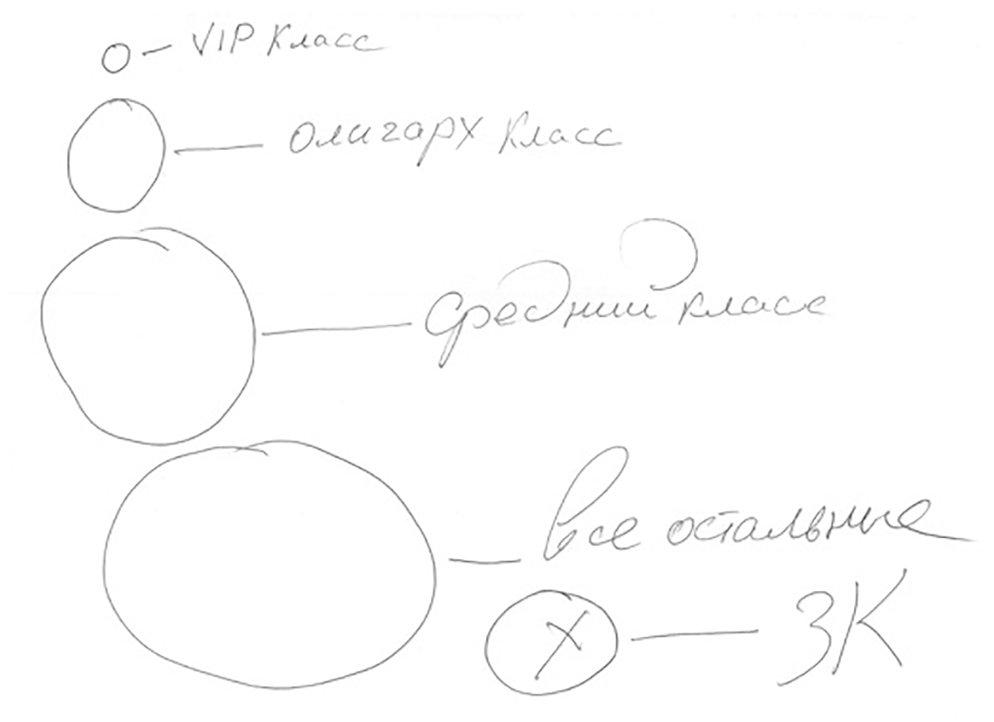
The pyramid of classes reads (from top to bottom): ‘VIP class’, ‘the oligarch class’, ‘the middle class’, ‘all the rest’, ‘convict’.
Bikbov (2007: 169–170) revealed a similar hierarchised perception of the social structure, consisting of ‘the president’, ‘oligarchs’, the ‘upper class’, ‘middle class’ and ‘lower class’, driven by the top–down logic of power in the drawings of Russian society created by some pupils from St. Petersburg. In the drawing by Anatolii, moral classes are isolated and separated from each other without intersecting, which indicates the accumulation of power and resources within the enclosed social circles and groups. The very top is morally signified by prestige and importance, while the very bottom is signified by exclusion and stigmatisation. Notably, Anatolii uses lines to show the barriers for upward social mobility for workers and the low symbolic evaluation of ex-prisoners lacking respect and moral worth.
Anatolii spent six years in prison for killing his common-law wife’s lover. Before that, he worked as a joiner at a factory. He was skilled at making household items out of wood, a skill that helped Anatolii survive in prison. There, he carved backgammon sets and small versions of sailing ships for free at the request of the prison directors. I asked why the directors ordered these ships. Anatolii replied that the price of one ship varied from 50,000 to 250,000 rubles (approx. £500 to £2500), adding, ‘it is a very cool present! Haven’t you noticed that every self-respecting, let’s say, oligarch has a ship in their study or at home? It’s mandatory!’ In this sense, the sailing ship made by the subordinate prisoner connects the top and the bottom of the social pyramid, because it is a ‘present’ that the director of the prison can give to ‘the oligarch’ to help reach an even higher position in the power hierarchy.
When I asked Anatolii about who lived in his industrial neighbourhood, he differentiated local residents by the type of a car they owned. ‘Somebody drives Peugeot, somebody drives Chetvyorka [a car manufactured in Russia]’, he said and added that ‘the neighbourhood is no longer working class’. In this narrative, affordability of a foreign car becomes a marker of class distinction. In this neoliberal context, economic resources and consumption practices signify status and lifestyle interrelated with prestige and respectability in the local area, where Anatolii feels himself out of society and out of place (Bourdieu, 1999: 128). As Rivkin-Fish (2009: 81) explains, during the 1990s, some social groups, like ‘intelligentsia’, cultivated class subjectivities through consumption that resulted in drawing moral and symbolic boundaries between them and those who could not afford to pay for commercial services and expensive commodities. Anatolii’s vision of hierarchical Russian society, differentiated by morally evaluated classes, is conditioned by his biographical experience of incarceration and extreme stigmatisation in this setting, and his lack of resources and difficulties getting a job after release due to his convict status and poor health.
Inversion of Power Hierarchy through Irony
Another way research participants expressed their lay perceptions of inequality and social divisions was to depict either more detailed images of people, or many small human figures representing the people. These portraits (11 items altogether) appear to give participants more creative freedom to express critical and political views on social inequalities and the established social order. According to James Scott (1990), the subordinate use irony and humour to resist domination in everyday life. As Clément and Zhelnina (2020: 151–152) show, ordinary people employ narrative strategies of making jokes, ironic inversion and mockery of the authorities to resist social inequality in Russia. In my research, five of 11 drawings contain critical messages challenging the power hierarchy either explicitly or in a more implicit way through rhetorical devices like irony and humour. The inverting power hierarchy strategy was visualised only in one drawing by Danila, a 29-year-old male graduate from Moscow’s industrial neighbourhood who is employed as a project manager. This drawing (Figure 2) is significant because it represents the overturned social structure and illustrates the theme of implicit critique of social inequalities through irony.
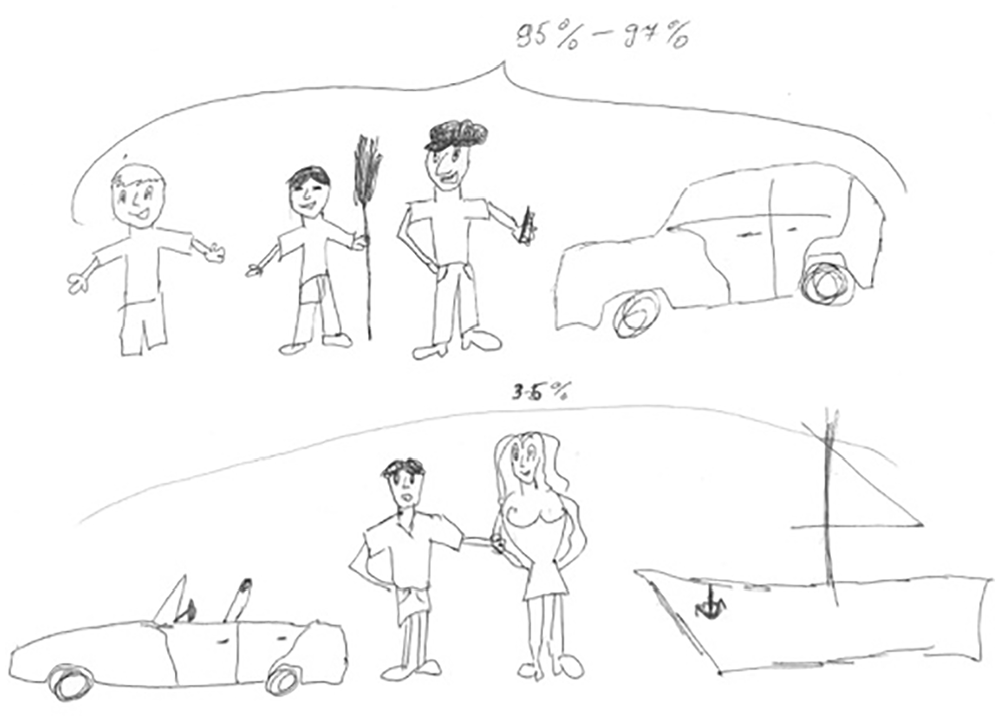
Russian society turned upside-down: The poor 95–97% (top) and the rich 3–5% (bottom).
Danila imagined Russian society as social portraits of people belonging to two different groups: the poor and the rich. There are ordinary people in society (placed at the top) who do manual jobs. The socio-material attributes of this social group are ‘a broom’, ‘an old mobile phone’ and ‘a cheap car’, which symbolise their lifestyles and activities. One can recognise here a migrant worker from Tajikistan who cleans the streets (in the middle); a vegetable seller from the Caucasus who may also work as a taxi driver (to the right near the car); and an ordinary man from Russia (on the left). The rich people are depicted at the bottom and have prominent social characteristics as well as extraordinary lifestyles. We see a luxury car and an expensive sailing yacht. In the Russian popular social imaginary, these material attributes are primarily associated with the rich. The man with a stylish haircut and fashionable clothes resembles a Russian oligarch, while the woman with long hair, big breasts, high heels and long legs resembles a fashion model. These social portraits demonstrate not only class but also gender and ethnic unequal power relations.
In the drawing, Danila expressed his perception of inequality ironically and drew an inverted power hierarchy, which I interpret as an implicit critical message about the social structure. At the same time, Danila’s verbal explanation of the drawing shows not only his moral evaluation of classed groups and his feelings about inequality but also his xenophobic attitude towards migrant workers, whom he meets in his local area every day: [W]hat did I want to draw? Basically, most people living in Russia are middle class or below. I mean there are so many newcomers, who come . . . to the largest cities of Russia . . .. I mean mostly newcomers are coming, migrants, so many Caucasians, who are stealing, killing, selling drugs, guns, other things too. [. . .] And indeed, there are fewer and fewer Russian guys, very few in proportion to migrants and newcomers. Well, let’s say this category of people accounts, in my opinion, for 95%, maybe, 97% of the whole population in Russia while those segments of the population, maybe 3–5%, these are people who are living the high life, who have access to the big money, power, luxurious life and all the rest. And that stratum [the middle class], which probably should exist in normal society, it does not exist. People are either just scraping by, or they have some wealth, about which we do not know and will never know probably, or they live in this tiny stratum and make money off people, off the ordinary citizens who live here, from taxes, from extortion, and all the rest.
Danila perceived Russian society as highly polarised between the rich who live a full life being ignorant to the rest of society, and the poor whose lives are boring and deprived. In research on the crisis imaginary, Shevchenko (2009: 41) analyses a similar narrative by a female retired schoolteacher from Moscow about ‘the moral decline’ in society that she connected to ‘a global break in Russia’, which emerged during the 1990s. Unlike most participants from the study by Irwin (2018) who tended to self-identify as people in the middle of society, Danila placed himself at the same level as the working people (in the left upper corner) but visualised different segments of the poor and built moral boundaries between ordinary Russian men and migrant workers from Central Asia and the Caucasus. In the interview, he distinguished himself from the working class and pointed out that he did not socialise with migrant workers. Danila’s quote shows his worries about the social standing of ordinary Russian people in an unstable society and his negative xenophobic perception of migrant workers.
When I asked Danila who lived in his industrial neighbourhood, he explained that it was: definitely people whose income is not high . . . this is mostly the middle class or lower . . . [D]ue to the hard economic situation, the middle class came to an end . . . Earlier we equated ourselves to it, but now I wouldn’t say that it is so.
Explaining his drawing, Danila also focused on the absence of the middle class in society, even though he took a more secure social position than the workers I interviewed. Talking about his lifestyle, he said that he spent leisure time outside the neighbourhood due to the absence of ‘good, expensive restaurants with a normal public’ there. Danila viewed Russian society as a polarised class structure with moral and symbolic signifiers driven by income, consumption and prestige, as described by Rivkin-Fish (2009). But he visualised it through the ironic inversion of power hierarchy. The participant’s senses of place, inequality and social justice were shaped by his lived experience in Moscow’s industrial neighbourhood with a large proportion of migrant workers and his white-collar job in the telecommunications industry.
Subversion of Power Hierarchy
Other drawings contained explicit critical reflections on unequal power relations in Russian society. Castoriadis (1975: 146) terms this as ‘radical imaginary’ that contributes to the production of social change and constitutes symbolic significations. Of the 35 drawings, three fall under this type (two by trade unionists from Moscow and one by a civil activist from Yekaterinburg). The drawing by Elena (Figure 3), a female 30-year-old trade union activist and former service worker from Moscow, provides an example of subverting the power hierarchy and an explicit political message about antagonistic relations between capitalists and proletarians. As well as her trade union activity, she takes part in open street protests and social movements. She enjoys reading works by Marx and Engels and other critical thinkers, which is reflected in her drawing. At the top, Elena depicted a small group of large pigs accompanied by the dollar symbol (‘$’) denoting ‘business’, ‘richness’, ‘wealth’ and ‘prosperity’. At the bottom, she put a large group of small people of different genders protesting against social inequality and injustice with placards. At the very bottom, she drew vegetables: ‘potatoes’, ‘carrots’ and ‘tomatoes’ to represent people who ‘sleep’, that is, those who do not have political awareness and do not struggle for their rights and for a better life. Elena used a line to depict class conflict by adding a fortified fence between the rich and the ordinary people. This is how Elena explained her image: At first, I just tried to draw a fence with barbed wire. Well, in fact, this is the barrier, which does not let them [people from the bottom] go here [to the top], even if, to take another perspective, the person is from an ordinary family, I could even say me. Yes, I’m from an ordinary family, with ordinary . . . I cannot climb over the fence into their society, because they do not let me. Basically, people like me are not allowed where money and power are. I mean, [they let in] either their acquaintances, or people they are connected to, or their [friends], but not these [ordinary people], not this stratum. I don’t even know how to draw it. And I have drawn this whole spikey fence, spiked path, which will be long, difficult and hard. But, in the end, I hope after all that a mass of these people will be able to make a hole in the wall, or to overcome this spiked path, to make a hole in the wall and break in here and establish equality (ravnopravie), so that these [people] will not suffer, and these will not have so much power.
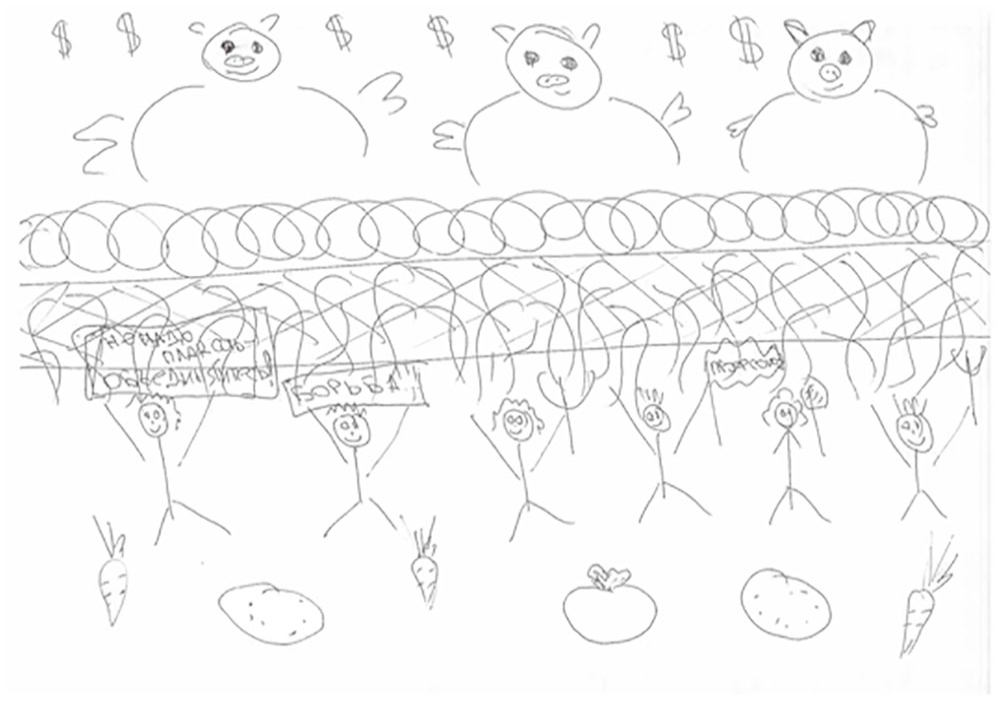
Signs on the placards (from left to right): ‘Don’t cry! Unite!’, ‘Struggle!!!’, ‘Trade Union’.
This drawing shows not only a perception of the antagonistic relations between dominant and subordinate but also an attempt by ‘ordinary people’ to challenge and subvert the power hierarchy while desiring a new order with equality and social justice. Elena expressed her hope for a better society, where all people maintain equal relations and live happily. She also drew very deprived people (at the bottom) whom she morally categorised as ‘passive’, ‘blind’ and ‘sleeping’. These images of ‘pigs’, ‘vegetables’ and ‘ordinary people’ have morally loaded signifiers (Savage et al., 2001) and function as metaphors in the narrative about inequality. The ‘pigs’ signify bad, overfed capitalists, who hide their money behind their fence and ‘govern life’ of subordinate groups. The ‘pigs’ are the metaphor of unfair wealthiness and power possession. ‘Vegetables’ morally denote lazy people watching TV, complaining about their misfortune and doing nothing to change their situation. The ‘vegetables’ are a metaphor for ordinary people’s political passiveness and powerlessness caused by their unwillingness to unite and solidarise. And, finally, struggling people (maybe ‘industrial workers’, as she said) whom she considered to be ‘good’ because they try to improve life around them by openly showing discontentment and disobedience, and by participating in trade unions and grassroots collective action.
Talking about people’s engagement in political struggle, Elena stressed the increase of inequality compared with the Soviet era: [T]his generation, which, for example, is younger than me, they do not have any more what was in the USSR. They do not have flats, do not have education, medical care is also not free of charge. Anyway, even public [medical care] requires payments. You should pay for everything, but you do not have money, you know, people have become disenfranchised.
The quotes by Elena about inequality and the conflicting image of society are exemplary in terms of moral and symbolic boundaries (Lamont, 2000) between rich and poor underpinned by their economic opportunities in neoliberal neo-authoritarian society. Her narrative and image include different moral signifiers of ‘struggling’ and ‘sleeping’ workers, all belonging to ‘ordinary people’. Elena’s drawing visualises the bottom–up power dynamic in Russia society. This is an attempt to change the social order by accumulating social energy from horizontal cooperation and networks of solidarity. Finally, this drawing expresses Elena’s sense of inequality and social justice (together with her radical dispositions) shaped by her trade union activity, political experience and collaboration with left-wing activists.
Discussion and Conclusion
The article enhances our understanding of inequality by exploring the moral and symbolic signification of the social structure in postsocialist society. The study contributes to the debate on moral classes and class feelings (Bottero, 2020; Clément, 2022; Irwin, 2018; Lamont, 2000; Morris, 2016; Rivkin-Fish, 2009; Salmenniemi, 2012; Sayer, 2005a, 2005b; Skeggs, 1997; Walker, 2022) by focusing on lay perceptions of inequality through the lens of the social imaginary that I analysed as a semantic structure (Barthes, 1993; Castoriadis, 1975; Williams, 1961). The article develops an innovative arts-informed method of ‘drawing of society’ (Bikbov, 2007) by applying it to a multi-sited ethnography of everyday inequalities experienced by members of deindustrialising communities in several locations. An invitation to draw society during an interview engages the creativity of research participants and helps visualise their social imaginary interrelated with their sense of inequality and social justice. Drawing society allows a visualisation of power dynamics within society and lay perception of inequality, while the complementary verbal explanations and interview narratives help analyse moral and symbolic signification. However, applying a drawing in research requires a creative strategy for its analysis. The suggested multimodal approach to data collection and analysis combining ethnographic and arts-informed methods provides an opportunity to further develop creative ethnography.
I have argued that in Russia members of deindustrialising communities, including workers and professionals, tend to imagine society as consisting of morally signified classes and as divided between a small number of rich and a large number of poor. Working-class and middle-class research participants tended to locate themselves at the bottom of the social hierarchy. Some of them perceived Russian society as class based with a widening gap between the subordinate and the dominant. But they narrated inequality differently by drawing moral and symbolic boundaries between social and also ethnic groups. This finding is evidence of class polarisation and an ethnic/racialised vision of inequality resulting in the increase of a social tension and xenophobia regulated by the neoliberal neo-authoritarian regime of Russia. This develops and specifies Clément’s (2017) argument of cleavages in Russian society.
I have supported this finding with three examples. First, the drawing by a retired factory worker from Yekaterinburg represented a hierarchy of classes differentiated by the configuration of income, symbolic status and moral worth. The participant located himself outside society as lacking all these resources. Second, the drawing by a young professional from Moscow showed the absence of the middle class and exemplified the critical imaginary combined with xenophobia. The participant distinguished himself from ‘ignorant’ and ‘unfair’ rich people who could afford a luxurious lifestyle, as well as from workers and migrants whom he viewed as poor and not ‘normal’. Despite mentioning his opportunities of prestigious consumption, he placed himself at the same level as the latter. In contrast, the drawing by a young woman, trade union activist from Moscow suburbia, represented her radical social imaginary (Castoriadis, 1975; Clément, 2022). Her narrative about inequality focused on the absence of economic opportunities for ordinary youth to be engaged in upward mobility. The participant signified the rich as morally unfair and built the moral boundary inside the poor distinguishing between politically indifferent and active people.
The research revealed three strategies of imagining inequality in society, including compliance to the established social order, inversion of power hierarchy through irony and subversion of power hierarchy. The social imaginary of members of deindustrialising communities is interrelated with their sense of inequality shaped by their lived experiences gained in deindustrialising urban spaces. This means that ordinary people develop class feelings within socio-material infrastructures helping them navigate inequality in everyday life. This confirms the arguments of ordinary people’s awareness of inequality by Irwin (2018) and Bottero (2020). Simultaneously, the social imaginary of younger participants and their narratives about the established order were more critical compared with the older participants’. This may indicate a generational divide reinforced by different visions of Russian society and leading to an increasing tension between older and younger people. However, further research on the social imaginary and its interrelation with generational, gender and other inequalities is needed.
Footnotes
Acknowledgements
I would like to thank my research participants for sharing their stories and the two anonymous reviewers for their valuable comments that allowed me to improve the article. Further thanks go to Wendy Bottero, Hilary Pilkington, Andrew Miles and James Rhodes for their helpful feedback on my research project throughout different stages of its conduct. I am also grateful to William Shankley for his thoughtful suggestions for interpreting ethnic/racial inequalities.
Funding
The author received no financial support for the research, authorship and/or publication of this article.
Ethics statement
The research project received an approval from the University of Manchester’s Ethics Committee. All research participants signed the informed consent form. In the article, I use pseudonyms to align with the ethical principle of anonymity and protect participant identities.

Notes
References
Supplementary Material
Please find the following supplemental material available below.
For Open Access articles published under a Creative Commons License, all supplemental material carries the same license as the article it is associated with.
For non-Open Access articles published, all supplemental material carries a non-exclusive license, and permission requests for re-use of supplemental material or any part of supplemental material shall be sent directly to the copyright owner as specified in the copyright notice associated with the article.
