




Abstract
We examine how inter-class relationships shape attitudes towards inequality. Our theoretical frame defines attitudes towards inequality as ethical dispositions and hypothesises that class-based network diversity may favour the development of what has been termed a ‘reflexive habitus’ that likely pushes for more egalitarian dispositions. The focus of our enquiry is on Chile – one of the most unequal countries in the world. We use large-scale representative survey data collected in 2016 (N = 2927). Results of our regression analyses indicate that class diversity in social networks strongly increases awareness of inequality and more egalitarian preferences while reducing belief in meritocracy and the perception that the current distribution is fair. Additional analyses suggest that network diversity influences views on inequality to a similar degree among individuals from different social classes, except for meritocratic beliefs, where network diversity especially affects the upper class. We conclude by discussing the importance of reducing socio-economic segregation.
Introduction
Economic inequality appears to be growing in many countries worldwide (Alvaredo et al., 2018; Piketty, 2014). This is particularly worrisome because inequality often brings stark differences in educational opportunity and healthcare disparities among people from different class backgrounds (Neckerman and Torche, 2007). Inequality also yields a reduction in social trust and social cohesion in general, while creating social unrest and conflicts (e.g. Rothstein and Uslaner, 2005). Beyond macro-institutional conditions, especially the political economy of welfare states, economic inequality is also shaped, at least in part, by people’s perceptions, attitudes and beliefs about inequality (Alesina et al., 2012). Popular views on inequality and related issues might symbolically legitimise or challenge the political status quo (Sandel, 2021). As such, enquiry into subjective attitudes towards inequality and how these attitudes are formed is key to achieving a better understanding of the persistence of inequality.
The existing literature on contemporary politics has tended to examine class differences in attitudes towards inequality while defining classes as distinctive positions in labour markets and workplaces. Studies have generally shown that people from the working class are more prone to perceive inequality, support redistribution policies and understand the causes of inequality in structural terms, while those from the upper classes are less likely to support economic restructuring and more likely to justify inequality by locating the cause of status differences in meritocratic processes (e.g. Lindh and McCall, 2020; Mijs, 2021). When looking at horizontal class distinctions within the upper (-middle) class, support for inequality is disproportionately low among socio-cultural specialists, that is, qualified professionals working in client-interactive settings (e.g. Oesch and Rennwald, 2018). The story of class differences in economic interests has been particularly relevant to explaining the class divide in attitudes towards inequality, while other mechanisms such as class cultures, economic insecurity and job autonomy have also been proposed as contributing to the class–attitude link (e.g. Brooks and Svallfors, 2010; Langsæther and Evans, 2020).
While studies have provided indispensable insights into the micro-foundations of class attitudes, it is clear that research has focused primarily on immediate employment situations. This is far from trivial, as people do not simply occupy locations within a given hierarchy: they also experience the class structure through the specific classes to which they are bound as part of their daily lives (e.g. Bottero, 2005; Wright and Cho, 1992), which can profoundly influence their perspectives and shape how they perceive the world around them. With this caveat in mind, recent studies on political attitudes have concluded by speculating that personal networks might be a key factor in disentangling the relationship between social class and political attitudes, specifically, that inter-class relationships may play an important role in explaining people’s views on inequality (e.g. Langsæther and Evans, 2020). Some of the research conducted to date has incorporated the class position of family members (romantic partners and/or parents) to examine class–attitude association (e.g. Häusermann et al., 2016; Newman, 2014; Paskov and Weisstanner, 2022). However, only a few studies have explicitly considered how the class profile of one’s extended personal network influences individuals’ political attitudes, and especially their views on inequality (Lindh et al., 2021). As such, studies relating to this emerging research agenda remain scarce and far from conclusive.
In order to advance on this issue, the current article examines the extent to which inter-class relationships shape views on inequality, including awareness of inequality, evaluation of the principles that govern the distribution of resources (perceptions of the fairness of social inequalities and meritocratic beliefs) and egalitarian preferences. Our theoretical frame defines attitudes towards inequality as ethical dispositions (Sayer, 2005) and proposes that personal networks may favour the development of what has been termed a ‘reflexive habitus’ (Sweetman, 2003). We specifically focus on the role of network diversity in terms of class, which has been shown to favour the development of generalised trust, cooperation and civic action (e.g. Chua et al., 2020; Glanville et al., 2013), but has not been systematically considered to explain views on inequality. Our main argument is that knowledge accumulation and lived experiences of inequality derived from contact with people from different social classes might produce disruption to habitus and thus substantially affect the class divide in attitudes towards inequality. Thus, the relevance of addressing inter-class relationships in order to explain variations in attitude lies in their potential to offer a representation of collective experiences related to the class structure that cannot necessarily be captured through static class locations or employment situations. In this sense, we consider that the joint analysis of individual class may help us to gain a clearer understanding of the overall influence of class on attitudes towards inequality.
We expect to provide internationally relevant insights by focusing our enquiry on Chile, one of the most unequal countries in the world. In general, unequal societies are expected to recreate more polarised attitudes towards inequality along the lines of class, and the most unequal countries are also those in which wealthy people are more likely to express meritocratic beliefs to justify their own good fortune (Mijs, 2021). Unequal societies also tend to be marked by greater social distance, with the rich and the poor more likely to live in segregated social environments. As such, people in more unequal countries are more likely to underestimate the extent of inequality, especially due to socio-economic insulation (Rothstein and Uslaner, 2005).
In this context, our research questions are as follows:
How closely is social class associated with attitudes towards inequality?
To what extent is network diversity associated with attitudes towards inequality above and beyond class?
To answer these questions, we use large-scale representative survey data collected in 2016 for the Chilean urban population aged 18–88 years (N = 2927). The article continues by discussing the theoretical arguments, proposing attitudes towards social inequality as ethical dispositions, and examining the relationship between the class-diversity of networks and attitudes towards inequality to propose our hypotheses.
Attitudes Towards Social Inequality as Ethical Dispositions
In this study, we focus on distinct attitudes to social and economic inequality. It is possible to differentiate between perceptions of existing income inequality, which refer to how resources are distributed among the people in a society, and preferences concerning the distribution of economic resources, especially willingness to reduce inequality of opportunity and the degree of agreement on the principles of distributive justice (e.g. Castillo et al., 2022; Osberg and Smeeding, 2006). There are also beliefs and judgements regarding the legitimacy and justification of inequality, including meritocratic beliefs and the perceived fairness of social inequalities (e.g. McCoy and Major, 2007; Mijs, 2021). As such, the literature on contemporary political attitudes to inequality is complex and multidimensional.
It is widely acknowledged that attitudes towards inequality vary considerably according to class positions. People from the upper classes are often less worried about inequality and less open to supporting policies regarding the redistribution of wealth, while those who are more disadvantaged tend to problematise inequality and express support for the provision of universal services (e.g. Brooks and Svallfors, 2010; Chan and Goldthorpe, 2007; Evans and Kelley, 2017; Lindh and McCall, 2020; Mijs, 2021). These attitudinal differences can be explained, at least in part, by economic individualism or objective economic self-interest (Meltzer and Richard, 1981). Indeed, the rich are more likely to have lower egalitarian dispositions because they have the most to lose from any government redistribution policies, while the poor are more likely to support the implementation of redistributive policies because they expect to receive more welfare benefits with which to improve or overcome their Socioeconomic deprivation (see also, for example, Svallfors, 2006). Other explanations for attitudinal differences include subjective class identity, economic insecurity or relative deprivation, job autonomy and the lack of information or misinformation about policies (e.g. Evans et al., 2022; Langsæther and Evans, 2020).
We consider that class-related differences in attitudes towards inequality might be further explained with the help of Pierre Bourdieu’s theoretical approach, in particular the concept of ‘habitus’. This is a system of dispositions, transmitted through socialisation, that shapes individuals’ common sense, worldviews and tendencies to see others in distinctive ways while delivering a collective ‘practical sense’ of objective possibilities (Bourdieu, 1984). The dispositions shaped through the habitus do not emerge from a vacuum but originate from the individual’s past and ongoing experiences within different social spaces or fields (Atkinson, 2021). Such experiences are related to processes inherent to all fields, particularly competition between individuals to accumulate particular resources or capitals that ultimately define their social positions. In this sense, the habitus is a structured structure; an objective product of social structures; ‘a means of viewing structure as occurring within small-scale interactions and activity within large-scale settings’ (Reay, 2004: 439). This pushes individuals with similar social positions to develop relatively analogous attitudes and behaviours, since they probably share similar experiences within certain fields. Given that agents are generally involved in multiple relatively autonomous fields, both synchronically and diachronically throughout their lives, their dispositions are arguably formed by a combination of field forces (Atkinson, 2022).
This definition of habitus as a structured structure is helpful to understanding individuals’ subjectivity as socially situated and anchored in their field-shaped social conditions, especially their social class. The habitus, however, is also a structuring structure, since new behaviours related to previous ones can be generated to ‘master all problems of a similar form that may arise in new situations’ (Bourdieu, 1990: 94). This means that the habitus does not automatically translate into practices and that, to a certain degree, it is flexible and creative (Bourdieu and Wacquant, 1992) and can originate both conservative (to maintain the field’s principles and balance of forces) or subversive (to transform the field’s rules) strategies (Atkinson, 2021). There are several ways through which the structuring mechanisms of the habitus work to account for more reflexive individual responses, rather than attributing immediate adaptation to new situations (e.g. Bottero, 2010; Sweetman, 2003).
One way to further understand the connection between habitus and reflexivity, particularly regarding attitudes towards inequality, is by focusing on the analysis of what Sayer (2005) calls ethical dispositions. In general, ethical dispositions refer to the moral dispositions of the habitus, including those of care, compassion, classism and selfishness. All of them require that individuals evaluate things, partly subconsciously through emotional responses and partly consciously through reflection. In this sense, ethical dispositions constitute a realm of the habitus that necessarily implies a degree of attentiveness and reflexivity to evaluate, confirm or gradually shift our moral inclinations.
Our argument is that emotions at the base of ethical dispositions need to be understood not only as feelings but as responses to our situations and concerns (e.g. emotional responses to injustice and social inequality) that are, to some extent, mediated by lay reflexivity (e.g. convictions, when conscious deliberation is very strong). In turn, ethical dispositions affect the ways in which we act towards such concerns, as it is our attitudes towards others in society that shape our views on issues like meritocracy, social justice and inequality. The definition of habitus as a structuring structure and the concept of ethical dispositions are helpful in understanding political attitudes in relation to potential conservative or subversive strategies to maintain or transform the organisational principles of society. But how can reflexivity form the basis of the emergence of ethical dispositions?
The Role of Class Networks in Shaping Subjectivity and Ethical Dispositions
Bourdieu argued that reflexivity in the habitus may be triggered by moments of ‘crisis’, where a poor fit between position and dispositions leads to habitus disruption and a poor ‘feel for the game’ in a definite field (hysteresis effect, in Bourdieu’s terms). In other words, our embodied practical beliefs no longer match a changing context and consequently are disrupted, or cease to be taken for granted. Several authors have ventured deeper into Bourdieu’s understanding of such potential disruptions, highlighting the role of intersubjective negotiation and the relational nature of habitus formation.
Here, we follow an approach that suggests that ambiguities and ambivalences fostering reflexivity and a critical distance from one’s own situation are especially associated with shifts in social connections, which we argue are favoured by the agents’ simultaneous and diachronic participation in different fields. The core argument within this framework is that cross-class social interactions may help people to learn about alternative worldviews, reflect more carefully upon their own knowledge and eventually modify and reconstruct their dispositions in the process. As such, reflexivity can be understood as the incorporation of the other’s perspective within our own habitus in such a way that habits fit into an ongoing dialogue between individuals and their world (Bottero, 2010; Crossley, 2001).
A key factor for understanding the way in which social connections could be related to a different set of dispositions is the class patterning of social interactions. There is a well-established tendency for people to interact and associate with similar class others, that is, class homophily in social relationships, which normally implies the emergence of homogeneous networks (e.g. Alecu et al., 2022; Otero et al., 2021; Wright and Cho, 1992). This pattern occurs because class similarity is predisposed to closer relations: individuals located in a particular sector of the social hierarchy are physically closer and more culturally disposed to becoming closer still (Bourdieu, 1998). Nevertheless, to some extent, individuals can experience inter- and intra-generational social mobility and traverse different social contexts, thereby moving through more or less heterogeneous social milieus. In doing so, they can be exposed to people of diverse classes and thus access the worlds of others (e.g. Li et al., 2008).
We argue that the role of class diversity within networks might be of particular relevance in fostering disruptions of habitus in regard to what we refer to here as ethical dispositions. In general, networks form the basis of reference groups and provide the social structure by which individuals acquire insights into others’ information and experiences. As such, network ties enable people to make social comparisons and consequently define the frame of reasoning within which they perceive and evaluate social reality. An essential phenomenon by which to understand the socially classed patterns of perceptions and beliefs about social inequality is social influence, which implies that ‘individuals take impression from others and modify their attitudes accordingly’ (Lindh et al., 2021: 698). There are several mechanisms that could explain the influence of networks on political attitudes, including spontaneous imitation, the cognitive aspect of identification with a particular social class and social pressure to align with particular group norms.
When explicitly referring to inter-class relationships, network diversity thus represents a scenario in which people can potentially improve their knowledge about the lives of others and experience or learn more about inequality (Lockwood, 1966). This especially occurs because cross-class relationships allow people to make more social comparisons with different reference groups (e.g. Clark and Senik, 2010; Condon and Wichowsky, 2020), such as acquaintances in a state of financial hardship, unemployment or geographical deprivation (e.g. Kearns et al., 2014; Newman, 2014). This implies that individuals can be more likely to understand their place in the world and gain a deeper understanding of society, thereby reducing systematic cognitive or perceptual heuristic availability biases and/or bounded rationality when they read the social reality and extrapolate from their own situated position (Irwin, 2018), particularly in their inference of the distribution of economic resources and estimation of inequality (e.g. Cruces et al., 2013). Similarly, this social process – acquiring more accurate information about inequality by means of inter-class relationships – might have important consequences regarding subjective beliefs about the nature of society and reduce erroneous ideas about what causes inequality. This may especially be the case as people can become more aware of the unfulfillable promise of meritocracy and recognise that poverty is often caused by circumstances beyond individual control, rather than by laziness, ignorance or irresponsibility (e.g. Merolla et al., 2011; Newman et al., 2015).
The disruption of habitus through network diversity may particularly affect commitment to egalitarianism, including the provision of equal educational opportunity and support for income redistribution. There may be additional non-mutually exclusive mechanisms that could explain this process in more detail. When people learn and experience inequality due to cross-class extended contact, the associated reflexivity can help dispel myths, reduce prejudice, undermine negative stereotypes and build tolerance about those in different economic positions (Pettigrew and Tropp, 2006). This type of sociability may also help individuals to develop cognitive and affective identification and eventually trigger feelings of sympathy and empathy for others (Sennett, 2012). Combined, these underlying mechanisms might, therefore, profoundly alter attitudes in ways that cultivate greater solidarity and altruism. The scarce quantitative studies explicitly addressing the role of networks in defining attitudes towards inequality have supported this assumption to some degree by showing that more social ties with people in lower-class occupations (e.g. service workers) increase support for redistribution, while greater connections to managers reduce this support (Lindh et al., 2021; Paskov and Weisstanner, 2022).
In short, we argue that reflexivity associated with ethical dispositions is, in part, rooted in intra-habitus tensions generated by more general ‘incongruences’ between class and network structures. We suggest that network diversity in terms of class might be especially relevant to encouraging such disruptions in class habitus and thus positively affect the perception of economic inequality, reduce the perceived fairness of inequality and attitudes that tend to foster its legitimation (meritocratic beliefs especially) and ultimately push for more egalitarian preferences. As we know from previous studies that people’s views on inequality are strongly affected by class positions, we specifically expect that network diversity produces summative effects. This is our main hypothesis.
We also acknowledge the potential heterogeneity in the relationship between network diversity and perceptions of inequality. Affluent individuals, in particular, tend to participate in socially homogeneous spaces, which notably restricts their exposure to the structural constraints that affect socially disadvantaged people (e.g. Khan, 2012). This might lead them to have a more significant lack of understanding of the determinants of structural inequality and of the exogenous factors that shape individual agency, as well as to view lower-class living conditions significantly more positively than they are (e.g. Thal, 2017). Thus, the disruption of habitus by means of inter-class relationships could be especially beneficial in terms of changing their understanding of how the world works (e.g. Edmiston, 2018). If this holds true, the effect of network diversity on attitudes might be greater for the upper classes, shifting towards relatively greater awareness of inequality and egalitarian values. This constitutes an additional secondary hypothesis.
The Chilean Context
We test the above-mentioned hypotheses in Chile, one of the most economically unequal countries in the world. Today the top 1% of households take home around 27% of total income, while the top 10% income-share is estimated to be approximately 63% (World Inequality Database (WID), 2022). This uneven economic distribution has yielded strong class stratification, with stark differences in access to high-quality education, healthcare and housing between classes (PNUD, 2017). Moreover, the prospects for intergenerational mobility have been reported to be restricted and characterised by short-range upward mobility within the middle classes, and strong limitations to entry into the upper classes and elite positions (Espinoza and Núñez, 2014; Torche, 2005).
Social stratification is clearly visible in terms of social distance and segregation between classes. The education system is strongly segregated by social class, with the upper classes mostly accessing fully private schools and the lower classes overrepresented in the public system (e.g. Carrasco et al., 2021). There is also increasing residential segregation, especially in Santiago, the Chilean capital, characterised by strong self-isolation among affluent residents, along with extreme urban exclusion and marginalisation of the lower classes on the south-western periphery of the city (Garretón, 2017). It is, therefore, not surprising that acquaintanceship networks are overwhelmingly reported to be class-homogeneous in Chile, especially among the upper and lower classes (Otero et al., 2021).
With Chilean society highly segregated in terms of class, it has been essential to examine people’s views regarding inequality and assess whether citizens legitimise or criticise inequality, as well as their preferences for more egalitarian policies. Aligned with the international evidence, research has revealed that the preference for a more active role of the state in redistribution decreases with income (Castillo et al., 2013). Studies have also shown a generalised tendency to rely on meritocratic discourses, especially among individuals with lower educational levels (Castillo et al., 2019). Nevertheless, there is a clear lack of knowledge regarding how class positions – which are primarily associated with relations in the labour market and occupations – particularly affect attitudes towards inequality. All of these aspects highlight the relevance of analysing the role of lived class experiences in shaping views on inequality and encourage us to examine how inter-class relationships may produce variations in political attitudes.
Data, Variables and Methods
Data
We use survey data from the first wave of the Longitudinal Social Study of Chile (Estudio Longitudinal Social de Chile, ELSOC) collected in 2016 and representing the Chilean urban adult population. The sample frame was proportionally stratified according to six population scales (e.g. large cities, small cities), followed by a random selection of households within 1067 city blocks. After this, 2927 individuals were surveyed using face-to-face interviews. The survey was designed by the Centre for Social Conflict and Cohesion Studies (COES) and covered a wide range of sociological issues (see ELSOC, 2018).
Ethical Dispositions towards Inequality and the Social Structure
We define attitudes towards inequality as a particular kind of ethical disposition and operationalise them through five indicators often used in research to capture views or perceptions of inequality. All of these five factors are used as dependent variables in statistical analyses.
Perceptions of income inequality. An item on the assertion ‘In Chile, differences in income are too high’ – five-point Likert-type scale, 1 ‘Strongly disagree’ and 5 ‘Strongly agree’.
Meritocratic beliefs. Average index of two items: ‘people are compensated for their efforts’ and ‘people are compensated for their intelligence and abilities’ (α = 0.820) – five-point Likert-type scale, 1 ‘Strongly disagree’ and 5 ‘Strongly agree’.
The perceived fairness of social inequalities. An item on how fair or unfair people consider the difference in living conditions between the upper and lower classes to be – five-point Likert-type scale, 1 ‘Very unfair’ and 5 ‘Very fair’.
Attitudes towards equal opportunities. Average index of two items: ‘we should work to give all groups an equal chance to succeed’ and ‘we should do what we can to equalise conditions for different groups’ (α = 0.705) – five-point Likert-type scale, 1 ‘Strongly disagree’ and 5 ‘Strongly agree’.
Egalitarian preferences. Average index of three items: it is fair or unfair that people with high incomes (i) have larger pensions, (ii) can buy better education for their children and (iii) can access better healthcare than people with lower incomes (α = 0.837) – five-point Likert-type scale, 1 ‘Very fair’ and 5 ‘Very unfair’.
Social Class
Social class is our first main independent variable of interest in learning about people’s views on inequality. This factor is measured using the seven-class version of the class scheme devised by the UK National Statistics Socio-Economic Classification (NS-SEC) and based on the influential Goldthorpe class schema (e.g. Goldthorpe, 2010). In addition, we incorporated two population segments that do not hold full-time jobs – the unemployed and the retired.
In this schema, the class structure is regarded as one formed by relations in labour markets and production units. Thus, a primary level of demarcation of class positions is employment status (e.g. employers, self-employed workers and employees), and further differentiation is based on occupations. These two factors are taken as proxies for employment relations and, in particular, it is supposed that individuals with similar employment status and occupation probably have similar forms of employment regulation and, thus, similar class positions. Moreover, although this class schema manifestly reflects a structure of inequality, classes are not seen to represent a simple hierarchical ordering. Nor are they intended to capture ‘real’ socio-cultural collectivities that are subjectively meaningful to their members; rather, they are simply groupings of individuals that have in common a specific causal component of their life chances. We note that this class classification has also been used to analyse the class divide in political attitudes and preferences (e.g. Chan and Goldthorpe, 2007) and applied to the Chilean context to study differences in network resources (e.g. Otero et al., 2021).
The Position Generator and Network Diversity
We use the ‘position generator’, which is a widely recognised survey instrument for the measurement of social contacts across different occupations or classes (Hällsten et al., 2015). The instrument works by asking respondents: ‘How many people do you know who are X?’, where X indicates a variety of occupations or jobs. The ELSOC survey posed the following question to participants (our own translation from Spanish): Now I will ask you about some of your acquaintances. It doesn’t matter if they are close to you (family members or friends) or not. An acquaintance is someone you know at least by first name and with whom you might talk if you came across each other in the street or at a shopping centre. Think only of people who live in Chile. Can you tell me, based on the following card (and even if only approximately), how many people you know who are . . .?
A list with the following 13 occupations was then shown to respondents: (1) manager of a large firm; (2) street vendor; (3) secretary; (4) car mechanic; (5) shop assistant; (6) lawyer; (7) office cleaner; (8) doctor; (9) preschool teacher; (10) taxi driver; (11) waiter; (12) accountant; and (13) university professor. Seven response alternatives were presented: none, one, 2–4, 5–7, 8–10, 11–15 and 16 or more. For the analyses, we assigned midpoints to the original intervals (e.g. range 2–4 is coded as ‘3’), and we also assigned the value of 17 contacts to the ‘16 or more’ category.
We used these variables to build five indicators of network diversity. Most of them are traditional measures in the literature on social capital and personal networks (e.g. Van Tubergen and Volker, 2015). The first is the total number of occupations accessed (network extensity). The second is the range between the most senior and most junior occupations (resource heterogeneity). The third is network dispersion, which is the standard deviation of the occupational prestige scores assigned to social contacts in the overall social network. To calculate the last two indicators, we assigned occupational prestige scores using the International Socio-Economic Index of Occupational Status (ISEI), derived from the 2008 version of the International Standard Classification of Occupations (ISCO-08) (see Ganzeboom, 2010). A fourth indicator of network diversity is cross-class embeddedness, referring to individuals’ relations with various types of social contacts across a range of classes, that is, cross-cutting networks. Finally, we built an Index of Qualitative Variation (IQV), a measure of statistical dispersion for class positions in social networks: an IQV of 0 indicates no diversity at all, while an IQV of 1 indicates that the distribution is highly diverse in terms of class positions. For the latter two indicators, we classified the occupations included in the position generator into three occupational positions, closely resembling Goldthorpe’s class scheme (see Table A1 in the Online Appendix).
Since these five measures were strongly correlated, we applied a Principal Components Analysis (PCA) to extract the most important information from the data (see Table A2 in the Online Appendix). As expected, we identified one single factor from the analysis, which accounts for approximately 81.5% of the variance present in the data – a large portion (Abdi and Williams, 2010). We used this information to create a composite measure representing class diversity in social networks. This index has a mean of 0 and a standard deviation of 1 and will be used in all subsequent analyses throughout the article.
Analytical Strategy
Our main analysis consists of the estimation of Ordinary Least Squares (OLS) regression models. These models are specifically used to examine the associations of social class and network diversity with attitudes and perceptions towards inequality and associated issues. The dependent variables are the five indicators previously described. All models include control variables for gender, age, marriage or cohabitation status, education and household income. Education and household income are essential control variables. Several studies have provided evidence for the significant role of these factors as predictors of political attitudes. They often have distinct effects on attitudes, which can be differentiated from the impact of social class. Moreover, these factors partially account for or explain the relationship between social class and political attitudes, particularly regarding attitudes towards inequality (e.g. Chan and Goldthorpe, 2007; Evans et al., 2022; Van de Werfhorst and De Graaf, 2004). With regard to education, we use five levels of attainment ranging from no formal education to university education. We cover household income with a linear measure represented in Chilean pesos. We also added geographical strata as a control variable because, as mentioned, it constitutes the key stratification factor for sample selection. Table 1 shows the descriptive statistics of the variables used in the regression models.
Descriptive statistics of variables included in the regression models.

Note: ELSOC survey, N = 2748. Weighted figures.
The analyses involve fitting three different regression models for each dependent variable. Model 1 considers only socio-demographic controls (i.e. gender, age, marriage or cohabitation status) and social class. Next, in Model 2, we add the socio-economic controls (i.e. education and income). After this, Model 3 incorporates our composite measure of network diversity. In addition, we include complementary models to test for interaction effects of social class and network diversity on attitudes towards inequality. Models 1 to 3 are designed to test our main hypothesis, while complementary models allow us to test our secondary hypothesis.
Results
Descriptive Analyses
We begin by analysing descriptive findings. Table 2 shows attitudes towards inequality by social class and network diversity. Our composite index of network diversity was recoded into quintiles to show differences in attitudes in more detail. Regarding social class, we generally observe the lower classes to have slightly lower perceptions of income inequality and higher levels of meritocratic belief than other classes, while the perceived fairness of inequality appears to be higher at the top, that is, for those individuals with higher managerial or professional occupations. Moreover, people’s willingness to provide all groups with equal social opportunities to succeed seems to be similar across the class structure. The attitudinal gaps are especially large with respect to egalitarian preferences, with the upper class showing a lower preference for egalitarian provision of social services (healthcare, education and pensions).
Perceptions of inequality and social structure by social class and network diversity.
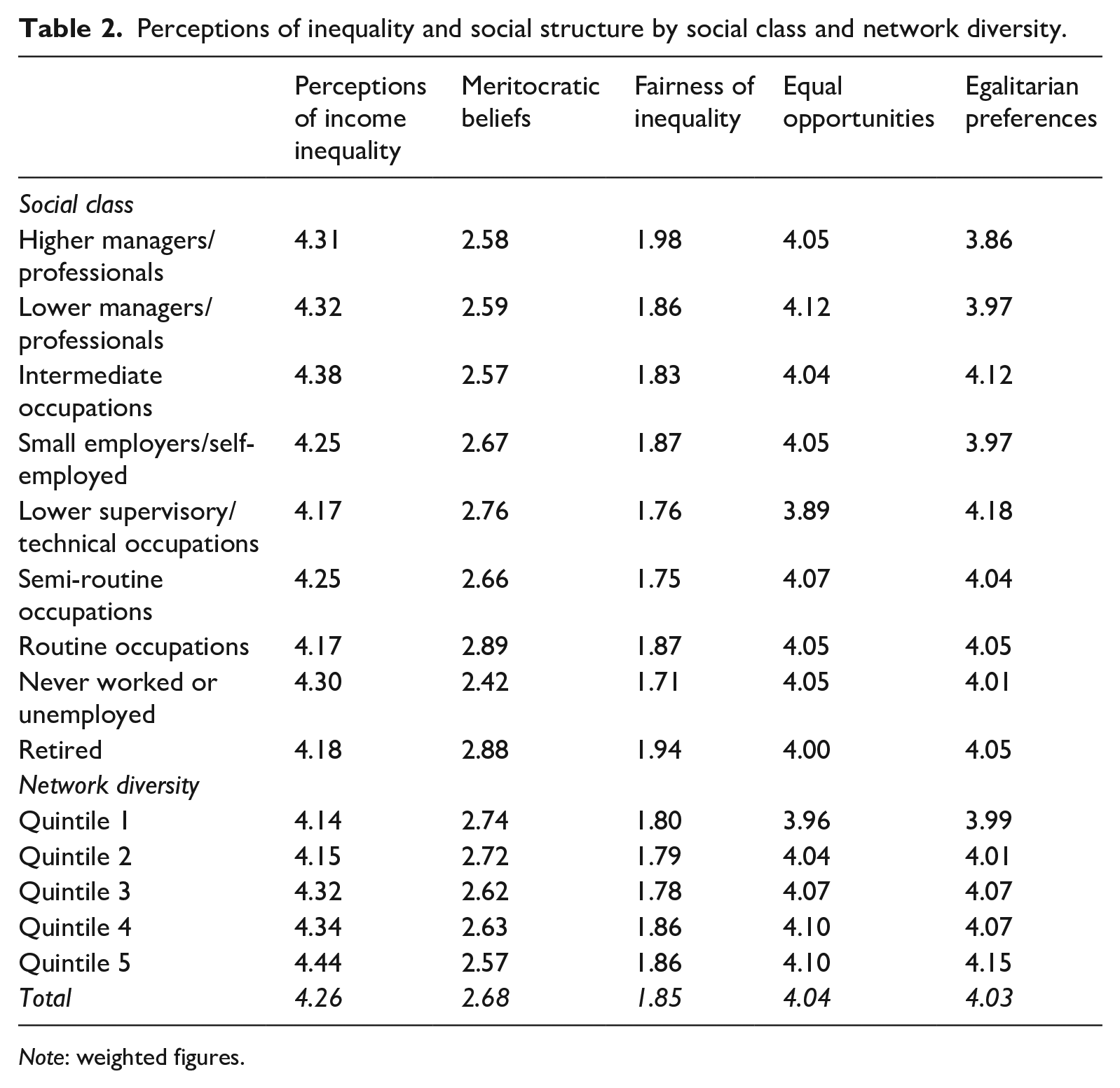
Note: weighted figures.
Differences in attitudes towards inequality are also visible according to network diversity. Table 2 shows that people who are exposed to less class diversity in their networks (quintiles 1 and 2) perceive smaller gaps between rich and poor, have relatively strong meritocratic beliefs and present less favourable attitudes towards equal opportunities. They also report lower commitment to egalitarianism. By contrast, those with more diverse networks in terms of class perceive relatively high levels of income inequality and indicate lower meritocratic beliefs. They also show a stronger willingness towards providing all groups with equal social opportunities to succeed and more egalitarian preferences regarding the provision of social services.
These patterns are also evident in the bivariate correlations between our (continuous) measure of network diversity and the five variables representing perceptions of inequality (see Table A3 in the Online Appendix). Although correlations are relatively small, network diversity is positively correlated with greater perceptions of income inequality, the desire to provide equal social opportunities and egalitarian values, while negatively correlated with meritocratic beliefs. The association between network diversity and the perceived fairness of social inequalities is less clear. Overall, these descriptive results are in line with our main hypothesis.
Explanatory Analyses
We now proceed to present the results of multivariate regressions that examine whether the differences in attitudes towards inequality described above remain stable when social class and network diversity are analysed together and control variables are included in the models. The findings are presented in Tables 3 to 5.
OLS regression models of perceptions of income inequality.

Notes: N = 2748. Control for geographical strata is included in all models. Standard errors in parentheses.
p < 0.1; **p < 0.05; ***p < 0.01.
OLS regression models of meritocratic beliefs and the perceived fairness of inequality.
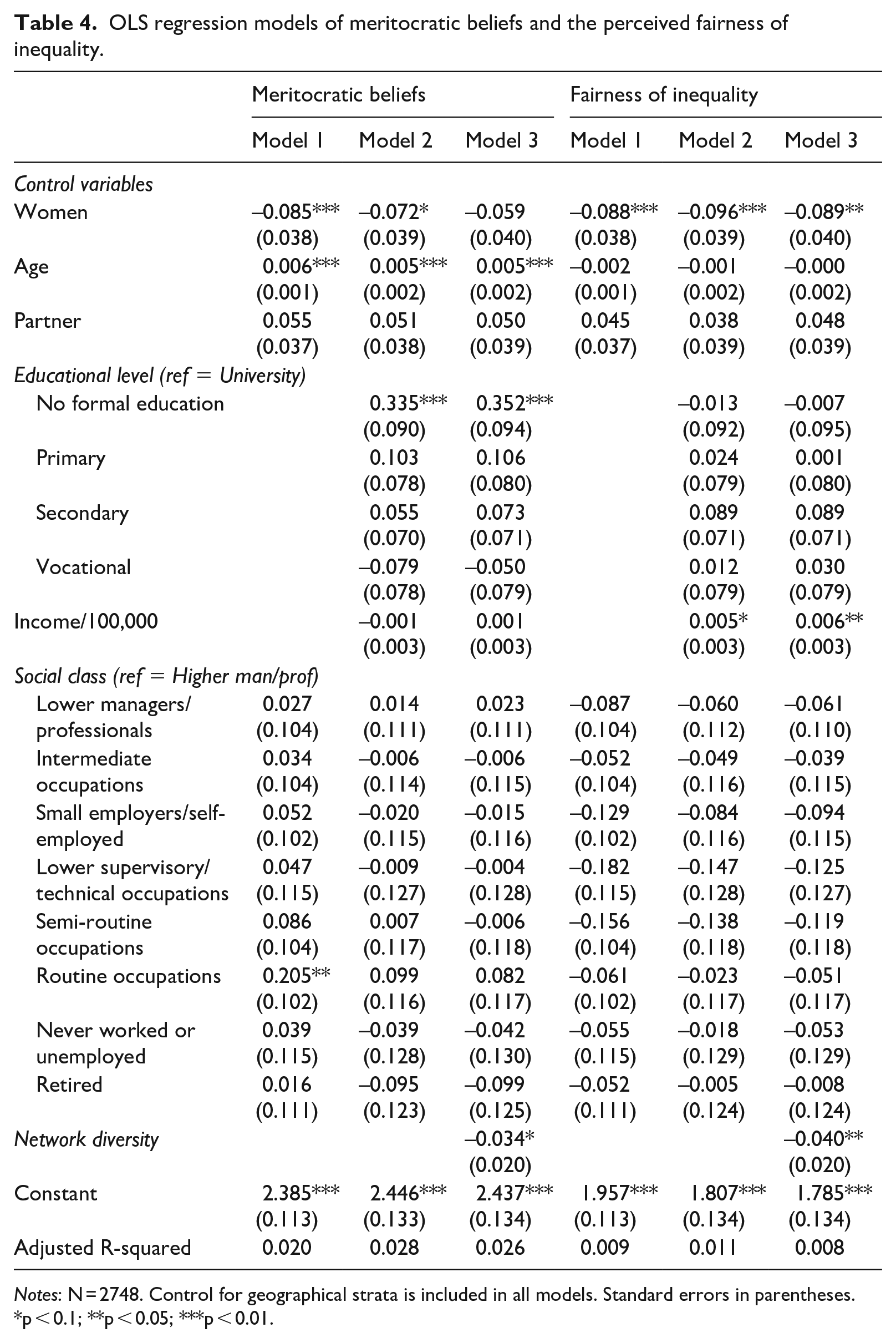
Notes: N = 2748. Control for geographical strata is included in all models. Standard errors in parentheses.
p < 0.1; **p < 0.05; ***p < 0.01.
OLS regression models of egalitarian preferences.

Notes: N = 2748. Control for geographical strata is included in all models. Standard errors in parentheses.
p < 0.1; **p < 0.05; ***p < 0.01.
Perceptions of Income Inequality
We begin by interpreting the results for the perceptions of income inequality, which are displayed in Table 3. Model 1 only includes social class and socio-demographic controls, and results indicate that people in the lowest class (i.e. routine occupations) and the retired have fewer perceptions of income inequality than those in the upper class (the reference). Model 2 incorporates the socio-economic control variables (education and income) and shows that people with a university degree have higher perceptions of income inequality than the less educated, although this is only statistically significant compared with those without formal education. Household income is not significantly related to perceptions of income inequality. We also note that the coefficients of respondents’ own class position are reduced, suggesting that educational attainment in particular goes some way towards accounting for the relationship between class and perceptions of income inequality. When network diversity is included in Model 3, results reveal that this factor significantly increases people’s perceptions that the differences in income are too large in Chile: every 1-standard deviation increase in class network diversity significantly increases perceptions of income inequality by approximately 0.092 points (p < 0.01).
Meritocratic Beliefs and the Perceived Fairness of Social Inequalities
Table 4 shows that, similarly to perceptions of income inequality, social class only produces minor differences in meritocratic beliefs. In Model 1, we see that people from the lower classes, especially those in routine occupations, have significantly greater levels of meritocratic beliefs than their counterparts in higher managerial or professional occupations (b = 0.205, p < 0.05). Model 2 tests for the impact of education and income and shows that individuals with no formal education have significantly greater meritocratic beliefs than those with a university degree (the reference group). The coefficients associated with social class are reduced in this model, suggesting that education and income partly account for the relationship between class and meritocratic beliefs. Model 3 introduces network diversity, and results indicate that this factor is significantly and negatively related to meritocratic beliefs, but only at a 0.1 significance level. This means that network diversity slightly but significantly reduces people’s belief in the existence of meritocracy.
Regarding the perceived fairness of social inequalities, there are no statistically significant differences according to social class (see Model 1). In Model 2, education and income are incorporated and the latter is significantly and positively associated with the perceived fairness of social inequalities. This means that the higher the income, the greater the legitimation of socio-economic disparities. Moreover, results in Model 3 show that network diversity is also relevant to explaining the perceived fairness of social inequalities. In particular, we find that the perceived fairness of inequality significantly decreases with network diversity (b = −0.040, p < 0.05).
Egalitarian Preferences
As can be seen in Table 5, differences in people’s dispositions towards providing all groups with equal social opportunities are not significant according to class (see Model 1). By contrast, Model 2 shows that both education and income are significant predictors: people with a university degree have greater dispositions towards equal opportunities, whereas income is significantly and negatively associated with these attitudes (at a 0.1 significance level). The latter result suggests that people with higher incomes are less egalitarian. In Model 3, we see that network diversity is also significantly and positively associated with attitudes towards equal opportunities. Specifically, we report that every 1-standard deviation increase in network diversity significantly enhances dispositions to provide equal opportunities by approximately 0.036 points (p < 0.01).
Finally, Table 5 shows that, unlike other attitudes towards inequality, social class is clearly relevant in explaining egalitarian preferences. Model 1 indicates that, on average, individuals in routine occupations (b = 0.170, p < 0.1), semi-routine occupations (b = 0.181, p < 0.05), lower supervisory or technical occupations (b = 0.324, p < 0.01) and those who are small employers or self-employed (b = 0.252, p < 0.01) or occupy intermediate positions (b = 0.205, p < 0.05) all present significantly higher egalitarian preferences than the highest class (the reference category). Model 2 includes the socio-economic covariates, and results show that education and income are also associated with egalitarian preferences. Specifically, we find that those with a university degree are less egalitarian than those with lower educational levels, whereas higher income has a substantially negative impact on egalitarian preferences. The coefficients for own class position are clearly reduced and turned out to be not statistically significant, suggesting that education and income, to some extent, account for the relationship between class and egalitarianism. Turning to Model 3, the results show that network diversity also has a significant impact. Our estimates reveal that having contacts in different parts of the occupational structure significantly increases commitment to egalitarianism.
In Figure 1, we have plotted the predicted values of views on inequality by network diversity in order to graphically summarise the main results. This figure shows that network diversity sharply increases awareness of income inequality, while slightly reducing meritocratic beliefs and the perceived fairness of inequality. Moreover, network diversity increases attitudes towards equal opportunities and fosters egalitarian preferences in particular.
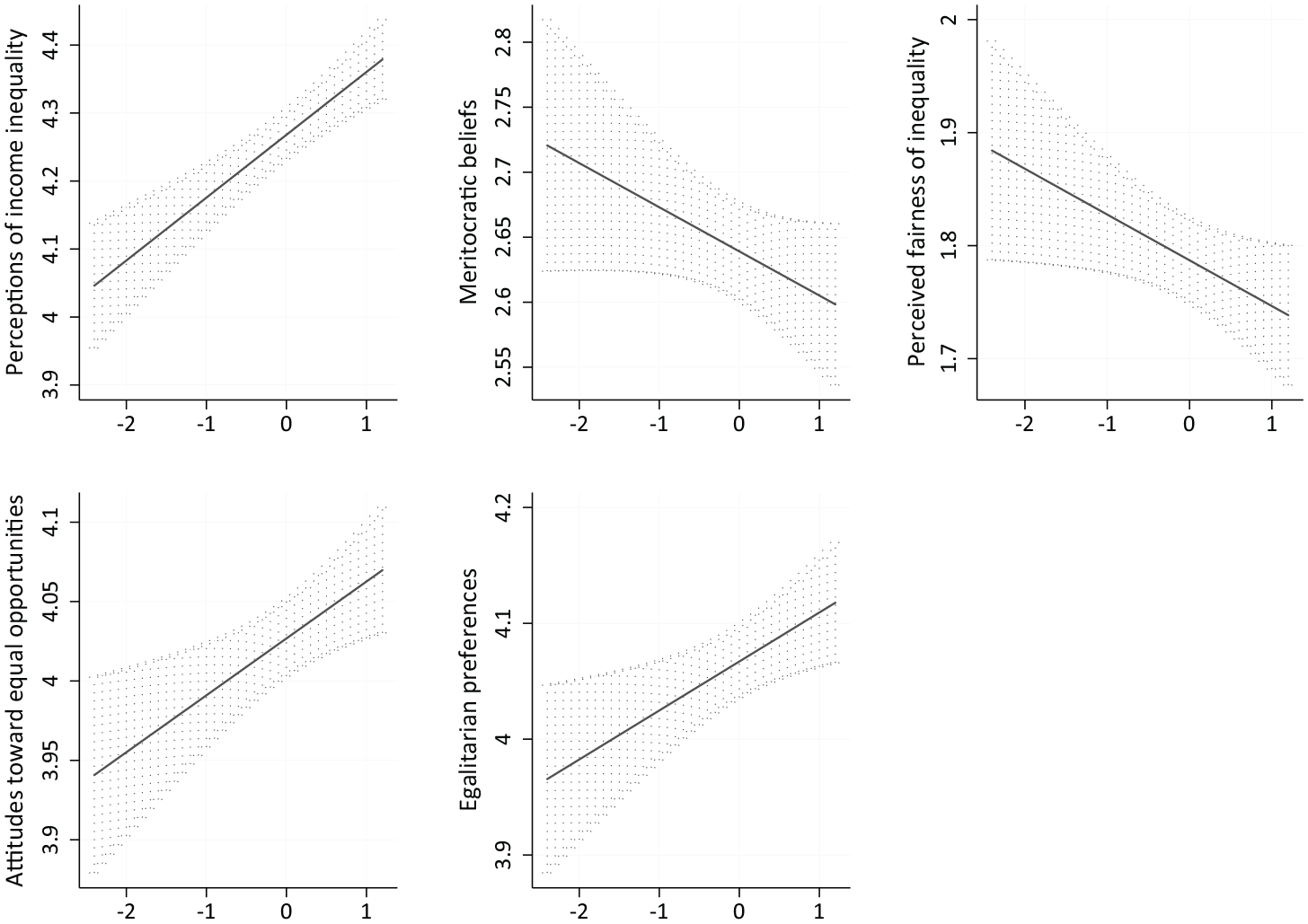
People’s views on inequality by network diversity.
As we additionally expected network diversity to affect people’s views on inequality to varying degrees according to class, we also estimated models that include interaction terms between social class and network diversity. These additional analyses are presented in the Online Appendix (see Table A4). Our findings indicate that, in general, interaction terms are not statistically significant, particularly in relation to perceptions of inequality, the perceived fairness of inequality, dispositions to provide equal opportunities and egalitarian preferences. This means that the positive influence of network diversity to make people more aware of the extent of inequality and show greater commitment to egalitarianism is uniform across the different social classes. Nevertheless, this does not apply to meritocratic beliefs because the relationship between network diversity and such attitudes differs across social classes. In particular, we see that network diversity reduces meritocratic beliefs, especially for the upper class.
In short, our results indicate that social class predicts egalitarian preferences but does not significantly alter the other attitudinal dimensions. Specifically, the preference for an egalitarian provision of social services notably falls with increasing class positions. More interestingly for our purposes, our findings indicate that network diversity influences all attitudes evaluated, over and above one’s own class position. This highlights the power of diversity when it comes to attitudes towards inequality and clearly supports our main research hypothesis.
In addition, our findings show that, in general, network diversity affects people’s views on inequality to a similar degree for individuals from different social classes. The only exception is the results reported on the analysis of meritocratic beliefs, in which network diversity is found to reduce these perceptions, especially for the upper classes. These are interesting findings that do not provide sufficient evidence to support our secondary hypothesis and will be discussed in the following and final section of the article.
Conclusions and Discussion
Drawing on the growing body of literature that argues that social networks may play an important role in shaping the relationship between class and political attitudes, the aim of this study has been to examine the association of social class and network diversity with attitudes towards inequality in Chile. We addressed two research questions: (1) How closely is social class associated with attitudes towards inequality? and (2) To what extent is network diversity associated with attitudes towards inequality above and beyond class? Following Pierre Bourdieu’s concepts, our study conceptualised attitudes towards inequality as ethical dispositions (Sayer, 2005), that is, the moral sentiments of the habitus, including those of classism and selfishness. We used large-scale representative survey data and applied multivariate regressions. Overall, our results indicated that network diversity operates as a significant factor that influences the degree to which individuals perceive and develop attitudes towards socio-economic inequality after accounting for class. There are specific findings to be highlighted and discussed.
Regarding our first research question, theoretical accounts suggest that the lower classes might be particularly prone to perceive greater inequality and to reflect on structural factors such as family background rather than personal skills and effort to explain individual achievement, especially because they are those who most suffer the consequences of inequality. However, our results indicate that the perception of inequality is slightly more salient among people at the top of the class structure, while lower-class individuals have more meritocratic beliefs than their counterparts in the upper classes. These counterintuitive findings contrast with prior international studies on contemporary politics (e.g. Evans and Kelley, 2017; Mijs, 2021) but are aligned with research indicating that socio-economically disadvantaged people generally underestimate the extent of their deprived position and frequently blame themselves for their circumstances (e.g. Cruces et al., 2013; McCoy and Major, 2007). To some extent, this probably has to do with a certain lack of knowledge about how unequally resources are distributed and why, which is often linked to education level (e.g. Castillo et al., 2019, 2022). In fact, when we added education and income into estimates, we noted that people with no formal education have significantly lower perceptions of inequality and higher levels of meritocratic belief than those in the upper class, whereas the class factor turns out to be statistically insignificant. This means that education effectively accounts for the association between class and perceptions of inequality and meritocracy in Chilean society.
Moreover, we found that class is strongly related to egalitarianism, and specifically that egalitarian preferences notably decrease with rising class positions. This result is in line with previous evidence showing that the upper classes are less worried about inequality, particularly expressing less openness to supporting the provision of universal services and the redistribution of income (Lindh and McCall, 2020). This is argued to happen for several reasons, including subjective class identity and economic insecurity, but especially economic self-interest (e.g. Langsæther and Evans, 2020; Svallfors, 2006). We found some evidence consistent with the latter explanatory principle, in that class categories turned out to be insignificant in determining egalitarian preferences when income (and education) was included in models. This suggests that income captures a substantial proportion of the association between class and egalitarianism.
In relation to our second research question, our analyses cast new light on the class divide in political attitudes by showing that social class and network diversity operate in tandem to affect the way in which people develop dispositions towards inequality. In fact, network diversity operated as a statistically significant predictor of such dispositions for all the dimensions evaluated. First, we showed that network diversity increases the perception or awareness of income inequality. Second, we found that diversity in class social contacts markedly reduces the perceived fairness of inequality and one of the main sources of its legitimation: meritocratic beliefs. Third, we also showed that network diversity notably increases egalitarian preferences in the provision of social services. Altogether, these results complement the scarce prior research on the importance of networks for attitudes towards inequality (e.g. Lindh et al., 2021; Paskov and Weisstanner, 2022). Moreover, they are consistent with prior suggestions indicating that class analysts might benefit from relaxing the assumption that class differences in attitudes towards inequality primarily operate through class positions themselves (and associated mechanisms such as self-interest) and from further investigation of the influence of personal networks on class attitudes (Langsæther and Evans, 2020).
We additionally investigated whether the association between network diversity and people’s views of inequality varies according to social class. With the exception of meritocratic beliefs in which cross-class ties particularly affect perceptions held by the upper class, our results indicate that diversity in class connections uniformly affects attitudes towards inequality: for all classes, network diversity increases the perception of inequality, people’s willingness to provide equal opportunities and their commitment to egalitarianism, and also reduces the perceived fairness of inequality. Overall, these are interesting findings because they indicate that network diversity generally rises above the class divide in political preferences.
Based on our theoretical framework (e.g. Bottero, 2010), we interpret these findings as suggesting that diversity in class connections works as a powerful source of habitus disruption that provides individuals with greater opportunities to reflect on, rethink and gradually change their ethical inclinations. Specifically, we argue that class diversity within networks might offer individuals not only a broader point of view regarding different social realities and more information with which to understand socio-economic conditions from every part of society, but also – and especially – concrete experiences that arguably serve to increase their predisposition to empathise with the lives of others. As such, network diversity is relevant because, without access to other people’s direct experiences, information about economic inequality is not likely to alter individuals’ perceptions (e.g. Edmiston, 2018; Newman, 2014; Pettigrew and Tropp, 2006).
The relevance of our findings lies in their contribution to further understanding how and the degree to which social class shapes political attitudes and views on inequality in particular. While our analyses showed that the association between social class and attitudes towards inequality turned out not to be statistically significant when education and income are added to models, this certainly does not mean that the class factor is not relevant to the shaping of political attitudes. Rather, it implies that such socio-economic factors capture and reinforce the ‘effect’ attributed to class and, more critically, that immediate employment situations may offer only a partial representation of the class divide in political attitudes. The incorporation of class-based network diversity was particularly valuable in this regard, as we demonstrated that this factor constitutes a more significant predictor than individual class positions when attempting to understand views on inequality. We consider that the relevance of inter-class relationships lies in their ability to capture collective experiences related to the class structure that are not necessarily anchored in individual class positions. As such, class-based network configurations appear to be crucial in offering a more detailed examination of the overall influence of class on political attitudes.
Three main weaknesses of this study merit acknowledgement. First, we used cross-sectional survey data, which makes it impossible to cope with potential problems of reverse causality. It is probable that ethical dispositions predispose individuals to connect with dissimilar-class others. We hope that researchers can address this problem in the future and conduct further quantitative research on the role of networks in shaping class divides in political attitudes. Second, we recognise that the position generator applied in the ELSOC survey is limited in that it only comprises 13 occupational positions, which certainly does not represent the entire occupational structure. Although this should not change the overall results, estimates could be conservative. Finally, we proposed particular mechanisms to explain the power of diversity in changing people’s views on inequality. For instance, we consider that network diversity likely enables people to improve their knowledge about the lives of others and to learn and experience inequality, thereby changing their ethical dispositions in the process. However, we were not able to explicitly test these potential explanatory principles. Therefore, we also call for further research, especially qualitative work, to complement what is derived from quantitative studies.
All in all, we expect to have contributed to the growing number of studies showing that social class connections may play an important role in class analysis of political preferences, as they provide additional explanations for attitudes towards inequality. We showed that network diversity makes inequality more visible, reduces its legitimacy and promotes more egalitarian preferences that go above and beyond class positions. In regard to public policy, these findings could be especially relevant for societies historically characterised by high degrees of inequality and strong class stratification, of which Chile is one. Specifically, our findings suggest the need to foster desegregation policies and provide citizens with public spaces in which to encounter social class difference as a means of acknowledging the lives of others, problematising inequality, and developing egalitarian ethical dispositions. However, it is comprehensively acknowledged in the literature that forcing inter-class interactions might result in symbolic violence, self-exclusion and stigmatisation, thus generating even greater social distress and conflict between classes (Pettigrew and Tropp, 2006). Therefore, it is crucial to accompany desegregation policies with context-specific strategies to promote symmetrical recognition and mutual learning between people from different socio-economic backgrounds.
Supplemental Material
sj-docx-1-soc-10.1177_00380385231217625 – Supplemental material for The Power of Diversity: Class, Networks and Attitudes Towards Inequality
Supplemental material, sj-docx-1-soc-10.1177_00380385231217625 for The Power of Diversity: Class, Networks and Attitudes Towards Inequality by Gabriel Otero and Manuela Mendoza in Sociology
Footnotes
Acknowledgements
We are grateful for support from the Centre for Social Conflict and Cohesion Studies – COES.
Funding
The authors disclosed receipt of the following financial support for the research, authorship and/or publication of this article: this work was supported by the National Agency of Research and Development (ANID) at the Chilean Ministry of Science, Technology, Knowledge and Innovation, grant/award numbers: ANID/FONDAP/15130009, ANID PFCHA/DOCTORADO BECAS CHILE/2017–72180515 and ANID PFCHA/DOCTORADO BECAS CHILE/2015 – 72160369.

Supplemental Material
Supplemental material for this article is available online.
References
Supplementary Material
Please find the following supplemental material available below.
For Open Access articles published under a Creative Commons License, all supplemental material carries the same license as the article it is associated with.
For non-Open Access articles published, all supplemental material carries a non-exclusive license, and permission requests for re-use of supplemental material or any part of supplemental material shall be sent directly to the copyright owner as specified in the copyright notice associated with the article.
