




Abstract
How family background affects students’ fields of study across different historical periods in China is not well studied. Post 1949, China explicitly prioritized specific industrial sectors when allocating resources, creating an especially strong reason to expect that the industrial sector in which a parent was employed might strongly influence a child’s educational outcomes and career aspirations. Using data from the school registration records of 51,801 students who entered an elite regional university from 1952 through 2002, this study is the first to examine the role of parents’ industrial sectors in predicting children’s fields of study and the temporal patterns of this association. Applying multinomial logistic regression and the log-multiplicative layer effect model, we found that parents’ industrial sectors predicted children’s fields of study independent of parents’ broad categories of occupation. The strength of the association was particularly strong during the Cultural Revolution and post-market transition periods.
Introduction
Family background’s influence on educational outcomes is a crucial concern in social science research. In China, the percentage of high school graduates attending college increased significantly from 43% in 1998 to 83% in 2005, intensifying the impact of family background on college attendance (Yeung, 2013) and ‘horizontal stratification’ (Gerber and Cheung, 2008), such as fields of study. Fields of study are key in predicting future labour market outcomes (Yang, 2018). However, while the effect of family background on fields of study is increasingly studied in western contexts (Andrade and Thomsen, 2017; Helland and Wiborg, 2019; Kraaykamp et al., 2013; Van de Werfhorst and Luijkx, 2010), it remains largely unexplored in China.
Post 1949, China’s focus on specific industrial sectors, such as heavy industry and energy, likely shaped children’s educational outcomes. The socialist economy led to more resources for these sectors, giving workers benefits like higher wages and more housing (Naughton, 1995; Xie and Wu, 2008). Employment in these industries impacted wages and welfare more than factors like education or occupation in China (Wang, 2008). However, studies in both China and the western context often overlook the impact of parental employment in industrial sectors (the primary economic activity at a person’s workplace). Instead, they tend to focus on the relationship between parental employment (the condition of having paid work) or occupation (specific skills and type of work one does for a livelihood) and children’s educational outcomes (Hu and Wu, 2019; Van de Werfhorst and Luijkx, 2010). In China, state resources were allocated mainly by industrial sector, not occupation, highlighting the importance of parental industry in influencing children’s education. Moreover, the intergenerational transmission process can be better understood by examining the link between parents’ industrial sectors and children’s fields of study, considering both vertical ranks (economic returns and prestige) and horizontal specializations (fields of professional knowledge) (Van de Werfhorst and Luijkx, 2010).
Additionally, understanding long-term societal changes since 1949 requires analysing data representing multiple cohorts for a comprehensive view. However, studies examining long-term temporal changes in the relationship between family background and educational outcomes in China are scarce. Existing research typically relies on cross-sectional survey data, which might not accurately represent each cohort’s patterns (Golley and Kong, 2013), or covers only up to two decades of temporal changes (Deng and Treiman, 1997).
This study addresses the gaps by examining the relationship between parents’ employment in different industrial sectors and their children’s fields of study, and exploring the temporal patterns of this association over five decades. We argue that parents’ industrial sectors provide economic, cultural and social capital that influences their children’s college fields of study. Our data consist of 51,801 undergraduate students from Jiangsu Province who enrolled in an elite provincial university between 1952 and 2002. This population dataset from a major Chinese university informs our research and has implications for other elite universities, given China’s standardized college admissions. Through multinomial logistic regression analyses, we investigate how parents’ industrial sectors were associated with their children’s fields of study. Additionally, the log-multiplicative layer effect model (Xie, 1992) is employed to assess variations in this relationship across four historical periods: pre-Cultural Revolution (before 1966), Cultural Revolution (1966–1976), post-Cultural Revolution (1977–1991) and post-market transition (1992–2002).
Theoretical Framework
Family Background and Fields of Study
Bourdieu’s (2003) social reproduction theory suggests that social inequalities are passed down through generations via the transmission of economic (material assets that can be converted into money and property rights), cultural (cultural signals that can be converted into economic capital and educational qualifications) and social capital (resources linked to social networks), with educational institutions being key in this process. Studies in western contexts show that family background affects children’s fields of study via these forms of capital (Van de Werfhorst and Luijkx, 2010; Van de Werfhorst et al., 2001). Parents with economic capital focus on labour market outcomes, supporting their children in lucrative fields and valuing commercial skills, whereas cultural and social capital drive the transfer of preferences, aspirations and specialized skills (Van de Werfhorst and Luijkx, 2010; Van de Werfhorst et al., 2001). Western research indicates that upper-class students often select majors based on intellectual interests, while lower-class students prioritize practicality (Mullen, 2014). Specifically, children of economic elites often study fields like Economics and Law, while those from cultural elites choose Humanities or Social Sciences (Andrade and Thomsen, 2017; Helland and Wiborg, 2019; Kraaykamp et al., 2013). Conversely, STEM (science, technology, engineering and mathematics) subjects are seen as upward mobility paths by less privileged families, attracting their children, especially boys (Xie and Killewald, 2012).
In China, family influence is crucial in passing down educational success, as education is a key pathway to upward mobility (Fan, 2014). Hu and Wu (2019) found that Beijing students from wealthier families chose liberal arts over STEM due to greater cultural capital exposure. This study, however, only compared liberal arts and STEM. Recent experiments in China show that more information about meta-majors encourages disadvantaged students to choose them, hinting at their informational barriers (Ma et al., 2023). Yet, a comprehensive examination of how family background, especially parental industrial sectors, impacts children’s study choices in China is needed.
Parents’ Industrial Sector as Family Background
Most studies on family background and fields of study focused on hierarchically ordered aspects such as parental educational attainment, social class and income (Andrade and Thomsen, 2017; Helland and Wiborg, 2019; Kraaykamp et al., 2013). However, fields of study have both hierarchical rankings based on future economic returns and/or prestige, and horizontal structures representing specialized skills. Therefore, it is essential to link them to a family background that encompasses both vertical and horizontal dimensions (Van de Werfhorst and Luijkx, 2010). Parental occupation is one such aspect. For instance, Van de Werfhorst and Luijkx (2010) found in the Netherlands that students’ study fields were shaped by the economic, cultural and social capital tied to their parents’ occupations.
Existing research has focused more on occupations (specific skills), with their vertical rankings in economic and cultural values, than on industrial sectors (primary economic activities), which have a more horizontal structure (Mannetje and Kromhout, 2003). Occupations are categorized within sectors, and shifts in industrial structures affect occupation prevalence (Shin, 2007). Sometimes, sectors may be more critical for economic and social capital than occupations, as industry-specific human capital is crucial for managers’ and professionals’ wages (Sullivan, 2010). Moreover, people change occupations more often than industries, indicating the value of industry-specific networks and knowledge (Kambourov and Manovskii, 2008).
In China, state resource allocation favours industrial sectors over occupations, a feature of its socialist economy (Naughton, 1995). This focus results in wage and resource disparities across sectors, including higher education (Naughton, 1995). The state controls economic production by establishing work units (danweis) and assigning individuals to them. Historically, sectors like heavy industry and transportation received more benefits. The 1985 Industrial Census in China showed that danweis in heavy industries had 80% more housing space, twice the healthcare resources and four times the within-danwei schooling than those in other sectors (Naughton, 2015). Market reforms in the mid-1990s introduced high-value sectors like banking, electricity, real estate, transportation and telecommunications (Wang, 2008). Unlike in the West, industries in China have varying prestige, with sectors like Public Management and Social Organization (PMSO) offering high security and benefits, termed the ‘Iron Rice Bowl’ (Ding et al., 2000).
In China, the industrial sector significantly impacts economic, cultural and social capital, more so than occupations. It strongly correlates with wages (Wang, 2008). For example, data from Jiangsu show the wage gap between the highest (PMSO) and lowest (Agriculture) sectors increased from 1259 yuan in 1993 to 11,479 yuan in 2002 (see Figure 1). Government agencies, state-owned enterprises and higher-ranked danweis are known to provide better material benefits like housing, schooling and healthcare (Bian, 1994; Xie and Wu, 2008), and these advantages are often concentrated in specific industrial sectors, such as PMSO.
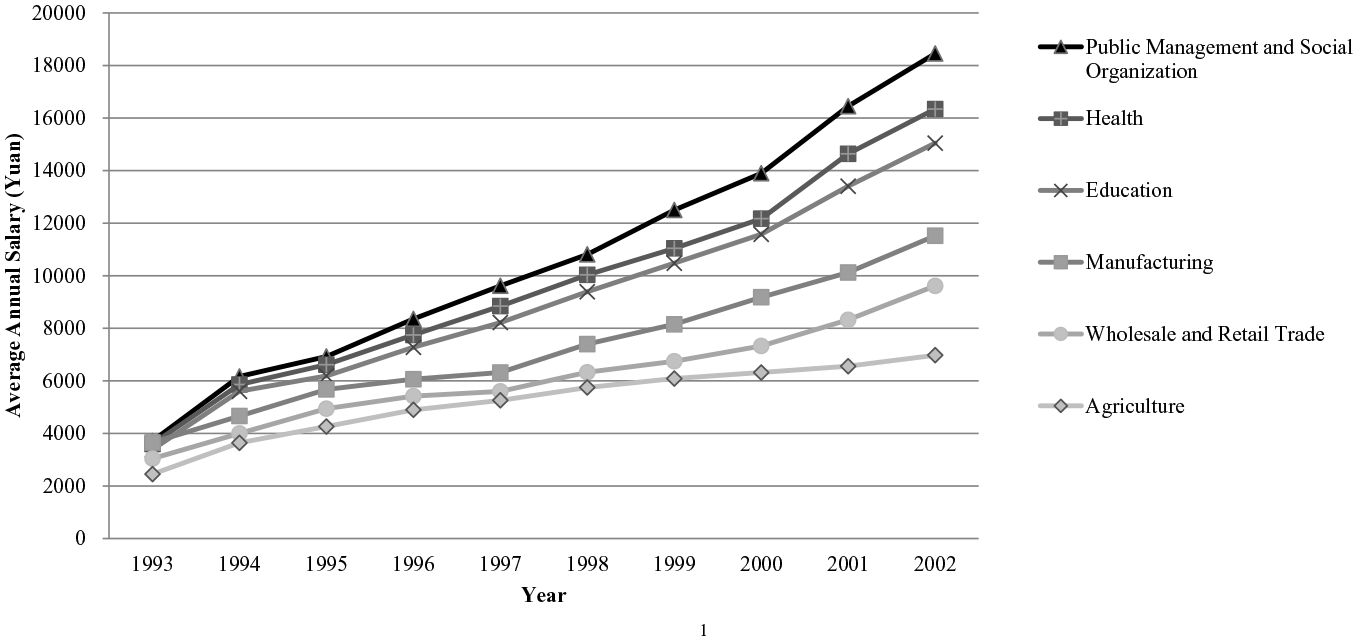
Average annual salary of six industries in Jiangsu, 1993–2002.a
Cultural capital varies significantly across industrial sectors, linked to differences in educational attainment (Bourdieu, 1986; Van de Werfhorst et al., 2001). In China, children from higher socio-economic backgrounds have more cultural capital (Hu and Wu, 2019). Figure 2 illustrates the percentage of workers with at least some college education (an indicator of institutionalized cultural capital, according to Bourdieu [1986]) from 2002 to 2019 in the six industries studied (Agriculture, Manufacturing, PMSO, Education, Wholesale & Retail and Health). The gap between the industry with the highest percentage (Education) and the lowest (Agriculture) was substantial, reaching 58% in 2002. This indicates a trend where individuals with higher education are concentrated in specific sectors, reflecting self-selection based on cultural capital.

Percentage of workers with at least some college education by six industries, 2002–2019.a
Industrial sectors in China offer valuable guanxi (social networks) that significantly impact workers’ and their family members’ employment outcomes (Bian, 1994). In the past, children could secure jobs in the same danwei or administrative system, and thus the same industrial sector, as their parents (Bian, 1994). Even after these practices ended, guanxi continued to play a crucial role in employment, as individuals relied on it to obtain job information and influence the job screening process (Bian, 1994).
Most research focuses on current income inequality across industrial sectors, with less emphasis on its impact on the next generation. In China, varying economic, cultural and social capital across sectors could lead to educational disparities among children. Children from high-economic-capital sectors might choose fields like Economics and Law for their financial returns, mirroring their parents. Those from high-cultural-capital sectors may prefer liberal arts, influenced by their parents’ cultural interests and industry-specific knowledge (Hu and Wu, 2019; Van de Werfhorst et al., 2001). For example, health professionals’ children often show a higher interest and likelihood of studying Medicine (Friedman and Laurison, 2020). Social networks in parents’ sectors also shape children’s major preferences. Children of parents who were not specialists still had exposure to related fields through a neighbourhood peer effect, as they often lived in danwei communities with colleagues and attended the same danwei schools. Conversely, children from sectors with lower capital often turn to STEM as a traditional upward mobility route with fewer entry barriers (Xie et al., 2015).
Temporal Changes in the Relationship between Family Background and Fields of Study in China
The period from 1952 to 2002 can be divided into four school cohorts, representing different historical contexts in Chinese higher education: pre-Cultural Revolution (before 1966), Cultural Revolution (1966–1976), post-Cultural Revolution (1977–1991) and post-market transition (1992–2002). Gaokao (the College Entrance Exam) scores play a crucial role in determining students’ field of study, except during the Cultural Revolution. Students in China had one chance per year to select an institution and major based on cut-off scores set by each institution. While they could be admitted to their chosen institution, getting their preferred major was not guaranteed. If they did not meet the cut-off score of their desired major, they could be assigned to a different major or choose to retake the exam the next year. In Jiangsu, students were required to declare their college and major before taking the gaokao until 2000, and the matching process followed the Boston mechanism until 2008, and ‘parallel’ choices of colleges for each choice-band were not allowed (Chen and Kesten, 2017).
Before the Cultural Revolution Chinese society was undergoing a period of socialist transformation characterized by rapid industrialization. The state implemented policies to ensure equal access to colleges, such as free tuition, subsidies and entry quotas based on family background (Hunt, 1975; Seybolt, 1974). These policies resulted in a diverse student population (China Department of Education, 1982), with universities offering programmes in STEM, Medicine and Education (Hunt, 1975). The job assignment system further disconnected students’ college majors from their eventual industrial sectors or occupations (King and Zhang, 1992). Therefore, students’ fields of study were influenced more by their personal interests rather than their family background.
After the Cultural Revolution, the gaokao system was reinstated in 1977, and China began the Reform and Opening-up policy that aimed to modernize the Chinese economy. During this period, students were assigned jobs by the government, and there was a greater emphasis on the value of their specialties compared with the pre-Cultural Revolution era (King and Zhang, 1992). Additionally, the influence of guanxi, based on family background, became increasingly significant in determining employment outcomes (Bian, 1994).
During the post-market transition period, the state further emphasized the importance of developing a market economy under a socialist system and implemented policies to expand higher education in order to promote economic prosperity. This led to an increase in college choices for students, particularly in Social Sciences and Humanities (Yeung, 2013). College majors gained more significance, with STEM, Economics & Management and Law becoming increasingly popular due to their high economic returns in the labour market (Hu and Vargas, 2015). The implementation of the One-Child Policy intensified competition among students, and parental resources were heavily invested in the educational outcomes of their only child. Consequently, family background became crucial in determining children’s fields of study during this period.
The Cultural Revolution, which occurred from 1966 to 1976, was a socio-political movement initiated by Chairman Mao Zedong, aiming to eliminate traditional culture and promote communist ideology. During this period, colleges were mostly closed, and high school graduates were sent to rural areas to work regardless of family background (Bernstein, 1977). Some colleges reopened in 1972 but had restricted recruitment, prioritizing applicants from worker, peasant or soldier families (Seybolt, 1974). During this period, it was common that college students were recommended by their danweis that were closely linked to their parents’ danweis. After graduation, they were expected to return to their danweis (King and Zhang, 1992). Consequently, they were assigned majors closely related to their own and their parents’ industrial sectors. This period exhibited a particularly strong association between family background and fields of study.
Hypotheses
We hypothesize that parents’ industrial sectors predict students’ fields of study, independent of parents’ occupations (H1). For instance, individuals in Education, with higher cultural capital at work, may have children more inclined towards non-STEM majors compared with those in Transportation. Similarly, children of accountants in the Health sector may show more interest in studying Medicine due to established guanxi with health professionals, compared with accountants in other industries.
We expect two patterns in the link between parents’ industrial sectors and children’s fields of study: intergenerational transmission and upward mobility. The intergenerational transmission pattern includes children from high-economic-capital sectors (e.g. PMSO) favouring economic majors (H2a), children from high-cultural-capital sectors (e.g. Education) favouring humanities majors (H2b) and children from specialized sectors such as Health favouring corresponding majors such as Medicine (H2c). The upward mobility pattern involves children from low-capital sectors studying STEM (H3). While economic capital, cultural capital and levels of specialization are not mutually exclusive, they play varying roles across industries in shaping the relationship between parental industries and children’s fields of study.
We hypothesize that the link between parents’ industrial sectors and children’s fields of study was particularly strong during the Cultural Revolution and post-market transition periods (H4). Parents’ industrial sectors played a crucial role in determining their children’s college majors during the Cultural Revolution. In the post-market transition period, fields of study became more hierarchical due to varying economic returns and increased competition.
Data and Measures
We collected industry information of household heads and job titles from 80,807 undergraduate students at an elite regional university in Jiangsu from 1952–2002, with the university’s consent (Liang et al., 2012, 2013). Our data were derived from student registration cards, which provided details such as sex, ethnicity, academic major, family address and high school. The registration cards contain students’ information in five key areas: (a) school-related details such as student ID and college major; (b) personal information including name, age, gender and birthplace; (c) educational history covering enrolment dates and school names from primary to high school; (d) political affiliations; and (e) family background like parental occupation and family relationships (Liang et al., 2012, 2013). Out of these students, 65,141 were from Jiangsu Province, and to partially consider academic ability variations, we focused our analysis on students from Jiangsu since the cut-off scores for students from other provinces to enter the university could differ significantly. Among the students from Jiangsu, 58,335 reported their household heads’ (mostly fathers’) industrial sectors. Evidence from China indicates that the socio-economic traits of household heads, especially fathers (Wu, 2010), significantly determine children’s educational outcomes (Liang and Chen, 2007).
We examined six fields of study: Economics & Management, Humanities, Law, Education, Medical Science and Science & Engineering. While all fields were available throughout the study period, Economics & Management majors were introduced after the Cultural Revolution, which could have influenced the impact of parents’ industrial sectors. To address this concern, we conducted robustness checks excluding Economics & Management, and the results remained highly consistent (see the online Appendix Figure 1). Law, certain components of Science & Engineering and Medicine were the most prestigious fields at the university. Despite the strength of the Medicine programme, it was not particularly popular due to longer graduation times and relatively lower average income for medical school graduates in China (MYCOS Institute of Research, 2009).
Industrial sectors were coded based on the Chinese Standard Industrial Classification (CSIC). Since six out of 16 major industrial sectors covered around 88.8% of all students from Jiangsu, we included only students from Jiangsu Province whose parents worked in one of the following six major industrial sectors: Agriculture, Manufacturing, PMSO, Education, Wholesale & Retail and Health. The online Appendix Figure 2 provides numbers and percentages of missing cases by year, with most missing cases occurring in earlier years due to data preservation challenges. The pattern of missing cases suggests some uncertainty in our estimates for the pre-Cultural Revolution period. We accounted for this uncertainty by considering confidence intervals associated with our estimates. The online Appendix Table 1 shows that the percentage of cases excluded was highly similar across children’s fields of study, indicating no systematic differences in the proportion of excluded cases. Our final sample consisted of 51,801 students.
We categorized parents’ occupations into eight categories based on the Chinese National Standard Occupational Classification System: cadres, professionals, office workers, service and sales workers, agricultural workers, labour workers, military personnel and others. Specifically, the term ‘cadres’ refers to leaders of state agencies, political party organizations, enterprises and public institutions. ‘Professionals’ are individuals engaged in scientific research and technical work. In Jiangsu, the manufacturing sector has experienced rapid growth, resulting in a larger number of workers, professionals and cadres compared with other occupational categories such as farmers and soldiers (as shown in Figure 3). However, it is important to note that the increase in professionals and cadres does not necessarily indicate greater societal equality. The definitions of cadres and professionals have become broader, leading to significant differences in income and prestige within cadres across different industrial sectors, which may be larger than the differences between certain cadres and farmers.

Changing numbers of cadres and professionals in Jiangsu by year, 1958–1998.a
Based on previous research that finds students’ choice of college majors is influenced by sex and performance in high school (Wiswall and Zafar, 2015), we consider covariates including sex (male, female) and attendance at key high schools. Taking into account the substantial rural–urban disparities and geographic variations in industrial composition and academic achievements, we also account for several contextual factors such as urban residence (city, rural, town/suburban), regions of origin in Jiangsu (southern, northern, central) and school cohort year. Among the 51,801 students, approximately 20% did not provide specific occupation information for their parents, and an additional 10% did not provide valid information on attending key high schools. To address this, we used multiple imputations by chained equations to impute the missing values in the covariates (Royston and White, 2011). We performed imputations on 10 datasets and combined the regression coefficients using Rubin’s (2004) rule.
The university registration cards used in our study have distinct advantages. First, they cover every student from 1952 to 2002, allowing for individual and cohort comparisons, which is rare in China. Second, the standardized format of university registration cards enables future comparisons with other universities. Third, as official documents, the information provided on the cards is considered more reliable than self-reported data in surveys. By requiring students to report their parents’ precise danweis and positions, our coding of industry sectors and occupations is likely to be more accurate than survey-based reports.
Our study on an elite provincial university in China has implications for other provincial elite universities due to several reasons. First, the Chinese college admission system is largely standardized, ensuring similarity in the application and admission processes across provinces and schools. Second, the historical trajectory of this elite provincial university reflects the experiences of many average Chinese universities over the past few decades. Initially focused on STEM, Medicine and Education, it later transitioned into a comprehensive institution in the late 1990s. Therefore, changes observed in the student body of this university can be representative of similar transitions in many other colleges. Third, admission to this university requires students to achieve top scores, placing them among the top 10% of gaokao test-takers in Jiangsu. Thus, students at this university can be considered comparable with those at numerous other provincial elite universities where top 10% scores are also required.
The provincial context we examined in Jiangsu can be considered representative of many other provinces in China. Initially, when the new China was established, Jiangsu’s industrial structure aligned with the nation’s focus on primary industries such as mining, agriculture and forestry. During the 1960s, Jiangsu underwent a shift towards a greater emphasis on secondary industries, particularly manufacturing. Since the 1980s, manufacturing has remained the most significant industry in Jiangsu. In Figure 4, we compare the employment distributions across the six industrial sectors in Jiangsu and nationwide based on data from 1992–2002, and they exhibit substantial similarity. Furthermore, the increases in the number of undergraduate students during the period from 1952 to 2002 were also highly comparable in Jiangsu and nationwide (refer to the online Appendix Figure 3).

Employment by industry sector, Jiangsu and nationwide, 1992–2002.a
Empirical Strategy
Our study focused on two main questions: first, we investigated whether parents’ industrial sectors could predict their children’s fields of study, even after accounting for parents’ occupations. Second, we explored the temporal patterns in this association from 1952 to 2002. To answer these questions, we utilized multinomial logistic regressions to analyse the relationship between parents’ industrial sectors and children’s fields of study. Our analysis included controls for parents’ occupation and all other covariates. We chose not to control for types of danwei to prevent overcontrolling, as danweis play a crucial role in how industrial sectors influence students’ fields of study (e.g. most danweis in PMSO are state-owned and hold high ranks).
To address the second question, we utilized loglinear models to compare and analyse the association over multiple school cohorts. It is crucial to consider changes in the marginal distributions of parents’ industrial sectors and children’s college majors when examining associations across a large number of cohorts. Over the five decades, the sizes of industrial sectors and the number of admission slots for different fields of study underwent changes, potentially impacting the association of interest. Loglinear models offer a significant advantage in that the estimated strength of the association is not influenced by the marginal distributions of the variables under examination (Van de Werfhorst and Luijkx, 2010).
We used the log-multiplicative layer effect model (Xie, 1992), also known as the UNIDIFF model (Erikson and Goldthorpe, 1992), to analyse the three-way table of students’ fields of study by parents’ industrial sectors and school cohorts. This model, implemented using the UNIDIFF package in Stata 15, allows us to identify a consistent pattern of associations between fields of study and parents’ industrial sectors across different cohorts. It captures variations in the strength of the association through a layer-specific multiplicative parameter (Xie, 1992). Among several alternative models compared, the UNIDIFF model performed the best (see the results section), indicating a common pattern of associations over time. This suggests the presence of shared mechanisms through which parents’ industry sectors influence students’ fields of study across different periods. The online Appendix Table 1 provides the unweighted cell distributions by industrial sector and college major for further reference.
We compared a sequence of log-linear models based on their goodness of fit. First, we fitted the null association model (Equation 1). This model assumes that the parents’ industrial sector and field of study are unrelated for each of the cohorts. The formula is written as below:

where I denotes parental industry, F denotes field of study and C denotes cohort.


Descriptive Analysis
Table 1 illustrates the distribution of parental occupations within each industrial sector, emphasizing the importance of differentiating between occupations and industry sectors when studying the intergenerational transmission of educational inequality. While certain occupations dominate specific industrial sectors (e.g. agricultural workers comprising 77% of individuals in Agriculture), we observe significant occupational heterogeneity within each sector. For example, 9% of individuals in Agriculture held cadre positions, and an additional 5% were professionals. Notably, in industrial sectors where professionals are dominant, such as Health and Education, nearly 30% of individuals were cadres.
Distribution of parental occupation by parental industry sector.
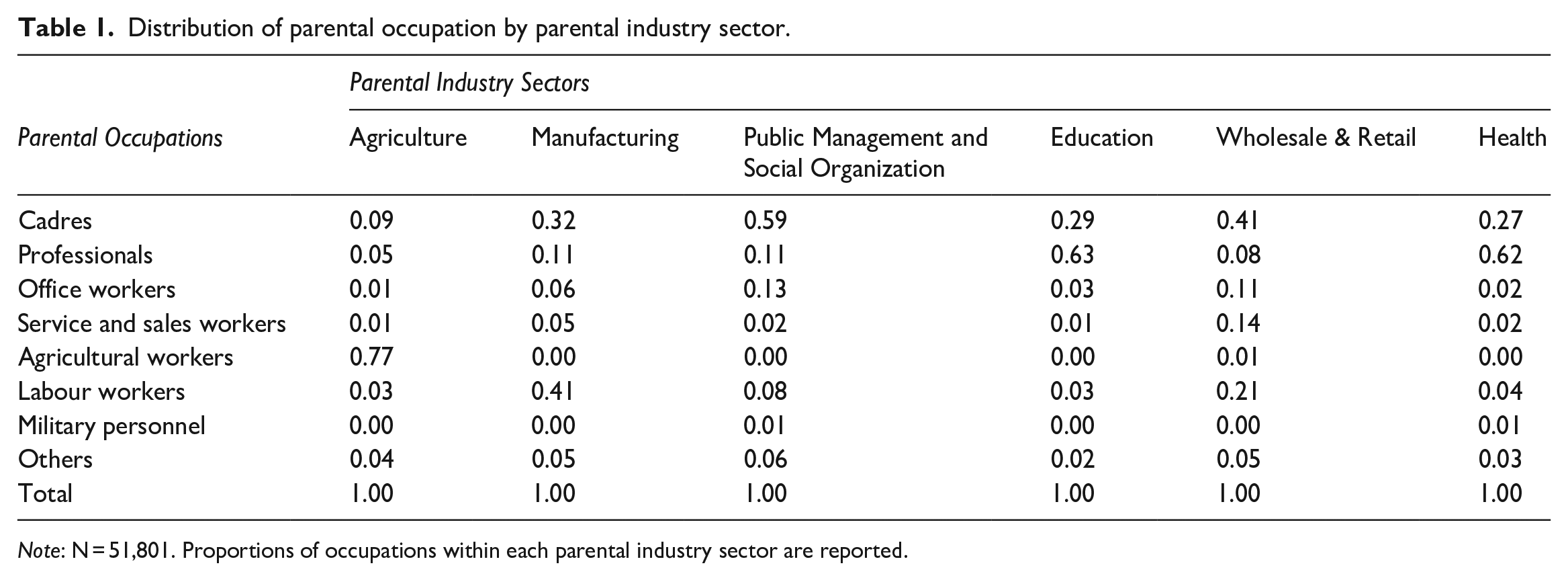
Note: N = 51,801. Proportions of occupations within each parental industry sector are reported.
Figure 5 Panel A illustrates the changing distribution of parents’ industrial sectors in our study. Agriculture and Manufacturing comprised over 60% of all sectors. However, the proportion of students from an Agriculture background declined from 60% in 1964 to 25% in 1992. Meanwhile, students from a Manufacturing background increased from 15% in 1982 to nearly 40% in the early 1990s. The remaining sectors – Health, Wholesale & Retail, Education and PMSO – accounted for 25% to 35% of students, experiencing smaller changes with increases in PMSO and Wholesale & Retail, and decreases in Health and Education during the 1990s.

Distributions of parental industry sectors and student fields of study, 1952–2002.
In terms of absolute numbers, Agriculture and Manufacturing were dominant, but the proportion of students from the PMSO background was disproportionately high. Figure 6 compares the proportion of students by family industrial background to the proportion of employment in Jiangsu from 1993–2002. The ratio of students from a PMSO background to employees in that industry stood out, indicating that students from an advantageous industrial background may have an advantage in college admissions.
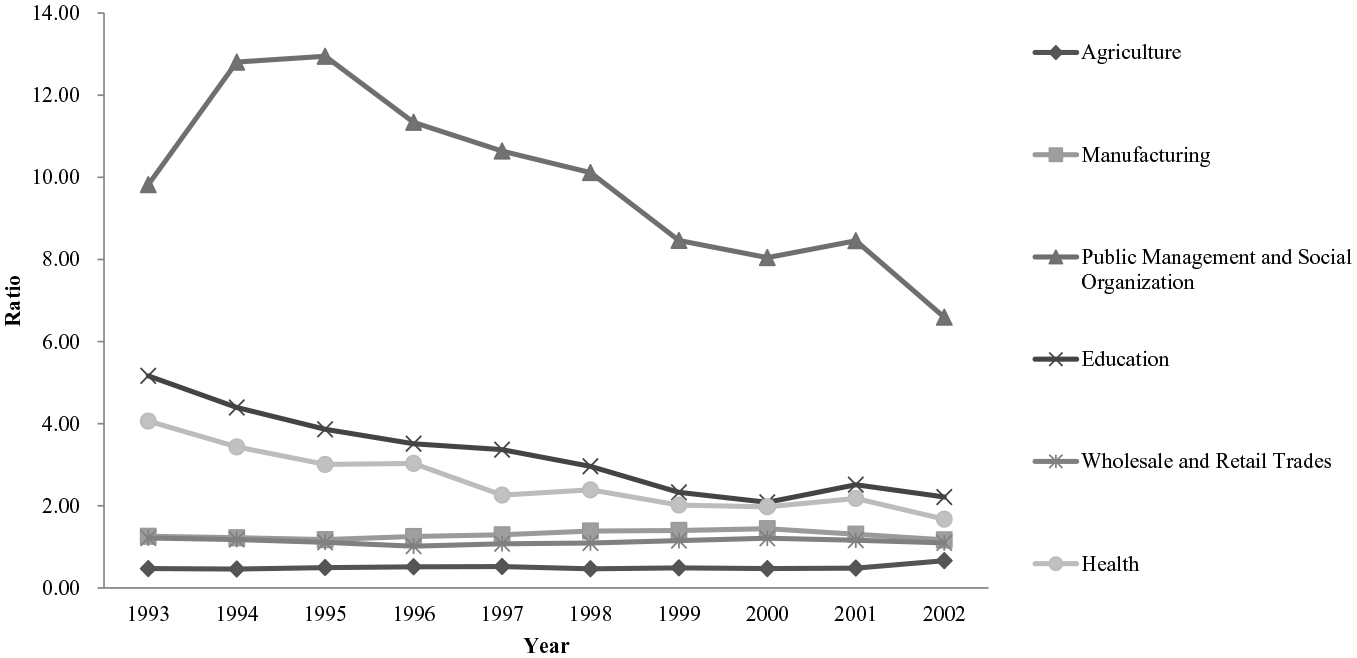
Ratios of proportions of students by family industry background to proportions of employment by industries in Jiangsu, 1993–2002.a
Figure 5 Panel B displays the changing distribution of fields of study over the past five decades. Major composition underwent significant shifts, with fluctuations in earlier years due to limited admissions and a notable decline in Medicine majors. Following the Cultural Revolution, while Science & Engineering remained prominent, there was a substantial increase in students majoring in Economics & Management, Law and Humanities. For comparison, the proportion of undergraduates by major nationwide from 1994 to 2002 is shown in the online Appendix Figure 4. Overall, we observed increased admissions for Humanities and Social Sciences but lower admissions for STEM fields.
Main Results
We assessed whether parents’ industrial sectors predicted their children’s fields of study, independent of parents’ occupations. Results from multinomial logistic regressions are presented in the online Appendix Table 2, and the predicted marginal probabilities of studying each college major by parental industrial sector are shown in Figure 7. The online Appendix Figures 5 and 6 display separate analyses for female and male students. Agriculture was used as the reference category for parental industrial sector, given its prevalence in our sample. The results strongly indicate that parents’ industrial sectors, even after accounting for parents’ occupations, significantly predict their children’s fields of study, supporting H1. Additionally, an F-test demonstrated that including parents’ industrial sectors in the model substantially improved its explanatory power (F-statistic = 16.51, p < 0.0001), providing further support for H1.
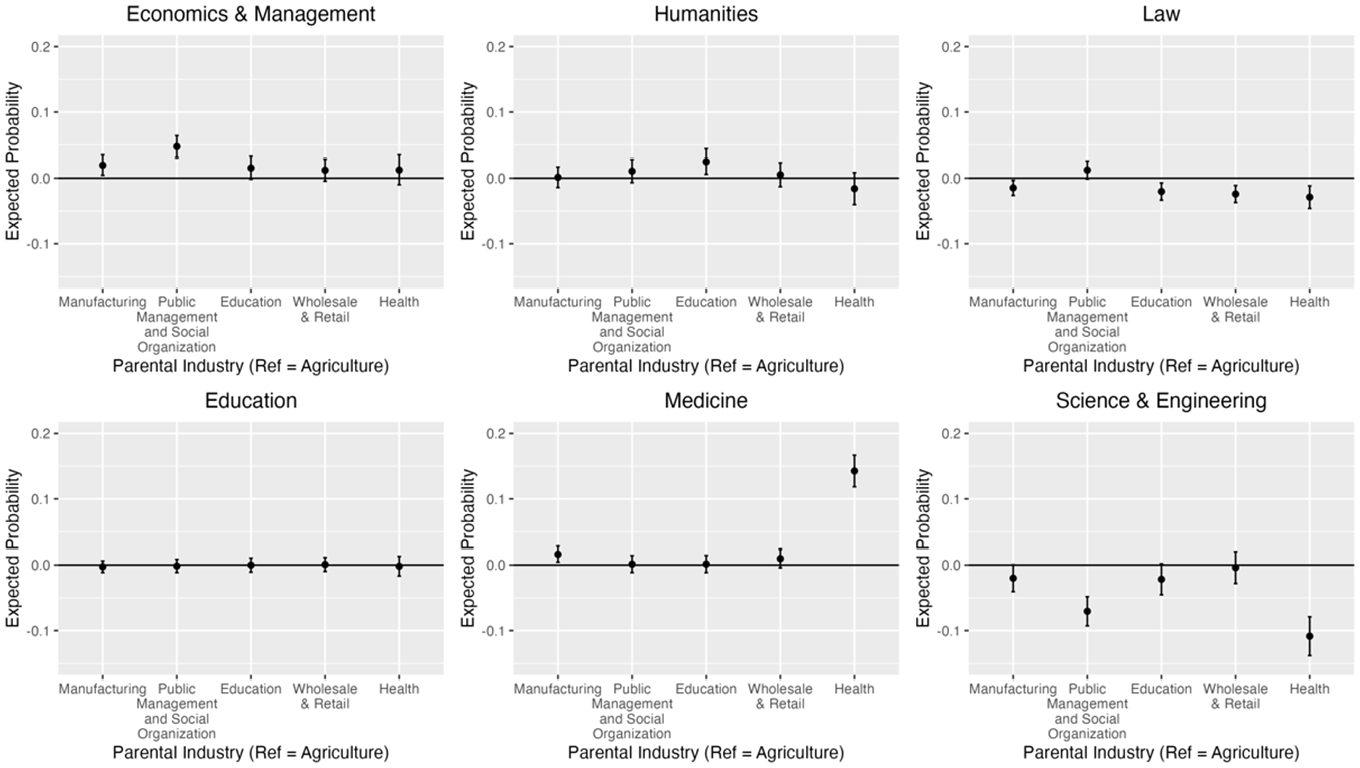
Predicted probability of studying each major by parental industry from multinomial logistic regression models, with 95% confidence intervals.
Compared with children whose parents worked in Agriculture, children whose parents worked in Manufacturing, PMSO and Education had a higher predicted probability of studying Economics & Management by 0.020 (p = 0.011), 0.047 (p < 0.0001) and 0.015 (p = 0.077), respectively. Children whose parents worked in Education had a higher predicted probability of studying Humanities by 0.025 (p = 0.010). On the other hand, children whose parents worked in Manufacturing, Education, Wholesale & Retail and Health had a lower predicted probability of studying Law by 0.015 (p = 0.012), 0.020 (p = 0.002), 0.024 (p < 0.0001) and 0.029 (p = 0.001), respectively, while children whose parents worked in PMSO had a higher predicted probability of studying Law by 0.012 (p = 0.075). Children whose parents worked in Manufacturing and Health had a higher predicted probability of studying Medicine by 0.016 (p = 0.007) and 0.142 (p < 0.0001), respectively. Children whose parents worked in Manufacturing, PMSO, Education and Health had a lower predicted probability of studying Science & Engineering by 0.020 (p = 0.055), 0.071 (p < 0.0001), 0.022 (p = 0.071) and 0.109 (p < 0.0001), respectively. The only exception was Education, where parents’ industrial sectors did not appear to influence whether their children studied Education, even after controlling for parental occupations.
Analysis of predicted probabilities shows that the impact of parental industrial sectors on educational choices is similar to or greater than that of parental occupations. For instance, students with parents in the Health sector were more likely to study Medicine than those with parents in Agriculture by 0.142. Meanwhile, students with agricultural worker parents had a 0.053 higher chance of studying Medicine compared with those with cadre parents, the largest observed gap across occupations.
We found a strong intergenerational transmission pattern in our study. PMSO, representing the industrial background with the highest economic capital, showed the highest likelihood of children studying majors with high economic returns, such as Economics & Management, as predicted by H2a. Similarly, students from Manufacturing and Education backgrounds, which also had relatively high economic capital, showed a higher likelihood of studying Economics & Management. Students from a PMSO background had the highest likelihood of studying Law, likely due to its status as the strongest major with the highest admission cut-off scores in the university. Their privileged background also tended to correlate with better academic performance on average. Moreover, consistent with H2b, students from an Education background, representing high cultural capital, were more likely to study Humanities. H2c was supported by the finding that having parents working in the Health industry strongly predicted students studying Medicine. We also observed a strong upward mobility pattern: students from an Agriculture background were most likely to study Science & Engineering, which supports H3.
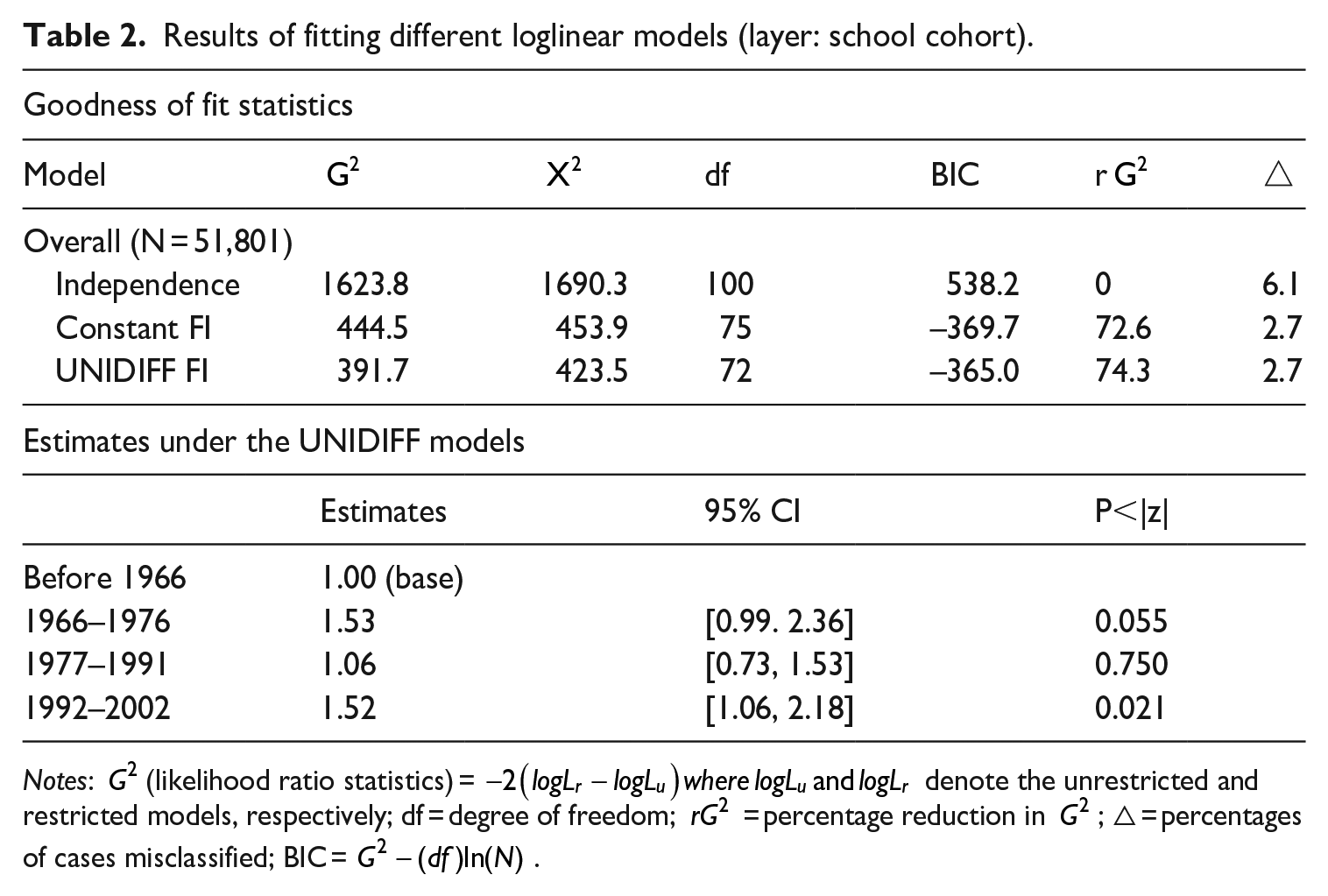
Table 2 presents fit statistics for the constant association and UNIDIFF models, which examine the association between parents’ industrial sectors and their children’s fields of study over time. Following Hout et al. (1995), the UNIDIFF model was selected over the constant association model based on likelihood ratio statistics (
Results of fitting different loglinear models (layer: school cohort).
Notes:
Table 2 shows the UNIDIFF coefficients, indicating the proportional changes in the association between parents’ industrial sectors and children’s fields of study compared with the pre-Cultural Revolution period. The association was 53% stronger during the Cultural Revolution period (p = 0.055), 52% stronger during the post-market transition period (p = 0.021) and relatively unchanged during the post-Cultural Revolution period. These results, along with the kappa indices presented in Figure 8 summarizing the overall level of the association between parents’ industrial sectors and fields of study, support H4.

Strength of the association between parental industry sectors and fields of study across four cohorts, kappa indices of the UNIDIFF model with 95% confidence intervals.
The online Appendix Figures 7 and 8 depict the predicted probabilities of college major choice based on parental industrial sector, during the Cultural Revolution and the post-market transition. Students with parents employed in the privileged PMSO industry had a higher likelihood of pursuing Law and Medicine, the esteemed majors of that era for the school. Similarly, those with parents in the Health sector showed a strong preference for studying Medicine. These findings indicate significant intergenerational transmission patterns. Compared with these privileged sectors, students with parents in other industries were more inclined to pursue Science & Engineering, suggesting an upward mobility pathway. These results challenge prior research (Deng and Treiman, 1997) that downplayed the influence of family background on educational attainment during the Cultural Revolution. They highlight the importance of examining fields of study to uncover hidden inequalities, as educational attainment alone may not provide a complete picture. Similar patterns persisted during the post-market transition period. Additionally, students whose parents worked in the Education sector, suggesting high cultural capital, showed a greater likelihood of studying Humanities.
Conclusions and Discussion
This study examines the association between parental industry sectors and students’ fields of study in China and investigates the temporary patterns of this association over the period of 1952–2002. We found that parents’ industry sectors predicted students’ fields of study, independent of parents’ occupations. The association was particularly strong during the Cultural Revolution and the post-market transition periods compared with the pre- and post-Cultural Revolution periods.
Our study, in line with Bourdieu’s (2003) theory, shows parents’ industrial background significantly affects their children’s education, transmitting specific cultural, economic and social capital, and thus influencing social status across generations. Specifically, children from high-economic-capital backgrounds often choose economic majors, those from high-cultural backgrounds prefer humanities, while those from specialized sectors, like Medicine, follow suit. In addition, children from low-capital sectors tend to pursue STEM.
This study has three important contributions. First, it explores the role of parents’ industrial sectors as part of family background, shedding light on the relationship between family background and students’ fields of study in China. By considering parents’ industrial sectors, we capture both vertical and horizontal dimensions, providing a more comprehensive understanding than previous studies. Second, our findings highlight the significance of parents’ industrial sectors in predicting students’ educational outcomes, even independently of parental occupations. Previous models of status attainment focused primarily on parental occupation and education (Hauser et al., 1983), and the independent effects of industrial sectors were seldom examined or justified. In addition, by focusing on fields of study, we also contribute to the knowledge of horizontal stratification in education, complementing studies that solely rely on college ranking (Feng, 2022). Third, this study is the first to systematically analyse the temporal pattern of the association between parents’ industrial sectors and children’s fields of study using extensive school registration data spanning several decades in China. This offers valuable insights into the relationship across different cohorts and the dynamics over a 50-year period. This is particularly significant in China, where access to registration data is limited, and high-quality school-level data are scarce.
While our data have unique advantages, we acknowledge their limitations. Results should be interpreted cautiously, as our data only come from one university and results may not be generalizable beyond selected institutions. Estimates may be biased by previous selection processes (Mare, 1980), as unobserved factors like motivation and ambition could influence institutional enrolment but are not captured in the data. The limited variables available also restrict our understanding of students’ decision-making processes for choosing college majors. Future studies should incorporate more detailed information, such as parental educational attainment, choice rankings and exam scores. Additionally, considering changes in the occupational structure and exploring the predictive power of parents’ industrial sectors after accounting for more detailed occupations is necessary. Furthermore, expanding the analysis to include information on other parents or family members’ industrial sectors would enhance our understanding. Finally, the broad fields of study examined mask heterogeneity within each, and detailed majors within these fields may have shifted over time.
Despite limitations, our findings have important implications for educational stratification in China. Despite efforts to promote fairness in higher education access, our results demonstrate that students’ family background, especially their parents’ industrial sectors, still contributes to educational stratification. Even with recent decentralization and marketization, the state retains significant control over higher education institutions (Huang, 2005). Students from prestigious industrial sectors with high economic capital have greater opportunities to choose majors with high economic returns and workplace authority, perpetuating social status reproduction among the elite class (Wu, 2017). These findings emphasize the need for policies to ensure equal access to educational resources and promote fairness.
Supplemental Material
sj-docx-1-soc-10.1177_00380385241242044 – Supplemental material for Parents’ Industrial Sectors and Fields of Study: Five Decades of Evidence from an Elite Regional University in China
Supplemental material, sj-docx-1-soc-10.1177_00380385241242044 for Parents’ Industrial Sectors and Fields of Study: Five Decades of Evidence from an Elite Regional University in China by Emma Zang, Yining Milly Yang and James Z Lee in Sociology
Footnotes
Acknowledgements
Versions of this article were presented at the Summer 2015 Meeting of the ISA Research Committee 28 on Social Stratification and Mobility in Philadelphia, United States, 2015; the Summer 2016 Meeting of the ISA Research Committee 28 on Social Stratification and Mobility in Bern, Switzerland, 2016. We are grateful to Dwight Davis, Hao Dong, Cameron Campbell, Chen Liang, Yu Xie, Xi Song, Xiang Zhou and Donald Treiman for their suggestions.
Funding
The authors disclosed receipt of the following financial support for the research, authorship and/or publication of this article: Dr Zang received support from the Research Education Core of the Claude D Pepper Older Americans Independence Center at Yale School of Medicine (P30AG021342).
Ethics Statement
Under Chinese administrative law, student registration data belong to the universities, not the individual students. In compliance with this regulation, we accessed de-identified student data through an agreement with the university, bypassing the need for individual student consent. This facilitated the ethical use of the data for research purposes, leading to the publication of several academic articles in Chinese without any objections or controversy, in full adherence to data privacy and security standards.

Supplemental Material
Supplemental material for this article is available online.
References
Supplementary Material
Please find the following supplemental material available below.
For Open Access articles published under a Creative Commons License, all supplemental material carries the same license as the article it is associated with.
For non-Open Access articles published, all supplemental material carries a non-exclusive license, and permission requests for re-use of supplemental material or any part of supplemental material shall be sent directly to the copyright owner as specified in the copyright notice associated with the article.
