




Abstract
Public visibility plays a crucial role in how inequality becomes publicly recognised and debated. Yet we know little about how often the very wealthy appear in the public sphere. This study examines the public visibility and invisibility among Germany’s 1718 richest individuals using Manager Magazin rich lists and a unique corpus of 143,774 press articles from eight German outlets (2001–2023). Nearly one-quarter of the rich remain entirely invisible, and most others are mentioned only sporadically. Visibility varies systematically with the historical origins of wealth. While the press more often features owners of old dynastic fortunes and newly accumulated wealth, those owning fortunes rooted in the interwar and National Socialist periods remain largely invisible. Such selective invisibility shapes what aspects of wealth become publicly knowable, thereby limiting the societal scrutiny and debate through which inequality can be recognised, discussed and politically challenged.
Introduction
The concentration of private wealth has become a central concern in sociological and economic research, widely recognised as key factor of inequality and societal tensions (Piketty, 2014; Savage, 2021). In response, a growing body of scholarship shifted its focus towards the super-rich, a small but highly privileged economic elite with substantial economic, cultural and political influence (Beckert, 2024). Their wealth and power enable them to entrench their position at the top of the economic hierarchy, often beyond established democratic processes and political accountability (Mills, 2000; Page et al., 2019). This detachment of the rich creates significant democratic imbalances, as their influence is largely unchallengeable by ordinary citizens.
Economic inequality requires public legitimacy to persist (Alfani, 2023; Piketty, 2020). It is therefore not only a material but also a cultural phenomenon, shaped by how it is negotiated and perceived in the public sphere (Gajek and Lorke, 2016; Grisold and Preston, 2020; Sachweh, 2012). Against this backdrop, sociologists have increasingly turned their attention to the legitimation of extreme wealth, examining how narratives of deservingness, such as meritocracy (Carr et al., 2024; Waitkus and Wallaschek, 2022) or ordinariness (Reeves and Friedman, 2024; Sherman, 2018) serve to justify wealth concentration among a small elite. Complementing this focus on proactive legitimation, the sociology of ignorance introduces an alternative mechanism through which the rich and their wealth might remain unchallenged, namely, their invisibility in the public sphere (McGoey, 2012). Rather than responding to concerns through justification, invisibility circumvents such debates altogether by restricting public access to information about wealth and its owners (Harrington, 2021). This article contributes to this emerging conversation by examining the visibility of the German super-rich in the press, with a particular focus on variation according to the historical origin of their fortunes. I focus on Germany, given its comparatively high level of wealth concentration (Pfeffer and Waitkus, 2021), the longstanding history of its largest private fortunes (Albers et al., 2022; Tisch and Ischinsky, 2023) and the frequent characterisation of the German super-rich as particularly invisible, both by media and academic discourses (Gajek, 2016, 2024; Kurr, 2022).
Drawing on 143,774 press articles published between 2001 and 2023 in eight print outlets, along with Manager Magazin rich list data, this study combines word frequency analyses and hurdle models to examine patterns of visibility among Germany’s 1718 wealthiest individuals. Public visibility among Germany’s super-rich is highly limited. Roughly one-quarter of the rich remain entirely absent from the press, while most others are only minimally covered. In turn, a minority of individuals receive disproportionate attention, particularly those with celebrity status or media power. Within this generally low visibility, some subgroups are still less likely than others to appear in public discourse: owners of fortunes rooted in the interwar and National Socialist (NS) periods are notably absent from media coverage, whereas those with either exceptionally old or rather recent fortunes are more likely to be featured in the press.
This study contributes to the scholarship on top wealth. First, by integrating literature on the legitimation of economic inequality, the sociology of ignorance (McGoey, 2012) and agenda-setting (Bachrach and Baratz, 1962; McCombs and Shaw, 1972), I shift the focus from analysing how the rich are portrayed to the extent they are present in the public sphere at all. Second, while previous research on media coverage of the rich has focused on already prominent individuals, such as business owners (Waitkus and Wallaschek, 2022), I do not preselect my sample on individual characteristics. This allows me to examine both visibility and invisibility by also including those who receive little or no coverage. Third, accounting for the historical entrenchment of Germany’s largest fortunes (Albers et al., 2022; Tisch and Ischinsky, 2023), I demonstrate that public visibility of the rich is structurally biased. I argue that the German super-rich are not only underrepresented in public discourse but are also selectively ignored. This invisibility limits public awareness about the rich, shielding them from democratic scrutiny (Harrington, 2021; McGoey, 2019).
Visibility and Invisibility of the Super-Rich
Inequality is sustained not only through economic but also through cultural mechanisms of how people perceive and evaluate wealth. However, these perceptions diverge sharply from reality (Bellani et al., 2021; Gimpelson and Treisman, 2018), weakening problem awareness and shaping redistributive demands. Yet, even where inequality is recognised, people’s moral evaluations of the wealthy themselves are more decisive for whether inequality is perceived legitimate (Sachweh and Eicher, 2018). Whether they are seen as deserving thus becomes central to understanding public acceptance of inequality. Against this backdrop, sociological research has explored recurring narratives of deservingness (Korom, 2022; Prasad et al., 2009), such as talent and hard work (Friedman et al., 2024), ordinary lifestyles (Reeves and Friedman, 2024; Sherman, 2018) or philanthropic activities (Sklair and Glucksberg, 2021). Not only do the rich themselves mobilise these narratives (Sherman, 2018), but they are also adopted and reproduced by the media (Kendall, 2011; Vikström, 2024; Waitkus and Wallaschek, 2022). However, rather than asking how the rich are portrayed, little attention has been paid to the extent to which they are subject to public discourse at all.
Visibility, Ignorance and the Media
The mass media play a crucial role in shaping public perceptions of the super-rich. Since people cannot rely on direct information in their local contexts, as the rich and ‘the rest’ inhabit separate worlds (Knell and Stix, 2020), media representations become a primary lens through which people form their impressions (Grisold and Theine, 2017; Kendall, 2011). According to agenda-setting theory, the prominence of issues in the media shapes what is publicly perceived as important (McCombs and Shaw, 1972; McCombs et al., 2014): ‘the press may not be successful much of the time in telling people what to think, but it is stunningly successful in telling its readers what to think about’ (Cohen, 1963: 13). The media visibility of the super-rich may thus shape public perceptions of how powerful and important they are in society.
One crucial dimension of public visibility is personalised reporting. Rather than addressing wealth through abstract categories such as ‘the 1%’, personalised coverage assigns fortunes to identifiable individuals, thereby making wealth tangible and accessible (Derix, 2022; Kurr, 2022; Schifferes and Knowles, 2023). Social hierarchies become more meaningful when they are rendered communicable through narratives and representations (Gajek, 2024). By linking wealth to individual actors, personalised reporting enables moral evaluation – allowing the wealthy to be assessed, compared and judged – and provides the symbolic foundation for societal debates about inequality and its legitimacy (Sachweh and Eicher, 2018).
At the same time, invisibility can be equally consequential. According to the sociology of ignorance, the unknown serves as a resource for those in power to protect their material assets and interests from scrutiny (Lukes, 2005; McGoey, 2019). When the wealthy are invisible to the public, this reduces the discursive space to assess their wealth and negotiate their role in society, business and politics (Bachrach and Baratz, 1962; Harrington, 2021; McGoey, 2012). Hence, public invisibility of the rich might not be merely coincidental but, under certain conditions, strategic, serving to secure their privileged position by keeping it out of public view (Kantola and Vesa, 2023; Lukes, 2005; McGoey, 2012). It is therefore essential to consider not only the extent to which the press reports on the rich, but also the extent to which it ignores them.
Demand and Supply of Press Reports on the Rich
In public discourse, the German super-rich are frequently portrayed as particularly invisible (Gajek, 2024; Kurr, 2022). On the one hand, this invisibility might stem from a limited demand for information about the rich among media audiences. On the other hand, it could also reflect lacking supply of information, whether due to media reporting practices or the reluctance of the wealthy themselves to engage with the public. The following sections examine the demand for and supply of personalised reports on the German rich.
Invisibility might result from a lack of demand for stories about the wealthy. However, public fascination with the wealthy and controversies surrounding them has been a constant feature of modern societies (Alfani, 2023; Gajek, 2024), eliciting curiosity, envy and critique rather than indifference (Hansen, 2023; Schürz, 2022). According to news value research, their elite status and (self-)perception as the personification of economic success (Waitkus and Wallaschek, 2022) would be expected to attract substantial public attention (Eilders, 1997). Limited visibility of the wealthy, therefore, cannot easily be attributed to low audience demand.
Rather, visibility of the rich often depends on those who supply such information – most notably, the media and the wealthy themselves. On the one hand, media coverage often reflects the perspectives and interests of more affluent groups (Grisold and Theine, 2017; Jacobs et al., 2021). This bias is closely tied to corporate and ownership structures of media enterprises, which tend to serve the interests of powerful elites rather than functioning as independent watchdogs of power (Herman and Chomsky, 2002). As the German newspaper market is concentrated among a small number of super-rich individuals and families (Media Ownership Monitor Germany, 2024; Röper, 2018), reporting tends to align with elite interests, while critical perspectives receive less attention (Neimanns, 2021). Given that greater visibility of the rich could amplify public salience and, consequently, potential concerns about their legitimacy, this concentrated ownership may incentivise ignorance, contributing to invisibility. At the same time, if the wealthy do appear in the press, coverage is likely to take a personalised form. Rather than situating wealth within broader social or structural inequalities, the press tends to individualise success stories, attributing economic outcomes to talent, effort and entrepreneurial skill (Derix, 2022; Grisold and Theine, 2020). Such personalisation may offer a controlled form of selective visibility that aligns with elite interests by reproducing neoliberal ideas of individual merit.
On the other hand, visibility is shaped not only by media dynamics but also by the extent to which the wealthy supply information about themselves (Gajek, 2016; Kurr, 2022; McGoey, 2019). First, they might want to remain invisible. Social actors adjust their media presence based on whether they perceive it as beneficial or harmful (Nölleke et al., 2021). Potential downsides of public visibility – such as critique, reputational risk or kidnapping – may lead the rich to avoid media attention (Gajek, 2024; Kantola and Vesa, 2023). Second, the super-rich do not need to be visible. For marginalised groups, public visibility is essential for securing social recognition and political rights (Lamont, 2023). In contrast, the wealthy already possess resources that confer social status and political influence. Economic affluence inherently provides respectability (Simmel, 2017) and is accompanied by high political responsiveness and personal connections to political elites (Elsässer et al., 2018; Kantola and Vesa, 2023). Third, the super-rich can remain invisible. They have considerably more power than other groups to control the information they disclose to the public (Gajek, 2016; Kurr, 2022). This monopoly over information also restricts journalistic access to more nuanced insights (Stocking and Holstein, 2015), suggesting that visibility is more strongly controlled by the rich than by the media.
Historical Origins of Wealth and Public Visibility
While overall visibility of the rich is likely to remain limited, it might not be uniform across all groups. Media interest, audience appeal and the rich’s own incentives create systematic variation in who remains hidden. One important factor shaping this variation is the historical origins of their fortunes. Owners of old, dynastic wealth have little incentive to seek publicity: their economic position is secured through entrenched preservation structures rather than public recognition (Hecken, 2016; Tisch and Ischinsky, 2023). Moreover, as inherited wealth is perceived as less legitimate than wealth acquired meritocratically (Rowlingson and Connor, 2011; Sachweh and Eicher, 2018), invisibility may serve to avoid public awareness and potential criticism. Accordingly, owners of old, inherited fortunes benefit from discretion.
In the German context, however, it might not be the distinction between ‘old’ or ‘new’ wealth per se driving public visibility, but potential ties to the NS regime. Many of today’s largest fortunes trace back to this period, having profited from forced labour, expropriations or other forms of exploitation (Albers et al., 2022; De Jong, 2022). Since NS wealth is perceived as especially illegitimate and eligible for taxation (Becker and Waitkus, 2025), its owners face reputational risks and thus heightened incentives for concealment. Although the NS past of certain fortunes makes them attractive subjects of journalistic scrutiny, their visibility largely depends on investigative efforts, as many wealthy families actively withhold information (De Jong, 2022). This pattern indicates an active supply-side strategy of secrecy through which the wealthy limit their exposure to public scrutiny (McGoey, 2019).
Overall, these considerations suggest that public visibility of the rich is limited. Some subgroups, such as owners of younger fortunes, might be more likely to appear in public, while others – particularly owners of inherited and NS-related fortunes – may remain less visible. Visibility itself thus constitutes an important dimension of inequality, independent of the specific content of reporting (Bachrach and Baratz, 1962; Harrington, 2021; McGoey, 2012). Examining these patterns helps understanding of how selective visibility may contribute to a systematically skewed public image of the rich.
Data
I collected data from two sources to measure the public visibility of Germany’s super-rich. First, I gathered their names and characteristics from the Manager Magazin rich lists and supplemented them with information from public records. Second, I used these names for a keyword search in LexisNexis to create a comprehensive corpus of press articles about the rich. I describe these data collection processes in the following.
Manager Magazin Rich Lists, 2001–2023
In the absence of administrative tax data and lacking accuracy of surveys capturing the rich in Germany, social science research has drawn on journalistic rich lists to assess the top of the wealth distribution (Freund and Oliver, 2016; Tisch and Ischinsky, 2023). Listings of the richest Germans are annually published in the Manager Magazin and provide their names, rank, industry, location and wealth estimates. These estimates are based on archives and registers as well as interviews with asset managers, lawyers and the rich themselves (Manager Magazin, 2024: 12f.). Rich lists receive criticism for their limited completeness and uncertainty of wealth estimates, as individuals might conceal assets or legally remove themselves from publication (Jirmann and Trautvetter, 2023; Piketty, 2014). Nevertheless, they remain valuable sources for studying the super-rich, providing an important basis for the linkage between capitalism and visibility (Derix, 2022).
The Manager Magazin lists are rather inconsistent both within and between years as to whether they attribute a particular fortune to an individual or a family, and whether they treat family members as one or multiple entries. Table 1 outlines my approach to addressing these inconsistencies by replacing family entries with at least one individual, thereby personalising wealth ownership. The annual number of entries varies between 100 and 1001, of which I keep a maximum of 500 entries for each year, covering the period from 2001 to 2023. This process results in a database of 1718 super-rich individuals (= 15,065 person-years; see also Online Supplementary Figure A1).
Typology and personalisation strategy of rich list entries.
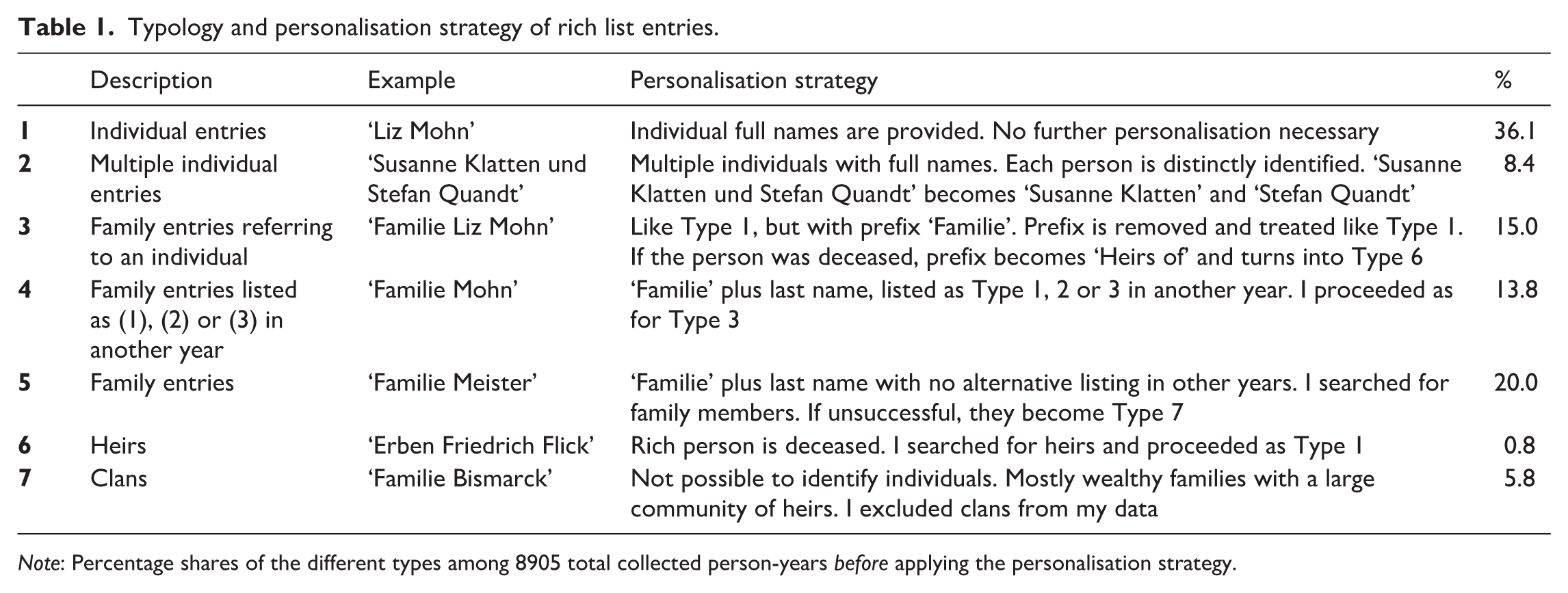
Note: Percentage shares of the different types among 8905 total collected person-years before applying the personalisation strategy.
To measure the historical origins of Germany’s largest fortunes, I captured the company founding dates by matching company data provided by the rich lists with their Wikidata-IDs via OpenRefine and manually adding missing years. Although company founding dates may not perfectly align with wealth creation (Mills, 2000), they offer a more nuanced historical perspective than simple binary classifications of inherited and ‘self-made’ wealth (Lillie and Tisch, 2026). For individuals without an assigned company, I applied the starting year of their career (N = 4).
Table 2 provides a descriptive overview of those founding dates. Germany’s largest fortunes are particularly old, with a median age of 79 years (as of 2025). Almost half of the companies were founded before the end of the Second World War, while about one-quarter were founded even before the year 1900. For the regression analyses, I categorised the company founding dates into historical periods, reflecting the five major political systems of 20th-century Germany. I did not include the founding date as a continuous variable in the analyses, as initial bivariate results suggest a non-linear relationship between fortune age and public visibility of the respective owners (see Online Supplementary Figure A2).
Descriptive statistics on the age of wealth-generating German companies.

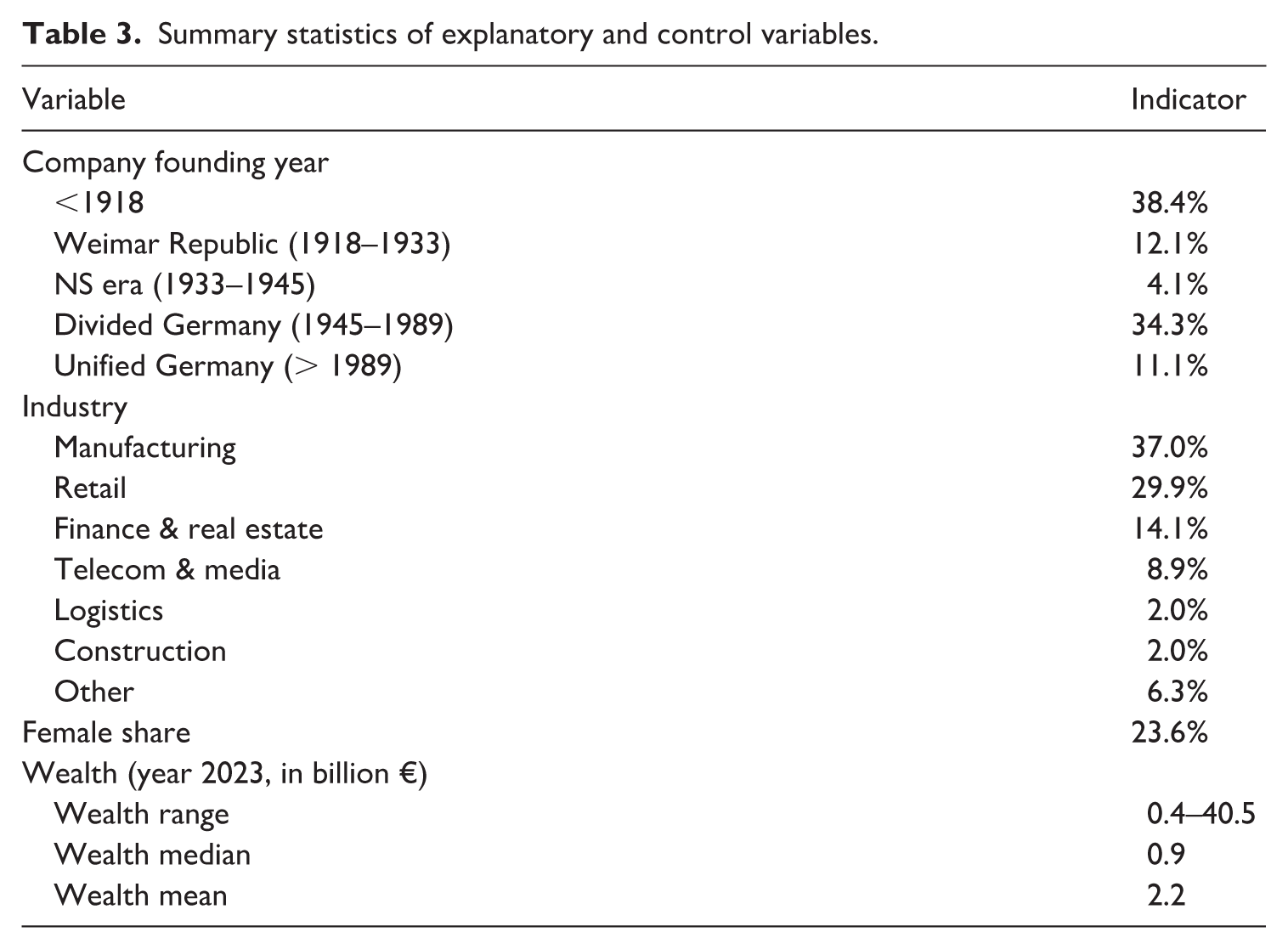
Table 3 presents the distribution of the grouped historical origin of the fortunes alongside other controls. Based on the industry classifications provided by Manager Magazin, I aggregated company sectors into broader categories. Owing to the small representation of some sectors, 1 these were consolidated into a residual category. 2 I manually assigned a binary gender variable, indicating a female share of roughly one-quarter among the German rich – a relatively high proportion in international comparison (Ischinsky and Tisch, 2023). I used log-transformed wealth (in billion Euros) as a predictor in the hurdle regressions due to its highly skewed distribution (400 million to 40.5 billion Euros).
Summary statistics of explanatory and control variables.
Press Articles
To analyse the public visibility of the rich, I gathered 143,774 German print articles from LexisNexis that were published between 2001 and 2023 and that mention at least one super-rich person. I included the following outlets: Bild, Bunte, Der Spiegel, Die Zeit, Frankfurter Allgemeine Zeitung (FAZ), Süddeutsche Zeitung (SZ), die tageszeitung (taz) and Welt. Despite a significant decline in the production, distribution and consumption of print media, over half of the German population still regularly engages with the press (Arbeitsgemeinschaft Media-Analyse (agma), 2024), shaping awareness and ignorance of social and political issues (Stocking and Holstein, 2015). Press coverage thus reflects not only what is considered important and newsworthy, but also what is missing.
This sample of outlets includes different ideological orientations and readership demographics to best reflect the German public sphere. Der Spiegel, Die Zeit, SZ and FAZ are regarded as national quality newspapers, with the first three leaning more liberal, whereas FAZ is considered more conservative (Röper, 2018). The daily tabloid Bild has the largest outreach and is published by Axel Springer SE, just as Welt, a right-leaning, conservative newspaper. Bunte is a celebrity gossip magazine, publishing supposedly exclusive stories about elites in a personalised and depoliticised way (Hennig, 2013). Table 4 provides an overview of these outlets and their readership demographics as provided by the agma (2025).
Overview of press outlets and readership demographics.
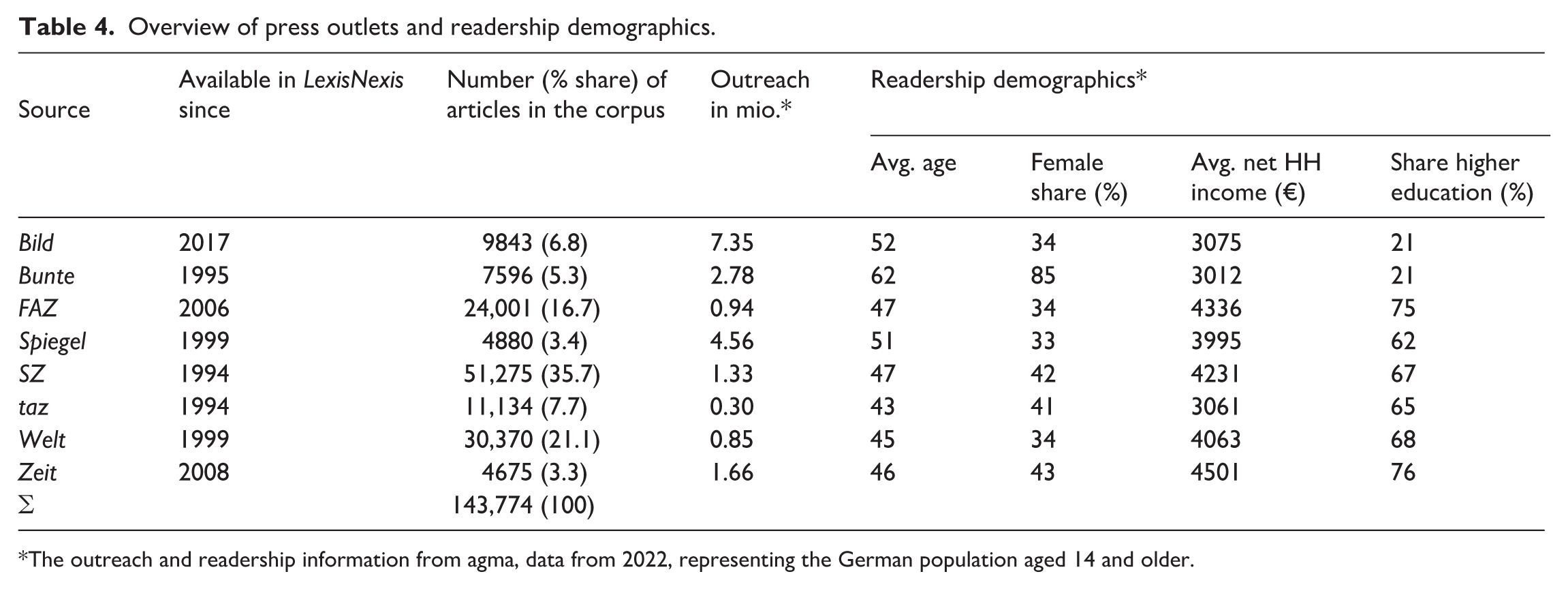
The outreach and readership information from agma, data from 2022, representing the German population aged 14 and older.
I gathered press articles that mention the super-rich by name. To ensure accuracy and minimise both false positives and false negatives, I implemented a three-step validation process. For individuals with common names, I required that the company name also appear in the same article (e.g. ‘Klaus Meier’ and ‘WPD’). This condition was applied only when necessary to reduce corporate bias. Second, I accounted for spelling variations (Rossmann/Roßmann), nicknames (Elisabeth ‘Liz’ Mohn), middle names or changes due to marriage (Maria Grundig/Wruck). Third, non-human entities like companies or foundations were excluded (e.g. Hasso Plattner Institut). This procedure failed in three instances due to identical naming of individuals and their companies, which were excluded (Max Bögl, Robert Berger, Robert Vogel).
Methods
Public visibility is operationalised as binary measure indicating whether an individual is mentioned in the press. This captures the fundamental distinction between visibility and invisibility. As a supplementary indicator, the number of mentions measures variation in the intensity of coverage among those who appear. Using the quanteda package in R (Benoit et al., 2018), I counted how often each of the 1718 individuals is mentioned. The resulting longitudinal dataset is structured at the person-newspaper-year level (N = 271,444), capturing each individual in each of the 23 years and in each press outlet, thereby controlling for potential variation related to both publication timing and media source.
To account for both the probability of being mentioned and the number of mentions, I used hurdle regression analyses (Mullahy, 1986). Hurdle models are well suited for count data with a large number of zeros. Rather than estimating two separate models, they combine a binary logit model estimating whether an individual is mentioned or not (0/1), and a Negative Binomial model estimating how often they are mentioned given that they appear. This approach appropriately handles excess zeros and overdispersion.
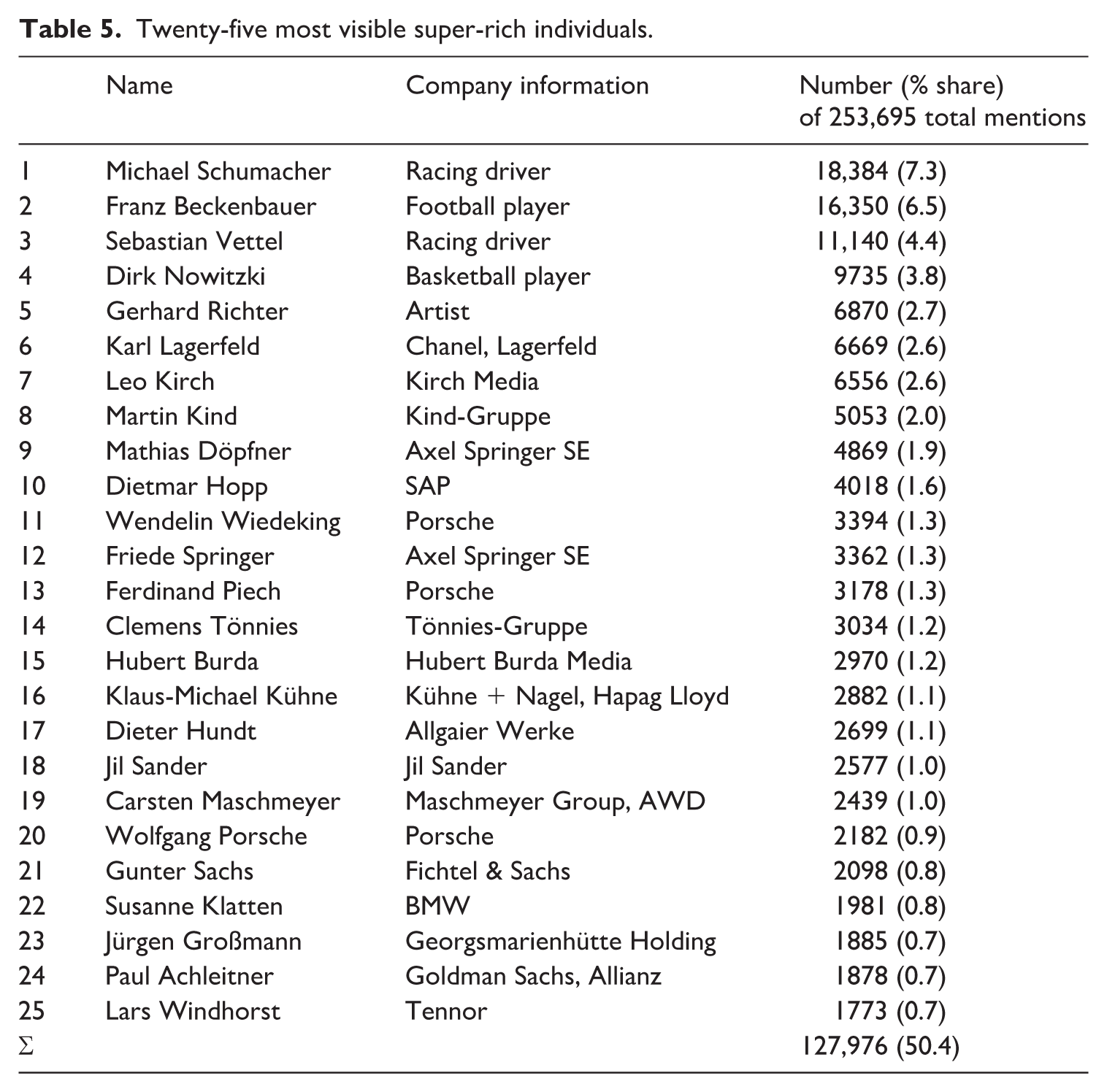
The historical period in which the company was founded serves as explanatory variable. I additionally controlled for sector, gender, the amount and year-to-year change in wealth, and whether an individual died or was already deceased in the publication year. Early death may reduce overall mentions, while death itself might increase media attention. Because each observation reflects the number of mentions of an individual in a given newspaper and year, I included newspaper and year dummies to account for systematic differences across outlets and time (Online Supplementary Figures A2 and A3). To ensure that the results are not driven by individuals whose wealth is tied to fame, I conducted robustness checks excluding the six most frequently mentioned individuals (see Table 5). Additional checks exclude newspapers that are not covered for the total period (Bild since 2017, FAZ since 2006 and Zeit since 2008). Moreover, I tested whether the results vary across individual news outlets (Online Supplementary Table A2, Table A3, Figure A3 and Figure A4).
Twenty-five most visible super-rich individuals.
Results
Descriptive Results
Figure 1 presents how public visibility is distributed among the rich. It provides the number of articles in which a person is mentioned (blue), the number of total name occurrences across all articles (red), and the number of those individuals that are never mentioned (grey) on a log scale to account for the highly skewed visibility. These occurrences are counted across all eight outlets and 23 years (Online Supplementary Table A1).
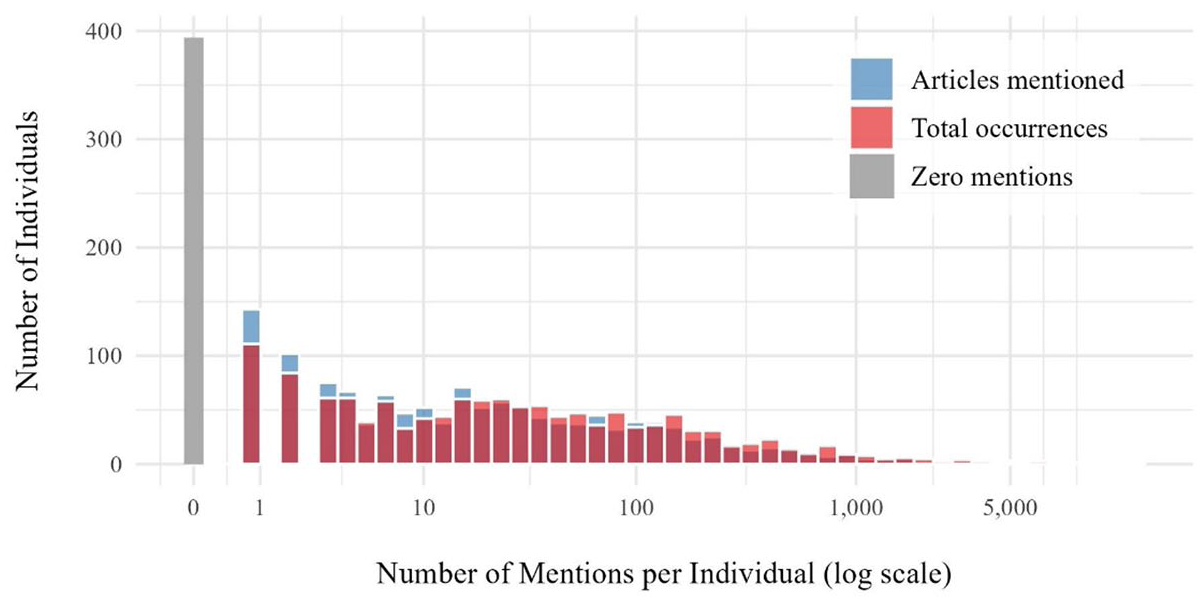
Distribution of visibility measures.
Public attention paid to individual members of the German super-rich is highly uneven, with a substantial portion remaining invisible. Among the 1718 individuals, about 23% (n = 394) do not appear in the press at all, rendering about one-quarter entirely invisible to the public. Of those who are mentioned, half appear 22 times or less, and about three-quarters receive fewer than 90 mentions across all outlets and years. Thus, most super-rich individuals receive either no or only occasional media attention.
In contrast, public visibility is concentrated among a small subset of the rich. Table 5 shows that the 25 most visible individuals (1.5% of the rich) account for half of all name mentions over the observed period. Notably, the top six alone generate one-quarter of total visibility. These individuals derive their wealth primarily from celebrity careers in sports or the arts, rather than from economic ownership, and their visibility likely stems from their cultural prominence (Imbusch, 2009).
Regression Analyses
To assess whether the public attention paid to the rich varies by historical origins of wealth, I estimated a hurdle model (Figure 2). The model measures (a) the probability that an individual is mentioned at all, and (b) the number of mentions among those who are visible. Positive coefficients imply higher odds of being mentioned (zero part) or more mentions (count part), while negative ones imply lower visibility. The main explanatory variable is the historical period in which the company was founded. Additional controls account for the industry sector, gender, amount of wealth, year-to-year changes of personal wealth, whether the individual died during the year of publishing, whether they were already deceased and for the newspaper outlet and year of publication. These controls are included in the regression tables (Online Supplementary Tables A2 and A3) but visually omitted from the figure for clarity. For better interpretability, Supplementary Figure 3 additionally presents predicted probabilities of being mentioned for each founding period, derived from the zero part of the hurdle model. Online Supplementary Figure A3 presents replications of the regression analyses, excluding (a) the six most frequently mentioned individuals to control for potential celebrity effects; (b) newspapers that are not available for the total period (Bild since 2017, FAZ since 2006 and Zeit since 2008); and (c) both subsamples. The core findings remain robust. Online Supplementary Figure A4 presents robustness analyses by media outlet. For the binary visibility measure, coefficients remain largely consistent, with deviations only for Bild and Bunte, likely due to their tabloid orientation favouring nobility and celebrity over economic elites (Hennig, 2013). The supplementary count-based measures show greater variation, indicating that coverage intensity depends more on outlet-specific reporting patterns. The robustness of the binary measure suggests that general patterns of visibility are largely consistent across outlets.
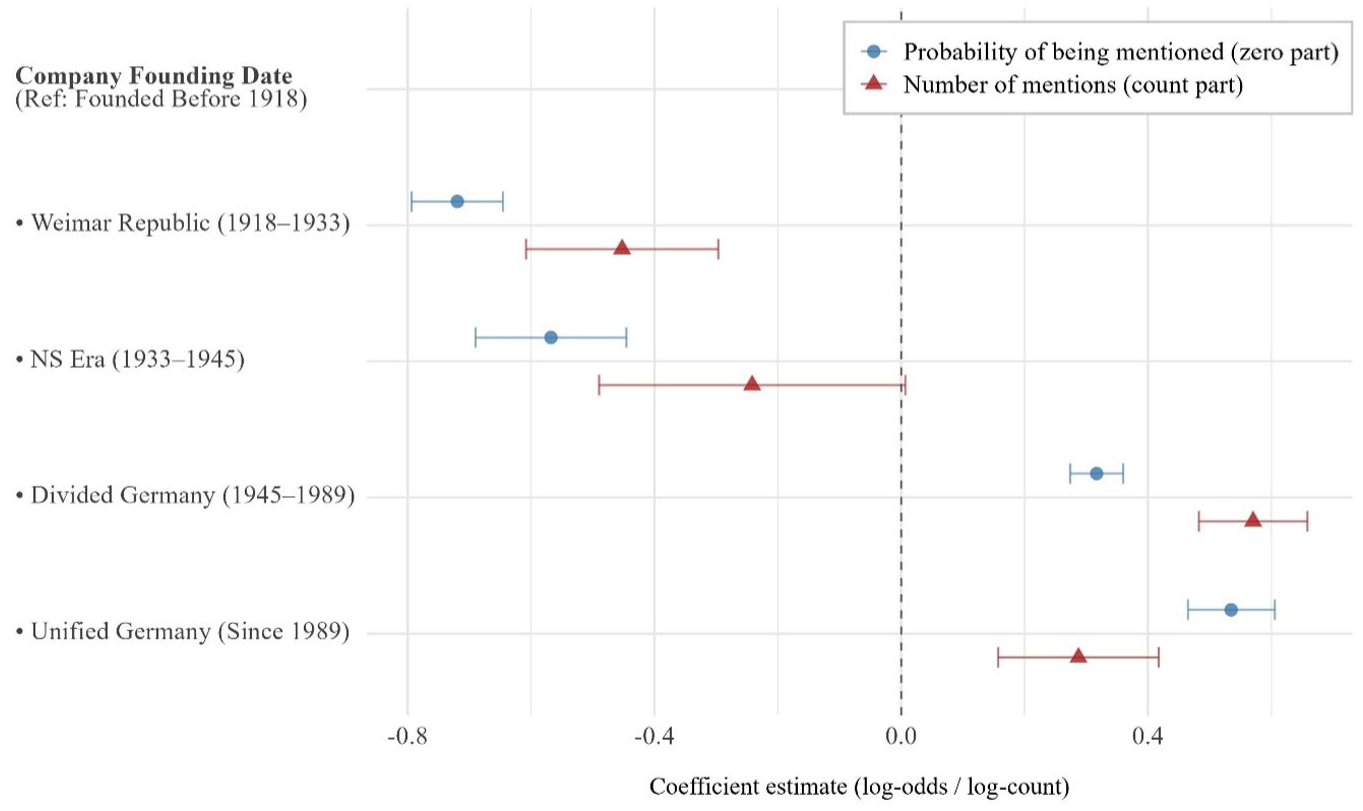
Regression results.
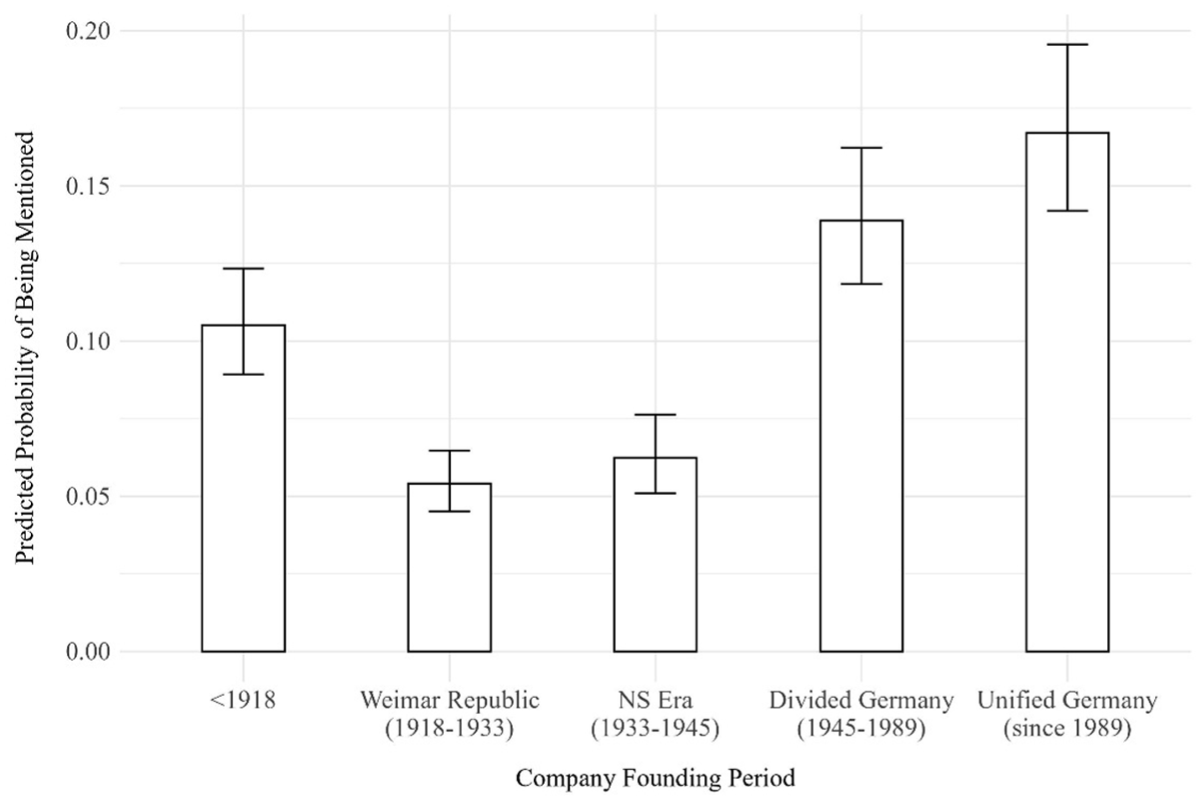
Predicted probabilities of being mentioned by company founding period.
Owners of companies founded between the First World War (1918) and the Second World War (1945) are significantly less visible in the public sphere than those associated with companies founded before or after this period (Online Supplementary Figure A2). Consequently, wealthy individuals who receive attention typically represent either relatively new or dynastic family wealth. In the following, I examine the visibility of these dynastic fortunes, then the comparatively low public profile of wealth originating between the World Wars and finally the higher visibility of owners of younger fortunes.
Wealthy individuals with company histories exceeding one hundred years are relatively publicly visible, challenging the assumption of inherently invisible old wealth (Hecken, 2016; Imbusch, 2009). Their visibility may be explained by their historically crucial and enduring role in shaping the German economy. These families have long defined the narrative of successful capitalism and continue to promote Germany’s image as an export economy (Beckert, 2024; Waitkus and Wallaschek, 2022). Accordingly, their visibility suggests that old wealth is not generally ignored.
Instead, the findings suggest a selective ignorance of fortunes originating in the interwar and NS era. Although earlier-founded companies also economically benefited from the NS regime (such as Kühne + Nagel or Bahlsen), owners of companies founded immediately before or during this period are significantly less visible. A possible explanation is the historical association of these firms. While older dynastic companies can discard their NS involvement within a broader corporate history, companies founded in the interwar or NS period might be more closely identified with this specific historical context. Consequently, heirs of these fortunes may prefer to remain invisible to avoid public scrutiny (De Jong, 2022).
In contrast, fortunes established after 1945 occupy a different historical landscape, which may contribute to greater visibility of their owners today. Their visibility might be partly explained by a particular form of historical legitimacy: these fortunes emerged during a period that was widely perceived as a collective economic ‘reset’ (Kurr, 2022). The large-scale destruction of private wealth during the World Wars (Albers et al., 2022; Piketty, 2014) and the 1948 currency reform fostered a public belief that everyone started under equal conditions (Kurr, 2022). Economic success, therefore, was attributed to hard work and entrepreneurial spirit rather than inherited privilege. Thus, the wealth held by today’s owners of post-war fortunes might still be perceived to reflect merit and economic contribution (Vikström, 2024).
Finally, owners of fortunes founded in the most recent decades are particularly visible. On the one hand, this might be explained by media-supply logics: living founders are more newsworthy than multi-generational heirs, as their entrepreneurial stories, personal leadership and active involvement in their companies offer compelling narratives (Hecken, 2016). At the same time, this visibility may serve a legitimising function. Younger fortunes are more likely to be perceived as ‘self-made’, created through achievement and hard work rather than inheritance, aligning with dominant ideals of deservingness (Rowlingson and Connor, 2011; Sachweh and Eicher, 2025).
Overall, the results show that the German super-rich are largely absent from public discourse. Around one-quarter of the 1718 richest individuals receive no press coverage at all, and those who do are mentioned only sporadically. Attention is concentrated on a small subset of individuals, including several media owners. Notably, visibility also varies by the historical origins of fortunes: owners of wealth originating in the interwar and NS period are significantly less likely to appear in the press than those with older or more recent fortunes.
Conclusion
Despite a growing body of research on the public legitimation of the super-rich and their wealth (Carr et al., 2024; Kendall, 2011; Waitkus and Wallaschek, 2022), little is known about the extent to which they are public at all. This article investigates patterns of visibility and invisibility among the 1718 richest Germans between 2001 and 2023, using word frequency and multivariate regression analyses on 143,774 press articles. Particular attention is paid to the historical origins of fortunes. The German super-rich are largely absent from public discourse. Coverage is concentrated on a small minority of highly visible individuals, including several media owners. Visibility further varies systematically along the historical origins of fortunes: owners of wealth originating in the interwar and NS period are significantly less likely to appear in the press than those with older or more recent fortunes.
These patterns have several implications. First, the concentration of coverage on a small subset of the wealth elite demonstrates that public and journalistic interest in the rich exists, challenging the notion that the general invisibility of the wealth elite might be driven by demand logics. Moreover, the substantial visibility of some media owners, particularly in their own outlets, 3 indicates that public exposure is not purely externally imposed but rather actively pursued and managed. As owners of key platforms of visibility, they possess disproportionate power to suppress or amplify their own public presence (Herman and Chomsky, 2002; McGoey, 2019). This suggests that the invisibility of many others is likely not due to low demand but reflects supply-side dynamics, such as the deliberate withholding of information by the wealthy themselves.
Second, the historical origins of fortunes appear to shape patterns of visibility in meaningful ways. Wealth connected to the NS period is widely perceived as especially illegitimate, even more so than inherited fortunes in general (Becker and Waitkus, 2025). In line with this, NS-era fortunes in Germany are much less visible in the press than older or more recent fortunes. This selective absence may shield these historically burdened fortunes from public attention, limiting societal awareness and discussion of their origins (De Jong, 2022). In other words, invisibility does not simply reflect indifference – it structures the information that reaches the public, shaping which forms of wealth are scrutinised and which remain largely unexamined. This resonates with Derix’s (2022) observation that focusing only on visible stories risks overlooking the subtle, hidden mechanisms through which economic and social inequalities are maintained.
This study comes with some limitations. First, using press articles as data source can be criticised. Newspaper readership is declining, and ownership is increasingly concentrated, raising questions about the representativeness of press coverage. It is plausible that the visibility of the German rich differs significantly across platforms. Given their already limited visibility in the press, it is likely that they are even less present in visual media such as television or social networks. Anecdotal cases such as the Albrecht brothers, who are relatively frequently mentioned in the press despite the absence of publicly available photographs (Gajek, 2024), highlight how public visibility in print media does not necessarily translate to visual recognition elsewhere. As media systems become more hybrid, future research should broaden its scope to include digital and social media (Vaughan et al., 2025). Second, the national focus on Germany presents another limitation. The German rich are often characterised as particularly publicity-shy (Gajek, 2016), but it remains unclear how their visibility compares internationally. A comparative analysis with, for example, US billionaires – whose wealth is often considerably younger, more strongly concentrated in tech and finance, and accompanied by higher political involvement (Freund and Oliver, 2016; Page et al., 2019) – could offer important context for interpreting the relative invisibility of the German wealth elite. A potentially more frequent media portrayal of non-German elites may contribute to a perception that extreme wealth is primarily a foreign phenomenon, thereby diminishing public awareness and urgency around domestic wealth inequality.
This study thus contributes to a growing body of work concerned with how symbolic and informational asymmetries shape public understandings of inequality in contemporary democracies (Grisold and Theine, 2017; Kantola and Vesa, 2023). Taken together, visibility and invisibility can be understood as complementary aspects of how wealth is represented in the public sphere. Inequality is not only maintained through economic structures (Piketty, 2014) or narratives legitimising the rich (Waitkus and Wallaschek, 2022), but also through their public absence. Building on media theory (McCombs and Shaw, 1972; McCombs et al., 2014), elite and power studies (Harrington, 2021; Lukes, 2005; McGoey, 2019), it is plausible to assume that this absence limits the extent to which wealth concentration, its origins and its beneficiaries become salient topics of public concern. Whereas agenda-setting studies traditionally examine what is made salient, the present study highlights that what is withheld from public view can function as an ‘invisible agenda’, shaping the scope and limits of public discourse. The selective omission of certain individuals and forms of wealth may shape which aspects of inequality are publicly debated, and which remain largely unchallenged. This study underlines that analyses of inequality benefit from considering public presence alongside narratives. Investigating who is visible and who remains hidden provides critical insight into how wealth and power are maintained in contemporary societies, independent of the specific content of reporting. In this sense, invisibility is not simply a mere symptom of elite privilege but a mechanism that helps sustain it.
Supplemental Material
sj-docx-1-soc-10.1177_00380385261428292 – Supplemental material for The Invisible Super-Rich? A Quantitative Analysis of the Press Coverage of Germany’s Wealth Elite
Supplemental material, sj-docx-1-soc-10.1177_00380385261428292 for The Invisible Super-Rich? A Quantitative Analysis of the Press Coverage of Germany’s Wealth Elite by Emma Ischinsky in Sociology
Footnotes
Acknowledgements
I would like to thank Jens Beckert, Daria Tisch, Nora Waitkus, Eva Maria Gajek, Doron Shiffer-Sebba, the participants at the Summer School on Elites, Power, and Inequalities (2024) and the two anonymous reviewers for their valuable comments on previous versions of this manuscript.
Funding
The author received no financial support for the research, authorship and/or publication of this article.

Supplemental Material
Supplemental material for this article is available online.