




Abstract
The Sociology of Emotions is characterized by a significant dearth of writing and research on positive emotions, including pleasure and affection. In this article, we examine gendered disparities in the prevalence and change over time of pleasure, climax, and affection in frequently watched mainstream free online pornography. Our systematic content analysis of 255 highly watched heterosexual videos, all uploaded to PornHub since the beginning of the new millennium, shows that the gap between male and female performers’ pleasure displays has closed in recent years, while the gap in displays of male and female climax remains substantial. The rate of videos depicting affection in mainstream pornography has roughly doubled over the last two decades. These findings suggest that frequently watched mainstream pornography may be gradually shifting toward more mutual and gender egalitarian portrayals of sexuality and pleasure.
Introduction
Sociologists of emotions (Cieslik, 2015; shuster and Westbrook, 2024; Wettergren, 2019) and pleasure (Abrutyn, 2025; Fine and Corte, 2017; Higgins and Hirsch, 2007; Jones, 2019, 2020; Regan, 2024; Shor, 2025) have highlighted a significant dearth in the sociological writing and research on positive emotions. This shortage is particularly salient in the academic discourse surrounding sexuality, where pleasure has often been erased, problematized, and vilified (Beasley, 2008). Regan (2024), for example, notes that while issues such as sex work, sexual violence, and sexual health have received ample scholarly attention, research on sexual pleasure has been scarce. Jones (2019) similarly argues that while recent work on sexuality has often examined sexual identities and inequalities, it continues to neglect the sexual act itself and the role that pleasure plays within it.
Furthermore, the small body of research that currently engages with pleasure often highlights heteronormative and androcentric scripts of sexual pleasure (Fahs and Swank, 2016; Frith, 2015). While heterosexual men’s pleasure is often vilified and problematized (Beasley, 2008), heterosexual women’s pleasure has often been trivialized or ignored in much of the scientific study of sexuality and sexual behaviors, in what Higgins and Hirsch (2007) have termed “the pleasure deficit.” Moreover, even when pleasure, satisfaction and orgasm are discussed in this literature, scholars often adopt a negative perspective, focusing on factors that decrease satisfaction, difficulties in experiencing pleasure, and faking orgasms, or not reaching them (Jones, 2019). Advances made around the exploration of sexuality and pleasure in disciplines such as gender studies, cultural studies, philosophy, literature, and film studies (e.g., Orne, 2017; Schippers, 2016; Ward, 2015) are therefore often ignored or belittled by social scientists.
In this study, we take a step toward addressing this sociological “pleasure deficit” by examining temporal developments in the gendered representation of pleasure and affection in mainstream pornographic videos. Traditional feminist writing on pornography (e.g., Dines, 2010; Dworkin, 1989; MacKinnon, 1989) has suggested that pornography focuses on men’s comfort and pleasure while ignoring or trivializing women’s emotions, pleasure, and sexual satisfaction. Notwithstanding a few recent exceptions (Fritz et al., 2021; Seida and Shor, 2021), analyses of pornographic content have seldom examined displays of affection and pleasure beyond orgasm, focusing instead on acts of aggression and humiliation. Several recent studies did examine pornographic depictions of climax, finding that male orgasms are much more frequently depicted than female orgasms (Fritz and Paul, 2017; Klaassen and Peter, 2015; Séguin et al., 2018; Shor and Seida, 2019). However, the prevalence of other displays of pleasure by both female and male pornography performers in mainstream heterosexual videos remains unclear, as does the prevalence of displays of affection. Furthermore, we know little about the potential volatility of these pleasure and affection displays, and how they may have changed over the years.
The sociology of positive emotions and pleasure
Sociology has historically focused primarily on negative experiences and emotions, while ignoring or problematizing positive ones (Cieslik, 2015; Fine and Corte, 2017). In fact, even when sociologists do mention or analyze feelings such as happiness, joy, and pleasure, they often do it in a critical manner, highlighting their problematic nature and questioning what they see as the dubious human pursuit of these emotions (Cieslik, 2015; shuster and Westbrook, 2024).
Following the growing sociological interest in positive emotions (Cieslik, 2015; Fine and Corte, 2017; shuster and Westbrook, 2024; Veenhoven, 2018), we argue that sociology should pay greater attention to positive emotions, in a similar manner to the emergence of positive psychology in the discipline of psychology over the last few decades (Seligman and Csikszentmihalyi, 2000; Seligman et al., 2005). Positive psychology brought to the forefront positive emotions such as happiness, joy, pleasure, compassion, and tenderness and highlighted their importance for human motivations, behaviors, and experiences (Carr, 2011; Emmons, 2020). However, it is important to note that such emotions are not merely individualistic phenomena; rather they are social (Cieslik, 2015). Sociologists should therefore move past the longstanding tendency to abdicate the study of these emotions to psychological research or to treat them as “vapid” consumption patterns (Veblen, 1899; Warde, 2015), highlighting primarily aspects such as the commodification of emotions such as love and happiness (Cabanas and Illouz, 2019; Illouz, 1997), or denouncing the pursual of “the wrong kind” or pleasure in sexual fantasies and practices (Dworkin, 1994; Fielder et al., 2014). A sociology of positive emotions could help highlight the aspects of life that sustain people through difficulty, help them rise against oppression, and make their lives worth living (Emmons, 2020; Thin, 2014; Westbrook, 2021).
In this article, we build on and expand the seminal work of several sociologists, who over the last two decades have outlined the sociology of joy, fun, and pleasure as distinct subfields of study. Earlier work by Beasley (2008) has highlighted the missing discourse of pleasure and desire in academic writings on heterosexual relationships, while others have identified a similar neglect in sex education programs (Allen and Carmody, 2012; Fine, 1988; Lamb, 2010). More recently, Fine and Corte (2017) built on the seminal work of Goffman (1961) in outlining a sociology of fun, which they see as a necessary condition in creating and maintaining social ties. Fine and Corte argued that fun is collective pleasure. While pleasure is a personal experience of individual actors, fun is a social experience, often used by groups to solidify allegiance, facilitate cohesion, and encourage commitment and participation. It thus contributes to the formation, stability, and reproduction of social groups.
Sociologist Angela Jones has similarly advocated for the sociology of pleasure as a unique subfield. Jones (2019) notes the frequent erasure of pleasure as a key motivator of sexual behaviors and the frequent treatment of sex as a problem, noting that acts and practices such as sex work, pornography consumption, and even orgasms are primarily discussed in a negative context. She therefore argues that the sociology of pleasure should explore how experiences of pleasure are shaped and regulated by culture and institutions, unpacking inequities in access to pleasure (Jones, 2020). Similarly, Abrutyn (2025) has suggested that sociologists must pay greater attention to people’s active search (seeking) of pleasure and the affective urgency and expectation associated with this search as primary motivating factors in various social behaviors.
Following Jones, as well as insights from recent work by Shor (2025) on the pleasure experiences and perceptions of pornography viewers, we argue that a sociology of pleasure sees pleasure as a social rather than just a biological, neurological, or psychological experience. Pleasure is heavily shaped by and embedded in social networks of meaning. People often find certain actions and experiences pleasing because of how those around them define these experiences or expect them to feel. One of the earliest examples of this comes from Howard Becker’s (1953) study on the social nature of drug consumption. Becker argued that for most people marijuana consumption initially produces physical discomfort and psychological disorientation. New users thus learn to feel pleasure when consuming the drug mainly due to the expectations and interpretations of friends and acquaintances who teach them how to consume the drug and how to interpret its effects as pleasurable (see also Measham, 2004).
Departing from common conceptualizations of pleasure as merely an individual and personal experience of agreeable affect or satisfaction (Fine and Corte, 2017), we suggest that pleasure is often experienced through social connections, acceptance, and belonging, as well as through meeting social expectations. It is hard to fully understand the pleasure that some individuals derive from activities such as physically excruciating work, marathon running, professional swimming, mountain climbing, body modifications, or religious fasting by focusing solely on the physical sensations associated with these activities, as these are often uncomfortable or even painful. Instead, it is the social, cultural, and symbolic meanings associated with these activities and experiences that largely give them their value and allow individuals to experience them as pleasurable. Firefighters or nurses may derive relatively little pleasure from the physical labor involved in their work. However, they may still enjoy the comradery of their colleagues and the knowledge that their work is esteemed by others and perceived as socially beneficial. Similarly, mountain climbers may feel considerable levels of pain and discomfort and Olympic swimmers may find lengthy daily practices to be mundane and physically excruciating (Chambliss, 1989). Yet, they may still enjoy the sense of accomplishment associated with their achievements and the social appreciation that comes with it.
This socially embedded understanding of pleasure is in line with the work of Geertz (1973), who defined pleasure as a social experience in which the body is caught up in webs of significance. This view recognizes that pleasure is often experienced at the same time in both the body and the mind and that cognitive and social frameworks that involve seeking and expectation dramatically influence the interpretations of bodily sensations (Abrutyn, 2025). Thus, one can engage in physically painful and uncomfortable activities while feeling emotional elation due to a sense of achievement or social recognition. Conversely, humans can experience corporeal pleasure mixed with feelings of emotional disgust, guilt, and discomfort, for example when knowingly over-consuming unhealthy food or when engaging in sex with partners whom they find emotionally revolting.
Exploring pleasure as a social phenomenon thus enriches our broader understanding of emotions as socially constructed. Furthermore, as shuster and Westbrook (2024) note, exploring positive emotions such as happiness, joy, and pleasure, does not undermine the study of social inequalities, which often forms the core of sociological research (Lamont, 2018). In this article, we explore the ways in which the pornography industry represents and regulates sexual pleasure, paying particular attention to the role of gender inequalities in the depiction of pleasure and the ways in which gendered representations of pleasure (or its absence) have evolved over the years.
Gender inequalities in pornographic pleasure representations
While all sexual pleasure is socially scrutinized and regulated, this has been particularly true regarding women’s pleasure in pornography and, more generally, in sex work. In the traditional view of radical feminist thinkers (e.g., Brownmiller, 1975; Dines, 2010; Dworkin, 1989; Dworkin and MacKinnon, 1988; MacKinnon, 1989), women in pornography are reduced to passive erotic objects; faceless bodies used for male pleasure. In this critical view of the industry, women’s emotions, pleasure, and sexual satisfaction are ignored or trivialized and become inconsequential to pornographic scripts. The emphasis on men’s dominance and aggression and on the technical aspects of sexuality (positions, camera angles, and unrealistic sexual scripts) leaves little room for displays of affection, passion, emotions, commitment, softness, and attention to genuine pleasure. Since these scripts are largely conceived by male producers and directors and designed primarily for the consumption of male audiences (Fritz and Paul, 2017), they almost invariably represent “the male gaze” and focus almost entirely on men’s welfare and pleasure (Neville, 2015). As such, they encourage women to be sexually passive and to feel ashamed of their sexual desires, behaviors, and pleasure (Endendijk et al., 2020). As a result, some feminists argue that genuine female pleasure in mainstream pornography becomes secondary at best, and often it is simply erased (Fitzgerald and Grossman, 2017; Wright, 2017).
These traditional feminist approaches have been challenged over the years by sex-positive feminist scholars, who criticize the anti-pornography movement for repressing sexuality (particularly that of women and sexual minorities), criminalizing fantasy, and encouraging censorship (Kipnis, 1998; McElroy, 1997; Rubin, 1984; Willis, 1994). More nuanced understandings of pornography suggest that even if the industry is primarily phallocentric and caters to male viewers, this does not entail videos that focus on male pleasure and are disinterested in female pleasure (Attwood et al., 2018; Daskalopoulou and Zanette, 2020). Instead, several feminist pornography scholars have suggested that in fact pornographic productions mostly focus on the pleasure of female performers, while the bodies and pleasure of male performers are rarely visible (Moye, 1985). According to Attwood (2005), this leads to a “cultural blind spot,” where viewers (particularly women) are not taught to view the male body erotically and displays of female pleasure represent both male and female pleasure.
Previous content analyses of pleasure and affection displays in pornography
Research on displays of pleasure and affection in pornography has been scarce, as most previous content analyses have focused on displays of aggression and “humiliation” (e.g., Bridges et al., 2010; Fritz et al., 2020; Gorman et al., 2010; Klaassen and Peter, 2015; McKee, 2005; Shor, 2019, 2022; Shor and Golriz, 2019; Shor and Liu, 2026; Zhou and Paul, 2016). Two recent exceptions come from studies by Shor and Seida (2021) and by Fritz et al. (2021). Shor and Seida analyzed the content of 70 highly watched online videos on a popular mainstream pornography website up to 2016. They reported that fewer than 30% of the videos depicted affection. Fritz et al. (2021) analyzed the content of 1741 randomly selected pornographic scenes in two of the largest online pornographic streaming tube sites, in 2014. While the authors did not report the overall prevalence of affection displays, they did report that kissing appeared in about 25% of the scenes, while cunnilingus appeared in about 30% of them.
The research further suggests that the gap between portrayals of women’s and men’s pleasure in pornography is perhaps most pronounced in depictions of climax. While female characters are significantly more likely than male characters to be depicted experiencing orgasm in written erotic fiction (Cabrera and Ménard, 2013), previous content analyses of visual pornography have consistently reported that depictions of male orgasms are much more common than those of female orgasms. Séguin et al. (2018), for example, analyzed popular pornographic videos and found that only 18.3% of women, compared with 78.0% of men, were shown reaching an orgasm. This orgasm gender gap exists in both amateur and professional videos (Klaassen and Peter, 2015), as well as in both feminist and mainstream pornography (Fritz and Paul, 2017), although women in queer pornography are more likely to experience (or portray) an orgasm than they are in mixed gender videos (Fritz and Paul, 2017; Shor and Seida, 2019). Moreover, since women’s orgasms are hard to depict on screen, female pornography performers often resort to exaggerated performances (Williams, 1989), which, in turn, raise substantial doubts about their authenticity (Frith, 2015).
While the studies reviewed here provide a partial picture of the presence of pleasure and affection in pornography, we still lack a more comprehensive and up-to-date account of the prevalence of women’s pleasure and climax relative to men’s, as well as the presence of overall affection displays, as opposed to mechanical or hostile sex. It is also not clear whether the prevalence of such displays is time-invariant or whether there are changes over time in the frequency of pleasure and affection displays in mainstream pornography. This article explores these questions, with an emphasis on temporal tendencies over the last 20 years.
By exploring these questions in the field of pornography, the article makes a wider contribution to sociological literatures on affective motivation and to theories of emotions, with an emphasis on the sociology of positive emotions (shuster and Westbrook, 2024; Veenhoven, 2018) and the sociology of pleasure (Abrutyn, 2025; Jones, 2020; Regan, 2024). We further show that the study of positive emotions, including pleasure, and the study of social inequalities, which lies at the heart of the sociological enterprise, are not antithetical. Instead, gendered and racial inequalities in positive emotions and experiences have the potential to affect people’s attitudes, actions, and wellbeing.
Methods
Sampling and analytical strategy
The research team coded 255 “all time most watched” videos from PornHub, one of the world’s top adult websites, and according to Alexa Internet, the 13th most visited site on the Internet in 2024, with about six billion monthly visits. PornHub is a freely accessible sharing website, similar to YouTube. While some former studies of Internet pornography examined multiple websites (e.g., Klaassen and Peter, 2015; Vannier et al., 2014), many of the most popular websites have overlapping ownerships (van der Linde, 2016). Therefore, the list of most watched videos in these websites includes multiple overlapping and consequently comparable videos (Klaassen and Peter, 2015).
Similar to other recent analyses of pornographic content (Bridges et al., 2010; Klaassen and Peter, 2015; McKee, 2005), we sought to analyze the all time most watched videos on PornHub by year. This strategy was designed to increase generalizability and explore the pornographic content that is most likely to be watched by wide audiences (and therefore have a potentially larger cultural impact). Hence, all the videos in our sample received at least two million views and all included two partners (we excluded from the sample three videos that did not include two partners). As we sought to examine time trends in the representation of pleasure, our sampling strategy was designed to obtain at least 15 videos per year for each of the last 20 years. We were able to reach this target for the last 16 years (2009–2024), but not for earlier years, as we were only able to locate 11 “most popular” videos uploaded to the website between 2000 and 2008. Of note, this sample is predominated by North American video productions and features primarily all-White couplings. In addition, all videos that were among the 15 most watched annually featured a heterosexual couple and none had gay or lesbian couplings.
To reduce the random volatility of the data over time and improve the visibility of time trends in the graphs, we combined every two successive years before conducting the analyses presented below. Time trends were then statistically assessed using logistic regression analyses, treating year-pairs as continuous. Of note, robustness checks for single non-combined years did not show any differences in the statistical significance of time trends, supporting the decision to combine years to enhance clarity of presentation and reduce statistical noise.
Measurements and coding
Defining and coding pleasure and affection displays
Defining and coding pleasure displays in pornography is a difficult task, due to issues of ambiguity and subjective interpretation, which require the adoption of clear and consistent definitions. We defined pleasure displays in pornographic videos as any acts or expressions by pornography performers that signaled sexual pleasure, enjoyment, or gratification. We tracked four major expressions and cues of pleasure: (1) verbal expressions, such as performers declaring “I love it,” “please don’t stop,” “this feels good,” and “Kimochi” (a common verbal expression in Japanese pornography, meaning “good sensation”); (2) non-verbal vocalizations, such as moaning and screaming in pleasure; (3) facial expressions meant to convey pleasure, such as eye rolling or shutting, facial contractions, and the face becoming flushed; (4) various bodily expressions, such as hand gestures (e.g., grabbing sheets or pillow), becoming sweaty, and the male performer appearing to be struggling to avoid climaxing. Additionally, the presence of pleasure was noted following any expression of climax, as described below. The research team coded both the presence of such pleasure displays (1 = yes; 0 = no) and the length of these displays as a share (percentage) of the entire video.
Climax displays for men are in most cases relatively easy to identify, as they are typically depicted with the clear release of semen during ejaculation (which many pornographic videos deliberately make visible). Female performers’ climax, on the other hand, is notoriously harder to depict and code in visual pornography, as it is often considered “invisible” (Lebedíková, 2022). To maximize standardization and reduce ambiguity, we therefore followed three key principles. First, in contrast with some previous approaches to coding climax (e.g., Klaassen and Peter, 2015), we did not try to differentiate between “authentic” and “fake” displays of orgasm. Instead, we chose to treat any expressed climax display by either male of female performers as an orgasm, without making any assumptions about the ontological “real world” essence of these displays. This approach recognizes that representations may not be authentic and focuses instead on the performance of orgasm rather than its authentic experience.
Second, similar to other recent studies (Fritz and Paul, 2017; Séguin et al., 2018), we considered both auditory and visual indicators of climax. The former included proclamations of an orgasm (most notably “I’m cumming”), as well as screams of pleasure or deep moaning that followed what appeared like a clear buildup and subsided consequently. Visual indicators included cues such as muscles (e.g., in the legs or hands) seeming to contract or tremble uncontrollably, seemingly spasmic facial contortions, hyperventilation, the absence of breathing at the pre-orgasmic phase, and clear displays of relaxation or sensitivity after the display of climax. We opted here for a conservative approach that prioritized clarity. Hence, in cases where orgasm displays were somewhat ambiguous, we coded the video as not depicting a female orgasm (such ambiguities were only present in cases of female orgasms).
Next, considering the challenges with assessing pleasure and climax (particularly female climax), we also coded and analyzed acts that are often associated with increasing women’s pleasure and climax. Most notably, we examined clitoral stimulation, either by the male performer (typically with either the hand/fingers or the mouth) or by the female performer herself (female masturbation). Scholars have noted that such sexual practices significantly increase women’s likelihood of enjoying the act and reaching an orgasm (Darling et al., 1991; Herbenick et al., 2020). We also coded the percentage of videos in each year that included sexual positions where the female performer was on top, as this position allows female performers greater control of their movements and easier access to clitoral stimulation.
Finally, displays of affection were generally clearer and less ambiguous, and therefore relatively easier to code than pleasure or climax displays. Again, we did not try to differentiate between “authentic” and “fake” displays of affection, instead treating any such representation as a display of affection. Similarly, we did not differentiate displays of affection based on specific contexts (e.g., those appearing in BDSM scenes vs. those depicted in romantic “vanilla” scenes). Of note, this approach may not fully capture the context and meaning of these displays, which in turn may influence how individuals interpret and internalize them (McKee, 2015; Simon and Gagnon, 1984). Nevertheless, this approach provides some insights into what producers believe consumers find desirable and what consumers, in turn, may perceive as desirable and as part of the normative sexual script. We coded the following acts as displays of affection: kissing (on the mouth or the kissing of other body parts), hugging, gentle caressing of any body part, including the breasts and buttocks, and expressing verbal affection, in the form of praising (e.g., of a partner’s physical traits or personality) or using terms of endearment (e.g., “baby” and “honey”). We coded the general affection variable as 1 (“yes”) whenever at least one of these displays of affection was present.
Coding procedures and inter-coder reliability
The coders were two graduate students with good familiarity of sexually explicit materials from previous research projects. The coders first met several times with the project leader (the lead author), who trained them in the method and coding scheme. Before coding from the actual sample, they each coded separately five trial videos. The research team then met to discuss the coding and resolve unclear issues. Next, the coders continued to code all videos in the sample. When they encountered questions regarding the interpretation of contents, they met with the project leader and the entire research team discussed the issues and reached a resolution. Finally, the project leader re-watched all the videos to ascertain coding accuracy and independently coded displays of affection and pleasure. Inter-coder agreement between students’ coding and the project leader’s coding was high: 88.9% agreement for the overall measure of pleasure, 93.3% agreement for the measure of female performers’ climax, and 98.8% for the overall measure of affection. Kappa statistic scores for these measures were 0.77 and 0.81, and 0.85 respectively, indicating strong to excellent agreement. When disagreements occurred, they were usually minor and were resolved by re-watching the video and discussing it until we reached a consensus. We assessed the statistical significance of the time trends using logistic regression analyses with two-tailed tests of significance.
Findings
Overall, we found a relatively minor difference in depictions of male and female pleasure for the entire sample (n = 255). While male pleasure was clearly displayed in 95.7% of the videos, female pleasure appeared in 88.2% of them. Gender differences were much larger for displays of climax, with 83.5% of the videos including displays of male climax, compared with only 23.5% of the videos that included displays of female climax. Still, 77.7% of the videos included some form of clitoral stimulation (by a partner’s fingers or mouth or by the female performer herself). As for displays of affection, the majority of the videos in the sample (82.8%) included displays of affection by male performers and 40.0% of them also included displays of affection by female performers.
Time trends in pleasure and affection displays
In Figure 1, we present time trends in pleasure displays. The figure shows that depictions of male performers’ pleasure are ubiquitous across time, never falling under 90% of the videos. However, depictions of male orgasm did increase with time, from 80% or less up to 2014 to at least 85% in the late 2010s and more than 90% in the 2020s (t = 3.03; p = 0.006). Similarly, both depictions of pleasure and depictions of climax for female performers increased substantially over the years. Female performers’ pleasure displays have increased from about 70% of all videos in the 2000s to more than 95% of the videos in the 2020s (t = 3.44; p = 0.001). Similarly, the prevalence of female performers’ orgasm displays has grown from less than 10% of the videos in the 2000s to more than 30% of them in the 2020s and more than 40% in 2023–2024 (t = 2.54; p = 0.011).
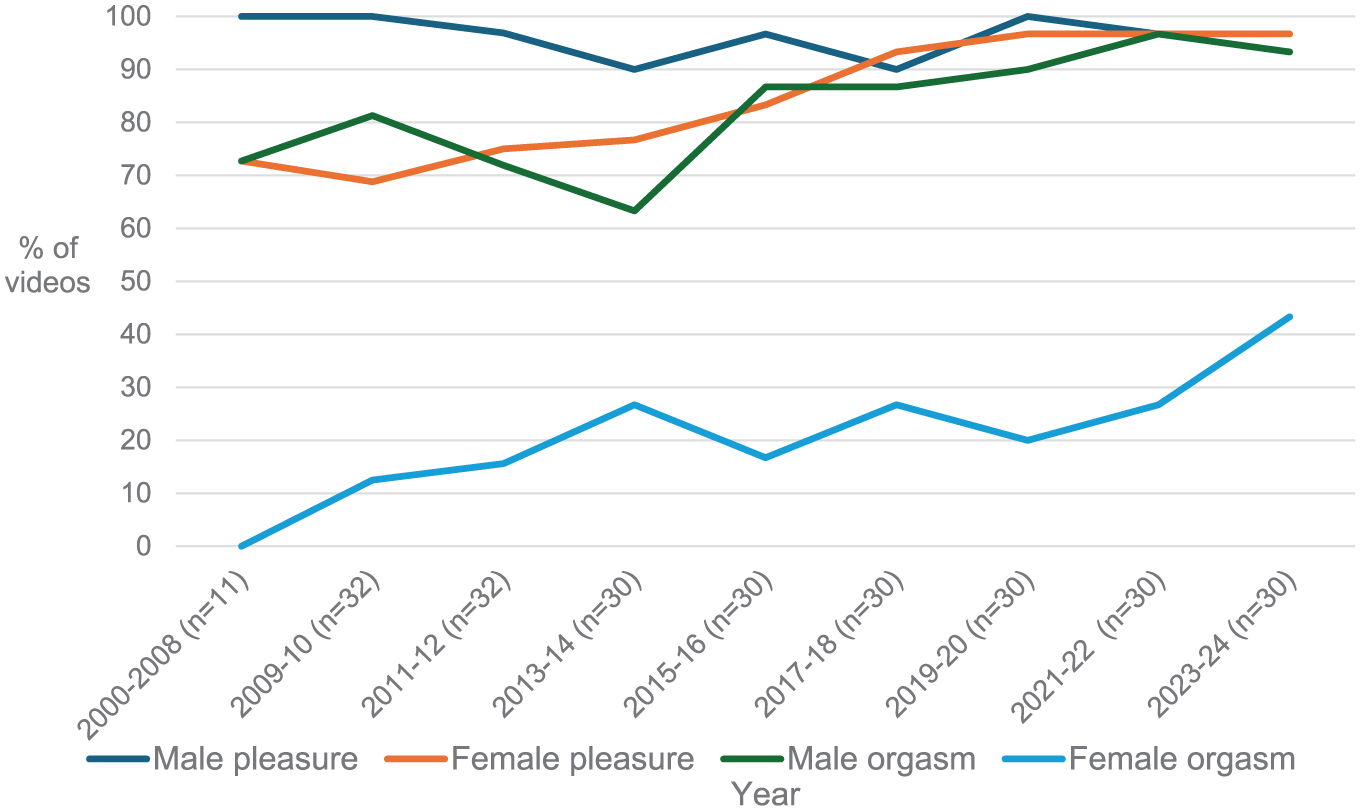
Temporal tendencies in pleasure displays (n = 255).
While the trends presented in Figure 1 are informative, their validity could be questioned. Detecting and coding displays of pleasure and climax is notoriously fraught with challenges. It can depend on the perceptions of coders, their cultural norms, and the way in which they interpret subtle cues. We therefore also coded complementary measures that examine clearly visible acts that are often associated with women’s pleasure and climax, primarily ones where the female clitoris was stimulated. In Figure 2, we present time trends in such acts. The figure shows three measures of direct clitoral stimulation (by a partner’s mouth or fingers or by the female performer herself), an overall measure for clitoral stimulation, and one measure of the sexual position, where the woman is on top, allowing her greater control of the movement and the potential ability to achieve clitoral stimulation. The figure shows that overall clitoral stimulation has increased throughout the years, growing from less than 70% of the videos in the 2000s to almost 90% of them in the 2020s (t = 2.55; p = 0.011). Interestingly, oral stimulation of the clitoris (cunnilingus) decreased from more than 40% of the videos in the 2000s to less than 30% of them in the early 2020s (t = −2.80; p = 0.005). However, other forms of clitoral stimulation increased significantly and more than compensated for the decline in oral stimulation. Manual (finger) clitoral stimulation by the partner increased from less than 40% of the videos in the 2000s to about 60% of the videos in the 2020s (t = 3.58; p < 0.001). And self-stimulation of the clitoris by the female performer herself (masturbation) increased from about 40% of the videos in the 2000s to nearly 70% of them in the 2020s (t = 2.75; p = 0.006). Finaly, the rate of videos including sexual positions where the female performer was on top also showed a moderate increase, from less than 60% of the videos in the 2000s to more than 70% of them in the 2020s, though this increase was only marginally significant (t = 1.73; p = 0.84).

Temporal tendencies in acts associated with female performers’ pleasure (n = 255).
Finally, in Figure 3, we present time trends in displays of affection. The figure shows that overall displays of affection by male performers grew from less than 70% of the videos in the 2000s to 90% of them in the 2020s, with an average yearly increase of about 8% (t = 2.16; p = 0.032). Examining specific affectionate practices, we found a significant positive trend for affectionate caressing of a female performer’s body (t = 1.97; p = 0.49), but not for kissing. Affection displays by female performers also increased over time. They were present in less than 20% of the videos in the 2000s but appeared in more than half of the sampled videos uploaded to the website in the 2020s (t = 3.55; p < 0.001). We also found a significant positive trend in men’s verbal affection. Verbal praise (“sweet talking”) appeared in less than 15% of the videos in the 2000s but its prevalence increased to more than 40% of the videos in the 2010s (t = 3.68; p < 0.001).

Temporal tendencies in displays of affection (n = 255).
Discussion and conclusion
This article examined the common notion that pornography focuses almost exclusively on men’s pleasure, while women’s emotions, pleasure, and sexual satisfaction are therefore ignored or trivialized. Our findings show that male pleasure was indeed somewhat more common than female pleasure in the overall sample. However, an analysis of time trends over the last two decades reveals a gradual narrowing of this gap, to the point where in videos uploaded to PornHub in the 2020s female performers’ pleasure has been portrayed just as often as male performers’ pleasure. While depictions of male orgasm have also steadily risen, depictions of female orgasms have seen an even larger increase, from being nearly non-existent in the 2000s to appearing in nearly half of the videos uploaded to PornHub over the last few years. Consistent with this trend, we also found a significant increase in the ratio of pornographic videos featuring the stimulation of the female clitoris by either the male partner or the female performer herself. Finally, both male and female affection displays have risen considerably over time, with verbal affection and caressing both showing significant positive trends.
It remains to be seen whether this trend toward greater representation of affection, female orgasms, and attention to female pleasure in pornography persists, further narrowing the orgasm gender gap in pornography. However, it is also important to remain cautious when interpreting this narrowing of the gap. While the male “money shot” as a signifier of male orgasm is clear, visible, and “camera friendly,” female orgasms take different forms and are often expressed more subtly. The visual representation of these various forms of climax is challenging for both pornographic producers and performers, often necessitating audible rather than visual cues, such as declarations of climax or exaggerated loud moaning or even screaming (Williams, 1989). Since these audible cues are easily feigned, they have become cliched and pornography viewers often mistrust them (Frith, 2015; Shor, 2023, 2024).
The results of our study join recent contributions to the sociology of positive emotions (Cieslik, 2015; shuster and Westbrook, 2024) and, more specifically, the sociology of fun and pleasure (Abrutyn, 2025; Fine and Corte, 2017; Jones, 2016, 2019, 2020). We move beyond approaches that treat pornographic displays of pleasure and viewers’ desire to consume these as problematic, misguided, or harmful (Dworkin, 1989; Fielder et al., 2014), in what McCormack and Wignall (2017) have termed “the Negative Effects Paradigm.” Instead, we treat pleasure and affection as desired and beneficial human emotions, with the potential to promote forms of sexuality that are safer and more egalitarian (Beasley, 2008).
At the same time, we also recognize the various nuances related to the portrayal of pleasure in pornographic videos and the myriad ways in which one may experience pleasure. Indeed, while pleasure in pornography is mostly represented in visual and auditory forms, one has to consider that pornography performers might experience pleasure from other aspects of their work, beyond the physical sensations experienced while participating in sexual acts. These may include the monetary compensation that some of them receive, the knowledge that they are objects of sexual desire, or the connections and social relationships they form with other performers (Simmel, 1949). These aspects correspond with the conceptualization of fun, as outlined by Fine and Corte (2017), and as such blur the distinction between the two, as both pleasure and fun can often be viewed as collective and interactive experiences rather than just personal sensations.
Our findings further suggest that increasingly, pleasure in pornography, or at least its representation, is actively sought after by both male and female performers. Rather than passively experiencing (or not experiencing) pleasure, female performers increasingly seek active pleasure through masturbation, greater control over sexual positions, and asking their partner to pleasure them. These findings are in line with Abrutyn’s (2025) theory of affective motivation, where active pleasure seeking and expectations to experience pleasure motivate in large part various human behaviors and endeavors. In this view, various pursuits have mixed motives, and the journey often matters just as much, if not more, than the destination (Simmel, 1919 [1911]). Viewed from this perspective, a narrow focus on visible or audible pleasure and climax displays might miss much of the phenomenology of performers’ pornographic experience. While performers certainly seek and are motivated by physical pleasure (Jones, 2020), they may also enjoy and feel satisfied by various other aspects and processes surrounding their work. These aspects could include the seeking of new experiences and the expectation to experience pleasure (Abrutyn, 2025), as well as the recognition that their performance and physical attributes are appreciated by others (be it other performers or the viewers of pornographic videos) and generate pleasure. They may also include building networks of meaningful connections with like-minded workers who do not pass judgment and stigmatize you (Griffith et al., 2012).
Our study further illustrates shuster and Westbrooke’s (2024) argument that the study of positive emotions, including pleasure, and the study of social inequalities are not antithetical. Instead, inequalities in representation of and access to pleasure can have significant implications on sexual scripts, real life practices, and gendered perceptions and ideologies about entitlement to experience pleasure, affection, and compassion. The findings also demonstrate that such inequalities are neither inevitable nor immutable, as they have shifted over time and could continue shifting with the adoption of new industry norms and further changes in social perceptions and values regarding pleasure.
One possible critique of our findings regarding pleasure, climax, and displays of pleasuring one’s partner is that these might merely reflect profit-driven industry demands. As such, the increase in pleasure and affection displays may simply be an act rather than reflecting a real rise in genuine pleasure, climax, and affection. While such critiques may be valid, they fail to consider an important aspect of mainstream pornography – its normative messaging. Both sexual script theory and media effects approaches (Galdi and Guizzo, 2021; Hesse and Pedersen, 2017; Simon and Gagnon, 1984; Ward et al., 2022; Wiederman, 2015) emphasize the importance of such messaging in shaping sexual norms, ideologies, and behaviors. That is, even if female performers are merely simulating pleasure and climax, while male performers are simulating affection, emotions, and tenderness, the normative messages communicated through these increasingly frequent displays are of consequence. These messages signal to viewers that displays of affection are fundamental to sexual acts and scripts and that women’s pleasure is a valued and important commodity; an integral part of the sexual act, which must not be ignored or neglected.
Study limitations and directions for future research
While our methodological approach focused on normative scripts and the frequency of their depictions, we acknowledge certain limitations in this approach, particularly related to its lack of sufficient context and nuance. For example, while the practice of kissing generally conveys affection, in certain videos it appeared to also (or primarily) be an act of dominance and submission. Our coding approach generally decontextualized behaviors from their broader narrative meaning, thus risking the reduction of complex interactions into simplified labels. As Fritz and Paul (2017: 649) note, content analyses often risk extracting “the text out of the context,” and our own shares this limitation. Indeed, behaviors do not exist in isolation; they are embedded within a network of cues—scene tone, intent, and surrounding actions—that shape their meaning. Failing to fully account for these contextual elements runs the risk of collapsing diverse expressions into a singular framework that may not reflect how individuals process and internalize these portrayals.
Future research on expressions of pleasure and affection may thus try to attend more carefully to these background dimensions, carefully observing and coding the setting and context in which acts such as kissing or cunnilingus are performed and how they might shape viewers’ interpretations and sexual scripts (McKee, 2015; Simon and Gagnon, 1986; Vera-Gray et al., 2021). Such an approach has the potential to provide a more nuanced and deeper understanding of changes in pornographic scripts, their content, and the ways they are likely to shape sexual scripts. Still, it is important to note that in our own sample, none of the videos contained instances of forced kisses or seemingly affectionate displays that were in fact merely displays of power and control (e.g., in the context of a rape fantasy). Thus, while we recognize the limitations of coding behaviors without accounting for their broader context and potential meaning for audiences, we remain confident that our results reflect a genuine trend toward increased prevalence of affectionate behaviors in mainstream pornography.
The simultaneous growth in expressions of affection and emotional warmth, as well as in female performers’ displays of pleasure and climax, may suggest that the mainstream pornographic industry is gradually shifting toward more mutual and egalitarian portrayals of sexuality and pleasure. These shifts suggest that mainstream pornography must be understood as an evolving medium, open and susceptible to transformations. Such an understanding challenges common claims by anti-pornography scholars who decry the industry’s essentialist and inherently misogynistic nature. However, it should be noted that the rise in female pleasure and climax and in affectionate displays documented in this article only applies to the “most watched” videos in PornHub, which are predominated by all-White heterosexual couplings. As many of the former critics of pornography have focused on these heterosexual videos, this increase in pleasure and affection displays in notable. Still, future research should examine whether the increase in female pleasure and climax displays documented for these most-watched videos is also present in videos depicting non-heterosexual couplings and in those featuring a wider representation of racial and ethnic minorities.
Future studies could also look more closely at the ways in which the proliferation of pleasure and affection displays and acts are experienced by pornography performers themselves. For example, interviews with performers can examine whether they experience greater satisfaction in their work or feel that gender relations have improved when their partners show greater affection or try to pleasure them. Alternatively, performers may feel that such acts increase pressures to perform pleasure and climax even when they do not actually experience them, thus increasing their need to engage in emotional labor. Future research can also examine the potential effects of the time trends found in our study on pornography viewers, how they interpret these displays, and the potential effects these may have on viewers’ attitudes and behaviors.
Footnotes

Ethical considerations
All interviewees for this study gave their informed consent for (confidential) inclusion before they participated in the study. The study was conducted in accordance with the Declaration of Helsinki, and the entire research protocol was approved by the McGill University Research Ethics Board (REB File #: 392-0219).
Funding
The authors received no financial support for the research, authorship, and/or publication of this article.
Declaration of conflicting interests
The authors declared no potential conflicts of interest with respect to the research, authorship, and/or publication of this article.