



Abstract
The concept of coupling—the relationship between the environment, administrative goals, and instructional practices of education organizations—is a staple in New Institutional research. Yet processes of coupling have remained elusive. Drawing on ethnographic research of the ‘‘Ontario Learning Center’’ (OLC) franchise, along with interviews of franchise owners and representatives, this article examines an ideal-type, tightly coupled organization. Despite the fact that the educational materials, the progress monitoring, and even the ‘‘emotional labor’’ of instruction are highly formalized and monitored, the author discovered evidence of loose coupling everywhere. Most strikingly, loose coupling is being accomplished in the context of rule following (rather than rule breaking) based on how managers and instructors interpret and prioritize available technical and institutional frameworks. By examining these processes, this article makes two contributions: First, it examines the symbolic dimensions of tightly coupled organizations by articulating how organizations and their actors reinterpret environmental demands in mutually beneficial ways. Second, this article situates the growing ‘‘inhabited institutions’’ literature within the new realities of education organizations, examining how meaning is actively constructed and how such processes generate understandings about appropriate lines of action.
Keywords
Almost four decades have passed since New Institutionalism popularized the image of education organizations as “loosely coupled” systems. This concept captures the relatively weak connection between the institutional environment and its instructional activities. In theory, loose coupling allows schools to integrate multiple and conflicting goals, while awarding them legitimacy and trust. The malleability of this concept, and its ability to explain the “structural looseness” among parts of schooling systems, has made it a staple in studies of education organizations (Bidwell 1965; Hallett 2010; Meyer and Rowan 1978; Scott and Meyer 1991; Weick 1976; for a general discussion, see Rowan 2006a).
Despite its centrality, processes of coupling—and more specifically, the relationship between the environment of schooling, instructional practices, and actors within educational settings—have remained elusive. As Spillane and Burch (2006) argue, most examinations view loose coupling as a “monolithic or unitary practice” that assumes that all day-to-day instructional practices are divorced from administrative structures and policies (see also Gamoran and Dreeben, 1986; Orton and Weick 1990). Differentiating elements between and within teaching and learning reveals that the environment is tightly coupled to some instructional practices and loosely coupled to others. Similarly, Coburn (2004) and Jennings (2010) each detail how messages from the environment filter into schools and how such messages are interpreted and reinterpreted through teachers’ or principals’ worldviews. In a recent article, Hallett (2010) illustrates how environmentally defined accountability regimes encouraged one school to recouple practices that were formerly loosely coupled, creating (in his participants’ words) “turmoil.” Broadly, this scholarship recognizes not only that education organizations face pressures emanating from the institutional and technical environments of schooling but also the value of situating participants within these analyses.
While most of this literature focuses on traditional public schools or other fully or semi-government-funded options (e.g., charter schools), this article considers coupling within a second context: What happens within education organizations that are already rationalized and that have practices designed, since inception, to be tightly coupled? How do instructors within these education organizations interpret and manage pressures emanating from the technical and institutional environment of schooling? And how do these interpretations affect the degree to which instructors loosely or tightly couple their day-to-day activities with administrative goals and instructional goals and practices? In light of the scholarship cited above—along with increasing accountability and market reforms in education, the emergence of the (largely private) school improvement industry, and the growth of various forms of private education—these questions are no longer far-fetched (see Davies, 2004; Meyer and Rowan 2006; Spillane, Parise, and Sherer 2011). Instead, questions such as these bring to life not only the realities of the schooling environment but also calls to “recouple” traditional schooling organizations (for examinations of recoupling, see Espeland 1998 and Hallett 2010).
To answer these questions, this article draws on a one-year ethnographic study of an education franchise, the “Ontario Learning Center” (OLC), and interviews with OLC owners and managers. These types of businesses are a growing presence in the expanding “school improvement industry” (see Rowan 2006b) and provide a strategic case study to examine the context of coupling in a novel setting. OLC offers a variety of education services, including tutoring, test preparation, preschool education, summer camps, and courses for high school credit. OLC also has recently opened a handful of private schools and has plans to open more. OLC has all the markers of a highly rationalized and tightly coupled education organization. As a private for-profit business, the technical environment looms large. Maintaining a brand identity, streamlining the distribution of goods and services, and ensuring customer satisfaction are all paramount. A central office creates and monitors educational materials, regulates training and instructor–student interactions, mandates regular testing of student performance, and sanctions noncompliance (Aurini and Davies 2004).
By examining patterns of tight and loose coupling within a for-profit education context, this article makes two contributions to the New Institutionalism scholarship. First, this article examines the symbolic dimensions of tightly coupled organizations. As I illustrate, we have overlooked how tightly coupled organizations may encourage highly interpretative processes for their members and how such processes generate departures from formal instructional practices and goals. I examine how this interpretative process inspires a variety of strategies, including the reprioritizing of organizational goals and the utilization of existing policies, in light of the incentive structure of OLC. These strategies are not the result of outright defiance or resistance to OLC policies but instead reflect how OLC and its instructors attempt to blend technical and institutional frameworks and cope with the multiple pressures emanating from a highly competitive and uncertain for-profit environment.
Second, this article situates the growing “inhabited” institution literature within the new realities of education organizations. This scholarship articulates the microfoundations of New Institutionalism and allows me to examine how instructors at OLC actively construct meanings within contextually bounded parameters and draw available cognitive frameworks to construct appropriate lines of action. This interpretive process shapes how actors manage and interpret institutional and technical scripts and resolve inconsistencies or conflicts (Johnson, Smith, and Codling 2000; Weick 1995). In short, this literature brings people back into New Institutional analyses (Binder 2007; Colyvas and DiMaggio 2006; DiMaggio 1988; Hallett and Ventresca 2006; Powell and Colyvas 2008). Through an in-depth qualitative study of the frontline actors embedded in this sector, this article contributes to our understandings of the microlevel processes by which actors interpret, elaborate, and revise the organizing principles that are available to them and how such principles are supported or constrained within a specific environmental context.
New Institutionalism and Education Organizations
Institutional and Technical Environments of Schooling Organizations
Earlier versions of New Institutionalism differentiate the institutional and technical environments of organizations. Building on Parsons (1960), this distinction captures how environments pose different demands on organizations and the rational responses that support their survival. Traditionally, there has been a division of labor between systems that are more loosely coupled or more tightly coupled. Seminal articles by Weick (1976) and Meyer and Rowan (1977, 1978) inspired the former thesis by acknowledging the nonrational, weakly coupled, and uncoordinated character of education organizations. These path-breaking articles detail how schools smooth over structural inconsistencies by complying in highly symbolic ways to macrocultural forces emanating from the environment. District, administrative, school, and classroom personnel are seen to operate with a high degree of independence, despite marshaling around a set of common teaching and learning goals. And while tightly coupled systems are theorized to operate with greater goal clarity amenable to inspection and outcome-based processes, in reality schools thrive by loose coupling and conforming to environmental expectations (Scott and Meyer 1991).
Theoretically, loose coupling provides sociologists of education a powerful analytical tool to explain the disparities between formal structure and classroom practices (Meyer and Rowan, 1978), the remarkable similarities between systems of education (DiMaggio and Powell 1983; Meyer 1977), and why reforms fail to produce fundamental structural changes (Binder 2001; Tyack and Cuban 1995). Researchers continue to build on this scholarship, examining a variety of topics including accountability schemes (Hallett 2010), sense-making processes (e.g., Coburn 2004; Jennings 2010), school shootings (Fox and Harding 2005), and the worldwide institutionalization of schooling (e.g., Schofer and Meyer 2005). These analyses advance the conceptual machinery of environments and coupling.
In recent years, the image of schools as loosely coupled has been questioned. Specifically, sociologists of education have called for greater sensitivity to the loose- and tight-coupled features of education systems (e.g., Coburn 2004; DiMaggio and Powell 1991; Spillane and Burch 2006; Spillane at al. 2011). Revisiting some of the limitations noted by Weick (1976), sociologists have started to reconceptualize teaching and learning as a highly differentiated and “multidimensional activity” (Spillane and Burch 2006:89; see also Gamoran and Dreeben 1986). This research distinguishes the specific subject areas and instructional activities that are more or less loosely coupled and tightly coupled to the technical core of schools (e.g., Spillane and Burch 2006) and how coupling processes are understood and engaged by participants (e.g., Coburn 2004; Hallett 2010; Jennings 2010; Spillane et al. 2011).
In the sociology of education, two major developments bring this theoretical point into sharp relief (see Meyer and Rowan 2006:2). First, the technical environment is growing stronger. In recent decades, the K-12 education sector has faced escalating accountability mechanisms such as standardized tests and codified benchmarks. Second, the organizational field of education is becoming more diverse. Traditional public schools now compete for students with a growing array of alternatives such as charter schools, magnet schools, and private schools (e.g., Fuller 2000). Alongside this growth, others have documented what Rowan (2006b) coined the “school improvement industry.” This industry includes the learning centers described in this article, along with corporate training ventures, education coaches, evaluation and testing services, and textbook companies that sell goods and services either to public schools (e.g., professional development services) or to their clients (e.g., tutoring, academic coaching; Kirp 2003; McDonough 1994; Rowan 2006b).
Bringing People Back In: Coupling and the Inhabited Institutions Approach
Part of the advancement to the New Institutionalism and coupling scholarship has been inspired by DiMaggio and Powell’s (1991:16) observation that “there has been little effort to make neoinstitutionalism’s microfoundations explicit” (for recent discussions, see Colyvas and Powell 2006 and Powell and Colyvas 2008). Previous scholarship emphasized the adoption of institutionalized templates, albeit sometimes unevenly, by legitimacy-seeking organizations. These applications of New Institutionalism tend to favor statements about how institutions are “infused with value” and how rules take on a “life of their own” (DiMaggio 1988). Individuals are often entirely absent or treated as “cultural dopes” (Garfinkel 1967:68-75). As Powell and Colyvas (2008:4) argue, this literature typically examines how actors save face, “negotiate”, or “enact” rather than how they “choose, plan or determine”.
Heeding these criticisms, there have been several theoretical advances in the field that correct New Institutionalism’s “macro-evolutionary drift” (Hallett 2010:56). Building on the “cultural-cognitive” pillar of New Institutionalism, this literature promotes examinations of the “socio-cognitive” dimensions of organizations (McKinley, Zhao, and Rust 2000), “organizations as interpretive systems” (Daft and Weick 1984), “script development” (Johnson et al. 2000), and “sense-making” in organizations (Weick 1995). This line of theorizing is sensitive to the “cognitive complexities” (Jennings and Greenwood 2003) that ultimately guide behavior and recognizes the varied ways that institutionalized practices operate at the micro-level (Powell and Colyvas 2008). It argues that while organizations may operate under a similar set of environmental pressures (e.g., weak economy), responses are always nested in perceptions of the past and in the range of future actions that are believed to be possible. These cognitive frameworks guide microlevel responses and may account for the multiple ways actors come to interpret and respond to pressures emanating from the environment. Thus, while prevailing institutionalized scripts may appear objective, they are always filtered through the unique repertoires and schemas of individual organizations and their members (see Berger and Luckmann 1966). Not only do these accounts draw on established concepts in microlevel sociology, but they also explain variations and new lines of action; they are the basis of many New Institutionalism critiques (e.g., Cummings 2003).
While invigorating the microcultural dimensions of New Institutionalism, much of this literature has been heavily theoretical, providing critiques, typologies, and concepts (e.g., Daft and Weick 1984; Johnson et al. 2000; Fligstein 1997). Empirical research only recently has made attempts to “inhabit” institutions by grounding analysis within the dynamic exchange between environments, organizations, and participants. Research by Creed, Scully, and Austin (2002), Hallett and Ventresca (2006), and Binder (2007) and the scholarship noted above (e.g., Coburn 2004; Hallett 2010; Jennings 2010) have used case studies to demonstrate how “organizations are not merely the instantiation of environmental, institutional logics ‘out there,’. . . but are places where people and groups make sense of, and interpret, institutional vocabularies of motive” (Binder 2007:547). By embedding agency within local contexts (Creed et al. 2002:475), this article builds on this scholarship and examines how actors within the private education sector actively construct meaning within a specific organizational context and how such constructions affect patterns of loose and tight coupling.
Case Study: Background and Methods
To document how patterns of coupling are actively constructed, I draw on an ethnographic study of the OLC and interviews with learning center owners or managers in Toronto, Ontario. Located in a leafy suburb outside of Toronto, the site of my ethnographic research is situated between two affluent and highly educated neighborhoods (Environics Analytics 2011; Ontario Ministry of Education 2011). 1 OLC purposefully keeps its franchises small and neighborhood based and on average enrolls no more than 100 students per month. As a result, OLC franchises pull clients from the immediate community.
In contrast to “mom-and-pop” tutoring businesses, learning centers are sophisticated education franchises that produce their own curricula, educational booklets, and training and testing protocols. OLC has almost 100 locations across Canada and abroad and offers a variety of education services under one roof, including tutoring, test preparation, preschool reading, full-day summer programs, and in some cases, courses for high school credit. Similar to its competitors, OLC charges approximately $300 per month for eight hours of tutoring. OLC has also opened a handful of private schools that draw on its educational philosophy and materials, and it has plans to open several more. 2
To select a sample of potential businesses, I turned to the Yellow Pages (Toronto East and West directories). The “tutoring” and “supplementary education” listings served as the basis for potential interviews and my subsequent field research site. Since most major franchises have detailed Web sites, I also reviewed available online materials. Given the level of involvement required to conduct ethnographic work, the site selection was largely a function of geographic proximity and access to the specific learning center location. However, since organizational practices vary much more between franchise brands (e.g., between Franchise A and Franchise B) rather than within (e.g., between two franchise locations of the same brand), my ethnographic site reasonably captures how other OLC locations function.
Field research started May 2001 and ended May 2002. 3 During my tenure at OLC, I taught, twice a week, at least three one-hour sessions during after-school hours (the equivalent of more than 300 hours of instruction time), including direct instruction of one to three students. I was assigned the same students each week, although substitutions were sometimes made if a child did not show up for his or her scheduled time slot. In addition to my initial training, I participated in six staff meetings and four workshops that were held during the year. Most days, I spent additional time at OLC before and after my instructional hours with the goal of informally interacting with OLC’s instructors and the two full-time managers (Emerson, Fretz and Shaw 1995; Appendix A).
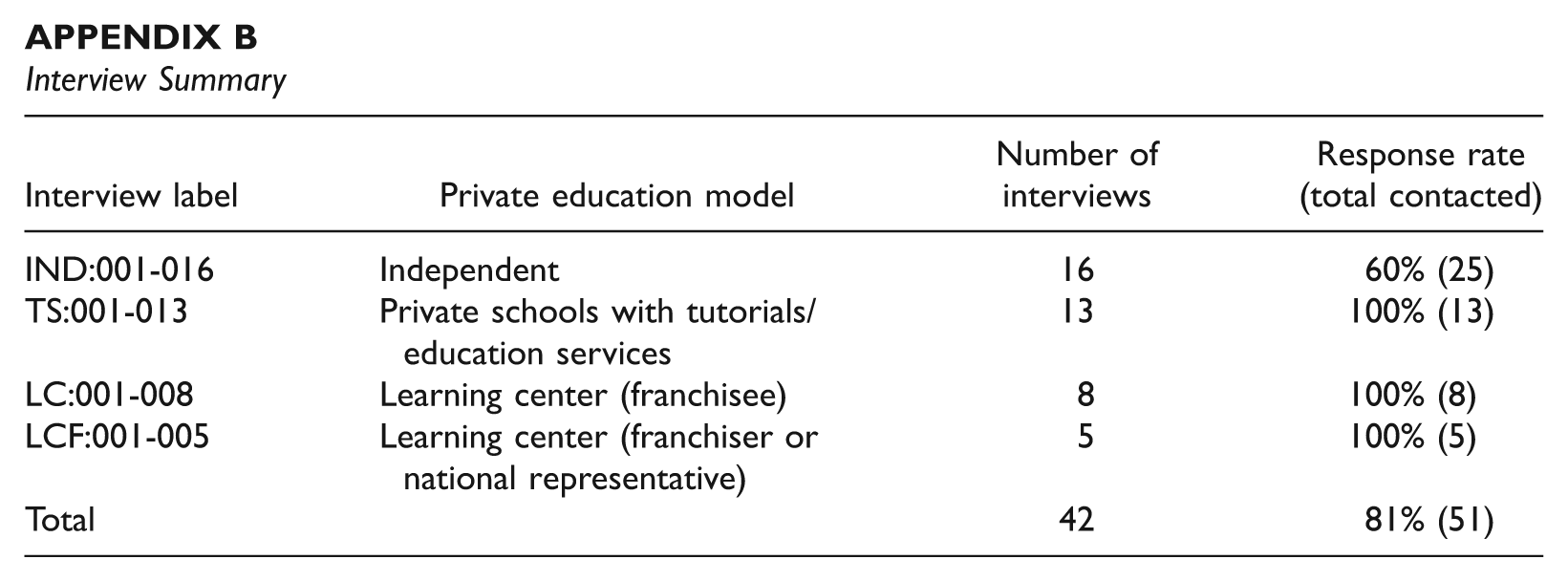
The interview portion of the project includes meetings I held with the owners or national representatives of five major learning center brands, including the founding owner of OLC. Eight interviews were conducted with franchisees from each brand, including two OLC franchise owners. I also interviewed the remaining 29 tutoring businesses listed in the Yellow Pages (Appendix B). Interviews were digitally recorded and later transcribed with the permission of the interviewees. Interviews, typically lasting 90 to 120 minutes, were held either at the head office or at one of the corporate locations. All names and identifiable information have been altered to protect the confidentiality of the participants. Data analysis of field notes and interview data was accomplished using QSR NU*DIST, a software program that assists in the organization and systematization of qualitative data (for a review, see Dohan and Sanchez-Jankowski 1998). By drawing on multiple sources of data, I simultaneously cross-checked my interviewee data while conducting fieldwork, and I used interviewees to verify my initial interpretations (see Appendix A). This approach allows me to account for convergences and divergences that I may have missed if I had relied on only one source of qualitative data (Huberman and Miles 2002; Ragin 1987; for further information, refer to the journal’s Web site at http://soe.sagepub.com/).
The Anatomy of an Ideal-type Tightly Coupled Education Organization
On the surface, OLC exemplifies an ideal-type tightly coupled organization. As a franchise corporation, the business has a patented “OLC Method” that has been rationalized by the head office. While OLC concedes much of the daily operation to local owners, franchisees are provided with a template for delivering the service, and they must purchase certain products supplied by the franchiser. As a result, OLC franchises are more standardized than independent small businesses since OLC’s reputation is at stake at all local outlets. A franchisee, who also developed a comprehensive private school in partnership with OLC, explained how these rules operate (TS:005): “They’re still very strict in running the program. It has to match the franchise’s philosophy, and it has to match that standard of quality control. . . . ‘This is the rule, this is what you have to do.’”
“Quality control” includes unifying and regulating the physical space, materials, student placement, and teaching protocols across sites. Most OLCs are approximately 1,000 square feet and efficiently divided into four rooms: waiting room, instructional area, manager office, and a small washroom. The instructional room houses patented C-shaped OLC desks that seat one instructor and three students. The room is painted in OLC’s signature color and decorated with classic alphabet and inspirational posters (e.g., a cat hanging off a tree, telling students to “Hang in There”). The perimeter of the room is lined with computers and bookshelves containing students’ baskets for their workbooks and other supporting materials. The design of the space maintains a look and feel across locations that is immediately identified with OLC.
Beyond the physical space, the standardization and control over student placement, education materials, and instructional methods are the most distinctive features of a learning center franchise. OLC has developed a highly prescriptive diagnostic test that managers are required to administer to students before enrolling them. Once assessed, the manager uses the test results to assign students to one of the literacy or numeracy programs, along with workbooks, lessons, and an instructor. The manager is required to reassess each student’s progress every 12th tutoring session and hold a parent–manager meeting to discuss the results. This assessment typically consists of a progress review, the instructor’s nightly feedback, and a review of the student’s workbooks. In consultation with the parents, managers use this information to guide future program decisions, including whether the student should advance to a different program or program level. 4 All of this information, including the diagnostic tests, notes from parent–manager meetings, and feedback from instructors, is used to craft a formal report that is then submitted to the head office for review by curriculum specialists and regional managers. This report not only aids in the development of new programs but also ensures that OLC procedures are being followed.
The use of OLC’s educational materials and instructional methods is tightly controlled and regulated by central administrators. While traditional tutors routinely use students’ school materials, OLC instructors do not allow students to review their school work or use their school textbooks. As one franchiser explained, OLC programs “don’t do that.” He explained that learning centers such as OLC are “more universal” and do not “tailor everything by province or by school board” (LCF:003). Instead, OLC stresses the value of using its “skill-building” materials, which include generic numeracy and literacy programs that are not tied to a particular school district or timetable (Aurini and Davies 2004). This emphasis on centralized educational materials allows OLC to produce a unique set of instructor manuals, workbooks, readers, texts containing literacy and numeracy exercises, and other supporting materials. During the workshops and training sessions I attended, a great deal of time was devoted to detailing the mechanisms of each workbook and program and how they should be “properly” used. Managers continually review the implementation of these materials, and attention is paid to even the smallest detail, such as dating each page of work. Instructors are also expected to record the progress of each student in a communication binder, including details of work completed and any notable successes or difficulties encountered during the session. Not only is this regulation of standardized nonverbal and verbal protocols seen to promote positive interactions between instructors and students, but it is also believed to create continuity of service between instructors and between locations.
Making Room in Tightly Coupled Spaces: Compromises, Noncognitive Goals, and Symbolic Coupling Rituals 5
Despite the high degree of formalization and oversight, evidence of loose coupling in OLC is everywhere. Ceremonial compliance (creating the illusion of conformity) and buffering (protecting the technical core of the organization) are routine events, and OLC instructors made concessions on a regular basis during my tenure. Over the yearlong observation, what became apparent is that these compromises are entirely consistent with OLC policy and instructional protocols. In fact, OLC conspires in the active construction of loose coupling by privileging customer satisfaction and institutionalizing protocols that potentially detract from more tangible instructional goals.
The art of compromising
While loosely coupled organizations provide participants with ample “wiggle room,” tightly coupled organizations are theorized to minimize conflict, uncertainty, and individual discretion by codifying and monitoring formal processes (Meyer and Rowan 1977; Weick 1976). Yet the high degree of formalization did not minimize conflict that spontaneously arose in the context of instruction and the resulting necessity of redefining the meaning of a “successful” instructional session. Sometimes students were “just being kids, giggling and goofing off.” Some students were rude and disruptive, defiantly shoving workbooks across the desk and forcefully telling instructors, “You can’t make me do anything.” A number of students tried to rattle instructors by asking personal or embarrassing questions such as “Do you have a boyfriend?” or “How much do you weigh?” More seriously, a handful of students periodically became physically aggressive, including throwing small objects (e.g., erasers, books) and, in rare instances, larger items such as chairs or readers. While instructors are not permitted to fundamentally change the content of the literacy or numeracy programs, they frequently made compromises that, by extension, reinterpreted instructional goals in order to handle these disruptions. In training sessions and informal conversations, my colleagues routinely complained about difficulties of getting students to “stay on task.” Once strategies such as appeals to common sense (e.g., “If we finish this page today, we won’t have to do it next time”), humor, and even small bribes (e.g., chocolate bars) failed, we routinely allowed students to work on another OLC booklet, draw, read a book, or play a short computer game.
For most students, these strategies (and subsequent departures from the programs) were used only sporadically—but each instructor (including myself) had one or two students who, according to a more vocal colleague, were a “total freak show, a complete nightmare.” Of my own students, for example, one of the more challenging was “Kim.” One evening my lesson with her quickly unraveled, as it had so many times before during our working relationship. Our session had begun with a review of her school agenda, a type of day planner used in most public schools in Ontario. Kim had an upcoming spelling test, and I attempted to discuss how she would use OLC instructional techniques to study for the test (OLC has a patented set of study guidelines that includes teaching students the importance of understanding the parameters of the task and learning how to ask questions that will allow them to complete it successfully). Kim, a veteran OLC client, was well versed in this technique. She knew a spelling test was imminent, but she did not know the test date or the materials that were going to be covered. Students who struggle in school, like Kim, often lack the tools for finding out basic information about their assignments and tests and have weak test preparation skills. Using the OLC technique, I first probed her about how she could find out more information about the test. Repeatedly, Kim told me, “I don’t know” and accompanied her responses with eye rolling, sticking her tongue out, or crossing her arms and smiling sarcastically. I ignored her and turned my attention to how she could use the OLC study approach (which includes reading each word, covering it, and spelling it out loud) to prepare for the spelling test. Kim claimed she had “never heard of it” and did not know how to use it. When I (re)explained the technique, she shrugged her shoulders and began to doodle on her workbook, her head firmly planted on the desk.
Rather than escalating the conversation, I presented a short reading comprehension assignment that I knew she tolerated but that was out of sequence with the prescribed tasks for the evening. While I had technically presented the OLC study technique, and was able to document this attempt in my communication binder, I had failed to meaningfully guide Kim through the process of finding out more information about the test. In my field notes, however, I wrote that “thankfully” she “got at least something done” without disrupting my two other students. Despite taking 45 minutes to complete a short assignment that was beyond the scope of the most immediate task scheduled for the evening, my session with Kim was a success.
Regulating emotional labor within the context of noncognitive goals
Despite the high degree of regulation surrounding the materials and instructional practices, OLC also emphasizes noncognitive goals. This emphasis is embedded not only in OLC’s promotional materials but also in the training it provides its instructors. While part of this training is aimed at crafting consistent instructional practices, it also includes prescribing student–instructor interactions. As an instructor, I was expected to learn verbal and nonverbal protocols for interacting with students. These techniques include a variety of statements to reinforce positive behavior and the use of body language. “Focusing on the positive” was a central theme that emerged throughout the training sessions I attended, and we practiced techniques for attracting students’ attention away from rude or disruptive behaviors. These techniques include using “welcoming” body language such as “nodding in an encouraging fashion,” maintaining eye contact, smiling, and keeping arms open and outstretched. We also developed a toolkit of “appropriate” encouraging phrases that aligned with OLC’s philosophy of instruction.
To master the OLC method of instructor–student interactions, short vignettes were presented to the instructors in which we were to take turns playing the student and instructor roles. The skits included a student who refused to do his or her work, a student who became frustrated, and a student who had difficulty concentrating because of a personal situation at home or school. After each instructor’s turn, the audience (made up of fellow instructors and the managers) would critique how the instructor responded to the student. As audience members, we were expected to give suggestions as to how the instructor could have more effectively responded or how he or she might have further bolstered the student’s confidence. Compromising, discussed above, was in many ways an extension of OLC’s “focus on the positive” mantra. And, like compromising, focusing on the positive often came at the expense of more tangible instructional goals. Despite this, instructors are expected to respond in an encouraging and supportive manner, praise even the smallest victories, and avoid conflict with students in an effort to build their confidence and maintain a high level of engagement and enjoyment of the program.
The creation of symbolic coupling mechanisms
At the organizational level, evidence of loose coupling is crystallized in the formalization of symbolic coupling mechanisms. OLC and its competitors do not offer their clients guarantees but rather build in other forms of accountability. Pointing to their patented diagnostic tests, most franchise representatives admit that clients are promised that their children will increase a level in their program. Franchises also use advertising and catchy slogans such as “improved grades, improved confidence” to “suggest . . . that you get better grades and higher competency” (LCF:004). An emphasis on improving “confidence,” “self-esteem,” and “love of learning” is symbolically connected to learning outcomes rather than to more observable measures such as raised test scores and grades.
Beyond advertising slogans, OLC actively developed the connection between self-esteem and improved academic performance when it institutionalized the “Ontario Moment” (Aurini 2006). During the last five minutes of every session, students take turns explaining what they had just accomplished (e.g., “I worked on the reading comprehension book”) and how this, in turn, will help them in school (e.g., “It will help me understand the main idea of a story, and I’ll do better on reading comprehension tests”). OLC emphasizes that the Ontario Moment boosts students’ self-esteem and provides them with an opportunity to reflect on their accomplishments. Instructors often have to coach students through this process, reminding them of the books or exercises they had worked on that evening and helping them connect that activity to a tangible outcome. Symbolic coupling rituals, such the Ontario Moment, serve as evidence that the session yielded tangible learning outcomes. Alongside the diagnostic testing, patented educational materials, communication binders, and efforts to build positive instructor–student interactions, the Ontario Moment contributes to OLC’s image as an effective and happy place for children to learn.
What is striking is that loose coupling is accomplished in the context of rule following, rather than rule breaking, based on how managers and instructors interpret and prioritize available technical and institutional frameworks. Some forms (e.g., compromises) appear to organically emerge in the context of instructor–student interactions, while others (such as the Ontario Moment) are formally institutionalized. Below, I discuss how managers and instructors marry technical and institutional logics in highly compatible and mutually beneficial ways.
Marrying Technical and Institutional Logics 6
On the surface, OLC is superbly positioned to appeal to the growing technical environment of education. As I presented above, tight control over student placement, educational materials, and instructional practices are seen to generate numerous benefits for OLC and their customers. By developing unique educational materials, OLC is able to efficiently and profitably create a mass education product that is readily monitored from its central office. Formal policy also regulates the emotional labor of teaching, scripting the minute details of “acceptable” instructor–student interactions. These organizational features, coupled with OLC’s market position, project an image of order and transparency by aligning closely with the culture of accountability and supporting private solutions to various individual or social problems (e.g., Belfield and Levin 2002; Chubb and Moe 1990; Henig 1994).
However, OLC also draws on—and benefits from—the institutional environment. By design, the central focus on its product (education) and clientele (children) allows OLC to tangibly relate to the institutional environments of schooling and childhood. By offering numeracy, literacy, and preschool programs, OLC relates directly not only to formal schooling processes but also to an increased emphasis on “stimulating” young children’s growing minds (Quirke 2006; Wrigley 1989). As a business that caters to children from mostly middle-class families, OLC is also wedded to the logic of “intensive parenting” (Lareau 2011). Borrowing therapeutic language, this emphasis on “nurturing children’s inner essences and catering to their individual needs” has permeated the institutional field of education and child rearing for several years (Stevens 2001:183).
Common terms that emerged during interviews with OLC and its competitors were the importance of “boosting children’s self-esteem and confidence,” “meeting the needs of diverse learners,” “respecting children’s individuality,” and “nurturing children’s love of learning.” An excerpt from an Oxford Learning Centre (2010) Web site captures these emphases by stressing the importance of higher self-esteem and learning how to “think.” “Better grades,” rooted in the technical environment, is just part of contributing to children’s “life-long” emotional and cognitive toolkit:
Life-long tools like high self-esteem, an active, agile mind, and an understanding of how to study, learn and think. Only Oxford Learning puts all these outcomes within your child’s reach—along with better grades—with our cognitive approach to learning, where we focus on helping children learn how to learn.
Like its competitors, OLC does not simply play lip service to institutional logics but actively embeds them in formal policy. Protocols to rationalize positive instructor–student interactions, while marking a concerted effort to create “continuity of service” between instructors and between locations, also speak to the institutional environment of schooling. Compromises, conflict avoidance, and celebrating small and often inconsequential victories are part of this broader emphasis on building children’s love of learning and self-confidence. The interaction with Kim described above typifies the importance placed on “positive” student–teacher interactions. Practices such as the Ontario Moment are similarly positioned as self-esteem boosters by providing students with the opportunity to reflect on their accomplishments. 7
Embedding institutional logics within technical environments
The utility of institutional logics went beyond merely appealing to parental desires or boosting children’s confidence for marketing or altruistic reasons. Despite the optimistic growth OLC and its competitors have experienced in recent years, a looming sense of financial vulnerability permeated my discussions with learning center owners and managers and seeped into the fundamental core of OLC instructional and training policies. As a for-profit business operating in a highly competitive environment, OLC survives solely by maintaining and building a strong customer base. Consumers can enter and exit their services easily, on a weekly or monthly basis, and learning centers such as OLC do not benefit from truancy laws or catchment areas that would provide them an audience for their services. The for-profit private business model is further complicated by transforming parents and students into bona fide clients. These conditions made my interviewees sensitive to the imperative of maintaining a strong customer base, along with high levels of parental satisfaction and children’s enjoyment of the program. As one franchisee explained (LC:006): “They [children] are customers, and we treat them like customers.”
OLC managers and their instructors have a deep understanding of the complicated marriage between the technical and institutional environments of education and childhood. For OLC employees, these logics serve a larger purpose—the survival of OLC and their livelihoods—and directly inform how they talk about and manage OLC policies and instructional protocols. When using techniques such as compromising, managers and instructors are not simply avoiding instructional goals but rather privileging another, more immediate technical imperative: the maintenance of positive customer relationships. As my manager explained, “If the kids are happy and like coming here, then their parents will sign them up again for another month” (Aurini 2006). Student happiness in these terms not only serviced the institutional logic of children’s happiness or self-esteem but also was justified as a technical imperative that encouraged the very type of customer relationships necessary for continual enrollment.
In this context, conflict avoidance methods such as compromising and allowing a student to play a computer game during the session no longer are seen as a breach of instructional goals but rather are viewed as a way to secure continual enrollment at OLC. Allowing Kim to work on a different task is a clear example of how I, along with my fellow instructors, understood and actively reprioritized technical imperatives using institutional logics. During informal discussion, we frequently joked about “saving” a session by allowing students to read a book, play a computer game, or work on a different task (as I had done in the example above). While saving the session and maintaining order, compromising represented at best a minor detour—and at worst, an abdication of the evening’s main instructional goals. Nevertheless, the harmony of the session was restored; Kim left the session in a good mood, having completed “something”; and I was able to document her progress in my communication binder.
The Ontario Moment was also reinterpreted within the logic of organizational survival. Beyond its theorized therapeutic benefits, this ritual speaks to the technical core of OLC by signaling accountability and effectiveness to parents by seemingly coupling the OLC program with a tangible academic outcome, regardless of what actually transpired during the session. My experience one evening with “Peter,” a new Grade 3 student at OLC, was typical. Five minutes before the hour a bell rang and I told my students that it was the “Ontario Moment time.” I asked Peter, “What did you work on today, and how do you think it will help you in school?” Shrugging his shoulders, Peter told me, “I dunno.”
“We worked on the Reading Comprehension book. You read me a story and answered all of the questions about the story correctly.” “Yeah!” Raising his head, Peter interrupted me and turned excitedly to his desk mates. “My mom said we can order pizza after soccer tonight. . . . ” “Peter, please let’s finish the Ontario Moment. What did we talk about earlier? About how the reading comprehension booklet will help you in school?” “Uhmmm, so I know what the story is about? And then I’ll understand what I read in school and will be able to do better on my schoolwork, because my teacher, she likes stories, and we have to write about the stories.”
During a training session at the OLC, a manager emphasized the importance of getting the Ontario Moment, in her words, “right.” After a parent has spent $300 or $400 (per month) at OLC, they want some reassurance that the session has been productive. Administered right before students leave the center, the Ontario Moment provides some measure of hope that students are “able to tell parents, ‘. . . right off the bat, I worked on fractions, I worked on the main idea in my reading book, and it will help me do better in school in such-and-such way. . . .’” (Aurini 2006:102). Instructors at OLC understand the delicate balance of following the OLC Method while meeting demands to maintain a strong customer base in the absence of guaranteed funding or enrollments. Making concessions during the session, offering over-the-top praise for even the smallest accomplishments, and following OLC’s prescription for coupling instruction with some tangible outcome are part of this balancing act.
Discussion
The tight-coupling thesis—that organizations in technical environments reduce uncertainty and individual discretion by formalizing and monitoring processes—has served as the alter ego of loose-coupling research on schooling organizations for decades. This article demonstrates that this image needs to be altered. Building on the mounting acknowledgment of the technical environment of schooling, this study provides empirical evidence that even within the confines of tightly coupled education organizations, participants actively re-create technical and institutional imperatives and align them with their understandings of an organization’s central purpose and goals. These opportunities were present because OLC’s policies (despite its high degree of regulation and oversight) provide instructors with the flexibility to maneuver within the program, while avoiding confrontations or other challenges that arise within the context of teaching. In fact, despite the presence of standardized protocols and a high degree of oversight, the management of these priorities generated tight coupling of some rules and also looser coupling of others.
The empirical scope of this article is limited to the for-profit education industry and to one type of supplementary education business. While these limitations affect the potential generalizability of this study, these data have implications for how we theorize the emergent nature of education organizations and the meaning-making processes of their participants. Meyer and Rowan (2006:2) have noted these changes, including an “increased demand for accountability, and a heightened concern with educational productivity.” This shift, coupled with the entry of new forms of education, including charter schools, coaching services, test prep companies, and homeschooling, contribute to a new environment of K-12 schooling that has eclipsed the theoretical limits of the loosely coupled classroom. As the environment of schooling becomes more rationalized and diverse, learning centers such as OLC provide a novel vehicle to examine how environments interact in mutually beneficial and transformative ways.
Oliver’s (1991) article started this dialogue by developing a typology of organizational responses to institutional pressures. Strategies include not only acquiescing to environmental pressures (or mimetic isomorphism) but also compromise, avoidance, defiance, and manipulation. This article suggests that we need to push this logic further. If institutional and technical environments are mutually interactive (e.g., Coburn 2004) and if all organizations exhibit degrees of tight coupling and loose coupling (e.g., Spillane and Burch 2006), then this case study illustrates that when participants have access to a fuller menu of options, they can couple, reprioritize, and discard them in an effort to strengthen (as in this case) or undermine (as in Hallett’s 2010 case study) technical or institutional imperatives and the very survival of the organization or individuals within. In this case study, managers and instructors actively loosely coupled instructional practices from instructional goals, but they did so within the parameters of OLC’s larger and (what they understood to be) more immediate technical imperative.
We have the conceptual tools to theorize a loosely coupled education organization that enjoys a stable revenue stream and clientele, high levels of parental confidence, and professional norms that support teachers’ autonomy within classrooms. In the 1970s, public schools fit this image. We also have frameworks for conceptualizing a tightly coupled education organization that operates in a highly competitive marketplace, that has a clear mission, and that offers courses that are amenable to some type of performance indicator (e.g., LSAT preparation). The changing environmental and organizational landscape of education is far messier. For New Institutionalists, these changes generate questions about how educational forms relate to one another, how the tight- and loose-coupling configurations operate within organizations, and how those arrangements intersect with specific organizational features (e.g., franchising, charter schools, voucher programs) and larger macroenvironmental forces (e.g., competition, parental demand, state testing regimes; see Spillane and Burch, 2006; Rowan 2006a). Learning centers illuminate similar processes in other sectors that constitute the changing landscape of education.
Finally, this article highlights the utility of the “inhabited institution” approach by examining the meaning-making processes within more technically oriented education organizations and provides empirical evidence of the linkages between micro- and macrolevel processes that generate new understandings and novel lines of action. While others have shown how individual biography (e.g., Coburn 2004) and resistance (e.g., Hallett 2010) can alter technical imperatives, this article suggests a third possibility. At OLC, diagnostic tests are administered in a timely fashion, the OLC materials are used and implemented properly, and instructor–student interaction rules are followed. OLC prides itself on its carefully crafted educational products and attention to customer service. At the head office, the CEO and founder detailed the extensive research and development of the educational materials, the OLC Method of instruction, and even the name of the franchise. Sitting in his boardroom, there was no question that he demanded excellence from his franchisees and expected them to “buy into” the OLC Method—a method he believed helped children overcome learning challenges. Since the reputation of the entire franchise operation is at stake at each outlet, potential franchisees must demonstrate that they have not only the education and business experience to run a successful franchise but cognitive alignment with the OLC Method.
Yet, procedural and cognitive alignment with the OLC Method does not guarantee tight coupling, and it left room for managers and instructors to interpret and reprioritize the “official” version of the OLC Method. If the franchise had a reliable revenue stream and clientele base, then deviations to the programs may have been interpreted differently. Allowing a student to play a computer game during the session may be seen not as a way to “save the session” and restore positive instructor–student relationships but instead as a gross violation of organizational goals. Within a for-profit context, however, enrollment may be privileged since it better serves the economic fitness of the franchise.
More generally, by “inhabiting institutions” this article contributes to the literature that analyzes “what people do, how they do it, and why they do it, while simultaneously attending to the . . . system that enable and constrain that activity” (Spillane and Burch 2006:97). In so doing, this article extends New Institutionalism by demonstrating how these actions—compromises, prioritizing, organizational goals, and reinterpreting OLC policies—are redrawn in the context of rule following (rather than rule breaking) based on managers’ and instructors’ interpretations of the OLC Method and the need to maintain a strong customer base. Formal policies and scripts are not simply taken for granted but rather provide the raw material by which processes of loose and tight coupling are actively constructed.
Footnotes
Appendix
Interview Summary
| Interview label | Private education model | Number of interviews | Response rate (total contacted) |
|---|---|---|---|
| IND:001-016 | Independent | 16 | 60% (25) |
| TS:001-013 | Private schools with tutorials/education services | 13 | 100% (13) |
| LC:001-008 | Learning center (franchisee) | 8 | 100% (8) |
| LCF:001-005 | Learning center (franchiser or national representative) | 5 | 100% (5) |
| Total | 42 | 81% (51) |
Acknowledgements
The author would like to thank Scott Davies, Tim Hallett, Judith Pace and the anonymous reviewers for their helpful comments and suggestions.
Funding
This research was funded by a SSHRC Doctoral Fellowship from the Social Science and Humanities Research Council of Canada.