



Abstract
In the decades following World War II, a significant expansion of community colleges occurred throughout the United States. As the baby boom generation came of age, demand for higher education spiked, and policy makers allocated the requisite funding to expand institutions of higher education. This expansion, including vigorous funding from federal, state, and local units of government, was politically popular. This openhanded support ended in the latter decades of the twentieth century as hostility to paying taxes and to public spending mounted. In recent decades, community colleges have competed with other social expenditures, such as prisons and health care demands, for scarce public resources. And, in a number of states, community colleges have fared poorly in this competition. Using multivariate analyses and data gathered from several sources, including the American Association of Community Colleges, the authors examine the impacts of community colleges on local employment trends. Their research focuses on rural counties over four time periods between 1976 and 2004. This focus is important, as rural areas have faced severe and chronic economic decline over the study period. Their research (specifically for the 1976-1983 and 1991-1997 panels) provides evidence that established community colleges made a significant contribution to employment growth. However, for the most recent panel (i.e., 1998-2004), the coefficient for community colleges is negative. An examination of the interaction between community colleges and states’ fiscal contexts provides evidence that this decline may be the result of states cutting back their funding levels for community colleges.
Keywords
In the decades following World War II, nations throughout the world (rich and poor) invested in educational institutions, and educational attainment was defined as the path to opportunity (Meyer et al. 1979). The United States was, in important respects, the leader in (1) investing in educational institutions, (2) stressing that higher education afforded opportunity to large segments of its population, and (3) relying on the growth of human capital to provide a boost to the larger economy (Callan and Finney 2005). The expansion of R&D capacity and of four-year colleges and universities has deservedly drawn the attention of scholars. But community colleges grew at a very rapid pace as well. The first community college was founded in the early twentieth century; more than 1,000 community colleges were built in the following century (Brint and Karabel 1989; Dougherty 1988; Edwards 1982; Rephann 2007). Dougherty (1994) demonstrates that this expansion was not an inevitable side effect of industrial development; it was the result of political choices taken in a specific institutional context. When discussing the 1960s and early 1970s, the community colleges’ “golden age,” Katsinas (2005:19) writes, “higher education enjoyed a ‘favored position’ in states, and community college leaders looked optimistically to state legislatures for badly needed support.”
Although the twentieth century witnessed a sharp increase in the number of community colleges, they are far from ubiquitous. In fact, many rural Americans reside in areas that are not within reasonable commuting distance to a community college (Rephann 2007). Those living in proximity to a community college may enjoy significant advantages over those who live far from the nearest community college. Because rural communities have confronted stagnant economic growth and continuing outmigration, a host of strategies have been advanced to stem the tide. Research has critically examined the purported benefits of tourism (Tooman 1997), prisons (Hooks et al. 2010; Hooks et al. 2004), manufacturing (Barkley and Henry 1997), digital development (Malecki 2003), entrepreneurs and entrepreneurship (Henderson 2002; Murray and Dunn 1995), transportation infrastructure (Irwin and Kasarda 1991; Rephann and Isserman 1994), and augmentation of health care systems (Doeksen et al. 1988). Surprisingly, despite the depth of concern and the wide array of strategies considered, there has been little effort to examine the impact of community colleges on rural communities.
The impact of community colleges on local areas has not been ignored. Accountability measures imposed by lawmakers typically require community colleges to document their contributions (Laanan, Hardy, and Katsinas 2006). Beyond direct tangible benefits, Boone (1992) argues that community colleges contribute to community efficacy; Miller and Tuttle (2007) document contributions that community colleges make to the identities of rural communities and individuals. Further, scholars (Rephann 2007; Schuyler 1997) and policy makers (including the Obama administration) make the case that community colleges can help revitalize ailing communities and regions. While anecdotal evidence is readily available and the rationale for anticipating local contributions by community colleges is clear and compelling, systematic examination into this issue has been surprisingly rare. To begin to fill this void, we assess community colleges’ contributions to employment growth in rural counties from 1976 to 2004.
Employment growth and decline (the dependent measure in this study) in a given county is influenced by the larger economic and political context. As a number of scholars have documented (see Leicht and Jenkins 2007), the devolution of responsibilities from the federal to the state level has resulted in state governments having a significant and growing impact on employment in cities, counties, and communities. These trends come into play when studying the local employment impact of community colleges because states have scaled back support in recent decades. In the context of shrinking state and local budgets, community colleges compete with a host of social institutions and initiatives, most notably policing, incarceration, and health care (Katsinas 1994, 2005; Roessler, Katsinas, and Hardy 2006). For these reasons, when modeling the impact of community colleges on employment trends in rural counties, we situate counties in a larger political and economic context.
The Waxing and Waning of the Community College Movement
The waxing of the “community college movement” was propelled by (1) the Truman Commission on Higher Education (1946) and (2) the Eisenhower Administration’s Committee on Education beyond the High School (1957). The Truman Commission perceived higher education—including community colleges 1 —as a solution for the nation’s survival in a world enmeshed in ideological crises (Schrum 2007; see also Brint and Karabel 1989; Quigley and Bailey 2003). The launch of the Soviet satellite Sputnik amplified concerns that the United States was lagging behind in education, especially in vocationally oriented fields (Dougherty 1994; Brint and Karabel 1989). In this context, Eisenhower’s Committee on Education beyond the High School called for an expansion of community colleges, building on and surpassing goals established by the Truman Commission (Diener 1986; Dougherty 1988; Edwards 1982).
The reverberations of this new commitment extended into the 1960s and 1970s. Over this period, the number of community colleges doubled; enrollment quadrupled (Kane and Rouse 1999). Several factors contributed. First, as the baby boom generation reached adulthood, the number of people seeking postsecondary educational opportunities spiked. Community colleges were seen as a cost-effective way to “ingest the bulk of the enrollment wave” (Dougherty 1994:149). Second, the adoption of labor-saving technologies in manufacturing resulted in redundancy and unemployment. New jobs were being created, but these new jobs required retraining current workers (Dougherty 1988; Mellow and Heelan 2008). Vocational training provided by community colleges promised to build a more flexible and better trained labor force, spurring productivity gains while reducing unemployment (Dougherty 1994). Third, spurred by federal inducements, state governments increased funding. Prodded by the 1965 Higher Education Act (Cohen 2001), states drafted master plans that staked out a broad and growing role for community colleges. Finally, interest groups lobbied for community college expansion. Labor unions sought to reduce the costs of apprenticeship programs; businesses valued the role that community colleges played in training and retraining their employees (Dougherty 1988).
By the late 1970s, the “golden age” of community colleges was on the wane. This decline was part of the larger reassessment of government programs. Symbolic of this shift—and of singular importance in California—Proposition 13 (a ballot initiative) put strict limits on property taxes (Boggs 2000; Katsinas 2005). Over this period, the media and public opinion became more skeptical of the links between postsecondary education and job security (Brint and Karabel 1989; Edwards 1982). This heightened skepticism ushered in an “age of accountability” that continues into the present. Under the banner of accountability, not only are community colleges evaluated in terms of educational performance, but community colleges must demonstrate that they are a prudent “strategic investment” (Laanan 2001:60). It is no longer enough for a community college to provide access to students who would otherwise be shut out of postsecondary education (Levin 2005); they must be catalysts of local economic development.
When assessing the local employment impact of community colleges, we draw on methods and modeling strategies used to assess the impact of prisons (see below). The links between prisons and community colleges go beyond methodological parallels. Rather, in important respects, the end of the golden age for community colleges is linked to the “great American carceral boom” (Wacquant 2005:5). As shown in Figure 1, this surge in incarceration resulted in the construction of a large number of prisons, with rural counties hosting a disproportionate number of them (Beale 1997; Hooks et al. 2010).

New prisons and community colleges in rural U.S. counties in two periods (1960-1980 and 1980-2000)
From 1960 to 1980, the United States displayed a commitment to education, reflected in the construction of community colleges across the country (253 new community colleges in 247 rural counties). Prison construction lagged during this golden age of community colleges (77 new prisons in 69 rural counties). By contrast, the latter decades of the twentieth century (1980-2000) witnessed an unrelenting commitment to incarceration and prison building (434 new prisons in 340 rural counties)—with a turn away from community colleges (only 31 new community colleges). As a number of observers have documented, the “great American carceral boom” was not driven by a crime wave—the crime rate stagnated and decreased over the period. While cuts to social and educational programs were undertaken in the name of ending “big government,” this surge in incarceration ensured that a very big and intrusive government (in terms of surveillance, retention, and punishment) remained in place. But the focus of this big government shifted away from education and social welfare and was redirected to policing and incarceration (see Wacquant 2005:6-8). With this shift, the United States all but stopped building community colleges (Figure 1), and state governments grew increasingly reluctant to provide appropriations to fund existing community colleges (see below; see also Katsinas 2005; Zumeta 1996).
Compared with four-year universities, community colleges are far more dependent on public funding; they receive far less from alumni donations, research grants, out-of-state tuition, or endowments. As a result, when state appropriations stagnate or decline, community colleges have limited alternatives to replace lost revenues (Hebel 2003; Katsinas 2005; Keener, Carrier, and Meaders 2002). There are signs that sustained cuts to community colleges are eroding access and quality. Even as funding and resources shrink, the demand for accountability has continued to grow (Christophersen and Robison 2002; Cohen 2001; Siegfried, Sanderson, and McHenry 2007).
Rural Community Colleges and Local Employment Impacts
While the literature is not extensive, prior studies do indicate that institutions of higher education make contributions to local economies through “spillover effects”—creating jobs for staff and faculty and consuming goods and services from local vendors (Siegfried et al. 2007). Still, most assertions that community colleges contribute to local employment growth emphasize their contribution to human capital development. Where human capital is defined as “acquired energy, motivations, skills, and knowledge of individuals that can lead to the production of goods and services,” Schuyler (1997:74) argues that community colleges are “producers” of human capital (see also, Findeis, Shields, and Shrestha 2009; Gibbs, Kusmin, and Cromartie 2005; Huang, Orazem, and Wohlgemuth 2002; Partridge and Rickman 2005; Weber et al. 2007).
Credentialing theory downplays skill development, placing greater emphasis on prestige. Postsecondary degrees signify that an individual possesses a certain degree of aptitude, but the degree does not ensure that the degree holder has acquired tangible skills (Brown 2001; Collins 1971, 1979). Seen through this lens, because community college degrees are less prestigious, they are less likely to yield tangible benefits for the degree holder. In fact, because community colleges are not selective in their admission practices, employers might devalue degrees earned from them, leaving community college graduates at a disadvantage relative to graduates of more influential institutions.
When reviewing human capital and credentialing theories, Bills (2003, 2004) offers a reminder of the wide variety of work settings, employers, and credentials. Even if credentialing theory is correct about the effects of education on earnings and prestige, our research focuses on job growth. While some employers may value a degree from a prestigious university, others may emphasize tangible skills. Community colleges often provide industry-certified and other skill-specific training. Some critics cast doubt on the link between skill development and employability. For example, Brint (2003:31) writes, “Overall, the new economy looks less like Silicon Valley than Wal-Mart Valley.” When evaluating these claims and counterclaims, preliminary evidence suggests that for some employers, at least, “trust is shifting from traditional educational credentials to such presumably more information-rich markers of skill acquisition as episodes of industry-certified training” (Bills 2003:459).
Skeptics make the case that community colleges prevent individuals from attending four-year institutions where they would receive superior education and benefits. This assertion does not appear to be relevant to rural areas since geographic distance often serves as a barrier to any form of postsecondary education. Evidence shows that the likelihood that an individual will attend a community college increases by 3.6% for every 10 miles of distance between where he or she lives and the nearest four-year institution (Mykerezi et al. 2009). In other words, rural residents are likely to take advantage of community colleges when they are significantly closer than universities.
Even if community college education helps students find jobs, local areas may not benefit. Scholars (Barkley, Henry, and Li 2004; Goetz 1993; Katsinas and Miller 1998; McGranahan and Beale 2002) point to a potential risk that individuals with the highest levels of human capital in a rural community will leave to seek employment in other areas. Therefore, it is possible that instead of serving as an economic catalyst, a community college might create a “brain drain” (Huang et al. 2002; Weber et al. 2007). While it is true that outmigration increases with educational attainment, a significant number of highly educated persons stay in place and others return after acquiring additional human capital and experience. With a focus on four-year institutions, Malecki (2003:210) finds that “jobs are created by new (or returning) residents who bring enhanced human capital with them—i.e. they are skilled and experienced.” Specific to rural counties with persistently high poverty, Partridge and Rickman (2005:432) report that as the percentage of the population with an associate’s degree increases, the poverty rate declines significantly.
There is likely a significant time lag between education and economic impact. The aforementioned studies of education and rural employment growth emphasize human capital stock in the region (not the direct economic stimulus of educational institutions). It takes time for those who are trained to secure a job, and no doubt it takes longer still for new employers to locate or expand due to local human capital (Christy and Figueroa 1990; Hage, Fuller, and Garnier 1998; see also O’Neill 1995).
After reviewing prior research, we believe it is likely that community colleges have benefited local areas. We recognize that the question is by no means settled. We have undertaken this research to shed light on these issues. We focus on rural counties because they offer important advantages. As Henry, Barkley, and Li (2003) argue, if community colleges do have a measurable effect on human capital, then it would likely be most noticeable in rural areas.
Data and Methods
Individual community colleges routinely issue economic impact studies. These studies typically focus on a single community college, and they are likely biased given that they are issued by the institution (Christophersen and Robison 2002; Siegfried et al. 2007). For this research, we have gathered data on all community colleges and all counties in the United States. Our measurement and modeling choices follow those used in recent studies of prisons (Hooks et al. 2010; Hooks et al. 2004). That is, Hooks and colleagues made use of information on the county and founding date of prisons to examine employment growth over time in rural counties. While the specific focus is different—community colleges instead of prisons—the data structure is similar. Hooks et al. (2004:43) explain the benefits of using counties as the unit of analysis: “Counties provide comprehensive national coverage. . . . They offer advantages for comparative, cross-time analyses because their boundaries, unlike cities and labor markets, are highly stable. Because counties are smaller than states, they are less likely than states to obscure within area differences.” While county-level data offer several benefits, county boundaries often do not contain all relevant social processes. To minimize this limitation, we situate counties into larger economic and political contexts, and we include measures and corrections for spatial autocorrelation (see below).
Data provided by the American Association of Community Colleges (2005) identify the location and founding year for all community colleges. We have integrated data from Roessler (2006) to ensure that each community college in this study is a rural-serving institution (as defined by the Carnegie Foundation for the Advancement of Teaching [2011] Basic Classification of Associate’s Colleges). Through regulation or statute, states assign service delivery areas to community colleges. Moreover, many states have developed a distinct funding formula depending on whether the institution serves a rural, suburban, or urban delivery area. Using the Carnegie classification ensures that we are examining comparable institutions. Roessler (2006) compiled data on funding sources over a 20-year period (1981-2001). Integrating these data into our study makes possible an examination of the state-level contexts in which community colleges operate and the consequences for counties in which community colleges are located. Roessler (2006) was unable to find data for six states (Alaska, Hawaii, Kentucky, Louisiana, Rhode Island, and South Dakota). Counties in these states are not included; 2,017 rural counties in the remaining 44 states are included in this study. 2
Employment change in rural counties is examined in four different time periods: 1977-1983, 1984-1990, 1991-1997, and 1998-2004. When employing a panel design to study change, Halaby (2004; see also Finkel 1995) makes a persuasive case for employing the method of first difference; that is, the dependent and independent measures are change scores. This approach models directly the change under investigation and provides some protection in the case of omitted variables (see Finkel 1995:5). Table 1 provides descriptive statistics for measures included in the ensuing analyses.
Descriptive Statistics (means and standard deviations) for Variables Included in Estimations (observed and natural log), 2,017 Rural U.S. Counties

Note: As discussed in the text, all values are change scores. Natural log was calculated as the absolute value of change score multiplied by −1 for observed values less than 0. Data on community college funding trends are not available for Alaska, Hawaii, Kentucky, Louisiana, Rhode Island, and South Dakota (Roessler 2006). For this reason, counties in these states were dropped from all analyses and are not included in this table of descriptive statistics.
Dependent Variable: Employment Growth
When studying prisons, Hooks et al. (2004:43) focused on employment “because jobs are the prize in contests to attract new prisons.” In their study of economic development policies pursued by states, Jenkins, Leicht, and Jaynes (2006, 2008) also focus on employment growth. Given their role in human capital formation, a focus on employment is, if anything, even more appropriate when examining community colleges.
Since 1980, rural unemployment has been consistently higher than unemployment in metropolitan areas. Hundreds of rural counties, many clustered in agricultural and mining–forest regions, have experienced employment losses starting as far back as 1969 (Barkley 1995; Kannapel and DeYoung 1999). Lack of job opportunity and high levels of unemployment have harsh consequences. In his study of industrial restructuring and inner-city blacks, Wilson (1996) documented sharp differences between the working poor and the unemployed poor. He claims that the decline of both morale and mores in inner-city neighborhoods is attributable to increasing rates of chronic unemployment. Chronic rural unemployment will likely give rise to similar disparities between those who can find employment and those who cannot.
In this study, panels span seven years. The dependent variable is the average annual change in employment (except construction sector, natural log 3 ). Construction employment has been disaggregated (see below), thereby allowing closer consideration of the possible contributions of large building projects (e.g., a prison or school) to local employment prospects (Bartik 1991).
Independent Variables
Community colleges
Data on the location and founding date of community colleges have been provided by the American Association of Community Colleges (2005). Established community colleges are measured as the count (natural log) of community colleges in a county at the beginning of the preceding seven-year period (t – 1). New community colleges refers to the count of those founded in the prior period. The overall human capital in a region changes slowly (Christy and Figueroa 1990; Hage et al. 1998). For this reason, we anticipate that new community colleges will make little contribution to employment growth. However, we anticipate that established community colleges will play a positive role.
Agglomeration
Because the advantages of regional clustering (agglomeration) have been well documented, we include several variables to control for this tendency. We include a measure of average annual change in employment in the preceding period. Both the dependent measure and this lagged measure of employment growth exclude construction employment. We include a separate variable that focuses specifically on this sector, construction growth in the preceding period. Construction employment under the North American Industrial Classification (NAIC) system includes commercial, industrial, and residential projects (U.S. Bureau of the Census 2008). The NAIC system was introduced in 1997. Prior to 1997, codes from the Standard Industrial Classification system, which are equivalent to those in the NAIC, are used. Over the period studied, population stagnated in a number of rural counties; other counties experienced a loss of population. The stagnation or loss will likely impede employment growth in subsequent periods. To control for this dynamic, we identify counties growing slowly (population growth below the mean, dummy variable). 4
Infrastructure
We include several controls for infrastructural development. First, Irwin and Kasarda (1991) demonstrate that the existence of a commercial airport positively effects economic growth in rural areas. We measure the change in commercial aircraft activity (natural log) using data from the U.S. Federal Aviation Administration (1971, 1981, 1990). Second, we include the lagged change in bank deposits (natural log). It is anticipated that positive changes in bank deposits will contribute to economic growth. Land-grant universities are large educational and research complexes. To control for the significant economic activity these campuses bring, we include a dummy variable that is coded 1 for the presence of a member of the Association of Public and Land-grant Universities (APLU) and coded 0 otherwise (Association of Public and Landgrant Universities 2010).
Role of government
There are different schools of thought on the role the government plays in economic development. Some emphasize that taxation impedes economic growth. To control for this possibility, we include the average change in per capita property taxes (U.S. Department of Commerce 1981, 1995; natural log). Alternatively, a number of scholars document public investments that positively influence economic growth. To control for this, change in revenues available to local government is included in the model (U.S. Department of Commerce 1981, 1995; natural log). For additional detail on the role of taxation and government capacity, see Hooks et al. (2010).
Labor market structure
Segmented labor market theory asserts that uneven development between peripheral firms and capital-concentrated or core firms “has resulted in two distinct privatized sectors” (Lobao 1990:8). Peripheral sector employment is often linked to low-skill, low-wage jobs, poverty, and simpler forms of control, while core sector employment has been linked to more sophisticated forms of control, unionization, and high-skill, high-wage jobs (Edwards 1979; Lobao 1990). Following Lobao and others, we include four variables based on segmented labor market theory. These measures allow us to tap into the large growth in low-wage service sector jobs that occurred in the latter decades of the twentieth century. These four measures (expressed as percentage change) are core manufacturing, core nonmanufacturing, competitive, and state sector.
Human capital
The availability of human capital has been found to contribute to employment growth in a region. Two measures are included: the percentage change in persons 25 years and older with a high school degree and the percentage change in persons 25 years and older with a bachelor’s degree. Education data are drawn from the U.S. Department of Commerce (1981, 1995).
Fixed Effects and Spatial Autocorrelation
To control for regional variation in the economic and political context, we situate each county in a Bureau of Economic Analysis (BEA) economic area: “Each area [encompasses] the place-of-work and place-of-residence of its labor force” (U.S. Department of Commerce 1977:1). Because our analyses begin with panels in the 1970s, we have opted for the older designation of BEA economic areas over more recent updates (183 BEA economic areas, including Alaska and Hawaii). The Bangor (Maine) economic area (BEA Economic Area 1) is omitted and serves as the reference category. The nesting of places in larger areas creates a data set that is unbalanced due to different numbers of counties within each area (Nielsen and Alderson 1997). This variability in the data introduces potential heterogeneity bias, where unmeasured variables that are county invariant within a BEA economic area may bias the effects of covariates of interest. We follow Lobao, Rulli, and Brown (1999) in modeling the area-specific intercepts as fixed effects.
Growth or decline in one county likely influences trends in nearby counties (e.g., commuting to work across county boundaries or the expansion of service industries to support economic activities in nearby counties). We address spatial autocorrelation with a procedure developed by Land and Deane (1992). To calculate the spatial effects term, “each place is treated successively as the point of reference, and the sum of quotients of the [dependent measure] of every other place divided by its distance from the reference point is computed” (Land and Deane, 1992:227). Distances are computed using latitude and longitude coordinates internal to each county. As the spatial effects term is endogenous, it is regressed on all dependent variables in the model plus one or more instrumental variables. In turn, the instrumented form of the spatial effects term is used in the model of interest. We use the change in population density (1940-1950) as the instrumental variable.
Results
Our analysis measures employment growth in rural counties for the 44 states included in Roessler’s (2006) research.
Baseline: Zero-order Models of Community College Impacts on Employment Growth
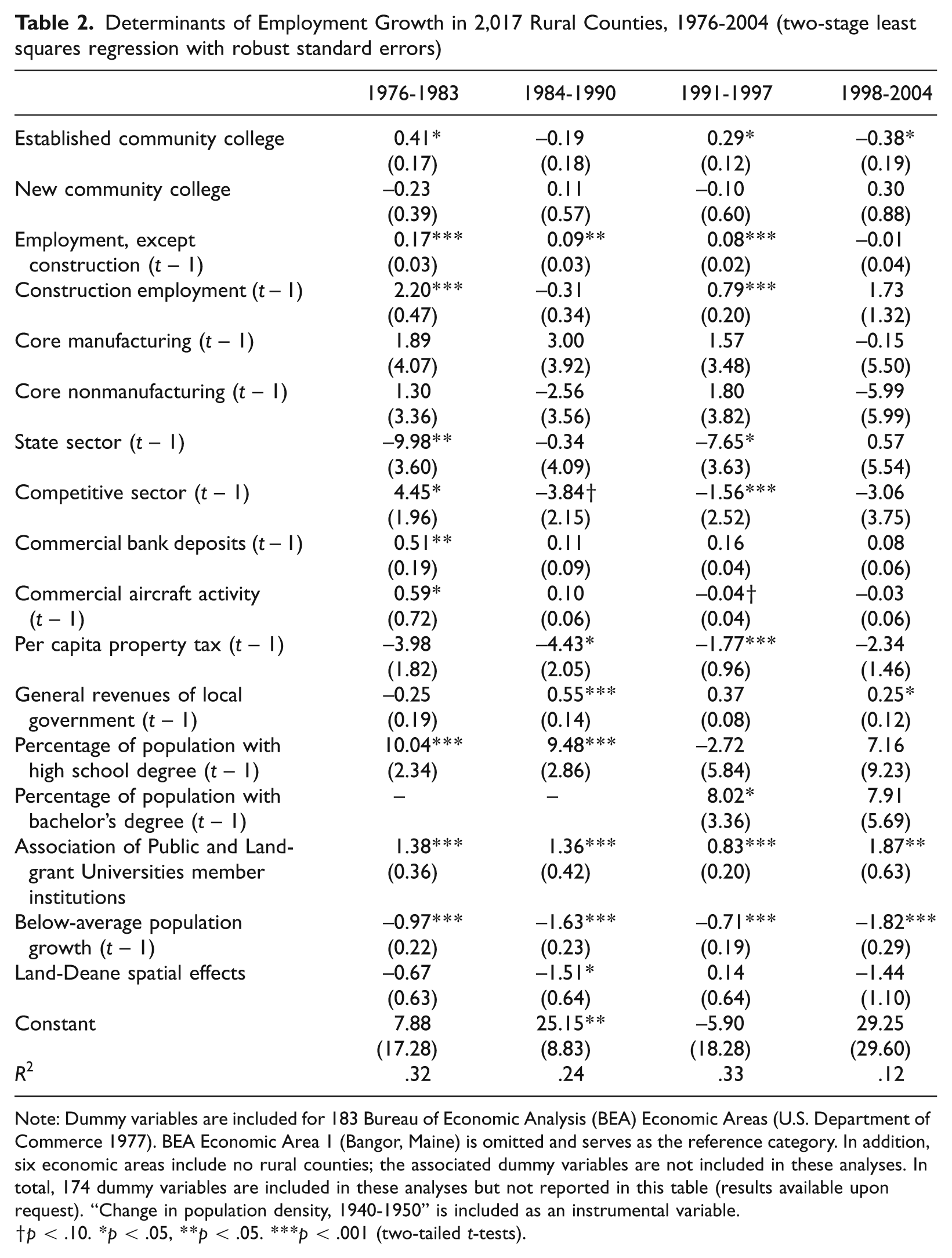
Table 2 reports results for employment growth in four periods. The Land-Deane term achieved statistical significance in the 1984 to 1990 panel, suggesting that a diffusion process was at work; the Land-Deane term controls for this diffusion. In the remaining three panels, the Land-Deane term failed to achieve statistical significance, providing little evidence that an unmeasured spatial process is at work. Several of the control variables operated as anticipated. Total employment growth (three panels) and growth in construction employment (two panels) proved to be positive and significant. Counties housing an APLU member university experienced significantly more employment growth in each panel. Conversely, below-average population growth is inversely related to employment growth in each panel.
Determinants of Employment Growth in 2,017 Rural Counties, 1976-2004 (two-stage least squares regression with robust standard errors)
Note: Dummy variables are included for 183 Bureau of Economic Analysis (BEA) Economic Areas (U.S. Department of Commerce 1977). BEA Economic Area 1 (Bangor, Maine) is omitted and serves as the reference category. In addition, six economic areas include no rural counties; the associated dummy variables are not included in these analyses. In total, 174 dummy variables are included in these analyses but not reported in this table (results available upon request). ‘‘Change in population density, 1940-1950’’ is included as an instrumental variable.
p < .10. *p < .05, **p < .05. ***p < .001 (two-tailed t-tests).
Human capital gains make a significant contribution to employment growth. Growth in the percentage of the population 25 years and older with a high school diploma was strongly positive in the first two time periods, 1976 to 1983 and 1984 to 1990. This coefficient is, however, negative (and significant) in the 1991 to 1997 panel and failed to attain statistical significance in the last panel. Because this variable is measured as a change score, it is possible that counties experiencing increases in the percentage of their populations with high school diplomas are only catching up from significant deficits. Data on bachelor’s degrees are only available for the last two time periods. This measure makes a very strong contribution in the 1991 to 1997 panel, and this contribution increased in the 1998 to 2004 period. By and large, the remaining control variables performed as anticipated (albeit several tended to be insignificant or inconsistent across the panels).
Turning to the independent variables of interest, community colleges, the results presented in Table 2 are uneven. Consistent with expectations, new community colleges did not make a significant contribution to employment growth. This finding lends support to the belief that local economic benefits provided by community colleges and other educational facilities occur over time (Findeis et al. 2009:15). Established community colleges make a significant and positive contribution in the 1976 to 1983 panel and in the 1991 to 1997 panel. While established community colleges made a positive and significant contribution in two of four panels, the relationship was negative and significant (at the .05 level) for the most recent panel.
Local Employment Growth and Stagnating Support for Community Colleges
Table 2 does not include controls for state funding trends over the period. Because the number of students and the cost per student increased over the period, total expenditures for rural-serving community colleges increased between 1981 and 2001. While tuition increased at community colleges, the pace of growth and of increases in total tuition was significantly lower than that found at four-year institutions. For example, tuition and fees (in constant dollars) at community colleges grew by 91% between 1982 and 2002 (see College Board 2007:10), but tuition and fees increased by 115% at public universities and by 110% at private universities. At the end of the period, community college tuition and fees represented approximately 41% of charges at public universities and 9% of private universities.
With a focus on the relative contribution of several revenue sources, Figure 2 provides a summary of trends, by state, of revenue sources for rural-serving community colleges from 1981 to 2001.

Revenue sources for rural-serving community colleges in 44 States, 1981-2001 (median percentage of total for selected revenue sources)
Over the period, the centrality of state appropriations declined. For the 44 states included by Roessler (2006), the median share fell consistently and significantly over the period, from 48.5% in 1981 to 39.7% in 2001. This decline was not offset by increased federal and local appropriations; this source of revenues also made a declining contribution. Instead, community colleges grew increasingly dependent on tuition and fees (increased from 14.7% in 1981 to 19.5% of total revenues in 2001). Revenues from grants and contracts (including private and governmental contracts) became decidedly more important; the median share was 10.6% in 1981 and the comparable measure was 21.3% in 2001.
The decline in state appropriations proved challenging for all community colleges, but “rural-serving community colleges appear to be most vulnerable to cuts in state appropriations” (Roessler et al. 2006). The growing importance of tuition and of grants and contracts also raises equity concerns (see below). With tuition and fees going up quickly, less affluent residents may no longer be able to afford community college. Grants and contracts (whether with private employers or with government agencies) typically focus on customized labor training. Training is molded to serve the employer; for trainees, human capital gains are often narrower than a standard a curriculum. Because the customized training supported by grants and contracts focuses on the needs of existing employers, the growing reliance on grants and contracts may be working against counties with small employment bases.
The spatial context matters (Hooks and Lobao 2010). Specific to the question at hand, it is likely that the impact of community colleges on local employment growth is influenced by shifts in revenue sources. For this reason, we examined interactions between community colleges and shifts in revenue sources. Maintaining a focus on employment, we explored interactions between the presence of community colleges and three revenue sources: state appropriations, grants and contracts, and tuition and fees. For each state, Roessler (2006:Appendix C-Appendix UU) reports on shifts in revenue sources for rural-serving community colleges (five-year intervals from 1981 to 2001). We made use of these data to revisit the analysis of employment trends from the 1990 to 1997 period and the 1997 to 2004 period. For the 1990 to 1997 panel, we incorporated information on funding shifts from 1981 to 1991; for the 1997 to 2004 panel, we focused on shifts from 1991 to 2001. For each revenue source, a dummy variable was created (coded 1 for growth above the mean; coded 0 otherwise). Following Jorgenson (2006; see also Hamilton 1992; Hooks et al. 2010; Hooks et al. 2004), four slope dummies were created: (1) established community colleges experiencing a relatively slow growth in a given revenue source, (2) established community colleges in counties experiencing more rapid growth in the revenue source, (3) new community colleges in counties with relatively slow growth for the selected revenue source, and (4) new community colleges in counties experiencing growth in this revenue above the mean.
Table 3 examines three revenue sources: tuition and fees, state appropriations, and grants and contracts (all sources). 5 First, to facilitate comparison, a measure of the selected revenue source is added to the baseline model (see Table 2). Then a second model, including slope dummy interaction terms (see above), examines state-level funding trends and county employment patterns. Each of the models presented in Table 3 includes a full set of control measures (including spatial autocorrelation); control measures performed (sign and significance) as reported in Table 2. For purposes of display, Table 3 presents only coefficients and standard errors for variables of interest.
Determinants of Employment Growth in 2,017 Rural Counties, with Slope Dummy Interaction Terms, 1990-2004 (two-stage least squares regression with robust standard errors)

Note: Models reported in Table 3 used full set of control variables, including controls for spatial autocorrelation (see Table 2). For purposes of display, Table 3 reports only variables of interest.
p < .10. *p < .05, **p < .05. ***p < .001 (two-tailed t-tests).
Over the period, the contribution made by state appropriations fell significantly (from 48.5% in 1981 to 39.7% in 2001, see Figure 2). Table 3 examines the impact of this decline for the counties hosting rural-serving community colleges. For the 1990 to 1997 panel, the zero-order model suggests that established community colleges made a positive and significant contribution to employment growth. However, for the 1997 to 2004 panel, the presence of an established community college was inversely related to employment growth (.10 level of significance) in the zero-order model. For the 1990 to 1997 panel and with a focus on interaction terms, established community colleges contributed to employment growth regardless of trends in state appropriations (providing no evidence of interaction during this time period). In the 1997 to 2004 panel, there is evidence of interaction between the fiscal climate and employment impacts. Where growth of state appropriations was below the mean, both new and established community colleges are inversely related to employment growth; that is, where state appropriations fell at the fastest pace, the counties housing community colleges suffered a loss of jobs.
Whereas state appropriations provide a shrinking portion of community college revenues, grants and contracts (10.6% in 1981, 21.3% in 2001) and tuition and fees (14.7% in 1981, 19.5% in 2001) account for a growing share of community college revenues (see Figure 2). In the zero-order model focused on grants and contracts, the presence of an established community college is positively associated with job growth in the 1990 to 1997 panel, but this relationship is negative and significant in the 1997 to 2004 panel. The interaction terms are revealing. In the 1990 to 1997 panel, established community colleges in the context of below-average growth in grants and contracts made a positive contribution to employment growth. Apparently, during a period in which state appropriations remained relatively high, community colleges’ emphasis on grants and contracts did not contribute to local employment growth. However, in the most recent panel (1997-2004), lagging growth in grants and contracts undermined community college contributions to local employment growth. Both new and established community colleges are associated with slower employment growth where grants and contracts growth is below the mean.
The pattern reported for tuition and fees resembles that of grants and contracts. In the zero-order models, the presence of an established community college is positively associated with job growth in the 1990 to 1997 panel, but this relationship is negative and significant in the 1997 to 2004 panel. The findings related to interaction terms are also similar. In the 1990 to 1997 panel, established community colleges in the context of below-average growth in tuition and fees made a positive contribution to employment growth. But for the 1997 to 2004 panel, Table 3 reports that established community colleges are associated with slower employment growth where the growth in tuition and fees was below the mean. 6
Discussion and Conclusion
In one sense, our research into the local employment impacts of community colleges represents a completely new line of research. That is, the education literature has tended to focus on the impact of human capital growth at the national level or on tracking outcomes for individuals. There is relatively less concern for regional dynamics. In another sense, this research builds on and extends a line of research that highlights the potential impact of state and local policies on regional employment and quality of life (Lobao and Hooks 2003). Specific to employment, several recent studies have critically examined and provided evidence that public policy and infrastructure can make a positive contribution (see, e.g., Jenkins et al. 2006, 2008; Leicht and Jenkins 1998; Malecki 2003). Our findings corroborate the general theme that pubic investments can make a difference. And, we extend these findings to show that for rural areas struggling to find a toehold in a globalizing economy, basic postsecondary educational opportunities have the potential to contribute.
Community colleges experienced tumultuous change over the past several decades. They survived. In fact, as unemployment increased, enrollment surged: “In October 2007, some 3.1 million young adults, or 10.9% of all 18- to 24-year-olds, were enrolled in a community college. A year later, that figure had risen to 3.4 million students, or 11.8% of all 18- to 24-year-olds. By contrast, enrollments at four-year colleges were essentially flat from 2007 to 2008” (Fry 2009:1). With state appropriations providing a shrinking portion of overall budgets (Figure 2), fiscal solvency pushed community colleges toward a growing reliance on tuition. This growing reliance sparks equity concerns. When comparing academic year 1980-1981 to academic year 2007-2008, Sullivan (2010:652) documents that the cost of attendance spiked (up 40% in constant dollars; 427% in current dollars). This increase creates daunting challenges for less affluent families. In 1992, for the bottom income quintile, the cost of attending a public two-year college represented 50% of annual income. By 2005, this had risen to 58% of annual income. With tuition up sharply and income down (especially for the least affluent), the trends have only worsened in recent years.
Although policy makers often claim they are pursuing a policy of “high tuition/high financial aid,” financial aid has lagged: Federal grants increased 23% (constant dollars—distributed among a substantially larger number of students) over the period, while work-study funds decreased by 29% (constant dollars). State grants increased by nearly 300% (summing all 50 states)—but this large percentage increase is due to the very small commitment (in absolute dollars) in academic year 1980-1981 and does not offset the decline in federal spending. Federal, state, and private lending is up sharply. For the least affluent, the United States no longer provides ready access to community colleges; postsecondary education now comes with indebtedness. It should come as no surprise that the least affluent families incur more debt and have greater difficulty repaying loans. For these reasons, family income plays a large and growing role in deciding whether or not to pursue postsecondary education. In fact, “concern about financial need [skews] children’s attitudes about their academic work as far back as elementary school. Tuition increases, which may seem like minor nuisances to more financially advantaged families, affect poor and working class families profoundly. Obviously, this fatally compromises the community college ideal of open access” (Sullivan 2010:657; see also Kennamer et al. 2010). If postsecondary education is less accessible for the least affluent, federal, state, and local governments have committed enormous resources to the “great American carceral boom”—ensuring that the working class and poor have “access” to prison (Wacquant 2005; see also Figure 1).
Grants and contracts—typically focused on customized training to serve local employers—also are providing a growing share of revenues for community colleges. For a number of observers, this is a welcome development—demonstrating the entrepreneurism of community colleges and their ability to contribute to local economic development (Brumbach 2005; Erwin 2005). But critics lament the abandonment of the community colleges’ commitment to students. Where students are the focal point of community college efforts, emphasis is placed on preparation for university attendance and for a career. For customized labor training, the focus shifts toward the needs and preferences of employers: “On site at the community college as well as in courses delivered using technology through continuing education or contract education, the needs of business and industry are at the center of the curriculum . . . [T]he needs of business and industry are [being] pitted against liberal learning” (Levin 2005:15).
In earlier decades—a period in which state appropriations supported community colleges and pedagogy was student centered—the presence of a community college in a county was linked to employment growth. In the most recent panel, however, the presence of a community college is inversely related to employment growth (see Table 2). This inverse relationship is linked to revenue streams. We found this inverse relationship where community colleges secured less revenue from tuition and from grants and contracts. However, no significant relationship was found for those community colleges able and willing to increase reliance on revenues from tuition and from grants and contracts (see Table 3). As states retreated from funding community colleges through appropriations, they emphasized the importance of community colleges becoming more self-sufficient and “entrepreneurial” (typically resulting in higher tuition) and finding ways to contribute to local economic development (often taking the form of grants and contracts to perform customized labor training). Our findings suggest that state appropriations may have been the most effective means for community colleges to contribute to local employment growth. When state appropriations constituted the lion’s share of revenues, community colleges made a significant and positive contribution to employment growth. During the most recent panel, with state appropriations representing a smaller and still shrinking share of revenues, community colleges no longer make a positive contribution to local employment growth.
This study begins to fill a void in studies of education and economic development. Community colleges (and other educational institutions) enable individuals to acquire human capital, thereby augmenting earnings across the life course (Kane and Rouse 1995; Marcote et al. 2005). However, the impact of community colleges on local labor markets has received little attention. This study makes a contribution on this front. For this research, we relied on studies of prisons in rural areas (Hooks et al. 2010; Hooks et al. 2004) for methodological guidance. However, there may be close linkages between declining support for community colleges and surging support for prison building. Boggs (2000:56) identifies a contradiction rooted in the robust support (rhetorical and fiscal) for incarceration and prison building: “The idea of getting tough on crime and building up more prisons while giving the state more power over people’s lives is one of the present era’s prime articles of faith.” Boggs claims that policy makers have been selective in determining what types of public expenditures constitute “big government.” That is, states have allocated increasing funds to build and expand prisons while retreating from support for education. Recent research suggests that prisons do not help and may impede local employment growth (Hooks et al. 2010; Hooks et al. 2004); this study provides evidence that the presence of community colleges spurred local employment growth during the earlier portion of the study period (1976-1983 and 1991-1997). In the most recent panel (1997-2004)—in the context of an incarceration boom and declining support for community colleges—the presence of a community college is inversely related to job growth where state appropriations have lagged.
Rural America’s economic plight is undeniable; a host of “new” ideas have been put forward to address this plight. Instead of focusing on a “new” approach, this study has focused on an “old”—but overlooked—alternative. Historically, policy makers supported public education despite the relative weakness of the U.S. welfare state (Skocpol 1992). Instead of policies justified in terms of “getting tough” and “cracking down,” the United States has long emphasized the government’s singular capacity to nurture “education” and “opportunity.” The recent decline in support for education goes against this tendency. It remains to be seen if and when cash-strapped state governments will reinvest in community colleges and postsecondary education more generally. Based on our findings, if they do reinvest, rural counties housing community colleges may enjoy significant employment gains. For policy makers looking beyond the next election cycle and committed to promoting the viability of rural communities, community colleges might generate long-term benefits.
Footnotes
Acknowledgements
We would like to thank the American Association of Community Colleges for providing data on community colleges. Katie Vandermark provided valuable assistance with data management. Gregory Hooks gratefully acknowledges the support of the Open Society Institute (Soros Justice Fellowship Program) for making this research possible.
Funding
Gregory Hooks was Senior Soros Justice Fellow (academic year 2005-2006). This support facilitated data collection and initial statistical analyses.
Notes
Bios
References
Supplementary Material
Please find the following supplemental material available below.
For Open Access articles published under a Creative Commons License, all supplemental material carries the same license as the article it is associated with.
For non-Open Access articles published, all supplemental material carries a non-exclusive license, and permission requests for re-use of supplemental material or any part of supplemental material shall be sent directly to the copyright owner as specified in the copyright notice associated with the article.
