



Abstract
We update theories of teacher expectancy and cultural capital by linking them to discussions of technology. We argue for broadening the span of culturally important forms of capital by including the digital dimension of cultural capital. Based on data from the third-grade and fifth-grade waves of the Early Childhood Longitudinal Survey–Kindergarten cohort (ECLS-K), results suggest a comprehensive model where teachers play a prominent, mediating role in the effects of computer proficiency on academic achievement. These findings have practical applications within classrooms, which can lead to a reduction in stratification. Our findings modernize and renew theoretical tools for understanding teacher and student interactions and the effects on achievement outcomes
Computers play an important role in creating, maintaining, and perpetuating inequality in schools, but existing research has not clarified the mechanisms through which they do this. Research on information technology emphasizes how access to and usage of computers leads to skills that improve students’ academic outcomes (Attewell, Suazo-Garcia, and Battle 2003; Beltran, Das, and Fairlie 2006; Underwood, Billingham, and Underwood 1994). This research, however, may underestimate the importance of other social processes (Beltran et al. 2006; Huang and Russell 2006; Judge 2005). Sociology of education scholars, for instance, have shown that ascribed characteristics affect student achievement indirectly: Ascribed characteristics influence teacher expectations, which lead to evaluation bias (Brophy 1983; Dusek and O’Connell 1973; Ferguson 2007). This literature, however, has ignored how technology may influence teachers’ perceptions or expectations and, ultimately, student achievement. Indeed, despite a burgeoning interest in digital inequalities (see e.g., DiMaggio et al. 2004; Hargittai 2010; Mesch and Talmud 2010), few sociologists have examined technology in schools (for exceptions, see Attewell 2001; Attewell et al. 2003; Entwisle, Alexander, and Olson 2000, 2003).
In this article we draw on insights from the study of information technology and teacher expectations to examine how computer usage may influence student achievement both directly and indirectly. Specifically, we suggest that Bourdieu’s theoretically robust idea of cultural capital may include a digital dimension. Computer proficiency may influence academic achievement directly because of the skills it develops, but it may also influence achievement indirectly through teachers’ evaluations. 1 We explore the following questions: How does computer proficiency affect academic achievement? How does computer proficiency affect teachers’ evaluations of students? And finally, to what extent do teachers’ evaluations mediate the relationship between computer proficiency and academic achievement?
Computer Use and Academic Achievement
Researchers disagree on the benefits or shortcomings of computer use and academic use of computers. Empirical evidence is controversial, and some research finds that computers matter in the classroom and at home (Attewell et al. 2003; Beltran et al. 2006; Underwood et al. 1994), but other research suggests that computer use has a negative effect on academic achievement (Giacquinta, Bauer, and Levin 1993; Stoll 1995).
The research that demonstrates computers increasing or decreasing achievement tends to highlight human capital. Researchers have found that elementary-aged students who have access to and use computers consistently perform at higher rates than their nonusing counterparts (Attewell and Battle 1999; Huang and Russell 2006; Judge 2005). These findings suggest that using a computer contributes to a skill set that allows children to perform better academically because they possess greater knowledge and expertise. Other research, however, demonstrates that computer use may not be helping students achieve gains in all areas within the classroom (Judge, Puckett, and Bell 2006), while still other research suggests a negative relationship between computer use and educational outcomes (Giacquinta et al. 1993; Stoll 1995). In fact, an overabundance of time on the computer may even detract from academic outcomes if students spend excessive amounts of time on the computer engaging in nonacademic activities (Lei and Zhao 2007).
Researchers turned to specific uses of computers in order to determine how computer use might influence students’ academic achievement. Some of these studies find that how a student uses a computer is the most important aspect of computer use, regardless of quantity (Burbules and Callister 2000; McFarlane 1997; Wenglinsky 1998), emphasizing quality computer use over frequency. These findings help fuel arguments claiming that teaching students to acquire intellectual tools on the computer is the most efficient use of computer instructional time.
It is an important next step to determine how computer use is playing a role in the classroom and whether or not teachers are facilitators of this apparent positive correlation between computer proficiency and academic achievement. We use Bourdieu’s (1979) existing take on cultural capital as a springboard for examining technology as a new dimension of cultural capital. We argue that technological knowledge, expertise, and competence can be used as exchange value within a technological/information age society, conferring power and status upon individuals who proficiently demonstrate their knowledge. This technological competence is used by teachers to make evaluations of students that may translate into increased academic achievement.
Adding the Digital Dimension to Cultural Capital
Sociologists unsatisfied with the unexplained social processes within human capital theory began hypothesizing about other forms of capital such as social and cultural capital (Bourdieu 1986; Coleman 1988; Roscigno and Ainsworth-Darnell 1999). Particularly important is cultural capital for understanding the interactions between teachers, computers, and student achievement. 2 Elements of cultural capital include preferences, tastes, inclinations, and “linguistic and cultural competence” (Bourdieu 1979). Bourdieu specifically intended to shed light upon differential educational outcomes, stating that accumulated cultural capital can be exchanged for power and status; thus, a gain in cultural capital will lead to cultural advantages, particularly within the educational sphere.
Cultural capital in the classroom refers to students’ attributes that contribute to teachers’ expectations (Bourdieu 1979; Lareau 1987; Lareau and Weininger 2003) and are often equated with high social class activities. Children who are capable of translating their learned cultural knowledge into the classroom usually experience more success than students who cannot exhibit such preferred cultural expertise or do not possess the same cultural capital (see e.g., Aschaffenburg and Maas 1997; DiMaggio 1982; Roscigno and Ainsworth-Darnell 1999). Research continues to show the importance of upper-class capital, such as going to a museum, on teachers’ beliefs about children and ultimately their success through something other than human capital (Dumais 2002).
We argue that similar mechanisms are at work for a digital dimension of cultural capital that has not been tapped by the traditional measures of cultural capital thus far. Bourdieu wrote and theorized during a time when technology and computer use was not as prominent, thus rendering a discussion of technology unnecessary and even unimaginable. We suggest, however, that students who possess knowledge of computers and other digital devices may gain actual skills (as they might in ballet classes or violin lessons or at the museum), but more importantly, they are presenting themselves as culturally competent members of our information-age society. Bourdieu’s conception of cultural capital would predict that those students who possess and exhibit it as measured by cultural activities, such as attendance at a museum or participation in dance (see e.g., Dumais 2002), will be more likely to succeed educationally. We suggest that the same should hold true for the digital dimension of cultural capital. Therefore, we propose that the concept of cultural capital can be updated by including a digital dimension (in this vein, Hamelink [2000] urged researchers to consider the concept of “information capital” ). By including this dimension of cultural capital, researchers can focus on a specific aspect of access to computers that has yet to be fully explored for student outcomes and increase our understanding of cultural capital in the digital age. We study the process by which the digital dimension of cultural capital affects student outcomes by investigating computer use as a social process. Our conceptualization allows us to examine the role that teachers play in defining and valuing computer use or proficiency as capital within the classroom.
Teacher Expectancy
Teachers play a significant role in how students perform in the classroom (Rist 1970; Rosenthal and Jacobson 1968). The theory of teacher expectancy argues that teachers’ a priori evaluations of students transfer into differential levels of academic achievement. Evaluations from teachers have an indirect influence on students’ academic performance and contribute to a social process where students are not achieving academic outcomes based on a concrete skill set, but responding to their individual teachers’ expectations and/or evaluations. Teacher expectancy, derived from Merton’s (1968) self-fulfilling prophecy theory, refers to the opinions, judgments, and expectations of students that teachers form and hold based on information from other teachers, an individual student’s records, and other physical or visible student characteristics that are thought to influence students’ academic performance (Dusek 1985; Ferguson 2007; Rosenthal and Jacobson 1968; van den Bergh et al. 2010).
Essentially, teachers create expectations for their students prior to witnessing academic prowess. Performance expectations are manufactured based upon a number of student characteristics, such as gender, race, the performance of siblings, information from other teachers, and the demographic composition of the school (see e.g., Brophy and Good 1974; Ferguson 2007; Lee and Smith 2001; Rosenthal and Jacobson 1968; van den Bergh et al. 2010). Other research has shown that familiarity and use of cultural objects also lead to a priori evaluations of students (e.g., Arabsolghar and Elkins 2001). Nevertheless, even those studies that considered cultural objects have neglected to consider computer use as an attribute that might affect teachers’ expectations of students.
Teacher Expectations and Computer Proficiency: Hypotheses
The recent increase in computer usage across many social spheres may cause a change in the ways in which teachers evaluate students within their classroom. Teachers may presume their students are familiar with computers within and away from the classroom (Emihovich 1990), adding to the list of expectations already cited within educational research (e.g., student self-motivation, interest) (see e.g., Rist 1970; Rosenthal and Jacobson 1968). Given the findings within the information technology and teacher expectancy literatures, we make particular hypotheses about the mediating effects of teachers’ evaluations on the relationship between computer proficiency and achievement.
Before we can show the role teachers play in the relationship between computer use and achievement, we must initially show how computer proficiency directly affects teachers’ evaluations of students’ efforts. Given the theory outlined previously, we predict that computer proficiency will positively affect teachers’ evaluations, even after controlling for measures of academic achievement. If teachers have higher evaluations for students who are proficient with computers, net of their “actual” performance in the classroom, we will be able to show that teachers indeed use computer proficiency to make assessments about their students. This hypothesis only gets us halfway to linking the two theories, however, and in order to fill the gaps in the literature, we use a more complete model to show how the effect of computer proficiency on academic achievement is mediated by teachers’ evaluations. Thus, we also expect to see a direct relationship between computer proficiency and academic achievement and an indirect relationship between computer proficiency, teachers’ evaluations, and academic achievement. Therefore, we expect that teachers’ evaluations mediate the relationship between computer proficiency and academic achievement. In sum, we expect to see the same theoretical mechanisms at play for computer use as we would for traditional measures of cultural capital, but instead we are measuring a modern source of capital to reflect the digital/information age.
Data and Methods
We use the Early Childhood Longitudinal Survey–Kindergarten cohort (ECLS-K) provided by the National Center for Education Statistics (NCES). The NCES randomly sampled and tracked students and gathered information from their teachers, parents, and administrators from the time the sampled children entered kindergarten in the academic year of 1998-1999. Students were sampled within specific ECLS-K schools, and many students are clustered within the same schools. Because the ECLS-K is a longitudinal study, we are able to examine teacher expectations and computer proficiency and achievement over time rather than simply providing a snapshot of one year (Funnell and Smith 1981). We include waves five and six of the ECLS data—third- and fifth-grade years. While the sample of children in the fifth-grade wave of data collection is representative of the children who were in kindergarten in 1998-1999, it is not representative of all fifth graders in 2003-2004.
Variables
Dependent Variables
Math and reading item response theory scores. 3
Academic achievement is measured with an item response theory (IRT) score. This is a continuous measure that allows for longitudinal analysis of achievement without using the same test questions at each point. The IRT score for math and reading in the fifth-grade wave takes into account responses from all waves prior to the current wave of testing in order to calculate a score for each student (Tourangeau et al. 2006). This measure of achievement is commonly used in the literature because IRT scores are a very reliable measure of academic achievement over time (e.g., Cheadle 2008; Downey, Paul, and Broh 2004; Wagmiller et al. 2010).
Independent Variables
Computer proficiency in the classroom
We use a measure of teachers’ perceptions of students’ computer proficiency in the classroom from the third-grade wave. We also measured this variable from the fifth-grade wave (in analyses not shown here) and found nearly identical results. This is an appropriate measure of perceptions of students’ computer proficiency based on our theoretical notion of the digital dimension of cultural capital described previously. We test this variable in a number of ways in our analyses to create a model that is robust and easy to interpret. 4 We construct the computer variable as dichotomous variables that combine intermediate and proficient computer use as one dummy-coded variable; not yet, beginning, and in progress were combined to create an additional dummy-coded variable that would denote basic or no computer skills.
Teacher evaluations
Teacher evaluations are used as a dependent variable for an initial analysis. Both evaluation measures are used: (1) if the student works to the best of his or her abilities and (2) how the student works compared to other students. To measure how computer proficiency is associated with academic achievement, this analysis uses two different teacher evaluations for each student from the respective math and reading teacher questionnaire as independent and mediating variables. Substantively, there is no difference between results, so for the ease of interpretation, only the dummy variable (whether the child works above average = 1) is included in these analyses. 5 We use this variable from the third-grade wave in Table 3, but we also estimated models (not shown here) that are substantively similar using the fifth-grade wave.
Control Variables
To be sure that the digital dimension of cultural capital is not just captured by a more generic cultural capital variable, we also control for a traditional measure of cultural capital. We create a scale that incorporates attendance and participation in cultural events. This is consistent with other cultural capital measures used in education literature (see e.g., Dumais 2002). Though a third-grade measure would be ideal, only a fifth-grade measure is available in these data. Nevertheless, we believe that this type of capital is likely to have been present in third grade if it is in fifth. We should also note that computer use and cultural capital are not highly correlated (.15), thus indicating that we are examining a distinct dimension of cultural capital.
We control for numerous demographic variables to rule out a spurious relationship between student level characteristics and teachers’ evaluations, including race, gender, student socioeconomic status (SES), and dual-parent household. We also control for a measure of educational computer use in the home in third grade to reduce bias in our analyses. School-level characteristics could also influence teachers’ perceptions and student outcomes simultaneously: Again to rule out spurious relationships, we consider global school-level characteristics found to influence achievement, such as the percent of minority students within the school and the percent of students eligible for free lunch (see Table 1 for more detail).
Variables of Interest: Definitions, Sources, and Descriptives

Analytic Strategy
The analysis proceeds in three steps, which incrementally lead us to combine the literatures of teacher expectancy and information technology. Using logistic regression and the adjustments for standard errors to deal with nonindependence of cases (students nested in the same classrooms and schools), 6 we first measure a series of models that assess the relationship between teachers’ perceptions of computer proficiency and teachers’ evaluations of students in Table 2, using both measures of teachers’ evaluations as dependent variables. These models show how teachers’ perceptions of computer proficiency are related to teacher evaluations. The most restricted models with all the control variables still indicate a strong and statistically significant relationship between teachers’ perceptions of computer proficiency and teachers’ evaluations. Most importantly, we introduced our measure for academic achievement (IRT scores) as an independent variable to control for students’ actual achievement. 7 This allows us to determine whether evaluations are net of achievement. We also control for student-level characteristics.
Logistic Regression of Third-grade Math and Reading Teachers’ Evaluations Regressed on Classroom Computer Proficiency (Odds Ratios)
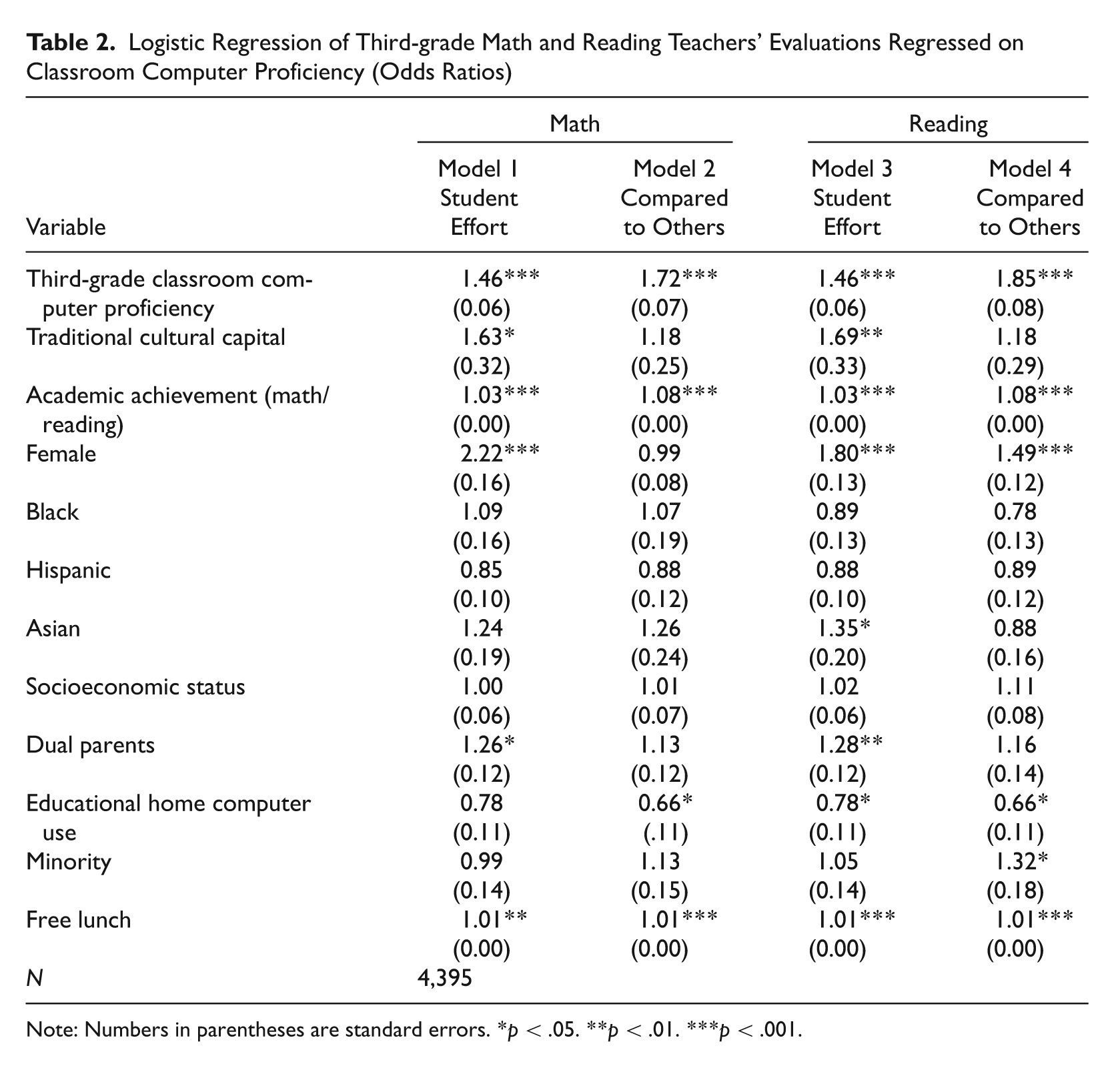
Note: Numbers in parentheses are standard errors. *p < .05. **p < .01. ***p < .001.
The second analysis allows us to examine the relationship between academic achievement and teachers’ perceptions of computer proficiency, an issue that has been debated in the field. Using an ordinary least squares (OLS) regression, clustering at the school level, and control variables, we show a model that tests the relationship between teachers’ perceptions of computer achievement and academic achievement. Table 3 reflects results from analyses using independent variables measured in the third grade and the dependent variable of academic achievement (IRT score), measured in the fifth grade. 8 By using this longitudinal model, we can show how teachers’ perceptions of computer proficiency and teacher evaluations have long-term and lingering effects for students’ academic performance. This choice is consistent with other analyses that use an IRT variable as a dependent variable (Downey and Yuan 2005).
Ordinary Least Squares Regressions of Fifth-grade Math and Reading Achievement on Classroom Computer Proficiency (Third-grade Independent Variables)
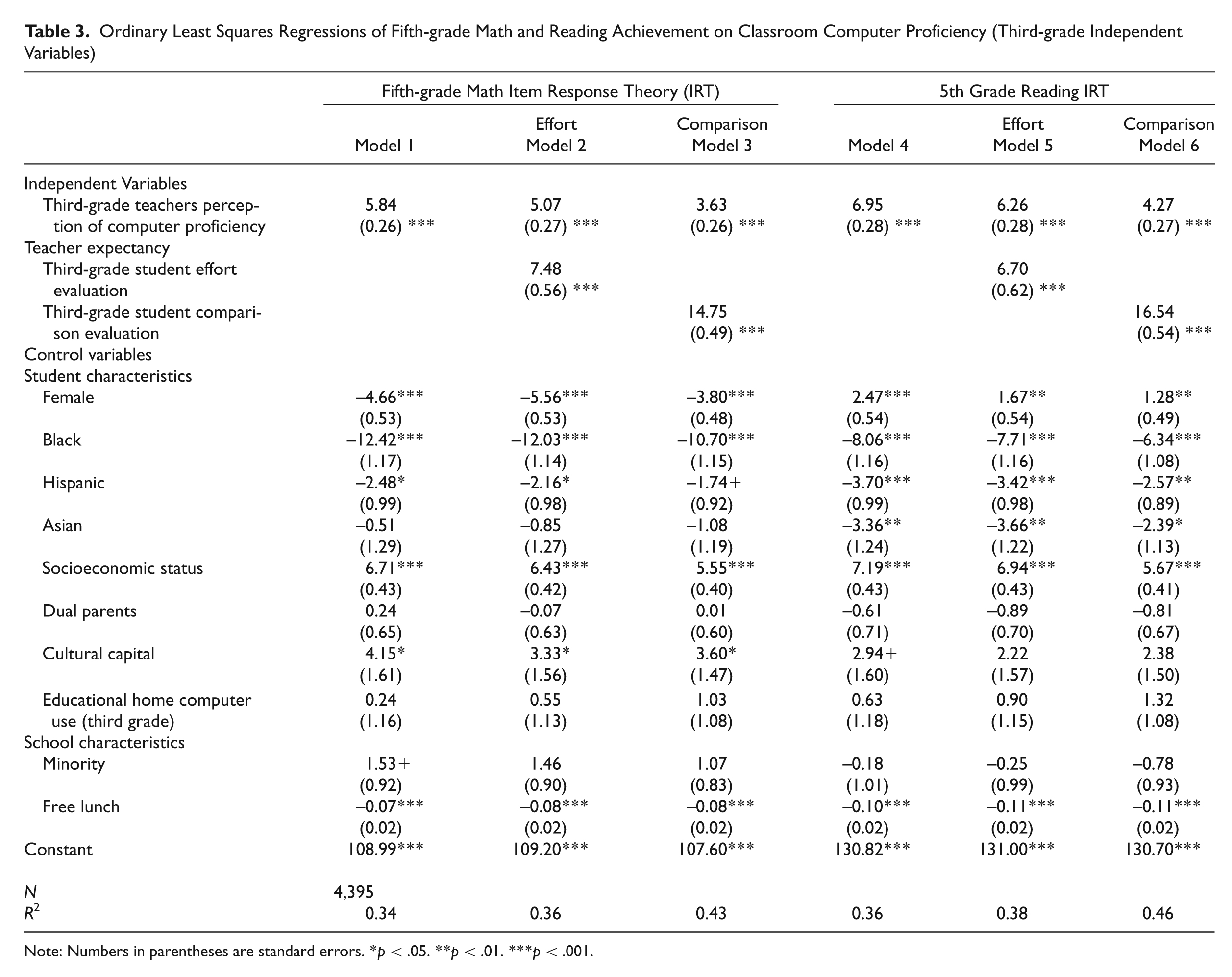
Note: Numbers in parentheses are standard errors. *p < .05. **p < .01. ***p < .001.
The third set of analyses shows the crux of our argument by bringing together our first analysis and tests for mediation. Math and reading evaluation variables are introduced to the models to test hypotheses of teacher expectancy and analyze indirect effects of perceived computer proficiency. We use the Sobel-Goodman approach to statistically test for mediation and thus examine both direct and indirect effects of computer proficiency on academic achievement and assess whether a theory of teacher expectancy is applicable. A Sobel-Goodman test measures the extent to which the effect of computer proficiency on academic outcomes (IRT) is mediated by teacher evaluations of math and reading performance and the extent to which the effect of computer proficiency on academic outcomes is direct. In doing so, it determines what percentage of the outcome (achievement gains as measured by IRT) is attributed to teacher evaluations of math and reading performance and what percent is attributed to teachers’ perceptions of computer proficiency. This analysis is a comprehensive model that tests our hypotheses of teacher expectancy in conjunction with theoretical models of information technology, allowing room for both theoretical frameworks.
Results and Discussion
Initially, we test the relationship between teachers’ perceptions of computer proficiency and teachers’ evaluations to gain information regarding the relationship of these two characteristics. Teachers’ evaluations include how a student compares to other students and how much effort the student puts forth in the classroom. Table 2 tests this relationship for both math and reading using logistic regression and presents the results using odds ratios. This table reveals statistically significant results for both evaluation measures. An increase in teachers’ perceptions of computer proficiency has a positive and significant effect on their teachers’ evaluations in both math and reading. Furthermore, the relationship remains positive and significant even after controlling for their actual math and reading test scores on the IRT. Those students who have higher levels of teachers’ perceptions of computer proficiency are 1.46 times (when asking teachers if students put forth maximum effort) and 1.72 times (when asking teachers how students work compared to other students in the class) more likely (than students who do not) to be positively evaluated by their teachers in math. Similarly, students who demonstrate higher levels of computer proficiency to their teacher are 1.46 times (when asking teachers if students put forth maximum effort) and 1.85 times (when asking teachers how students work compared to other students in the class) more likely (than students who do not show higher levels of computer proficiency) to be evaluated positively by their reading teachers, even net of their actual achievement level.
The statistically significant relationship between teachers’ perceptions of computer proficiency and teachers’ evaluations implies that regardless of objective achievement measurements, traditional cultural capital measures, and student or school characteristics, perceived computer knowledge is associated with teachers’ perceptions of students. These findings are thus crucial and lend support for this analytic strategy because they confirm the complex relationship between teachers’ evaluations in reading and math and teachers’ perceptions of computer proficiency, net of test scores.
The first three models in Table 3 show the relationship between teachers’ perceptions of students’ computer proficiency and math achievement; and the nested models depict the relationship between third-grade teachers’ perceptions of computer proficiency and fifth-grade math academic achievement, over time, using evaluations as mediating variables instead of dependent variables. The purpose of these analyses is to measure teachers’ perceptions of computer proficiency to glean the effects computers have on long-term achievement while considering control factors such as race, gender, socioeconomic status, and cultural capital. Models 1 and 4 in Table 3 depict the effects of teachers’ perceptions of computer proficiency on math and reading achievement on the IRT, respectively. As expected, findings are consistent with literature purporting that computer proficiency increases academic achievement. These findings support the human capital explanation of computer proficiency and achievement, but the other models show that the story is more complicated.
The essential portion of our analyses rests in Models 2 and 3, where we add both measures of teachers’ evaluations in order to understand the role that evaluations play in this social process. Models 2 and 3 in Table 3 add separate measures of teachers’ evaluations, with student effort in Model 2 and student comparisons in Model 3 as mediating variables. The table appears to indicate similar findings between sets of nested models. But, the teachers’ perceptions of computer proficiency coefficient is reduced between Model 1 and Model 2, and also from Model 1 to Model 3, suggesting a mediating effect of teachers’ evaluations, despite overall similar findings for specific demographic groups. Running the Sobel-Goodman mediation test, for Model 2 of Table 3, reveals a significant result and 13 percent of the effect of computer proficiency on IRT is indirectly working through teachers’ evaluations. Essentially, Model 2 illustrates that teachers’ evaluations significantly mediate the relationship between teachers’ perceptions of computer proficiency and academic achievement.
Model 3 uses the same dependent variable as the previous two models; however, the evaluation measure used in Model 3 is one that asks teachers to compare students to one another. These evaluations are significant within the final model, and the reader should note the drastic reduction in the teachers’ perceptions of computer proficiency coefficient between Model 1 and Model 3. This provides support for a mediating effect of teachers’ evaluations, and a second Sobel-Goodman mediation test examining student-comparison evaluations is also significant. In fact, we see that 38 percent of the relationship between teachers’ perceptions of computer proficiency and academic achievement in Table 3 can be attributed to teacher evaluations of students when comparing them with other students, thus confirming our hypothesis that teacher evaluations mediate a portion of the relationship between teachers’ perceptions of computer proficiency and math achievement. Model 3, in particular, suggests that this type of teacher evaluation is driving a substantial percentage of the effect of teachers’ perceptions of computer proficiency on math academic achievement, as teacher expectancy theories would predict.
Though we did not make predictions about race and gender, we did find interesting results worth discussing. Both black students and female students are significantly less likely than their white and male counterparts to experience improvements in math academic achievement. Before the effect of teachers’ evaluations are modeled in the analysis, we notice the achievement gap—both black and female students are at an achievement disadvantage net of cultural capital and our control variables. On average, female students score 4.67 points lower than males on math achievement. When our first measure of teachers’ evaluations (student effort) is introduced into the model, the results are substantively similar for math achievement and remain statistically significant. Similarly, individuals who enjoy higher levels of socioeconomic status are more likely to reap achievement benefits. These results may be indicative of conquering the second digital divide—access to resources that can effectively educate individuals who gain access to computers, which is why we also include a control measure for educational computer use in the home. But, teachers’ perceptions of computer proficiency remain significant predictors of students’ math achievement, independent of socioeconomic status. Furthermore, students who are educated in schools with a higher percentage of individuals eligible for free lunch are less likely to perform well in math.
Models 4, 5, and 6 in Table 3 depict the relationship between teachers’ perceptions of computer proficiency and reading achievement, using the same evaluation measures as mediating variables in our nested models. We include reading and math as separate aspects of academic achievement to ascertain if there are differences in the ways computer skills influence academic results or teachers’ expectations when evaluating students specifically on those subjects. Model 4 depicts the effects of teachers’ perceptions of computer proficiency and all of our control variables on reading achievement, similar to Model 1. These findings for reading are consistent with those found in math, with the exception of cultural capital. We ran separate analyses, where teachers’ perceptions of computer proficiency were not included in the model and found that cultural capital was significant for reading achievement. In Model 4, when we introduce teachers’ perceptions of computer proficiency, the statistical significance of cultural capital is reduced to .06. In the following two models we introduce the two measures of teachers’ evaluations.
Model 5 uses the teachers’ evaluation measure of student effort and Model 6 uses the teachers’ evaluation measure of student comparison; both models consider all student-level and school-level variables. Within our models on reading achievement, we find interesting results concerning gender and race. Even with our control variables, which again suggest that demographic variables are significant, we still find that teachers’ perceptions of computer proficiency remain an important factor. Similar to our findings on math achievement, black students are less likely than white students to experience improvements in reading, even before we model teachers’ evaluations. But, for males and females we find a reverse effect in reading achievement. Where girls were at a disadvantage in math, we now see that boys have the disadvantage in reading. This finding supports educational literature that discusses the gender gap by subject (Gallagher and Kaufman 2005; Marks 2007; Mickelson 1989). According to Model 5, the average female student scores 1.67 points higher than males on reading achievement. This model considers the traditional measure of cultural capital, teachers’ perceptions of computer proficiency, and teachers’ evaluations on student effort. Across all models, it is apparent that both black and male students are at a disadvantage. In addition, Hispanic students, in all three models, are lacking the reading achievement scores of white students in Table 3.
As we discussed earlier, individuals with higher levels of socioeconomic status perform better in reading. This model also includes a control measure for educational computer use in the home. Lastly, students housed in schools with a higher percentage of individuals eligible for free lunch are less likely to perform well in reading. We find in these models that dual parents in the home, educational computer use in the home, and a high percentage of minority students in the school have no statistically significant effect on reading achievement.
The comprehensive segment of our analyses is in Model 5 and Model 6 of Table 3, indicating the role that both teachers’ perceptions of computer proficiency and evaluations have for reading achievement. Models 5 and 6 of Table 3 separately test our two evaluation measures. Model 5 shows reading evaluations based on student effort and Model 6 shows how students work compared to others as mediating variables. We again test the evaluation measures as mediating variables in this analysis. Running the Sobel-Goodman mediation test for these models in Table 3 reveals significant results for both evaluation measures. Student effort evaluations can account for 10 percent of the indirect effect in Model 5, and comparison evaluations account for 39 percent of the indirect effects in Model 6. Therefore, the results support our hypothesis that teachers’ evaluations mediate the relationship between teachers’ perceptions of computer proficiency and reading achievement over time.
Again, our gender and race findings warrant some discussion. Female students are significantly less likely than their male counterparts to experience such positive outcomes in math; yet, the gap in reading achievement is completely reversed. Additionally, black students are negatively associated with positive academic outcomes in both reading and math. These disadvantages remain significant across all models. We find that in our final models for reading achievement, when we add teachers’ perceptions of computer proficiency and consider both evaluation measures, the disadvantage for Hispanic students is a score, on average, that is 3.42 (Model 5) and 2.57 (Model 6) points lower than whites. Higher levels of socioeconomic status are highly correlated with increased academic achievement across all models in both subjects. More concretely, for each unit increase in SES, a student will experience a 6.94 (Model 5) and a 5.67 (Model 6) point increase in reading achievement.
Evaluations are significant across all models, but the magnitude of mediation effects for both evaluation variables strongly vary, indicating that students can benefit from higher perceived computer proficiency for both direct and indirect effects leading to the same end—an increase in academic achievement. Overall, an increase in academic achievement, whether it be a result of direct, indirect, or both direct and indirect effects, is beneficial for students. Findings in these models support the idea that students who are perceived as having more computer knowledge will receive better evaluations from their teachers, subsequently resulting in increased academic achievement.
We ran supplemental analyses using OLS regression, testing different degrees of computer use in the home, and including it in all of our models as the independent variable of interest (with classroom use excluded). These analyses revealed no significant findings in the series of models we ran. We take this to indicate that computer use at home may be invisible to the teacher and thus have no effect on evaluations and ultimately achievement.
Conclusion
Technology as a cause and consequence of inequality has made many of our tried and true theories about stratification antiquated. In this article, we remind readers just how complex student achievement is and update our theories to account for technological advances. Drawing on disparate literatures that have found their scholarly work on opposite sides of the library, we have shown that achievement in math and reading depends on more than human capital investments. Specifically, when students are perceived as having computer proficiency in the classroom, their teachers are more likely to reward them with higher evaluations, which are subsequently correlated with higher levels of academic achievement
This analysis relies on teachers’ evaluations of their students to reveal whether perceptions of computer proficiency are contributing to the academic successes of their students. Including teachers’ comparative evaluations of students within the analysis specifically designates computer use as an academic achievement enhancer, even though it is not entirely through a direct route. The findings support hypotheses of a direct effect and an indirect effect of computer proficiency on academic achievement. Using a subjective measure of teachers’ perceptions of computer proficiency offers an advantage when testing the digital dimension of cultural capital. But, using an objective measure, such as a computer proficiency test, could shed light on how computer skills translate into student achievement more directly.
The learning environments of children are constantly shifting as technology becomes a dominant tool in our lives. Research should recognize these changes and incorporate them into theoretical arguments and empirical analyses. Therefore, future research on teacher expectancy may address the varying degrees of teachers’ expectations that play out in the classroom, using objective and subjective measures of computer proficiency. While our work examining subjective teacher perception of computer proficiency is useful for testing teacher expectation theory, objective measures (e.g., an assessment on computer skills/proficiency) may continue to be useful for understanding the role actual computer skills have for student achievement. Though we examined objective measurers somewhat in our “home-use” tests, this might just be the tip of the iceberg. The story we tell may be indicative of larger social problems of classroom evaluation and bias while objective computer use may be indicative of the second digital divide.
Computers themselves, however, will not solve the problem of a digital divide; it is not enough to simply place a computer in every child’s hands. Students must be proficient on the computer, and their proficiency must be visible to others, specifically their teachers. Students must first learn how to use a computer; however, our results suggest that once a student is aware of how a computer functions and can negotiate one independently, he or she must make such proficiency visible to his or her teacher. We believe that a strength of our article is the indication that visible computer proficiency rather than mere access to computers is the key component to both direct and indirect benefits for students. Research questions that ask who has access to computers or who uses computers in a certain way and with what programs may glean important information. This information, however, does not demonstrate how teachers view their students based on portrayals of computer use and addresses different aspects of how computers matter. In contrast, this analysis looks beyond the current understanding of the digital divide (access and resources) and considers how computer proficiency is understood as a form of cultural capital within the context of the classroom and provides another insight into the complex nature of student achievement and stratification in general.
Footnotes
Acknowledgements
We thank Jeremy Reynolds, David Smilde, and Jim Coverdill for their comments on this manuscript.
Notes
Bios
References
Supplementary Material
Please find the following supplemental material available below.
For Open Access articles published under a Creative Commons License, all supplemental material carries the same license as the article it is associated with.
For non-Open Access articles published, all supplemental material carries a non-exclusive license, and permission requests for re-use of supplemental material or any part of supplemental material shall be sent directly to the copyright owner as specified in the copyright notice associated with the article.
