




Abstract

The following is a shortened version of a plenary lecture by Steven Brint presented at the inaugural meeting of the Portuguese Sociology of Education Society in Lisbon, January 23, 2009.
You have asked me to speak about the current state of the sociology of education in the United States. The temptation is great in such an assignment to applaud the subdiscipline for following one’s own cherished positions or to lament its failure to do so. I will (for the most part) resist these temptations and talk instead about what a study of the “collective mind” of the field tells us about the current interests (and blind spots) of the field, the controversies that animate it, and the extent to which other possible discourses on education in society would be as scientifically productive.
In using the term collective mind, I do not have in mind a Hegelian notion of the Spirit realizing itself in history, or indeed any integrated image of the collective mind. Instead, I have a pluralistic and fragmented image, based on counting each specific piece of work in the field. One can count the pieces of work to form an image of the whole. As this reference to counting suggests, my approach will be quantitative. I have read and coded the past 10 years of work in Sociology of Education, the leading U.S. journal in the subdiscipline, and will present a portrait of the collective mind of the field based on a content analysis of that body of work.
Although I anticipate that you will find the results of this exercise illuminating, it is important to emphasize that my methodology has clear limitations. Many other journals publish work by U.S. sociologists of education, including the American Educational Research Journal and the American Journal of Education, to mention just two of the more prominent. Leading journals in sociology, such as the American Sociological Review and the American Journal of Sociology, also occasionally publish work by sociologists of education. And, of course, my methodology leaves out book publication altogether.
Moreover, it is important to emphasize that the collective mind of U.S. sociology of education is only one part of a much larger collective mind defined by the intellectual field of education studies. This larger collective mind can be conceived as the aggregate of all journals and book publication related to education and educational systems from all countries in the world and on all topics, from cognition to pedagogy to classroom and school organization.
Many of the silences in the collective mind of U.S. sociology of education can be understood as efforts to claim niche space within the complex ecology of the broader intellectual field. As I will show, the niche space claimed by U.S. sociology of education focuses on studies of educational achievement and educational attainment as conditioned by social inequality, family and student behaviors, and school organization. Although it is indirectly influenced by contemporary policy issues, Sociology of Education typically does not engage policy directly, because other journals do. It is relatively silent on comparisons of educational systems, because other journals and books examine educational systems from a comparative perspective. Given this intellectual division of labor, we can perhaps feel comforted that important issues neglected by the sociology of education are not entirely neglected by the larger collective mind.
Accordingly, the most I will claim for my approach is that it is a partial picture of the collective mind in U.S. sociology of education, albeit a partial picture that is closely connected to the core of the subdiscipline. The journal Sociology of Education is the one of the highest ranked education journals in the United States and the only highly ranked journal that publishes the work of sociologists of education more or less exclusively. Its acceptance rate ranges between 10 percent and 15 percent, and thus one can make a persuasive case that the journal represents work that is at the forefront of current sociological thinking about education in the United States. During the period I examined, 1999 to 2008, the journal published work by many of the leading senior sociologists of education in the United States. As the core journal in the field, the collective mind represented in the journal defines the center of gravity in the subdiscipline.
Method
Between 1999 and 2008, 168 articles appeared in Sociology of Education, between 3 and 5 articles in each of four issues during the year. (In 2000, the journal published a special extra issue, which included essays about current thinking about key issues in the subdiscipline.) I coded each of the articles that met my criteria for inclusion in four ways. First, I classified the articles by methodology: either quantitative or qualitative. In a few cases, both types of methodology were equally prominent. I noted these articles separately. Second, I classified the level of education addressed in the article: primary/secondary or tertiary. In some cases, articles concerned both primary/secondary and tertiary education. In these cases, I did not classify the articles. Third, I classified the articles into one of eight major topical categories: (1) inequality, (2) “nonstructural” sources of achievement, (3) culture/ideology, (4) school organization/school effects, (5) state/politics, (6) labor market/labor market transitions, (7) comparative/historical analysis, and (8) methods. Finally, I classified articles into a more fine-grained topical scheme of 22 categories in all. I will concentrate my discussion of content on the distribution of articles into the eight major topical categories listed above. Therefore, let me elaborate the conventions that I used in coding articles into these categories.
I classified the articles on the basis of the primary emphasis in the article. Where possible, I tried to classify under one category only. I classified only a handful of articles under more than one category, because I could not determine their primary emphasis. I made a distinction in coding between the major structural bases of inequality in American society (i.e., social class, race/ethnicity, immigration status, and gender) and social structures and behaviors that vary within these broad strata (such as family structure or student work effort). I reserved the category “nonstructural sources of achievement” for articles that took up these latter sources of variation in educational outcomes. Thus, articles about the effects of work effort, drinking behavior, or obesity on student achievement were coded into this category, but articles about the effects of wealth or immigration status on educational attainment were coded into the “inequality and schools” category.
In this coding scheme, “culture/ideology” includes articles both on cultural influences on the organization of schooling and the influences of the organization of schooling on culture. An example of the former would be an article on the interpersonal strategies used by high-achieving students to mask their school achievements in settings that belittle intellectuality. An example of the latter would be an article on the effects of educational attainment on attitudes about public affairs.
I will not make strong claims for the accuracy of my coding. In some cases, other equally expert coders would likely have made different coding choices. However, many of the articles were not difficult to code, and I believe the measurement error due to coding mistakes is relatively minor.
The contours of the “collective mind”
One inescapable conclusion is that the collective mind of U.S. sociology of education, as represented in its leading journal, is highly quantitative. Of those articles classifiable into one of two methodologies, 131 articles relied on quantitative methodologies, and only 27 articles relied on qualitative methodologies. The ratio is almost 6:1 in favor of quantitative methods. Given the number of high-quality data sets currently available to educational researchers in the U.S. (and abroad), the great incentive is to train students in quantitative methods and then to exploit that knowledge of statistical techniques to investigate topics using these high-quality data sets. Most researchers relied on well-established statistical methods, such as multiple regression, hierarchical linear modeling, and structural equation modeling. Only four articles (2 percent of the sample) focused specifically on advancing methods for the study of schooling systems.
The content analysis revealed that the collective mind of U.S. sociology of education is also highly oriented to primary and secondary education, rather than postsecondary education. Of the articles that could be classified by level of education addressed, 93 focused on primary/secondary education and 25 focused on postsecondary education, a ratio of almost 4:1 in favor of primary/secondary education. This orientation might seem skewed, given that at least three in five U.S. citizens now enroll in postsecondary institutions at some point in their lives and, further, that postsecondary achievements are highly connected to labor market outcomes. However, sociologists of education in the United States have followed the broader American public (and U.S. policy makers) in defining K–12 education as fundamental, both for equalizing opportunities and for building skills in critical spheres of cognitive and social development.
A very large proportion of articles concerned variation in student achievement, as measured by access to educational opportunities, scores on tests of reading or mathematics achievement, or educational attainment in degrees or years. These are very attractive dependent variables, because schooling is explicitly intended to encourage cognitive achievement and the attainment of valuable educational credentials. It is consequently of great interest for sociologists to try to understand with which populations and because of which methods of organization schools are and are not succeeding. Moreover, variation is easy to measure for variables such as these, and a variety of factors may be relevant to explaining this variation, ensuring an almost limitless supply of relationships to investigate.
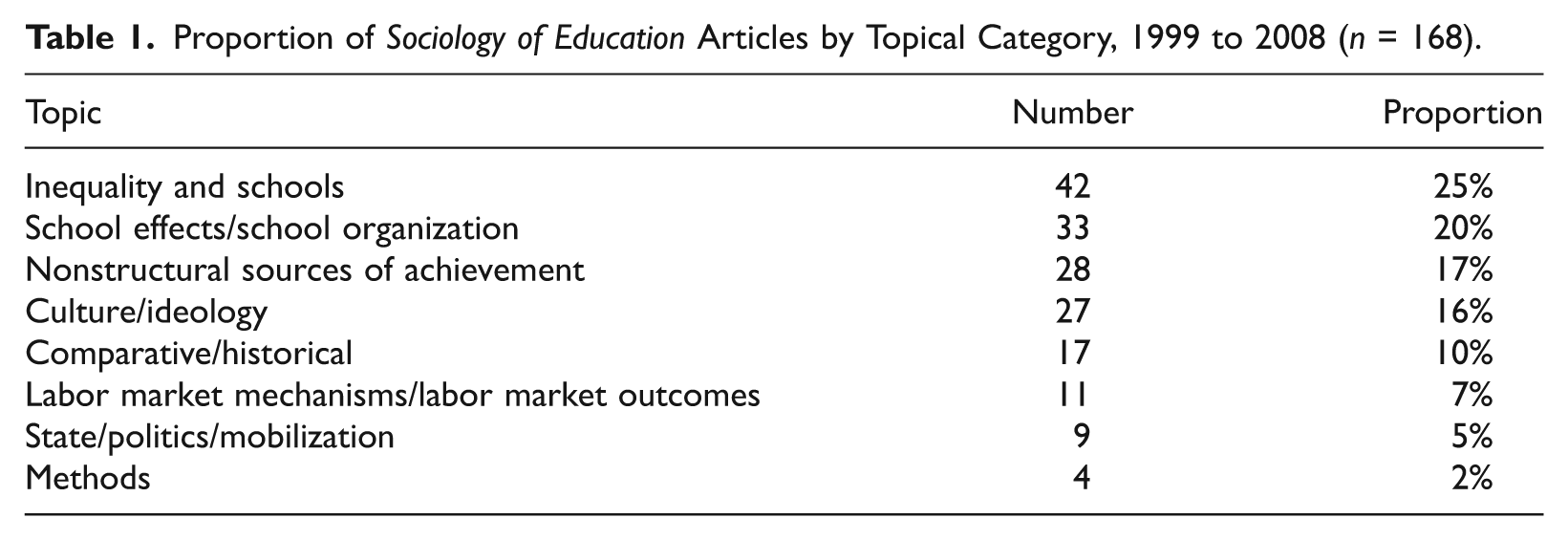
Only two of these eight topical areas, inequality and school effects/school organization, were the subjects of at least one fifth of articles (see Table 1). To a large degree, this reflects the core subjects of sociological analysis: inequality and social organization. We can gain more purchase on these two leading topics by looking at the more refined topical categories. Of the articles on inequality, 26 focused primarily on race and ethnicity, while 11 focused on gender, 7 on social class, and 5 on immigrants. These figures indicate that U.S. sociology of education is very much grounded in U.S. social relations. Race has been the pivotal division in American society, and the issue of black-white achievement gaps has been one of particular interest to American sociologists, following the influential work by Christopher Jencks and Meredith Philips on this topic in the late 1990s. Moreover, U.S. school policy has also been strongly oriented to reducing inequities by race, as evidenced by the legitimating language surrounding the U.S. No Child Left Behind Act of 2001, which sought to overcome “the soft bigotry of low expectations” for minority children. Surely, in most of Europe, immigration status is a more significant structural category, and one would expect to see variation along these lines.
Proportion of Sociology of Education Articles by Topical Category, 1999 to 2008 (n = 168).
Other structural bases of inequality received less attention. Social class was thoroughly analyzed in previous generations, and the major advance in recent years has been the incorporation of wealth measures into achievement and attainment models, as in the work of Dalton Conley. Gender has a far more limited differentiating influence in the United States. Indeed, as in the rest of the developed world, girls now greatly outdo boys in grades, verbal test scores, and college enrollment.
Articles studying the influence of school organization on achievement were nearly as common. In these articles, dimensions of variation in school organization—including sociodemographic composition of schools, school size, sector (private or public), tracking structure, and site-specific instructional styles—were analyzed for their associations with variations in student performance. Thus, the articles researched such topics as the connection between instructional activities and student engagement, school financing and achievement in urban school districts, school size and students’ psychoemotional adjustment, and the connection between tracking, student effort, and student achievement.
Indeed, the interaction between school organization and social inequalities is an important thread running through the past decade of work in Sociology of Education. Thus, for example, one article discussed how in socioeconomically similar schools, greater concentrations of minority students leads to the raising, rather than the lowering, of expectations for higher level degrees. Another showed that in comparative perspective, inequality between groups can widen in the initial phase of expanding educational opportunity, because the most advantaged groups are the first to exploit any new opportunities that policy changes offer.
The next largest group of articles belonged to the category I have termed “nonstructural” sources of achievement. Here, I categorized articles about social structures, attitudes, and behaviors linked to school performance but only distally related to the most important structural bases of social inequality in American society. In this category, we see articles focusing on family structures such as cohabitation and divorce; behaviors such as the timing of sexual initiation, obesity, and drinking; and academic resources, such as effort and academic skills developed in prior schooling. We can contrast sociologists’ focus on structural versus nonstructural bases of inequality, running over the past decade at a ratio of approximately 4:3 in favor of structural bases of inequality. Thus, one of the fault lines in studies of education divides those who place priority on categorical social inequalities and those who place priority on attitudes, behaviors, and practices that explain interstratum variation in achievement. This is a bigger issue in U.S. sociology generally, one that is relevant to the sociology of health behavior and the sociology of occupational advancement, as much as the sociology of education.
Why do we see this controversy? Many U.S. sociologists (particularly those who are closer to the center of the political spectrum) are impatient with the blunter forms of social determinism represented by those who root behavior in social structural advantages and disadvantages, and an equal or larger number of U.S. sociologists (particularly those who are closer to the left of the political spectrum) are impatient with those who focus on behavioral choices and effort to the relative exclusion of broader influences on educational outcomes due to structural inequalities.
U.S. sociology of education remains rooted in the “hard,” measurable realities of inequality, school organization, family structure, and individual behavioral choices. At the same time, like so much of the broader field of sociology, Sociology of Education has also experienced its own “cultural turn” during the past decade, and we have begun to see many more “soft” articles that examine how cultural meanings influence school outcomes. In one, Regina Deil-Amen and James Rosenbaum showed that efforts to reduce stigma from remedial education have unintended consequences on students’ understandings of schooling by failing to provide realistic feedback on skill levels. In another, my students Mary F. Contreras and Michael T. Matthews and I described the socialization climate of primary schools, linking emphases on self-esteem and praise to U.S. consumer culture. These articles have the appeal of taking seriously the mental picture that the schooling institutions project and the mental pictures that students bring with them to schooling.
As we move down to the bottom half of Table 1, we become more aware of what is missing from Sociology of Education than what is present. More than 90 percent of articles were about schools in the United States, rather than about schooling in other countries, a level of nationalist focus that is perhaps surprising for a country whose leaders touted globalization so frequently during this period. Indeed, the insularity of Sociology of Education is more profound than even this figure suggests. A majority of the comparative articles were published because they shed light on issues in U.S. sociology of education, such as whether educational expansion reduces social inequality and why some systems are better able to incorporate minorities than others.
Other less represented topics are equally surprising. Because schooling is, above all, preparation for adult work and civic life, it may be surprising that fewer than 10 percent of the articles focused on labor market mechanisms or labor market transitions. And of course, as we can see from these data, interest in the state or political groups as actors in the construction of schooling (or as a beneficiary of schooling) is weaker still. The collective mind represented in Sociology of Education has distinctive interests and biases, and these interests evidently do not include most of the rest of the world, the U.S. capitalist market economy, or state-based policy coalitions struggling over the forms and functions of schooling. We can gain a more detailed sense of what is deemphasized in the collective mind through examination of the more refined topic categories, as shown in Table 2.
Infrequent Subjects in Sociology of Education, 1999 to 2008 (n = 168).

Theoretical Versus Empirical Engagements
One conclusion I have drawn from reading a decade’s worth of articles in Sociology of Education is that U.S. sociologists of education have relatively little regard for theory. The vast majority of articles can be described as empirical examinations of relationships between variables measured in national surveys. Many of the titles of the articles convey the authors’ intent to examine empirical relationships, taking into account a standard battery of controls, to identify or to explore further heretofore unappreciated relationships. Thus, we have articles with titles such as “Gender, Obesity, and Education,” “Tracking, Student Efforts, and Academic Achievement,” or “High School Exit Exams and Dropouts.” These articles might be pejoratively characterized, in C. Wright Mills’s term, as “abstracted empiricism”; in other words, the investigation of sociological phenomena without significant concern for theory testing or the accumulation of propositional knowledge about schooling and society.
At the same time, we might wish to reconsider the usefulness of the term abstracted empiricism, because one common pattern found in these articles is the effort to engage, critique, or explain a previously posited empirical relationship, particularly one with important public policy implications. Thus, a number of writers dig into the causes of the educational gap between blacks and whites in the United States. Perhaps this form of investigation is not properly characterized as “abstracted empiricism”; instead, it is rooted in a real social problem with important policy implications. Here one sees the evident interest in the field in the amelioration of the negative consequences of social inequalities, a common outlook among sociologists of education (indeed, sociologists generally) who ground their work in social reform aspirations rather than purely scientific motivations to develop theory to better understand the working of social relations and social institutions.
Not all of the articles were entirely atheoretical. Pierre Bourdieu’s cultural capital theory is tested and refined by several authors, some drawing on Annette Lareau’s application of Bourdieu to family socialization practices. John W. Meyer’s “world polity” theory is investigated by two authors. Michael Hout and Adrian Raftery’s theory of maximally maintained inequality is subjected to investigation by two researchers. In one article, Samuel Bowles and Herbert Gintis reconsider their theory of schooling in capitalist America in light of recent scholarship, finding evidence to support some but not all of its propositions of their well-known 1976 book. In another, Randall Collins’s theory of credentialism is compared with human capital theory using the critical test case of employer-sponsored vocational training.
I identified only one ongoing debate in the journal related to a conceptual idea or theory. In the 10-year period, no fewer than five articles challenged the “oppositional culture” idea of John Ogbu: that highly subordinated minority students develop counter–school culture attitudes and behaviors. Sociology of Education authors attacked this idea in a variety of ways: showing that minority-concentrated schools include more students with high aspirations; showing that prior skills, rather than social disadvantage, explain the development of attitudes consistent with oppositional culture; or exploring the ways African American students manage dual identities: ambition to succeed combined with awareness of degrees of anti-intellectualism in their home environments.
It is unclear whether the near absence of theory and theoretical debate in Sociology of Education reflects the weakness of existing theoretical perspectives or simply the much greater interest of sociologists of education in exploring the truth or falsity of posited empirical relationships regarding social problems related to schooling using sophisticated analytical techniques on high-quality data sets. Whatever one makes of this, it is clear that statistical knowledge and data collection technology has advanced much faster than theory in the sociology of education and that the leading graduate programs are teaching data manipulation skills and encouraging students to make their careers by exploring underinvestigated empirical relationships rather than working on testing or developing theory. In terms of the standard scientific model of theory-grounded knowledge, this is a problem; in terms of understanding the empirical world of schooling as it currently exists in one national context, it may not be.
Conclusion: Notable Truncations
I will conclude by considering U.S. sociology of education in relation to alternative “collective minds” that could, in theory, define the field. One clear possibility is for a more international, comparative sociology of education. Unlike the founders of the discipline, U.S. sociologists have gravitated toward a narrow, nation-specific understanding of schooling. Such a change would require greatly reduced nationalism, broader historical and comparative training, and less parochial views about social relations and social institutions. Although one might hope for such an evolution in the field, it does not seem to be in the offing any time soon.
Another alternative conception would be to locate schooling in the context of non-school-based educational influences and institutions. At the moment, we have a sociology of schooling, rather than a sociology of education. A broader sociology of education would certainly be less school focused and instead compare schools with competing culture producing and knowledge creating institutions (such as religion and popular media) as influences on individual (and group) behavior and thought. As I noted in another work,
In adult life, the knowledge taught in school does not necessarily count for more than other forms of knowledge, such as common sense, popular culture, merchandising, folklore, and religious belief. . . . Moreover, some of these other “knowledge systems,” such as popular culture and religious traditions, have become more, not less important in shaping cognition (Brint 2006: 98).
The advantage of focusing on schooling, of course, is that schools are brick-and-mortar places that can be readily accessed and studied.
The subdiscipline’s one-sided focus on the society-to-school link creates a different sort of truncation. In the sociology of education, as currently constituted in the United States, we see very few studies of the other side of the relationship—the school-to-society link—whether this be the effects of formal education on the structure of labor markets (through credentialism and professionalization), on culture (through the creation of tastes, values, consciousness, and status cultures), or on individual behavior following the completion of schooling (through, for example, changes in parenting or in religious or political participation). Variations in students’ social backgrounds figure as inputs to schools, but levels and types of schooling only rarely figure as inputs to society or culture. A few scholars, such as Paul Kingston, have pursued the school-to-society link in recent years, but their work is marginal to the main topics in the subdiscipline.
In sum, today’s sociology of education in the United States is the study of the effects of social structure and school organization on educational achievement. These are undoubtedly very important subjects. But conceptions of alternative collective minds may suggest the limits of the current constitution of the field. In the United States, ours has been a nationalist sociology of schooling, not a sociology of all forms of education in global society. It has, in addition, been a sociology of schooling’s dependence on social inequalities, not of the dependence of society on the production of the carriers of school socialization and knowledge. A more rounded perspective would, I believe, lead to a stronger appreciation of education’s contribution to the construction of society and culture, one that might keep more of us optimistic about the great social enterprise we study, even as, true to our roots in social reform, we remain dismayed about its failures to provide equal opportunities for all.