



Abstract
By most media accounts, charter schools are innovative schools. But little empirical work interrogates this idea. We examine the growth and decline of specialist charter school mission statements as one indicator of innovation. In line with theories of resource partitioning, we find that specialist charter school missions—those asserting innovation with regards to populations served, curricula utilized, and/or educational focus—have become increasingly diverse over time. However, simultaneously, we find support for a generalist assimilation hypothesis: Charter schools have come to resemble traditional schools through isomorphic tendencies over time. Hence, we show that although specialist charter schools are becoming increasingly diverse in their missions, these charter schools are increasingly making up a smaller portion of the population. We also find, counter to charter school advocates’ intentions, that states with more permissive charter school laws are those that also tend to have a great proportion of charter schools with generalist missions. Our findings contribute to a theoretical understanding of specialist organizations by considering specialization as an example of innovation in the charter school population. Furthermore, our findings have implications for the way charter school laws are created and enacted to foster innovation through specialization.
Politicians, educators, and lay people have embraced the idea that the U.S. school system needs innovation to correct its perceived decline in quality. The charter school movement, promoted and enacted in 42 states and Washington, DC, has promised to provide such innovation. Indeed, nearly all states promote charter schools to encourage innovation in academic programs (Wohlstetter, Smith, and Farrell 2013). Similar to many states’ laws (Lubienski 2003), Maryland’s states: “The general purpose of the [charter school] program is to establish an alternative means within the existing public school system in order to provide innovative learning opportunities and creative educational approaches to improve the education of students” (Maryland Public Charter School Act 2003). Furthermore, many school founders cite innovation as the main reason to establish a charter school (Andrews and Rothman 2002; Lubienski 2004; Medler 1996). The extent to which charter schools are innovative is disputed however (Bulkley and Fisler 2003; Lubienski 2003; Preston et al. 2012).
In their early development, charter schools may espouse innovation through their stated missions. Such missions define schools’ intended goals and indicate the extent to which they seek to depart from standard practice by specializing in a particular population of students or by offering a special curriculum or educational focus (Lubienski 2004). As we will explain, in public education, such specialization is a unique form of organizational innovation. To what extent charter schools as a population have specialized missions that answer the call for innovation, however, has yet to be examined empirically.
By examining specialization among charter schools over time, we provide the first population-based study of innovation among charter schools. Guided by organizational theories, we attend to two processes of change. First, we examine schools’ missions to identify those that specialize and how the heterogeneity of this specialization has changed over time. Here we reveal the degree to which charter schools’ innovations are converging around a few specialist school types or diversifying in their specializations. Second, we assess how the overall prevalence of specialist schools in the population has changed over time. Our results show the extent to which the charter school population as a whole is becoming more or less likely to espouse specialist rather than generalist educational aims. We not only quantify these population changes but also examine several mechanisms to explain them. Our findings help describe and explain the changes in the prevalence of different types of charter schools, which increasingly educate a larger portion of the public school student population.
Our work extends previous research on organizational innovation in education in three ways. First, by using population-level analyses, we contextualize the model charter schools cited by movement advocates and the Department of Education as “laboratories of innovation” (U.S. Department of Education 2004), thereby informing core debates about the changing innovative potential of the charter school population as a whole. Second, we help clarify how statewide legislation and local contexts influence the extent to which charter schools embrace innovation. Finally, we provide a much needed theoretical framework for examining and understanding innovative educational forms. Our work builds on prior studies that use organizational theories to study educational organizations or populations (Meyer et al. 1994; Meyer and Rowan 1978; Renzulli 2005; Renzulli and Roscigno 2005) and synthesizes theories of resource partitioning and neo-institutionalism to predict the expansion or consolidation of specialist (i.e., innovative) charter schools.
Charter Schools: Organizational Specialization Is Innovation
The concept of innovation ranges from technical innovation to market niche innovation (Abernathy and Clark 1985; Henderson and Clark 1990). We draw on the conceptual frame of market niche innovation in our examination of charter schools, much like King, Clemens, and Fry (2011). Innovation of this type is evident when “an otherwise stable and well specified technology is refined, improved or changed in a way that supports a new marketing thrust” (Abernathy and Clark 1985:10). In this sense, organizations are innovative when they open new market opportunities (Henderson and Clark 1990) or forms (Lubienski 2004). What it takes to be innovative thus varies over time and from one population of organizations to another; it may involve new products or services, new methods or techniques, specialization, or some combination of these (Abernathy and Clark 1985). Ford Motor Company, for instance, was innovative because it sold cars, a product that was generally not available on the market previously. McDonald’s was innovative in its approach to selling an existing product, namely, hamburgers. Bakeries that specialize in cupcakes are a more recent innovation; although the product they sell and the procedures they use are not new, specialized cupcake bakeries are new.
In the educational landscape, which is dominated by generalist public schools that offer a broad curriculum and serve all students, specialization is one way to be innovative in the market (King et al. 2011). Innovative schools may specialize in the populations served, curricula utilized, or educational foci. According to the Department of Education, the very act of specializing “reflects the school’s freedom to experiment, to be creative in terms of organization, scheduling, curriculum, and instruction” (U.S. Department of Education 2004). In addition, theorists argue that specialization is a form of innovation for charter schools because it results in a new type or process of education offered in the market (Lubienski 2004).
Charter schools are thus well positioned to do something new and different, but they are often not held accountable (Bulkley and Fisler 2003; Lubienski 2004). Their ability to be innovative is rooted in the regulations that govern charter schools’ creation and operation; they are public schools that can be created by groups of lay people, educational management organizations (EMOs), or school districts. Because they agree to be accountable for student success, charter school administrators are exempt from most bureaucratic conventions as well as state and local regulations (except those related to health, safety, and nondiscrimination). 1 This legal structure allows charter schools to have specialized curricula, target populations, or foci that differ from their other public school counterparts. Legislative initiatives and the rhetoric of innovation among charter school supporters may thus spur charter school founders to develop specialist schools that meet cultural and political expectations of innovation. Alternatively, charter schools may capitalize on the freedom from bureaucratic conventions but maintain non-innovative generalist missions (Lubienski, Gulosino, and Weitzel 2009).
We assess evidence of innovation among charter schools by examining whether their mission statements set specialist or generalist goals. Charter schools with specialist missions embrace innovation in their aim to provide alternative educational options, often to targeted populations, that depart from generalist goals (U.S. Department of Education 2004). Charter schools’ practices may be used in other schools, but the act of specializing makes them different. Most traditional elementary schools, for instance, have an art class, but specializing in art and aiming to infuse art in the entire curriculum is innovative, albeit in an incremental rather than radical way (Henderson and Clark 1990). Charter schools that embrace a more generalist mission, in contrast, do not aim to educate differently. Rather, these founders may choose to create charter schools simply to avoid the restrictions imposed by local boards of education and certain state and local rules and regulations. As we will explain, this conceptualization of innovation is closely related to theories of resource partitioning and neo-institutionalism.
Resource Partitioning and Neo-institutional Theory
The theory of resource partitioning places organizations into two broad categories: generalists and specialists (Baum 1996; Freeman and Hannan 1983). Generalists depend on a large range of environmental resources and appeal to a wide audience. Specialists, in contrast, target a narrower audience and usually survive in environments where there is interest from subpopulations. Theoretically and empirically, these types of organizations exist simultaneously within the same environment, but they rely on different resources (Carroll 1985). Resource partitioning theorists argue that the niche width for each type of organization will vary based on organizations’ needs, as either generalists or specialists. Generalist organizations occupy the center of an environment and effectively partition the market along the periphery (Freeman and Hannan 1983). Specialist organizations, which occupy a smaller piece of the environment, can take advantage of unused resources left by generalist organizations in their narrow niche space.
The introduction of charter schools into an environment dominated by generalist public schools has the potential to encourage the development of specialists in unoccupied niches. A niche is the expression of the “ways in which the growth rates of populations depend on resources and on the actions of other populations” (Freeman and Hannan 1983:1118). More importantly, niche width depicts a population’s ability to survive varying levels of resources and competitors (Carroll and Swaminathan 2000). The theory of resource partitioning helps us understand how the environment affects the emergence of generalists and specialists in a population of organizations, and it is particularly useful for studying the population of charter schools.
In addition to resource partitioning, understanding charter school populations necessitates that we draw on neo-institutional theory. The neo-institutional principle of isomorphism predicts that organizations in a population will coalesce around similar characteristics and thus come to resemble each other (DiMaggio and Powell 1983; McKendrick and Carroll 2000; McKendrick et al. 2003). Because organizations compete for resources, political power, and institutional legitimacy, an isomorphic tendency may help an organization form (Renzulli 2005) and survive (DiMaggio and Powell 1983). Neo-institutionalism can thus help explain how a population of charter schools may adopt particular sets of characteristics.
Mission Heterogeneity: Specialist Mimicry or Generalist Assimilation
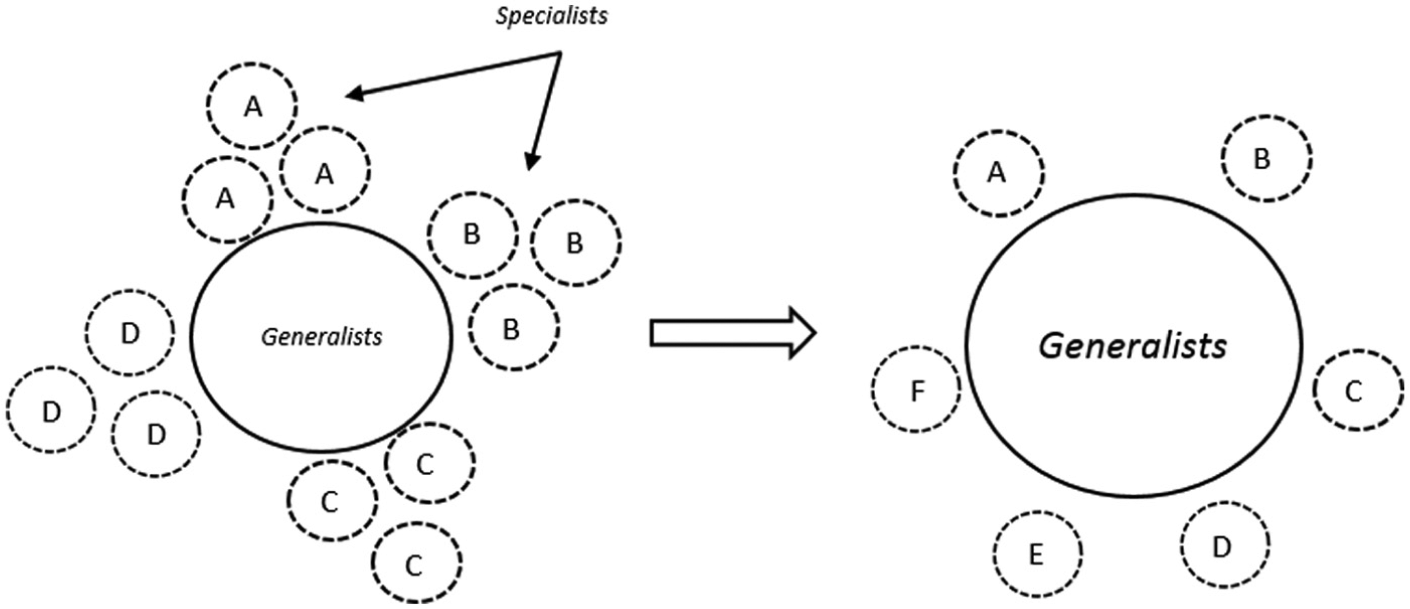
Contrary to the claims of charter school advocates, organizational theories imply that charter schools will show strong isomorphic tendencies rather than sustained and diversified specialization. This isomorphism may arise in the charter school population through two different processes. First, following resource partitioning, charter schools may begin as specialist innovators in niche spaces; but, as neo-institutionalism suggests, even specialists need legitimacy, and so these schools may become similar to one another over time (Greve and Rao 2012; King et al. 2011). This is the specialist mimicry hypothesis of decreased heterogeneity. Second, drawing mainly on insights from neo-institutionalism, charter schools may become more isomorphic with generalist schools to gain legitimacy as a school form. Given this possibility, we also outline the generalist assimilation hypothesis. Figure 1 depicts both hypotheses.

Hypothesized patterns of change in charter school specialization.
Specialist Mimicry Hypothesis
Charter schools have the opportunity to occupy a unique piece of the educational market. Charter school creators can only open specialist schools that the surrounding community desires; thus, there is a limit to how charter schools can specialize. We argue that specialized charter schools draw resources from subpopulations with limited resources, and over time, this specialized group will coalesce around fewer specialist types to gain legitimacy (Greve and Rao 2012; Henig et al. 2005). Because school founders do not know a priori what forms will become legitimate, more types of specialization enter the market than the market can sustain. Specialists compete for resources in the periphery, and those granted resources will gain legitimacy and survive while other innovations are selected out of the environment. The surviving specialist types will have legitimacy, and new organizations with the same specialization will open. This maturation process has occurred in other industries (e.g., wineries and voluntary social service organizations) (Carroll and Swaminathan 2000; Swaminathan 1995; Tucker, Singh, and Meinhard 1990). We expect charter schools follow a similar process, such that year 1 may have 20 different types of specialist charter schools vying for niche space, but only 5 may have survived by year 10.
Specialist mimicry suggests that charter schools will remain distinct from generalist schools but will do so in less diverse ways over time. As shown in Figure 1 (Panel A), the population of specialist charter schools may converge around a subset of specializations or innovations. Through this process of mimicry, heterogeneity among specialists will decrease over time.
Hypothesis 1: Over time, heterogeneity among specialist charter schools will decrease.
Generalist Assimilation Hypothesis
Whereas the specialist mimicry hypothesis concerns activity within niche spaces in the periphery, the generalist assimilation hypothesis concerns the potential expansion of the generalist center. Generalist assimilation suggests that over time, charter schools will become more like generalist schools. As shown in Figure 1 (Panel B), rather than specializing, charter schools will become more generalist.
Despite policymakers’ and advocates’ call for innovation in schooling, legitimate schools take a certain form, and deviations from that form may threaten school survival. As King and colleagues (2011) note, charter schools must balance legitimacy and identity. In the competition for resources (charter schools compete for students, political power, and institutional legitimacy), an isomorphic tendency toward generalists and their established legitimacy may help a charter school form and ultimately survive.
Consistent with neo-institutionalism, population heterogeneity should decrease due to isomorphic forces and limited resources flowing to generalist charter schools rather than specialist ones. If charter schools cater to the general population to gain legitimacy and attract students, we should see a decrease in the overall percentage of specialist charter schools in the population.
Hypothesis 2: Over time, the percentage of specialist charter schools in the population will decrease.
Mechanisms for decrease in heterogeneity
We also consider why one of these patterns of decreased heterogeneity (increased isomorphism) may arise within the population of charter schools over time. Changes in the heterogeneity of specialists or in the percentage of specialist schools might be a response to changing regulations or the successes and failures of existing specialist schools. We explore how state laws and patterns of charter school success over time influence specialist heterogeneity and the presence of specialization.
Coercive isomorphism results from political and social pressures to meet cultural and regulatory expectations (DiMaggio and Powell 1983) and will affect the type of schools that are formed. We thus examine how state laws affect the formation of charter school specialists and generalists. More permissive policies on the opening and operating of charter schools allow for more charter schools—either generalist or specialist—to be created. On the Center for Education Reform webpage, a charter school advocacy group, they state that “a good charter law is one that automatically exempts charter schools from most of the school district’s laws and regulations.” Restrictive charter school laws, in contrast, have more rigid guidelines relating to school commencement and operation (Vanourke et al. 1997). The greater freedom provided by permissive laws might allow charter schools to take more risks with specialist missions.
Hypothesis 3: Permissive state laws will be associated with an increase in both the heterogeneity among specialist missions and the percentage of specialist schools in the population.
Alternatively, lack of regulation in charter school laws might not promote specialization. If laws do not require charter schools to meet specialization requirements, then schools can easily open as generalists. For example, the Center for Educational Reform currently ranks New Jersey’s law as fairly restrictive; its law states that “the establishment of charter schools as part of this State’s program of public education can assist in promoting comprehensive educational reform by providing a mechanism for the implementation of a variety of educational approaches which may not be available in the traditional public school classroom” (italics added) (New Jersey Charter School Program Act of 1995). This restrictive law explicitly encourages specialization. Arizona’s law, in contrast, is permissive and states only that the “application shall include a detailed business plan for the charter school and may include a mission statement for the charter school, a description of the charter school’s organizational structure and the governing body” (Arizona Procurement Code 2004). Charter school advocates herald the Arizona law as exemplary, but it makes no demands on schools for specialization or innovation. Specialization may be incredibly difficult to achieve; permissive state laws may thus encourage less specialization than charter school laws that list specialization or innovation as a requirement for opening. We thus have a competing hypothesis to Hypothesis 3:
Hypothesis 4: Permissive state laws will be associated with a decrease in both the heterogeneity of specialist missions and the percentage of specialist schools.
Finally, Strang and Macy (2001) urge researchers to consider success and failure as a predictor of innovation. In their words, “the search for excellence” is an important piece of organizational and population dynamics. In fact, they suggest that in some cases organizational theory is undersocialized, leaving organizational actors outside the equation. Applying their frame to schools implies that in an attempt to create the best schools, organizational actors who control the process of charter school approval will make decisions based on recent successes or failures of particular kinds of charter schools (King et al. 2011). We recognize this critique and extend their theoretical ideas of organizational actors to the population level by including hypotheses about charter school success and failure rates. In states where charter schools with specialist missions fail, authorizing agencies and founders may be reluctant to introduce more specialist schools, resulting in decreased heterogeneity among specialist missions and a decline in the proportion of specialist schools in the population.
Hypothesis 5: As the mortality rate of specialist charter schools increases, the heterogeneity among specialist missions and the percentage of specialist schools will decrease.
Data, Measures, and Methods
We created a unique longitudinal national data set of charter schools compiled from resources from the Center for Education Reform (CER). In its directories of open charter schools from 1994 to 2006 (Center for Education Reform 2006), the CER provides information on charter schools’ individual mission statements, enrollment, grades served, sponsorship, location, and date of inception. In its database of closed charter schools, the CER reports the date a charter school ceased operation, the explanation for closure (e.g., academic, financial, or facility), and more details regarding the recorded explanation (e.g., low test scores) (Allen, Beaman, and Hornung 2006). The CER is an admittedly pro–charter school foundation; therefore, we employed several reliability checks on data collected from this source (e.g., by cross-checking CER data with data from individual charter school’s websites and state departments of education). We cross-checked information on mission statements, closures, and openings for approximately 20 percent of the charter schools in our data set, and the CER’s information appears accurate and reliable. Information on CER’s data collection methods is available on their website (http://www.edreform.com).
Because we are interested in population-level analyses over time, our unit of analysis is the state-year. We begin in 1992, the year the first charter school was founded, and observe through 2005, resulting in 14 years of data. By 2005, 40 states and the District of Columbia had charter school laws, resulting in a data set with 574 potential state-years. Given that not all states actually had charter schools in all 14 years of data under observation, the analytic sample size is smaller. The empirical sample size is reduced to 308 state-years for the mission heterogeneity analyses, which exclude state-years in which no missions or only one specialist mission were present (n = 34), and 324 for the percentage of specialist schools analyses, which exclude state-years with no charters or only one charter. This reduction in data is explained further in the Results section.
Conceptualization and Operationalization of Specialization
We use charter school mission statements to study specialization as a special case of organizational innovation. Because mission statements are the documents charter school founders use in their efforts to legitimize their schools, obtain permission to open them, and advertise their goals, they contain key information regarding the intended population, curriculum, and focus of a particular school. These stated goals (or missions) indicate if a school seeks to be a specialist school and thus innovative (Lubienski 2004).
Specialist missions stipulate a curriculum (e.g., Montessori), a thematic focus (e.g., marine biology), or a target population (e.g., at-risk students) that differs from the conventional curriculum, academic focus, or universal population found in the generalist public schools. For example, one specialist mission statement in our data reads: “Educational achievement in an environment sensitive to the cultural needs of community students. Utilizes traditional Pima-Maricopa Indian cultural values for Native American population.” Generalist missions have no such cultural or population statements; a typical generalist mission in our data reads: “Prepares elementary students for successful high school careers.”
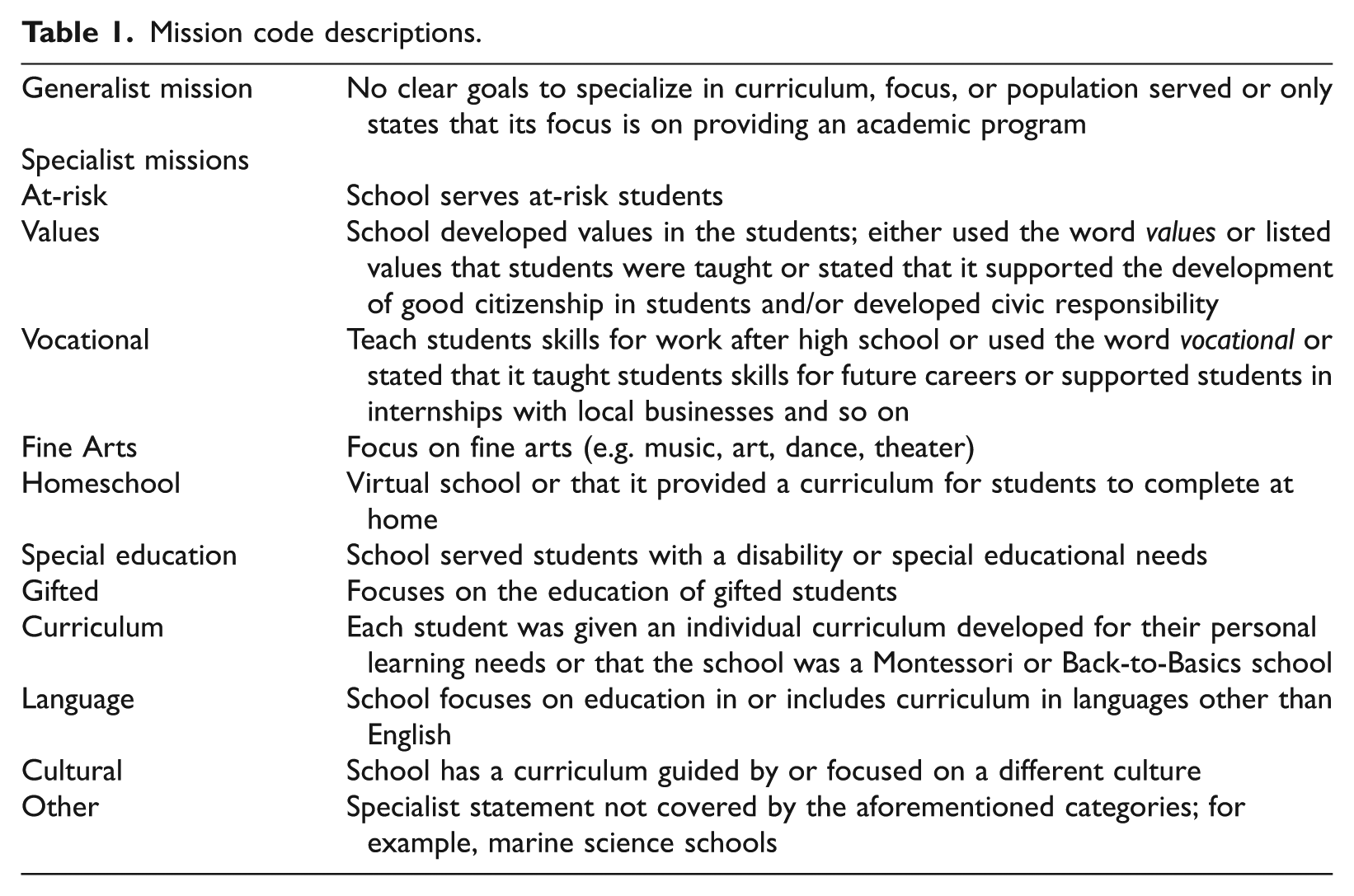
The coding of mission statements proceeded in several steps similar to the process Morphew and Hartley (2006) used when coding mission statements in higher education. First, we coded a sample of mission statements to establish a coding schema (this encompassed 12 potential types of individual missions included in each mission statement). After agreeing on the coding schema, we then recoded a sample of mission statements and checked levels of coding agreement. Each mission within a mission statement was coded by two researchers with an interrater reliability of .80; for the few cases in which there was disagreement, we discussed them and came to a consensus on coding. Each mission statement could have multiple missions (approximately 20 percent of statements had more than one mission), but no statement had more than three. After categorizing individual missions that appear in a mission statement as specialist (11 types of curricular or student specificity, see Table 1) or generalist (one type, academic focus with no mention of curricular or student specificity), we then categorized schools as either specialist or generalist based on their missions. Generalist schools had no specialist missions; specialist schools had one or more specialist missions.
Mission code descriptions.
Dependent Variables
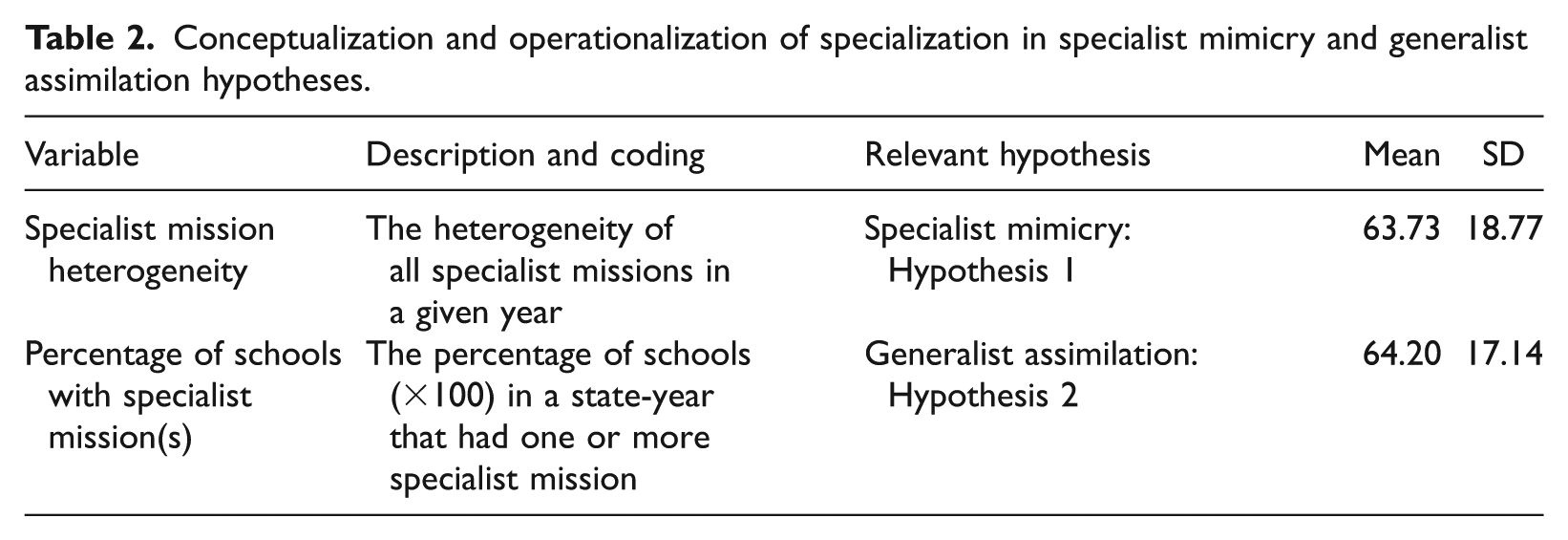
We use two dependent variables, created from the school-level mission codes aggregated to the state-year: the specialist mission heterogeneity in a state-year and the percentage of specialist schools in a state-year. Table 2 describes each variable and links each to the relevant hypothesis.
Conceptualization and operationalization of specialization in specialist mimicry and generalist assimilation hypotheses.
To calculate specialist mission heterogeneity, we first utilized the standard Index of Qualitative Variation (IQV) (Frankfort-Nacdhmias and Anna 2006:138–42):

In this equation, K equals the number of specialist mission types represented in any given state-year, and
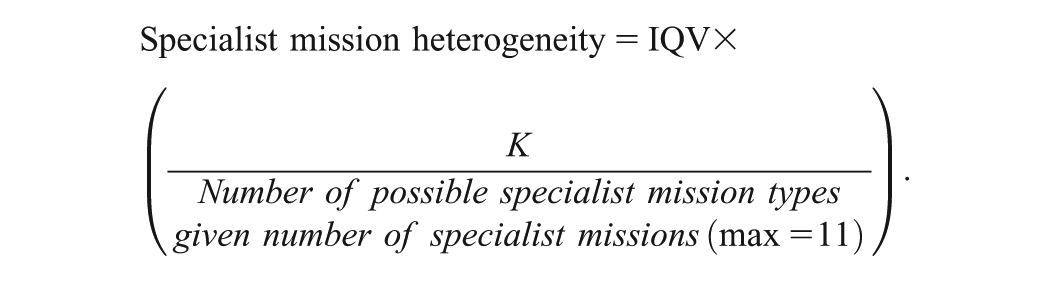
The resulting specialist mission heterogeneity score provides an index of qualitative variation indicative of the diversity of specialist missions, not among those that are actually represented but among those that could have been represented given the number of specialist missions in a given state-year. Applying this adjusted equation to the aforementioned example, state-year A maintains its heterogeneity score of 100 (specialist heterogeneityA = 100 × [10/10]), but state-year B is penalized because its 10 specialist missions are distributed across only 5 mission types. Instead of 100, state-year B’s specialist mission heterogeneity score is now 50 (specialist heterogeneityB = 100 × [5/10]).
The second dependent variable is the percentage of schools with specialist missions in a given state-year. To create this measure, we divided the total number of specialist schools in a state-year by the total number of schools in that state-year and then multiplied by 100. The resulting variable ranges from 0 to 100, with 0 indicating that no school in a given state-year was specialist in its missions and 100 indicating that all schools in a given state-year were specialist in their missions. 3
Independent Variables
Along with modeling change in specialist mission heterogeneity and the percentage of specialist schools, we also explore several predictors of this change. The first predictor is the percentile rank of each state’s law, as specified by CER, and is relevant to Hypotheses 3 and 4. The percentile rank indicates the percentage of states with more restrictive laws than a given state in a given year. For instance, in 2004, Minnesota was ranked second out of the 41 states or districts with charter school laws. This equates to Minnesota being in the 95th percentile (100 − [2/41] × 100) in that year, indicating CER rated its laws as more permissive than 95 percent of those in other states.
Our second time-varying predictor of interest (related to Hypothesis 5) is the mortality rate of specialist charter schools. We calculated this variable by dividing the number of specialist closures prior to any given state-year by the total number of specialist openings prior to that state-year and then multiplying by 100. A score of 50, for example, indicates that 50 percent of specialist schools that opened by a given year also closed by that year.
Finally, although we do not hypothesize how the year a state adopted a charter school law might affect our findings, our conditional models control for whether a state was an early adopter of charter school laws. Based on Renzulli and Roscigno (2005), who show that less than half the states that adopted laws did so by 1996, we use 1996 as the demarcation point for early adopters. 4 Early adoption status is positively associated with mortality rate (r = .20) and CER percentile rank (r = .16) and hence may confound the effects of these key predictors on our dependent variables. We coded this variable 1 if a state adopted a charter school law in 1996 or prior and 0 if the law was adopted after 1996. Table 3 describes these variables in more detail.
Independent variables of interest.

Analytic Strategy
Growth curve models are ideal for studying changes in the population of charter schools. Although one might assume that descriptive statistics showing mean population characteristics by year would allow us to depict changes in the population of charter school missions over time, such descriptive analyses would be misleading. First, unlike growth models, descriptive data do not allow us to quantify the average trajectory of change in the population of charter schools as a whole while accounting for the clustering of charter schools within each state. If this clustering were not accounted for via growth models, population estimates of change would be biased toward states with larger numbers of charter schools. Second, unlike descriptive data or bivariate statistics, growth models allow for multiple predictors of population change to be estimated simultaneously via conditional models. These conditional models are essential to properly specifying the effects of state and local context on population change and to understanding how well these state and local characteristics explain population trajectories.
Our first set of hypotheses concerns two potential types of change: change in specialist mission heterogeneity (specialist mimicry, Hypothesis 1), which tests the extent to which the population of specialist schools is converging around particular specialist missions, and change in the percentage of specialist schools (generalist assimilation, Hypothesis 2), which tests the extent to which schools are becoming more or less likely to pursue specialist missions. Each type of change can be represented through a two-level hierarchical model, in which we view the yearly observations as nested within states. 5 The resulting model provides us with the mean growth trajectory from 1992 through 2005 for the 41 states or districts under investigation.
For each outcome, we explored the possibility of higher order (i.e., quadratic and cubic) growth parameters to capture potential nonlinearity in growth trajectories. In no model was the cubic growth parameter significant; hence, the highest order model estimated was a quadratic growth model. Using the first outcome of interest, specialist mission heterogeneity, as an example, the quadratic Level 1 model takes the following form:

In this Level 1 equation, the intercept, π0i, represents the heterogeneity of state i in year 1999, the midpoint of our observation period and the point at which we centered our time indicator. The linear component, π1i, is the instantaneous growth rate for state i in year 1999, and π2i captures the curvature or acceleration in each growth trajectory. We assume the error term, eti, is independently and normally distributed with a mean of 0 and a constant variance, σ2. The unconditional Level 2 equations are as follows:

In these models, only the intercept is specified as randomly varying across states. Both the growth parameter and the acceleration parameter are specified as fixed effects. After assessing baseline change in our two dependent variables (Hypotheses 1 and 2), we turn to Hypotheses 3 through 5 in fully conditional growth models. These conditional models allow us to test the extent to which changes in population heterogeneity can be explained by our state and time-varying predictors and help us understand the mechanisms of change.
Results
Prior to modeling change in specialist mission heterogeneity and in the percentage of schools with specialist missions, we examined the statistical distributions for our two dependent variables. Given the proportional nature of the dependent variables, we expected non-normality. Our expectations were confirmed: For each dependent variable, the relatively large number of 0 and 100 scores results in a trimodal distribution, peaking at each endpoint and in the center. This non-normality, however, is driven by the state-years in which only one school was open. For the specialist heterogeneity measure, 34 of the 342 state-years in which any specialist schools were open had only one specialist school. Likewise, for the percentage of specialist schools measure, 30 of the 354 state-years in which any school was open had only one school. After excluding these state-years from their respective analyses, both dependent variables approximate normality. This reduction in cases is justified empirically and theoretically. Empirically, linear growth models assume approximate normality in the dependent variable. Violations of this assumption may bias estimates. Furthermore, state-years with only one school are not theoretically interesting, as they will always be fully homogenous and totally specialist or generalist.
The following analysis modeling change in specialist mission heterogeneity includes only the 308 state-years with more than one specialist mission; the analysis for the percentage of specialist schools includes only the 324 state-years with more than one school. Because Mississippi never had any state-years in which more than one school was open (specialist or otherwise) and because 1992, the year the first charter school opened, did not have any states with more than one charter school, the total number of states in the analyses was reduced to 39, plus Washington, DC, and the total number of years to 13 (1993 through 2005).
As Table 4 shows, when only specialist missions are considered, both the slope and acceleration parameters differ significantly from zero, indicating a curvilinear relationship. A likelihood ratio test comparing the deviance statistic of the linear model to that of the squared model indicates that the squared model fits these data better than did the linear model (χ2 = 13.28, P < .001). This quadratic model shows a significant slope coefficient of 2.60 and significant acceleration parameter of −.28. This indicates that contrary to Hypothesis 1, across the observation period there was a significant increase in specialist mission heterogeneity, with a leveling off in later years. This increase in heterogeneity among specialist missions is modeled in Panel A of Figure 2.
Results of the baseline growth models.
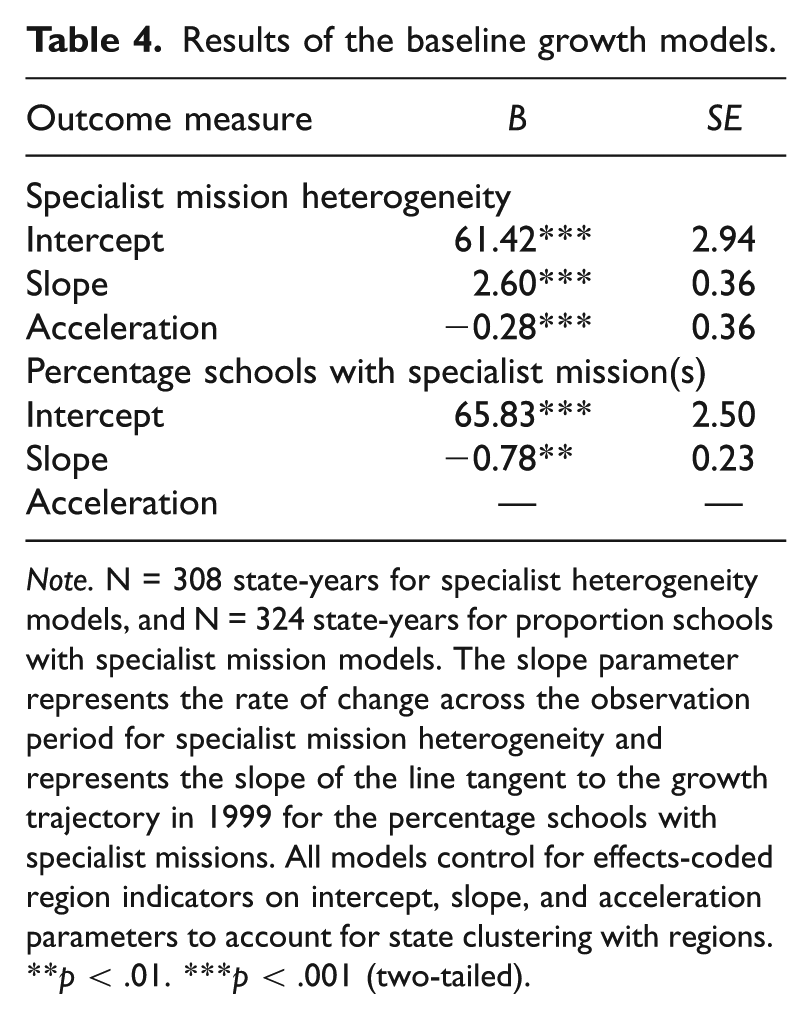
Note. N = 308 state-years for specialist heterogeneity models, and N = 324 state-years for proportion schools with specialist mission models. The slope parameter represents the rate of change across the observation period for specialist mission heterogeneity and represents the slope of the line tangent to the growth trajectory in 1999 for the percentage schools with specialist missions. All models control for effects-coded region indicators on intercept, slope, and acceleration parameters to account for state clustering with regions.
p < .01. ***p < .001 (two-tailed).

Growth trajectories of specialist mission heterogeneity (Panel A) and the percentage of schools with specialist missions (Panel B) as a function of time.
Post hoc analyses support this finding of increased heterogeneity among specialist missions. For example, in 1999, the midpoint of the observation period, the two most prevalent specialist mission types—to serve at-risk students and to provide values-based education—comprised over half (50.95 percent) of all specialist missions. By 2005, however, the two most prevalent specialist missions were the same but now accounted for only 33.43 percent of all specialist missions. Supporting the growth model in Panel A of Figure 2, these descriptive data reveal that the dominance of any few specialist missions decreased over time.
The second and final growth model addresses Hypothesis 2 and estimates change in the percentage of specialist schools in the population over time. In expanded models (not shown), neither the quadratic nor cubic parameters reach statistical significance. Furthermore, a likelihood ratio test comparing the deviance statistic of the linear model to that of the squared and cubic model indicates that these latter models do not fit the data better than the linear model. Hence, the linear model best describes change in the percentage of schools with specialist missions over time. Supporting Hypothesis 2, the significant slope term of −.78 indicates that on average, a state is expected to reduce its percentage of specialist schools by about .78 percentage points per year. This change is modeled in Panel B of Figure 2.
Taken together, the baseline growth models suggest a nuanced story of charter school specialization and heterogeneity. Our findings suggest two offsetting trends, as shown in Figure 3: Although specialist missions have become more heterogeneous over time, schools with such missions make up a smaller proportion of schools in the market, consistent with isomorphic pressure toward generalist schools. These diverging trends hold when we model change not in all open schools but only in schools entering the population in a given state-year. 6
Empirical patterns of change in charter school specialization.
Table 5 displays the fully conditional growth models testing the mechanisms behind changes in population heterogeneity and specialization (Hypotheses 3, 4, and 5). Although Hypothesis 1 is not supported (specialist mission heterogeneity increased rather than decreased over time), we continue to explore how state-level regulations (as indicated by the permissiveness of the law) and previous specialist deaths might affect specialist mission heterogeneity. As Table 5 shows, both CER percentile rank and cumulative specialist deaths significantly predict specialist mission heterogeneity. Permissive laws are associated with increased specialist mission heterogeneity (supportive of Hypothesis 3), but mortality among specialist schools predicts decreased heterogeneity (supportive of Hypothesis 5).
Results of the fully conditional growth models.

Note. N = 308 state-years for specialist heterogeneity models, and N = 319c state-years for percentage of schools with specialist mission models. All growth parameters are centered at year 1999. All models control for effects-coded region indicators on intercept, slope, and acceleration parameters to account for state clustering with regions.
Time-varying predictors are grand-mean centered.
Early adopter status is effects-coded and uncentered.
Five state-years were excluded in this conditional model because only 319 out of 324 state-years with more than one charter school had open charters the year before. Cumulative specialist deaths could not be calculated for five state-years.
p < .10. *p < .05. **p<.01. ***p < .001 (two-tailed).
Both variables are also significant in predicting the percentage of specialist schools in the population of charter schools. After controlling for state early adopter status, which approaches significance in both models, CER percentile is negatively associated with the percentage of specialist schools in the population, such that for each one-point increase in CER percentile, the percentage of specialist schools decreases by .19 percentage points. That is, supporting Hypothesis 4, in state-years with permissive laws, schools with specialist missions made up a smaller percentage of all schools. 7 Furthermore, supporting Hypothesis 5, Table 5 shows that for each percentage point increase in specialist deaths, the percentage of schools promoting specialist missions decreased by .28 percentage points. That is, deaths of specialist charter schools in preceding years predict a smaller percentage of specialist schools the following year.
The number of charter schools entering the population in any given year is typically greater than the number of schools that closed prior to that year. Hence, the decline in the percentage of schools with a specialist mission was not solely due to specialist deaths. When we restrict our sample to include only incoming schools, we find similar results. That is, the percentage of new specialist schools decreased over time, and this decrease is significantly predicted by prior deaths among specialist schools. Thus, the population is not changing solely because specialist schools are dying; rather, schools entering the population seem to be responding to these specialist deaths.
With the entrance of these significant time-varying predictors into the model, the slope parameter indicating linear change in the percentage of schools with specialist missions over time attenuates to nonsignificance. Such a finding means the decline in the percentage of specialist schools can be explained by changes in state laws and cumulative specialist deaths, supporting structural and socialized bases for organizational foundings.
Post Hoc Analysis: Charter School as the Unit of Analysis
After examining the growth curve models, we began to wonder if the same theoretical predictions and empirical realities would play out at the organizational level rather than the population level. This seems of particular importance for an analysis of charter schools, given the individual nature of starting a school and the way local environments affect school formation (Renzulli 2005). If charter schools are increasingly likely to enter the population with nonspecialist missions, why would any individual school enter the market with a specialist mission statement? In a post hoc analysis, we turn to the charter school as the unit of analysis to examine how robust our findings are to different methodological approaches and units of analyses. This allows us to predict an individual school’s mission statement as specialist or generalist.
To do so, we use a logistic regression model and adjust standard errors for the clustering of schools within states. Our unit of analysis is the charter school, and our sample size is now 3,964. Our dependent variable is the likelihood that an individual school will have a specialist mission statement. We used a set of controls, most of which came from district-level data found in the Common Core of Data and the NCES, 8 a timing variable (the year a school opened minus the year the state adopted the charter school law), and then examined the same sets of mechanisms we hypothesized in the growth curve analyses (see the Table 6 for variable details). Consistent with our findings from the growth curve models, we find that failure among specialist charter schools and permissive charter school laws significantly affect the likelihood that any individual school will open with a specialist mission.
Descriptives for variables of interest in post hoc logit models.
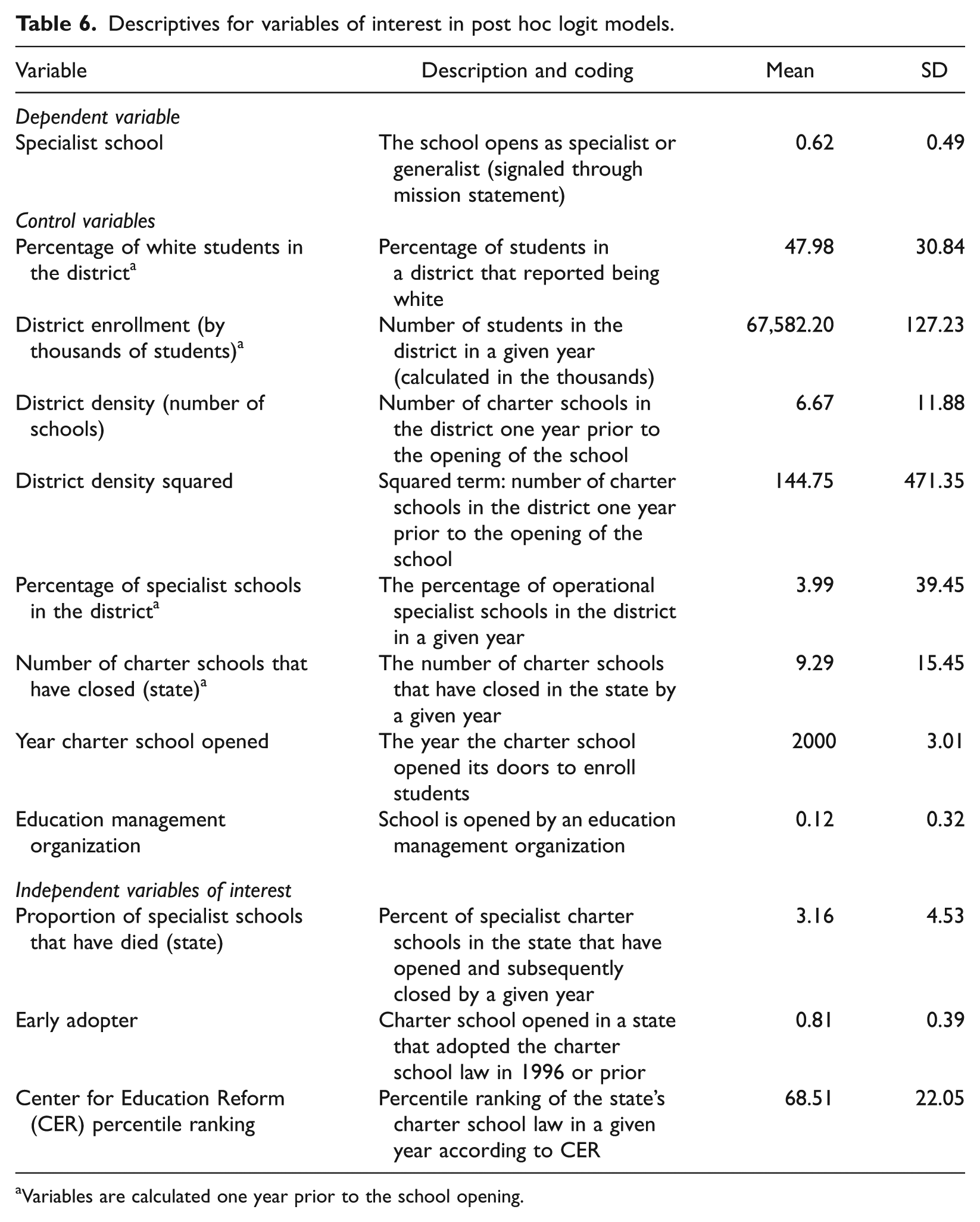
Variables are calculated one year prior to the school opening.
Table 7 shows that previous patterns of specialization significantly affect the likelihood of future mission specialization at the school level. More specifically, the higher the percentage of specialist schools that have died in a state, the lower the likelihood of a school opening with a specialist mission. This is the same pattern we saw at the population level, where for each percentage point increase in cumulative specialist deaths, the percentage of specialist schools in the population decreased.
Odds ratios predicting the likelihood of a specialist school opening.

Note. All continuous variables are centered at their mean.
Variables are calculated one year prior to the school opening.
p < .05. **p < .01. ***p < .001.
These logistic regressions show that legislation matters in predicting specialization at the school level. A school that opens in a state with less regulation of charter schools is less likely to specialize. Again, this finding is consistent with the way state laws predict the percentage of schools promoting specialist missions in our growth curve models. In addition, although not a significant predictor of the percentage of specialist charter schools in the growth curve models, the logistic regressions show that charter schools that open in early adopter states (states that legislated charter schools in or prior to 1996) are more likely to open as specialists.
Taken together, these findings are consistent at the population and organizational levels in suggesting that charter school specialization in mission statements is in part associated with the state’s legal structure and the success or failure of specialist schools to date. These findings shed light on policy and organizational practices, as we will discuss in the next section.
Conclusions
Examining innovation through specialization is ideal for studies of organizational formation because we can see how organizations situate themselves in their larger landscape. We argue that our understanding of charter schools as systematic sources of innovation must be informed by empirical and theoretical evidence from the population level. We address this issue by examining specialization among charter schools.
We found that charter school innovation exists through an increasingly heterogeneous set of specialist missions. We also found, however, increased educational sameness through an increase in generalist mission statements. As organizational scholars would expect, this latter group grew over time, indicating that charter school mission statements are increasingly assimilating to the generalist mode of schooling. Scholars may not be surprised by our finding that over time, charter schools tend toward generalist mission statements. Specialization in organizational populations is a substantial challenge, especially in large, inert populations that need public legitimacy. Our support for the generalist assimilation hypothesis is consistent with much of the current logic in organizational theorizing. At the same time, charter school advocates would not be surprised by the finding that some charter schools continue to promote innovation, at least in their missions touting specialized curricula, foci, or populations served.
Charter schools might have unique features that enable more heterogeneity and specialization than is found among other organizational types and more innovation than theories of isomorphism would predict. Because charter schools can be small in size, they may be able to cater to smaller niches than other organizational scholars have examined. Although organizational scholars have considered organizational size in relation to specialization (specialist organizations are typically smaller than generalist ones), more work can be done to parse out the carrying capacity of specialist organizations vis-à-vis populations and size of organization.
Analyzing trends in specialization among the charter school population is itself a contribution to the literature, but our work also aimed to explore the precipitating factors that created these trends. We found that state laws play an important role in statewide charter school specialization, lending support to a neo-institutionalist framework. The role of state laws, however, is contrary to what charter school advocates might expect. For instance, our findings indicate that more restrictive charter school laws actually lend themselves to more specialization than do more permissive laws. A decrease in restrictive laws may mean that charter school founders do not need to prove innovation by specializing; without state laws requiring innovation, we may see charter schools, but not specialization, thrive. This finding has profound policy implications. Organizations advocating and lobbying for charter schools, such as CER, want to promote innovation, specialization, and nonrestrictive laws. However, these objectives seem incompatible with each other.
In addition, by extending Strang and Macy’s (2001) idea that organizational analysis is sometimes undersocialized, we learned that the failure of charter schools with specialist mission statements has an effect on both the population of charter schools and the likelihood that an individual charter school will specialize. Organizational research thus can be informed by recognizing the structural, selective, and adaptive forces at work on populations and organizations simultaneously. Mimetic processes may be very powerful for charter school founders acting based on their environment (King et al. 2011). More work, particularly qualitative analysis of founders, could inform this line of inquiry.
Our work goes one step further. Although it is tempting to draw conclusions about schools based on an analysis of state-level data, our post hoc analysis helps avoid making an ecological fallacy. A school-level analysis predicting charter school missions could be comprehensive and include other theoretical perspectives (see King et al. 2011); however, our goal was to test the robustness of our work at two levels. We were particularly interested in being able to make statements about how laws and the success or failure of specialization can predict the likelihood of a specialist school opening, just as they predict the decline in the percentage of specialist charter schools in the population over time.
Understanding specialist mimicry and generalist assimilation is relevant to organizational theorists studying populations other than charter schools. For example, as the population of for-profit colleges and universities increases, will they look to traditional schools for legitimate structures or to each other for changes? The theories and hypothesis tests presented here provide researchers a new starting point for understanding organizational innovation, specialization, and formation within and beyond education.
Because longitudinal national data on charter schools had yet to be produced, policymakers have not had research findings to guide them. Our work begins to remedy this problem. These data are the first nationally compiled data on all charter schools and their mission statements from 1992 to 2005. But this work is not without its limits.
Mission statements may be optimal for understanding specialization at a charter school’s formation, but once a school is open, studying practice in the school and the classroom is ideal for understanding organizational behavior. On the one hand, charter schools often pull students from private schools, acquiring families and students who were already seeking a choice in the educational market (Chakrabarti and Roy 2010); these families may be looking at missions to help guide their decisions. On the other hand, mission statements and practice might be decoupled (Lubienski 2003; Weick 1976); specialist missions might be only signposts of innovation and have cultural and political purposes but few practical effects. Recent ethnographic work finds that families often consider the reputation of a school and hearsay, rather than hard data, to make school choice decisions (Lareau and Goyette 2014), in which case missions might not be salient to families making school choices. This is beyond the scope of our work, but it is the next step in understanding how specialization and innovation are created, demonstrated, and used by school constituents.
Now, policymakers can note that charter schools are increasingly likely to enter the landscape with mission statements that do not indicate specialization. But, specialization is not dead. A segment of the charter school population continues to specialize, and these specializations are increasingly diverse. Our data did not allow us to model a change in mission statements (i.e., a generalist becoming a specialist or a specialist becoming a generalist after formation); future research should explore how mission statements may change over time and subsequently affect the market of generalist and specialist organizations. In the meantime, if state policymakers want charter schools to be the R&D incubators for educational specialization, they may need to revisit their laws governing charter creation.
Research Ethics
Our research protocol was not reviewed by our institution’s Institutional Review Board because our work does not constitute human subjects research. Our research involves analysis of freely available public records on schools.
Footnotes
Funding
The author(s) disclosed receipt of the following financial support for the research, authorship, and/or publication of this article: Work supported by the National Science Foundation. #039310-01.