



Abstract
Country rankings based on the Programme for International Student Assessment (PISA) invite politicians and specialists to speculate about the reasons their countries did well or failed to do well. Rarely, however, do we hear from the students on whose performance these rankings are based. This omission is unfortunate for two reasons. First, research suggests that how students explain their academic performance has important consequences for their future achievements. Second, prior studies show that students’ attributions of success and failure in education can develop into explanations for social inequalities in adulthood. This article draws on PISA 2012 data on 128,110 secondary school students in 24 countries to explore how educational stratification shapes students’ explanations of their academic performance. I find that students in mixed-ability groups tend to attribute their mathematics performance to their teachers and to (bad) luck, whereas vocational- and academic-track students are more likely to blame themselves for not doing well. These differences between mixed-ability group students and tracked students are more pronounced in school systems where tracking is more extensive. I conclude by discussing how these findings speak to the broader impact of educational stratification on students’ psychology and cognition and the legitimation of inequalities.
Publication of the Programme for International Student Assessment (PISA) world ranking has become a spotlight event. Politicians and specialists evaluate their countries’ scores and try to explain their relative positions. Rarely, however, do we hear from the students on whose performance these rankings are based. There are two reasons why students’ own attributions of their academic success and failure warrant closer attention.
First, how students explain their school performance in turn affects their future achievements: Students who believe they have control over how well they do are more likely to be successful later in life than those who do not (Bozick et al. 2010; Dweck 1999; Lerner 2006). This applies to PISA too: Students who are convinced that success is within their control perform a third of a standard deviation better than students who are not so sure (Organisation for Economic Co-operation and Development [OECD] 2013). Conversely, a self-fulfilling prophecy may link low expectations to low achievement (Halleröd 2011; McLeod and Fettes 2007), especially for people who blame themselves for their failure or misfortune (Callan, Kay, and Dawtry 2014).
Second, research suggests that students’ attributions of school outcomes are instantiations of their emerging worldviews, which can develop into explanations for social inequalities in adulthood (Aloise-Young 1993; Altermatt et al. 2002; Baird and Astington 2004). This line of inquiry may thus provide a bridge to recent work on citizens’ inequality beliefs (McCall 2013; Reynolds and Xian 2014). However, we lack a generative model of the formation of these beliefs. The extant literature considers attributions either as beliefs described by certain universal tendencies (e.g., to justify one’s own successes while blaming others for their failings) or as monolithically shaped by the culture in which a person is socialized (Jost, Banaji, and Nosek 2004).
Disconnected from this literature, is a classic concern in the sociology of education with the kind of inferences students draw from their school environments (Parsons 1959; Turner 1960; Willis 1977). Work in this tradition describes how students’ school performance, their expectations and aspirations, and in fact much of their school experience is shaped by the degree to which their school system is stratified into vocational (labor-market-oriented) and academic (college-bound) tracks (Buchmann and Dalton 2002; Buchmann and Park 2009).
I build on this work to contribute a new approach to explain students’ attributions of success and failure. I argue that stratified school systems create settings that are relatively homogeneous in terms of students’ academic abilities and socioeconomic background, compared to mixed-ability groups (Chmielewski 2014; Flecha 2015; Gamoran 1992). Students in stratified systems learn from the homogeneity of those settings, and from the selection process that brought them there, that school performance is determined principally by effort and ability (Clycq, Nouwen, and Vandenbroucke 2014). In mixed-ability groups, students learn from the heterogeneity of their setting—by comparing themselves to other students—that school performance is shaped by effort and ability as well as by their teachers, the family support they do or do not receive, and sometimes (bad) luck. That is, students in more heterogeneous school settings learn from those settings that school performance is determined by a range of factors within and beyond their control.
I test hypotheses developed from this approach using PISA 2012 data for 128,110 secondary school students in 24 countries with different educational tracking practices. I exploit variation in track placement, school composition, and features of the school systems to describe patterns of covariation between educational stratification and students’ attributions of their mathematics performance.
Schools and Students’ Academic Attributions
Recent scholarship in sociology has explored the role of educational institutions in shaping the process whereby children learn to make attributions of school achievement and broader life outcomes (Brint, Contreras, and Matthews 2001; Teeger 2015; Warikoo and Fuhr 2014). Cultural sociologists treat schools as sites of social learning, where the lessons students learn concern the substance of learning as well as the topic of learning itself. Nunn (2014), for instance, describes how schools, through their discourse, policies, and grading systems, shape students’ understanding of the importance of effort and ability for doing well in school and beyond; this understanding leads students to develop a distinct “intelligence identity.” Khan (2010) shows how elite boarding schools similarly instill in their students the belief that they (and they alone) merit their success.
It is difficult, however, to confirm the role of the suggested cultural processes that are unique for any school, for every school is different from the next in infinite ways. Rather, I propose to focus on educational structure in an attempt to show some basic processes that affect all students. Specifically, I focus on the role of educational stratification: the extent to which a school system is organized as a collection of comprehensive, mixed-ability schools (e.g., as in Canada, Denmark, and Spain) or, alternatively, as a collection of programs hierarchically differentiated in vocational and academic tracks on the basis of ability tests or teacher recommendations (e.g., Belgium, Hungary, and Slovakia). In the latter school systems, selection into different tracks happens as early as age 10 and as late as age 14; mobility between tracks is possible but happens infrequently (Kerckhoff 2001; LeTendre, Hofer, and Shimizu 2003). Scholarship on educational stratification has established the negative effects such selection processes have for social inequality: Social (and racial) background is strongly related to track placement (Rosenbaum 1976; Tyson 2011), which in turn is highly predictive of students’ academic performance, college enrollment, and labor market outcomes (Van de Werfhorst and Mijs 2010). Research also suggests that track placement may affect students’ educational aspirations, expectations, and academic self-concept as students infer a more or less realistic view of their future school and work trajectory based on their track placement (Buchmann and Park 2009; Van Houtte and Stevens 2008).
Recent scholarship links educational stratification to students’ attributions of their school performance, but exactly how the two are related is disputed. Studies in Belgium, a country with a highly stratified school system, find that vocational-track students, net of social background, are more likely to internalize failure than are students in college-bound tracks (Agirdag, Van Houtte, and Van Avermaet 2012; Van Houtte and Stevens 2008). Students in academic tracks, conversely, are more likely to hold meritocratic beliefs and to think they can get anywhere if only they work for it (Clycq et al. 2014). Related research suggests that schools’ ethnic and socioeconomic composition can breed a “culture of futility” (Agirdag et al. 2012): Students in settings with a large share of underprivileged and immigrant peers may come to feel that school is working against them and that whether they do well academically is out of their hands. This, in turn, negatively affects these students’ academic performance. Scholars thus argue that the culture of futility explains the statistical relationship between school composition and average school performance.
Trautwein and colleagues (2006) give an alternative account, arguing that students are more likely to develop meritocratic beliefs in the absence of educational stratification. Their finding is based on a study of German students before Germany’s reunification, exploiting exogenous variation in educational stratification due to the different setup of East and West German school systems. The authors argue that the comprehensive East German schools, by fostering competition between students, promoted meritocratic beliefs. In contrast, West German schools tracked students by ability from an early age and thus tended to be relatively homogeneous; this made for a learning environment where “academic success and failure are seen as being multiply determined, with some of its causes falling outside a student’s realm of responsibility (e.g., difficulty of tasks), or being nonmeritocratic (e.g., ingratiation, luck)” (Trautwein et al. 2006:338).
A limitation of Trautwein and colleagues’ (2006) design is that the comparison of East and West Germany involves two school systems as well as two groups of students with distinct (cultural-ideological) upbringings. Likewise, the confluence in Belgium of tracking and school segregation complicates identifying the causal processes underlying the reported patterns. Absent internationally comparative research, we have no basis for assessing the role of national ideology, school composition, and confounding variables that may explain these disparate findings on how educational stratification shapes students’ attributions of their school performance. In what follows I develop a novel theoretical framework that allows for the comparative study of students in different school tracks, in schools that are differently constituted, and in countries that are differently marked by educational stratification.
Track Logic: How Educational Stratification Shapes Students’ Attributions
My argument that students’ explanations of success and failure are shaped by their selection into and exposure to a particular educational setting builds on Blau’s (1977, 1994) theory on the heterogeneity and homogeneity of social structures. However, I look not at how these structural parameters affect a person’s life chances but instead at how homogeneity and heterogeneity shape students’ understanding of their life chances—specifically, how students learn to explain their own school success or failure and that of others.
I further draw from research in social psychology on how college students’ political beliefs are shaped by the racial and socioeconomic heterogeneity of their school environment (Gurin et al. 2002; Sidanius et al. 2010). These studies are grounded in symbolic politics theory, which describes how political belief formation is shaped by the intensity and homogeneity of information to which a young person is exposed (Sears 1993; Sears and Valentino 1997). Shedd’s (2015) longitudinal study of 9th and 10th graders in three Chicago schools provides an illustration of how homogeneity/heterogeneity may shape belief formation: Students in segregated schools, with a racially and socioeconomically homogeneous student body, were less likely than students in integrated schools, with a more heterogeneous student body, to develop perceptions of injustice due to their “restricted comparative frame from which to understand their position in society” (Shedd 2015:158). The primacy of race may be unique to the U.S. context on which these studies are based, but I draw heavily on these insights in formulating my theoretical framework.
I argue that educational stratification leads to more homogeneous classrooms in terms of students’ academic ability as well as, indirectly, their social and ethnoracial background (Flecha 2015; Hallinan 1994; Sørensen 1970). Conversely, in the absence of educational stratification, in comprehensive school systems, students’ immediate school setting will be more heterogeneous (Gamoran 1992; Marks 2006). My argument implies that vocational and academic tracks are surprisingly similar in one crucial dimension: homogeneity.
By taking placement tests and hearing their teachers’ evaluations, students in stratified school systems learn of the importance of academic ability for their school success. These influences are compounded by going to school in relatively homogeneous high- (academic) or low- (vocational) ability tracks. Here, students develop an understanding of success and failure as dealt out on the basis of effort as effort is what principally distinguishes one student from the next. The more homogeneous the school setting, the more remains hidden from sight. Through their school experience, students learn that hard work pays off: In their experience, students who struggle academically, fail, or drop out do so by their own fault—they did not work hard enough (Agirdag et al. 2012; Clycq et al. 2014).
In contrast, students in more heterogeneous mixed-ability programs should be more likely to experience differences between themselves and others in terms of academic talents, race and ethnicity, family background, and status. They should thus be more attuned to the role these factors play in how well students do academically (Blau 1977, 1994). Students in mixed-ability programs learn that school success is shaped by effort, talent, home support, and luck—that is, a combination of things within and beyond a student’s control. Students who fail academically may be lacking in any one of those things.
In summary, educational stratification may affect students’ understanding of their academic performance in two ways, typically referred to as “selection” and “treatment” effects (Bol et al. 2014; Van Houtte and Stevens 2008). I consider these effects two sides of the same coin: Educational stratification is both a selection mechanism and a treatment. Students are shaped by educational stratification through both the “selection effect” of ability tests and teacher advice, on the basis of which students are assigned to a vocational or academic track, and the “treatment effect” of the (homogeneous or heterogeneous) group of students who will be their classmates (cf. Gamoran 1992; Hallinan 1994). Students, I argue, draw on both experiences in making sense of their school performance (Graham 1991; Trautwein et al. 2006).
In the empirical analysis, I study educational stratification as expressed in terms of (1) students’ track placement, (2) the (heterogeneous or homogeneous) composition of their schools’ student bodies, and (3) the rigidity of their countries’ school systems, which may involve within- and between-schools tracking. I expect the effects of educational stratification to be most strongly felt by students in ability-tracked classrooms (as compared to mixed-ability groups), by students in schools that are homogeneous in terms of students’ academic ability and socioeconomic background, and by students in countries with more extensively stratified school systems.
Hypothesis 1: Ability-tracked students are more likely than mixed-ability-group students to attribute their academic performance to factors within their control (internal attribution). Conversely, mixed-ability-group students are more likely to attribute their academic performance to factors outside of their control (external attribution).
Hypothesis 2: The differences in attributions between mixed-ability-group students and tracked students are greater in school systems marked by more extensive educational stratification.
Hypothesis 3: Students in schools that are more homogeneous in terms of students’ academic ability are more likely than students in less homogeneous schools to attribute their academic performance to factors within their control (internal attribution). Conversely, students in schools that are more heterogeneous in terms of students’ academic ability are more likely to externalize their academic performance (external attribution).
Hypothesis 4: Students in more socioeconomically homogeneous schools are more likely than students in more socioeconomically heterogeneous schools to attribute their academic performance to factors within their control (internal attribution). Conversely, students in more socioeconomically heterogeneous schools are more likely to externalize their academic performance (external attribution).
Data and Methods
I analyze data from the 2012 edition of PISA, which is the only data set, to my knowledge, to (1) contain measures of tracking and students’ attributions (2) for a representative sample of the student body (3) in a large set of countries. For each country, schools were sampled from a national list of PISA-eligible schools, after which a target number of 35 students was sampled within each school. In countries with tracked school systems, students were sampled from each school track (OECD 2014). I draw on a subset of 128,110 students in 7,627 schools, based on two restrictions. First, I selected only the 24 countries out of 65 for which PISA collected data on students’ track enrollment and for which I have country-level data on the extent of educational stratification. 1 Second, the main dependent variable for my analyses is part of a rotated student context questionnaire, which was posed to 2 out of every 3 students. As a result, my sample is further restricted to the 128,110 out of 193,935 students who filled out this questionnaire (OECD 2014). The percentage of missing values on control variables is between 0 and 1.34, which I address by listwise deletion (see the online appendix for a discussion of these procedures). I use sampling weights to give equal weight to each country, in line with PISA’s data analysis manual (OECD 2014).
Measuring Students’ Attributions
The dependent variable for this article is an index of attributions of failure in mathematics (OECD 2014), which is based on a question posed to students after they took the PISA mathematics test but before they were informed of the result. The question assesses how students would explain a bad test result in mathematics and was asked on a four-point agree/disagree scale with six items. Each item emphasizes a potential explanation for a student’s failure to do well in mathematics: a student’s inability, the poor support received from his or her teacher, and bad luck. Responses were coded such that positive values indicate external attributions (i.e., bad luck, teachers) and negative values indicate internal attributions (i.e., ability). Table 1 gives an overview of the question, response categories, and item parameters. The delta scores show to what extent each of the six items is taken as an indicator of an external or internal attribution: High scores for items c and b (blaming failure on bad guesses and a teacher’s poor explanation, respectively) mean these are the strongest forms of externalization, followed by items e and f, which point to a teacher’s failure to enthuse students for the material and bad luck, respectively. Conversely, items d and a (in that order) are the strongest indication of students’ blaming failure on their inability to do well in mathematics: The material is too hard for them, or they are just not good at mathematics. The scale has a moderate to high internal reliability, α = .64.
Programme for International Student Assessment’s Scale of Students’ Attributions of Failure in Mathematics.

Source: Programme for International Student Assessment 2012.
Note: The scale of students’ attributions is based on the six items listed here, which follow the question as worded above. The response categories ranged from ‘‘strongly disagree’’ to ‘‘strongly agree’’ (four options). In creating the scale, all items were reversed so that a higher score indicates external attributions of failure (to the teacher or to bad luck).
Measuring Educational Stratification
I measure educational stratification in three ways. First, on the student level, track placement gives the program a student is enrolled in: vocational, academic, or mixed ability. Second, I acknowledge the difference between the rigid ability-group stratification that happens in countries like Belgium, Hungary, and the Czech Republic and the less widespread tracking that happens in countries such as France, Ireland, and Slovenia (Chmielewski 2014; LeTendre et al. 2003). To incorporate variation of this kind in my models, I include a country-level tracking index variable that indicates the extent to which students are tracked in rigidly separated vocational and academic school tracks or, more loosely, in separate streams within schools. Here I follow other comparative research on school systems and draw on Bol and Van de Werfhorst’s (2013) index of tracking (Bol et al. 2014; Levels, Van der Velden, and Di Stasio 2014) updated with PISA 2012 data. The tracking index is based on publicly available data on three features of tracking regimes: a student’s age at first track placement, the length of the tracked curriculum, and the number of parallel tracks (Bol and Van de Werfhorst 2013). 2 The three indicators are loaded on one factor (eigenvalue 1.76). Factor loadings, saved as regression coefficients, give each country a score on the index, with a mean of zero and a standard deviation of one. Scores higher than zero mean a school system is more extensively stratified compared to other countries; scores lower than zero indicate the opposite.
Third, I look at the cross-level interaction between a student’s track placement (individual level) and the school system’s score on the index of tracking (country level) to assess the variable impact of track placement by the extent to which a school system is stratified.
I concur with scholars who argue that tracking may have a different impact on students depending on the school context (Gamoran 1992; Van Houtte and Stevens 2009). Therefore, in addition to these three ways of measuring tracking, I include school composition measures for average socioeconomic status and its standard deviation, and for the mean PISA math test score and its standard deviation. These measures allow me to assess to what extent students’ attributions are associated with their peers’ academic and social background characteristics, especially the extent to which the peer group is more heterogeneously or homogeneously constituted.
Control Variables
I include a set of control variables that other studies suggest are correlated with students’ attributions and related beliefs, such as their expectations (Buchmann and Park 2009), aspirations (Buchmann and Dalton 2002), and academic self-concepts (Chmielewski, Dumont, and Trautwein 2013). I observe that boys tend to do better in mathematics than girls and may hold higher expectations, as do older students and those in higher grade levels (as compared to lower grade levels). Hence, I include controls for students’ gender, age, and grade level.
I address selection effects by including a dummy for immigration status and a measure of socioeconomic status (PISA’s index of economic, social, and cultural status) (cf. Bol et al. 2014; Borgna and Contini 2014), in acknowledgment of the facts that ethnic minority students and students from lower socioeconomic backgrounds are disproportionally placed in vocational tracks (compared to the academic track) and peer processes may affect these students differently (Agirdag et al. 2012; Tyson 2011).
Furthermore, I expect students’ attributions to be affected by how good they are at mathematics. As an indicator of mathematics ability, I use students’ mathematics scores on PISA, which is unknown to students when they fill out the questionnaire. I focus on mathematics rather than science and reading because the latter two are more sensitive to students’ socioeconomic background (Bol et al. 2014; Driessen, Sleegers, and Smit 2008). PISA mathematics scores are reported in an arbitrary metric, scaled to an average of 500 with a standard deviation of 100, which I standardized (mean of zero, standard deviation of one) for the sake of interpretation (cf. Evans, Kelley, and Sikora 2014). 3
Finally, I include country dummies to account for country-specific variation in students’ attributions of success and failure. Incorporating dummy variables allows me to estimate a country effect, net of the structure of the school system and student-level variables. Table 2 gives descriptive statistics on all variables used in this study.
Descriptive Statistics.

Source: Author’s empirical sample of the Programme for International Student Assessment 2012 (N = 128,110).
Note: Data are weighed to give equal weight to each country.
Modeling Approach
I estimate the relationship between students’ attributions of failure in mathematics and a set of student-level, school-level, and country-level determinants. To account for the multilevel structure of the data, I estimate two-level hierarchical models (students nested in schools), with random school intercepts and country-level fixed effects. By modeling random effects for the school level, I consider the set of schools included in the analysis to be a sample from a larger population defined in terms of the observed school characteristics. The estimated regression intercept is a population average, and deviations from this average are assumed to be uncorrelated with the school-level random effects included in the model. With these assumptions, we can generalize the results to other schools.
I use a fixed-effects approach to model the country-level influence to account for unobserved heterogeneity at the country level, following previous research (Hanushek and Wösmann 2005). In this approach, the emphasis is on the uniqueness of each country in the data set: I estimate a country effect for each country, reflecting its unique characteristics as they relate to students’ attributions. Using a fixed-effects approach avoids two pitfalls of random-effects models: The nonrandom sample of countries violates the assumption of normality of the country-level residuals, and the low sample size of 24 countries means the limited degrees of freedom would lead to unreliable country-effect estimates (Bryan and Jenkins 2013). These problems do not arise with the estimation of school effects, which is based on a random and large sample of 7,627 schools.
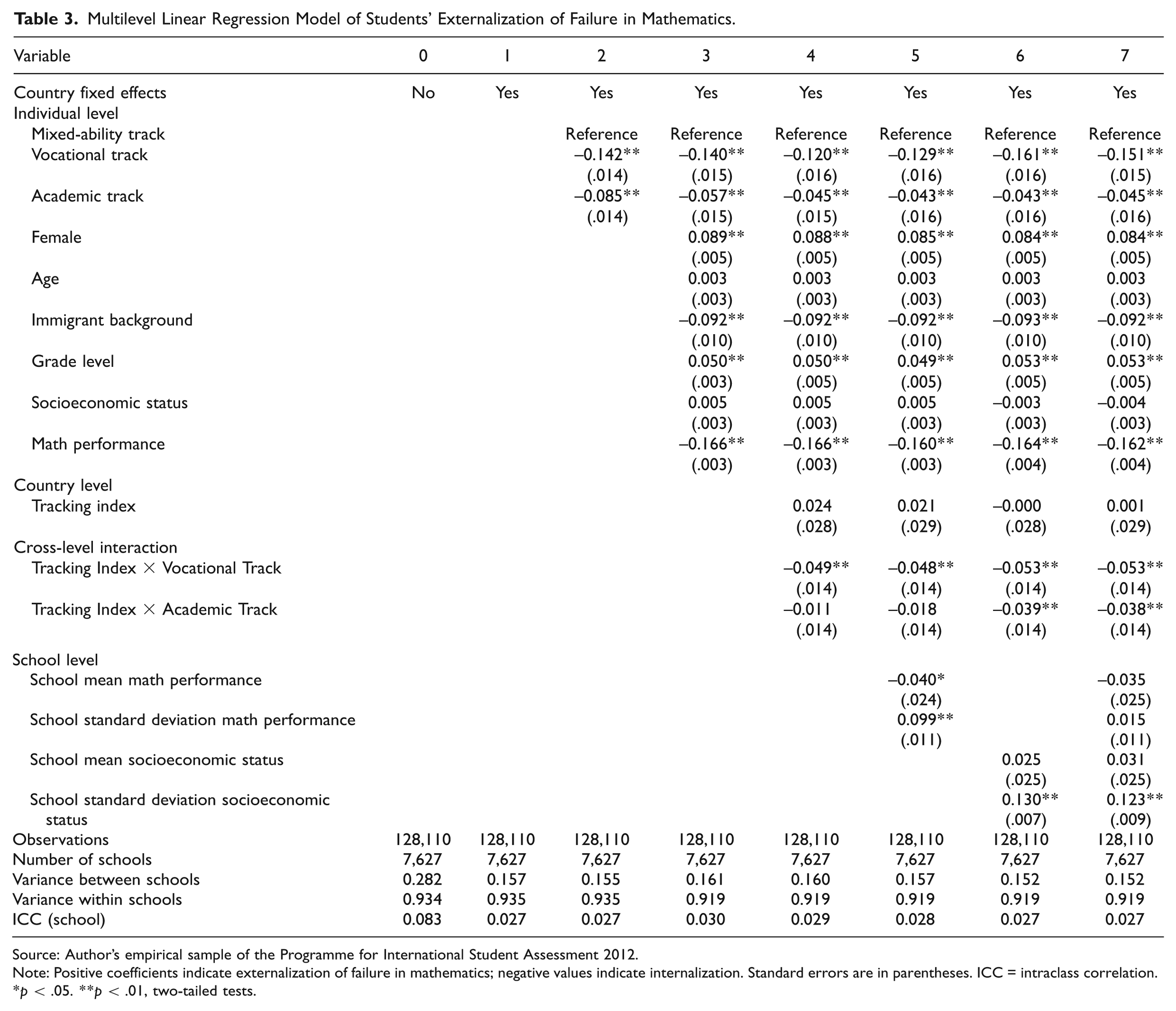
Baseline model 0 allows for an interpretation of the proportion of total variation in students’ attributions that is explained by students’ enrollment in different schools. In model 1, I add country dummies to estimate the variation in students’ attributions associated with the country a student lives in. Model 2 gives an estimation of the association between track placement and students’ attributions of their mathematics performance. For a first assessment of hypothesis 1, model 3 includes the full set of individual-level controls.
In model 4 I add a cross-level interaction, which allows me to estimate whether the association between track enrollment and students’ attributions varies with the degree to which a school system is stratified (cf. Gelman and Hill 2006). Positive values for the estimated interaction effect would indicate that students in ability tracks are more likely to attribute failure to external factors, the more rigidly their school system is stratified; a negative value would indicate that tracked students are more likely to internalize failure when the school system is more rigidly stratified (hypothesis 2).
In model 5, I add measures for the school-level mean mathematics performance and the school-level standard deviation in math performance. These estimates allow me to assess whether students’ attributions vary as a function of (1) how well their peers do and (2) how much difference there is between the mathematics performance of students in a given school (hypothesis 3). In model 6, I make a similar assessment by incorporating the school-level mean socioeconomic status and the school-level standard deviation (hypothesis 4). Model 7, the full model, allows for an assessment of hypotheses 1 and 2, taking into account the variable composition of schools.
Results
Before discussing the results, I look more closely at the variance explained at various levels of the multilevel model. Model 0, which includes only the dependent variable and school-level random effects, allows for an assessment of the proportion of variance in students’ attributions that is due to differences in the schools that students attend. The estimated variance at the school level is .282, compared to an estimated variance at the student level of .934, which means that
Multilevel Linear Regression Model of Students’ Externalization of Failure in Mathematics.
Source: Author’s empirical sample of the Programme for International Student Assessment 2012.
Note: Positive coefficients indicate externalization of failure in mathematics; negative values indicate internalization. Standard errors are in parentheses. ICC = intraclass correlation.
p < .05. **p < .01, two-tailed tests.
Model 1 incorporates country-level fixed effects in recognition of the fact that students’ experiences may be shaped by the school context as well as their unique country context. The estimated variance components for model 1 indicate that when factoring in the country level, the variance explained at the school level drops from an estimated 8.3 percent to 2.7 percent. A comparison between model 0 and model 1 thus indicates that a large portion of the between-schools variance in students’ attributions is associated with differences at the country level: A majority of the between-schools variance indicates between-countries variance, whereas a smaller part of the between-schools variance can be considered between-schools, within-country variance. This points to the importance of country factors, such as the organization of the school system, and emphasizes the salience of considering both the school and the country level in studying students’ attributions.
A first indication of the association between students’ track placement and their attributions of failure in mathematics is given in model 2, which describes the pattern of association by track placement, taking into account the fact that students attend different schools and come from different countries. The negative model estimates for the ability-grouped tracks (–.142 and –.085 for students in the vocational and academic track, respectively) indicate that these students are more likely than students in a mixed-ability group (the reference category) to blame themselves for not doing well. Conversely, students in mixed-ability groups, on average, tend to blame their failure on forces outside of their control, such as the teacher’s lack of enthusiasm, the teacher’s poor explanation of the material, or a case of bad luck.
Model 3 includes individual-level variables for gender, age, immigrant background, socioeconomic status, and mathematics performance. Incorporating these controls does not change the direction or significance of the association between track placement and students’ attributions, but it does affect the size of the coefficients: Whereas the estimated coefficient for students in the vocational track remains strong at –.140, the coefficient for academic-track placement drops from –.085 to –.057. This reduction in the strength of association points to the fact that students in the academic track, on average, do better than vocational students. The negative coefficient for mathematics performance (–.186) indicates that students who generally do better in mathematics are less likely to attribute failure to external factors: when they fail on a particular test, these students tend to blame themselves.
In model 4, I assess the role of the school system by modeling a cross-level interaction between students’ track placement and the extent to which their school system is stratified. My findings are threefold. First, the negative coefficient estimated for the cross-level interaction between students’ vocational-track enrollment and stratification of the school system indicates that vocational students, compared to students in mixed-ability groups, are especially likely to internalize their failure in mathematics. The total association between students’ track placements and attributions, for students who are placed in vocational tracks in school systems with above-average educational stratification (i.e., one standard deviation above the mean), can be estimated as –.120 + –.049 = –.169, which is roughly equal to the estimated coefficient for a one standard deviation change in mathematics performance. In contrast, the model estimates show no cross-level interaction between educational stratification and students’ placement in academic tracks or mixed-ability groups.
Model 5 introduces school-level measures of average math performance and standard deviations as an indicator of school-level ability heterogeneity. The estimates indicate that school average mathematics performance is negatively associated (p < .05) with students’ scores on the attribution index: Students at schools where math performance is higher are more likely to internalize their failure to do well in math. Conversely, students in heterogeneous schools are more likely to attribute failure to factors outside of their control. Incorporating these school composition measures does not affect the estimated relationship between students’ track placement and their attributions, nor does it affect the cross-level interaction.
In Model 6 I assess the association between students’ attributions and their schools’ socioeconomic compositions. I find no association for the school-level mean, but heterogeneity in socioeconomic status is associated with an increased likelihood of externalizing failure in mathematics. Including measures of school-level socioeconomic status affects other model estimates in two ways: The coefficient for vocational-track placement increases by about 25 percent, from –.129 to –.161; estimates for the cross-level interaction also increase, rendering the coefficient for academic-track placement by educational stratification statistically significant. These changes in the estimated coefficients reflect the fact that the makeup of a school’s student body is systematically associated with track type.
Model 7 includes all previously discussed measures and validates the statistical patterns discussed earlier: Students in ability-tracked programs are more likely to internalize failure. A direct interpretation of the strength of association is not readily available, because the dependent variable is an index score. However, the strength of association can be interpreted by making comparisons between variables. Thus, the association between students’ placement in the vocational track and their score on the attribution index, net of student-level, school-level, and country-level factors, can be expressed as
School System and Country Effects
With regard to the school system, the association between students’ track placements and their attributions is more pronounced in countries with more extensive tracking regimes. Figure 1 illustrates the cross-level interaction between (student-level) track placement and (country-level) educational stratification, estimating scores on the attribution index for students in the three tracks, based on the estimated coefficients in the full model:
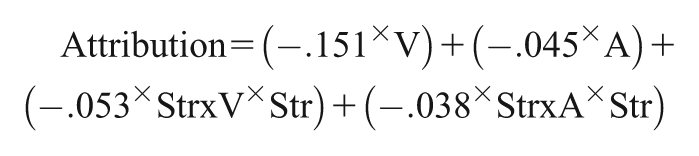
where V is a dummy (0 or 1) for vocational-track placement, A is a dummy for the academic track, StrxV is a dummy for the interaction between educational stratification and vocational-track placement, StrxA is a dummy for the interaction between stratification and the academic track, and Str is the score on the stratification index for students’ school systems.
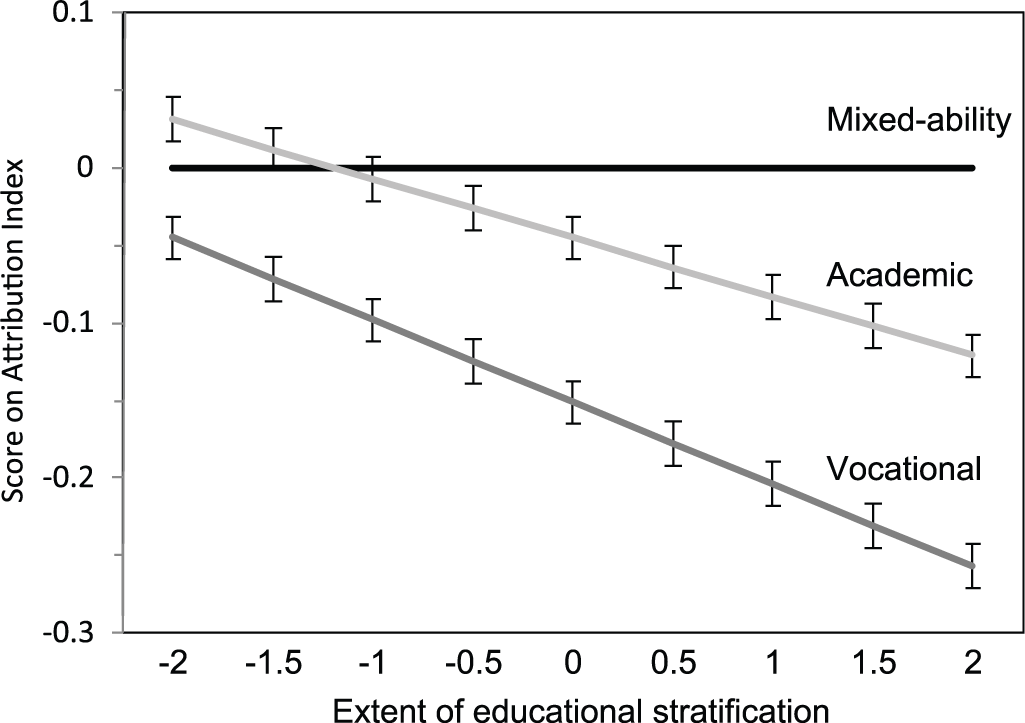
Attributions of failure by track placement and educational stratification
Figure 1 shows that the differences between students in the three school tracks are larger in more stratified school systems: The difference between students in mixed-ability programs versus vocational tracks is less than .05 on the attribution index in countries at the lower end of the educational stratification index, whereas the difference reaches a peak of .25 in countries whose school systems are most extensively stratified.
In the final step of my analysis, I more closely examine the variation in students’ attributions associated with country factors. I take the regression coefficient estimated for each country dummy in model 7 and plot these against that country’s corresponding tracking index score to assess the covariation and correlation of the two (see Figure 2). 4 The correlation between the country regression coefficients and the country’s score on the tracking index shows how much of the country’s association with students’ attributions is a product of variation in the school system and how much is due to unobserved institutional and cultural factors.
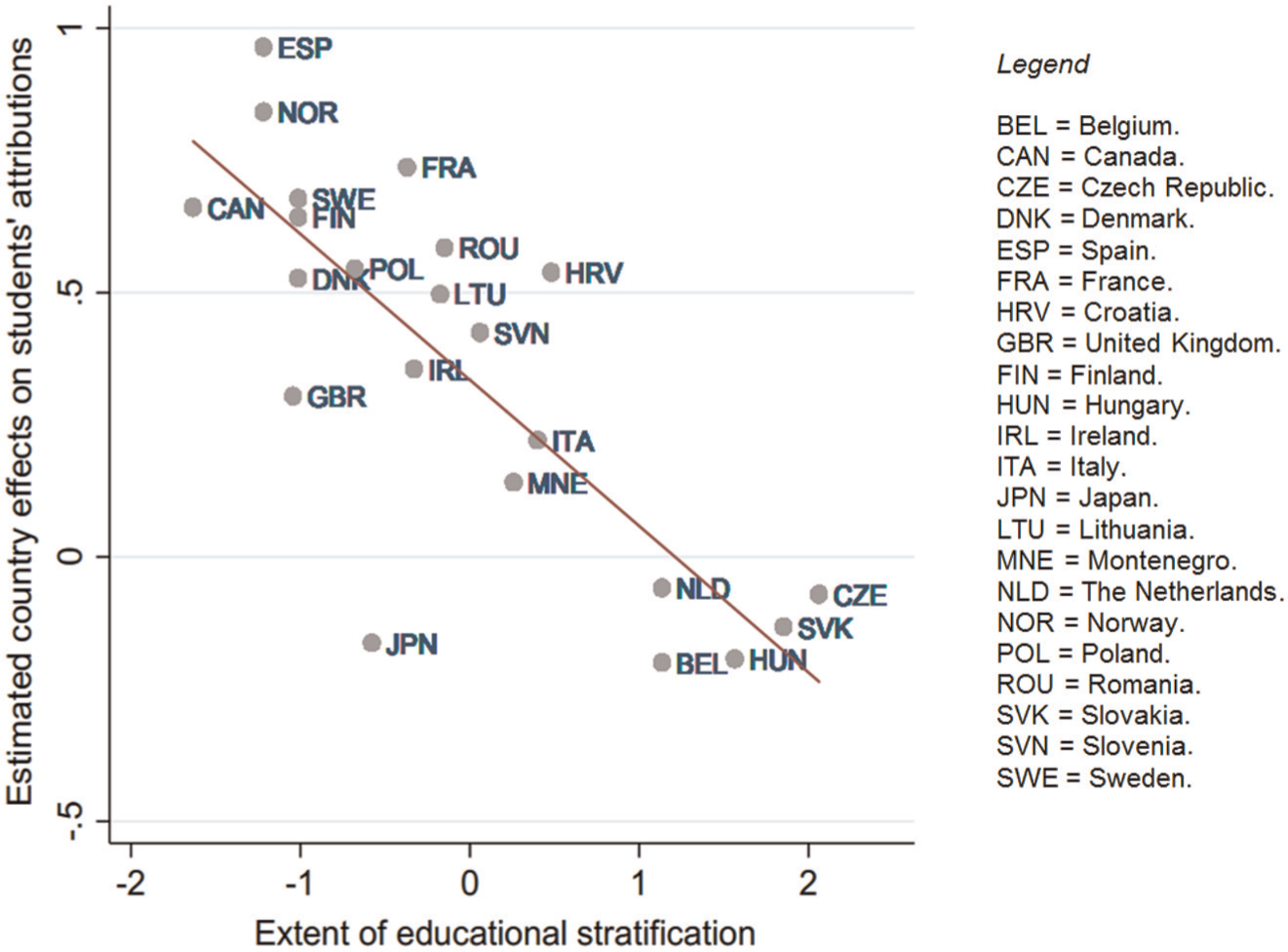
Estimated country effects on students’ attributions by educational stratification
As can be gauged from the figure and inferred from the coefficient of determination (R = –.79), the tracking index is a good predictor of the country effects: About 63 percent of all variation in students’ attributions at the country level is due to variation in the country’s school system in terms of the tracking index.
Conclusions
After accounting for between-countries differences, the role of schools, and student background factors, important differences in students’ attributions of their mathematics performance remain unexplained. I find that these patterns are associated with educational stratification in the following ways.
First, students in mixed-ability groups are more likely than students in vocational and academic tracks to attribute their mathematics performance to teachers or (bad) luck and to externalize failure. Conversely, students in ability-tracked programs are more likely to internalize their failure and attribute poor test results to their inability to do well in math (hypothesis 1).
Second, differences between the attributions of mixed-ability and ability-tracked students are more pronounced in countries where tracking is more extensive: Students are particularly likely to internalize failure when they are placed in ability-tracked programs in school systems that are extensively stratified (hypothesis 2).
Third, the association between educational stratification and students’ attributions is strengthened by the fact that schools attended by ability-tracked students have more socioeconomically homogeneous student bodies: The more homogeneous the student body, the more likely a student is to internalize failure (hypothesis 4). Taking into account schools’ socioeconomic composition, I find no support for hypothesis 3, which states that students’ attributions are shaped by school-level heterogeneity in math scores.
These findings are best explained by the track logic perspective developed in this article. Educational stratification affects students’ understanding of their academic performance in two ways: Students’ attributions of their school performance are shaped through ability tests and teacher advice, on the basis of which they are placed in vocational, mixed-ability, or academic tracks, and by the (homogeneous or heterogeneous) groups of students who are their classmates. The more homogeneous their school experiences, the more likely students are to believe that how one does in school is due solely to one’s own (lack of) hard work and academic (in)ability. Conversely, the more students are exposed to heterogeneity in school, the more likely they are to attribute academic failure to a range of things, including effort, ability, and external factors such as teachers, bad luck, or the home support a student does or does not receive.
I acknowledge a number of limitations to this study. First, the measurement of students’ attributions relies on only six indicators, underlying a single survey question. In discussing the findings of this study, I implicitly assumed that attributions of failure have a symmetric structure; that is, they are also reflective of attributions for success. However, this remains a testable hypothesis. Second, the limited set of countries for which tracking data were available, with the notable exclusion of the United States and Germany, further limits the generalizability of my findings. Finally, my survey-based cross-sectional approach means I cannot directly observe the processes I hypothesize, nor can I study the formation of beliefs over time or ascertain their behavioral consequences. These limitations suggest paths for future research and data collection.
Research from the 1970s onward demonstrates that incorporating the structure of school systems into our analyses greatly enriches our understanding of social inequality and social reproduction (Hallinan 1994; Kerckhoff 2001; Rosenbaum 1976). My findings suggest that educational stratification may also provide a context for cognitive processes that reinforce social inequality. In fact, the statistical evidence presented in this article suggests that most of the variation in how students make sense of their mathematics performance is attributable to students’ track placement, mathematics ability, and individual background factors. Only a very small part of the variation in students’ attributions of their mathematics performance can be linked to the particular schools they go to or the countries in which they live.
The nature of the evidence presented in this article means that these findings should not be taken as necessarily conflicting with accounts of school-level (Nunn 2014; Shedd 2015; Van Houtte and Stevens 2008) or country-specific (Trautwein et al. 2006; Warikoo and Fuhr 2014) processes that affect students’ attributions of their academic performance. Rather, the cross-national design of this study allows me to describe general patterns of association between educational stratification and students’ attributions of failure, which are realized in the unique cultural context of school and country. The framework presented here builds on these studies, confirms their main findings, and provides a roadmap for systematic exploration of the educational structures that shape young adolescents’ attributions of success and failure.
This article points to general processes, but it bears emphasis that underprivileged and minority students’ disproportional allocation to vocational tracks means they are especially likely to internalize failure. Conversely, the disproportional representation of students from more privileged social backgrounds in the academic track, in combination with these students’ higher average academic performance, means they may come to justify their advantage as merited by their superior ability.
Taken together these findings support the claim that public educational policies are consequential for more than students’ outcomes in school and on the job market; my research suggests that policies that stratify students into hierarchical school tracks also may shape these students’ inclination to blame themselves when they fail. As such, educational stratification affects social stratification in two ways: (1) Educational stratification sets the pathways to social stratification by providing preparation for college and the upper echelons of the labor market to students in the academic track while pointing students on vocational tracks toward increasingly precarious work, and (2) the process of track selection and treatment cements social stratification by shaping how students come to understand what makes for success and why some are less successful than others. The outcome of that process may serve to legitimize inequalities: Students who fare well come to think of their accomplishments as the sole result of their effort and ability, whereas students who fail to do well academically have only themselves to blame.
Footnotes
Research Ethics Statement
I affirm that the research in this manuscript was registered and conducted in line with requirements of the institutional review board of Harvard University. My analysis uses only publicly available data that do not include personal identifiers or other means to disclose participants’ identities. All Programme for International Student Assessment participants gave their informed consent prior to their participation in the research.
Acknowledgements
I thank Katerina Bodovski, HyoJung Jang, Janine de Novais, David Post, Herman van de Werfhorst, Natasha Warikoo, and other participants for their thoughtful feedback. A special thanks to Jason Beckfield, Anny Fenton, Rob Warren, and the three anonymous reviewers for their comments and suggestions. Previous versions of this article were presented at the International Sociological Association RC 28 summer conference at the University of Pennsylvania and at the Sociology of Education workshop at Harvard University.