




Abstract
Given the dominance of residentially based school assignment, prior researchers have conceptualized K–12 enrollment decisions as beyond the purview of school actors. This paper questions the continued relevance of this assumption by studying the behavior of guidance counselors charged with implementing New York City’s universal high school choice policy. Drawing on structured interviews with 88 middle school counselors and administrative data on choice outcomes at these middle schools, we find that counselors generally believe lower-income students are on their own in making high school choices and need additional adult support. However, they largely refrain from giving action-guiding advice to students about which schools to attend. We elaborate street-level bureaucracy theory by showing how the majority of counselors reduce cognitive dissonance between their understanding of students’ needs and their inability to meet these needs adequately given existing resources. They do so by drawing selectively on competing policy logics of school choice, narrowly delineating their conception of their role, and relegating decisions to parents. Importantly, we also find departures from the predictions of this theory as approximately one in four counselors sought to meet the needs of individual students by enlarging their role despite the resource constraints they faced. Finally, we quantify the impact of variation in counselors’ approaches, finding that the absence of action-guiding advice is associated with students being admitted to lower-quality schools, on average.
Sociologists have demonstrated that higher-income parents attempt to transmit advantage from one generation to the next through enrolling their children in higher-quality schools (Lareau and Goyette 2014). Existing studies also document considerable variation by socioeconomic status in how parents approach and experience school selection. Higher-income parents are more likely to make residential decisions to access particular schools (Holme 2002; Lareau 2014; Owens 2016), whereas multiple factors, including financial constraints, exclusionary housing policies (Massey and Denton 1998), and reactive moves in response to eviction or safety concerns (Desmond 2016; Rhodes and DeLuca 2014), prevent economically disadvantaged families from doing so.
In the past two decades, however, urban districts that serve large numbers of lower-income students have sought to break the link between residence and school assignment. Cities like New York, Chicago, and Boston have implemented large-scale open enrollment plans, and in New Orleans, Detroit, Washington, D.C., and Kansas City, over 40 percent of students attend charter schools (National Alliance for Public Charter Schools 2016). Given persistent residential segregation by race and income (Reardon and Bischoff 2011; Reardon and Owens 2014), school choice has the potential to reduce inequality in access to higher-quality schools. At the same time, choice policies privilege parent agency and autonomy and require parents to navigate complex administrative processes. These features may limit the extent to which choice levels the playing field.
Scholars have identified several barriers that prevent lower-income families from prioritizing academic quality when making school choices. Lower-income parents have limited access to information about school quality through social networks (Lareau 2014; Sattin-Bajaj 2014); they are more likely to learn about their options through their schools and other formal information channels, like newspapers and radio (Schneider, Teske, and Marschall 2000; Teske, Fitzpatrick, and Kaplan 2007). Lower-income families are more likely to prioritize geographic proximity over academic quality (Buckley and Schneider 2007; Glazerman and Dotter 2017; Hastings and Weinstein 2008; Nathanson, Corcoran, and Baker-Smith 2013), although the mechanisms producing this finding are not fully understood. Time and transportation costs (Denice and Gross 2016; Lareau, Evans, and Yee 2016), limited information and understanding of the process (Gross, DeArmond, and Denice 2015), concerns about safety (Pattillo 2015; Weininger 2014), and beliefs that all schools offer similar educational opportunities (Rhodes and DeLuca 2014; Sattin-Bajaj 2014) have all been offered as explanations for this finding.
Across these studies, parents predominantly occupy the focal role as decision makers (Buckley and Schneider 2007; Condliffe, Boyd, and DeLuca 2015; Schneider et al. 2000). Given the historical dominance of residentially based school assignment, this makes sense; prior researchers have conceptualized K–12 enrollment decisions as beyond the purview of school actors. Empirical research on school personnel’s involvement in students’ schooling decisions often focuses on college applications and the contentious role of high school counselors in this process (Hill 2008; Holland 2015; McDonough 1997; Smith 2009). Yet current studies show positive links between students’ contact with school counselors and their pursuit of postsecondary education (Belasco 2013; Robinson and Roksa 2016; Woods and Domina 2014), particularly for disadvantaged students (Avery 2010; Roderick, Coca, and Nagaoka 2011; Stephan and Rosenbaum 2013).
Given evidence of counselors’ large impact on students’ post–high school destinations, it is logical to ask whether and how they shape choices in the K–12 system. Existing K–12 studies focus on behavior of the receiving schools and principals’ efforts to use the choice process to select a more advantaged population (Jabbar 2016; Jennings 2010). The influence of actors in sending schools—that is, the schools students currently attend—on families’ enrollment decisions is left unexamined. Understanding variability in school-based support in navigating enrollment processes is important for evaluating the mechanisms through which choice policies affect inequality as well as for shaping interventions to support lower-income families.
This article focuses on the behavior of guidance counselors charged with implementing New York City’s universal high school choice policy, which is the largest public school choice program in the country. Drawing on structured interviews with 88 middle school counselors (1 per school), surveys of counselors and students, and administrative data on choice outcomes at these middle schools, we ask the following:
Research Question 1: How do counselors describe the primary challenges that students, parents, and counselors themselves face in the high school choice process?
Research Question 2: How do counselors inform and engage with students and parents about high school choice?
Research Question 3: How do counselors account for their varying approaches to offering formal advice to students and families about high school choices?
Research Question 4: To what extent is variation in counselors’ approaches associated with students’ enrollment outcomes?
We show that counselors largely refrain from giving action-guiding advice to students about which schools to attend despite recognizing that students frequently lack adult support when making school choices. We extend street-level bureaucracy theory (Lipsky [1980] 2010) by showing how many school counselors draw selectively on competing policy logics of school choice policies, narrowly delineating their conception of their role and relegating decisions to parents as a means to reduce the cognitive dissonance between their understanding of students’ needs and their inability to meet these needs given existing resources. At the same time, we also find departures from this theory’s predictions. Approximately one in four counselors enlarged their role to meet individual students’ needs despite the resource constraints they faced. Together, these processes generated wide variation in access to counseling support across schools.
After reporting our qualitative findings, we analyze administrative data outcomes to quantify the impact of variation in counselors’ approaches. We find that the absence of action-guiding advice from counselors is associated with students being admitted to schools with lower graduation and college-going rates. The magnitude of this association is large. We do not claim to identify causal effects, but we provide the first evidence of which we are aware linking qualitatively derived data on counselors’ approaches to student outcomes.
Street-Level Bureaucracy Revisited
Lipsky ([1980] 2010) defines “street-level bureaucrats” as workers who have high contact with clients and substantial discretion and autonomy in shaping the benefits and sanctions their clients receive. Discretion is necessary in these roles because the complexity of the tasks at hand makes it difficult to create rules for all possible situations. In exercising discretion to implement policies that have ambiguous or conflicting goals, Lipsky ([1980] 2010:xii) argues that “the devices that they invent to cope with uncertainties and work pressures, effectively become the public policies they carry out.” With this assertion, Lipsky shifts the discussion from policy as written by elites to policy as enacted on the ground.
Central to this theory is the idea that street-level bureaucrats work in an environment of scarce resources, which makes doing the work at the desired level nearly impossible. Adding more resources alone cannot solve this problem as demand for services typically evolves to meet supply. This constraint is particularly influential for mission-oriented bureaucrats like teachers, social workers, and public interest lawyers, who Lipsky ([1980] 2010:xii) sees as going into these professions because of their social goals, only to find that they cannot approximate their “ideal conceptions of their jobs.” To cope with these pressures, they develop routines that allow them to “mass process” their clients.
In contrast to previous research about work routines established to manage uncertainty, Lipsky’s theory attempts to account not only for the behaviors street-level bureaucrats adopt but also for their psychological responses to the conflicts they face. Yet the focus on psychological mechanisms notwithstanding, street-level bureaucracy is, at its heart, a structural theory of how workers deal with constraints. Limited resources produce the discrepancy between service ideals and provision, and a series of coping mechanisms “reduce[s] the strain between capabilities and goals, thereby making their jobs psychologically easier to manage” (Lipsky [1980] 2010:141).
Specifically, Lipsky details three responses to uncertainty that are particularly useful to understanding the results of our study. First, Lipsky argues that street-level bureaucrats develop techniques to “limit demand, maximize the utilization of available resources, and obtain client compliance over and above the procedures developed by their agencies” (Lipsky [1980] 2010:83). Changing work routines is coupled with a second response, which involves modifying “the concept of their jobs so as to lower or otherwise restrict their objectives and thus reduce the gap between available resources and achieving objectives” (Lipsky [1980] 2010:83). Finally, they “modify the concept of the raw materials with which they work—their clients—so as to make more acceptable the gap between accomplishments and objectives” (Lipsky [1980] 2010:83).
With that background, our study seeks to elaborate street-level theory in two main ways. First, Lipsky’s theory spoke to the average street-level bureaucrat’s practice and how it generates variation in services provided. Few studies, however, identify distinct coping strategies in street-level bureaucrats’ responses to pressures. Ignoring this variation turns our attention away from investigating the individual and organizational determinants of bureaucrats’ diverse practices and coping mechanisms. It also sets aside how street-level bureaucrats respond to ambiguities in public policies by rhetorically drawing on competing policy logics to rationalize how they carry out their work. Bringing attention to heterogeneity addresses what Lipsky ([1980] 2010) saw as one of the misapplications of his theory: to assume that every frontline worker faces uniform pressure and uses standard coping strategies associated with the street-level bureaucrat. This is one gap our study attempts to fill.
Second, we bring Lipsky’s theory into more direct conversation with research on inequality by quantifying the impact of variation in school counselors’ practices on student outcomes. Although numerous qualitative studies show how street-level bureaucracies generate variation in benefits and services provided to clients (Maynard-Moody and Musheno 2000; Watkins-Hayes 2009), we are not aware of any studies that explicitly link this variation to client outcomes. Using a mixed-methods approach, we present evidence that contributes to a sociological understanding of how people-processing organizations, in responding to work pressures, structure the life chances of those they serve and how these micro responses can contribute to or interrupt macro patterns of inequality.
Data and Methods
In this study, we utilize qualitative and quantitative methodologies to analyze data from multiple sources: school counselor interviews and surveys, student surveys, and administrative data.
School Counselor Interviews and Surveys
To better understand variation in counseling practices across New York City middle schools, we conducted interviews with and surveyed 88 school counselors (1 per school). 1 We randomly sampled from 520 eighth grade–serving schools that we divided into four strata based on the graduation rates of previous students’ high school choices and into two strata based on the neighborhood poverty of their student bodies. Of the schools we contacted, 70 percent agreed to participate. Table 1 reports descriptive statistics for the 88 schools represented in our interview sample. By design, schools in our sample varied substantially in the graduation rates of students’ top three choices, with a mean of 80.4 and a standard deviation of 6.2. These schools varied even more on postsecondary attendance rates within 18 months of graduating; the average school reported 65 percent of graduates attending (SD = 8.7). Also by design, our schools varied substantially in the percent of students qualifying for free and reduced-price lunch, with a mean of 85.5 and an SD of 15.4.
Descriptive Statistics, School Sample.
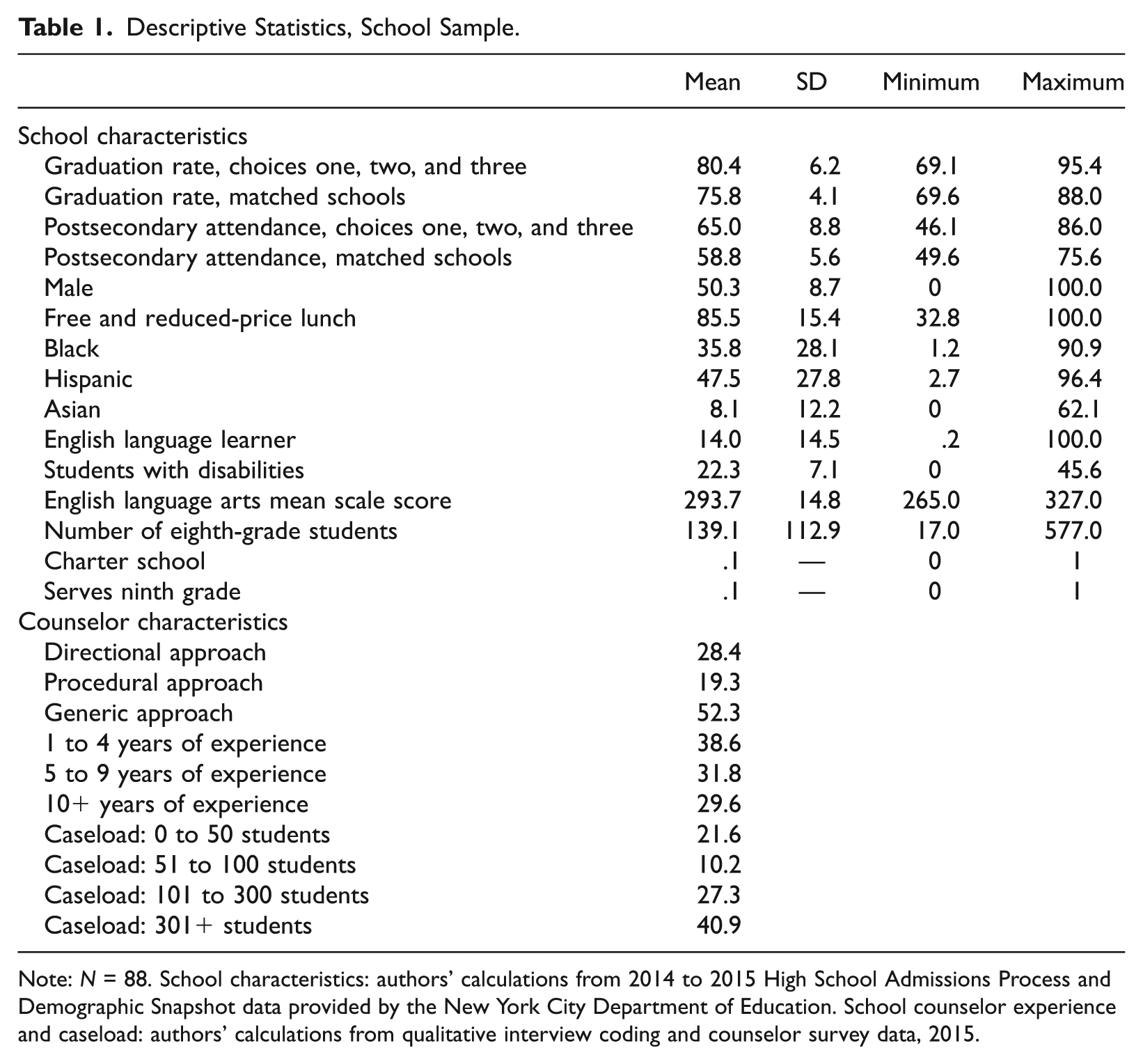
Note: N = 88. School characteristics: authors’ calculations from 2014 to 2015 High School Admissions Process and Demographic Snapshot data provided by the New York City Department of Education. School counselor experience and caseload: authors’ calculations from qualitative interview coding and counselor survey data, 2015.
In both modes of data collection, we captured information about respondents’ preparation and training, their information provision to students and parents about high school admissions, their assessment of students’ and parents’ primary information sources and approaches to school selection, and the recommendations, advice, and choice strategies they offered to students and parents.
Qualitative Analysis
We analyzed interview data using a multistage approach combining inductive and deductive techniques. First, we conducted preliminary inductive coding of four interview transcripts and used codes based on our research questions to generate a comprehensive list of potential codes. Next, two of the authors independently piloted the coding scheme on four interviews to evaluate the validity of the codes. Once the coding scheme was finalized, all interviews were coded using Dedoose.
To answer our research questions, we examined a subset of nine codes specifically related to guidance approaches, information provision, and perspectives on making specific recommendations about high schools. Using the technique of data displays (Miles and Huberman 1994), we created a spreadsheet that included all interview excerpts associated with the selected codes. Every interview subject was given a row, and the columns contain the quotes associated with each code. Using the constant comparative method (Strauss and Corbin 1994), we read down each column to identify patterns of responses and behaviors within each major code. In this step, we began to detect three core categories of guidance that appeared repeatedly across multiple codes. We labeled these guidance approaches directional, generic, and procedural. To better understand these emerging categories and the relationships among the codes that composed them, we read across by row to determine whether behaviors and perspectives could be linked and whether there was consistency in guidance category within each interview subject. Ultimately, we conducted cross-case analysis to test categories within and across cases (in this instance, each school counselor).
To assign each counselor to a guidance “type,” two researchers independently read all coded excerpts in the spreadsheet and separately categorized them. We achieved 80 percent intercoder reliability for this categorization, and a third coder adjudicated any instances of disagreement.
Administrative and Student Survey Data
We validated these three guidance categories using administrative and student survey data. Our administrative data include students’ school choices in the same school year in which counselors were interviewed, from which we can calculate the average graduation rate of students’ choices and school assignments. These data also include school demographic and achievement data, which serve as controls in our analysis. We estimated three sets of models: multinomial logistic regression models predicting guidance counselor type as a function of counselor- and school-level characteristics (Table 2), ordinary least squares regression models predicting the average graduation and college-going rate of students’ first through third choices as a function of counselor type and school-level controls (Table 3), and linear probability models predicting whether students talked with their guidance counselor or attended an open house as a function of guidance counselor type and student-level controls (see Table 5).
Multinomial Logit Models Predicting Guidance Counselor Type.

Note: N = 88. Standard errors are in parentheses. Authors’ analysis from Demographic Snapshot data provided by the New York City Department of Education, qualitative coding, and counselor survey data, 2015. Omitted category is directional counseling. All continuous variables are standardized to have a mean of zero and standard deviation of one.
p < .10. *p < .05.
Ordinary Least Squares Regression Models Predicting School-level Choice Outcomes.

Note: N = 88. Standard errors are in parentheses. Authors’ analysis from 2014 to 2015 High School Admissions Process Demographic Snapshot data provided by the New York City Department of Education, qualitative coding, and counselor survey data, 2015. Omitted category is directional counseling. All outcome variables are standardized to have a mean of zero and standard deviation of one. Controls include school percent male; percent free and reduced-price lunch; racial, English language learner, and students with disabilities composition; charter status; serves grade nine; and caseload. Full models are reported in Appendix A.
p < .10. *p < .05. **p < .01.
We also validate our guidance categories against behavior captured in student surveys. We administered these surveys in 25 schools in January through March 2015 after students submitted their high school applications. We recruited these schools as part of a larger study of the impact of informational interventions on students’ high school selections and assignments. 2 Surveys addressed the informational resources students used to learn about schools, the parties they talked to about schools, and their preferences for a variety of school characteristics.
Professional Discretion and Autonomy: Implementing New York City’s School Choice Policy
New York City has one of the longest standing and most complicated high school choice policies in the nation. Application is required; there are no default neighborhood schools. In December of eighth grade, all students submit a single application form listing up to 12 high school programs they would like to attend, ranked in order of preference. Applicants choose from a portfolio of over 750 high school programs, some of which admit students based on academic criteria such as grades and test scores. The matching process relies on a complex algorithm that takes into account students’ preferences, available space, and the schools’ own rankings and priorities (Abdulkadiroğlu, Pathak, and Roth 2011). Students are matched to only one high school; if students do not receive a match in the first round, they participate in a second round of applications.
School choice policy in New York City, like many other choice-rich districts, incorporates two distinctive policy logics that create opportunities and constraints for those charged with implementing them (Bridwell-Mitchell and Sherer 2017). These logics overlap in some respects, but they vary in the emphasis they put on the intrinsic value of choice. From the perspective of individuals invoking an agency logic, giving parents the opportunity to choose a school is inherently valuable; choice is, to some extent, an end in itself. According to this line of thinking, because parents know their children best, they are optimally positioned to make the most suitable choices about their children’s education. These aggregated choices also have the benefit of stimulating competition between schools and generating pressure to improve performance overall. Some of the earliest proponents of school choice relied heavily on this agency logic to promote and rationalize the introduction of market-based theories into the public education sector (Chubb and Moe 1990; Friedman 1962). Granting parents freedom to choose what is best for their children remains a widely touted explanation for the benefits of choice (Gill and Booker 2008; Hoxby 2003). Yet critics attribute increased educational stratification and growing school segregation to the vast expansion of choice policies (Lareau and Goyette 2014; Orfield and Frankenberg 2013).
The agency logic abounds in public descriptions of the purpose and goals of high school choice policy in New York City. In its online and printed brochures and on its website, the New York City Department of Education (NYC DOE) advertises high school choice as an opportunity for students and families to select the most fitting and desirable school option. For example, as Sattin-Bajaj (2014) details in her ethnographic study of Latino immigrant families’ experiences with high school choice, the NYC DOE webpage dedicated to the city’s school choice policies describes the high school admissions process as centered on two principles: equity and choice. The student-driven process enables students to rank schools and programs in an order that accurately reflects their preferences. . . . The Department of Education conducts workshops and fairs to help parents and students learn about the high school admissions process and make informed choices. (Sattin-Bajaj 2014:29)
Although students and parents are frequently named together as the key actors in the process, district administrators ultimately expect parents to be the final authority on what is right for their children. As one NYC DOE representative speaking at a high school choice workshop articulated, “Parents, you know better than anybody what your child is capable of and what his strengths are” (Sattin-Bajaj 2014:35). Parents’ job, from this perspective, is to match their children’s strengths with the right educational fit. One DOE representative explained, “For most families, this is an individual experience, and they look at different factors when they contemplate what makes a great school. It could be the size of the school or the number of enrichment programs. Or it might be an academic specialty” (Chapman 2016). This agency logic is built on a set of assumptions about parents’ time, resources, child-rearing perspectives, and capacity to comply with the demands of choice. As a consequence of these assumptions—which are based largely on middle-class parenting norms and resources—this agency logic may at times come in direct conflict with the other commonly expressed goal of choice policies: to promote and increase equity.
An agency logic can be understood as a logic of the market. A competing logic for school choice policies, which we call the equity logic, is to allow a larger fraction of families to access better educational opportunities. Choice is valuable because of the opportunities it affords, not as an end in itself. This logic suggests that institutional agents have a role to play in facilitating families’ access to better school choices. Beyond explicitly stating equity as a goal of its high school choice policy, as the NYC DOE did on its website, the district represents the equity logic in two primary ways. First, district officials repeatedly highlight the number of available educational options across the city—all of which are ostensibly open to students regardless of where they live. In this respect, the equity logic has substantial overlap with the agency logic. By emphasizing the plethora of schooling possibilities, the NYC DOE accentuates its pursuit of educational equity through the separation of residential neighborhood and access to a high-quality school. For example, one of the first pages of the 2017 Directory of NYC High Schools—an over 600-page tome listing all high schools and programs—introduces the high school choice policy in the following way: “New York City residents have more high school options than students living in any other city in the country. There are over 700 programs at over 400 high schools from which to choose” (NYC DOE 2017:7).
Next, and most relevant to this discussion, the NYC DOE describes a central—if supporting— role for middle school counselors in facilitating the high school choice process. In printed materials and at events, the NYC DOE directs students and parents to “talk to your guidance counselor” about everything from open house dates and registering for auditions to reviewing the final application and “getting buy-in as to which programs make the most sense to put on [your application]” (Sattin-Bajaj 2014:38). Yet as we will demonstrate, the district leadership did not formalize the equity logic through clear communication to school counselors about their expected involvement in students’ school selections. Moreover, the district did not provide guidance about how school counselors should deal with conflict between the logic of equity and the logic of agency—conflicts made immediately apparent when low-income parents did not enact agency as anticipated.
These logics are central to understanding the uncertainty and challenges that counselors face in implementing school choice policies on the ground as well as how they psychologically resolve these tensions. School choice policy exemplifies the ambiguity and goal conflict identified by Lipsky ([1980] 2010), who saw street-level bureaucrats as the ultimate adjudicators of unclear and contradictory expectations embedded in policy. Through the lens of agency logic, school counselors ought to defer to parents and families and refrain from directly influencing their choices. Yet meeting the demands of equity logic requires a hands-on stance from counselors when disadvantaged families are unprepared to navigate complex school choice systems.
Middle school counselors in New York City operate with few rules or standardized instructions. Individual middle school principals can mandate specific school choice–related tasks and evaluate counselors based on their performance on these tasks, but no formal districtwide requirements exist about how middle schools must work with eighth-grade students and families on high school choice. In fact, this was a source of confusion among our survey respondents: 33 percent of counselors reported that there are no system-wide requirements for implementing the high school admissions process, whereas 53 percent indicated that the district required them to meet with students to help fill out applications.
In guiding middle school students through the high school admissions process, school counselors, at a minimum, are expected to distribute the high school directory to all eighth-grade or rising eighth-grade students, distribute and collect completed applications, and enter each student’s application manually into the enrollment system. These tasks represent the most basic responsibilities of middle school counselors assigned to oversee the high school choice process. Many middle schools also have their counselors disseminate some information and hold school choice awareness activities for students and families. However, school-level activities are neither officially measured nor monitored by the NYC DOE.
Conditions of Work: Street-Level Challenges Faced by Counselors
According to Lipsky ([1980] 2010:xii), understanding the conditions of scarcity in which street-level bureaucrats work is critical to comprehending their behaviors because “the most important aspects of interactions with clients are those affecting the structure of the interactions: when they will take place, with what frequency, under what circumstances, with what resources commanded by the parties.” Each year, middle school counselors face the formidable task of guiding students and parents through New York City’s high school choice process with what they believe to be inadequate support, particularly given the tremendous demands made by students and families. In this way, middle school counselors in New York City confront the typical dilemma of street-level bureaucrats: implementing public policies without sufficient resources.
To start, middle school counselors in our study identified a lack of time to dedicate to informing students and families about how to navigate choice (due to competing obligations) as a major barrier to effectively carrying out their duties. They cited the size of their caseloads, which could be as high as 400 in some schools, and the variety of tasks they are assigned generally as some of the biggest challenges they must contend with. One counselor framed the issue this way: “I mean, as a counselor, you have other responsibilities. High school is very important, but at the same time so are other students who have other needs. I would just say it’s just challenging meeting with them fairly. It’s just the time. Not enough time” (N761). Another counselor enumerated the different expectations of her job, of which high school choice was just one small part: We also—we’re guidance counselors here. We also see students at risk and we deal with ACS [Administration for Children’s Services] cases and we deal with behavior issues, we do mediations in the office. We get involved a little bit with discipline and do the recruitment. . . . It’s a very busy office. (P880)
The imbalance between the volume of tasks counselors were given and their capacity to complete these tasks, let alone do them well, was a source of considerable stress for counselors.
On top of competing demands for their time, school counselors described the choice process itself as difficult to comprehend—for themselves as well as the students and parents in their schools. In particular, counselors were critical of the number of high school options available, identifying this as a source of anxiety for students and something that prevented them from becoming familiar with schools. One counselor (J501) described New York City’s high school choices as “an abyss,” and another referenced the seemingly endless cycle of school openings and closures as an additional difficulty: “There’s so many new schools opening, and they’re so diverse. . . . Trying to find out about the new schools that are opening . . . and then try[ing] and keep up and see how they’re progressing because since they’re new schools, you won’t necessarily have statistics or general information on them” (N422). For their students, the process of finding a high school—not to mention finding 12 for their applications—is “overwhelming . . . it is an entire other job on top of being a student” (P294). Students’ anxiety and confusion take up counselors’ already limited time and mental energy: Students’ challenges become school counselors’ challenges.
Middle school counselors were most vociferous about the difficulties associated with the limited involvement of parents in their students’ high school choices. The modal response to a standard interview question about the most challenging part of working on high school admissions was some variation of the following: “I think just getting people engaged. The parents start thinking about this too late. And the students are not ready to do this on their own, take it seriously” (C663). Another counselor put it this way: “Parents, parents, parents. . . . They’re almost like last minute. Things that you’re teaching students not to be” (B327). School counselors also lamented putting in the effort to organize workshops and events where “nobody comes,” and many dismissed parents as “not really working that hard on helping their children get into these high schools” (A125). At the same time, counselors almost uniformly acknowledged how difficult high school choice in New York City was for the parents, many of whom were “working three to four jobs, they’re immigrants so they don’t understand” (P135). Counselors described parents as “up in the air” and “totally lost,” and they expressed empathy for “these poor people” who “don’t know what’s going on” (C912). In the end, however, most school counselors framed parents as failing to live up to their parental obligations—a response to cognitive dissonance predicted by Lipsky’s ([1980] 2010) model of street-level bureaucrats in conditions of uncertainty, scarcity, and conflict.
Students’ need combined with minimal parental direction left most of the middle school counselors in our study alone to ensure that hundreds of overwhelmed and often disengaged eighth-grade students submitted a completed high school application by early December. Confronted with this reality, and with frequent requests from students and parents to pick schools for them, the majority of school counselors avoided providing action-guiding advice. Counselors justified their responses by deferring to the agency logic, giving explanations like, “I can only say so much. In the long run the parent has to sign off on the application” (B327).
To rationalize their own behaviors in a context in which parents were not actively involved, the majority of school counselors generated a simplified narrative of a complex situation. First, the school counselors believed parents should care about their children’s high school choices because these choices were important. Relatedly, they felt that high school decisions should be made by families, with considerable parental oversight. As one counselor phrased it: “It comes to the point where a parent has to be a parent and make the best choices for their child” (I150). Counselors faulted parents for setting bad examples for their children about not meeting their responsibilities or taking seriously a consequential task: “Kids do not live in a bubble. . . . If you have a parent who’s ‘eh’ about it, they’re gonna be the same way ’cause their parents are their main role models, so they’re gonna follow their lead” (A214). This reframing of parents as blame-worthy was a self-protective strategy that allowed counselors to function under conditions of ambiguity and dissonance. It provided cover for the stories they told themselves (and us) about the guidance they did (and did not) offer and what that meant for students’ futures. Counselor J501 summarized this perspective by saying, “It’s really an impossible job for me as one person to handhold 95 kids. If their parents aren’t involved, then they’re really doing it on their own, and a lot of them really are.”
Nearly one-third of counselors in our sample deviated from this pattern, however. Although they shared their colleagues’ belief that school selections should be the province of parents, these counselors were motivated by personal and professional ethics to step in and fill the void when they saw students struggling with the choice process unsupervised. They understood the challenges in parents’ lives that prevented them from helping their children, and they took it upon themselves to do what they thought needed to be done to guide their students. As one counselor (C093) explained: One of my philosophies is I have to give these kids what their parents cannot give them, not because they don’t want to but because they don’t know, they was [sic] never taught on how to do it, so I’m here to compensate. . . . I cannot expect a parent that has never been to visit a school and who has limited education or limited formal education or doesn’t feel comfortable, because of a language barrier, to go to a school and inquire, to do everything the way I want them to do it or I would like them to do it. You understand? For me, I know I have to meet those parents sometimes more than half way.
These “directional” counselors did not explicitly articulate an equity logic to explain their behaviors. Rather, they pointed to inequities built into the choice policy itself, including the complexity and resulting confusion described earlier, and the unfair demands made of parents as justification for their greater than average investment in providing personalized support to students facing this task.
In summary, roughly two-thirds of the school counselors in our sample resolved the conflict between their clients’ need for assistance and the competing demands on their time in ways consistent with Lipsky’s ([1980] 2010:xii) assertion that “large classes or huge caseloads and inadequate resources combine with the uncertainties of method and the unpredictability of clients to defeat their aspirations as service workers.” However, a sizable number of school counselors did not follow this path. We next elaborate three distinct types of school counselor responses to the common challenges they face, and we measure the impact of students’ access to different types of school choice guidance. In doing so, we advance theoretical understandings of street-level bureaucracy by identifying the sources of variation in guidance behaviors and quantifying their significance for students’ chances of accessing high-quality educational opportunities.
Three Approaches to High School Choice Guidance
The school counselors in our interview sample utilized three approaches to counseling students and families about high school choice, which we refer to as directional, generic, and procedural guidance. School counselors who provided directional guidance worked individually with students to identify high schools in which they would have the greatest chance of achieving academic success and graduating. Our notion of directional guidance includes providing detailed recommendations of high schools to include on their applications and dissuading students from listing high schools that were either too low performing or unrealistic given admissions criteria.
School counselors who offered generic guidance communicated general information about high schools to students and their families and worked to ensure that all students received an admissions offer during the first round of applications. With some hesitation, generic counselors would provide students with personal recommendations, but only when students or parents made an explicit request for this type of assistance. For these counselors, naming specific schools for students to list on their applications was the exception rather than the rule; they did not conceive of this as an appropriate part of their job. In contrast to directional and generic approaches to school choice counseling, counselors who engaged in procedural guidance focused solely on basic information dissemination and strongly resisted providing students with concrete high school recommendations. Rather, these counselors believed high school application decisions should be driven by parents’ choices, and they rejected outright any requests for suggestions or opinions about specific schools.
The categories of directional, generic, and procedural guidance are composites of a set of behaviors and perspectives that distinguish interview respondents from one another in three key areas: overall willingness to make high school recommendations to students, inclination to encourage or dissuade students from choosing specific high schools, and approaches to teaching students how to evaluate and rank high schools.
Slightly more than half of guidance counselors (52.3 percent) fell into the generic category, 28.4 percent fell into our directional category, and 19.3 percent were in our procedural category. The bottom panel of Table 1 displays the distribution of counselor-related characteristics. Counselors varied substantially in experience: 38.6 percent had 1 to 4 years of experience, 31.8 percent had 5 to 9 years, and 29.6 percent had 10 or more years of experience. Caseloads also varied dramatically, with 21.6 percent of counselors reporting caseloads of 0 to 50 students and 40.9 percent reporting caseloads of 301 or more students.
Table 2 reports the results of multinomial logistic regression models predicting guidance counselor type as a function of these characteristics. Here, we see that counselors with five to nine years of experience are less likely to be procedural (relative to directional, the omitted category), as are counselors in schools with higher English language arts (ELA) scores and higher fractions of black, Hispanic, and English language learner (ELL) students. Caseload is also associated with guidance counselor type; counselors with larger caseloads are less likely to be procedural and more likely to be generic. These results suggest that approaches to counseling vary by school context, but not always in predictable ways. For example, disadvantaged students are not necessarily more likely to have procedural or generic counselors.
Perspectives on Making Recommendations
Street-level bureaucrats’ daily work is often a juggling act. To survive the crush of demands in an environment of scarcity, bureaucrats must develop strategies to make the day-to-day more manageable. For the school counselors in our study, this meant establishing clear internal rules about what information they would (and would not) provide about high schools and the choice process, how they would most efficiently provide this information, and how they would respond to student and parent requests for personal recommendations.
Previous work documents the challenges that virtually all New York City families experience when attempting to navigate high school choice, including inaccessible information and inconsistent admissions criteria (Jessen 2013; Sattin-Bajaj 2014). Amid widespread confusion, school counselors often serve as a primary, and in some cases the sole, source of information and guidance for eighth-grade students and parents. In their survey responses, 66 percent of school counselors reported they were “very influential” in students’ school choices. Students confirmed the essential role of school counselors in their own survey reports; approximately three in four students reported talking to the school counselor about their high school choice.
In many cases, students’ and parents’ disorientation translated into their requesting that school counselors orchestrate the choice process or even make the selections for them. Counselors reported that students and parents frequently asked them to choose the “right” high schools, a phenomenon summed up by counselor N111: “Ultimately, I have parents who come in who sit with me and say, ‘Tell me what schools to put down’” (N111). Counselors’ responses to these requests for assistance capture a key distinction among directional, generic, and procedural approaches.
The flip side of making student-specific high school recommendations is dissuading students from applying to certain high schools that are either too low performing or out of reach for admission. To estimate their likelihood of admission to a particular school, students must compare their seventh-grade final grades and standardized test scores (for schools that screen on academics) and any other metrics that determine “priority” status (e.g., living in the geographic zone) with each high school’s specific matrix of admissions criteria and the historic demand for seats in that school program. The struggle to accurately assess likelihood of admission to each school and to rank-order high schools on the application remains one of the most frequent complaints lodged at the NYC DOE by students, parents, and school counselors. Consistent with their perspectives on providing recommendations, directional, generic, and procedural counselors diverged considerably in their responses to students who listed very low-performing high schools or highly competitive high schools for which they had slim chances of admission. Counselors’ responses to interview questions about their propensity to make explicit, personalized high school recommendations and their inclination to advise students against applying to certain schools constitutes the fundamental point of divergence among directional, generic, and procedural guidance approaches.
Directional Guidance
Counselors who engaged in directional guidance activities believed it was their duty to ensure that students would be assigned to high schools that facilitated their long-term academic advancement and personal well-being. This meant they would recommend specific high schools to students, and they would intervene when students listed inappropriate or undesirable schools on their applications. One directional counselor described her work to support informed, appropriate high school matches as an essential part of her job: “I feel like it’s my responsibility to make sure the child gets in a school that’s a good fit for them. . . . Just like when a kid goes to college, but this is even more important because some schools are good, and some schools I wouldn’t put my dog in” (C912).
Directional counselors often set up meetings with each eighth-grade student (and sometimes their parents) and would use this time to make personalized, student-specific recommendations. They would also provide step-by-step instructions for how to research schools and fill out the application. For example, one counselor recounted the kinds of conversations she has with students during individual meetings to arrive at a possible set of schools: When I speak to them individually . . . we talk about their life, and we talk about their grades. It’s the reality. If you don’t have high grades, you’re not gonna be able to get into certain schools. So we find matches for them. I don’t pick the schools for them. I just give them advice, so I tell them, “This is a good school. They have this kind of criteria, and you have these kind of grades.” (N430)
Counselors who used directional guidance approaches attempted to seek a balance between supporting students’ aspirations and helping them make realistic decisions that would set them up for success in the high school choice process and after. These counselors felt strongly about the value of encouraging students to aim high and pursue challenging educational opportunities, but they also wanted students to be strategic in their selections. Directional counselors described having “honest” discussions with students about their grades and eligibility and letting students reach their own conclusions after reviewing the information. In this way, directional counselors used conversations with students about their applications to help them build analytic skills and self-awareness. One counselor (A112) explained her approach in the following way: I’ll say to them, “This is what you need. Let’s look at your application, and what your grades are, and where do you feel you fall.” I’ll have them do some of those kind of reflections. I feel that that would help because, if it says I need between an 80 and 100 in my four major subjects, but yet, they’ll see the application with their seventh-grade scores and they’ll say, “I don’t have that,” I think that helps them see . . . to regulate themselves, right.
If directional counselors received an application that contained high schools they believed were too low performing or too far outside a student’s eligibility threshold, they would contact students and parents and raise a red flag. Counselor A239 said: So you get a student that has seven choices but they’re completely unrealistic, I send a letter home, I say “Please review the application. . . . You might want to look them over. Do a little bit more investigating. If you don’t want to change it, then have a parent sign the bottom of this letter and return it to me.” . . . When I see that, I—my job is to then inform the parent of what they’re putting down and signing off on.
Generic Guidance
In contrast to directional counselors’ highly individualized approach, counselors who engaged in generic guidance practices rarely initiated one-on-one conversations with students and families, and they refrained from proactively offering opinions and recommendations. Instead, these counselors focused on helping students cultivate their own opinions about high schools and generate their own lists based on their independently determined goals and preferences, not those of the counselor. When students did ask for suggestions or names of high schools to list on their applications, generic counselors either provided all students with a general list of high schools that met basic academic standards (e.g., a certain minimum graduation rate) or made recommendations based on students’ expressed preferences (e.g., school theme, location). One counselor (A313) answered an interview question about how she responded to student requests for recommendations by reporting, I give a list of schools that I feel have good standing . . . or that I’ve heard have good reputations. . . . I do not put my seal of approval on it. Again, I just tell them, this is something they have to go check out for themselves because not everything matches everybody.
Generic counselors felt it was outside their purview to steer students away from high schools in which they had expressed interest even if a student’s academic record fell well below the admissions criteria. In fact, a number of the generic counselors felt that raising concerns about students’ admission chances at highly competitive high schools might be more harmful to students than just letting them proceed. Because of the confusion surrounding the matching algorithm used by the NYC DOE, some counselors also left open the possibility that students could be matched to a high school they did not appear to qualify for. As one generic counselor (J901) recounted, I always encourage them. “If it’s a school that you really want, put it down. I don’t care if there’s no chance of you getting in, still put it down anyway. . . . Not all of your choices should look like that, but if you have a reach school, put it down ’cause you never know. You never know.”
Generic counselors would not instruct students to remove schools for which they were ineligible, but to avoid complete rejection in the first round, they would urge students to include a mix of schools with different admissions criteria.
Procedural Guidance
Procedural guidance counselors were committed to the idea that high school decisions should rest solely in the domain of students and parents. Consequently, they restricted their guidance to disseminating information about high school choice events, materials, and required procedures; they also kept track of deadlines and managed administrative tasks. Counselors who adopted procedural approaches delivered this information in an undifferentiated, abstract way that left students largely in the dark about how to strategically make high school selections. At the most extreme end of procedural guidance, counselors would distribute the directories and tell students it contained everything they needed. As one school counselor (J698) put it, “Yeah, the booklet is very comprehensive, so we usually tell them to look at the requirements in the booklet [High School Directory]. We tell them that if they don’t meet the requirement, it’s not a wishing sort of thing . . .they probably will not be matched to that school.”
Unlike their counterparts, procedural counselors took few steps to explain the various high school admission methods or show students how to evaluate their eligibility. Rather, one procedural counselor (J698) summarized his high school choice–related activities by saying, “We give them the information. . . . We let the students and their families navigate the High School Directory on their own.” Another interviewee (A214) stated, “I won’t tell a student, ‘I think you should go here,’ because, like I said, it is their understanding.” This quote reflects a view held by many procedural counselors that it was not appropriate to direct a student toward a particular school.
Counselors who engaged in procedural guidance maintained a neutral stance that did not implicate them in any decision making. These counselors did not want to deliver the unwelcome information to students about their competitiveness for admission to highly sought after schools. Therefore, when procedural counselors encountered students who listed schools for which they did not meet the admissions criteria, they would do little more than caution that the odds of admission were small. As one counselor (J851) explained, “I try not to [dissuade] because I don’t wanna tell a kid that— even if they’re not a great student I don’t wanna tell them that they, ‘Oh, that school is too—you can’t function there or you can’t do it.’”
Some procedural counselors explained their behaviors as a function of wanting to avoid complaints from parents. Rather than engaging in unpleasant conversations with parents about their children’s academic records and chances of admission, procedural counselors deferred to parents. One such counselor (J382) explained it this way: A lot of our kids don’t meet the requirement for the screened programs yet they feel there’s a need to put it on their application. Which is fine but I feel like sometimes it’s a waste of a choice . . . if you’re not going to get in. . . . If you don’t have the grades for a school that tells specifically in the directory that you need these grades to get in then don’t—sometimes families don’t understand that as well. I’m like, “Okay. That’s fine. Put it on the application.”
Ultimately, the procedural counselors described their approach to guidance, in part, as a means to avoid possible backlash from students and parents. As counselor J086 explained: Because I don’t want it said that now that child has to go to a school, and they didn’t really want that child in that school. Which parents have said, even though they put that choice on the application. I don’t want to be accused of controlling that process for that parent or that student.
These counselors were largely motivated by self-protection rather than facilitating informed high school choices.
Generic and procedural guidance approaches exemplify Lipsky’s ([1980] 2010:xii) claim that “[t]he helping orientation of street-level bureaucrats is incompatible with their need to judge and control clients for bureaucratic purposes,” which in turn results in their “invent[ing] benign modes of mass processing that more or less permit them to deal with the public fairly, appropriately and successfully.” Yet as our quantitative results will show, generic and procedural approaches were not benign; in fact, students who did not benefit from directional counseling were worse off in the high school choice process. The existence of three types of guidance approaches indicate that not all street-level bureaucrats eschew their “helping orientation” in the face of these conditions. Not all counselors responded to the ambiguous and conflicting policy logics by prioritizing parental agency. Rather, directional counselors acted in accordance with their “ideal conceptions of their job” and in doing so privileged the equity logic above all else.
Approaches to School Choice Guidance Explained
The variation in counselors’ responses to conditions of ambiguity raises questions about why some provided hands-on, responsive, action-oriented directional guidance and equally important, why the large majority of counselors in our interview sample took a far more impersonal, bureaucratic approach.
The explanations that generic and procedural counselors gave for their behaviors in the context of the high school choice process, and specifically their responses to students’ and parents’ requests for explicit high school recommendations, were virtually indistinguishable from one another. These counselors’ resistance to guiding individual students toward particular high schools was a function of three core factors. First, a number of counselors expressed anxiety about directing students to high schools in which they might not ultimately be satisfied. They feared being responsible for students ending up in schools where they would not be successful, and they were concerned about repercussions from angry parents or displeased school principals. One school counselor (C093) described this widely shared sentiment among generic and procedural counselors: Because I may like a school, and this is the other part of the process, it can be very subjective. I’ve been to schools that I really like what I see; but then a parent goes and a child goes, they come back and they say, “Miss—, I don’t know why you like it, but I don’t like it.” Right there, even if I’m recommending it, I’m disservicing [sic] the child because the family does not like the school. That’s why I’m very cautious as to how I present information.
Counselors frequently cited their own limited knowledge of the range of high school options as another reason for their reluctance to identify specific schools for individual students. One generic counselor (A325) described her discomfort with responding to student inquiries about schools as a function of her relative lack of familiarity with the school supply: “The questions that they have . . . I don’t necessarily know the answers to. . . . The differences of the schools they want to go. The only research I’m doing is the same research they’re doing. It’s not like I have any more expertise in each high school than they do.” Other counselors said they were not equipped to make determinations of “good” high schools because they had not participated in the high school choice process as a student or a parent or because they had not worked in the high schools.
A final justification for generic and procedural counselors’ minimal personal engagement with students about high school selections stemmed from their belief that each child is different and therefore there is no such thing as a universally “good” choice. This idea was closely linked to counselors’ perception that only parents and family members could accurately determine which schools would be best for their children—the foundation of the agency logic of choice. As one procedural counselor (I150) explained, she thought questions about whether a certain school was “good” were actually “trick questions”: The other question I get is “What do you think is a good school?” That’s really a trick question. I went to one school, my brother went to the same school. Two different experiences, two different opinions. He liked it, I didn’t. . . . That’s a question that I don’t like answering for them. I told them, I said, “Your experiences could be different than anyone else’s. That’s just a personal thing.” What’s good for one kid might not be good for another.
Other counselors emphasized that each family has its own set of choice criteria, which rendered counselor-initiated recommendations neither useful nor appropriate. Counselors who articulated these views gave no indication of feeling regretful or having doubts about their non-interventionist approach. On the contrary, they spoke confidently about what they did and did not do to help students and families through the high school choice process, revealing their adoption of the agency logic of school choice policies as a primary orientation.
For the directional counselors, deep engagement with individual students about their high school choices stemmed from a combined sense of obligation and vocation. These counselors’ actions indicated that they prioritized equity over parental agency within the context of New York City’s choice policy. Directional counselors viewed themselves as ultimately responsible for the quality of high school eighth-grade students were assigned, and they understood the weight of the task: “I take it too personal. . . . It’s a huge responsibility for a counselor. I feel it’s one of the most important things that I’ve done” (C912). Their primary motivation for guiding students in this way, however, stemmed from a recognition that parents were generally providing no guidance: These counselors acted when they saw that students were left almost entirely on their own. The counselors attributed such cases to parents being “very confused by the entire process.” The situation was particularly acute for students of immigrant parents who did not speak English, but limited family knowledge and involvement was a common refrain across schools and student populations.
In the end, directional counselors understood their position as one with significant potential to influence children’s long-term life outcomes. If this required additional time investment, supplanting parents’ roles, or making concrete high school recommendations, they determined that these sacrifices and potential risks were worthwhile. One counselor (C613) aptly summarized this perspective: If I feel that my opinion—if I can kind of sway their parents’ opinion, then I’ll call the parent. I mean I know better. I care a lot about this process and I feel that I invest a lot of time in this process. If I feel that I can change a student’s life by making the right choice for them, then I call the parents and I convince them.
Whether students who experience different counseling approaches end up in schools of different quality is an open question. In the next section, we present the results of our quantitative analyses of the relationship between counseling approach and choice outcomes at the school level. These analyses demonstrate the consequences of procedural and generic counseling approaches for students.
The Impact of Counseling Approaches on Student Experiences and Outcomes
Our qualitative results show significant variation in guidance approaches; however, they do little to tell us about the impact of these approaches on students. The regression results reported in Table 3 are intended to validate our counselor categories; they examine the graduation rates of students’ first through third high school choices (on their applications) and the schools to which they are matched. For each outcome, we display an unconditional model and a model that includes controls for school composition and achievement, eighth-grade enrollment, and counselor caseload. We focus our attention here on the models with controls. Across all four outcomes, students in schools served by a procedural counselor chose and were matched to schools with lower graduation rates, on average, than were students in schools served by other counselor types. The magnitude of these differences is large—approximately half a standard deviation for three of the four outcomes. For example, students served by procedural counselors chose schools that were .518 standard deviations below the sample mean, and they were matched to schools .51 standard deviations below; in other words, students were matched to these lower-performing schools because they were choosing lower-performing schools. As expected, schools served by counselors providing generic advice did better than those served by procedural counselors but still worse than those served by directional counselors. Together, these results suggest that our independently derived categories pick up important dimensions of practice that are associated with consequential outcomes for students. This finding is important for assessing the inequality implications of variation in counseling approaches.
Next, we turn to results from our survey of 25 schools, which yielded a 39 percent consent rate from students (see descriptive statistics in Table 4). We introduce evidence from this survey to further validate the guidance categories against student reports of their interactions with and importance given to counselors’ input as well as a process measure of engagement (attending an open house). We surveyed students in a subset of highly disadvantaged schools as part of a larger study of school choice, and this is reflected in the higher percentages of free and reduced-price lunch, ELL, and students with disabilities in these schools.
Descriptive Statistics, Student Survey Sample.

Note: Analytic sample includes 955 students from 25 schools participating in the New York City High School Admissions Study. The consent rate was 39 percent.
Table 5 displays regression coefficients for models predicting whether students reported talking to their counselor about their high school choice, how important the counselor’s opinion was, and whether the student attended a school open house. Here, we find further evidence that our independently derived counselor categories track student behavior. For instance, students with a procedural counselor were less likely to talk to the counselor, less likely to say the counselor’s opinion was important, and less likely to attend an open house. The point estimates for generic counselors again fall between those for procedural and directional counselors in two of three cases.
Regression Models Predicting Student Survey Responses.

Note: Standard errors are in parentheses. Analytic sample includes 955 students from 25 schools participating in the New York City High School Admissions Study. Sample size varies because of nonresponse. Odd numbered columns exclude controls; the even numbered columns include them. The outcomes ‘‘talked to counselor’’ and ‘‘attended open house’’ are dichotomous, and we display the results of linear probability models. ‘‘Counselor’s opinion is important’’ is a 1 to 4 scale; that column displays results of ordinary least squares regression models. Full models are reported in Appendix B.
p < .10. *p < .05. **p < .01. ***p < .001.
Discussion
This article examined the forms and intensity of middle school counselors’ guidance to students and families participating in universal high school choice in New York City. After framing our case in the context of street-level bureaucracy theory and classifying three approaches to school choice guidance derived from qualitative interview data, we drew on survey and administrative data to quantify the impact of these approaches. Given recent evidence of the powerful effects of high schools on graduation rates, college attendance and completion, and other life-course outcomes (Abdulkadiroğlu, Hu, and Pathak 2013; Allensworth et al. 2017; Bloom and Unterman 2014; Deming 2011; Deming et al. 2014; Jennings et al. 2015), we argued that variation in access to directional counseling may contribute to inequality in students’ longer-term educational outcomes.
Recognizing the uniqueness of the scale and scope of school choice in New York City, we nonetheless contend that insights gleaned from this specific context about counselors’ responses to choice-related tasks and their influence on students’ and families’ outcomes have broader significance beyond city limits. Ongoing expansion of school choice nationally—a phenomenon that will likely continue under the current U.S. Department of Education—means school-level actors may increasingly be asked to play a central role in implementing choice policies and interacting with families engaging in choice. Understanding the factors that contribute to variation in counselors’ guidance behaviors and the implications of their actions may thus help explain choice outcomes elsewhere. Moreover, our evidence demonstrating heterogeneity in counselors’ responses to similar challenges adds an important new dimension to Lipsky’s foundational work on the strategies street-level bureaucrats develop to cope with their demanding work.
Middle school counselors in New York City operate in a bureaucratic environment typical of those Lipsky ([1980] 2010) described in his original theory of street-level bureaucracy. Counselors are assigned a complex task but receive few instructions and lack sufficient support to successfully carry it out. We find that the majority of counselors responded to these conditions in ways that conform to Lipsky’s model. Generic and procedural counselors established firm boundaries and restricted the amount of time they dedicated to high school choice–related tasks. They also clearly defined for themselves (and for students and parents) what they believed to be the appropriate role of a school counselor in a student’s high school selection. With this delineation between counselors’ and parents’ responsibilities, these two groups of counselors attempted to resolve the tension between the agency and equity policy logics, privileging agency above all else. Yet, they came face-to-face with the reality of parents’ inability (due to language barriers, work, or other competing demands) to fulfill their expected role. In line with Lipsky’s theory, to justify their own inaction, generic and procedural counselors framed parents as not doing enough.
The directional counseling approach, however, deviated from Lipsky’s model. These counselors personalized their guidance activities in response to students’ and families’ apparent need. This departure from street-level bureaucrats’ typical responses, and the positive outcomes associated with directional guidance, complicates the theory about how street-level bureaucrats behave in the face of “conflicting or ambiguous goals that unevenly guide their work” (Lipsky [1980] 2010:81). More specifically, our data demonstrate the possibility of diverse responses to common conditions of uncertainty and scarcity and show that the response matters. By formally linking counseling approaches to student choice outcomes, we are able to connect theoretical work in the area of organizations to research on inequality. In other words, if students’ results are directly affected by the type of support they receive, then we can look to organizational inputs as potential contributors to between-school variation in choice outcomes.
We did not find one uniform explanation for directional counselors’ behaviors, but these counselors were deeply committed to serving students who needed help making appropriate school selections. This resulted in their privileging the equity logic of school choice even while acknowledging that under ideal circumstances, parents would lead the decision-making process. Significantly, our directional counselors had more experience, on average, than the other two types. Their greater familiarity with the choice process might have played a part in their guidance producing better outcomes for students. This is important because although the students exposed to directional counseling in our sample seemed to benefit, less experienced counselors who act in similarly hands-on ways could potentially be harmful to students’ choice outcomes. In other words, although we find strong positive associations between providing action-guiding advice and better choice outcomes, the advantages of such counseling might be largely dependent on the quality of the counselor’s knowledge. We thus caution against interpreting our findings to indicate that all counselors should be more interventionist about helping students choose schools (or postsecondary pathways).
Overall, our results show that with considerable discretion and limited oversight, individual counselors choose to respond to clients’ needs and demands in very different ways. Yet formalizing all aspects of counselors’ responsibilities vis-à-vis school choice is neither realistic nor desirable, at least according to Lipsky. To maintain the contradictions of the agency and equity logics of the high school choice policy, districts must allow for a high level of discretion, thereby permitting counselors to selectively draw on each logic when appropriate. Our findings highlight the equity penalty for maintaining such contradictions while also identifying potential points of intervention.
Specifically, we interpret our results to suggest that absent major changes in counselors’ job descriptions and incentives, informational tools that recommend schools may be a promising approach to supporting students navigating school choice processes. Schools have used such interventions effectively in students’ college selection (Hoxby and Turner 2013). Evidence from interventions implemented by our team (Corcoran et al. 2017), in which students were provided a list of 30 nearby schools with graduation rates above 70 percent (approximately the citywide median in that year), suggests that providing information decreases students’ odds of being assigned to schools with lower graduation rates (below 70 percent). We found the largest effects among students who may be most likely to lack information about school choice—for example, students from families that do not speak English at home. These interventions do not entirely eliminate inequalities for students of different backgrounds. However, in conjunction with evidence presented here about the significance of counselor behavior, these results suggest that students’ choices are malleable and can be shaped by policies and practices. Administrators, policymakers, and school leaders should thus commit to developing and implementing practices that can help students make school choices that are more likely to lead to long-term success.
Footnotes
Appendix A
Full Ordinary Least Squares Regression Results, Models Predicting School-level Postsecondary Enrollment Rate of Students’ Choices and Matches.

| Postsecondary Attendance, Choices One to Three |
Postsecondary Attendance, Matched Schools |
|||||||
|---|---|---|---|---|---|---|---|---|
| (1) | (2) | (3) | (4) | (5) | (6) | (7) | (8) | |
| Procedural | −.467 ** | −.425 * | −.518 ** | −.553 ** | −.368 † | −.426 * | −.510 * | −.447 † |
| (.16) | (.17) | (.17) | (.18) | (.22) | (.21) | (.22) | (.23) | |
| Generic | −.331 ** | −.326 * | −.262 * | −.225 † | −.268 | −.351 * | −.278 † | −.243 |
| (.12) | (.13) | (.13) | (.13) | (.17) | (.15) | (.16) | (.17) | |
| Male | −.109 † | −.123 * | −.123 * | −.109 † | −.143 † | −.152 * | −.149 * | −.130 † |
| (.057) | (.059) | (.059) | (.06) | (.076) | (.073) | (.073) | (.075) | |
| Free and reduced-price lunch | −.133 | −.109 | −.120 | −.106 | −.206 † | −.154 | −.156 | −.153 |
| (.081) | (.08) | (.081) | (.081) | (.11) | (.098) | (.1) | (.1) | |
| Black | −.051 | −.152 | −.151 | −.164 | −.129 | −.352 | −.375 † | −.349 |
| (.17) | (.17) | (.17) | (.17) | (.23) | (.21) | (.21) | (.22) | |
| Hispanic | −.090 | −.135 | −.117 | −.129 | −.123 | −.237 | −.225 | −.183 |
| (.18) | (.18) | (.18) | (.18) | (.24) | (.22) | (.22) | (.22) | |
| Asian | .104 | .166 | .160 | .198 † | .134 | .281 * | .267 † | .307 * |
| (.11) | (.11) | (.11) | (.12) | (.14) | (.14) | (.14) | (.15) | |
| English language learner | .045 | .031 | −.008 | −.018 | .093 | .060 | .015 | .010 |
| (.098) | (.098) | (.1) | (.1) | (.13) | (.12) | (.12) | (.13) | |
| Disabilities | −.198 ** | −.165 * | −.229 ** | −.252 ** | −.100 | −.028 | −.087 | −.093 |
| (.074) | (.077) | (.086) | (.087) | (.099) | (.095) | (.11) | (.11) | |
| English language arts mean scale score | .554 *** | .518 *** | .475 *** | .472 *** | .426 ** | .294 * | .260 † | .275 † |
| (.11) | (.11) | (.11) | (.11) | (.15) | (.14) | (.14) | (.14) | |
| Grade eight | −.091 | −.054 | −.082 | −.206 * | −.161 † | −.192 * | ||
| (.068) | (.071) | (.075) | (.083) | (.088) | (.094) | |||
| Charter | .524 † | .312 | .193 | .682 * | .530 | .603 | ||
| (.27) | (.29) | (.31) | (.33) | (.36) | (.38) | |||
| Serves grade nine | −.059 | −.048 | −.104 | .373 | .389 | .363 | ||
| (.19) | (.19) | (.19) | (.23) | (.23) | (.24) | |||
| Caseload: 51 to 100 | −.019 | .002 | −.151 | −.094 | ||||
| (.2) | (.21) | (.25) | (.26) | |||||
| Caseload: 101 to 300 | −.256 | −.273 | −.221 | −.165 | ||||
| (.17) | (.17) | (.21) | (.22) | |||||
| Caseload: 301+ | −.309 † | −.304 † | −.362 † | −.313 | ||||
| (.17) | (.17) | (.21) | (.21) | |||||
| 5 to 9 years of experience | −.094 | .168 | ||||||
| (.14) | (.17) | |||||||
| 10+ years of experience | −.250 † | −.018 | ||||||
| (.15) | (.18) | |||||||
| Constant | .263 * | .225 * | .420 ** | .528 ** | .211 | .169 | .378 * | .257 |
| (.1) | (.1) | (.15) | (.18) | (.13) | (.12) | (.18) | (.23) | |
Note: Standard errors are in parentheses.
p < .10. *p < .05. **p < .01. ***p < .001.
Appendix B
Full Regression Results, Models Predicting Students’ Engagement with Guidance Counselor and the Choice Process.
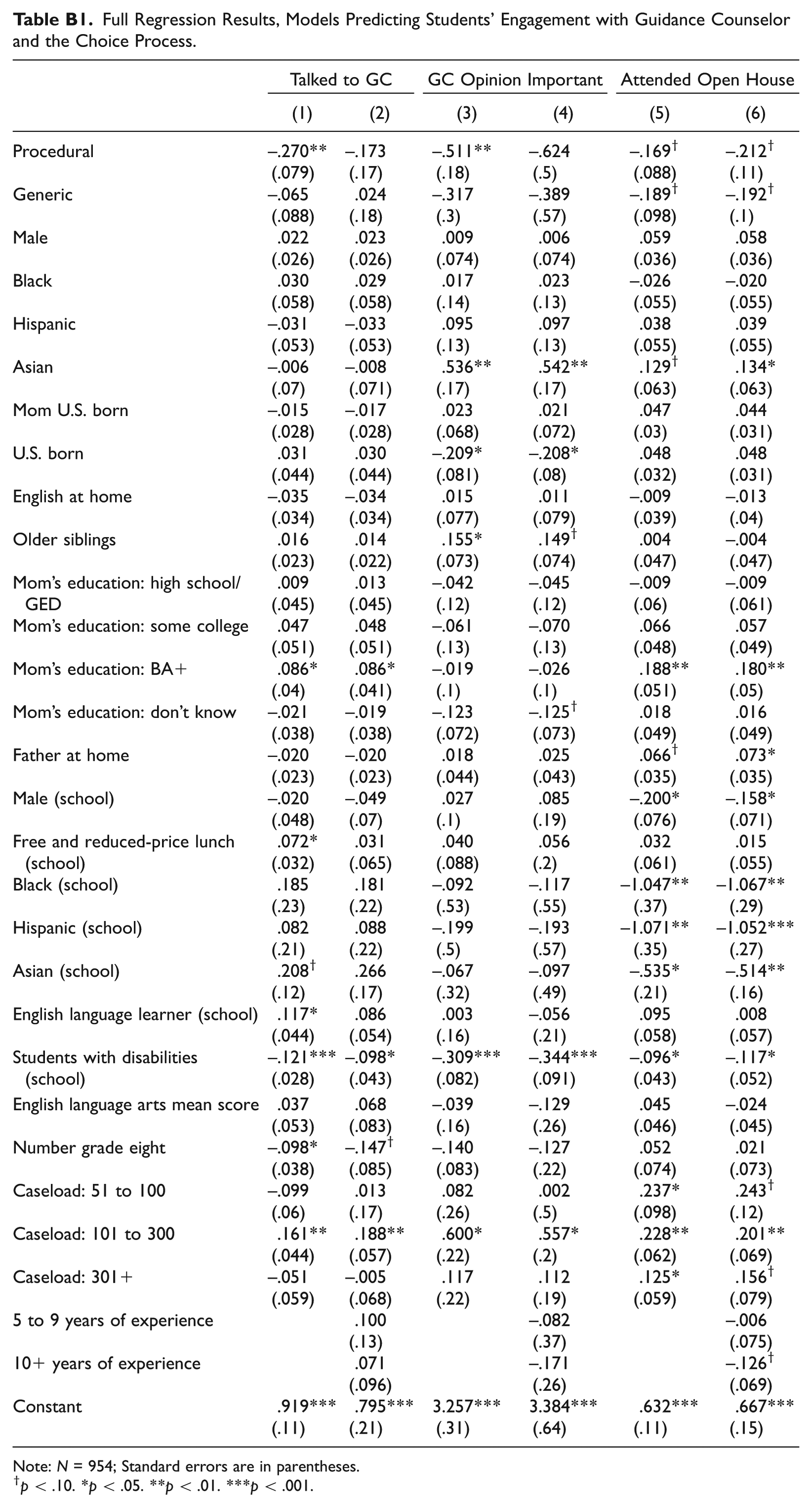
| Talked to GC |
GC Opinion Important |
Attended Open House |
||||
|---|---|---|---|---|---|---|
| (1) | (2) | (3) | (4) | (5) | (6) | |
| Procedural | −.270 ** | −.173 | −.511 ** | −.624 | −.169 † | −.212 † |
| (.079) | (.17) | (.18) | (.5) | (.088) | (.11) | |
| Generic | −.065 | .024 | −.317 | −.389 | −.189 † | −.192 † |
| (.088) | (.18) | (.3) | (.57) | (.098) | (.1) | |
| Male | .022 | .023 | .009 | .006 | .059 | .058 |
| (.026) | (.026) | (.074) | (.074) | (.036) | (.036) | |
| Black | .030 | .029 | .017 | .023 | −.026 | −.020 |
| (.058) | (.058) | (.14) | (.13) | (.055) | (.055) | |
| Hispanic | −.031 | −.033 | .095 | .097 | .038 | .039 |
| (.053) | (.053) | (.13) | (.13) | (.055) | (.055) | |
| Asian | −.006 | −.008 | .536 ** | .542 ** | .129 † | .134 * |
| (.07) | (.071) | (.17) | (.17) | (.063) | (.063) | |
| Mom U.S. born | −.015 | −.017 | .023 | .021 | .047 | .044 |
| (.028) | (.028) | (.068) | (.072) | (.03) | (.031) | |
| U.S. born | .031 | .030 | −.209 * | −.208 * | .048 | .048 |
| (.044) | (.044) | (.081) | (.08) | (.032) | (.031) | |
| English at home | −.035 | −.034 | .015 | .011 | −.009 | −.013 |
| (.034) | (.034) | (.077) | (.079) | (.039) | (.04) | |
| Older siblings | .016 | .014 | .155 * | .149 † | .004 | −.004 |
| (.023) | (.022) | (.073) | (.074) | (.047) | (.047) | |
| Mom’s education: high school/GED | .009 | .013 | −.042 | −.045 | −.009 | −.009 |
| (.045) | (.045) | (.12) | (.12) | (.06) | (.061) | |
| Mom’s education: some college | .047 | .048 | −.061 | −.070 | .066 | .057 |
| (.051) | (.051) | (.13) | (.13) | (.048) | (.049) | |
| Mom’s education: BA+ | .086 * | .086 * | −.019 | −.026 | .188 ** | .180 ** |
| (.04) | (.041) | (.1) | (.1) | (.051) | (.05) | |
| Mom’s education: don’t know | −.021 | −.019 | −.123 | −.125 † | .018 | .016 |
| (.038) | (.038) | (.072) | (.073) | (.049) | (.049) | |
| Father at home | −.020 | −.020 | .018 | .025 | .066 † | .073 * |
| (.023) | (.023) | (.044) | (.043) | (.035) | (.035) | |
| Male (school) | −.020 | −.049 | .027 | .085 | −.200 * | −.158 * |
| (.048) | (.07) | (.1) | (.19) | (.076) | (.071) | |
| Free and reduced-price lunch (school) | .072 * | .031 | .040 | .056 | .032 | .015 |
| (.032) | (.065) | (.088) | (.2) | (.061) | (.055) | |
| Black (school) | .185 | .181 | −.092 | −.117 | −1.047 ** | −1.067 ** |
| (.23) | (.22) | (.53) | (.55) | (.37) | (.29) | |
| Hispanic (school) | .082 | .088 | −.199 | −.193 | −1.071 ** | −1.052 *** |
| (.21) | (.22) | (.5) | (.57) | (.35) | (.27) | |
| Asian (school) | .208 † | .266 | −.067 | −.097 | −.535 * | −.514 ** |
| (.12) | (.17) | (.32) | (.49) | (.21) | (.16) | |
| English language learner (school) | .117 * | .086 | .003 | −.056 | .095 | .008 |
| (.044) | (.054) | (.16) | (.21) | (.058) | (.057) | |
| Students with disabilities (school) | −.121 *** | −.098 * | −.309 *** | −.344 *** | −.096 * | −.117 * |
| (.028) | (.043) | (.082) | (.091) | (.043) | (.052) | |
| English language arts mean score | .037 | .068 | −.039 | −.129 | .045 | −.024 |
| (.053) | (.083) | (.16) | (.26) | (.046) | (.045) | |
| Number grade eight | −.098 * | −.147 † | −.140 | −.127 | .052 | .021 |
| (.038) | (.085) | (.083) | (.22) | (.074) | (.073) | |
| Caseload: 51 to 100 | −.099 | .013 | .082 | .002 | .237 * | .243 † |
| (.06) | (.17) | (.26) | (.5) | (.098) | (.12) | |
| Caseload: 101 to 300 | .161 ** | .188 ** | .600 * | .557 * | .228 ** | .201 ** |
| (.044) | (.057) | (.22) | (.2) | (.062) | (.069) | |
| Caseload: 301+ | −.051 | −.005 | .117 | .112 | .125 * | .156 † |
| (.059) | (.068) | (.22) | (.19) | (.059) | (.079) | |
| 5 to 9 years of experience | .100 | −.082 | −.006 | |||
| (.13) | (.37) | (.075) | ||||
| 10+ years of experience | .071 | −.171 | −.126 † | |||
| (.096) | (.26) | (.069) | ||||
| Constant | .919 *** | .795 *** | 3.257 *** | 3.384 *** | .632 *** | .667 *** |
| (.11) | (.21) | (.31) | (.64) | (.11) | (.15) | |
Note: N = 954; Standard errors are in parentheses.
p < .10. *p < .05. **p < .01. ***p < .001.
Acknowledgements
We thank Sarah Cordes, Alex Kindel, Paul Starr, and members of Princeton’s Center for the Study of Social Organization workshop, and anonymous reviewers for feedback on this article and Stewart Burns, Alexandra Bray, Shaked Landor, and Diana Cordova-Cobo for research assistance.
The author(s) disclosed receipt of the following financial support for the research, authorship, and/or publication of this article: This research was funded by the William T. Grant Foundation, the Heckscher Foundation for Children, the Spencer Foundation, and the Institute of Human Development and Social Change at New York University.