



Abstract
This article examines global changes in tracking policies over the post–World War II period. Using a newly constructed quantitative panel data set of 139 countries from 1960 to 2010, I show that a majority of countries around the world have shifted away from sharply tracked institutions at the junior secondary level toward more formally “open” and “comprehensive” ones. To explain this trend, I argue that worldwide shifts away from more stratified and corporatist conceptions of the polity toward more liberal models led to the construction of norms of individual egalitarianism in the educational process, and this process delegitimated tracking at early ages. Findings from a series of panel regression models indicate that countries that are more formally committed to individual rights and universalistic conceptions of the educational process are less likely to track students at the junior secondary level; some nation-specific characteristics, such as levels of economic development, also shape tracking at lower levels of schooling. Most countries, however, continue to track students at the senior secondary level. The persistence of tracking at this level suggests a tension between existing conceptions of education as a mechanism for both propagating equality and allocating individuals to unequal opportunities.
Keywords
In the contemporary world, educational stratification is fundamentally shaped by national-level institutions that organize the educational process. A wide-ranging social science literature has documented extensive cross-national differences in the structural properties of education systems that shape social stratification (e.g., Allmendinger 1989; Kerckhoff 2001), linkages between educational credentials and labor market opportunities (DiPrete et al. 2017; Shavit and Muller 1998), and the consequences of these differences for individual opportunities (Pfeffer 2008).
Among the institutions that shape educational stratification, tracking has historically been regarded as one of the most crucial. 1 In the first half of the twentieth century, it was common for national education systems around the world to stratify students into sharply differentiated school tracks at early ages. In Europe, for example, nearly every country stratified its student population into several different types of secondary schools on the basis of children’s abilities (e.g., Britain’s 11-plus system or Germany’s tripartite system; Rubinson 1986), and other countries around the world also developed comparably stratified educational institutions (Benavot 1983). Over the past several decades, however, national education systems around the world have shifted away from these more stratified institutions at lower levels of the educational process. In the 1960s and 1970s, for example, a wave of “comprehensive” school movements in Europe aggressively advanced more democratic conceptions of educational opportunity at the junior secondary level (Levin 1978). Among developing countries, nation-states like Algeria, Brazil, and Indonesia all extended their “basic education” cycles to eliminate tracking at the junior secondary level in the 1970s and 1980s. On a global basis, 69 percent of countries streamed students into different “tracks” at the junior secondary level in 1960, yet only 27 percent did so by 2010 (author’s calculations).
What explains these global changes in the organization of the schooling process from early institutional differentiation toward more “comprehensive” forms of schooling? Existing literature in economics, political science, and sociology has been unable to explain these global changes in tracking institutions for three reasons. First, most studies of tracking focus on its effects on individual- and national-level outcomes and thereby take the institutional processes that shape the organization of a country’s educational process for granted (see Note 1). Second, studies that do explore the causal factors that shape educational institutions focus primarily on country-specific forms of economic and political organization in a handful of developed countries and may therefore only limitedly explain institutional changes in the rest of the world (e.g., Busemeyer 2015; Estévez-Abe, Iversen, and Soskice 2001; Heidenheimer 1981; Thelen 2004). Third, long-term and global data on national educational institutions like tracking have never been systematically collected.
To address this gap in the literature, I draw on world society theories of institutional change and a newly constructed panel data set of 139 countries from 1960 to 2010. I argue that a worldwide cultural shift toward more liberal models of the polity has led to the global decline of tracking at early ages of the educational process over the post-World War II period. This cultural shift entailed an expanding set of global norms of equal individual personhood and human rights: In this context, education became seen as a basic human right, all students were seen as capable of learning the same skills and curricular content at early ages, and education itself was recognized as an increasingly important source of social progress. These conceptions of education and equal individual personhood became part of a standard set of global norms, cognitive schema, and models of the nation-state that have delegitimated tracking at the junior secondary level of the educational process.
My findings support this theory at early ages of schooling: Most countries around the world have shifted away from tracking students into different types of schools at the junior secondary level. Results from a series of panel regression models show that countries more formally committed to individual rights and universalistic conceptions of the educational process are less likely to track students at the junior secondary level. In addition, the global consolidation of liberal conceptions of education as a human right is negatively associated with global trends in tracking at this level. Most countries, however, maintain school tracking at the senior secondary level, and several national-level characteristics (e.g., a country’s level of economic development or international migrant stock) significantly shape the use of tracking. These results highlight two broader tensions that shape tracking as an institution around the world: (1) a tension between conflicting conceptions of education as a mechanism that both generates equality and allocates individuals to unequal labor market opportunities and (2) a tension between countries’ distinctive properties and the more global institutional processes that shape a country’s educational institutions.
For definitional purposes, tracking in the public education system refers here to the external differentiation of students by their academic abilities into different types of schools that “charter” them for distinctive educational and occupational opportunities (Bol and van de Werfhorst 2011; LeTendre, Hofer, and Shimizu 2003; Meyer 1977). In particular, academic, technical, and vocational schools socialize students through different curricular and pedagogical approaches to participate in specific occupational sectors; these schools also enable or prevent students from attending different types of higher education institutions. In the following discussion, I focus exclusively on sharper forms of between-school tracking rather than course-by-course streaming within schools (e.g., ability grouping in the United States; on this distinction, see Chmielewski 2014). By design, between-school tracking entails a limited degree of fluidity between tracks and more severe forms of educational stratification given that curricular and pedagogical approaches in different school types vary greatly. The junior secondary level of schooling, as the first component of the secondary cycle of the educational process, typically begins at sixth or seventh grade and is often synonymous with middle school or junior high school.
Background
Historically, school tracking was a means of meeting existing demands for education while concurrently preserving elite status groups in societies organized around distinct class and status categories (Rubinson 1986; Turner 1960). In theory, mass education was intended to be a “civilizing” institution to integrate citizens into the nation-state, and academic education at the secondary level was intended for a limited set of elites (Ramirez and Boli 1987). Where opportunities to attend secondary education did exist, formal tracking was often developed around the assumption that students would leave school after a certain age. In Britain’s 11-plus system, for example, Kandel (1955:276) notes that roughly 97 percent of students in the “modern schools” (i.e., schools for students with the lowest academic abilities, based on an exam at age 11) left school by age 15, whereas the more academically able students in grammar and technical schools continued their educations at universities or technical colleges (see also Kandel 1930:381). More generally, the global average secondary enrollment ratio was just 2.9 percent in 1910, and it only increased to 11.8 percent in 1950 (compared to 74.2 percent by 2010; Barro and Lee 2015).
These strongly tracked systems in the first half of the twentieth century were legitimated by more general forms of institutionalized stratification that did not conform to contemporary norms of individual rights. In Britain, for example, the word person (and the rights this social category entailed) did not legally apply to all women in the country until 1929; prior to this, women were typically portrayed in international discourse as morally and physically inferior entities whose roles in society were primarily confined to that of homemakers or mothers (Berkovitch 1999). In the 1950s, only around 30 countries could be considered democratic (Doorenspleet 2000); where democratic institutions did emerge in Europe in the early twentieth century, egalitarian political norms existed in conspicuous tension with the interests and power of the “old regime” elites (Ziblatt 2017). A substantial portion of the rest of the world remained colonized by European nations that routinely subjugated and exploited indigenous populations in the “age of empire” (Hobsbawm 1987).
Liberalization and Globalizing Norms of Education as A Human Right
Over the post–World War II period, a more liberal vision of a “world society” expanded globally through a growing number of international organizations and institutions (Meyer et al. 1997). This broader social and cultural change encompassed a global set of norms, policies, abstract models, and discourse that emphasized the fundamental importance of individual rights and thereby de-egitimated older, more corporatist forms of stratification (Elliott 2007; Jepperson 2002). A wide array of economic, political, and social rights were extended along these universalistic conceptions of the individual: For example, women were increasingly granted equal employment and suffrage rights (Berkovitch 1999; Ramirez, Soysal, and Shanahan 1997), social security programs expanded to protect the rights of individuals (Schmitt et al. 2015), and a growing number of ethnic social movements mobilized around universalistic claims of human rights (Tsutsui 2004).
In this context, education became a fundamental human right, and students came to be seen as empowered individuals with expanded dimensions of selfhood and capabilities (Meyer and Jepperson 2000; Schofer and Meyer 2005). This cultural shift meant all individual students were perceived as capable of learning the same curricular content, and all individuals became entitled to extended durations of basic education (Baker 2014; Benavot and Resnik 2006). Several themes developed that were incompatible with more “elite” models of education: For example, educational curricula moved away from unidimensional images of children and rigid notions of elite culture that students would simply conform to and instead emphasized the development of individual selfhood and freedoms (Bromley, Meyer, and Ramirez 2011; Lerch et al. 2017). “Education for All” became a global social movement (Chabbott 2003), and stratified institutions at early levels of the educational process were seen as economically wasteful and unjust to “late bloomers” (Levin 1978). By 1997, the definition of basic education was institutionalized in UNESCO’s International Standard Classification of Education to comprise both primary and junior secondary education.
These underlying conceptions of education and individual rights at the global level were strengthened by a thickening set of international organizations and institutional processes that created social pressures for countries to commit to more liberal models of the polity (Strang and Meyer 1994). For example, the explosive increase in the number of democracies in the world during the “third wave” of democratization (Huntington 1991) led to a stronger focus on issues related to democracy and the development of the individual in countries’ formally stated educational goals (Fiala 2007). The rise of national and international assessment tests over the same period also reflects expanded social commitments to global ideals of Education for All and a common assumption that all students are capable of learning and obtaining the same academic skills (Ramirez, Schofer, and Meyer 2018). International nongovernmental organizations that focus on education as a strategy for promoting social progress and justice also grew significantly over the postwar period (Bromley 2010).
Theoretical and Empirical Implications
Following world society theory, my argument emphasizes two core theoretical propositions and the several corollary hypotheses that can be empirically tested. First, over the post–World War II period, global cultural changes in the institutional environment toward more liberal models of the polity, expanding conceptions of individual rights, and more comprehensive and student-centered models of schooling weaken tracking at the junior secondary level on a global basis. Following prior studies, this suggests that the growth of international nongovernmental organizations, growing number of democracies, and increasing global average duration of compulsory schooling reflect the consolidation of liberal and individualist models of education on a global basis (Schofer and Meyer 2005). Higher levels of these indicators should be negatively associated with the use of tracking at lower levels of schooling. Second, countries that are more committed to these global cultural models of liberal individual rights and open conceptions of the educational process are less likely to track students at the junior secondary level. This general proposition entails two sets of hypotheses that can be empirically tested.
A first set of hypotheses posits that countries with formal political and organizational commitments to protecting individual social and political rights are less likely to track students at early ages. More specifically, (1) countries that create state ministries that target issues related to health, labor, education, or women create formal and rationalized processes to protect and expand individual social rights in these areas (Drori and Meyer 2018). (2) Countries that have ratified more International Labour Organization (ILO) conventions are more formally committed to internationally recognized social rights that “[promote] opportunities for women and men to obtain decent and productive work, in conditions of freedom, equity, security and dignity” (ILO 2017c). (3) Countries that are more democratic are more committed to cultural values of individualism and self-expression (Inglehart and Welzel 2005), and democratic institutions have been historically important in shaping social rights and welfare policies around the world (Haggard and Kaufman 2008). (4) Countries that legalize women’s suffrage rights are more committed to inclusive notions of individual rights that develop from global principles of justice and progress (Ramirez et al. 1997). I expect a negative relationship between each of these empirical indicators and the use of tracking at the junior secondary level.
A second set of hypotheses contends that countries that are more committed to universalized norms and conceptions of education propagated through international organizations and institutions are less likely to track students at early ages. Thus, (1) countries that have more memberships in international nongovernmental organizations are more strongly linked to “world societal” models of schooling that legitimate more liberal educational policies at the national level (Boli and Thomas 1999). (2) Countries that administer international and national assessment tests more intensively (e.g., TIMSS at the international level or NAEP in the United States at the national level) are more institutionally linked to global conceptions of Education for All: Assessment tests are rationalized forms of evaluating and extending equality of educational opportunity to all students in a given area (Kamens and McNeely 2010). (3) A country’s duration of compulsory schooling represents its normative commitments to education as an individual entitlement and the state’s responsibility to provide an extended amount of education to all children (Ramirez and Ventresca 1992). For each indicator, I again expect a negative relationship with the use of tracking at the junior secondary level.
Figure 1 summarizes this argument, and Table 1 lists the hypotheses tested. As my discussion indicates, the global- and national-level components of the argument are related: At the global level, an abstract model of the polity emerges that emphasizes education as a fundamental human right, and national-level policies enact and reinforce this global model (Meyer et al. 1997). Both levels directly affect a country’s tracking policies, but these processes are not entirely independent: Nation-states enact this model of the polity that is propagated through international organizations and institutions (Boli and Thomas 1999), and in doing so, they reinforce the legitimacy of these cultural changes and generate transnational pressures for other countries to do the same (Ramirez et al. 1997; Simmons, Dobbin, and Garnett 2006). In the following analyses, I include both sets of global- and national-level variables in the models estimated. The results are similar when these variables are tested separately.
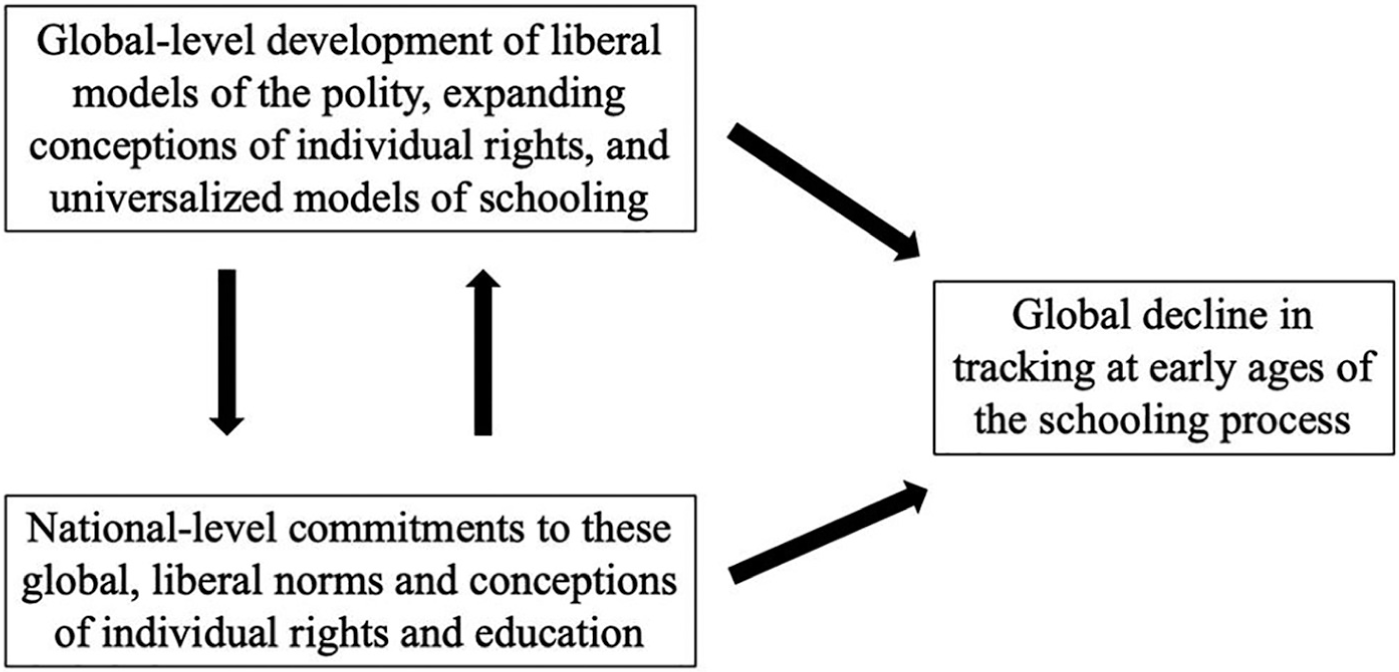
Summary of the argument.
Summary of the Argument.

Alternative Explanations
The main argument of this article emphasizes how global cultural changes in conceptions of education and the individual shaped national policies on educational tracking. A variety of other factors, however, may also explain the decline (or persistence) of tracking at early ages of schooling. My argument does not rule out these other processes from shaping the use of tracking; rather, I emphasize that these explanations are not sufficiently able to explain the global nature of the changes observed. The following discussion focuses on country-specific characteristics as well as more realist and nonliberal factors at the regional and global levels.
First, following functionalist arguments that link a country’s educational institutions to its economic needs, more developed countries may be less likely to track students at the junior secondary level. Macroeconomic studies of development emphasize that countries with higher per capita incomes are more likely to have economies with larger service sectors (and therefore more jobs that require more general skills; Eichengreen and Gupta 2013). In this context, vocational and technical tracking at early stages of the educational process may simply be incompatible with the functional needs of the economy because these forms of schooling train students for specific tasks and skills that quickly become obsolete (Hanushek et al. 2017).
Second, countries with higher primary enrollment ratios may face greater mechanical and normative pressures from their populations to expand educational opportunities at the junior secondary level (i.e., to eliminate tracking at this level) through two processes. First, as primary education expands, lower levels of the educational process reach their carrying capacities and offer fewer advantages for individuals who complete this level (Raftery and Hout 1993). Second, countries with stronger and earlier commitments to mass education have historically been more strongly linked to world societal conceptions of education as a fundamental component of legitimate nation-statehood (Meyer, Ramirez, and Soysal 1992; Ramirez and Boli 1987). This measure cannot discriminate between these two processes, but both arguments suggest that countries with expanded primary enrollment ratios will eliminate tracking at the junior secondary level.
Third, countries with larger immigrant populations may be more or less likely to maintain tracking at the junior secondary level. On the one hand, “exclusionary” theories of educational stratification suggest that tracking occurs at early ages in some countries to separate nonnative students and limit their future educational opportunities (Shavit 1990); this proposition implies that countries with larger immigrant populations are more likely to track students at the junior secondary level. On other hand, countries also seek to attract global talent in a globalizing world shaped by norms of Education for All; less-tracked schooling processes at the junior secondary level may allow countries to integrate immigrant students into society through policies that avoid wasting potential human capital (Brown and Tannock 2009; cf. Benavot 1983). This line of reasoning suggests countries with larger immigration populations are less likely to track students at the junior secondary level.
Fourth, former Communist countries may be less likely to track students by academic ability at early ages given their ideological commitments to political uniformity and polytechnical forms of education (Azrael 1965; Matthews 1982). In the Soviet Union, for example, the educational process was often characterized by long cycles of homogeneous school curricula for the first 8 to 10 years, followed by sharp differentiation into academic, technical, and vocational schools at the secondary level. Although these countries did not typically track students at the junior secondary level, the institutional logic of their schooling processes was fundamentally distinct from that of the argument emphasized here.
Finally, countries funded by the World Bank may shape their education policies according to the norms of international institutions because of coercive conditional requirements that shape their eligibility to receive these resources rather than because of the more cultural processes described earlier. The World Bank also funds educational programs that emphasize the importance of Education for All and vocational education training (Mundy and Verger 2016). These programs reflect competing conceptions of education as an individual right and a source of economic development for nation-states (a collective form of progress). Countries that receive World Bank funding may therefore create national policies that eliminate early tracking to align with these programs’ emphasis on equalizing education among individuals. Or, World Bank funding may reinforce early tracking if countries try to follow the emphasis on the importance of promoting collective forms of progress for the nation-state.
Data
To quantitatively explore global changes in tracking policies over the past several decades, I draw on a newly constructed panel data set of 139 countries from 1960 to 2010 that identifies three relevant indicators: tracking at the junior secondary level, tracking at the senior secondary level, and the earliest grade level that student tracking occurs (where applicable).
To create this data set, I drew on several primary and secondary sources that describe the structural dimensions of national education systems around the world and the histories of countries’ education policies over the past several decades. In particular, I focused on country-level policies that identify the existence of high-stakes exams, tracking, national assessment tests, and compulsory schooling. For example, the World Education Encyclopedia (Kurian 1988) includes roughly 180 descriptions of different national education systems, including broad overviews of the historical processes that shaped each country’s approach to the educational process; detailed characterizations of the institutions that constitute the pre-primary, primary, secondary, and tertiary levels of the educational process (this is especially relevant to student evaluation and promotion, differentiation into specific types of schools with distinct curricula, and the duration of compulsory schooling); and specific reforms, acts, or constitutional provisions that determine education policies in a given country. Appendix A1, available in the online version of this journal, provides a full list of primary sources; whenever multiple primary sources of historical information were available for a given country and time period, the coded data were cross-checked across all available sources for accuracy and consistency. In some cases, to corroborate coding decisions, I consulted secondary literature that describes changes in countries’ education policies.
I coded a country’s tracking policies at the junior and senior secondary levels using the definition of tracking introduced earlier and the grade levels of junior or senior secondary schooling reported by each source. 2 Wherever possible, I identified the exact year in which a country’s school-tracking institutions changed. For example, in 1960, Indonesia’s education system included a wide array of academic, technical, and vocational school tracks starting at the beginning of the junior secondary cycle (grade seven); tracking at this grade level continued until 1994, when the country’s basic education curriculum was extended to grade nine by presidential decree (UNESCO 2006). For Indonesia, the variable that identifies tracking at the junior secondary level was therefore assigned a value of 1 from 1960 to 1994, and the earliest grade of tracking variable was assigned a value of 7 for this time period; from 1994 to 2010, the junior secondary tracking variable was given a value of 0, and the earliest grade of tracking variable was given a value of 10. When data on the exact year of a change in tracking were not available (roughly 24 percent of the changes in the data set were not identifiable in the sources), I imputed tracking policies of a given country for the full decade in which the sources were published. For example, if country i tracked students at the junior secondary level in the 1960s but did not track students at this level in the 1970s (and the exact date of this change was unknown), this variable was assigned a value of 1 from 1960 to 1969 and a value of 0 from 1970 to 1979. Finally, for countries that do not explicitly identify a junior secondary level in the educational process (e.g., countries that only have basic education and secondary levels), I assigned the variable for junior secondary tracking a value of 0, following the ISCED definition of basic education (UNESCO 2012).
Dependent Variable
The existence of tracking at the junior secondary level in country i at time t is coded as a dichotomous variable, where a 1 indicates a country has some form of tracking at this level of the educational process, and a 0 indicates the country does not track students. Figure 2 also depicts global trends in a similarly coded dichotomous variable that captures whether students are tracked at the senior secondary level.
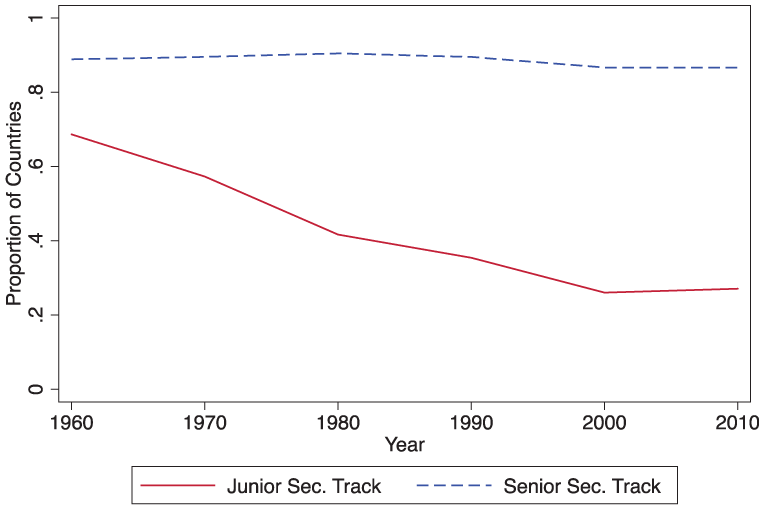
Proportion of countries with tracking at various levels.
Independent Variables
Formal organizational commitments to principles of social equality in country i at time t are captured as an index of four variables that separately identify the total number of years since a country established a ministry of education, ministry of women, ministry of health, or ministry of labor. These variables are coded using data from The Statesman’s Yearbook since 1870 (Drori and Meyer 2018); each variable is coded dichotomously to identify whether each type of ministry in country i had been founded by year t, and these four variables are then standardized and combined into an index (α = .74).
The number of ILO conventions ratified in country i at time t is coded as the total number of fundamental and governance international labor conventions a country had ratified in any capacity by year t, using publicly available data from the International Labour Organization’s website (ILO 2017a). Fundamental conventions concern “fundamental principles and rights at work,” and governance conventions are “‘priority’ instruments . . . because of their importance for the functioning of the international labour standards system” (ILO 2017b). I coded a series of 12 dichotomous variables to indicate whether country i had ratified (or in some cases denounced) each convention at time t, and I summed these variables for each country-year observation to create an index ranging from 0 to 12.
Democratization is measured as a country’s democracy score from the Polity IV data set (Marshall, Gurr, and Jaggers 2014), a time-varying interval variable that measures a country’s level of democratization on a scale from –10 (fully autocratic) to +10 (fully democratic).
A country’s years of women’s suffrage rights is coded as the number of years since women were granted the right to vote in country i at time t; if country i does not yet have women’s suffrage rights at time t, this variable has a value of 0. These data come from the UN Women’s (2011) report on the Progress of the World’s Women, which identifies the first year in which women were given the right to vote (if applicable) in all countries around the world.
I measure a country’s commitments to universalized conceptions of education using an index that combines four variables. First, a country’s number of international nongovernmental organizations its citizens are members of uses data from the Union of International Associations (UIA; 1960–2010) Yearbook of Organizations (see also Boli and Thomas 1999) and is logged to account for the positive skewness of the variable. Second, a country’s participation in international assessment tests is measured as the cumulative number of international assessment tests (e.g., tests administered by the International Association for the Evaluation of Educational Achievement) country i has participated in by time t (Kijima 2013). Third, a country’s use of national assessment tests is coded as the cumulative number of national assessment tests (e.g., the National Assessment of Progress in Education in Uganda) country i has administered by time t. These data come from UNESCO (2015), which is the most comprehensive source on the use of national assessments over the post–World War II period, and from sources described in Kijima (2013). Fourth, a country’s duration of compulsory schooling is coded as the number of years a student is required to attend school by law in country i at time t; I coded these data manually using the sources listed in the online Appendix A1 and methods described in more depth in Furuta (2017). These four variables are standardized and combined into an index (α = .71).
Finally, an index that reflects globalizing liberal norms of education as a human right is composed of three variables used in previous research to reflect changing conceptions of education in the global institutional environment (Schofer and Meyer 2005). First, the global number of international nongovernment organizations (INGOs) in year t captures overall activity of international nongovernmental organizations over time using data from the UIA Yearbook of Organizations; this measure is logged to account for the variable’s positive skewness. Second, the number of democracies in the world in year t is measured using democracy scores from the Polity IV data set; following prior literature, a country is considered a democracy if its polity score (described earlier) is a 4 or higher. Third, the global average duration of compulsory schooling is measured at the global level using the data on compulsory schooling described earlier. These variables are standardized and combined into an index (α = .96) that is strongly correlated with time (r = .98). 3
Control Variables
The analyses include several control variables to account for the ancillary processes that shape educational tracking policies. A country’s economic development is measured as its GDP per 10,000 capita (logged), using data on real GDP from the Penn World Tables (Feenstra, Inklaar, and Timmer 2015). The primary enrollment ratio (gross) is measured using data from the World Bank (2013) Development Indicators and additional sources described in Benavot and Riddle (1988); this variable is top-coded at a value of 100 to address the substantial number of overage students enrolled at the primary level, which may create measurement issues in the analyses. A country’s immigrant population is measured as its international migrant stock as a percentage of its total population (logged) using data from the World Development Indicators (World Bank 2013).
Finally, funding from the World Bank is coded as the cumulative number of education-related World Bank projects for which country i has received funding by time t (from 1947 to 2010) (logged). I coded this variable using the complete list of 13,108 World Bank projects funded according to its “Projects and Operations” website (as of 2017; World Bank 2017). I manually coded education-related projects based on the titles of the projects given, and I then added these projects over time for each country. For example, Laos has a project titled “Education Development Project” funded by the World Bank in 1993 and a “Second Education Development Project” funded in 2004; it is thus given a value of 0 from 1960 to 1992, a value of 1 from 1993 to 2003, and a value of 2 from 2004 to 2010 for this variable.
The online Appendix A2 provides descriptive statistics of the dependent and independent variables for the sample of countries used in the analyses, and the online Appendix A8 presents a correlation matrix.
Methods
I use random-effects panel regression models on an unbalanced panel data set of 139 countries observed annually over 51 years (from 1960 to 2010). These models take the following general form:

In Equation 1, yit is the dependent variable, μ
t
is a time-varying intercept, xit is a vector of time-varying independent and control variables, zi is a vector of time-invariant independent and control variables, α
i
is a time-invariant error term, and ϵ
it
is a time-varying error term for country i and time t (Allison 2009). In Table 2, the dependent variable follows a binomial distribution and is transformed via a logit link function (where yit =
Results
Figure 2 presents global trends in tracking policies across a consistent sample of countries from 1960 to 2010. A clear pattern emerges: A large majority of countries around the world (nearly 70 percent) tracked students at the junior secondary level in 1960, but only a small proportion (less than 20 percent) continued to do so by 2010. This pattern suggests tracking has become increasingly illegitimate at lower levels of the educational process; in particular, tracking at the junior secondary level declined on a consistent basis from 1960 to 2000 (before stabilizing from 2000 to 2010). These results are consistent with trends in vocational enrollments described by Benavot (1983), who observed a consistent decline in the proportion of students enrolled in vocational programs in almost every world region from 1950 to 1975. Yet, almost every country tracks its students at the senior secondary level, and these institutions remained relatively unchanged over the study’s time period. This sharp difference between tracking at the junior versus senior secondary levels suggests a tension between conceptions of education as a mechanism for propagating equality versus stratifying individuals into unequal opportunities later in life.
Figure 3 disaggregates tracking policies at the junior secondary level across different regions of the world. Tracking at the junior secondary level declines consistently across all regions over time, and the overall trends shown in Figure 1 are not primarily determined by any single region. These patterns are especially striking in the first few decades of this study’s time period: From 1960 to 1980, in all regions except sub-Saharan Africa and Central/Eastern Europe, the proportion of countries that track students at the junior secondary level declined by at least 20 percentage points. Even in sub-Saharan Africa, where tracking at the junior secondary level is comparatively more prevalent than in other regions, the overall trend is downward: Nearly 90 percent of countries in this region tracked students at the junior secondary level in 1960, yet fewer than 50 percent did so by 2010. No countries in Eastern Europe track students at this stage; given the influence of the Soviet Union on this region’s education systems, it is not surprising that they have adopted similar educational processes motivated by commitments to manpower planning and political homogeneity.
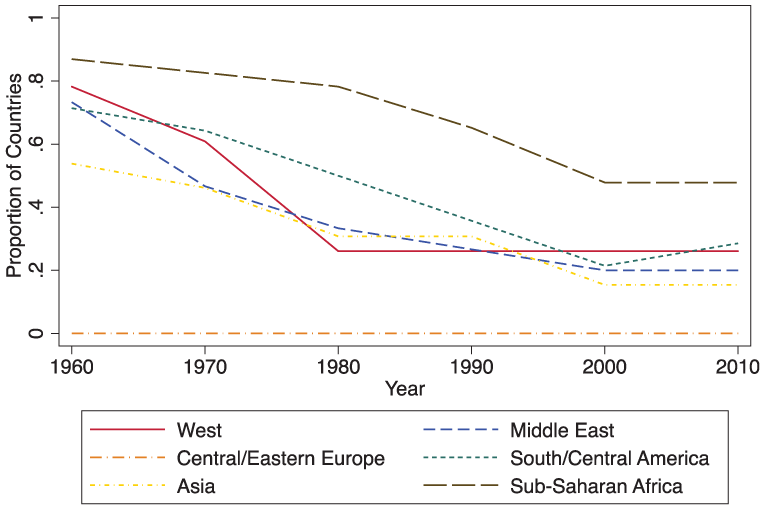
Proportion of countries with junior secondary tracking by Region.
Figure 4 shows the global average earliest grade level that students are tracked (countries that do not track students are given a value of 14, which is one grade level higher than the highest value among countries that do track students). As my argument here would expect, the overall average grade level of first tracking increases from approximately grade 8 to grade 10. While the most common first grade level to track students in 1960 was grade 7, by 2010, the most common first grade level of tracking was grade 10. These grade levels also conform to a global standardized model of six years of primary school, three years of junior secondary school, and three years of senior secondary school that diffused around the world as part of the U.S.-influenced global education regime discussed earlier (Meyer and Ramirez 2000).
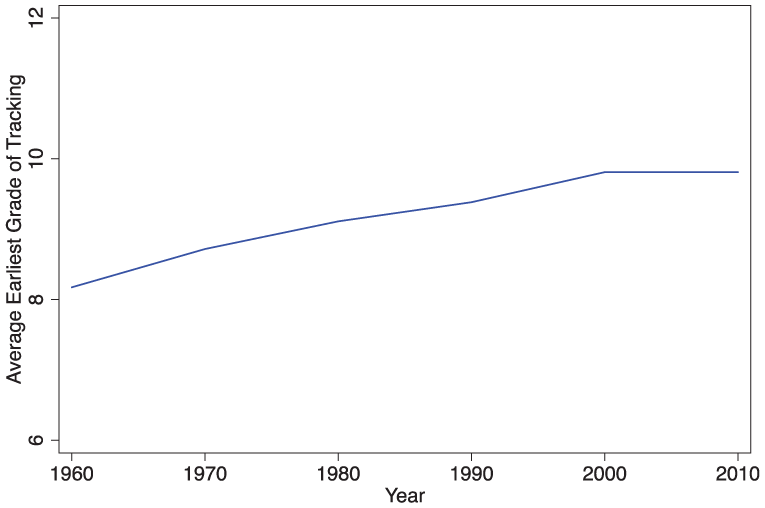
Global average grade of earliest tracking, 1960–2010.
Table 2 presents multivariate analyses of the effects of the aforementioned independent variables on tracking policies at the junior secondary level using random-effects panel regression logit models. 4 These results, reported as logged odds coefficients, are consistent with the argument advanced here. At the global level, the index that captures globalizing norms of education as an individual right is almost always negatively associated with use of tracking at the junior secondary level (p < .01 in most models), except in Model 5, where the coefficient is positive and slightly significant (Hypothesis 1). Given that this global measure is highly correlated with the national-level independent variables used in these models (see note 3), it is not surprising that independent effects for this variable are sometimes difficult to identify. 5 Country-level commitments to these globalizing cultural models of individual rights and universalistic conceptions of the educational process also strongly predict use of tracking: Countries with more extended social states are less likely to use tracking at the junior secondary level (p < .001; Hypothesis 2a), as are countries that are more committed to the social and political rights of individuals (p < .001 for the number of ILO conventions ratified by a given year and years since women’s suffrage was granted; Hypotheses 2b, 2d). Countries that are more committed to universalistic conceptions of education are also less likely to have tracking policies at the junior secondary level (p < .001; Hypotheses 3a, 3b, 3c, and 3d). 6 Surprisingly, however, countries that are more democratic are not significantly less likely to track students at the junior secondary level (Hypothesis 2c). This is a less direct measure of a country’s commitments to individualism in the education system given that it primarily identifies the political structure of a given country.
Random-Effects Panel Regression Logit Models of Junior Secondary Tracking on independent Variables, 1960–2010 (all years pooled).

Note: Standard errors are in parentheses. All independent and control variables are lagged one year. ILO = International Labour Organization; INGOs = international nongovernmental organizations.
Index that captures the consolidation of the global education regime is a world-level composite variable of three standardized variables that identify the number of INGOs in the world in a given year, the proportion of countries that track students at the junior secondary level in a given year, and the global average duration of compulsory schooling in a given year (α = .95).
Social state index is a composite variable of four standardized variables that each identify the total number of years since a country established a ministry of education, women, health, and labor (α = .74).
Variable indicates the number of fundamental and governance ILO conventions that have been ratified by a country by a given year.
Universal conceptions of education index is a composite variable of four standardized variables that identify the cumulative number of national assessment tests conducted by a country by a given year, cumulative number of international assessment tests a country has participated in by a given year, INGO memberships, and the duration of compulsory schooling (α = .71).
Variable capped at 100 percent enrollment ratio.
p < .10. *p < .05. **p < .01. ***p < .001.
These logged odds coefficients suggest steep changes in a country’s predicted probability of tracking students at the junior secondary level at different values of these independent variables. Figure 5 depicts the predicted probabilities that a country tracks its students at the junior secondary level by the independent variables that capture women’s suffrage rights and universalized conceptions of education when all other variables in the models are held at their means (and all years of data are pooled). These results are striking: Countries with the lowest possible score on the index that captures a country’s commitments to universalized conceptions of education (lowest score = −6), for example, have a .5 predicted probability of tracking students at the junior secondary level. This probability drops sharply for countries with higher values on this index such that countries with the highest value (highest score = 22) only have a .03 predicted probability of tracking students at this level. These results are nearly identical for the independent variable that identifies years of women’s suffrage, and calculations for the other independent variables (not shown) yield similar trends.

Predicted probability of tracking at the junior secondary level.
The control variables in these models yield results that are somewhat expected. Higher primary enrollment ratios in a given country are negatively (but typically not significantly) associated with use of tracking at lower levels of the educational process, and a country’s level of economic development is also negatively associated with use of tracking at the junior secondary level (p < .001 in all models). As expected, Communist countries are also less likely to track students at the junior secondary level (although these results are only weakly and inconsistently significant).
Surprisingly, however, countries with higher proportions of international migrants are less likely to track students at the junior secondary level (p < .05 in all models): Countries appear to design their educational institutions to include immigrant populations in academic education at earlier ages. In addition to the possibility that countries seek to attract global talent, it is also possible that countries with less educational tracking may be more open to migration (an instance of reverse causation). It is also surprising that receiving funding from the World Bank is positively and significantly associated with use of tracking at the junior secondary level (p < .05); this effect is initially positive in Model 1, when none of the independent variables are included, but the sign of this coefficient flips in Models 2 to 6. These effects may capture the dominance of the World Bank’s advocacy of programs that advocate for stronger vocational education and training over the time period of these analyses (which offset their encouragement of programs that advance goals of Education for All; Mundy and Verger 2016). More generally, this effect captures competing tensions between conceptions of education as an individual right and as a source of development for nation-states (as a collective form of social organization).
Finally, in the online Appendix A3, the effects of the same independent and control variables are estimated using random-effects panel regression Tobit models, 7 where the dependent variable identifies the earliest grade level in which tracking occurs in country i at time t. This variable operationalizes how early student tracking occurs in the educational process in comparison with the dependent variable in Table 2 that captures whether tracking exists for a given schooling cycle (r = −.74). For countries that do not track students at all during the secondary level, this variable is given a value one grade level higher than the highest value in the data (i.e., a value of 14), and the variable is treated as right censored. The results of these models are nearly identical with those presented in Table 2. Formal commitments to the social rights of individuals and to expanded and more liberal conceptions of education are all positively associated with the earliest grade level in which tracking occurs in a given country (p < .01 or .001 for all indicators). At the global level, the consolidation of norms of education as a human right is also positively associated with the first grade level in which students are tracked in all models estimated. The consistency of these results with those of Table 2 suggests the global decline in tracking at the junior secondary level reflects a more general delegitimation of tracking at early stages of the educational process.
It is notable that more democratic countries have significantly lower ages of tracking in these models. To inspect this unanticipated finding, I examined several alternative specifications, including a squared term for a country’s democracy score. The coefficient for this covariate is negative and significant (p < .001), as originally expected, and visual depictions of this indicator show a clear U-shaped relationship between democratization and the first grade level of tracking. This finding suggests that countries that are very autocratic and very democratic are both less likely to track students at the junior secondary level. In a democratizing world, it is plausible that exceptionally autocratic states attempt to educate all students homogeneously at early ages to socialize them into the values and belief systems of the political regime. As countries become slightly more democratic (up to a point), states may create technical and vocational tracks at the junior secondary level to address growing (and unmet) demands for education (e.g., on Singapore in the 1970s, see Kwang, Kheng, and Goh 2008). And as countries become even more democratic, egalitarian and liberal individualist norms lead them to eliminate tracking at the junior secondary level, as my argument expects.
Discussion
The central findings of this article highlight a global decline in the use of tracking at early levels of the educational process during the post–World War II period. This trend is driven by countries that support liberal norms of individual rights that are tied to a globalizing set of norms of education as a human right. I use a newly constructed data set to systematically test this argument on a sample of 139 countries from 1960 to 2010. The results of a series of panel regression models indicate that countries with governments that formally protect individuals’ social rights, extend voting rights to women, and commit to more universalized conceptions of education are less likely to use tracking at the junior secondary level and instead delay the first grade level in which tracking occurs. Additionally, the consolidation of global norms toward more liberal conceptions of education as a human right is negatively associated with use of tracking at early stages of schooling. These findings support world society theories of institutional change (at early rather than later ages of the schooling process) that emphasize the importance of global cultural models in shaping legitimate nation-state behaviors and activities and depict how these models developed after World War II.
In the absence of these global norms, cognitive schemas, and conceptions of education and individual rights in the institutional environment in the first half of the twentieth century, it is not surprising that a few developed countries failed in their attempts to create comprehensive secondary schools. As my argument emphasized, these earlier education reforms failed because they lacked legitimacy. In Germany, for example, at the end of World War I, proposed reform attempts for a “common school” (Einheitsschule) were seen as too radical because they “would have resulted in a lowering of standards and the cult of mediocrity” (Kandel 1930:264; see also Paulston [1968:37] for similar attempts in Austria and France). In Sweden, meager reforms to create a comprehensive school were proposed as early as the 1860s, but they failed to gain much political support from any political groups before the 1900s. Even proposals to create a six-year comprehensive primary school in the early twentieth century were widely opposed and unpopular (Paulston 1968). Japan’s efforts to modernize its education system during the Meiji period were strongly influenced by the U.S. common school model and Western liberal ideals of individualism, but these ideals were incompatible with some features of Japanese society and eventually gave way to the more “congenial” Germanic model of early and intensive streaming in the early twentieth century (Passin 1965).
Several other country-level properties also significantly predict use of tracking during this time period (e.g., levels of economic development and immigration levels), and tracking continues to formally occur at the senior secondary level. These findings suggest a series of competing pressures that continue to shape educational institutions around the world: In particular, tensions exist between nation-specific and global processes, individualistic versus collective notions of progress (e.g., human capital as a property of both individuals and nation-states), and conceptions of education as a mechanism for both promoting equality and legitimately allocating individuals to unequal opportunities. The existence of these contradictions is unsurprising given that institutions such as tracking evolve through longer historical processes: As new ideas and forms of social organization emerge, older processes may weaken or co-evolve without necessarily becoming extinct (Mahoney 2000; cf. Lerch et al. 2017). My argument here emphasizes the extraordinary growth of social and cultural pressures that are global (vs. national and functionalist), oriented ontologically around individuals (vs. collectives), and rooted in a logic of equality (vs. logics of elitism); these pressures have been underemphasized in existing literature on tracking as an institution.
As discussed earlier, it is important to emphasize that this article primarily concerns between-school rather than within-school tracking, and the changes documented are observed in policy rather than in practice. I do not contend that all elite forms of educational stratification at the junior secondary level have been eliminated or that more “open” policies prevent other subtler forms of tracking from emerging (see Lucas [2017] on theories of “effectively maintained inequality”). The analyses presented here are unfortunately unable to capture subtler changes in fluidity across tracks in different countries or changes in the relative size of different tracks over time. It is worth emphasizing, however, that these milder forms of within-school tracking are less stratified by socioeconomic status than between-school tracking (Chmielewski 2014).
Finally, my results suggest two areas for further research to extend world societal theories of educational institutions. First, neo-institutional theories typically focus on educational expansion rather than educational inequalities. One could therefore extend the theory to examine effects of between-school tracking on national levels of income inequality over this time period. In particular, countries with educational institutions that “charter” students into sharply differentiated institutions may create stronger forms of country-level economic inequalities (Meyer 1977), and these effects may become stronger over time as norms of individual rights and Education for All continue to become institutionalized on a global basis. Second, world societal theories tend to emphasize global forms of institutional isomorphism across national systems rather than institutional patterns within systems. As my findings demonstrate, education is conceived of as both a mechanism of allocating individuals to unequal opportunities and an institution that promotes individual equality. One might expect this tension to be strongly expressed in global trends in other educational institutions, like high-stakes exams (particularly in their use at different levels of the schooling process).
Supplemental Material
SOE873848_App – Supplemental material for Liberal Individualism and the Globalization of Education as a Human Right: The Worldwide Decline of Early Tracking, 1960–2010
Supplemental material, SOE873848_App for Liberal Individualism and the Globalization of Education as a Human Right: The Worldwide Decline of Early Tracking, 1960–2010 by Jared Furuta in Sociology of Education
Footnotes
Acknowledgements
The author wishes to thank John Meyer, Evan Schofer, Michelle Jackson, Francisco Ramirez, Tricia Bromley, Daniel Scott Smith, David John Frank, Ann Hironaka, Julia Lerch, Paul Hanselman, Aaron Tester, and members of the Stanford and UC-Irvine Comparative Workshops for valuable comments and Gili Drori for providing data on government ministries.

Supplemental Material
Appendices are available in the online version of this journal.
Notes
Author Biography
References
Supplementary Material
Please find the following supplemental material available below.
For Open Access articles published under a Creative Commons License, all supplemental material carries the same license as the article it is associated with.
For non-Open Access articles published, all supplemental material carries a non-exclusive license, and permission requests for re-use of supplemental material or any part of supplemental material shall be sent directly to the copyright owner as specified in the copyright notice associated with the article.
