



Abstract
This article draws from American research on ‘‘concerted cultivation’’ to compare the parenting logics of 41 upper-middle-class parents in Toronto, Canada. We consider not only how parents structure their children’s after-school time (what parents do) but also how the broader ecology of schooling informs their parenting logics (how they rationalize their actions). We find that parenting practices mirror American research. Upper-middle-class families enroll their children in multiple lessons and cultivate their children’s skills. However, unlike their American counterparts, Canadian parenting logics are not explicitly stratification oriented, guided by a desire to access elite universities. Canada’s relatively flat stratification system of higher education, where prestige differences between universities are minimal, prompts the emergence of a more expressive parenting ethos. Our findings draw attention to the macrofoundations of social behavior by articulating the connection between parenting logics and educational status hierarchies. We conclude by considering the implications of cross-national differences to theories of parenting and social stratification.
Sociologists have examined how parenting styles differ across social groups and how this contributes to observed patterns of social stratification. This research has found that parents from wealthier families engage in more time-intensive child-rearing practices than working-class counterparts. In what has been labeled “concerted cultivation” (Lareau 2011), parents treat children as “projects-in-the-making” (Davies and Aurini 2008:55; see also Hamilton, Roska, and Nielsen 2018). The cultural products of such practices, including robust academic credentials, extracurricular accomplishments, and fine-tuned interaction styles, have a strong “conversion value” across school and work organizations (Armstrong and Hamilton 2013; Brint and Yoshikawa 2017; Hout 2012; Lareau 2002; Rivera 2016; Stevens 2007; Weininger, Lareau, and Conley 2015). These returns have led some to view intensive child-rearing as a form of strategic action in which parents “prime” children for an increasingly competitive world (Friedman 2013; Galloway and Conner 2015).
Building on Bennett, Lutz, and Jayaram (2012), we extend our analytical focus to consider both family characteristics and the broader social ecology in which parenting occurs. An ecological perspective emphasizes that decision making at the family level is “nested” in surrounding neighborhoods (i.e., crime) and meso-organizational (i.e., admission requirements) and macrolevel structures (i.e., labor markets; Bronfenbrenner 1977). The influence of social forces at the macro and meso levels of analysis has been undertheorized by parenting scholars. Few qualitative studies have considered how these factors can prompt consequential variation in parenting logics across social settings (for exceptions, see Harkness et al. 2011; Kremer-Sadlik and Fatigante 2015; Kremer-Sadlik, Izquierdo, and Fatigante 2010).
While general parenting behavior among highly educated Canadian parents mirrors that seen in U.S. research, the assumed drivers of concerted cultivation vary (Gauthier, Smeeding, and Furstenberg 2004; Ramey and Ramey 2009). Aspects of the U.S. context inform parental decision making in ways not observed in other nations (e.g., see Espeland and Sauder 2016). The chief sorting mechanism determining “winners” and “losers” within American society is its steeply stratified higher education (HE) system, with interorganizational differences in prestige and resources that are unmatched internationally (Davies and Hammack 2005; Davies and Pizarro Milian 2016; Davies and Zarifa 2012). These structures serve as a key point of differentiation and may render observations made by the American concerted cultivation literature ungeneralizable. 1
As the recent “admission scandal” illustrates, the stratification of the HE system drives U.S. high school students to focus on gaining acceptance into universities closest to the “peak” of the hierarchy (Khan 2019; Lucas 2001), incentivizing a host of competitive parenting strategies (see Buchmann, Condron, and Roscigno 2010; Smith and Sun 2016, 2017). Historically, intense interstudent competition has driven elite American universities to develop elaborate admissions criteria, including standardized tests (i.e., SATs), interviews, entrance essays, and extracurricular activities, that have not materialized in other English-speaking nations (Karabel 2005). Pressures to meet these criteria, to get into a top school, influence parenting decisions early on in a child’s life, including the selection of extracurricular activities (Friedman 2014; Ginsburg 2007). Regardless of whether there are direct benefits, American parents believe that extracurricular activities are an essential component of admission into a “good” college (Friedman 2013).
The U.S. postsecondary context begs several questions for parenting scholars: What happens when we remove stratification-related incentives for concerted cultivation? How do higher socioeconomic status parents, who possess a wide range of “capital,” behave when confronted with a “flatter” HE system, where differences between universities are minimal and no social advantages are accrued by attending “top schools”? To answer these questions, this article examines a strategic testing ground: Toronto, Canada. The Canadian HE system provides an ideal counterfactual to test many assumptions of the American literature on parenting. Canada and the United States are democracies that have similar attitudes about government, health care, religion, and personal freedom (Baer, Grabb, and Johnston 1990; Grabb and Curtis 2010). The education system in each country is designed as a “giant missile-staging system,” encouraging the vast majority of students with a “strong boost towards higher levels of education” (Brint 2017:69).
Canadian HE, however, exhibits a far more compressed hierarchical structure (Davies and Hammack 2005; see also Davies and Pizarro Milian 2016; Pizarro Milian and Rizk 2018). Research has yet to document any strong status-based variation in the economic returns of “elite” Canadian degrees (Betts, Ferrall, and Finnie 2007; Davies, Maldonado, and Zarifa 2014). This context deprives the cultural products of concerted cultivation of their conversion value across organizations, including advanced education programs (i.e., medical school) and elite employers. It thus allows us to examine parenting within a context that differs from the existing literature and test assumptions about the reactivity of parents to their social environments.
To examine parenting practices and logics, we compare a large body of American research on concerted cultivation with 41 interviews with upper-middle-class parents in Toronto. Although Canadian parents engage in time-intensive parenting, they disassociate such behavior from discourses of social stratification. Instead, they rationalize intensive child-rearing through an alternative “expressive logic” that taps into a more generalized notion of children’s physical, social, and emotional well-being (Aurini and Davies 2005). We interpret such findings through the lens of social “embeddedness” (Coleman 1988; Granovetter 1985) and “ecological” (Bronfenbrenner 1979) theoretical frameworks. These frameworks emphasize how contextual forces at multiple levels shape social behavior. Our findings address the connection between parenting practices and social stratification systems as well as the implications of cross-national differences for theories of child-rearing and social inequality.
An Ecological Framework for Parenting
Examinations of parenting have a rich history in sociology (i.e., Arendell 2000; Risman and Rutter 2015; Zelizer 1985). Sharon Hays’s (1996:8) pathbreaking book on “intensive mothering” not only described how contemporary mothering was “emotionally absorbing, labor-intensive, and financially expensive” but articulated how attitudes about mothering varied by social class. Lareau (2002, 2011) also examined social class differences but adopted a wider lens. Lareau’s concept, concerted cultivation, captures a distinctive parenting style among the middle and upper classes that emphasizes language use, enrolling children in organized activities, encouraging children to express their opinions, and intervening when necessary.
Sociological research has tended to focus on how parenting logics are shaped by one or two intersecting explanatory variables (i.e., Cheadle and Amato 2011; Lareau 2011). Rather than providing a cultural or structural explanation, Bennett et al. (2012) adopted an ecological perspective to consider how social class gaps in children’s participation in out-of-school activities are associated with factors such as local institutions, neighborhood contexts, and family finances. We build on their work by tackling another neglected ecological dimension: how macrolevel factors shape upper-middle-class parenting logics. We use the term logic to articulate how parents understand their decisions, the tools or resources that parents draw on to enact their “strategies of action,” and how such logics are embedded within a particular context (Swidler 2001:187).
When coupled with the predominant focus of sociological research on parenting within the confines of the United States, previous research has not fully appreciated the influence that national contexts exert on parenting. Research, however, suggests that the amount of time devoted to child-rearing among parents varies greatly (Bradbury et al. 2015; Dotti Sani and Treas 2016; Kan, Sullivan, and Gershuny 2011; Ramey and Ramey 2009; Sayer, Bianchi, and Robinson 2004). Extending this research to another national context provides a way to test many assumptions that underpin much of the qualitative research on child-rearing and stratification in the United States.
We conceptualize parenting as a form of social behavior that is “embedded” (Coleman 1988; Granovetter 1985) in a multilayered ecological framework (Bronfenbrenner 1977, 1979, 1986). This ecology is constituted by levels of analysis that are each “nested” within another (Fligstein and McAdam 2015; Goldstone and Useem 2012; Hüther and Krücken 2016), simultaneously shaping how parenting is performed. Factors at multiple levels intersect to give rise to distinct logics, which orient parenting across variable social locations. First, we accept that parenting is shaped by the presence or deficit of resources within the “family unit,” including parental stocks of cultural capital. In short, parents cannot help with homework they do not understand, purchase products they cannot afford, or encourage habits (i.e., reading) they do not appreciate or have the skills to support. Parenting is also shaped by individuals within parents’ social networks. These chains of interaction (Collins 2004) provide opportunities for informal learning via the provisioning of parenting advice and the gathering of information about organizations such as child-care centers (Small 2009).
Second, surrounding neighborhood characteristics influence how parenting is performed (Ceballo et al. 2006). After-school programs, day cares, community facilities (i.e., libraries), and cultural organizations (i.e., ethnic associations) provide parents with an assortment of resources. At the same time, neighborhoods can present hazards that tax the energies of parents, forcing them to enact adaptive strategies. Furstenberg et al. (1993), for example, found that parents in crime-ridden Philadelphia neighborhoods restricted children’s unsupervised play outside of the home and vetted friendship networks. “Hyperprotective” parenting vividly demonstrates how parents react to perceived threats in the environment.
Finally, societal-level factors inform parenting practices, including the criteria of organizations serving as entry points to the upper-middle class. These vary widely across nations, providing unique stimuli for parents. In the United States, there is a distinct arrangement of mobility “tournaments” (Rosenbaum 1976, 1979) or “contests” (Turner 1960) through which socioeconomic rewards are distributed. At each credential tier, students are sorted into stratified tracks and earn credentials to facilitate access to institutions. Sorting culminates at the highest level with access to elite credentials, including highly selective universities that serve as an entry “ticket” into elite work organizations (Rivera 2016).
In response, research finds that American middle- and upper-class parents actively foster their children’s talents (Craig, Powell, and Smyth 2014; Lareau 2011). Schaub (2010, 2015) demonstrated how parenting for cognitive development has become the norm in American families. Parents also enroll their children in extracurricular activities believed to develop self-confidence, cultural competency, and other social skills (Covay and Carbonaro 2010; Weininger et al. 2015). Friedman (2013) argued that this behavior has an explicit stratification focus: Parents desire credentials for their children that they see as a precondition for entry into the upper-middle class and the “good life that accompanies it” (Friedman 2013:3). Parental “anxieties” about social mobility (Cucchiara 2013; Roda and Wells 2012; Stearns 2004) and “fears of falling” (Ehrenreich 1989; Newman 1999) have been widely documented. Milkie and Warner (2014:66) dubbed parents’ responses to these anxieties as “status safeguarding,” whereby parents do “everything possible to ensure that a child’s future social and economic status in a competitive marketplace is sustained or improved” (see also Oyer and Schaefer 2019).
Rationale for Study
Scholars have long referred to Canada as a “strong counterfactual” to the United States, noting that their many “similarities provide a persuasive basis for analysis of their distinctions” (Siddiqi et al. 2013:198). We focus on one key point of differentiation between the two nations: the stratification of HE. Although HE is a primary distributor of social rewards in both countries, Canada has a relatively flat status structure, with no equivalent to an Ivy League (Davies and Hammack 2005). The offspring of elite Canadian families migrate to prestigious American universities to quench their thirst for status (Baker 2014). Those who remain behind are less status conscious (Davies and Pizarro Milian 2016; Kong and Veall 2005) and exhibit a high degree of “distance deterrence” (Frenette 2004, 2006; Zarifa, Hango, and Pizarro Milian 2018). Admission decisions are also less competitive; they are based on high school grades rather than standardized tests (i.e., SAT), elaborate portfolios, or interviews.
By focusing on one neighborhood in Toronto, Canada, we strategically hold constant family- and community-level ecological factors while considering the impact of national-level factors. Davies and Hammack (2005) argued that in the absence of a steep hierarchy, Canadian students seek wage premiums through lucrative fields such as engineering and medicine (Betts et al. 2007). In the absence of elite universities, there are also few incentives to develop “competitive kid capital” in Canada (Friedman 2013:3). As such, there is a reason to believe that Canadian parents will differ in how they make sense of their child-rearing decisions.
Other researchers have observed divergence from the American middle-class standard of parenting. Kremer-Sadlik et al. (2010) found that American parents often link their children’s involvement in sports to college admissions, fantasizing about lucrative scholarship offers (Clotfelter 2019). However, they found no comparable rhetoric among Italian parents relating to the academic benefits of extracurricular activities. Kremer-Sadlik and Fatigante (2015) similarly noted that Italian parents view children as less of a “project” than their American counterparts. However, given the cultural, historical, and linguistic differences between the American and Italian contexts, isolating factors contributing to these observed parenting differences is difficult. We provide a more proximate comparison with the American “archetype” than other studies. As a result, we are better able to isolate and study the effects of the role played by national stratification systems in parenting logics.
Data and Method
Interviews were conducted with 41 mothers and fathers from an affluent neighborhood in Toronto, Canada (see the Appendix in the online Supplemental Material). We compare trends in our interview data with the findings documented in secondary sources from the United States. The U.S. literature on parenting details how middle- and upper-middle-class parents support their children’s educational success and “institutionally align” with schooling organizations (i.e., Demerath 2009; Hamilton 2016; Khan 2010; Lareau 2011; Stevens 2007; see also Davies and Rizk 2018).
Sampling Strategy
“Upper-middle class” was defined as households with significantly higher than average incomes compared with the Canadian and city average. Families had to have at least one parent who was university educated and employed in a professional, managerial, or business occupation. Households with at least one child under the age of 17 were targeted to capture parents who still had control over their children’s academics and after-school activities.
Our sampling strategy was informed by the following premises that are grounded in the literature: (a) Upper-middle-class parents may have different logics than lower-class parents, (b) these class-based practices are stable over time, and (c) it is “not the intrinsic nature of the parenting itself, but rather the uneven rewards dominant institutions bestowed on different types of strategies” (Lareau 2015:1; see also Cheadle 2008).
Data made available through Statistics Canada (2012) and the City of Toronto (2008) were used to select one postal code. Within the selected area, 500 randomly selected names, addresses, and phone numbers were purchased from a marketing company, InfoCanada. From the list of names, every 10th name was chosen for recruitment. Potential interviewees were sent an information letter and telephoned by a research assistant four or five days later. Between 2007 and 2008, 47 families were interviewed. A total of 41 are included in the analysis due to some missing information. Each interview lasted approximately 60 to 90 minutes and was digitally recorded and transcribed with the permission of the interviewee.
Description of Sample and Site
Upper-middle-class families have incomes that afford them “living standards considerably above the basic necessities and discretionary income available to spend on higher-quality goods and services” (Rose 2016:1; see Reeves 2018). According to the 2006 census, the average family in the selected postal code neighborhood had a median income of $175,000, compared with the Toronto median income of $52,000 (City of Toronto 2008). All targeted families (interviewees or their spouses) had at least one parent with a bachelor’s degree; however, in most cases, both parents had at least one degree, and several parents had postgraduate credentials (i.e., MD, LLB, MBA). Parents’ occupations included lawyer, doctor, architect, bank executive, and business owner. Of the parents who were interviewed, 79 percent were mothers, and 21 percent were fathers.
The average Toronto home price in 2007 was $375,000. In contrast, homes in the selected postal code area had an average price of just over $1 million (Toronto Real Estate Board 2011). The neighborhood boasts mature trees, a stunning ravine, tennis courts, and one of the most prestigious private schools in Canada. Trendy stores and restaurants line the main streets, and residents have access to reliable public transportation. The neighborhood is also peppered with a variety of educational services (e.g., private tutoring; Aurini, 2012).
Analysis
Interviews were imported into QSR NVivo (Aurini, Heath and Howells, 2016; Saldaña, 2015). A two-phase coding strategy was used. In the first phase, responses were organized by the main interview questions. The node activities, for example, focused on questions relating to how parents structured their children’s out-of-school time, including the type and frequency of after-school activities. We also coded parents’ responses to questions about why their children participated, how they benefited, and their selection criteria.
In the second phase, theoretically informed nodes were developed to capture how parents made connections between activities and their children’s future. While the first findings section of the essay primarily draws on the more descriptive accounts of children’s extracurricular activities, the second findings section draws on the theoretically informed master node institutional variations and its child nodes to illustrate key aspects of the ecology of schooling in Canada: aspirations, institutional hierarchies, and roles.
The node aspirations captures parents’ responses to questions relating to postsecondary expectations, including whether (and why) it mattered if a child attended a postsecondary institution and, if so, whether they preferred community college or university (four-year university). The node institutional hierarchies examines the relative importance of institutional status. We asked parents whether the “name brand” of the university mattered and whether they believed that there were differences between universities (i.e., quality, job opportunities). We also captured parents’ understandings of institutional status versus field of study. The node roles includes questions relating to how parents viewed their connection and responsibility to schooling, including how or whether they prepared their children for HE. The second findings section draws on the activities node to consider how parents selected and rationalized their children’s after-school activities.
Finally, we did a manual count of the types and number of activities reported by parents. After two rounds of coding, two major categories (sports and arts/drama) emerged, along with academic enrichment and youth development codes to capture a handful of other activities, such as Girl Guides (see Quinn 1999).
Upper-Middle-Class Families’ Parenting Practices and Logics
Extracurricular Activities
Similar to American parents, Canadian parents engaged in time-intensive forms of child-rearing, akin to concerted cultivation (Lareau 2011). We compiled a list of 213 structured extracurricular activities (Table 1). The mean number of activities parents enrolled their children in was 5.2 (see Table 2 distribution). Sports extracurriculars accounted for over half of activities (55.4 percent), including team (i.e., hockey) and individual (i.e., gymnastics) sports. Athletic activities ranged from recreational house leagues to selective “rep” teams. Other forms of athletics, such as dance, also varied from more recreational classes to selective studio lessons.
Number of Activities Cited per Family

Types of Activities

The second largest category (29.6 percent) of activities was arts/drama; it included private music lessons as well as participation in orchestra groups and the Royal Conservatory of Music. Children also participated in school plays, theater groups, and improvisational teams.
Beyond these two broad categories, there were two smaller nodes. Enrichment activities, such as the Mad Science club, are academic but are not closely tied to the curriculum. Surprisingly, there was no mention of after-school tutoring, even among the parents of tweens and teenagers in our sample.
Parents’ Rationalizations
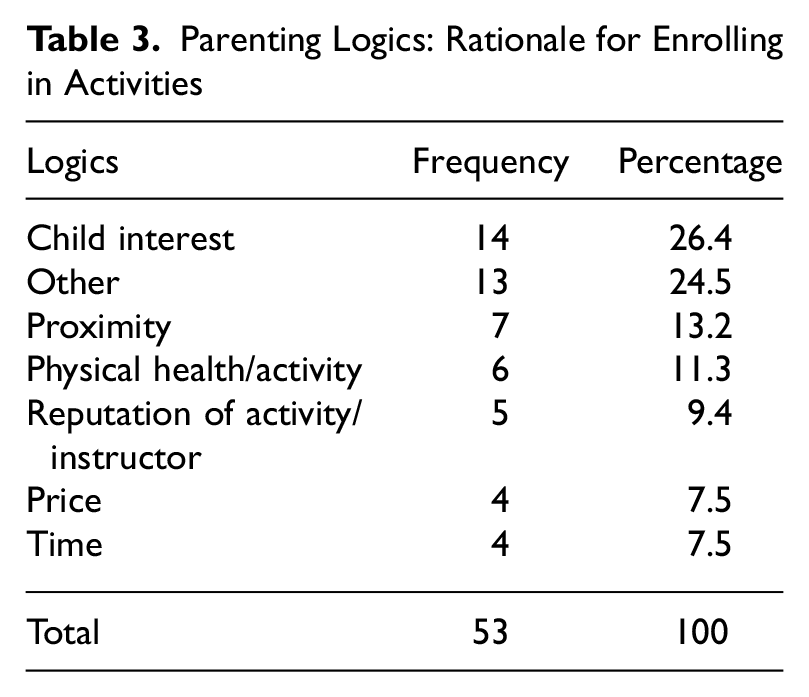
Parents provided varied rationales for enrolling their children in extracurricular activities (Table 3). However, none of these logics were tied to future academic contests. Like Bennett et al. (2012), we found that parents considered children’s interest and well-being when selecting extracurriculars.
Parenting Logics: Rationale for Enrolling in Activities
Child’s interest or ‘‘fit.’’
The most common criterion for selecting activities was child interest, or fit. As one mother explained: “We let them choose what they want to choose. We didn’t want to force them into things. Our dream is about their dream” (Aubrey). Another mother said that she “would never sort of pick something” that her child did not want to do (Lucy). Parents primarily wanted their kids to “have fun and come out smiling” (Victoria). The selection of activities involved repeated trial and error as activities were sampled and evaluated by both parent and child. As Alice, the mother of two children, explained: We tried a few different things, and he ended up really liking soccer. If it was something they didn’t enjoy, we definitely would try something else. . . . Stephanie had the opportunity to try out for a competitive team. I pushed her to go, and she absolutely hated it. So, she hasn’t done that since.
Parents’ sensitivity to their children’s interests resulted in considerable variation in the types of extracurricular activities, even within the same family. Child interest was often tied to the relative fit with a child’s temperament and stage of development. As Leila, the mother of two boys, explained: Depends on their interest . . . whether they enjoy it or not. So, for example, the older one also did piano last year, and we are just signing him up for another session now cause he shows a lot of interest in it. But the younger one is still too young for it, and I’m not sure if he will have the same interest. He’s more active, so it depends on the personality of the child.
If a child did not want to participate, one father explained, it would just become a “drudgery, and waste of money, and waste of time for everybody” (Robbie). Similarly, Victoria recounted her experiences putting her six-year-old child in a music class that was a poor fit, particularly given the demeanor and expectations of the instructors: Their style was very abrasive, they’d yell very loud, and she would end up in tears. . . .He was yelling, “B-sharp! B-sharp! B-sharp!” When she came to me after and said, “Mommy, the only sharp I know is when I sharpen my pencil.”
Parents were also willing to terminate lessons regardless of their potential benefit. Lily, for example, allowed her son to quit a hockey league when he was unable to “bond” with his teammates.
Physical health
Parents actively looked for lessons that had an “athletic element” (Vivian). As one mother explained, she looked for activities that provide a “positive experience, and a way that they can burn off all that good energy that they have” (Paige). Many parents framed extracurriculars as a way to promote a healthy lifestyle. As Alice explained: My daughter Stephanie, she loves to read and would be very happy sitting down and doing that. She’s a little bit more of a solitary child as well. So, really the soccer and activities for her are just us trying to get her out of the house and to be active a few days a week. Soccer gets her out and gets her running.
When selecting activities, parents tried to maximize opportunities for their children to engage in some form of “cardio” (Nora). As Vivian explained, a camp that had her daughter swimming and participating in nature walks every day was a “big plus.”
Practical considerations
Parents also cited more practical or logistical considerations. Parents were apprehensive about activities in distant locations, particularly when juggling after-school activities for more than one child. Several parents explained that their “criteria was close” (Caroline) to avoid feeling as though they were “running around like a chicken with [its] head cut off” (Charlotte). A father explained that he sought out “the next-closest [lacrosse] program” rather than the next “best” lacrosse program (Owen).
These rationales contrast with discourses of concerted cultivation as a strategic form of action. The parents in our sample did not explicitly link activities to notions of social mobility or competition. Parents were not concerned with developing “competitive kid capital” (Friedman 2013) or with how participation in extracurriculars would be perceived by third-party evaluators (i.e., admissions committees). Instead, they were concerned with whether activities would make children happy, the relative fit with the child’s age and personality, the potential health and fitness benefits, and geographic proximity to home.
Anticipated Gains
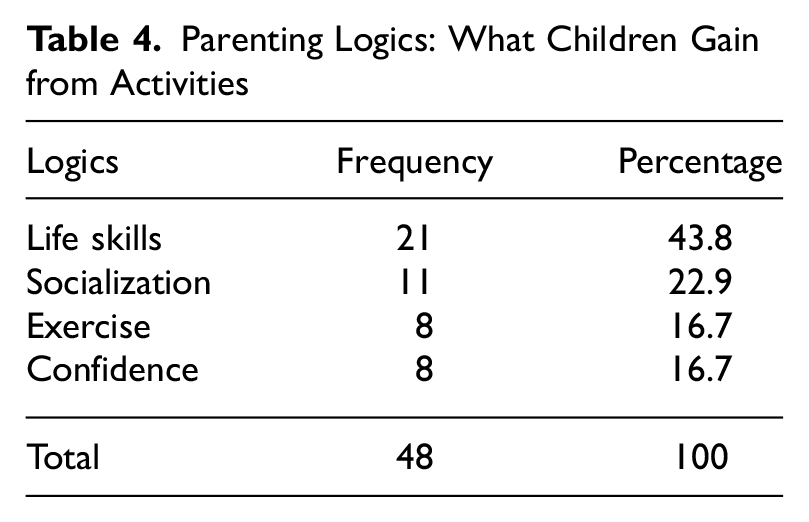
Parents were asked about the anticipated returns of extracurricular participation. As with selection criteria, parents did not make an explicit link between activities and success in education institutions. Self-discipline, for example, was not valued for its potential to boost grades or conversion value across social institutions. Instead, the returns to participation in extracurriculars were connected to the development of generic skills (Table 4).
Parenting Logics: What Children Gain from Activities
Social and life skills
Parents frequently explained that extracurricular activities would help their children develop social and life skills. As Grace noted, some activities exposed her children to others “who are not as privileged as they are”: They’re really learning how to socialize because they are always around so many different kids . . . from different areas of the city. There are children who are not as privileged as they are, and some that are even more so. So, this really gives them a good idea of what is going on. So really, skills like this are useful in many aspects of their life.
Parents also explained that beyond teaching children how to interact with other kids, extracurriculars were a “socialization” tool. Vivian explained that her daughter’s participation in Brownies, a branch of the Girl Guides of Canada for seven- to eight-year-old girls, was a “glorified playdate” that “reinforces social interaction.”
Similarly, another mother explained that extracurriculars helped her children “learn to take instructions” from authority figures such as coaches and teachers (Emily). Such activities also allowed them to assume the “team member” and at times, a “leadership” role (Natalie). Some parents also saw extracurricular activities as a way to shore up social skills they lacked at a similar age. As one father reminisced, “When I compare myself to my son at the same age, I was terribly shy, and he is . . . far more outgoing at that age than I was, for sure” (Kaden).
Parents also considered the potential for extracurriculars to develop valuable character traits. As Liam explained, by repeatedly practicing “dance or hitting a ball,” children learned the generic recipe for success: dedication and hard work. Claire, whose daughter participated in cross-country running competitions, was pleased that her daughter understood the connection between hard work and success. These values, and not “winning,” are what matter: I think the most important thing is mental discipline. . . . [My daughter] said to me once that a friend of hers . . . was saying how “lucky” she was to be able to leave the city and attend these runs. But she said to me that she didn’t feel lucky, because it was something she had worked so hard for. So, I really like that she has made the connection that her achievements are something that she has worked at. . . .Those are the values my husband and I have tried to instill in our children. It’s not all about winning.
Parents believed that these values extend into adulthood. Thus, even if children did not continue to practice music or sports, “they have an appreciation for what other people do to be successful at it, and the kind of effort that goes into becoming a fine athlete, or a fine artist, or a fine musician” (Catherine).
Self-confidence
Improved self-confidence was another anticipated benefit of extracurricular activities. As Owen explained, “You can’t tell a kid that they should be self-confident. They have to ‘do’ and ‘know’ that they are good at something.” Nora, the mother of a gymnast, explained how the support and encouragement of a gymnastics coach had a positive impact on her daughter’s confidence: I have seen a huge change in terms of her confidence. She has always been someone who is shy and more introverted. . . . And ever since she started gymnastics . . .coaches would call me and tell me that they saw potential in her. . . . She just felt so special that she had this skill. . . . So, the confidence level for her has just been fantastic.
Parents also associated improved self-confidence with learning how to deal with failure, priming children for life challenges. Emily recounted how her son getting cut from his hockey team was “one of the hardest experiences for him and really hurt him.” As her son grew older, however, he told her that “rejection” had made him “very strong because now he had learned how to be rejected . . . and wasn’t afraid of it.” With the benefit of hindsight, she was able to rationalize that “wow . . . even when things don’t necessarily go well, it’s still a learning experience.”
Situating Parenting Locics within the Broader Ecology of Schooling
An ecological perspective takes seriously not only the dynamic exchange between structural location and culture but also the broader institutional context of social action. In this study, we hold constant family and community contexts. Participating families were all upper-middle class, owned homes in the same neighborhood, had high levels of status, had disposable income, and had adults (i.e., nanny, stay-at-home mother) who could shuttle children to various activities. Their education and income also afforded their children with the type of capital—social, cultural, and economic— that has been connected to access to and success within HE institutions (i.e., Armstrong and Hamilton 2013; Lehmann 2014; Radford 2013).
We use these constants to consider how macro factors, such as institutional stratification, inform parenting logics: the day-to-day micro decisions that parents make and how they rationalize such actions. Our sample of upper-middle-class parents, like their American counterparts, spent a considerable amount of energy cultivating their children’s emotional, social, and academic capabilities. They were also exposed to the same messages emanating from the environment about the importance of stimulating children’s development (i.e., Canadian Council on Learning 2008; Quirke 2006; Wall 2010). Prominent foundations in both countries, such as the Reiner Foundation (U.S.) and the Invest in Kids Foundation (Canada), and a variety of popular media sources promote similar advice that aligns with the tenets of concerted cultivation (i.e., Milkie and Denny 2014; Quirke 2006; Wall 2004; Wrigley 1989).
While American and Canadian parents subscribe to the generic ideals of concerted cultivation, structural conditions repurpose how Canadian parents rationalize their children’s participation in extracurricular activities. We interpret this as evidence that macrolevel structures of stratification inform parenting logics at the micro level. These findings also add weight to the assertion that postsecondary contests inform parenting logics among the middle and upper-middle classes: If, as the American literature claims, parents are responding to institutional status competitions, we should find that the absence of these mechanisms generates a distinctively “un-American” parenting logic.
Institutional Hierarchies
Our findings point to how national contexts inform upper-middle-class parenting practices and how parents make sense of their actions. Our Canadian sample of affluent parents lacked a sense of urgency to place their children into “top schools.” We attribute the absence of explicit links between extracurriculars and education across our interview data to the unique composition of Canadian HE.
‘‘Some form of postsecondary.’’
As in American research, Canadian parents expected their children to attend a postsecondary institution and saw it as a “nonnegotiable.” However, there was little concern about whether their children attended college or university. 2 As Aiden explained, “I don’t have any aspirations in terms of particularly what they’re going to do, but they are going to have to do something after high school, so some form of postsecondary.”
Beyond this constraint, parents placed few other demands on the educational pathways of their children. Even among parents with favorable opinions of university-level education, there was an openness to alternative paths. As Juliet explained, she was “not thinking of it [university] as a given.” Instead, whether her children chose a “university, or a college, or an apprenticeship,” she would “get them on the path that they want to take.” Ethan similarly explained that while he preferred university, he was “not going to impose” or “force” his children onto a particular postsecondary pathway. Like several parents in our sample, Ethan noted that “it’s just not practical, because if you do that [force a choice], you’re just going to win resentment.”
Openness to alternative pathways contrasts with the more well-defined expectations that middle- and upper-class parents south of the border have about where their kids end up in the mosaic of American HE (i.e., Radford 2013). The relatively flat hierarchy of institutions appears to depress the intensity of parenting expectations in Canada.
Staying close to home
Another way in which Canadian parents demonstrated their ambivalence toward institutional prestige was their preference for their children to attend schools that are closer to home. Even though these parents had substantially more resources than most families, reducing costs was still a consideration, particularly when faced with the prospect of sending more than one child to HE. The added expense of staying in a dorm room and a meal plan (approximately $14,000–$16,000 per year) made commuting to one of the nearby university campuses an attractive option. As Lily explained: I would have liked them both to go to Toronto . . . because I can help them out more that way. So, Callum, for example, went to the University of Toronto and was able to live at home for the first three years, and so that we could feed him and what have you, and didn’t amount to a lot of debt. Our younger son is going to go to Concordia because very few places offer degrees in creative writing. So, that’s going to be . . . a big challenge financially.
3
While the University of Toronto ranks considerably higher than Concordia University (28 compared with 464; QS World University Rankings 2019), Lily’s rationale for endorsing the former was not status maximization. Instead, her younger son’s decision to attend the much lower-ranked Concordia was less desirable because it was farther away and more expensive once room, board, and travel were considered. During the interview, she did not discuss the status difference between the two universities. As in the rationales of many of the parents in our sample, the emphasis on the relative fit of a particular institution or practical considerations contextualizes the lack of perceived benefits from attending higher-ranked universities. 4
Substance over ‘‘name brand.’’
Some parents were explicitly hostile to the “American style” of going away for college, emphasizing that HE experiences are very much the same regardless of the school. Instead, they emphasized the human capital element of the HE experience (i.e., the absorption of knowledge). In doing so, they eschewed the credentialing benefits of attending a more elite institution. As Liam explained: I would say going away to college, like, American style, going to college for an experience, isn’t the be all and end all . . . ’cause no matter where you go the reality is that to do relatively decently at university, you do have to work fairly hard. So, basically, you’re just hitting the books at home rather than at the library. . . . That’s the reality, and don’t let anyone tell you otherwise.
Grace, whose son wanted to attend medical school, argued that once an individual gains the “MD” designation, patients do not care about “what school they graduated from”: Having the degree was more important than, like, let’s say, if they got into medical school, and maybe got into Laurentian as opposed to Western, that wouldn’t bother me. For a doctor, I don’t know anybody who goes to the doctor’s office and looks at what school they graduated from and what marks they got, right?
This example illustrates the importance that parents placed on earning the credential and developing a skill set rather than the status of the school.
Field of study versus institution
Instead of institutional ranking, a few parents discussed the quality of a particular program. As Annabelle noted, some programs have “better reputations than others.” Alice, for example, explained that she only cared that the institution was strong in the field of study that her children chose to pursue: “So, I guess I would have to say as long as they’re going somewhere that is strong in the area they’re interested in, that would be ok with me.”
Gavin echoed Annabelle’s and Alice’s statements. According to Gavin, “You make the decision on what university is best for that field.” Similarly, Lily stated that the acquisition of skills was “probably more important for them than whether they came from a specific university.”
Discussion
In our investigation of upper-middle-class parenting logics, we considered not only how parents structure their children’s time but also how the broader ecology of schooling informs such behavior and rationales (see Aurini and Hillier 2018). Similar to Bennett et al. (2012), our study points to the role of structural explanations in understanding strategic parenting (Coleman 1988; Granovetter 1985). While they focus on microlevel (i.e., family finances) and school contexts, our study highlights how macrolevel factors influence parenting logics.
We find that the level and range of activities in our sample mirrors that found in American research. Our interviewees also saw HE enrollment as a “given” and were attuned to cultivating their children’s skills and talents. Parents also believed that extracurricular activities endowed their children with valuable skills that would benefit them in the future. These findings are consistent with the characterization of involved parents in the United States (i.e., Hamilton 2016).
Stevens (2007:247), however, reminds us that “ideal childrearing in America” is strongly influenced by the evaluation criteria of elite colleges and universities, prompting a form of clearly delineated micro-macro “reactivity.” The steep prestige hierarchy of American HE organizations has generated a small cottage industry of articles, books, and documentaries detailing how the structure of HE triggers a variety of strategic parenting practices. Researchers have documented how the hypercompetitive landscape of American schooling generates a series of branching points early on in the life course, with lasting consequences for children’s academic and professional outcomes. Some parents even consider getting into the “right” nursery school as a critical stepping-stone, prompting a host of investments to improve admission chances (i.e., see Nursery University). The recent admission scandal highlights the extreme actions some wealthy American parents take to secure access to elite universities (Clotfelter 2019; Khan 2019; Lifschitz, Sauder, and Stevens 2014).
We argue that the structure of HE in Canada dampens stratification-oriented intensive parenting among the upper-middle class. Practical considerations along with perceptions of what activities children will enjoy loom large. This social context means that there are few incentives to rank after-school activities according to their conversion value on a university application. Our findings suggest several considerations for researchers when theorizing how broader, macrolevel social forces may influence microlevel parenting practices.
First, ecological pressures inform strategic parenting. The “fear of falling” (Ehrenreich 1989), widely documented within American research, may be particularly palpable in national contexts where social reproduction hinges on achieving access to elite universities. In such contexts, upper-middle-class families will make significant investments to secure access to elite organizations. In the United States, the expansion of HE mirrors increased participation in extracurricular activities, such as private tutoring, music, and sports lessons, along with related purchases such as books and musical instruments (Kaushal, Magnuson, and Waldfogel 2011; Snellman et al. 2015), especially among the upper-middle class (Schneider, Hastings, and LaBriola 2018; see also Kornrich and Furstenberg 2013). These investments serve a variety of purposes (i.e., fun) but also have a stratification-oriented focus.
While research has yet to conclusively link enrichment activities to academic outcomes, parents’ perceptions of their strategic value can drive them to make substantial time and financial investments. These investments are consistent with theories about the maintenance of social inequality in expanded HE systems, via the placement of children from upper-class families in the most rewarding tracks within the system (Lucas 2001; Raftery and Hout 1993). The intensification of parenting and its cultural products can be understood to play a role in this process. In the absence of a steep prestige hierarchy, parents are deprived of the stimulus to engage in similar strategies. However, we anticipate that if the structure of HE in Canada changed, upper-middle-class parents would respond accordingly.
A second important consideration is to account for the macro-structural forces that prompt cross-national variation in the hierarchical structures of HE systems and the distinct parenting styles they reward. The focus of qualitative research on parenting has been to develop “thick” descriptions at the micro level. This focus has obfuscated the array of contingencies that prompt stratification-oriented concerted cultivation in the United States at this particular historical juncture and not in other regions and at other time periods, including the vast expansion of student access to HE systems (Rosenbaum 2001; Schofer and Meyer 2005), the subsequent internal diversification of HE systems (Bastedo and Gumport 2003), shifting societal and economic class structures (i.e., middle-class “squeeze”), and the emergence of “winner-take-all” labor markets (Frank and Cook 2013). Accounting for these social forces may produce a more nuanced understanding of parental “sensemaking” processes across national contexts (Weick 1995; see Cummings 2003).
Third, existing research routinely attributes class-based differences in parenting to differentials in cultural capital or other resources (i.e., financial). While our study draws attention to the role of macrolevel forces, accounting for parents’“reactivity” to ecological pressures at the neighborhood level may also provide a deeper understanding of parenting practices across social classes. Beyond variations in resources (i.e., human capital), working-class families’ inability to engage in stratification-oriented child-rearing may be partly a function of their need to engage in “protective” parenting, to shelter their children from the immediate risks present in the environment (i.e., Jarrett 1999).
Conclusion
This article draws on an ecological understanding of parenting. We emphasize the social embeddedness of such behavior within national contexts and the corresponding meso- and macrolevel institutional structures within them. Our work utilizes existing American research on concerted cultivation as a point of reference to compare the parenting logics of 41 upper-middle-class parents in Toronto, Canada. Our data suggest that this distinct national context does not eradicate the practice of concerted cultivation but instead, prompts the emergence of an alternative and more expressive parenting ethos.
We find that Canada’s relatively flat HE system deprives the products of concerted cultivation of their stratification-related conversion value. Our interviewees appreciated the importance of HE but were ambivalent to what type of HE children attended. When selecting an extracurricular, they were more concerned with whether a child would enjoy it, along with other practical concerns (i.e., location), rather than future status competitions. This work provides a contrast to anecdotes that have emerged in the American context, whereby parents have been found to “drill” their children, coercing them to practice skills for sustained periods with the hope of impressing future gatekeepers (see Chua 2011).
By adopting an ecological approach to parenting, our work draws attention to the “macrofoundations” (Fine 1991) of social behavior. From this theoretical vantage point and by strategically varying the national context, we are able to complement recent work that acknowledges the micro-macro link in parenting practices (i.e., Hamilton 2016; Stevens 2007). We posit that future comparative research is needed to unravel the causal links between national contexts and parenting behavior, specifically paying attention to how HE hierarchies, labor markets, and broader processes of social stratification influence parenting logics.
Supplemental Material
Educational_Status_Hierarchies.Appendix.ed – Supplemental material for Educational Status Hierarchies, After-School Activities, and Parenting Logics: Lessons from Canada
Supplemental material, Educational_Status_Hierarchies.Appendix.ed for Educational Status Hierarchies, After-School Activities, and Parenting Logics: Lessons from Canada by Janice Aurini, Rod Missaghian and Roger Pizarro Milian in Sociology of Education
Footnotes
Acknowledgements
This research was generously supported by a Social Science and Humanities Research Council postdoctoral fellowship and a Social Science and Humanities Research Council Standard Research Grant. The first author would like to thank her postdoctoral supervisor, Dr. Michele Lamont, Harvard University. The authors are indebted to the families who participated in this study. The authors would also like to thank Dr. Linda Quirke and the anonymous reviewers for their helpful suggestions.
Research Ethics
This project was given ethics clearance by the Institutional Review Board at Harvard University (IRB No. 109) and the Office of Research Ethics at the University of Waterloo (ORE No. 13977). Names and other identifiable information have been removed or changed to protect the confidentiality of the participants.

Supplemental Material
Supplemental material for this article is available online.
Notes
Author Biographies
References
Supplementary Material
Please find the following supplemental material available below.
For Open Access articles published under a Creative Commons License, all supplemental material carries the same license as the article it is associated with.
For non-Open Access articles published, all supplemental material carries a non-exclusive license, and permission requests for re-use of supplemental material or any part of supplemental material shall be sent directly to the copyright owner as specified in the copyright notice associated with the article.
