



Abstract
Previous research suggests high school counselors are not living up to their potential as social/emotional, academic, and postsecondary counselors. This article addresses this concern by studying how schools and districts utilize counselors. Through interviews and observations of high school counselors, administrators, and counselor educators in an urban midwestern community, I find that counselors suffer from role ambiguity and role conflict due to lack of a clear job description, overlap with similar professions, supervision by noncounseling administrators, inadequate forms of performance evaluation, and conflict between their roles as counselors and educators. This conflict leads to poor boundaries at work, with counselors receiving an overwhelming amount of noncounseling duties that reduce their time with students. High school counselors have the potential to improve student social and academic outcomes, but these obstacles of role ambiguity and role conflict reduce them to school managers rather than master’s-level trained educators with a mental health background.
Keywords
Previous research suggests high school counselors are not living up to their potential as social/emotional, academic, and postsecondary counselors (Bridgeland and Bruce 2011b; Johnson and Duffett 2005). Some scholars argue that high school counselors provide a “one-size-fits-all” type of counseling, giving every student basic information on academics and college but spending little time discerning students’ individual appropriate pathways (Rosenbaum 2001; Rosenbaum, Miller, and Krei 1996; Smith 2011). Students report a lack of trust in their high school counselors and their ability to support their needs, and they generally do not see their counselors as social/emotional counselors (Holland 2015). In fact, about half of the 1,300 respondents in one study said they felt like “just another face in the crowd” (Johnson and Duffett 2005:10). A typical response to these issues has been to call for more counselors in schools. Policy reports, news reports, and academic literature alike suggest school counselors navigate high caseloads and have little time to develop individual relationships with students (Murphy 2016; Paisley and McMahon 2001; Radford, Ilfill, and Lew 2013; Smith 2011). Between an extraordinarily imbalanced student-to-counselor ratio of 464 to 1 (National Center for Education Statistics 2018) and an extensive breadth of counseling and noncounseling duties (Corwin et al. 2004), this suggestion is not without merit. However, such a solution is costly, and in an increasingly tight budgetary environment, school counselors may be seen as a luxury rather than a necessity.
Furthermore, focusing solely on caseloads and additional administrative tasks obscures how the school and district work environments and the school counseling profession itself affect student outcomes (Bidwell 2001). Bulk hiring does not guarantee counselors will be used appropriately and effectively. Research needs to incorporate an educational organizational theory approach to the school counseling profession to clarify the high school counselor work environment and, by extension, how this environment affects the way counselors serve students (Meyer and Rowan 2006).
My research addresses how the school counseling profession and the schools and districts in which they work structure the role of counselors in high schools today, often leading to underperformance concerns. Through interviews with high school counselors, school counseling faculty, and school/district administrators, as well as observations of counselors and school counseling conferences in an urban midwestern community, I examine the deeply embedded conflict school counselors face within the structure of the profession, their schools, and their districts. Extending research that suggests school counselors experience role ambiguity and role conflict (Bardhoshi 2012; Culbreth et al. 2005; Freeman and Coll 1997), I ask, How does the organizational structure of school counseling contribute to the role ambiguity and role conflict high school counselors face? How does this role ambiguity and role conflict affect the way counselors serve students? This article will address how high school counselors—educators with mental health training—have the potential to improve student social and academic outcomes but how these obstacles of role ambiguity and role conflict can render them largely ineffective.
Background
The counseling field has its roots in the guidance movement of the early 1900s (Gladding 2013). The early emphasis was on guiding people to make choices in the world of work and to address worries regarding the adverse effects of the Industrial Revolution on the labor market (Aubrey 1977). The first school “guidance counselors” were largely teachers and administrators. Training for counselors began at Harvard University in 1911 and emphasized vocational guidance; standardization and professionalization of training did not emerge until the 1960s (Gladding 2013).
In the late 1920s through the 1930s, there was a movement to increase the number of counselors and expand the role of the counselor beyond employment counseling into helping strategies for emotional problems, partially in response to a mental health movement hastened by World War II (Armor 1969; Gladding 2013; Hollis 1997). Benefiting from increased funding through the National Defense Education Act of 1958, the number of counselors almost doubled between 1958 and 1965, decreasing the student-to-counselor ratio from 960 to 1 to 507 to 1 (Shertzer and Stone 1966). During this time, the American School Counselor Association (ASCA) joined what is now the American Counseling Association (ACA) as a charter member, strengthening professional support for school counselors (Gladding 2013). However, school counselors were considered ancillary to the education process, and they struggled with increasing administrative duties, such as testing, tracking attendance, and data entry (Stewart 1959).
In the 1980s, a burst of professionalization led to the creation of counseling education standards and the Council for Accreditation of Counseling and Related Educational Programs (CACREP) through the ACA (Schweiger et al. 2011). In more recent years, the profession has grown and expanded past vocational guidance; counselors with master’s degrees in school counseling or a related field now provide social/emotional, academic, and postsecondary counseling to students in all grade levels (CACREP 2018). Since 1991, between 11,000 and 13,000 people a year have obtained master’s degrees in school counseling (U.S. Department of Education 1994, 2017), and the student-to-counselor ratio has decreased from 580 to 1 in 1986 to 464 to 1 in 2015 (see Figure 1 for trends in the student-to-counselor ratio since 1986). As of 2015–2016, there were 108,376 school counselors in the United States, a 58 percent increase since 1986 at 68,579 school counselors.
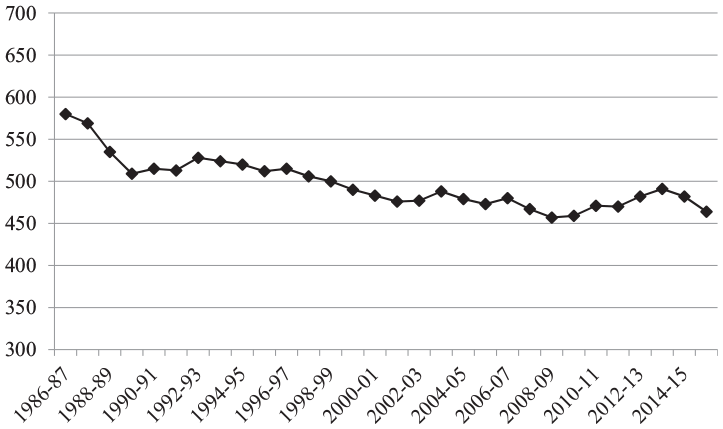
Trend in student-to-counselor ratio from 1986–1987 school year to 2015–2016 school year.
Understanding how effective counselors are at providing social/emotional, academic, and postsecondary counseling to students is difficult. Exploiting large data sets or natural experiments, researchers have shown that in certain cases, school counselors may improve test scores (Carrell and Hoekstra 2014; Reback 2010), influence school choice and course taking (Sattin-Bajaj et al. 2018), and increase college attendance (Engberg and Gilbert 2014; Hurwitz and Howell 2013). However, it is still unclear from these analyses what it is about school counselors and how they are positioned within schools that can make them effective in some cases but not others (for an exception, see Sattin-Bajaj et al. 2018).
Similar to research focusing on teachers from an organizational perspective (Bidwell 2001), I argue that the way schools and districts organize school counselors structures counselors’ ability to serve students. How counselors’ jobs are defined, how they are supervised within schools/districts, and the duties they are assigned all play a major part in how their roles are framed. Throughout this article, I point to how these aspects of the organization affect school counselors’ performance through the creation of role ambiguity and role conflict. As trained mental health professionals, school counselors occupy an ambiguous and inconsistent space within high schools. Viewing school counselors through this organizational lens, we can connect how school and district personnel view and assign school counselor roles, which ultimately affects how well school counselors serve students.
Role Ambiguity and Role Conflict
The concepts of role ambiguity and role conflict originate in role theory. Role theory is concerned with the way social actors behave. These behaviors are connected to actors’ social identities, the situation, and expectations of behavior understood by others (Biddle 1986). Role ambiguity is characterized by vague, incomplete, or inconsistent information or expectations regarding role responsibilities, how these responsibilities should be met, and how they will be evaluated (Biddle 1986; Freeman and Coll 1997; Rizzo, House, and Lirtzman 1970). Role ambiguity can occur when one does not have enough information to do the job well, when expectations of the job do not match the reality, or when one reports to multiple authorities (Culbreth et al. 2005; Maslach, Schaufeli, and Leiter 2001; Rizzo et al. 1970). Role theory suggests role ambiguity can increase stress and inefficient performance (Rizzo et al. 1970).
Along with unclear expectations, organizational actors may also be subject to multiple sets of expectations—from official requirements of the organization to informal expectations or desires of other groups—that can create role conflict (Biddle 1986). Role conflict is “the concurrent appearance of two or more incompatible expectations for the behavior of a person” (Biddle 1986:82). When expectations do not match reality, or when two or more people have different expectations for a role, actors must resolve the problem and adapt their behaviors (Culbreth et al. 2005).
Research on the effect of role ambiguity and role conflict on job performance within organizations is extensive and largely quantitative. Results of numerous meta-analyses suggest ambiguity and conflict within an organization can lead to poor job performance, role stress, and burnout (Jackson and Schuler 1985; Örtqvist and Wincent 2006; Van Sell, Brief, and Schuler 1981). Failing to address these issues can mean organizations fail to meet their goals in an efficient manner. Individuals in professions related to school counseling, such as social workers and teachers, suffer negative consequences from role ambiguity and conflict (Acker 2004; Schwab and Iwanicki 1982).
Research in school counseling itself has used survey data to measure perceptions of role ambiguity and conflict and their relation to job performance and burnout. Culbreth and colleagues (2005) and Freeman and Coll (1997) surveyed counselors with the Role Questionnaire (Rizzo et al. 1970), a 14-item questionnaire designed to measure role ambiguity and role conflict. The authors connected the questionnaire to counselors’ training and personal characteristics to understand predictors of role conflict and role ambiguity. Bardhoshi (2012) surveyed school counselors using the Counselor Burnout Inventory and the School Counselors Activity Rating Scale, connecting demographic and school variables to burnout (a potential consequence of role ambiguity and role conflict).
The current study expands on this research by using qualitative methods to interview and observe counselors as they navigate issues of role ambiguity and role conflict. Interviews with counselor educators and other school and district personnel provide an additional source of data regarding how role ambiguity and conflict structure the work of high school counselors. Interrogating the training and organizational structure of school counselors in this manner allows me to extend this research beyond individual counselor perceptions and demographics to a larger organizational framework of the profession. More importantly, viewing these obstacles as inputs to students’ educational outcomes, I situate the negative consequences of this role ambiguity and conflict for how counselors perform their roles as integral to students’ educational experiences. Before more counselors are hired to address the increasing social/emotional and academic needs of students, we need to know if the school counselors in place are being utilized to the best of their training. Knowing that role ambiguity and role conflict can lead to organizational inefficiency and poor job performance in other professions (Rizzo et al. 1970), I argue that understanding how these concepts play out in school counseling may give us a firmer grasp on why students perceive school counselors to be failing them.
Data and Methods
Sample
The sample school district, which I call Ashview, 1 is in a midsized urban city in a midwestern U.S. state. Ashview School District is largely low income (70 percent of students participated in the free-and-reduced-lunch [FRL] program) and diverse (at the time of the study, over 50 percent of students were black or Latino). Conducting research in this school district helps us understand school counseling dynamics within high-poverty and high-minority high schools.
I narrowed in on two public high schools in this district for my sample, rather than some of the private high schools in the area, to avoid conflating counselor effects with sector effects. The first school, Hunter High School (HHS), is the largest public high school in the district, with approximately 1,700 students (340-to-1 student-to-counselor ratio). HHS has a strong academic reputation in the area. Approximately 50 percent of students at HHS were on FRL, 40 percent were white, and over 90 percent graduated on time. The second high school is Edward High School (EHS), which has a larger black and Latino population than HHS (over 80 percent), a larger percentage of students on FRL (about 75 percent), and an 85 percent graduation rate. EHS is ranked much lower in the state than HHS, and it experienced large declines in student enrollment over the past 10 years due to open enrollment in the district; it enrolls approximately 900 students (225-to-1 student-to-counselor ratio). Both schools assigned students to counselors alphabetically, with students generally divided evenly among the counselors at each school.
I initially chose these two schools to serve as comparisons because they were the highest and lowest performing out of the four high schools in the district and because their racial and income demographics were on opposite ends of the district spectrum. Despite these demographic differences and very different student-to-counselor ratios, I found similar processes of role ambiguity and role conflict at each school. Interviews at the two other high schools in the district corroborated these results (for more details, see my conversation with Susan in the Role Ambiguity section). Part of this speaks to the influence of being in the same district, but part of this also speaks to my ultimate findings: High student-to-counselor ratios can be problematic, but the overarching issues of role ambiguity and role conflict can affect schools with different demographics and different counselor caseloads. For the remainder of the article, I analyze the results from both schools together.
Interviews and Observations
I conducted interviews with all the counselors in the two sample high schools during my study—four from EHS and seven from HHS (two counselors left during the study; I interviewed these counselors and their replacements). I interviewed the guidance directors from each of the 11 other public and private high schools in Ashview and a neighboring town to gain a broader sense of counseling for this area’s student population. I also interviewed four counselors from around the country I found through personal contacts to situate the Ashview counselors in a larger national narrative. In total, I interviewed 26 high school counselors (a partial list of interviewees—those quoted in this article—is included in Online Appendix A). 2
I conducted formal interviews with counselors between June 2015 and October 2016; interviews were semistructured, recorded, and transcribed, and each lasted between 45 and 180 minutes, with an average time of 76 minutes. My questions for school counselors focused on their roles, the constraints under which they worked, and how they spent their time on their various responsibilities. Questions covered course selection and scheduling duties, social/emotional counseling, postsecondary counseling, and high school graduation support (see Online Appendix B for select interview questions). During observation days, I also regularly conducted informal interviews with the counselors working in the two sample schools. These informal sessions allowed me to capture counselors’ in-time reactions to situations and clarify my observations, thereby reducing the recall bias that is endemic to formal interviews alone.
To capture the yearly cyclical nature of counselor relationships and advisement of students, I completed twice-weekly observations of counseling operations in the counseling office in the two sample schools from October 2015 to June 2016, with an additional observation in August 2016. These observations included counselor meetings with students, all-district counselor meetings, and more informal interactions in the outer counseling office of both schools.
Throughout the school year, I conducted formal interviews with 11 key school and district administrators who worked with counselors or affected their work. These administrators included the principals, social workers, career guidance specialists, and the district administrator over the high schools. Information from these participants highlighted the expectations each school and the district had for their counselors and provided details on their work conditions (select interview questions can be found in Online Appendix C).
To understand the professionalization of school counselors, I interviewed 11 faculty members, in person or by phone, from different counseling graduate programs across the state and five across the country for 60- to 90-minute semistructured sessions; these interviews were recorded and transcribed. I asked these counselor educators about the goals and nature of the course work and internships in their programs and about their thoughts on the state of the field (see Online Appendix D for select interview questions). The majority of counselors in Ashview obtained their master’s degree in school counseling in the same state, and over half of counselors in EHS and HHS from the same regional university, so these interviews supplied information regarding the training process of these counselors.
Finally, I conducted observations at one national and two state school counselor conferences to situate my study within the context of counselors’ contemporary training and ongoing professional development. I observed educational sessions to understand what knowledge the profession provided conference attendees. Analyzing the program and attending the sessions gave me a unique insight into the profession, an insight not gathered in previous research.
Data Analysis
I coded all field notes and interview transcripts with all participants using an iteratively based coding scheme, which was informed by my theoretical approach, findings from initial interviews and observations, and previous research. In particular, I looked for examples of role ambiguity and role conflict the school counselors faced, how counselors responded to these obstacles in their work, and how these obstacles affected the performance of their work. I obtained multiple data sources throughout the school year, which allowed me to triangulate the data to increase reliability of the analyses (Lareau and Shultz 1996).
Findings
To address the first research question—How does the organizational structure of school counseling contribute to the role ambiguity and role conflict high school counselors face?—I outline the structure of the profession that creates role ambiguity and role conflict. Role ambiguity is characterized by vague and unclear expectations regarding role responsibilities, how these responsibilities should be met, and how they will be evaluated (Biddle 1986; Freeman and Coll 1997; Rizzo et al. 1970). With role conflict, actors must contend with two or more sets of expectations that are incompatible with each other (Biddle 1986). Although related, these two aspects of role theory have different causes and consequences. In exploring these causes and consequences, I address the second research question: How do aspects of role ambiguity and role conflict affect school counselors’ ability to serve students and, ultimately, student outcomes?
Role Ambiguity
Lack of a clear job description
The school counselors in Ashview often spoke of the uncertainty they faced in performing their roles, particularly due to the lack of a clear job description from either the district or their schools. Susan, the guidance director at an Ashview public high school, described how the lack of a clear job description creates an “other-duties-as-assigned” role: My responsibilities are poorly defined. And I think it’s a challenge for all guidance counselors because there’s not a lot of unanimity around stakeholders about what’s expected of you. It tends to be a dumping ground or “We don’t know what they’re doing anyways, so we’ll give it to them.” When I was teaching English, nobody expected me to do math stuff. But you’re kind of in a no-man’s-land [as a counselor]. . . . I guess [the many responsibilities are] the price of poor boundaries. You don’t want to be the person who says, “Not my job, not my job.” But then you get completely overwhelmed with, if you say, “Sure I can help you out.” And you can’t get a bazillion other things done. I think that’s a real problem with those boundaries.
Susan highlighted a number of important points. First, she pointed out the role ambiguity for Ashview school counselors. Because expectations were unclear regarding the types of tasks counselors should perform and how to prioritize them (Freeman and Coll 1997; Holland 2015), Ashview high school counselors ended up having the kind of position that did everything, a sort of “dumping ground” for tasks that did not fit under someone else’s job description.
Second, any educational professional may deal with poor boundaries to some extent, but when she was a teacher, Susan had a set boundary of teaching English—no one was going to ask her to teach math. As a counselor, however, her role was so poorly defined that she could be assigned almost any task in the school (Seashore, Jones, and Seppanen 2001).
This placed school counselors in a difficult situation: They could either set clear boundaries (and serve students) or be a team player, help the school, and thus be overwhelmed by the “bazillon” things to do. Susan pointed out how difficult it was to say no to these extra tasks. Julia, the guidance director at HHS, echoed Susan’s statements in a more colorful way, saying on two separate occasions that the counselors were “everybody’s bitches!” The counselors wanted to be seen as team players, and they feared that if they refused additional responsibilities too often, there could be employment consequences. Julia and Susan implied they felt at the will of those around them and had no choice but to concede to ever-changing expectations and responsibilities to keep their jobs. As schools have taken on more special education services, testing, and accountability, school counselors—lacking professionally defined standards recognized outside of the profession—are assigned many of these additional duties, diluting their job description and their identity as counselors (Bardhoshi 2012; Gladding 2013; Paisley and McMahon 2001). Without a clear professional structure, “guidance had become the add-on profession, while counselors were seen as the ‘you-might-as-well’ group (‘While you are doing this task, you might as well do this one too’)” (Gysbers 1997:5–6). However, taking on too many responsibilities, and attempting to do everything for everyone, meant counselors left many tasks undone and had less time with students (Paisley and McMahon 2001).
This role ambiguity bled into high school counselors’ conceptions of their job responsibilities. When I asked Julia about her responsibilities, she said, “I can tell you what I think they are. As each day passes I find out that what I’m expected to do I didn’t think I was supposed to do. It seems to be just about anything and everything falls in my lap.” Most of the counselors discussed how the roles they believed they would have upon leaving graduate school were very different from the roles they actually took in the high schools. In addition, Stephanie, a counselor at HHS, spoke at length about how the district often changed the responsibilities and expectations of the school counselors and how she wanted a job manual for the counselors to create consistency.
The lack of a clearly defined role, and discrepancies with their graduate training, led Ashview counselors to experience contradictions in their work roles, goals, and expectations (Herr 2002; Lipsky 2010). In situations where roles are ambiguously defined, workers focus on what they believe will be formally and informally evaluated: that which is most pertinent, timely, and in need of immediate attention for the school to function properly (Rizzo et al. 1970). Thus, counselors pushed off student-centered responsibilities for more time-sensitive, immediate tasks. For instance, HHS counselors reported spending over 50 percent of their time on the most measurable and immediate tasks, such as emails, planning events, class scheduling, coordination of high-stakes testing, and creating a master schedule of courses for the school. These tasks generally had strict deadlines and understandably significant implications for the school. But the focus on these noncounseling tasks left less than half their time for their 225 to 340 students, lower than the 80 percent of their time recommended by ASCA, although generally in line with other studies of actual counselor time use (Radford et al. 2013). Generally, if Ashview high school counselors had any interaction with students during the school year, it was planning classes for the following year and adjusting schedules as needed. To compensate for their lack of time to meet with students, like other street-level bureaucrats, counselors would often engage in “mass processing” (Gast 2016; Lipsky 2010), averaging one 5- to15-minute meeting per student, per year, to schedule classes, making it extremely difficult to talk about deeper social or emotional issues or to guide students in their postsecondary pathways.
Overlap with similar professions
The role of Ashview school counselors also seemed ambiguous due to the presence of other similar personnel in the school—the social workers. School social workers are trained mental health professionals who specialize in providing services at school but also utilize home and community resources to respond to students’ mental health needs. School social workers often coordinate special education assessments and individual education plans. Whereas school counselors provide mental health counseling and academic support during the school day from a psychological perspective, school social workers focus solely on students’ personal, social, and emotional health, often reaching outside of school to get at the root of the problem from a sociological perspective (Cicourel and Kitsuse 1963; Kontak 2012).
This thin line separating the roles of social workers and counselors in regard to social/emotional counseling was apparent to both groups in Ashview. Robert, a counselor at HHS, said, “The school counselor and the social worker are the same person when it comes to counseling.” But social workers had a clear goal: personal, social, and emotional health and referral to outside, long-term care. In contrast, school counselors were trained in brief counseling plus were in charge of academic counseling, postsecondary counseling, and administrative tasks. Some counselors complained they never had the chance to provide social/emotional counseling to students. Julia disliked the division of responsibilities: “The social worker gets all the stuff we want to do. We’re like, ‘Oh, we chose the wrong path.’”
All of the counselors appreciated the social workers and lamented there was only one per school. Two counselors noted the social workers’ expertise in institutional support and how counselors were not trained for responsibilities that social workers took on, such as doing home visits and working with pregnant students. But relying solely on social workers for personal, social, and emotional counseling was problematic for two additional reasons. First, there was only one social worker for each high school in Ashview, whereas there were four or five counselors at each school. This meant social workers were responsible for 900 to 1,700 students, depending on the school. As Susan put it, “They’re understaffed and overwhelmed.” Second, by rejecting the role school counselors could play in providing social/emotional counseling, the Ashview school counselors were underutilized, forgoing the most specialized part of their education. They were not seen as counseling professionals but as school managers.
School counselor performance evaluations
The practice of being a high school counselor is generally unobserved. This creates a situation where it is unclear to stakeholders what counselors do and what value they bring to schools. Inherent in the tension between the role of school counselors and how they are evaluated is the “worth” of school counselors to the educational system. During a session at the annual ASCA conference in 2016, a presenter said that after funding cuts in his state, school counselor positions were some of the first to go. Counselors that remained were being asked to “prove their worth.” This message of having an ambiguous role, and that counselors needed to help districts define their role through data, was echoed in nine conference sessions that were specifically dedicated to using data to measure school counseling programs (Brown 2016). Speakers at these sessions encouraged counselors to gather more data to establish their value, especially if they had little control over formal evaluation procedures; presenters seemed to assume counselors’ value was not already inherently known to schools and districts.
Dr. O’Brien, a faculty member at a southern state university, tied this role ambiguity to data from high-stakes testing. When I asked what were some of the biggest challenges facing counselors in high schools today, she said, I think having people understand what we do and how it’s valuable. I think that there are lots of folks that get tied up in all of the accountability and academic achievement and the high-stakes testing that has no grounding in what’s actually beneficial to students, which is frustrating to no end.. . . There is this dance that’s happened between our school counselors having to sort of justify their existence. Standardized tests are being used in ways they’re not supposed to be used and don’t directly measure what our school counselors are doing. So, how do they work within that narrative to justify their time and their salary and what’s going on at school, and at the same time help educate folks that are not in education so that they understand that school and education are more than test scores?
At the district level, Ashview was trying a new way to evaluate school counselors the year I observed them. The HHS principal said that because school counselors were on the teacher contract, all counselors in the district would be evaluated using the same student-learning outcomes growth rubric as the teachers, with some of their evaluation score tied to individual schools’ overall performance on the graduation qualifying exams (GQEs). With this configuration, the principal said there was “a lot of skin in the game for everybody.” Both principals, who were on the district committee to redesign school counselor evaluations, recognized that this evaluation process might not be applicable to counselors, who do not teach classroom subjects, but they had not found a better evaluation system. This was despite an EHS counselor’s attempt to get the district to use the counselor evaluations created by ASCA. Her email request was never acknowledged.
Implementation of counselor evaluations was uneven across the two schools, one of the few instances where counselor management seemed to vary by school. I saw very little evaluation of HHS counselors. For instance, Jessica, the newest counselor at HHS, was supposed to meet with the principal in the spring so he could observe her working. He had observed her and Stephanie in the fall during administration of a test, when she said all she was doing was “running around.” But when she asked him to schedule a spring observation, he said he would skip it since he was just going to observe her doing testing again (versus the myriad other tasks and interactions she had with students). In the end, the observation meeting was never scheduled, there seemed to be no other evaluation of her work, and the principal submitted her evaluation to the district without ever going over it with her, leaving her with little feedback from which to grow.
This was in contrast to the evaluation system at EHS. Possibly because of the status of the school (as one of the lowest-performing schools in the state), or just the desires of that particular principal, EHS placed more emphasis on student-learning objectives for counselors. EHS counselors were told to choose five juniors within each of their caseloads to track to graduation; they would be evaluated based on how many of these juniors graduated from high school the next year, a narrow sliver of their responsibilities. EHS counselors could choose which students they would follow, and they all chose students they were fairly sure would graduate, making this part of the evaluation less meaningful. Counselors were explicit in noting they were not going to risk following kids who were unlikely to graduate, because there was no reward in doing so. Along with following these students, the counselors would also submit a two-page letter written by one of them that detailed 20 tasks they were in charge of throughout the year. It was unclear how this piece was evaluative versus just being a list of the things they did.
Despite frustrations with the evaluation system, Rose, the guidance director at EHS, recognized the opportunity to use the evaluation as a way to prove to others in the school that the counselors worked hard and had a lot of responsibilities on their shoulders—to reduce role ambiguity. When Rose said others in the school did not know what counselors do, Laura chimed in and sarcastically said, “We don’t do much of anything. We just have two pages of crap we don’t do” (referring to the list of 20 responsibilities submitted with the evaluations).
Because principals are under immense pressure to prove their schools are effective, school counselors too must demonstrate success, especially in a highly constrained budgetary environment. Principals largely control the goals and expectations on which school counselors are evaluated, and these could be an extension of principals’ own evaluations and increasing accountability mandates (Smith 2011). Even when schools and counselors agree regarding what a school counselor should be doing, much of this work is not measurable, such as counselors’ effect on students’ health and well-being or whether students were scheduled in the “right” class. These and other goals are not only hard to measure; they are difficult to observe from the outside (Hatch 2002) and difficult to directly attribute to the influence of school counselors (Lipsky 2010). For instance, how does one know the counselor’s relationship with a student is responsible for the student’s academic or postsecondary success? If counselors must use metrics such as high school graduation rates to measure their work, how can schools know how much of this metric is attributable to counselors? If the rate is low, does that mean counselors are performing poorly?
Like other street-level bureaucrats, high school counselors depend on “subjective assessments” of their work, which are rarely given in any regular fashion (Lipsky 2010). For counselors in Ashview, this seemed to mean that barring any major catastrophe, no negative evaluation would be put on record—and few suggestions for improvement would be offered.
Role Conflict
In addition to role ambiguity, school counselors also had multiple roles they were expected to embody that were in conflict with each other, creating role conflict (Freeman and Coll 1997). School counselors answer to a diverse group of stakeholders: students, parents, teachers, school and district administrators, counselor educators, and community members. Each group has different expectations for counselors, and these expectations sometimes conflict and affect how the school counselor’s role is defined and implemented (Freeman and Coll 1997; Paisley and McMahon 2001; Rizzo et al. 1970; Van Sell et al. 1981). These differing expectations developed over years during which the profession evolved from a vocational focus to a social/emotional focus, moving from teacher-counselors to full-time educational school counselors (Cicourel and Kitsuse 1963; Gysbers 1997).
Much of counselors’ role conflict came from the discrepancy between the expectations they originally had of the job versus what reality actually looked like (Freeman and Coll 1997). All the counselors in this study told me how surprised they were at how different their professional roles were from what they had learned in their graduate programs and internships. The next section provides a few examples of how the roles counselors wanted to fulfill conflicted with how others defined their role and how this conflict often meant counselors influenced student outcomes and success to a much lesser degree than they hoped.
Supervision of high school counselors by noncounseling administrators
Part of school counselors’ role conflict is due to the unique way the school counseling profession is organizationally arranged in schools. School counselors are trained in their graduate classes and internships by current or former school or clinical counselors, yet when they enter the workforce, they are supervised by principals and other school and district administrators. Typically, school counselors’ supervisors and evaluators were not trained as counselors and have little experience working with them. However, these supervisors have a great amount of authority and influence over school counselors, shaping organizational goals and decision making for counselors and their role in the school.
In Ashview, two positions—the school principal and the district administrator over high schools—supervised all high school counselors. These supervisors were unfamiliar not only with what counselors were trained to do but also with what they were actually doing in the schools, especially regarding students’ social/emotional needs (Amatea and Clark 2005; Seashore et al. 2001). When I asked the principal at HHS to describe the role of counselors in schools, he never mentioned social/emotional counseling—a role most counselors felt was essential to their decision to enter the field and their training (Bridgeland and Bruce 2011a)—although he did acknowledge this role when I brought it up. Both principals said their educational leadership master’s degree programs did not cover the role of school counselors or how to supervise them. The HHS principal was surprised when I asked him if he received this training, having not considered the issue before. Virginia, the district administrator over school counselors, admitted not knowing exactly what counselors did when she took over their supervision.
The lack of counseling-trained supervisors is an issue not just for Ashview. According to a presentation at the 2016 ASCA conference, 50 to 60 percent of the people who evaluate school counselors are not school counselors themselves. School administrators typically come from a teaching background (Bureau of Labor Statistics 2015; Seashore et al. 2001), so they may have a good idea of how to supervise teachers, but most do not have experience or training in supervising school counselors (Seashore et al. 2001).
Because principals and district administrators directly oversee the Ashview school counselors, their perceptions of the role of school counselors are integral to the kind of work counselors actually do (Amatea and Clark 2005). As Dr. Callahan, a counselor educator, explained, Who defines the role of a school counselor? And it is probably the principal. And if a principal does not understand the role of a school counselor, or doesn’t care to know about what . . . then, you’re stuck. If you want a job, you do what the principal tells you to do.
Because principals and district administrators often do not understand the scope of what school counselors believe they can do, counselors experience role conflict between what they want and expect to do (social/emotional, academic, and postsecondary counseling) and what they are assigned to do (administrative school-management tasks, class scheduling). For instance, in each of my interviews with school and district administrators, scheduling was the first job responsibility they mentioned for counselors; other tasks were not mentioned or seemed like afterthoughts, reinforcing the message that counselors were best utilized for scheduling issues.
Stephanie believed the administration saw and used counselors as schedulers only because that was the task most visible to others in the school. She said this perception hurt counselors’ ability to work with students. Stephanie was particularly annoyed about an incident at the beginning of the year. When the HHS principal was introducing the school counselors at freshmen orientation, he introduced them as the people who did students’ schedules, as if this were the counselors’ only function. Julia defended the principal, saying he was one of their biggest advocates, but Stephanie pushed back, noting that the comment set the groundwork for how these students would see the counselors for the next four years, merely as schedulers.
School counselors’ role conflict can become detrimental to the schools. In counselors, schools have a resource to help students socially, emotionally, and academically. Counselors can support the work of teachers and supplement the work of social workers. They can address problems in school climate, discipline, and underachievement on a schoolwide scale. But this becomes difficult when they are used mostly for low-level data-entry tasks or as test coordinators (Lipsky 2010). As Mr. Coughlin, a professor at a state university, said, They don’t get, when they have a half a dozen people that all have their master’s degrees, that you can make them do better things than walk around the room, supervising a test. . . . Principals don’t understand the magnitude of the impact counselors can have on the school, so they reduce that role to a kind of firefighting mode. “Oh, we have to get something done, call the counselors. They’re not stuck in classrooms.”
Ashview counselors consistently noted feeling underutilized based on their educational preparation because of the conflict regarding their roles. Leonard, a counselor at EHS said, “I don’t really need a master’s degree to do this. Why did I take that class in [counseling] theory?” This sentiment was repeated by most counselors. Denise, a counselor at another Ashview high school, said in a meeting with district administrators that many of them felt like “overpaid clerks.” Kathy, from a high school in the state capital, talked about how her administration used the counselors as “warm bodies” watching over students during the lunch hour in the cafeteria: This administration doesn’t want to hear that an hour and a half of cafeteria duty is not an efficient use of time. Because they needed a body. They needed a body in there for any kind of inappropriate activity. . . . I think, “Hey, you’re paying me a decent amount of money to get something else out of it. You can pay somebody 10 dollars an hour to do cafeteria duty.” . . . And their rationale is, “You got a captive audience in here. You know you can do counseling while you’re in here.” Because we always talk about curbside counseling. . . . There is some merit in going to the cafeteria and plucking out three or four or five kids and following up on something. But when a student is sitting in your office with a genuine concern and the bell rings and you’re like, “Hey, your dad’s on crack but I’m gonna go to the cafeteria and do cafeteria duty” . . . .
Kathy saw the opportunity to interact with students during lunchtime, but the purpose of lunch duty was prevention of “inappropriate activity,” not student support. Plus, this responsibility took her away from times students truly did need her help.
Despite being highly educated (most states require school counselors to have a 48-credit-hour master’s degree in school counseling from a nationally accredited program), the counselors felt their education was disregarded and underutilized. According to Mr. Coughlin, “a lot of the functions counselors are doing in schools could be done by somebody with a high school education and some inside knowledge about the functioning of the school. Fixing schedules, things like that.” If school counselors were not providing adequate social/emotional, academic, or postsecondary support, this responsibility invariably fell on the teachers, who also faced time constraints and were not trained in these aspects of counseling to the same extent as school counselors. Generally, if school counselors were not providing these services, students did not receive them and had to navigate these areas on their own.
Care versus accountability
Responsible for student-centered and school-centered duties, Ashview counselors sometimes had to choose between working for the best interest of students and the best interest of the school (Armor 1969). For instance, not only were Ashview high school counselors supposed to provide social/emotional and academic assistance; they were also supposed to be representatives of the school and were often responsible for the school’s reputation. This was especially true for counselors in charge of administering high-stakes accountability tests. For example, when coordinating the GQEs, counselors were responsible for tracking down students to ensure they completed the test. Because counselors believed the state graded schools partially on how many students took the test (regardless of whether they passed), they would track down missing students to protect the school’s ranking. This ranking was important to HHS, which competed with private schools in the area for high-performing students, and to EHS, which tried to avoid another year of probation with the state.
This additional role of test administrator had the unintended consequence of making school counselors seem less like the social/emotional counselors they wanted to be. When counselors encouraged students to come in to make up the test they missed, they no longer acted as counselors but as administrators, worried about the bottom line for the school and pleading with students to take the test. If students did not take the GQE, they could not graduate (with some exceptions), so one might interpret counselors’ work in in this role as a service to the student. However, this did not always seem to be the case. I observed a conversation between a counselor and a teacher about tracking down students to take the GQE. The students in question had serious obstacles to academic success. One recently gave birth and could not get to school without day care for her newborn. Another had been incarcerated five times and was not coming to school anymore. But the conversation between the counselor and the teacher revolved around tracking down the students to help the school with GQE completion rates, not reaching out to the students and helping them overcome these obstacles to graduate. Similarly, according to the EHS counseling office administrative assistant, students sometimes suffered from test anxiety, hiding in the bathrooms so no one could find them during the test. This was a missed opportunity for counselors to provide social/emotional support to a scared student. Because counselors’ role was to convince students to take the test, they could not provide impartial support.
Ashview high school counselors had to use influence to suggest or even strongly encourage students to comply with test taking. The consequence of this position of support but also authority led to opposite goals. Students may not view school counselors as counselors when some of their interactions with them are administrative. If students see counselors as authority figures, this could undermine counselors’ ability to be a safe person to confide in.
Care versus guidance
Another role conflict I observed occurred between the expectations and roles associated with being an educator and being a counselor. Like other mental health counselors, school counselors are trained to provide client-centered care. But this position can be compromised by the fact that they are also academic guidance counselors. The former position is about listening and providing support and referrals, whereas the latter is about the (sometimes tedious) tracking of progress, conversations about said progress, trying to convince students to come to class and get better grades, and having conversations about their future. During an interview, the social worker at EHS pointed out the negative consequences of this conflict for student perceptions of counselors: The counselors are very focused on, “You’ve got to get this credit. You have to take this class.” And sometimes kids don’t want to talk about what’s going on with their class. “My mom’s really sick. I don’t care about my math class right now.”
The EHS social worker explained that she liked that she did not have responsibilities regarding students’ grades or discipline, so she could focus solely on their well-being. Students could come to her just to talk, and she did not focus on their academic progress but on their mental well-being. She thought that worrying about academics could be problematic for establishing a counseling relationship. High school counselors might be hampered by their responsibility to make sure students are on track to graduate, so they cannot provide students with the counseling services they need. For instance, as the social worker explained, students might have personal or family issues that prevent them from being on time in the morning (e.g., morning sickness if pregnant). But if students do not see the counselor as a social/emotional counselor, they might not tell them the actual issue. Counselors and teachers would not see the real reason why the student was late to class and thus could not reach out to help. The EHS social worker implied that school counselors’ responsibilities in keeping students on track might conflict with their roles as counselors—they served as authority figures instead of just listening and counseling.
I asked Julia about the social worker’s observation. Would trying to get students to stay on track in academics get in the way of social/emotional counseling, making students less likely to share personal issues with her? Julia sort of agreed but then said she would not change this aspect of her job, because that is why they are school counselors. For Julia, school was the only thing these students have power over, and getting that right can fix a lot of the other issues.
Julia’s observation illustrates that an important aspect of her job was to ensure academic success, which involved a more directional relationship than one would typically have with a mental health counselor. School counselors give advice, but they also guide students in the direction they feel is best, in a way a typical therapist would not. School counselors still need to provide personal support for students, yet the EHS social worker implied that students, wary of counselors’ motivations, would not seek counselors out in this way because of this conflict.
Julia also inadvertently highlighted the difficulties in supporting students both academically and emotionally by using a circular logic regarding academic and social/emotional issues. Instead of addressing the social/emotional issues that prevent educational success, Julia indicated she preferred to focus on educational issues to solve the social/emotional issues. This will likely be a good solution for many students who come from low-income households—a college degree will help them get out of poverty. However, students may have social/emotional issues that are too large to overcome without help from an adult trained in this area, and that may distract them from educational success. If a counselor is not available as a resource for these social/emotional issues, student educational success may suffer. Therefore, even if high school counselors have the ability to provide academic counseling and social/emotional care to students, these two roles may conflict in certain situations and make it difficult for them to do both well, ultimately leaving students underserved.
Discussion
In this article, I explored why previous research suggests high school counselors are not living up to their potential as social/emotional, academic, and postsecondary counselors (Bridgeland and Bruce 2011b; Johnson and Duffett 2005). I used an organizational theory approach to understand the role ambiguity and role conflict public high school counselors face today in schools. With yearlong observations of high school counselors and interviews with counselors, administrators, and counselor educators in and around a diverse urban midwestern school district, I sought explanations for why school counselors suffer from role ambiguity and role conflict and how these factors affect their interactions with students.
With training as mental health professionals but jobs inside schools, school counselors experienced role ambiguity due to lack of a clear job description, overlap with similar professions, and inadequate forms of performance evaluation. They also experienced role conflict between their roles as counselors and educators, through performance of conflicting roles, and due to conflicts that arose through supervision by noncounselors. Counselors suffered from poor boundaries in their work, receiving multiple noncounseling duties that monopolized their time and reduced their time with students. Through these noncounseling tasks, school and district administrators underutilized the specialized education counselors received, and counselors questioned why they had spent so much time on an education they rarely used.
This role ambiguity and role conflict existed for counselors with different caseloads and in schools with different demographics and achievement levels, suggesting these issues can affect counselors regardless of these conditions (although see Holland [2015] for how race and class in the student population may influence individual interactions with students). Most of these issues affected counselors across the district—such as the lack of a clear job description and the basis for performance evaluation. How individual principals communicated counselors’ role to students, and how they evaluated counselors’ performance, did affect counselors, but counselors at every school appeared to experience role ambiguity and role conflict, with decisions regarding job performance and resources coming from the district level (e.g., switching all schools from assignment of students to counselors by grade level to alphabetical assignment the year after my observations). Previous research suggests role ambiguity and role conflict for school counselors are endemic to the education system as a whole rather than an idiosyncratic effect of the Ashview school district (Radford et al. 2013). However, this idea requires more research beyond this one district.
Role ambiguity and role conflict are related to job performance—it is difficult to do a job well when tasks are unclear or conflicting (Jackson and Schuler 1985; Örtqvist and Wincent 2006). Previous research has found that school counselors and others who encounter role ambiguity and role conflict experience role stress, exhaustion, burnout, deterioration of their personal life, feelings of incompetence in their work, lower job performance, and a higher propensity to quit (Bardhoshi 2012; Culbreth et al. 2005; Örtqvist and Wincent 2006). Little quantitative research directly connects school counselors’ role ambiguity and role conflict to student outcomes, but using a qualitative approach, I found school counselors felt overburdened by noncounseling work and believed they were not serving students to the best of their potential because of these issues. All counselors believed they could be more effective if allowed to do their jobs as they were trained, dedicating themselves to student-centered tasks rather than the school-centered tasks that monopolized their time. In the end, little of the counselors’ time was spent serving students in a meaningful way. Students likely recognize this lack of attention to their needs when they report a lack of trust with their high school counselors; students misunderstand the role of counselors (Holland 2015) and feel like “just another face in the crowd” (Johnson and Duffett 2005:10).
Implications
There is a large gap in the sociology-of-education literature regarding school counselors at all grade levels (Rosenbaum et al. 2015). As a vital link for students for information on social/emotional learning, academics, and postsecondary plans, this is disheartening. Despite the presence of one or more master’s-level trained school counselors in their schools, students largely report a lack of support from these counselors (Johnson and Duffett 2005). This lack of support often compounds social class differences in access to information about academics and the job market and increases the chances students will fail to receive social/emotional help, be placed in lower-track courses, undermatch at a college, or fail to attend college at all (Cicourel and Kitsuse 1963; Kaiser Family Foundation 2011; Lee and Ekstrom 1987; Radford 2013).
Movements and initiatives such as the Whole School, Whole Community, Whole Child model could encourage schools to invest in more school counselors and social workers in an effort to bridge the often-intertwined issues of academics, mental health, and physical health (Centers for Disease Control and Prevention 2018). However, clearly defining the roles of school counselors and giving them the time and resources they need to serve students will be necessary for such initiatives to succeed. Beyond the lopsided 464-to-1 student-to-counselor ratio in schools today (National Center for Education Statistics 2018), evidence from this study suggests we are not well utilizing the counselors we do have. Incorporating organizational theory with the sociology of education and schools, this article highlights the effect of schools and districts on student outcomes through structuring the role of high school counselors. Future research that connects school counselors’ work conditions with student perceptions of their influence will help bridge this gap in the literature; specifically, research should examine the effect of counselors’ role ambiguity and role conflict on student outcomes, such as high school graduation and college enrollment. Without a full understanding of school counselors’ work conditions, it is impossible to maximize their potential and identify areas for improvement in the profession. Counselors have a strong influence over students, especially in academics, course taking, and postsecondary outcomes (Engberg and Gilbert 2014; Reback 2010; Sattin-Bajaj et al. 2018). These processes are highly stratified by income and race, so understanding the role school counselors do have and the positive role they could have is imperative to increasing the number of academically and vocationally prepared citizens.
Research Ethics
Research protocol was approved by the University of Notre Dame Institutional Review Board. All human subjects gave their informed consent prior to their participation in the research, and adequate steps were taken to protect participants’ confidentiality.
Supplemental Material
Blake_online_appendicies_MG_edits_mkb – Supplemental material for Other Duties as Assigned: The Ambiguous Role of the High School Counselor
Supplemental material, Blake_online_appendicies_MG_edits_mkb for Other Duties as Assigned: The Ambiguous Role of the High School Counselor by Mary Kate Blake in Sociology of Education
Footnotes
Acknowledgements
I would like to thank William Carbonaro, Mark Berends, Omar Lizardo, and Jennifer Jones for their comments and suggestions while working on this project. I also thank Tobias Blake, Noelle Hurd, Barbara O’Brien, and Nicole Perez for reviewing previous drafts. Thank you to Linda Renzulli and the anonymous reviewers for their thoughtful and constructive feedback. Last, I am indebted to the school counselors, school counseling faculty, students, and others who allowed me to come into their space and listen to their stories. All errors are my own.
Funding
The author disclosed receipt of the following financial support for the research, authorship, and/or publication of this article: I am thankful for the generous support of this research by the William T. Grant Foundation through an officers’ research grant (no. 186448) as well as the Center for Research on Educational Opportunity and the Institute for Scholarship in the Liberal Arts at the University of Notre Dame.

Supplemental Material
Supplemental material is available in the online version of the journal.
Notes
Author Biography
References
Supplementary Material
Please find the following supplemental material available below.
For Open Access articles published under a Creative Commons License, all supplemental material carries the same license as the article it is associated with.
For non-Open Access articles published, all supplemental material carries a non-exclusive license, and permission requests for re-use of supplemental material or any part of supplemental material shall be sent directly to the copyright owner as specified in the copyright notice associated with the article.
