




Abstract

As a 501(c)(3) nonprofit membership organization, the Council for Exceptional Children (CEC) is governed by a board of directors that sets the overall strategy, allocates resources, and provides oversight to its management.
Fiscal oversight at CEC is also driven by the Finance and Audit Standing Committee (FASC), which reports to the board. The FASC is chaired by the treasurer and works directly with management in terms of fiscal policies, establishing the annual budget, making recommendations regarding asset management, and coordinating with an external accounting firm to conduct an independent annual financial audit. All this is done to maximize our resources on behalf of our members.
The following is a summary of CEC’s audited financial performance for the 2017 fiscal year, which was January 1 through December 31, 2017.
CEC Financial Performance
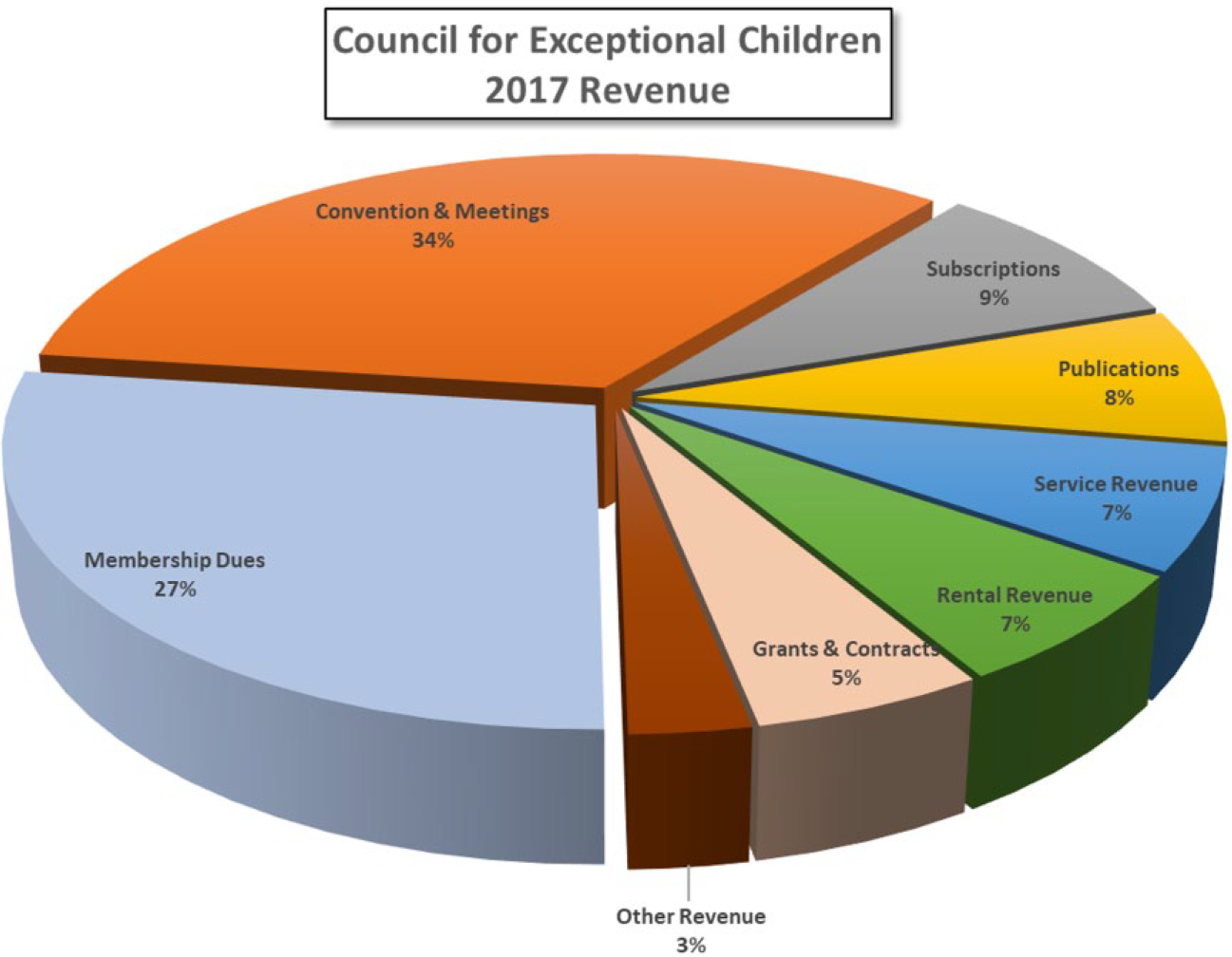
In 2017, CEC had total operating revenue of $6.9 million. Most of the revenue—61 percent—was generated from its convention and meetings (34%) and membership dues (27%). The 2017 Convention and Expo was held in Boston in April 2017 and attended by nearly 5,000 special education teachers, administrators, researchers, and exhibitors. At the end of 2017, CEC membership totaled 21,469. CEC also generated 8% of its revenue from printed and electronic book publications and 9% from subscriptions to its two journals, TEACHING Exceptional Children and Exceptional Children, and its Life-Centered Education transition curriculum.
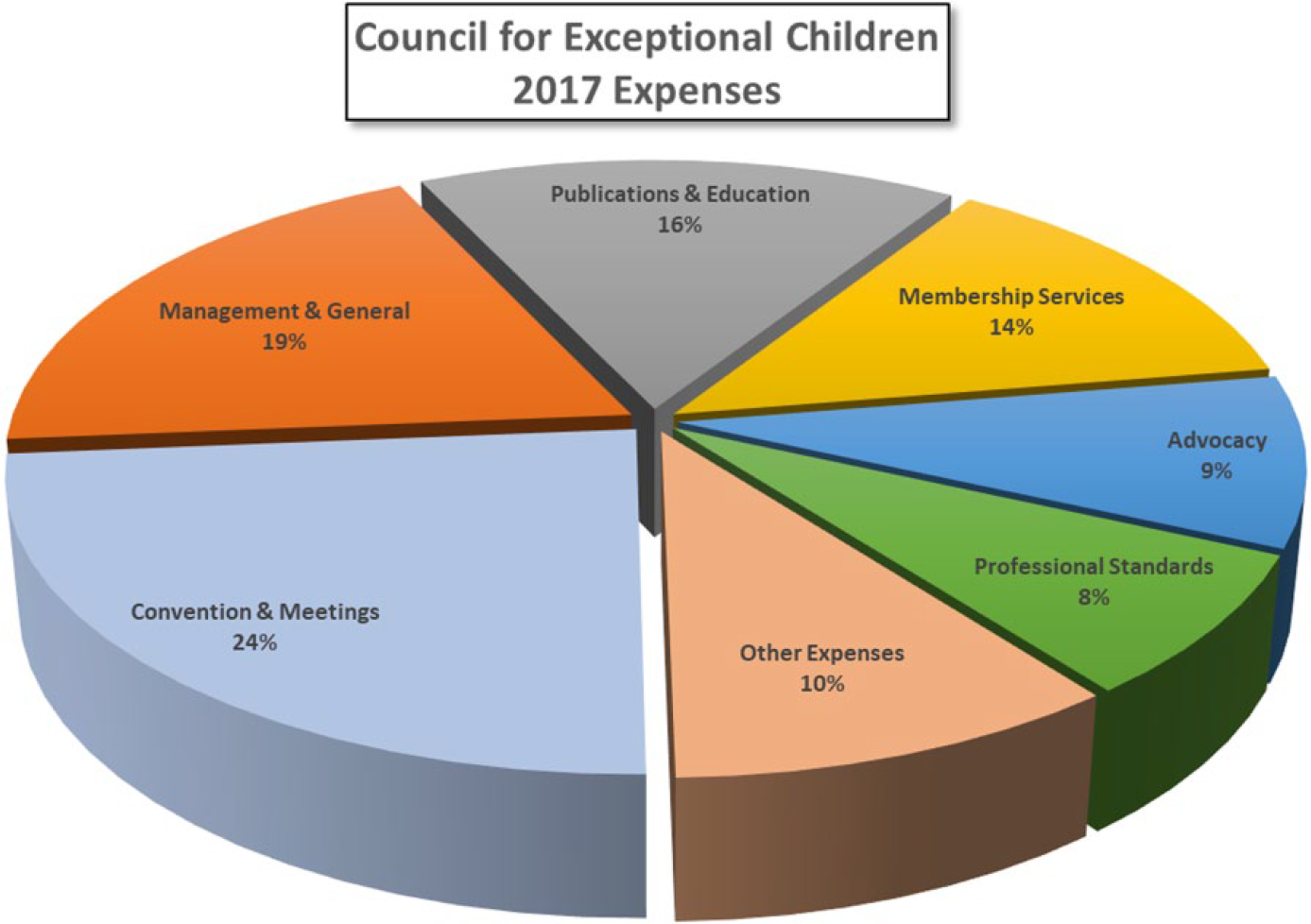
The CEC operating expenses of $6.7 million in 2017 reflect the mission of the organization, including advocacy, standards, and professional development. The convention and meetings represented 24% of total expenses, and standards and advocacy represented 17 percent. Also, publications, education, and membership services totaled 30% of total expenses. In terms of management and general expenses, industry guidelines suggest that costs should represent 30% or less of total expenses. CEC management and general costs were 19% of total expenses in 2017, indicating that 81% of its resources were spent on programming and support of its mission.
How CEC Stacks Up
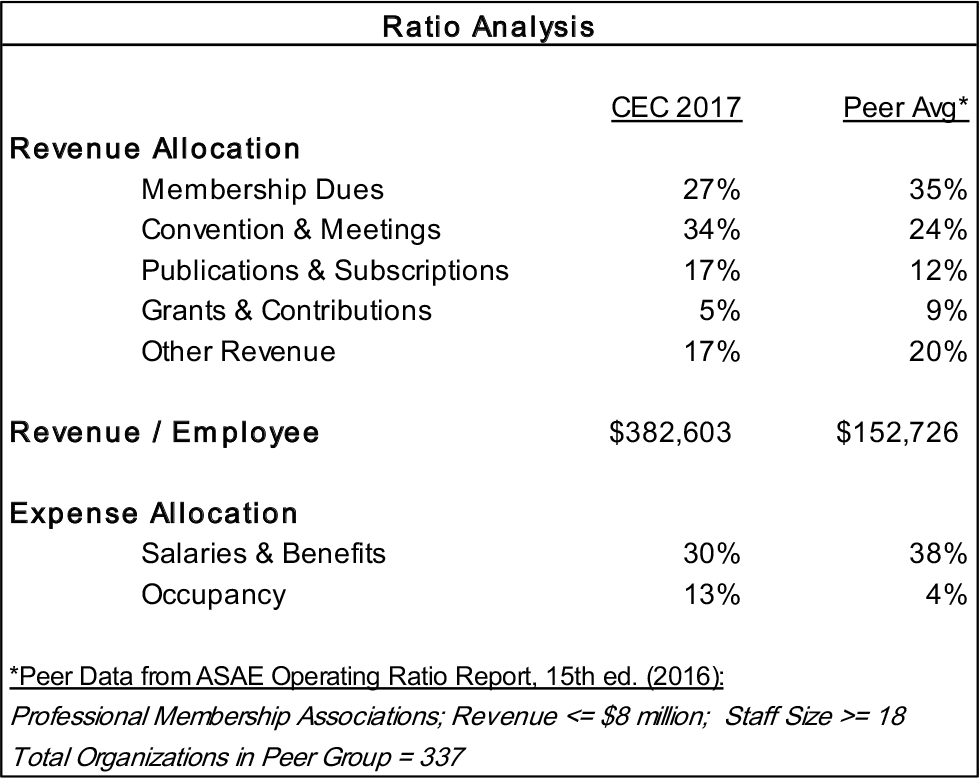
In comparison to industry peers, CEC derives more revenue from its convention and meetings while generating less from membership dues. Since 2015, CEC has operated with a lean staff, averaging 18 employees. Thus, the revenue generated per employee is 2.5 times greater than CEC’s peer group, and salaries and benefits represent only 30% of total expenses, compared to 38% for its peers. Salaries, as an expense, are distributed across appropriate categories (e.g., publication staff salaries are reflected within the Publications & Education category). Occupancy expenses for CEC are much greater than its peer group; given its small staff size, CEC has sublet a large portion of its office space to partially offset these occupancy costs.
Fiscal Safeguards and Your Association
As the treasurer, my role is to work with the Board and our management team to ensure that the financial resources are deployed to fully support the mission of CEC. I encourage you to contact me or CEC Chief Financial Officer, Craig Evans at any time if you have questions or concerns about CEC and its fiscal management. Just send your inquiry to