



Abstract

Annual individualized education program (IEP) meetings are a time for a student’s IEP team to review data, discuss student progress, and set goals for the year. Although students with disabilities are not required to attend their IEP meetings until age 16 (14 in some states), the Individuals With Disabilities Education Act (IDEA; 2006) advises that students should be involved in their annual meetings “whenever appropriate.” Despite this guidance, younger students often do not attend their IEP meetings (Cavendish & Connor, 2018; Chandroo et al., 2018).
For those students who do attend their meetings, simply being in the room is not enough. A 2014 study by the Office of State Superintendents of Education looked at how much time participants spent talking during IEP meetings and found that students talked only 3% of the time. This statistic is staggering when compared to the amount of time that other IEP participants spent talking during meetings: special educators (55%), general educators (19%), and family members (16%).
Why don’t students take an active role in their IEP meeting? Davis and Cumming (2019) posited that students often have poor self-determination skills and lack the necessary communication skills to take on a leadership role. The student’s perspective is often overlooked in the IEP process. Assistive technology (AT) can be beneficial in helping students address these barriers. AT allows students to actively participate by expressing their strengths, interests, preferences, and needs.
Chloe Sutterfield is a 20-year-old college freshman majoring in journalism who was using AT to be an active participant in her annual IEP process starting when she was in elementary school. Chloe’s mother and case manager encouraged her to begin participating in her meetings and having a say in her own education beginning when she was 10 years old. Chloe says, “This allowed me to determine which AT devices and strategies worked best for me. I credit my active participation in the IEP process with helping me learn to take control of my future.”
Why Should Students Actively Participate in IEP Meetings?
Cavendish et al. (2017) noted that effective IEPs are based on an individual student’s strengths and preferences. Who can better understand personal strengths and preferences than the student? It is only fitting that a student has ownership in the process (i.e., annual IEP), which revolves around their goals and needs. Student-led IEPs are student centered and student directed, empowering youth to actively contribute to the planning and implementation of their own IEPs (Davis & Cumming, 2019). Beyond the advantage of creating a superior educational program, student leadership can also enhance other important life skills (e.g., employment, financial management, overall quality of life). Branding et al. (2009) found students who are involved with planning their IEP have a better understanding of their disability and increased self-determination skills.
What Is Self-Determination?
The focus on self-determination started in the late 1980s with a national initiative sponsored by the Office of Special Education and Rehabilitative Services focusing on ways to increase the level of autonomy of students with disabilities with respect to both their educational plan and daily living decisions (Shogren & Ward, 2018). The 1997 and 2004 revisions to IDEA emphasized the importance of student involvement through both participation in transition planning and mandated invitation to the IEP meeting if postsecondary goals were discussed (Kohler & Field, 2003; Landmark et al., 2010; Wei et al., 2016).
However, meeting the legal requirements of transition services as dictated by federal law does not ensure positive postsecondary outcomes for students with disabilities (DeFur, 2003). Most of the disconnect emanates from either students not receiving services detailed in the IEP or poorly written IEPs that contain vague goals, no coordinating activities, and no connection to the students’ postsecondary aspirations (DeFur, 2003; Landmark & Zhang, 2013).
Multiple scholars have noted a relationship between student involvement in the IEP process and self-determination skills (Cavendish et al., 2017; Rodriguez & Cavendish, 2013). Self-determination refers to behaviors such as self-advocacy, goal setting, and self-awareness that allow an individual to serve as the primary causal agent in their own life (Moore & McNaught, 2014; Wehmeyer, 2006). The essential core components of self-determination include: choice making, decision making, problem solving, goal setting and attainment, self-observation, self-evaluation, self-reinforcement, self-instruction, self-advocacy and leadership, internal locus of control, self-efficacy and outcome expectancy, self-awareness, and self-knowledge (Wehmeyer et al., 1997). Simply put, individuals with strong self-determination skills can exert influence and control over their own lives. Self-determination skills can both contribute to and be improved by an effective student-led IEP experience.
Communication Skills as a Barrier to Student Leadership
An inability to communicate verbally might be seen by some as an indicator of low cognitive ability. As such, educators, other professionals, and even sometimes family members must be careful not to equate verbal ability to self-determination potential. All students have personal strengths, interests, preferences, and needs. The key is matching the appropriate AT to access the student’s voice. Communication involves not just what the student can say but other ways they share their ideas and knowledge (e.g., what they can write, design, or select). Student voice transcends verbal communication.
Chloe acknowledges, “Due to my disability, my speech is sometimes hard to understand. When I was younger, I relied on my case manager to initiate the planning process and determine supports needed for academic success.”
Defining AT
Students require a mode of communication to be active participants in their learning. Assistive technology can give students the necessary voice to take ownership of their education. The IDEA (2006) supports a continuum of AT solutions spanning no-tech, low-tech, and high-tech devices; however, many students will require support from teachers and related service providers to select and learn to use AT devices.
Preparing Students to Use AT
AT does not, by itself, equip students to lead the IEP process. Students require daily opportunities to use their AT while learning, across contexts and environments. AT for communication should be seen not as an accommodation for participation in IEP meetings but rather as an important skill to be generalized across environments, including the IEP meeting. Teachers should design instructional activities that allow students to access the curriculum through the use of AT devices. Using a variety of AT will equip students as they transition to postsecondary education or work environments. Regular consultations between a student and the educator or related service provider will help keep AT solutions viable.
Educators who support students using augmentative and alternative communication (AAC) may feel the need to preprogram phrases for the IEP meeting. However, this may not be necessary if educators teach core vocabulary words to their students. Core vocabulary offers students a versatile set of vocabulary that may be generalized across multiple contexts and a great way to answer questions during the meeting.
Chloe’s story highlights the potential for success when self-determination skills, parent and educator support, and AT converge. Chloe shares, “I have access to a speech-generating device, which I use as needed; particularly when I am communicating with people who don’t know me very well. In high school, I was actively involved in the planning of my IEP. By my sophomore year, I was creating and sharing PowerPoint presentations that communicated my academic needs to the IEP team.”
What AT May Support Students in IEP Leadership?
As has been discussed, verbal ability is not an indicator of self-determination or leadership skills. Individual students may actively participate in their IEP process in a variety of ways, including writing, presentations, video, or using AAC. There are many available devices, apps, and web tools that students and educators can use to support active participation in the IEP process. Table 1 displays sample AT tools available for use across various platforms.
Examples of AT Solutions That May Support Student-Led IEPs
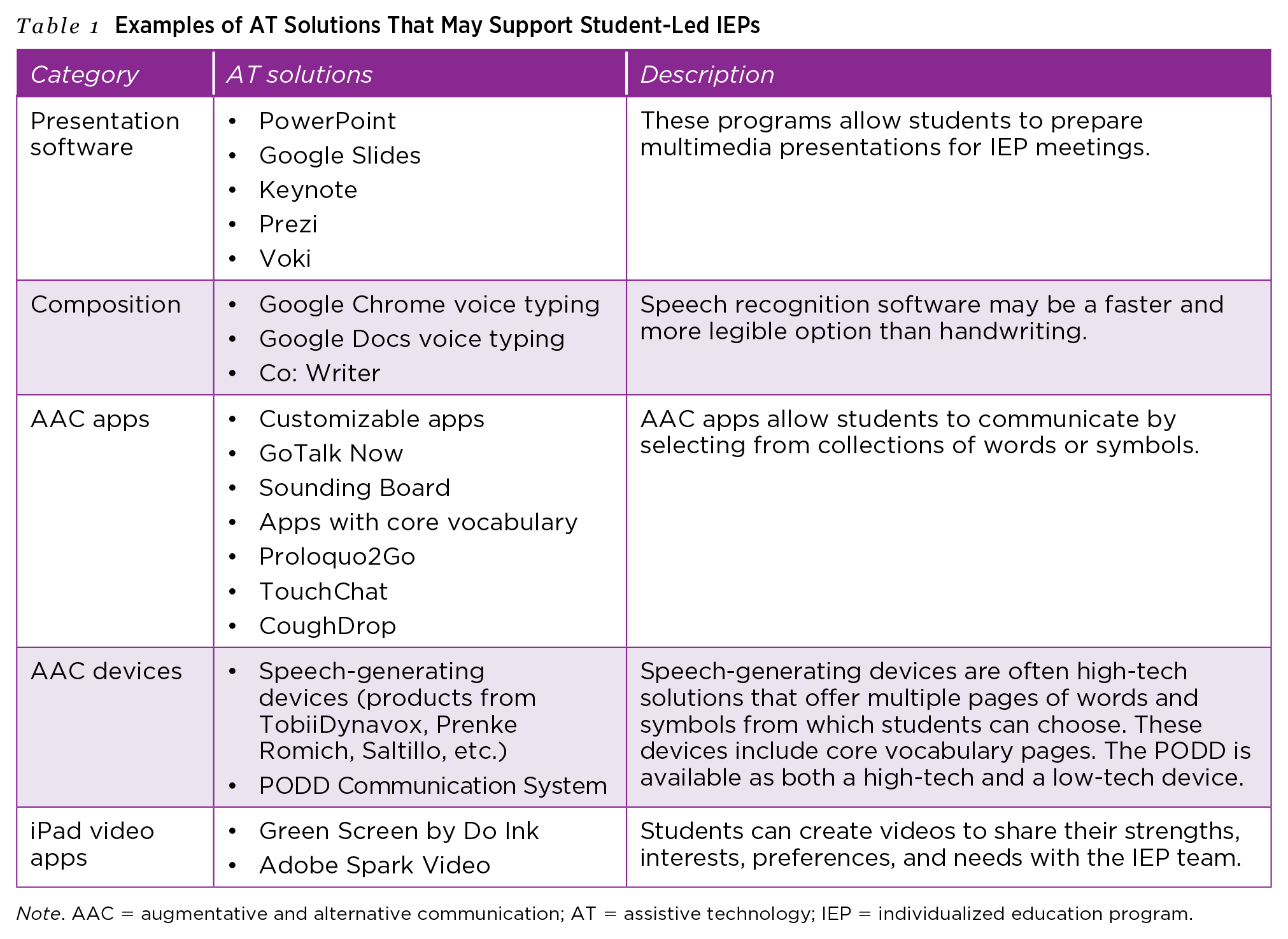
Note. AAC = augmentative and alternative communication; AT = assistive technology; IEP = individualized education program.
Students should never be mere spectators during the IEP process. When an IEP is developed solely by educators and family members, a student may come to believe that important life decisions will be made for them (Davis & Cumming, 2019). As educators, we must work to address any barriers that limit a student’s voice from being at the forefront of the IEP. Assistive technology solutions can offer students equitable opportunities to express themselves and emerge as leaders in the planning of their futures.